


Introduction
Sleep disturbances are prevalent in 34–67% of people following a stroke (Campos et al., Reference Campos, Diogenes, Franca, Dantas, Araujo and Menezes2005; Schuiling et al., Reference Schuiling, Rinkel, Walchenbach and de Weerd2005; Sterr et al., Reference Sterr, Herron, Dijk and Ellis2008). Approximately 37–57% of people with stroke fulfil the criteria for insomnia (Glozier et al., Reference Glozier, Moullaali, Sivertsen, Kim, Mead, Jan, Li and Hackett2017; Joa et al., Reference Joa, Kim, Park, Kim, Lee, Ko and Jung2017), a clinical sleep disorder defined as insufficient and/or non-restorative sleep for at least three months (American Psychiatric Association, 2013). In addition to pre-morbid sleep problems, post-stroke insomnia is attributed to disrupted neural mechanisms involved in sleep regulation and arousal (Bassetti and Valko, Reference Bassetti and Valko2006). The physical limitations associated with stroke and fatigue may also contribute to disturbed sleep due to low levels of activity associated with the development of a weak circadian cycle, frequent napping and ultimately problematic sleep (Campos et al., Reference Campos, Diogenes, Franca, Dantas, Araujo and Menezes2005). While insomnia is a known contributor to poorer psychological wellbeing (Reid et al., Reference Reid, Martinovich, Finkel, Statsinger, Golden, Harter and Zee2006; Strine and Chapman, Reference Strine and Chapman2005) and increased health care costs per se (Wade, Reference Wade2011), post-stroke sleep problems specifically impact daytime functioning including increased sleepiness, fatigue (Schepers et al., Reference Schepers, Visser-Meily, Ketelaar and Lindeman2006) and recovery outcome (Hermann and Bassetti, Reference Hermann and Bassetti2016; Joa et al., Reference Joa, Kim, Park, Kim, Lee, Ko and Jung2017). It may also affect mobility and health care appointment attendance, as well as participation in therapies (Joa et al., Reference Joa, Kim, Park, Kim, Lee, Ko and Jung2017; Worthington and Melia, Reference Worthington and Melia2006). Overall, poorer quality of life after stroke is partly attributed to sleep disturbance (Schuiling et al., Reference Schuiling, Rinkel, Walchenbach and de Weerd2005).
Surprisinginly, addressing sleep is a poorly recognized part of post-stroke care (Castriotta and Lai, Reference Castriotta and Lai2001; Wessendorf et al., Reference Wessendorf, Teschler, Wang, Konietzko and Thilmann2000) and may only involve pharamacotherapy (Leppävuori et al., Reference Leppävuori, Pohjasvaara, Vataja, Kaste and Erkinjuntti2002; Li Pi Shan and Ashworth, Reference Li Pi Shan and Ashworth2004) which can cause sedation, tolerance, dependence and re-bound insomnia (Morin and Espie, Reference Morin and Espie2003). Evidence suggests that non-pharmacological approaches are safer and more effective for long-term sleep management compared with pharmacotherapy in non-brain-injured patients (Mitchell et al., Reference Mitchell, Gehrman, Perlis and Umscheid2012; Qaseem et al., Reference Qaseem, Kansagara, Forciea, Cooke and Denberg2016); however, applications of these approaches to those with chronic physical illnesses is lacking in the literature and in the UK national health service (NHS). Sleep may be overlooked for several reasons such as lack of attention paid to sleep in medical training (Wessendorf et al., Reference Wessendorf, Teschler, Wang, Konietzko and Thilmann2000), few people seeking treatment for sleep problems (Hohagen et al., Reference Hohagen, Rink, Kappler, Schramm, Riemann, Weyerer and Berger1993), low self-recognition of sleep problems (Trudel et al., Reference Trudel, Tryon and Purdum1998), and sleep being overlooked whilst coping with the other effects of stroke (Chesson et al., Reference Chesson, Hartse, Anderson, Davila, Johnson, Littner, Wise and Rafecas2000). It has also been noted that dissemination of specific approaches to manage sleep problems is lacking amongst psychologists and therapists who have the appropriate skill set to apply non-pharmacological treatments (Troxel et al., Reference Troxel, Germain and Buysse2012).
Unhelpful behaviours and cognitions about sleep are important maintenance factors in the development and maintenance of insomnia (Edinger and Means, Reference Edinger and Means2005; Harvey, Reference Harvey2002). Cognitive behavioural therapy for insomnia (CBTI) aims to address unhelpful thought patterns and behaviour in poor sleep (Edinger and Means, Reference Edinger and Means2005; Morin and Espie, Reference Morin and Espie2003) and has been extensively used as a non-pharmacological alternative to treat insomnia. CBTI has shown clinically sustained improvements for sleep (Morin et al., Reference Morin, Vallieres, Guay, Ivers, Savard, Merette, Bastien and Baillargeon2009; Trauer et al., Reference Trauer, Qian, Rajaratnam and Cunnington2015) as well as quality of life (Morin et al., Reference Morin, Bootzin, Buysse, Edinger, Espie and Lichstein2006) in otherwise healthy participants and in those with long-term medical conditions (Smith et al., Reference Smith, Huang and Manber2005) including cancer (Johnson et al., Reference Johnson, Rash, Campbell, Savard, Gehrman, Perlis, Carlson and Garland2016), diabetes (Perfect and Elkins, Reference Perfect and Elkins2010), cardiovascular disease (Conley and Redeker, Reference Conley and Redeker2015) and chronic pain (Tang et al., Reference Tang, Lereya, Boulton, Miller, Wolke and Cappuccio2015).
Few studies have examined the efficacy of CBT for sleep problems in people with brain injury. The work of Ouellet and Morin (Reference Ouellet and Morin2004, Reference Ouellet and Morin2007) applied CBTI to patients with traumatic brain injury (TBI). They showed that eight out of 11 participants no longer fulfilled the criteria for insomnia post-treatment (Ouellet and Morin, Reference Ouellet and Morin2007). The protocol for the study consisted of the main components of CBTI (Morin and Espie, Reference Morin and Espie2003) with the addition of fatigue management. More recent studies have attempted to replicate these findings in TBI populations, revealing that CBTI has benefits for sleep, fatigue and mood (De La Rue-Evans et al., Reference De La Rue-Evans, Nesbit and Oka2013; Nguyen et al., Reference Nguyen, McKay, Wong, Rajaratnam, Spitz, Williams and Ponsford2017a; Ouellet and Morin, Reference Ouellet and Morin2015) and some yielding less significant effects (Lu et al., Reference Lu, Krellman and Dijkers2016).
The initial evidence suggests that CBTI is a feasible and effective approach for treating sleep problems in TBI. Although both stroke and TBI are brain injuries, TBI is qualitatively different from stroke (Nair et al., Reference Nair, Lehmann, Williams and Weiss1993) because it is caused by an external force, whereas a stroke occurs within the brain. Stroke patients tend be older, manifest a focal neurological damage and report higher rates of depression (Nair et al., Reference Nair, Lehmann, Williams and Weiss1993). TBI is also associated with overlapping post-traumatic stress disorder (PTSD) and sleep disturbance (Kaplan et al., Reference Kaplan, Vasterling and Priyanka2010). It is also known that different types of brain injuries are associated with particular sleep disorders, including sleep apnoea (Ouellet and Morin, Reference Ouellet and Morin2015). It is therefore important to examine specific neurological populations to further understand how CBTI can be utilized to support recovery where sleep management is equally as important as daytime rehabilitation (Duss et al., Reference Duss, Seiler, Schmidt, Pace, Adamantidis, Muri and Bassetti2017). There is only one other known study that has examined the benefits of CBT for sleep disturbance within a stroke population (Nguyen et al., Reference Nguyen, Wong, McKay, Rajaratnam, Spitz, Williams, Mansfield and Ponsford2017b).
Nguyen et al. (Reference Nguyen, Wong, McKay, Rajaratnam, Spitz, Williams, Mansfield and Ponsford2017b) applied an adapted CBT protocol drawn using previous fatigue and insomnia treatment manuals to a sample of people post-stroke with reported fatigue and poor sleep quality. The authors did not use insomnia criteria for inclusion. They showed that adapted CBT supported the improvement of fatigue in 5/8 participants and sleep quality in 4/8, as determined by validated questionnaires. Insomnia symptoms reported on the questionnaire improved following treatment, but this was not sustained at follow-up. This paper shows initial evidence for CBT usefulness in a stroke population and suggests that a CBTI protocol with a greater emphasis on insomnia symptoms could be of benefit for post-stroke insomnia per se. The additional emphasis on fatigue shows how modifying CBTI could further increase the relevance for those coping with the consequences of stroke.
With the current policies that people with long-term health problems in England will be treated by Improving Access to Psychological Therapies (IAPT), it is crucial to consider the effectiveness of current IAPT interventions for this patient group (Mental Health Task Force, 2016). CBTI is increasingly being offered in IAPT services given the evidence base and clinical demand (Espie, Reference Espie2009; Manber et al., Reference Manber, Carney, Edinger, Epstein, Friedman, Haynes, Karlin, Pigeon, Siebern and Trockel2012; Perlis and Smith, Reference Perlis and Smith2008), this could therefore be an effective intervention that can be offered to people with insomnia following stroke. However, other IAPT interventions have required adaptations for them to be effective for people with long-term medical conditions (e.g. Wroe et al., Reference Wroe, Rennie, Gibbons, Hassy and Chapman2015) and it is therefore necessary to research and adapt CBTI protocols to expand its use in other populations and service contexts (Vitiello et al., Reference Vitiello, McCurry and Rybarczyk2013) including those coping with the challenges of a stroke. Non-pharmacological approaches for stroke such as CBT foster self-management skills that are highly beneficial for improving recovery outcomes (Jones, Reference Jones2006).
The present study aimed to use the traditional CBTI protocol for chronic post-stroke insomnia and incorporate additional approaches relevant for those coping with the consequences of stroke. This included ensuring that the psychoeducation components of the treatment covered the effects of stroke on sleep mechanisms and neuroplasticity. Psychoeducation is a necessary part of CBTI for understanding the treatment approach (Carney and Edinger, Reference Carney and Edinger2010) and it also highly relevant in brain injury (Ostwald et al., Reference Ostwald, Godwin, Cron, Kelley, Hersch and Davis2014). It was also ensured that stroke-related problems were part of the shared CBT formulation of sleep difficulties to support particpants’ understanding of maintenance factors and potentially find modifiable areas for treatment.
Traditional CBTI incorporates strategies that aim to break the association between being awake in bed, where sleeplessness has become ‘conditioned’ (Perlis et al., Reference Perlis, Giles, Mendelson, Bootzin and Wyatt1997). In order to break this association, ‘sleep restriction’ and the ‘15 minute rule’ are applied to prevent time spent awake in bed. Restricting sleep through postponing bedtime and anchoring earlier wake time, in addition to getting up after 15 minutes if sleep has not been achieved, can result in a temporary increase in tiredness and for some, initial distress (Morin and Espie, Reference Morin and Espie2003). These strategeies may be additionally challenging for those with long-term conditions and could not only pose a safety risk but also affect engagement in the treatment. Seeking alternatives to these particular strategies could increase feasibility for this population. Therefore, replacing sleep restriction with ‘sleep compression’ (Morin et al., Reference Morin, Colecchi, Stone, Sood and Brink1999) as a more gradual approach to reducing time spent awake in bed was employed in this study.
Although CBTI advises avoiding napping (Stepanski and Wyatt, Reference Stepanski and Wyatt2003), it is often used by individuals to alleviate daytime sleepiness and fatigue after stroke (Campos et al., Reference Campos, Diogenes, Franca, Dantas, Araujo and Menezes2005). Given that sleepiness and fatigue affect daytime activities, mood and ability to function safely, ‘healthy napping’ was incorporated into the treatment protocol.
Overall, the above considerations factored into the traditional CBTI approach in this study is referred to as ‘CBTI+’. This study aimed to explore the efficacy of CBTI+ using a single-case experimental design (SCED), an appropriate method for assessing acceptability and feasibility of newly developed interventions (Rassafiani and Sahaf, Reference Rassafiani and Sahaf2010) using insomnia symptoms as the primary outcome.
Method
Design
The present study used a case series methodology with an A-B-A design. This entailed a 2-week baseline (A) followed by 7 weeks of treatment (B) with a follow-up 2 weeks after the end of treatment (A).
Participants
Community-dwelling individuals post-stroke for at least 12 months, therefore in the chronic phase of recovery, were approached via several local links, including stroke groups and charities, using flyers and posters. Potential participants who responded to study adverts were contacted for a telescreening appointment lasting approximately 20 minutes to check eligibility for the study and provide further information. Eleven individuals were telescreened and all met the preliminary criteria based on the DSM-IVFootnote 1 criteria for insomnia: (1) sleep onset is more than 30 minutes, (2) sleep duration is less than 6.5 hours, (3) three or more awakenings symptoms, (4) taking longer than 30 minutes to get back to sleep, (5) awakening 30 minutes before desired time, and (6) symptoms are associated with distress or impairment. These symptoms are based on self-reports and should occur three or more times a week.
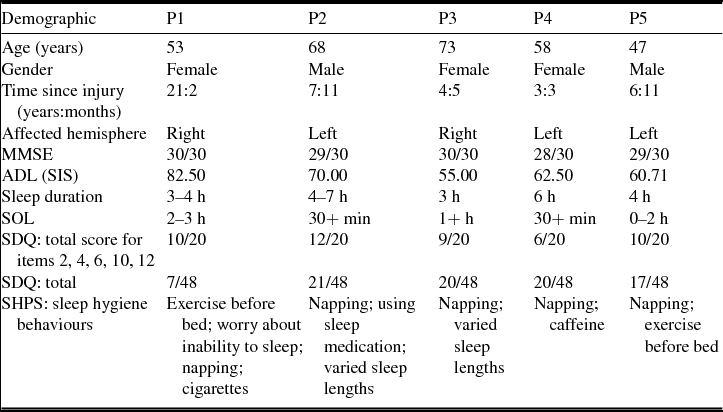
Five participants who met the initial criteria agreed to come for the full assessment, which lasted approximately 90 minutes. Following assessment, all five participants met the full study inclusion/exclusion criteria. In addition to the DSM-IV criteria for insomnia, this included rating at least one response as ‘often true’ (given a score of 3/4) for the following five unhelpful cognitions listed on the Sleep Disturbance Questionnaire (SDQ; Espie, Brooks and Lindsay, Reference Espie, Brooks and Lindsay1989): ‘My mind keeps turning things over’; ‘I get too “worked up” at not being able to sleep’; ‘My mind takes a long time to unwind’; ‘I am unable to empty my mind’; and ‘I worry that I won't cope tomorrow if I don't sleep’. The Sleep Hygiene Awareness and Practice Scale (SHAPS; Lacks, Reference Lacks1987) was used to indicate presence of unhelpful behaviours that maintain poor sleep. Presence of at least two unhelpful behaviours for sleep were used for inclusion criteria (e.g. napping, varied sleep lengths or caffeine use). Other inclusion criteria included GP approval and being at least one year post-stroke. Exclusion criteria were sleep disorders other than insomnia, medication that adversely impacts sleep, other serious co-morbid conditions, untreated psychological difficulties, significant cognitive difficulties (<25 on the Mini-Mental State Exam; Folstein and Folstein, Reference Folstein and Folstein1975), uncorrected visual impairment and aphasia. All participant details, referred to as P1 to P5, are presented in Table 1. P2 used temzepam (10–20 mg) once to twice a week if he could not get to sleep, but the frequency could increase if sleep was particularly poor.
Participant demographics and scores on questionnaires used for inclusion criteria

Sleep duration and sleep onset latency (SOL) were as reported on average per night. SDQ includes number of items rated ‘often’. SHPS includes the reported unhelpful sleep behaviours.
Ethics
Ethical approval was gained from the relevant university ethics committees and all participants gave their informed consent prior to participation.
Measures
Self-report daily sleep diaries were provided to all participants in paper form and were completed over 11 weeks, which included the 2-week baseline, 7-week intervention and 2-week follow-up. The sleep diaries collected information on bed time, wake time, get up time, sleep duration (SD; min) and sleep onset latency (SOL; min). Sleep efficiency (SE; %) was obtained by calculating the percentage time spent sleeping whilst in bed. Averages of sleep diary parameters were calculated per week.
A battery of questionnaires was administered at 2 weeks prior to treatment and at follow-up. Scores on the Insomnia Severity Index (ISI; Bastien et al., Reference Bastien, Vallieres and Morin2001) were used to measure insomnia severity where ≥7 suggests not clinically significant, 8 to 14 suggests sub-threshold for insomnia, 15 to 21 indicates moderate insomnia, and ≥22 is severe. To provide additional therapeutic information about the patient's experience of having a sleep problem, the Dysfunctional Beliefs and Attitudes About Sleep Scale (DBAS-16; Morin et al., Reference Morin, Vallieres and Ivers2007) was administered. It was also used to detect any change in attitude towards sleep post-treatment. A higher score on the DBAS-16 suggests that a person has a greater presence of unhelpful beliefs about sleep.
Daytime functioning measures were the Epworth Sleepiness Scale (ESS; Johns, Reference Johns1991) and the Fatigue Severity Scale (FSS; Krupp et al., Reference Krupp, LaRocca, Muir-Nash and Steinberg1989). The ESS records sleep propensity through eight hypothetical situations from which participants were asked to rate how likely they would fall asleep using a 4-point Likert scale ranging from 0 (no chance of dozing) to 3 (high chance of dozing). Items are summed to give an overall score. Scores between 0 and 6 indicate low sleepiness, 7 to 9 is average, and 10 to 24 indicates severe sleepiness. The FSS was used to measure fatigue, defined as physical or mental weariness as a result of exertion (Hossain et al., Reference Hossain, Ahmad, Reinish, Kayumov, Hossain and Sharpiro2005). It consists of nine statements relating to the impact of fatigue from which participants rate on an 8-point Likert scale how much they agree or disagree from 0 to 7. The mean score >4 suggests a moderate to high fatigue (Mathiowetz et al., Reference Mathiowetz, Matuska and Murphy2001).
The Stroke Impact Scale (SIS v.3; Duncan et al., Reference Duncan, Lai, Bode, Perera and DeRosa2003) is a multidimensional measure of the impact of stroke on quality of life and was used to examine changes following improved sleep. The SIS contains 59 items corresponding to eight subscales including: strength (S), hand function (HF), activities of daily living (ADL), mobility (M), communication (C), emotion (E), memory and thinking (MT), and social participation (SP). Response choices for each question are weighted on a 5-point Likert scale, ranging from 1 to 5. Scores for each item were transformed using the following algorithm: [(actual raw score – lowest possible raw score)/possible raw score]×100. Higher scores signify better quality of life. Due to the large amount of data provided by the SIS, all outcomes are presented in the Supplementary Material. To enable the reader to gain an understanding of level of disability following the stroke for each participant, ADL scores at pre-treatment are provided in Table 1.
All questionnaires have been shown to be valid and reliable measures when used with brain-injured populations, except the DBAS and ISI. However, these measures have been routinely used to investigate CBTI outcomes (Bastien et al., Reference Bastien, Vallieres and Morin2001; Carney and Edinger, Reference Carney and Edinger2006; Morin et al., Reference Morin, Vallieres and Ivers2007).
CBTI+
A seven-session treatment manual was drafted by the authors drawing on standard CBTI techniques (Morin and Espie, Reference Morin and Espie2003; Perlis et al., Reference Perlis, Jungquist, Smith and Posner2005) with the addition of professional expertise in stroke rehabilitation and feedback from service users. The resultant manual covered: (1) psychoeducation, (2) identifying maintenance factors of poor sleep through developing a formulation, (3) sleep hygiene, stimulus control and relaxation, (4) sleep scheduling, (5) managing emotions, (6) noticing and managing styles of thinking and (7) relapse prevention.
The ‘CBTI+’ protocol was delivered in the context of stroke, which ensured that other health factors were recognized and considered during treatment. This included providing information about how sleep processes are affected post-stroke, considerations around medication, neuroplasticity mechanisms and how the physical limitations associated with stroke can affect sleep routines and activity as well as information about insomnia within the psychoeducation component. When advising on reducing sedentary lifestyle as part of sleep hygiene, consideration was given to physical limitations commonly observed post-stroke. Participants were encouraged to increase activity where manageable and to use ‘pacing’ techniques as advised in both fatigue and chronic pain literature (Neilson et al., Reference Neilson, Jensen, Karsdrop and Vlaeyen2013).
The ‘15 minute rule’ aspect of the stimulus control component requires a person to leave the bedroom when failing to fall asleep within 15 minutes. Due to potential difficulties with implementing this, an alternative, such as a relaxation audio, was advised.
The traditionally applied sleep restriction approach aims to curtail time spent in bed to average sleep length, e.g. five hours, and gradually increasing time in bed by 15 minutes when sleep efficiency (% time spent asleep whilst in bed) reaches 90%. We exchanged this strategy for sleep compression as a gentler approach to managing learned sleeplessness that was considered more approapriate for those with long-term conditions. Sleep was compressed by reducing time in bed by dividing the difference between sleep time and time in bed by five. This time is then added to bed time so the person will go to bed later for one week. Should their sleep efficiency not reach 90%, sleep is further compressed by this amount. Should participants require to nap as part of managing their day, we advised that naps should occur only in bed and for no longer than 30 minutes, as well as before 4 p.m.
Furthermore, some of the cognitive work on thought management involved discussing the impact of having a stroke, as well as sleep problems. This also relied on the therapist to ensure that the work was orientated towards managing sleep in the context of stroke rather than CBT for coping with the consequences of stroke.
Procedure
Sessions were administered on an individual basis over 7 to 12 weeks and lasted between 60 and 90 minutes. All sessions were administered by a trainee clinical psychologist (K.H.) under supervision. K.H. was in the third year of a clinical psychology doctoral programme at Royal Holloway, University of London, having previously completed a PhD in sleep-related research and received training in CBTI by Professor Colin Espie.
Analysis
Statistically significant changes in the questionnaire measures were identified using the ‘reliable change index’ (RCI; Jacobson and Truax, Reference Jacobson and Truax1991). The RCI uses published reliability and population norms of the measure in question to determine whether any changes in scores are greater than that expected through measurement error (O'Neill, Reference O'Neill2010). The RCI determines a minimum change score required for statistical significance. The RCI was calculated using online software (http://www.psyctc.org/stats/rcsc1.htm) that provides a modified calculation based on the original formula (SD = standard deviation, r = published reliability of the measure): RCI = SD×√(2)×√(1–r) (Evans, Reference Evans1998). The minimum scores for RCI calculations for each questionnaire are described in the Results section. Norms are provided for insomnia cohorts.
For sleep diaries, improvements in the direction of healthy sleep at post-treatment and follow-up were examined using population norms. ‘Clinically meaningful change’ (CMC) allows the researcher to consider the extent to which the data changes in the target outcome measure, towards that expected in the normal population. Jacobson et al. (Reference Jacobson, Follette and Revenstorf1984) outlined a method to examine the data to determine clinical change. This can be achieved in two ways: (a) when a person has moved more than 2SD from the clinical group (e.g. insomnia normative data); and (b) when a person moves within 2SD of the normal population. For the purposes of this study, both (a) and (b) will be examined as there is overlap between sleep behaviour in the general population and in those with clinically significant insomnia. This may occur because normative data, particularly in self-reported sleep, may contain data from less healthy sleepers that do not fulfil the criteria for insomnia. Both normative and insomnia population data, for comparison with the data in the current study, were extracted from large studies as shown in Table 3a.
In order to allow the data to be compared with larger data sets including randomized controlled trials, effect sizes (ES) of the aggregated data for all questionnaires except the SIS and sleep diary measures were calculated. The following formula was used: ES (d) = [(pre-CBTI+ mean) – (post-CBTI+ mean)]/pre-CBTI+SD.
Results
All participants, referred to as P1 to P5, completed the intervention and provided follow-up data.
Insomnia symptoms
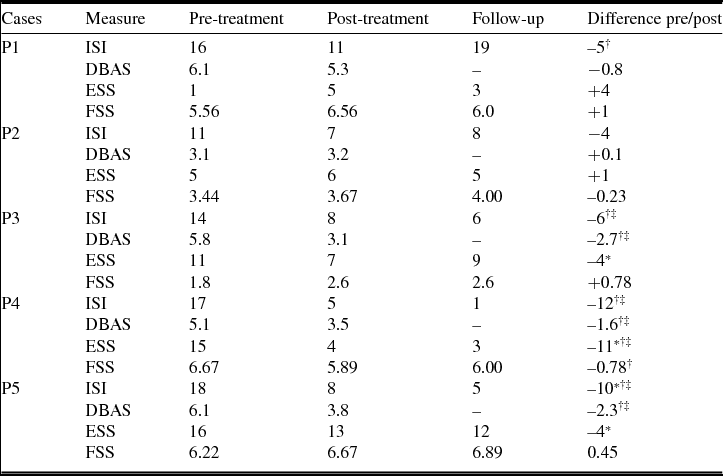
Three participants fell within the moderately severe clinical range on the ISI at pre-treatment and the remaining two participants were subclinical (Table 2). According to the RCI calculation for the ISI (Beaulieu-Bonneau et al., Reference Beaulieu-Bonneau, LeBlanc, Merette, Dauvilliers and Morin2007), change scores ≥4.9 and ≥5.9 are significant based on normal and insomnia population norms, respectively. At post-treatment, all participants reported a reduction in the severity of their insomnia symptoms, with three meeting the criteria for reliable improvement and maintaining the gains at follow-up. These three participants were in the ‘not clinically significant insomnia’ range by the time of the follow-up (see Table 2). Despite the improvement observed for P1 at post-treatment from moderate insomnia to subclinical, her symptoms worsened by follow-up into the clinical range. P2 did, however, move into the subclinical range from the moderately severe range which remained at follow-up. Two of these participants remained out of clinical range at follow-up. Although P5 was within the subclinical range at post-treatment, this came out of clinical range at follow-up. ES (d) was large at 2.67 for ISI.
ISI, DBAS, ESS and FSS outcomes per participant at pre-treatment, post- and follow-up

Symbol key indicates significance when RCI is based on normal sleeper†, insomnia‡ and general* population norms.
Impact on sleep cognitions and daytime functioning
The significant decreases found in DBAS scores (Table 2), using an RCI ≥1.6 (Carney and Edinger, Reference Carney and Edinger2006), suggests that three participants (P3, P4 and P5) developed helpful belief changes about sleep post-treatment (Table 2) with a group ES (d) of 1.15. Prior to treatment, three participants were above the clinical cut-off for sleepiness and moderate fatigue according to the ESS and FSS (Table 3). ESS RCI could be provided for general (≥4.8), normal (≥4.7) and insomnia populations (≥5.3) (Anderson and Horne, Reference Anderson and Horne2008; Sanford et al., Reference Sanford, Lichstein, Durrence, Riedel, Taylor and Bush2006). Three participants reported significant improvements in sleepiness with one participant out of clinical range. Fatigue scores revealed no significant change at post-treatment and follow-up when using FSS RCI for normal and insomnia norms of ≥0.81 and ≥0.37, respectively (Lichstein et al., Reference Lichstein, Means, Noe and Aguillard1997; Valko, et al. Reference Valko, Bassetti, Bloch, Held and Baumann2008). ES (d) were lower for these measures at 0.40 and –0.17 for ESS and FSS, respectively.
RCI for SIS indicates that any changes ≥9.4 indicate reliable change as drawn from Duncan et al. (Reference Duncan, Lai, Bode, Perera and DeRosa2003). All participants reported improved quality of life in one or more domains according to the SIS at post-treatment (see Supplementary Material for all SIS results). P1 reported a significant improvement within the emotional functioning domain (Epre = 83.33; Epost = 97.22), which did not extend to follow-up. P1 showed significant improvement in social participation (SPpre = 60.71; SPpost = 75.00) that did not remain at follow-up. She also reported worse memory and thinking (MTpre = 92.86; MTpost = 67.86) at post-treatment, likely to reflect her relapse in poorer sleep. P3 described increased social participation (SPpre = 28.13; SPpost = 50.00), and better memory and thinking (MTpre = 85.71; MTpost = 96.43), which remained at follow-up. Emotional functioning (EFpre = 69.44; EFpost = 94.44), social participation (SPpre = 43.43; SPpost = 82.14) and communication (Cpre = 57.14; SIS: Cpost = 71.43) improved for P4, which extended to follow-up. P5 reported improved activities of daily living (ADLpre = 85.71; ADLpost = 96.43), which remained at follow-up.
Sleep diary
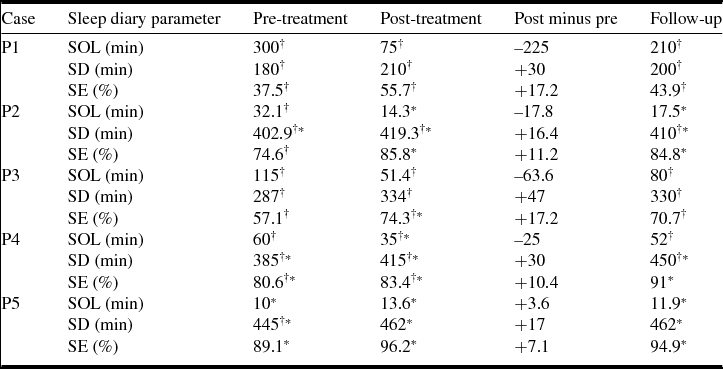
According to large insomnia population data (Table 3a), the self-reported sleep duration (SD) for all participants were within 1SD of insomnia norms, in line with clinically poor sleep (Table 3b). All patients reported at least 16 minutes average increase in sleep duration. Three participants reported achieving at least 30 minutes more sleep on average at post-treatment (Table 3b). P5’s sleep duration was within both the lower limit of the clinical range and upper limit for the normal range at pre-treatment; sleep duration then remained within the normal range only at post-treatment and follow up. ES (d) for the group was 0.26.
Mean self-reported sleep parameters for clinically meaningful change analyses drawn from Lichstein et al. (Reference Lichstein, Taylor, Bush, Reidel and Durrence2004, Reference Lichstein, Stone, Donaldson, Nau, Soeffing and Murray2006) matched for age and gender for the normal sample and for insomnia norms

Values given are means (SD).
Clinically meaningful change is indicated when a participant report falls within at least 1SD of normal* and insomnia† populations

Although four out of five participants reported taking over 30 minutes to fall asleep at post-treatment, a clinical indicator of insomnia (American Psychiatric Association, 2013), all reported reductions in subjective SOL, which remained at follow-up in three participants. P2 was the only participant to move out of clinical range post-treatment and at follow-up for SOL. The SOL group ES (d) was 0.56.
SE was below the healthy level of 85% in four participants at pre-treatment. In three participants, SE improved towards the healthy level of 85% at post-treatment, which was maintained at follow-up. P3 moved into 1SD of normal population for 17% improvement in sleep efficiency, which was not maintained at follow-up although still showed a 13% gain. As a group, the ES (d) was 0.55.
Despite P5 being reported at assessment to fit inclusion criteria for the study, SOL and SE were out of clinical range for insomnia according to sleep diaries at pre-treatment.
Discussion
This study aimed to examine the feasibility and acceptability of a manualized CBTI+ that is specifically tailored to post-stroke insomnia. Overall, the results show that four out of the five participants reported significant improvements in sleep disturbance at post-treatment according to increased SD (all participants), reduced SOL (P1–4) and improved ISI score (all except P2). Three participants maintained improvements in at least two of these domains at follow-up. Three participants showed a significant decrease in unhelpful beliefs about sleep. This suggests that insomnia maintained by unhelpful cognitions and behaviours can be reversible in people who have had a stroke.
The group effect size calculations for pre- and post-differences showed stronger magnitudes >1 from the ISI and DBAS-16, which are at least comparable with RCTs (Manber et al., Reference Manber, Edinget, Gress, San Pedro-Salcedo, Kuo and Kalista2008). Sleep diary data showed medium effects for SOL and SE similar to RCTs (Currie et al., Reference Currie, Wilson, Pontefract and deLaplante2000; Edinger et al., Reference Edinger, Wohlgemuth, Krystal and Rice2005). SD showed a small effect whereas RCT results are at least medium. Similarly to the studies that have applied CBTI to TBI (De La Rue-Evans et al., Reference De La Rue-Evans, Nesbit and Oka2013; Nguyen et al., Reference Nguyen, McKay, Wong, Rajaratnam, Spitz, Williams and Ponsford2017a; Ouellet and Morin, Reference Ouellet and Morin2015), this study suggests that this protocol also has clinical benefits for post-stroke sleep disturbance.
The results did not show any improvements in fatigue reports. Whilst studies in insomnia populations show that improving sleep–wake cycles can also reduce fatigue (Morin et al., Reference Morin, Bootzin, Buysse, Edinger, Espie and Lichstein2006), those with physical health problems are less likely to see improvements (Berger et al., Reference Berger, Kuhn, Farr, Lynch, Agrawal, Chamberlain and Von Essen2009). A Cochrane review concluded that there is insufficient evidence to guide practice for post-stroke fatigue following a review of both pharmacological and non-pharmacological studies (McGeough et al., Reference McGeough, Pollock, Smith, Dennis, Sharpe, Lewis and Mead2009). Given that stroke is associated with elevated levels of fatigue as a result of multiple neurological problems affecting mobility, cognition and general activity (Campos et al., Reference Campos, Diogenes, Franca, Dantas, Araujo and Menezes2005), it is likely that additional fatigue management and neurorehabilitation strategies are required to support improvement (White et al., Reference White2011). Therefore, further research is necessary to develop ‘holistic’ approaches to manage both sleep and daytime difficulties in stoke. The work of Nguyen et al. (Reference Nguyen, Wong, McKay, Rajaratnam, Spitz, Williams, Mansfield and Ponsford2017b) has shown promising results for applying CBT approaches to fatigue which would warrant further investigation.
Quality of life improved on one or more domain of the SIS, most notably social participation for three participants at follow-up. This is consistent with the studies that have shown quality of life benefits following CBTI in those with other long-term medical conditions (Espie et al., Reference Espie, Fleming, Cassidy, Samuel, Taylor and White2008).
Therapeutic reflections
Post-stroke considerations
All participants had post-stroke mobility problems and would have found it difficult to apply the 15 minute rule strategy as traditionally used in CBTI. The upheaval required to get up in the night and move to another room could have caused a greater level of arousal as well as concern about managing movement whilst drowsy or requiring carer assistance. Using relaxation or other meditation strategies did not appear to compromise benefit of CBTI+ according to the results. The sleep compression alternative to sleep restriction was taken on board by all participants and reduced potential risks from temporary sleep deprivation (Kyle et al., Reference Kyle, Morgan, Spiegelhalder and Espie2011). For any people with multiple physical health problems, sleep compression is a useful strategy for CBTI.
Two participants reported that pain symptoms interrupted their sleep at times. Pain management was not considered within the current CBTI+ model. The impact of post-stroke pain upon sleep has been documented as highly disruptive for sleep (Fictenberg et al., Reference Fictenberg, Putnam, Mann, Zafonte and Millard2001; Widar et al., Reference Widar, Ek and Ahlstrom2004). Furthermore, poor sleep can influence perception of pain (Lautenbacher, Kundermann and Krieg, Reference Lautenbacher, Kundermann and Krieg2006). For these patients, it may have been beneficial to consider additional self-management treatments for pain (Williams et al., Reference Williams, Eccleston and Morley2012) which could be included in a CBTI+ manual. The literature strongly supports the use of CBT approaches for supporting self-management for fatigue (Malouff et al., Reference Malouff, Thorsteinsson, Rooke, Bhullar and Schutte2008) and chronic pain (Eccleston et al., Reference Eccleston, Morley, Williams and de2013) with promising results for stroke populations (Nguyen et al., Reference Nguyen, Wong, McKay, Rajaratnam, Spitz, Williams, Mansfield and Ponsford2017b; Harrison and Field, Reference Harrison and Field2015).
Adherence
The literature on CBTI, as well as traditional CBT, highlights a strong correlation between level of adherence and outcome (Vincent, Lewycky and Finnegan, Reference Vincent, Lewycky and Finnegan2008). In the present study, most participants reported difficulty adhering to the treatment strategies at times. Low adherence in CBTI has been attributed to low self-efficacy regarding personal abilities to follow treatment advice (Bouchard, Bastien and Morin, Reference Bouchard, Bastien and Morin2003; Ouellet and Morin, Reference Ouellet and Morin2007) and previous difficulty in managing insomnia (Janz and Becker, Reference Janz and Becker1984). It is likely that participants in this study encountered similar problems. Participants from the current study fed back that barriers to adhering to strategies at times included social events, illness and difficulty in changing well-established habits surrounding sleep routines. This may further be influenced by the complications of stroke. It is therefore important to consider flexibility in manualized treatments where necessary, to address problems with adherence and facilitate open conversations about self-efficacy.
Medication
It is also important to consider medication when interpreting the results of this study. P2’s use of sleep medication may have contributed to treatment outcome and may also contribute to lower adherence to the techniques. Medication use may represent a safety behaviour that allows temporary relief of symptoms and the effort in having to manage them as commonly observed in anxiety disorders (Wells et al., Reference Wells, Clark, Salkovskis, Ludgate, Hackmann and Gelder1995). Sleep medication does not address the presumed mechanism underpinning insomnia; therefore, symptoms typically return once treatment is discontinued (Siebern and Manber, Reference Siebern and Manber2011). Although P2’s therapeutic gains were further limited by lower engagement, his level of distress reduced, sleep improved and medication use lowered during the study from a maximum of six doses per week during treatment to no more than three per week from session four. A medication withdrawal programme (Morin et al., Reference Morin, Bastien, Guay, Radouco-Thomas, Leblanc and Vallieres2004) prior to CBTI+ may have been of further benefit for P2.
Methodological issues
Research suggests that those with sleep disorders are less accurate at reporting sleep behaviour (Kushida et al., Reference Kushida, Chang, Gadkary, Guilleminault, Carrillo and Dement2001; Means et al., Reference Means, Edinger, Glenn and Fins2003). This has important implications for interpretation of data in the current study and findings in the literature, which relies predominantly on subjective reports of sleep for diagnosis and therapy outcomes (Morin et al., Reference Morin, Bootzin, Buysse, Edinger, Espie and Lichstein2006). It has been noted that P5 fed back his average sleep length as 4 hours at assessment; however, through sleep diary collection, his average sleep duration was 7 hours at pre-treatment. Studies have shown that those with distress about sleep are likely to under-report sleep lengths (Dopke et al., Reference Dopke, Lehner and Wells2004; Ouellet and Morin, Reference Ouellet and Morin2007). It is also seen in CBTI studies that keeping a sleep diary, normalizing insomnia symptoms and recognizing behaviour change can help sleep, has implications for reducing distress about sleep and greater accuracy in reporting sleep parameters (Smith et al., Reference Smith, Lang, Sullivan and Warren2004). For P5, attending assessment could have, in part, initiated these processes.
Future studies would benefit from utilizing objective measures such as actigraphy to supplement self-report measures, a favoured method when ‘gold standard’ sleep electroencephalography recordings are not possible (Ancoli-Israel et al., Reference Ancoli-Israel, Cole, Alessi, Chambers, Moorcroft and Pollak2003). Actigraphy is recognized as a valid measure of long-term sleep behaviour in stroke populations (Hermann et al., Reference Hermann, Siccoli, Brugger, Watcher, Mathis, Achermann and Bassetti2008; Schuiling et al., Reference Schuiling, Rinkel, Walchenbach and de Weerd2005).
The ability to generalize small sample data to larger populations is limited in SCEDs due to lack of randomization for a truly representative sample of the population in question and likely recruitment bias (Wilson, Reference Wilson2000). Despite these limitations, the present study provides a useful therapeutic structure for adapted CBTI from which larger studies can be designed. Tate et al. (Reference Tate2016) encourage the use of SCEDs with stricter guidelines. Given the sample size in this study and the exclusion criteria, the results are suggestive of benefits of CBTI in post-stroke insomnia in participants without significant cognitive impairment. It will be important for future research to investigate the applicability of CBTI treatments for those with cognitive/communication difficulties given that between 30 and 34% of people will experience this following stroke (Arba et al., Reference Arba, Quinn, Hankey, Inzitari, Ali and Lees2016; Flowers et al., Reference Flowers, Skoretz, Silver, Rochon, Fang, Flamand-Roze and Martino2016).
Previous studies have shown that up to two-thirds of participants maintain healthy sleep after CBTI (Morin et al., Reference Morin, Bastien, Guay, Radouco-Thomas, Leblanc and Vallieres2004) for several months after treatment. In order to fully assess the sustainability of sleep gains, longer follow-up data are required, which was not achieved with this study. This would be beneficial to determine the degree to which the learned techniques can be maintained in the absence of therapeutic sessions. It was observed in the current study that some improvements were not maintained at follow-up, which suggests that review sessions could be useful to support treatment efficacy.
Implications
While psychological options for treating insomnia are becoming more available in primary care (Edinger and Sampson, Reference Edinger and Sampson2003; Espie, Reference Espie2009), the lack of research in modified support for those with insomnia and long-term medical conditions is likely to reflect the lack of such treatment available in health services. Given that sleep is an important mediator for recovery from illness (Briones et al., Reference Briones, Adams, Strauss, Rosenberg, Whalen, Carskadon, Roebuck, Winters and Redline1996; Hyyppä and Kronholm, Reference Hyyppä and Kronholm1995; Worthington and Melia, Reference Worthington and Melia2006), it is surprising that sleep is poorly recognized as part of post-stroke care (Castriotta and Lai, Reference Castriotta and Lai2001; Worthington and Melia, Reference Worthington and Melia2006). It is therefore important for health care professionals to have awareness of approaches available that can support the management of post-stroke symptoms without the use of pharmacotherapy. The findings of this study suggest the evidence-based protocols of CBTI, which is currently offered in many IAPT services, can be modified to be effective for people with stroke, and may therefore be an effective intervention offered in IAPT settings for this patient group. Furthermore, introducing these approaches early could be an important aspect for rehabilitation in building healthy sleep routines to support other aspects of recovery. It is also important to consider the importance of increasing accessibility of CBT treatments through adaptations and modifications of traditional protocols for those recovering from stroke (Kneebone, Reference Kneebone2016).
Conclusion
People with post-stroke insomnia can benefit from a short-term CBTI+ intervention specifically designed to target post-stroke insomnia maintained by maladaptive behaviours and cognitions. The incorporation of CBTI+ into post-stroke care requires further investigation.
Acknowledgements
We would like to take the opportunity to acknowledge the input of Professor Derk-Jan Dijk for co-supervising the first author's PhD on sleep. We would like to thank Royal Holloway, University of London, for their support of the first author in carrying out this study as part of the Doctorate in Clinical Psychology degree. We would also like to thank our service user group for their input into the treatment manual.
Ethical statements: The Royal Holloway, University of London, Psychology Department Ethics Committee approved the protocol in May 2011. All procedures adhered to The Declaration of Helsinki (World Medical Association, 2000) and authors have abided by the Ethical Principles of Psychologists and Code of Conduct as set out by the American Psychological Association (2003).
Conflicts of interest: There are no conflicts of interest to declare.
Financial support: The study was completed in partial fulfilment of a Doctorate in Clinical Psychology by the first author at Royal Holloway, University of London.
Supplementary material
To view supplementary material for this article, please visit https://doi.org/10.1017/S1352465818000061





Comments
No Comments have been published for this article.