Extubation failure is not uncommon in children and has been shown to be a significant contributor to morbidity in children with cardiac disease.Reference Baisch, Wheeler, Kurachek and Cornfield 1 , Reference Harkel, van der Vorst, Hazekamp and Ottencamp 2 Children with congenital or acquired cardiac disease may be particularly vulnerable to adverse outcomes related to extubation failure, as many have a decreased ability to compensate for the alterations in cardiac loading conditions and increased cardiac output demands that occur upon extubation relative to patients without underlying heart disease. Previous studies have suggested that extubation failure in children with cardiac disease is a poor prognostic sign associated with a higher mortality.Reference Harkel, van der Vorst, Hazekamp and Ottencamp 2 , Reference Mastropietro, Cashen and Grimaldi 3
Neonates in particular have a higher rate of extubation failure (12 %) as compared to older children.Reference Mastropietro, Cashen and Grimaldi 3 – Reference Benneyworth, Mastropietro and Graham 5 Reported rates of extubation failure after neonatal cardiac surgery range from 5 to 23 %.Reference Mastropietro, Cashen and Grimaldi 3 , Reference Benneyworth, Mastropietro and Graham 5 , Reference Harrison, Cox, Davis, Piedmonte, Drummond-Webb and Mee 6 Common indicators utilised for assessing extubation readiness following congenital heart surgery include subjective and objective measures of neuromuscular function and oxygenation and ventilation and indirect markers of adequate cardiac output.Reference Newth, Venkataraman and Willson 4 However, extubation readiness tools that have incorporated these indicators have not yet been proven to be reliable in neonates.
Near-infrared spectroscopy (NIRS) is a real-time, non-invasive technology that has become ubiquitous in paediatric cardiac operating rooms and ICUs. It is utilised to assess regional oximetry as a surrogate for cardiac output.Reference Ghanayem and Hoffman 7 – Reference Nagdyman, Fleck and Schubert 11 In a recently published single centre study, a decrease in somatic NIRS values during an extubation readiness trial was associated with an increased risk of extubation failure in children and adolescents who underwent cardiac surgery.Reference Foster, Spaeder, McCarter, Cheng and Berger 8 To our knowledge, multi-centre studies examining the role of regional oximetry to predict extubation outcomes after neonatal cardiac surgery have not been published. We therefore aimed to use a multi-centre data set to evaluate the relationship between NIRS values and extubation outcomes in neonates who underwent cardiac surgery. We hypothesised that favourable changes in cerebral or renal regional oximetry from baseline values would be predictive of extubation success in neonates following cardiac surgery.
Materials and methods
In this retrospective cross-sectional multi-centre study, we conducted a secondary analysis of data collected during a prospective observational study of neonates (less than or equal to 30 days of age) who underwent cardiac surgery from 1 January, 2015, to 31 December, 2015, in seven tertiary-care children’s hospitals in the United States and had at least one extubation attempt. Each site obtained institutional review board approval prior to data collection. Out of the seven, six centres involved in the original study utilised NIRS monitoring routinely. At those six centres, cerebral and renal NIRS measurements were collected at baseline (i.e., in the operating room prior to surgical incision) and in the ICU prior to extubation using Medtronic’s INVOS Cerebral/Somatic Oximeter. Baseline regional oximetry values were obtained pre-operatively in order to reflect patients’ steady state prior to any intervention, as opposed to the immediate post-operative period, which can be a very dynamic and often volatile time. We also recorded pre-extubation regional oximetry measurements that were entered into the patients’ medical record closest to the time of the first extubation attempt. Neonates without cerebral or renal NIRS values at either time point were excluded from the current study. Due to the observational nature of our study, we did not provide a protocol for extubation readiness assessment; rather, clinicians at each centre made extubation decisions based on local practices and individual discretion. Extubation failure was defined as need for unplanned re-intubation within 72 hours of planned extubation. This definition was based on data obtained from local quality assurance initiatives examining extubation outcomes within the participating centres. This definition was supported by the findings in our previous work and confirmed by recent data published from the Pediatric Cardiac Critical Care Consortium (PC4), where a notable proportion (15.5 %) of the neonates who failed extubation within 72 hours did so within the 48–72-hour time frame.Reference Mastropietro, Cashen and Grimaldi 3 , Reference Benneyworth, Mastropietro and Graham 5
Statistical analysis
De-identified demographic, anthropometric, pre-operative, operative, and post-operative data were collected for all patients. Descriptive statistics were used to represent collected data, with categorical variables expressed as absolute count with percentage and continuous variables expressed as median with 25th %, 75th %. Bivariate comparisons in patients who failed extubation and patients who were successfully extubated were performed using chi-squared tests, Fisher’s exact tests, and Wilcoxon rank sum tests as appropriate for individual variables. To determine optimal cut-off points for the change from baseline to pre-extubation cerebral and renal NIRS values as predictors of extubation success, receiver-operating characteristic curves were generated. Sensitivity, specificity, positive predictive value, negative predictive value, and positive likelihood ratios were then determined for the identified cut-off measurements. Due to inherent differences in the normal ranges of goal oxygen saturations for the various congenital heart lesions included in the study, sensitivity, specificity, positive predictive value, negative predictive value, and positive likelihood ratios were not assessed for absolute regional oximetry values. Finally, multi-variable analysis was performed to determine if NIRS measurements were independently associated with extubation outcome. Statistical analyses were conducted with Stat version 14 (StataCorp, College Station, Texas, United States of America). p-values less than 0.05 were considered statistically significant.
Results
There were 293 neonates who underwent cardiac surgery at the seven institutions during the study period. Of these patients, 159 had at least one pair of baseline and pre-extubation near-infrared spectroscopy measurements and at least one extubation attempt and were included in this study. Of these 159 patients, 133 had both cerebral and renal regional oximetry measurements, 16 had only cerebral values, and 10 had only renal values (Fig 1). The most common operations performed in this cohort included arterial switch operation for d-transposition of the great arteries (n = 37); Norwood operation for hypo-plastic left heart syndrome or one of its variants (n = 21); systemic-to-pulmonary shunt placement (n = 20); isolated repair of coarctation of the aorta (n = 17); repair of total anomalous pulmonary venous connections (n = 11); pulmonary artery banding (n = 9); aortic reconstruction (n = 8); and repair of truncus arteriosus (n = 7).
Flow chart of patients included and excluded in the study analysis. A total of 159 patients from 6 institutions involved in the original study had at least one pair of near-infrared spectroscopy (NIRS) measurements (i.e. cerebral and/or renal at baseline and pre-extubation).

A total of 15 patients (9.4 %) failed their first extubation attempt: 8 were re-intubated due to presumed respiratory failure and 7 were re-intubated due to signs and symptoms of cardiogenic shock. None of the patients who were re-intubated died during their hospitalisation. There were no extubation failures after 72 hours in any of the neonates included in this analysis.
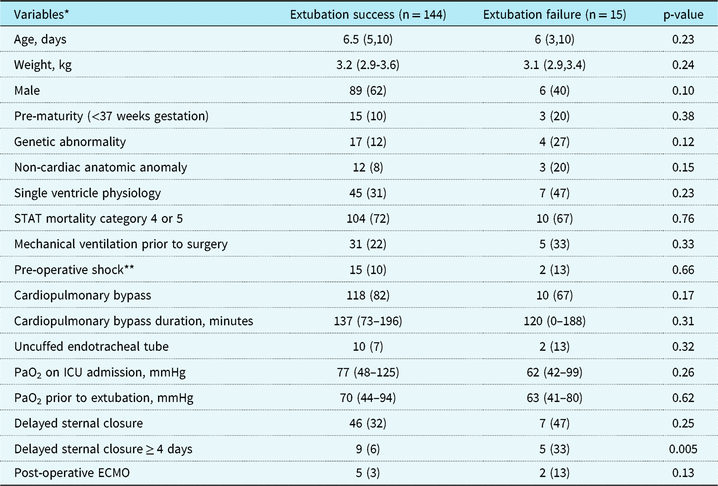
Characteristics of patients who were extubated successfully and those who were re-intubated are compared in Table 1. Patients from the two cohorts were statistically similar in terms of age at surgery, weight at surgery, number of functional cardiac ventricles, duration of cardiopulmonary bypass, post-operative use of extracorporeal membrane oxygenator support, and other clinically relevant variables. Patients who failed extubation, however, were more likely to have delayed sternal closure ≥ 4 days (p = 0.005). This variable was also identified in our previous analysis as an independent risk factor for extubation failure.Reference Mastropietro, Cashen and Grimaldi 3
Bivariate comparison of characteristics of patients who were extubated successfully and patients who failed extubation

* ECMO: extracorporeal membrane oxygenation; STAT: Society of Thoracic Surgeons – European Association for Cardio-Thoracic Surgery congenital heart surgery mortality category; categorical data represented as absolute counts (%) and continuous variables represented as median (25 %, 75 %)
** As defined by the Society of Thoracic Surgeons Congenital Heart Surgery Database: Metabolic acidosis with arterial pH < 7.2 and/or lactate > 4 mmol/L
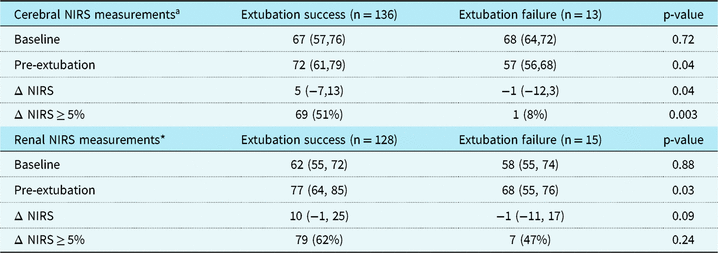
Cerebral and renal regional oximetry values are summarised in Table 2. Note that 149 of the 159 patients in the study (136 extubation successes, 13 extubation failures) had cerebral measurements at both time points and 143 patients in the study (128 extubation successes, 15 failures) had renal measurements at both time points. Baseline NIRS measurements (i.e., in the operating room before the commencement of surgery) were not different between patients who were extubated successfully and those who failed. Patients who extubated successfully had significantly higher absolute pre-extubation cerebral and renal regional oximetry measurements as compared to patients who failed extubation. Additionally, the median change in cerebral regional oximetry measurements from baseline to pre-extubation was increased in patients who extubated successfully, whereas the median change in cerebral regional oximetry measurements from baseline to pre-extubation was decreased in patients who failed extubation.
Cerebral and renal near-infrared spectroscopy (NIRS) measurements

* 149 study patients (94%) had cerebral NIRS measurements at baseline and pre-extubation and 143 patients (90%) had renal NIRS measurements at baseline and pre-extubation; Data provided as median (25%, 75%) for continuous variables and absolute counts (%) for categorical variables
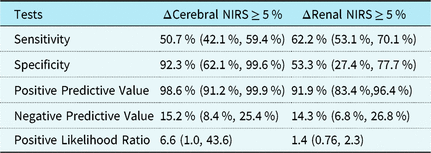
Sensitivity, specificity, positive predictive values, negative predictive values, and positive likelihood ratios for identified cut-off values for change in cerebral and renal regional oximetry measurements from baseline as predictors of extubation success are provided in Table 3. Based on receiver-operating characteristic curve analysis, we identified an increase in cerebral regional oximetry percentage values of 5 % or more as the optimal cut-off for predicting extubation success. Specifically, in the 70 patients who had a change in cerebral regional oximetry measurements from baseline to pre-extubation of at least 5 %, 69 extubated successfully, which equates to a positive predictive value of 98.6 %. Moreover, in a multi-variable analysis that included adjustment for prolonged sternal closure greater than 4 days, an increase in cerebral regional oximetry measurements of 5 % or greater from baseline values to time of extubation was independently associated with extubation success (OR 10.9; 95 % CI:1.4, 87.4; p = 0.027).
Sensitivity, specificity, and predictive values for the change (Δ) in cerebral and renal near-infrared spectroscopy (NIRS) as predictors of extubation success

Data provided as calculated percentage or ratio with 95 % confidence intervals
An optimal cut-off value for the change in renal regional oximetry measurements as a predictor of extubation success was not easily identifiable. We therefore utilised an increase in renal regional oximetry value of greater than or equal to 5 % as the cut-off point, to allow for comparison of our analysis of cerebral regional oximetry. In contrast to cerebral regional oximetry measurement, an increase in renal regional oximetry greater than 5 % was a poor predictor of extubation outcome (Table 3).
Discussion
Extubation failure occurs in 5–23 % of critically ill infants and children with cardiac disease.Reference Mastropietro, Cashen and Grimaldi 3 , Reference Benneyworth, Mastropietro and Graham 5 , Reference Harrison, Cox, Davis, Piedmonte, Drummond-Webb and Mee 6 , Reference Gaies, Tabbutt and Schwartz 12 Several recent studies have shown that neonates, not surprisingly, are more likely to fail extubation than older children. In our multi-centre investigation of extubation failure in a heterogenous cohort of neonates who underwent surgery for congenital heart disease, 12 % failed extubation, which was consistent with a recent study from the PC4 that reported an extubation failure rate of 11 % in 899 neonates who had undergone cardiac surgery.Reference Mastropietro, Cashen and Grimaldi 3 , Reference Benneyworth, Mastropietro and Graham 5 , Reference Gaies, Tabbutt and Schwartz 12 By comparison, extubation failure occurred in 6 % of the general cardiovascular ICU population.Reference Benneyworth, Mastropietro and Graham 5 , Reference Gaies, Tabbutt and Schwartz 12 Furthermore, extubation failure has consistently been shown to be associated with increased morbidity and mortality in paediatric populations.Reference Baisch, Wheeler, Kurachek and Cornfield 1 , Reference Harkel, van der Vorst, Hazekamp and Ottencamp 2 , Reference Gaies, Tabbutt and Schwartz 12 , Reference Kurachek, Newth and Quasney 13 For example, Baisch et al showed that it contributes to increased mechanical ventilation days as well as longer ICU and hospital length of stay.Reference Baisch, Wheeler, Kurachek and Cornfield 1 Likewise, an analysis of data from the PC4 registry found an association between extubation failure with longer cardiovascular ICU length of stay and in-hospital mortality.Reference Gaies, Tabbutt and Schwartz 12 Efforts aimed at identifying measures to predict and possibly prevent extubation failure could beneficially impact patient outcomes.
Several risk factors for extubation failure in neonates after cardiac surgery have been identified. In a single-centre retrospective study of neonates who underwent cardiac surgery, Laudato and colleagues found that genetic abnormalities, hypo-plastic left heart syndrome, and post-operative infection were independently associated with neonatal extubation failure.Reference Laudato, Gupta, Walters, Delius and Mastropietro 14 Gupta and colleagues found the use of inhaled nitric oxide after surgery, prolonged mechanical ventilation, and atelectasis on chest x-ray prior to extubation to be risk factors for extubation failure in a single-centre, retrospective study in neonates who had undergone the Norwood operation.Reference Gupta, McDonald and Goyal 15 More recently, in a multi-centre cohort of neonates from the PC4 registry, Benneyworth et al identified the presence of congenital airway anomaly as an independent risk factor for extubation failure.Reference Benneyworth, Mastropietro and Graham 5 In our previous work, we reported the use of uncuffed endotracheal tubes and delayed sternal closure of 4 days or greater as independently associated with extubation failure after cardiac surgery.Reference Mastropietro, Cashen and Grimaldi 3 In the present study, prolonged duration of delayed sternal closure was indeed significantly more common in patients who failed extubation, while use of uncuffed endotracheal tube was not. The latter discrepant finding may be attributed to the fact that only 12 of the 49 patients with uncuffed endotracheal tubes from our initial study had adequate NIRS data to be included in this analysis.
While knowledge of risk factors associated with extubation failure can help guide extubation practices, objective measures to assess extubation readiness in this complex patient population are also needed to better guide extubation practices. In particular, objective measures of cardiac output during the transition off of mechanical ventilation would be most helpful since many children recovering from congenital heart surgery have reduced cardiopulmonary reserve and, consequently, have limited ability to adapt to the metabolic demands associated with respiratory distress and increased work of breathing. Several studies in the adult literature that include post-operative cardiac surgical patients have demonstrated rapid declines in mixed venous oxygen saturation during spontaneous breathing trials and immediately after extubation due to either a decrease in oxygen delivery, increase in oxygen consumption, or an increase in systemic oxygen extraction during the transition off of mechanical ventilation.Reference Williams, McLean and Ahari 16 , Reference Paulus, Lehot, Bastien, Piriou, George and Estanove 17 To our knowledge, similar data in the paediatric cardiac population are lacking. NIRS, which has become ubiquitous in paediatric cardiac operating rooms and ICUs in recent years, represents a non-invasive means of monitoring this delicate balance of oxygen delivery and demand in these patients. Recent studies have demonstrated that low cerebral regional oximetry values in both single-ventricle and two-ventricle children after cardiac surgery can be a reflection of inadequate oxygen economy and are predictive of worse clinical outcomes.Reference Hoffman, Ghanayem, Scott, Tweddell, Mitchell and Mussatto 9 , Reference Phelps, Mahle and Kim 18 In one single-centre, prospective observational study, Foster et al evaluated the use of NIRS to predict extubation outcome in children after cardiac surgery.Reference Foster, Spaeder, McCarter, Cheng and Berger 8 These researchers found that a 12 % decline in somatic regional oxygen saturation during an extubation readiness trial was associated with an increased risk of extubation failure, suggesting that the addition of somatic regional oxygen saturation measurements to an extubation readiness trial may improve the ability to predict extubation outcome in paediatric cardiac patients.Reference Foster, Spaeder, McCarter, Cheng and Berger 8
Similar to the work of Foster and colleagues, our data support the use of NIRS measurements as an adjunct to extubation readiness assessment. In our study, we showed that an increase in cerebral regional oximetry greater than or equal to 5 % from baseline prior to extubation was predictive of extubation success in 99 % of cases. We speculate that this increase in NIRS measurements may be reflective of a greater degree of cardiopulmonary reserve, which allowed these patients to better tolerate the increased metabolic demands that can occur upon extubation. Importantly, renal NIRS measurements had limited ability to predict extubation success. Moreover, the inter-quartile ranges presented in Table 2 for the change in renal NIRS measurements are visibly wider than the cerebral measurements, which is evidence of greater variation in the former measurements between patients. In one single centre study of 20 children recovering from cardiac surgery, renal or splanchnic NIRS measurements were not predictive of low cardiac output.Reference Bhalala, Nishisaki and McQueen 19 Variations in probe placement and thickness of the abdominal wall or flank region, which were suggested as possible reasons for their findings, could have played a role in our results as well.Reference Balaguru, Bhalala, Haghighi and Norton 20 We also speculate that variations in pre-operative and post-operative feeding practices across patients and centres, which would result in variable mesenteric and renal oxygen extraction, could have negatively affected the predictive value of renal NIRS measurements.
Importantly, we acknowledge that while the positive predictive value of the change in cerebral NIRS measurements was robust, the sensitivity and negative predictive value were low. Notably, 67 neonates in whom cerebral regional oximetry values were not increased by 5 % or greater at the time of extubation were extubated successfully. From these data, we can conclude that while an increase of 5 % or more in cerebral regional oximetry should provide reassurance that extubation success is likely to occur, the absence of this positive change in cerebral regional oximetry should not be, in and of itself, a deterrent to extubation. Rather, our findings corroborate the potential of NIRS observed in earlier studies as a valuable adjunct for the assessment of extubation readiness in cardiac neonates.
Our study has several limitations. First, there are inherent limitations of regional oximetry technology that can hinder its ability to accurately reflect the adequacy or inadequacy of systemic oxygen delivery. Examples of these limitations include variability that can result from differences in patients’ body habitus or the degree of tissue oedema, and the absence of published age-based normal values in children with cardiac disease. In addition, NIRS monitoring was performed at the discretion of the clinicians at each centre and was not standardised. Additionally, extubation readiness assessment and criteria for re-intubation were not protocolised across participating institutions and were not assessed as a part of this study. The decision to extubate or re-intubate was made with some combination of the results of local extubation readiness tests and the impression of the clinical team. Also, clinicians were not blinded to cerebral and renal oximetry measurements, and the extent to which these measurements may have influenced the decision to extubate is unknown. Our data were obtained from a larger data set from a prior study that was not specifically designed to assess the effectiveness of near- infrared spectroscopy as an extubation readiness tool. Thus, cerebral and renal oximetry measurements were only recorded when available and at two time points, limiting the number of patients we could include in this sub-analysis and prohibiting us from analyzing the relationship between trends in cerebral and renal oximetry measures during ventilator weaning and extubation outcomes. Even with these limitations, our data, in conjunction with the data previously published by Foster and colleagues, highlight the promise of regional oximetry as an adjunctive tool for extubation readiness assessment in paediatric cardiac surgical patients and should stimulate further study. Further investigation, which should include additional measures of systemic oxygen delivery such as arterio-venous oxygen difference to support the notion of regional oximetry as a reflection of cardiopulmonary reserve, is warranted to specifically address the question of how to best implement this technology in extubation readiness protocols.
Conclusions
In conclusion, improvements in cerebral regional oximetry measurements from baseline to just prior to extubation were associated with extubation success in neonates recovering from cardiac surgery. More specifically, an increase in cerebral regional oximetry measurement of at least 5 % from baseline to pre-extubation was robustly predictive of extubation success. Our results suggest that NIRS monitoring has great potential as an aid to the bedside clinician in determining the likelihood of extubation success in neonates who have undergone congenital heart surgery.
Author ORCIDs
Eleanor A. Gradidge 0000-0002-2167-363X
Acknowledgements
We appreciate the input and dedication of the teams who gathered data for this study which was performed at Phoenix Children’s Hospital, Riley Hospital for Children, Children’s Hospital of Michigan, Cleveland Clinic, Arnold Palmer Hospital for Children, Ann & Robert H. Lurie Children’s Hospital of Chicago, and American Family Children’s Hospital.
Financial Support
This research received no specific grant from any funding agency, commercial or not-for-profit sectors.
Conflicts of Interest
None.
Ethical Standards
The authors assert that all procedures contributing to this work comply with the ethical standards of the relevant national guidelines on human experimentation (United States National Institutes of Health Belmont report) and with the Helsinki Declaration of 1975, as revised in 2008, and has been approved by the institutional review boards of each participating institution.