Introduction
Thiamine, in its biologically active form thiamine pyrophosphate, is an essential coenzyme for oxidative cellular metabolism (Sechi et al., Reference Sechi, Sechi and Fois2016).
Thiamine cannot be produced in the body and must be taken in from outside sources. However, the physiological store of thiamine is depleted in as few as 18 days (MacLean et al., Reference MacLean, Rhode and Shizgal1983), and a deficiency can occur after a loss of appetite lasting two to three weeks. A deficiency can leads to damage to the central nervous system, which consumes large amounts of energy and uses glucose as its sole energy source. Wernicke encephalopathy (WE) is a neuropsychiatric disorder known to be caused by thiamine deficiency (TD) (Sechi and Serra, Reference Sechi and Serra2007). The treatment of WE involves intravenous thiamine administration, and early detection and treatment affords resolution of the disease without sequelae. However, the symptoms of this disease are nonspecific, and WE is often overlooked as some cases are asymptomatic (Sechi et al., Reference Sechi, Sechi and Fois2016; Onishi et al., Reference Onishi, Ishida and Tanahashi2018c). If left untreated, WE can progress to Korsakoff syndrome, resulting in irreversible damage to the brain. At present, the most useful diagnostic tool for WE is clinical suspicion (Sechi and Serra, Reference Sechi and Serra2007). Recent clinical studies have revealed that WE is quite common in cancer patients (Isenberg-Grzeda et al., Reference Isenberg-Grzeda, Shen and Alici2017), being observed during chemotherapy, psychiatric examination, in patients with delirium, on admission to palliative care units, at the end of life and so on (Barbato and Rodriguez, Reference Barbato and Rodriguez1994; Onishi et al., Reference Onishi, Ishida and Toyama2016, Reference Onishi, Ishida and Toyama2018a, Reference Onishi, Sato and Uchida2021). Cancer patients often want to spend their final days at home (Nakamura et al., Reference Nakamura, Kuzuya and Funaki2010; Rainsford et al., Reference Rainsford, MacLeod and Glasgow2016). For this reason, it is essential that general practitioners have knowledge of and technical skills related to cancer medicine and symptom relief (Mitchell et al., Reference Mitchell, Senior and Johnson2018). Due to the high frequency of delirium in patients undergoing home medical care (Sandberg et al., Reference Sandberg, Gustafson and Brännström1998) and inadequate thiamine intake (Posner et al., Reference Posner, Smigelski and Krachenfels1987), there is the potential for some patients to present with TD or WE. However, there have been no reports to date on TD or WE in cancer patients undergoing home medical care.
Here, we report a case of a cancer patient undergoing home medical care who presented with delirium for whom WE was suspected from the clinical course and the improvement of symptoms was observed on administration of thiamine
Case report
The patient was an 84-year-old female with a history of surgery and anti-cancer drug treatment after diagnosis of Stage I breast cancer 18 years previously. The patient visited her previous hospital due to dyspnea. A chest X-ray showed right pleural effusion, with further examination revealing a clinical diagnosis of pleural dissemination based on CT scan showing right pleural effusion, pleural thickening, and subpleural nodules. Bone scintigraphy revealed multiple bone metastases, with the values of tumor markers CEA (494.7, reference range: 5.0 or less ng/mL), CYFRA (26.4, reference range: 3.5 or less ng/mL), and ProGRP (163.7, reference range: less than 81 pg/mL) all elevated, leading to a clinical diagnosis of Stage IV lung cancer.
Due to the patient's advanced age, she did not receive treatment such as anti-cancer drugs; instead, she received home medical care, with home visits by a physician beginning the following day. Thereafter, the patient received home visits twice a week and continued the treatment mainly with drug therapy for dyspnea.
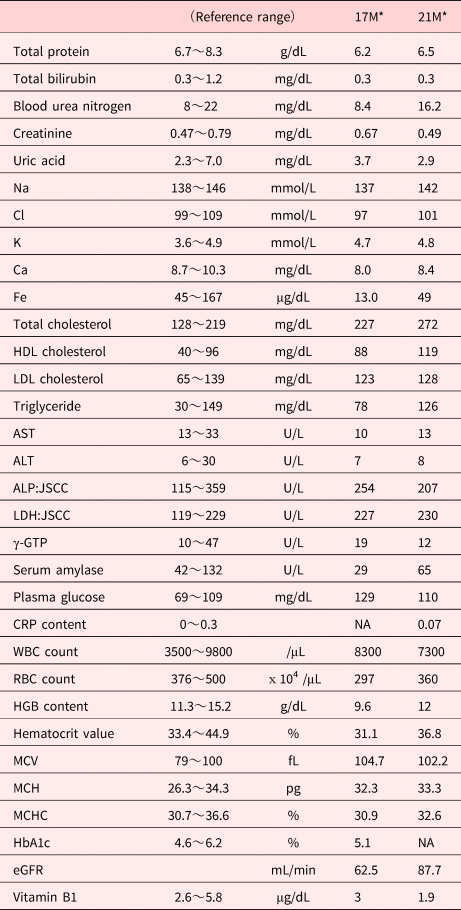
After 17 months, no disturbance to her mental status was observed, but the patient's appetite continued to decline. Her prescribed medication at that time was betamethasone 1 mg, lansoprazole 15 mg, and oxycodone 40 mg. An examination based on the suspicion of TD revealed that the patient's serum concentration of VB1 was 3 (reference range: 2.6–5.8 μg/dL), which was within the normal range.
After 21 months, a family member reported that the patient might have developed dementia because she had recently been saying strange things. A medical examination revealed an impaired mental state and an attention deficit. Her prescribed medication at that time was still betamethasone 1 mg, lansoprazole 15 mg, and oxycodone 40 mg, and there was no change for one month.
Based on the above clinical findings, her psychiatric features fulfilled the Diagnostic and Statistical Manual of Mental Disorders, 5th edition criteria (American Psychiatric Association, 2013) for delirium. In addition, her condition was classified as hypoactive delirium based on patient activity.
A detailed interview with the family revealed that the patient's food intake had fallen from normal a month previously to somewhere between 50% or just a few mouthfuls. As vitamin B1 (VB1) is only stored in the body for about 18 days (MacLean et al., Reference MacLean, Rhode and Shizgal1983), the possibility of TD was suspected, and VB1 was measured in addition to peripheral blood and biochemical tests.
Three days later, the blood concentration of VB1 was confirmed to have decreased to 1.9 (reference range: 2.6–5.8 μg/dL), and no other abnormalities likely to result in delirium were found (Table 1). The patient was clinically diagnosed with WE and the oral administration of fursultiamine 75 mg was started. An examination 3 days after the administration of fursultiamine revealed the time she spent awake had increased and the content of the TV programs she watch could be understood. The serum concentration of VB1 at the blood sampling after three weeks was 42.8 μg/dL. No signs of delirium were observed at the home visit four weeks later. Further, her level of activity had increased, such as starting of rehabilitation.
Laboratory findings

*Number of months from initial visit.
NA: not available.
Discussion
Herein, we reported a case of WE in a patient receiving home medical care for lung cancer. With proper diagnosis and treatment, the patient recovered without any brain-related sequelae.
Delirium is not uncommon in cancer patients receiving home care, but there have been no reports on the investigation of TD as the cause. This case, however, suggests the presence of WE in cancer patients undergoing home care.
The diagnosis was prompted by the patient's persistent loss of appetite. In this case, blood was collected to examine VB1 the very first time a reduction in appetite was reported. As store of VB1 in the body is depleted in about 18 days (MacLean et al., Reference MacLean, Rhode and Shizgal1983), it is not uncommon for cancer patients to exhibit VB1 deficiency (Yoshioka et al., Reference Yoshioka, Sato and Onishi2021; Onishi et al., Reference Onishi, Sato and Uchida2021), and it is considered appropriate to actively suspect TD if there is a loss of appetite.
Another trigger for diagnosis is hypoactive delirium. This condition is often overlooked (Inouye, Reference Inouye1994), but in this case, an appropriate examination provided a path for the diagnosis of WE.
In this case, WE developed 21 months after the diagnosis of lung cancer. It has been reported that 8% of lung cancer patients survive for more than 60 months (Kaira et al., Reference Kaira, Takahashi and Murakami2010). In cases of advanced cancer, loss of appetite and delirium may occur during this period. It is, therefore, necessary to always consider the possibility of the development of TD and provide home medical care.
In this case, thiamine was orally administered as a treatment for TD after diagnosis. The treatment of TD is based on high-dose intravenous thiamine administration (Galvin et al., Reference Galvin, Brathen and Ivashynka2010; Isenberg-Grzeda et al., Reference Isenberg-Grzeda, Kutner and Nicolson2012), although the oral administration of thiamine has been shown to improve WE symptoms (Onishi et al., Reference Onishi, Ishida and Tanahashi2018b) and there are also reports of improved quality of life in elderly patients with subclinical TD (Wilkinson et al., Reference Wilkinson, Hanger and Elmslie1997). In this case, the serum concentration of thiamine was sufficiently restored by oral administration, and the clinical symptoms were improved. This is considered to be due to the fact that the patient had no or only mild thiamine malabsorption. TD may lead to serious sequelae if treatment is delayed, and as it takes several days for thiamine test results to be obtained, it considered better to administer thiamine before the test results are confirmed
In conclusion, when delirium occurs in cancer patients undergoing home treatment, it is necessary to suspect TD as a potential cause, as appropriate diagnosis and treatment can prevent irreversible brain-related sequelae.