Staphyleaceae includes small shrubs and trees distributed mainly in temperate areas of North America, Europe and Asia. The traditional circumscription of this family recognises five genera distributed in two subfamilies (Pax Reference Pax, Engler and Prantl1893): Staphylea L., Turpinia Vent. and Euscaphis Siebold & Zucc. in Staphyleoideae, and Huertea Ruiz & Pav. and Tapiscia Oliv. in Tapiscioideae. They are distinguished based on the degree of fusion of the carpels. Nowadays, Tapiscioideae has been considered as a separate family (Takhtajan Reference Takhtajan1980) related to Capparales (Simmons Reference Simmons and Kubitzki2007), but more recently it has been included in Huertales (APG IV 2016).
The relationship between Staphylea, Turpinia and Euscaphis was resolved by Simmons (Reference Simmons2002), through a phylogenetic analysis based on nuclear (ITS 1 and 2) and chloroplast (matK–psbA and trnT–trnL) sequences. He recognised two genera: Staphylea s.l., which includes Staphylea s.s., Turpinia (New World species) and Euscaphis, and a second genus, Dalrympelea, consisting of the Old World species of Turpinia (Simmons Reference Simmons and Kubitzki2007). More recently, Harris et al. (Reference Harris, Chen, Xu, Zhang, Yang and Wen2017), based on a phylogenetic analysis with chloroplast markers (GBSSI, ITS, ndhF, psbA, rbcL, rps16, trnL-F, trnSGG), recognised five clades in Staphyleaceae: (1) Euscaphis, comprises the traditionally monotypic genus, Euscaphis; (2) Old World Staphylea is composed exclusively of Old World species of Staphylea; (3) Asian–North American Staphylea, a clade of all other Old World species of Staphylea and all New World species; (4) Old World Turpinia, comprises all species of Turpinia from the Old World; and (5) New World Turpinia, represents all New World species of Turpinia. Nevertheless, the intergeneric circumscription remains controversial.
Staphylea s.s. is a genus consisting of 10–13 species of large shrubs and small trees growing in subtropical to temperate habitats in the Northern Hemisphere (Li et al. Reference Li, Cai, Wen, Wu and Raven2008). The conspicuous, inflated, bladder-type fruits, shrubby habit and relatively small inflorescences have been used traditionally to identify Staphylea (Simmons Reference Simmons and Kubitzki2007).
The fossil record of Staphylea consists primarily of leaves, woods, fruits and seeds collected mainly from Europe (e.g., Kirchheimer Reference Kirchheimer1957; Dorofeev Reference Dorofeev1963; Gregor Reference Gregor1978), with only a few North American representatives (e.g., Huang et al. Reference Huang, Liu, Wen and Quan2015). In this study, the fossil record of Staphyleaceae is expanded to the New World based on a single flower preserved in Miocene amber from southern Mexico.
1. Material
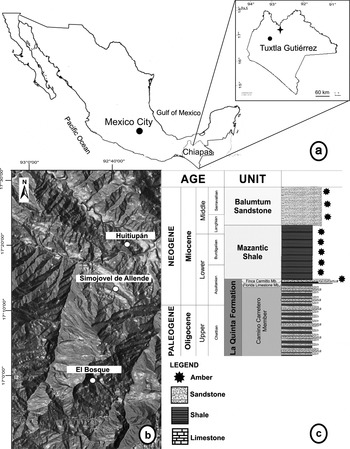
A single flower preserved in amber from Miocene rocks of Simojovel de Allende, Chiapas, Mexico, was studied in this paper. The fossil was collected in sediments at [17°08′19′′N, 92°42′00′′W], at 600m asl, approximately 50km north of the city of Tuxtla Gutierrez, Chiapas. The area is limited to the north by the Huitiupán municipality, and to the south by the El Bosque municipality (Wichard et al. Reference Wichard, Solórzano-Kraemer and Luer2006; Fig. 1).
(a) Geographic location of Chiapas, Mexico; (b) showing location of the Simojovel de Allende; (c) lower–middle Miocene stratigraphical log from Simojovel de Allende area, with amber levels (modified from Serrano-Sánchez et al. Reference Serrano-Sánchez, Guerao, Centeno-García and Vega2016).

1.1. Geologic sequence
Typically, the amber of the Simojovel area is found in three lithostratigraphic units: La Quinta or Simojovel Formation, Mazantic Shale and Balumtum Sandstone (from base to top), which form a sequence composed mainly of calcareous sandstone and silt with layers of lignite (Licari Reference Licari1960; Allison Reference Allison1967; Fig. 1). These units are exposed in the Sierra Madre del Sur, Chiapas: from the northern margin of the central depression (Totolapa) to Palenque, near the Gulf Coast of Tabasco. For further information on this topic see Solórzano-Kraemer (Reference Solórzano-Kraemer and Panney2010) and Serrano-Sánchez et al. (Reference Serrano-Sánchez, Hegna, Schaaf, Pérez, Centeno-García and Vega2015).
La Quinta or Simojovel Formation is the most characteristic litostratigraphic unit in the area and is subdivided into three members. The ‘Camino Carretero' is the lowest member of this formation, and is composed of calcareous sandstone, clay and shale intercalations, and contains foraminifera, scleractinid corals, molluscs and equinoids. The second member, ‘Caliza Florida', is composed of limolites and a heterogeneous alternation of calcareous sandstones, clays and shales, as well as thin layers of lignite. Finally, the uppermost member, ‘Finca Carmitto', comprises fine terrigenous clasts, quartz and limestone containing equinoids (Tomasini-Ortiz & Martínez-Hernández Reference Takhtajan1984).
The biostratigraphic scheme of the La Quinta formation is based on foraminifera, suggesting a late Oligocene age as defined by the Globigerina ciperoensis Bolli and Globerotalia kugleri Bolli zones (Veiga-Crespo et al. Reference Veiga-Crespo, Blasco, Poza and Villa2007). These correspond with intervals Nn3 and Nn4 of the nanoplacton stratigraphic sequence, suggesting an age of 26–22.5My (M. Benami pers. comm. 2004; Gómez-Bravo Reference Gómez-Bravo2005).
Coral biostratigraphy at the top of the ‘Camino Carretero' and the ‘Finca Carmitto' members suggest an early Miocene age; however, this scheme was not explicitly established. Its acceptance would result in a late Oligocene to early Miocene temporal interpretation for the entire formation (Frost & Langenheim Reference Frost and Langenheim1974). Recently, the biostratigraphic range of the ‘Finca Carmitto' member was confirmed using nanoplacton. The presence of Sphenolithus disbelemnos Fornaciari & Rio and S. tintinnabalum Maiorano & Monechi suggest the presence of the Nn2 biozone, which corresponds to the early Miocene (Solórzano-Kraemer Reference Solórzano-Kraemer2007; Serrano-Sánchez et al. Reference Serrano-Sánchez, Hegna, Schaaf, Pérez, Centeno-García and Vega2015). From this same member Serrano-Sánchez et al. (Reference Serrano-Sánchez, Hegna, Schaaf, Pérez, Centeno-García and Vega2015) provided a new age using 87Sr/86Sr from gastropod shell and established it at 22.88My (early Miocene).
The Mazantic Shale unit is composed of massive dark grey to black sandstones, containing plant remains, gastropods, bivalves and crustaceans (Vega et al. Reference Vega, Torrey-Nyborg, Coutaño and Hernández-Monzón2009). It was dated with benthic foraminifera, Siphogenerina transversa Cushman, as early Miocene, biozone Nn8–Nn9 (Solórzano-Kraemer Reference Solórzano-Kraemer2007). Later Vega et al. (Reference Vega, Torrey-Nyborg, Coutaño and Hernández-Monzón2009) using 87Sr/86Sr isotopic measurements taken from a well-preserved gastropod shell collected at Los Pocitos mine (lower Mazantic Shale) indicated an age of 23My. This unit has been correlated with the amber-containing sediments of the Dominican Republic based on the similar botanical origin of the amber, as well as the presence of lignite beds and comparable insect fossil record (40%). Thus, its age is suggested as 20–15My (Solórzano-Kraemer Reference Solórzano-Kraemer2007).
The Balumtum Sandstone, the uppermost in the Simojovel de Allende amber area, has been compared with the Mazantic Shale; however, there is insufficient evidence to support this correlation (Solórzano-Kraemer Reference Solórzano-Kraemer and Panney2010). The unit consists of ca. 760m of grey sandstone containing gastropods, bivalves and crustaceans (Frost & Langenheim Reference Frost and Langenheim1974).
The ages assigned to the amber-carrying sediments vary depending on the unit being considered (Serrano-Sánchez et al. Reference Serrano-Sánchez, Hegna, Schaaf, Pérez, Centeno-García and Vega2015). According to Vega et al. (Reference Vega, Torrey-Nyborg, Coutaño and Hernández-Monzón2009), amber was deposited from the late Oligocene to the early Miocene (Langenheim Reference Langenheim1966; Tomasini-Ortiz & Martínez-Hernández Reference Tomasini-Ortiz and Martínez-Hernández1984; Santiago-Blay & Poinar Reference Santiago-Blay and Poinar1993; Bousfield & Poinar Reference Bousfield and Poinar1994; Poinar & Brown Reference Poinar and Brown2002; Poinar Reference Poinar2003; Castañeda-Posadas & Cevallos-Ferriz Reference Castañeda-Posadas and Cevallos-Ferriz2007). Nevertheless, other interpretations indicate that the stratigraphic units carrying the amber are middle–early Miocene age (Meneses-Rocha Reference Meneses-Rocha, Bartolini, Buffler and Cantú-Chapa2001; Solórzano-Kraemer Reference Solórzano-Kraemer2007; Solórzano-Kraemer & Mohrig Reference Solórzano-Kraemer and Mohrig2007).
2. Method
2.1. Microscopy
An Olympus SZH stereoscopic microscope (equipped with a camera lucida) and an Olympus BH-2 optical microscope illuminated with transmitted white light were used for its morphological observation. The photographs were taken with an Olympus DP11 camera using polarising filters.
2.2. Comparison with extant taxa
The comparison of the fossil material with extant taxa was performed based on literature (cf. Cronquist Reference Cronquist1981), electronic keys such as Neotropikey-Interactive key (Milliken et al. Reference Milliken, Klitgård and Baract2009 onwards), Kevin Nixon's Families of Dicotyledons (http://www.plantsystematics.org) and information resources for flowering plants (Watson & Dallwitz Reference Watson and Dallwitz1992 onwards; Murguía & Villaseñor Reference Murguía and Villaseñor1993). Subsequently we consulted specialised literature of Staphyleaceae to compare the fossil material with extant members of the family (Dickinson Reference Dickinson1986; Carranza-González Reference Carranza-González2004; González-Villarreal & Jiménez-Reyes Reference González-Villarreal and Jiménez-Reyes2006; Simmons Reference Simmons and Kubitzki2007; Li et al. Reference Li, Cai, Wen, Wu and Raven2008; Huang et al. Reference Huang, Liu, Wen and Quan2015; Harris et al. Reference Harris, Chen, Xu, Zhang, Yang and Wen2017). Owing to the controversial circumscription of Staphylea, comparison of the fossil flower follows the sensu stricto proposal. Finally, the fossil flower was compared with material from MEXU herbarium (Herbario Nacional de México).
3. Systematic description
Order Crossosomatales sensu APG IV 2016
Family Staphyleaceae Martinov, 1820
Genus Staphylea Linnaeus, 1753
Staphylea ochoterenae Hernández-Damián,
Cevallos-Ferriz & Huerta-Vergara sp. nov.
Holotype. IGMPB 1350.
Repository. Colección Nacional de Paleontología, Museo Ma. Carmen Perrilliat M., Instituto de Geología, Universidad Nacional Autónoma de México (IGMPB).
Locality. Simojovel de Allende.
Stratigraphy. Formation La Quinta.
Age. Middle–early Miocene.
Etymology. The specific epithet refers to Dr Helga Ochoterena Booth for her contributions to the study of Mexican vegetation.
Diagnosis. Bisexual, pedicellate, actinomorphic, pentamer flower; tubular perianth; sub-obtrullated sepals; petals sub-obtrullated, almost the same size as the sepals; stamens with pubescent filaments; dorsifixed anthers; superior ovary and single style.
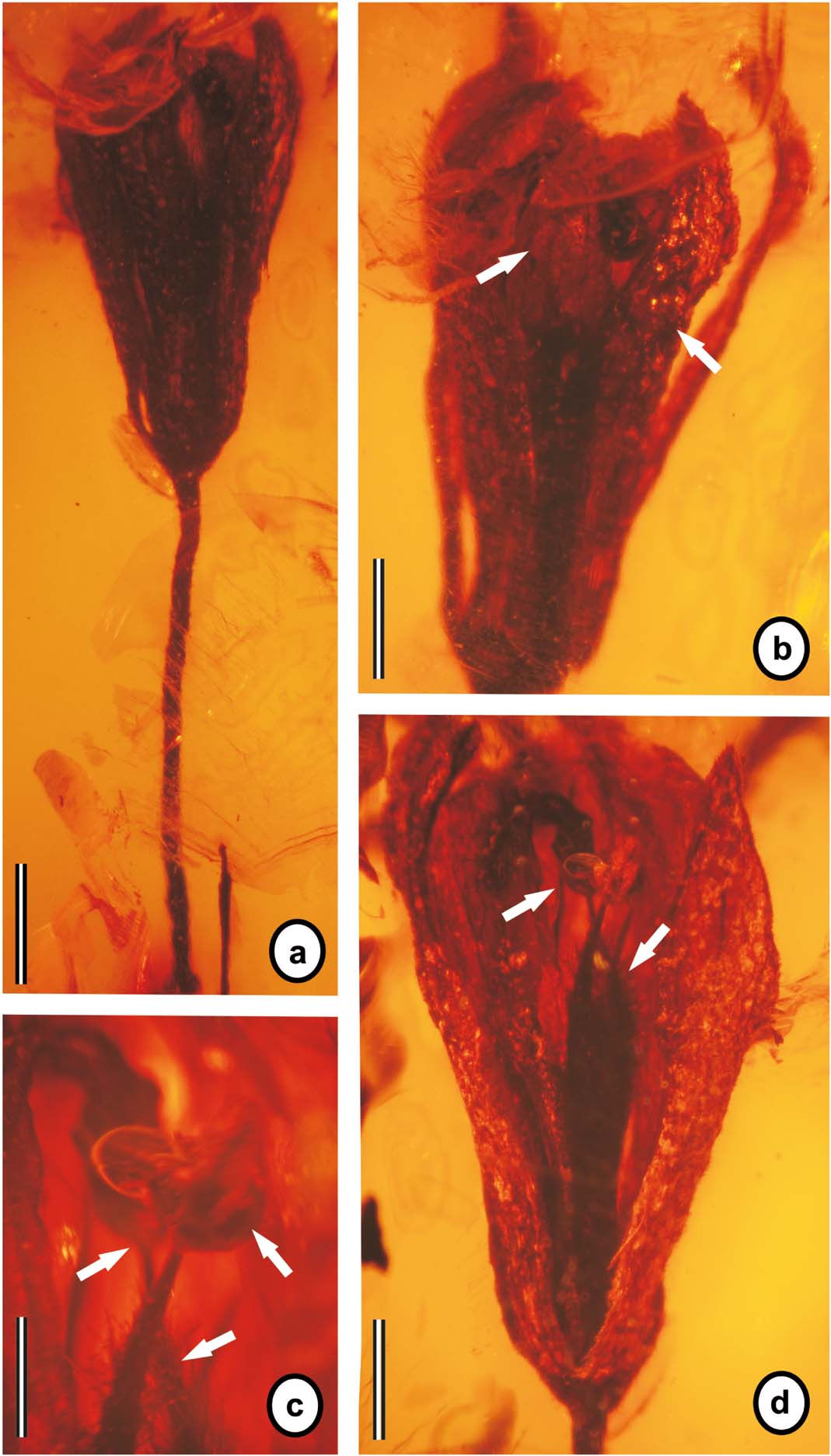
Description. Small, bisexual flower, 11.0mm long×3.0mm wide, actinomorphic, with a short pedicel, 6.0mm long×0.2mm wide (Fig. 2a); tubular perianth; five sepals, partially fused proximally, sub-obtrullated, ca. 5.5mm long×0.6mm wide; five petals, partially fused proximally, sub-obtrullated, 5.0mm long×0.6mm wide, almost the same size as the sepals, and opposed to the sepals (Fig. 2a, b, d); stamens five, filaments, subulated and pubescent, 3.0mm long×0.25mm wide; bithecated anthers, ovated, dorsifixed, 0.5mm in diameter, longitudinal dehiscence (Fig. 2c); superior ovary and single style 3.3mm long (Fig. 2d).
Staphylea ochoterenae Hernández-Damián et al. sp. nov. (a) Complete flower; (b) pentamer and tubular perianth, right arrow pointing to sepal and left arrow pointing to petal; (c) left arrow pointing to dorsifixed anther, lower right arrow pointing to pubescent filaments and upper right arrow pointing to longitudinal dehiscence; (d) left arrow points to large style, right arrow to pubescent filaments. Scale bars=1.0mm (a, b, d); 0.5mm (c).

4. Discussion
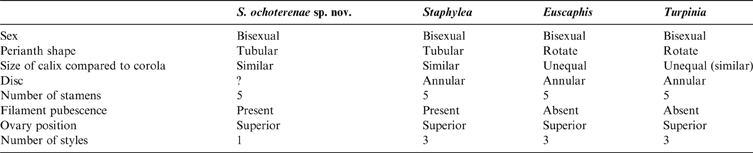
The new fossil flower preserved in amber from Simojovel de Allende has characters comparable with Aquifoliaceae, Apocynaceae, Malvaceae (Bombacoideae), Caricaceae, Solanaceae, Ericaceae, Gentianaceae, Polemoniaceae, Primulaceae, Sapindaceae and Staphyleaceae, since they have bisexual flowers and are pentamers with a superior ovary (Simpson 2010). However, the fossil flower has morphological similarities with Sapindaceae, Rutaceae and Staphylleaceae due to the presence of pubescent filaments, but these are distinguished by the shape of the perianth and the number of stamens (Ronse De Craene Reference Ronse De Craene2010; Simpson 2010) (Table 1).
Morphologic comparison between Staphylea ochoterenae sp. nov. and flowers of Sapindaceae, Rutaceae and Staphyleaceae families (Ronse De Craene Reference Ronse De Craene2010; Simpson 2010).

Flower comparisons between the fossil and living members of Staphyleaceae substantiate the similarities, such as tubular perianth and dorsifixed anthers, and these would seem to confirm that the fossil flower is a member of the Staphyleaceae (Dickinson Reference Dickinson1986). A notable difference among flowers of Staphyleaceae is the size of calyx in relation to the corolla. Sepals and petals of Turpinia and Euscaphis have different sizes, while in Staphylea they have almost the same size, and the stamens in the latter also have pubescent filaments (Dickinson Reference Dickinson1986; Sosa Reference Sosa1988). The size of the flowers is another character that differentiates flowers within the family (Li et al. Reference Li, Cai, Wen, Wu and Raven2008). The flowers of Staphylea are larger than those of Turpina and Euscaphis (∼5mm; Harris et al. Reference Harris, Chen, Xu, Zhang, Yang and Wen2017). The combination of characters found in the new fossil flower would seem to identify it as a Staphylea (Table 2).
Morphologic comparison between Staphylea ochoterenae sp. nov. and flowers of extant Staphylea, Euscaphis and Turpinia (Dickinson Reference Dickinson1986; Sosa Reference Sosa1988; Carranza-González Reference Carranza-González2004; Li et al. Reference Li, Cai, Wen, Wu and Raven2008).

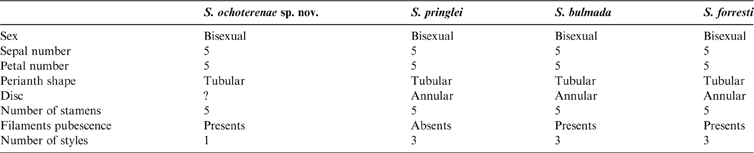
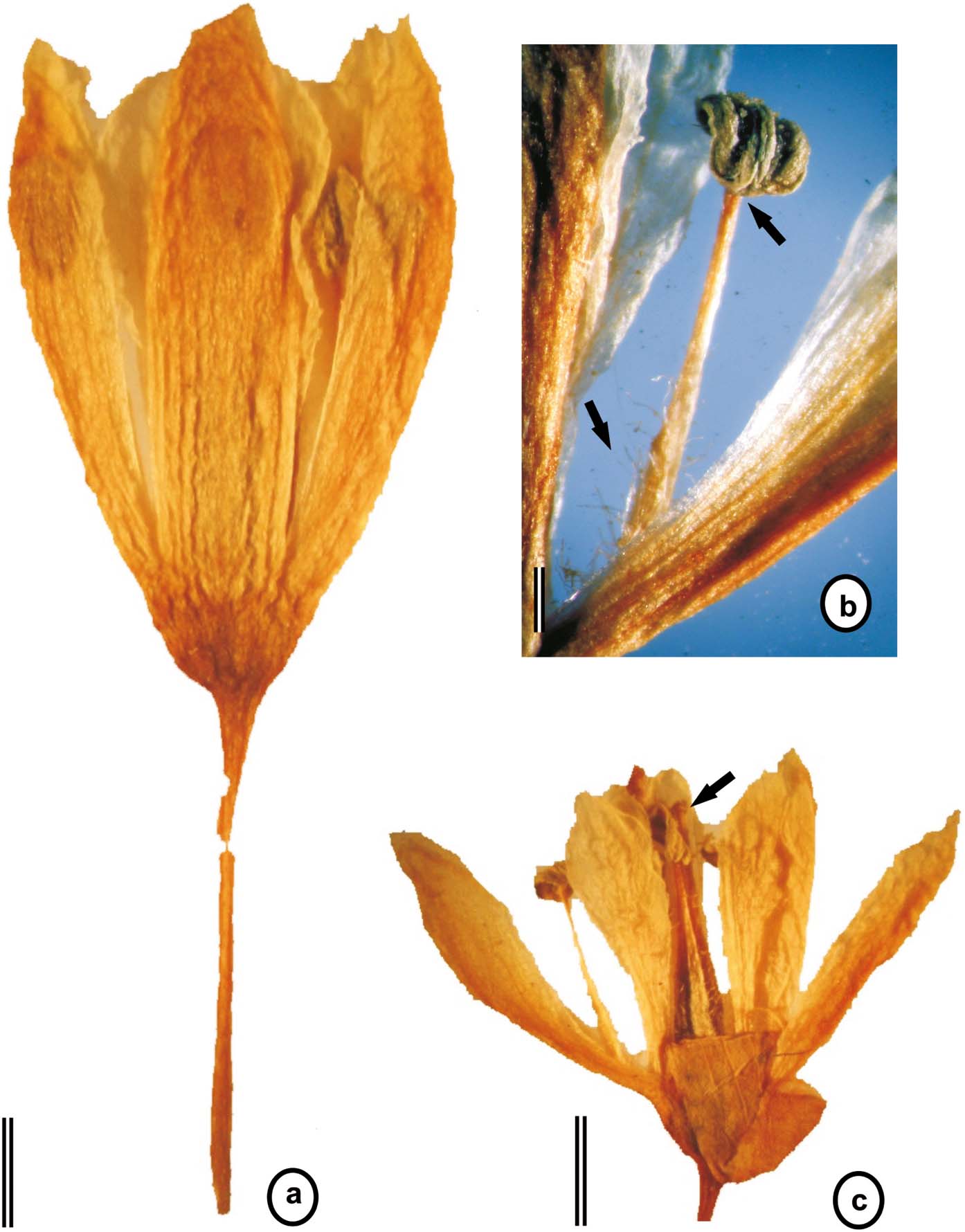
The studied fossil shares morphological similarities with flowers of extant Staphylea bulmada DC. and S. forresti Balf. F. species that grow in Asia and featuring stamens with pubescent filaments (Table 3, Fig. 3a,b). Nevertheless, the fossil flower differs from extant species of Staphylea in having a single style, instead of the three free or fused ones (Li et al. Reference Li, Cai, Wen, Wu and Raven2008) (Fig. 3c). It is not possible to confirm the presence of a disc because the fossil flower is closed. However, it is also very likely that the disc is inconspicuous as in extant members of Staphylea (Li et al. Reference Li, Cai, Wen, Wu and Raven2008). The morphological differences between the fossil and extant flowers of Staphylea, support the recognition of a new extinct species, Staphylea ochoterenae Hernández-Damián, Cevallos-Ferriz and Huerta-Vergara sp. nov.
Morphologic comparison between Staphylea ochoterenae sp. nov. and flowers of S. pringlei, S. bulmada and S. forresti (Dickinson Reference Dickinson1986; Sosa Reference Sosa1988; Carranza-González Reference Carranza-González2004; Li et al. Reference Li, Cai, Wen, Wu and Raven2008).

Extant flower of Staphylea bulmada DC. species (a) bisexual flower, actinomorphic, pedicellated with tubular periant; (b) left arrow pointing to pubescent filaments and right arrow to dorsifixed anther; (c) arrow pointing to large style. Scale bars=1.0mm (a, c); 0.5mm (b).

Based on the most recently phylogeny of Staphyleaceae by Harris et al. (Reference Harris, Chen, Xu, Zhang, Yang and Wen2017), it has been suggested that the size of the flowers in the family is probably related to a geographic pattern, where plants with small flowers are distributed at low latitudes (e.g. Turpinia y Euscaphis), while plants with larger flowers (e.g. Staphylea) live at higher latitudes (Harris et al. Reference Harris, Chen, Xu, Zhang, Yang and Wen2017). This study also recognised a clade containing the Asian–North American species, whose modern distribution suggests a minimum of two intercontinental biogeographic events. It is suggested that the Asian–North American Staphylea clade originated in Asia and from there extended its geographic distribution to North America. This proposal is consistent with the fossils included in the Boreotropical Flora hypothesis (Harris et al. Reference Harris, Chen, Xu, Zhang, Yang and Wen2017).
Staphylea ochoterenea supports the idea of Staphyleaceae being another lineage that has remained in the Northern Hemisphere after arriving from Asia (Raven & Axelrod Reference Raven and Axelrod1974). It has a similar spatial and temporal distribution to other groups of plants, such as Acer L. (Sapindaceae), Illicium Merr. & Chun (Schisandraceae), Liquidambar L. (Altingiaceae) and Quercus L. (Fagaceae) identified as part of either the ArctoTertiary (Axelrod Reference Axelrod1958; Simmons Reference Simmons and Kubitzki2007) or Boreotropical (Wolfe Reference Wolfe1975) Floras. All these elements were distributed during the Paleogene in a more or less continuous belt in high latitudes and extended to the lower latitudes of Eurasia and North America during the Neogene (Latham & Ricklefs Reference Latham, Ricklefs, Ricklefs and Schluter1993; Peinado-Lorca et al. Reference Peinado-Lorca, Macías-Rodríguez, Aguirre-Martínez and Delgadillo-Rodríguez2009).
According to Huang et al. (Reference Huang, Liu, Wen and Quan2015) the fossil record of the genus Staphylea in the Northern Hemisphere extends from Western Eurasia and Eastern Asia to North America. Thus, this new record expands the distribution of this genus to low-latitude North America. This distributional scenario is well supported by the fossil records of Staphylea as extensively documented by Huang et al. (Reference Huang, Liu, Wen and Quan2015). However, it also highlights its sparse records in America that include leaves (Knowlton Reference Knowlton1917; MacGinitie Reference MacGinitie1953; Brown Reference Brown1962), fruits (Hollick Reference Hollick1929) and seeds (Brown Reference Brown1933; Huang et al. Reference Huang, Liu, Wen and Quan2015).
In Mexico, both genera of Staphyleaceae, Turpania and Staphylea grow naturally. The latter genus is represented by a single species, S. pringlei, that is distributed in the states of Nuevo León, Tamaulipas, Hidalgo and Veracruz, and grows in pine-oak and deciduous forests (Sosa Reference Sosa1988; Carranza-González Reference Carranza-González2004). Staphylea is a characteristic element of the temperate areas of North America, Europe and Asia (González-Villareal & Jiménez-Reyes Reference González-Villarreal and Jiménez-Reyes2006).
The new Staphylea from the amber deposits of Simojovel de Allende, Chiapas, grew with other fossil plants and animals of these deposits (e.g. Miranda Reference Miranda1963; Poinar & Brown Reference Poinar and Brown2002; Castañeda-Posadas & Cevallos-Ferriz Reference Castañeda-Posadas and Cevallos-Ferriz2007; Solórzano-Kraemer Reference Solórzano-Kraemer2007; Solórzano-Kraemer Reference Solórzano-Kraemer and Panney2010; Chambers et al. Reference Chambers, Poinar and Brown2012) in a tropical lowland community where a forest dominated by Hymenaea developed near mangrove swamps, and where the resin of angiosperms trees were transported within a deltaic system (Langenheim et al. Reference Langenheim, Hackner and Bartlett1967).
We suggest that in the past, the Simojovel de Allende area supported a forest of Hymenaea composed of some members of tropical and boreal angiosperm families, as it occurs with extant floras in the state of Guerrero. In this west-central state of Mexico, Staphylea grows naturally in association with H. courbaril L. and Salix humboldtiana Willd. (Salicaceae) (Diego-Pérez & Fonseca Reference Diego-Pérez and Fonseca2000) among other Boreotropical taxa. Based on the fossil record of Mexico it has been suggested that local plants were closer to extant taxa since the Miocene (Cevallos-Ferriz et al. Reference Cevallos-Ferriz, González-Torres and Calvillo-Canadell2012). Nevertheless, the history of Staphylea ochoterenae would not support this hypothesis.
5. Conclusion
Staphylea ochoterenae is the first fossil record of Staphyleaceae based on a flower. This new extinct species resembles flowers of Asian species of Staphylea, based on the presence of a large, pedunculated, pentamer bisexual flower with sepals and petals with similar size and pubescent filaments. The putative affinity between S. ochoterenae and an Asiatic lineage of Staphylea is congruent with the most recent phylogeny of Staphyleaceae. Furthermore, the fossil record of the group supports the hypothesis that the lineage migrated to low-latitude areas of North America as an element of the Boreotropical Flora during the Paleogene. To further support this idea, phylogenetic studies are needed to establish more fully the relationships within the genus, including the fossils.
6. Acknowledgements
The authors thank Drs Laura Calvillo Canadell, Hilda Flores Olvera and Helga Ochoterena Booth, Instituto de Biología, UNAM. We also thank MEXU for its importance in allowing comparison of extant plant with the fossil material. This work was supported by the Posgrado en Ciencias Biológicas, Universidad Nacional Autónoma de México and the Consejo Nacional de Ciencia y Tecnología for the stipend (325158) and Programa de Apoyos a Proyectos de Investigación e Inovación Tecnológica (PAPIIT-UNAM IN204113), whose efforts are highly appreciated.