Introduction
Non-melanoma skin cancer is the leading malignancy worldwide, with Australians experiencing the highest annual incidence of cutaneous squamous cell carcinoma (SCC), at 387 per 100 000 population.Reference Staples, Elwood, Burton, Williams, Marks and Giles1 Lesions commonly arise (70–80 per cent) on sun-exposed head and neck skin in older Caucasian males following years of chronic solar radiation exposure. The external ear is the second most common site for cutaneous SCCs in males, due to its vulnerable, sun-exposed location.Reference Iversen and Tretli2
Non-melanoma skin cancers are often underestimated as causes of morbidity and occasional mortality, since the majority (75–80 per cent) are small, non-lethal basal cell carcinomas (BCC) which are easily treated, with local control rates of 90–95 per cent.Reference Rowe, Carroll and Day3 In contrast to BCC, however, patients diagnosed with cutaneous SCC may develop nodal and, to a lesser extent, distant metastases. Although BCC predominates as the commonest non-melanoma skin cancer, the external ear represents a unique anatomical subsite in which the majority of cutaneous lesions are cutaneous SCC.Reference Bumsted, Ceilley, Panje and Crumley4 While most small (2–3 mm), superficial head and neck cutaneous SCCs (all subsites) have a low risk of nodal metastasis (less than 5 per cent),Reference Czarnecki, Staples, Mar, Giles and Meehan5 cutaneous SCC of the external ear is associated with a higher incidence of local recurrence, nodal metastasis and mortality, compared with other cutaneous sites.Reference Yoon, Chougule, Dufresne and Wanebo6–Reference Afzelius, Gunnarsson and Nordgren9
The aim of this study was to document our unit's experience of managing patients with metastatic cutaneous SCC of the external ear, and to discuss the relevant issues.
Methods
This study was based on a retrospective analysis of prospectively collected data on patients with metastatic cutaneous SCC of the head and neck. Data on patient demographics, clinical details, tumour details, pathological findings and treatment were extracted from a prospectively maintained database. All patients were assessed by the multidisciplinary head and neck cancer service at Westmead Hospital, Sydney, Australia. All eligible patients were treated with either surgery alone, surgery plus adjuvant radiotherapy, or radiotherapy alone. Only patients treated with curative intent were included. Descriptive data were analysed using the Statistical Package for the Social Sciences version 16 software (SPSS Inc, Chicago, Illinois, USA).
Results
Patient characteristics
Between 1980 and 2007, eligible patients who developed metastatic nodal cutaneous SCC of the external ear were identified. A total of 43 patients (representing 13 per cent) were identified from a subset of 323 patients treated radically for metastatic nodal cutaneous SCC of the head and neck (all cutaneous subsites). Patients' median age at diagnosis was 72 years (range, 35–90 years). Patients comprised 39 men and four women. The median duration of follow up was approximately three years (35 months; range, 5–212 months). A minority of patients (7 per cent) were immunosuppressed.
Primary lesion characteristics
The primary lesion was recurrent in six of the 43 patients (14 per cent). The median tumour size was 21 mm (range, 4–70 mm), with a median thickness of 7 mm (range, 3–25 mm). Most lesions (79 per cent) were graded as moderately or poorly differentiated. Excision margins were close (2 mm or less) or involved in 49 per cent of patients (18/37), with half (nine of 18) subsequently receiving adjuvant radiotherapy. Most lesions were surgically excised (95 per cent); 30 per cent of such cases received adjuvant radiotherapy.
Nodal disease
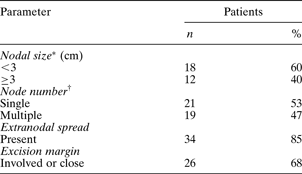
The majority of patients (28/43; 65 per cent) developed metastatic disease after treatment of the primary lesion, with a median time to relapse of 10 months (range, 2–70 months). All patients had involved lymph nodes ipsilateral to the primary lesion. Thirty patients (of 43; 70 per cent) had metastatic lymph nodes located in the parotid (six of these 30 had positive cervical nodes), while 13 patients (30 per cent) had metastatic cervical lymph nodes only (the majority at level II or III) (Table I). The median size of the metastatic nodes was 23 mm (range, 10–70 mm) and the median number of nodes involved was one (range, one to four). Extracapsular spread was present in 34/40 (85 per cent) patients, and excision margins were involved or close (i.e. 2 mm or less) in 26/38 (68 per cent) surgical specimens (Table II).
Location of metastatic lymph nodes

Nodal disease

*Median 23 mm, range 19–10 mm. †Median 1, range 1–4
Treatment of nodal metastases
The majority of patients underwent surgery and adjuvant radiotherapy (32/43; 74 per cent). Eight patients had surgery alone (19 per cent) and three patients (7 per cent) received radiotherapy alone.
Surgery
Thirty patients underwent parotidectomy either alone (three of 30) or in conjunction with a neck dissection (27/30). Two patients underwent total parotidectomy, one with a pre-operative malignant facial nerve palsy and one with macroscopic tumour involvement of the facial nerve at the time of surgery. Thirty-five patients underwent neck dissection (19 selective and 16 comprehensive). Two patients underwent nodal excision only. Patients undergoing surgery alone received either a comprehensive neck dissection (two of eight) or a parotidectomy and neck dissection (six of eight).
Radiotherapy
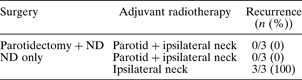
Thirty-two patients (74 per cent) received adjuvant radiotherapy, while three (7 per cent) received radiotherapy only. The three patients undergoing parotidectomy only received adjuvant radiotherapy to both the parotid and the ipsilateral neck. Of patients undergoing adjuvant radiotherapy with parotid-only metastases, the majority also received radiotherapy to both the parotid and the ipsilateral neck (14/20; 70 per cent). In patients with parotid and cervical metastases who underwent adjuvant radiotherapy, all received radiotherapy to both the parotid and the ipsilateral neck. In the nine patients with cervical-only metastases undergoing adjuvant radiotherapy, 67 per cent (six of nine) received adjuvant radiotherapy to both the parotid and ipsilateral neck, while 33 per cent (three of nine) received adjuvant radiotherapy to the ipsilateral neck only (Table III).
Cervical metastasis: treatment of uninvolved parotid

Data represent patient numbers unless specified otherwise. ND = neck dissection
The median radiotherapy dose delivered to the dissected parotid and/or neck was 60 Gy (range, 36–74 Gy) in 2-Gy fractions. The median radiotherapy dose delivered to the undissected (subclinical) regions was 50 Gy (range, 36–64 Gy) in 2-Gy fractions.
Recurrence following treatment of nodal metastases
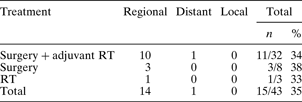
Fifteen patients (35 per cent) suffered a recurrence after treatment for metastatic disease (Table IV). Regional recurrence occurred in 14 patients, including one with persistent disease. Distant metastases were the first site of recurrence in only one patient, who developed lung metastases. The majority of recurrences occurred in the treated ipsilateral parotid gland or neck. Three patients (three of 15; 20 per cent) developed out-of-field recurrence; however, all occurred in ipsilateral nodes. After surgery alone, three patients (three of eight; 38 per cent) experienced regional recurrence, compared with 10 patients (10/32; 31 per cent) after surgery and adjuvant radiotherapy. The median time from treatment of metastases to development of recurrence was five months (range, 4–20 months).
Site of first recurrence by treatment

Data represent patient numbers unless specified otherwise. RT = radiotherapy
Survival
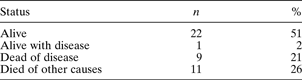
At last follow up, nine (21 per cent) patients had died of their disease, 11 (26 per cent) had died of other causes, one (2 per cent) was alive with disease and 22 (51 per cent) were alive without disease (Table V). Patients' median survival after recurrence was eight months (range, zero to 89 months).
Patient status at last follow up

Discussion
The external ear has been shown to be a high-risk subsite for the development of SCC metastases,Reference Brantsch, Meisner, Schönfisch, Trilling, Wehner-Caroli and Rocken10 accounting for up to 36 per cent of cases of metastatic cutaneous SCC of the head and neck in some series (13 per cent in our series).Reference Kraus, Carew and Harrison11 The external ear is a unique anatomical subsite of the head and neck in which non-melanoma skin cancer is more likely to be cutaneous SCC. Bumsted et al. Reference Bumsted, Ceilley, Panje and Crumley4 reviewed several series (n = 780 patients) and reported that cutaneous SCC accounted for 55 per cent of all cutaneous malignancies of the external ear. Ahmad and Das GuptaReference Ahmad and Das Gupta12 demonstrated a BCC to SCC ratio of 4:1 for all head and neck subsites; however, this ratio was almost equal for patients with cutaneous SCC located on the external ear (being 1.3:1).
As with other cutaneous sites, cutaneous SCC of the external ear occurs in predominantly older, white men in their sixth and seventh decades of life.Reference Bumsted, Ceilley, Panje and Crumley4–Reference Lee, Nash and Har-El8 This was reflected in our series: our patients had a median age of 72 years and were mostly male (91 per cent). The male predominance amongst cutaneous SCC sufferers is considerably greater for the external ear than other cutaneous sites – men are 17 times more frequently involved, and cutaneous SCC of the external ear accounts for 11–25 per cent of cutaneous SCC in men but only 0.2–3 per cent of this tumour in women.Reference Iversen and Tretli2, Reference Chuang, Popescu, Su and Chute13, Reference Kaldor, Shugg, Young, Dwyer and Wang14 While this may be explained by chronic exposure to solar radiation during outdoor occupations in men, it is also postulated that longer hair may offer a photoprotective effect in women.Reference Ahmad and Das Gupta12
Multiple risk factors for developing nodal metastases, based on primary site features, have been well documented, such as: location on or around the ear,Reference Rowe, Carroll and Day3, Reference Brantsch, Meisner, Schönfisch, Trilling, Wehner-Caroli and Rocken10 horizontal size (more than 2 cm),Reference Rowe, Carroll and Day3, Reference Brantsch, Meisner, Schönfisch, Trilling, Wehner-Caroli and Rocken10 tumour thickness (more than 4–5 mm),Reference Rowe, Carroll and Day3, Reference Brantsch, Meisner, Schönfisch, Trilling, Wehner-Caroli and Rocken10, Reference Veness, Palme and Morgan15 degree of differentiation,Reference Cherpelis, Marcusen and Lang16 desmoplastic subtypeReference Brantsch, Meisner, Schönfisch, Trilling, Wehner-Caroli and Rocken10 and immunosuppression.Reference Rowe, Carroll and Day3, Reference Brantsch, Meisner, Schönfisch, Trilling, Wehner-Caroli and Rocken10 A horizontal size of 3–4 cm has been reported to confer increased metastatic potential;Reference Afzelius, Gunnarsson and Nordgren9 however, Byers et al. Reference Byers, Kesler, Redmon, Medina and Schwarz7 did not support this finding, in a large patient series (n = 486). Horizontal size has been criticised as a weak predictor of metastasis: a large series of 266 Australian patients with metastatic cutaneous SCC of the head and neck reported a median lesion size of only 15 mm.Reference Veness, Palme and Morgan15 This finding was also reflected in our data, with a median horizontal lesion size of only 21 mm. Tumour thickness, in contrast, has been shown to be a highly significant predictor of not only metastatic potential but also local recurrence.Reference Brantsch, Meisner, Schönfisch, Trilling, Wehner-Caroli and Rocken10 A landmark German study by Brantsch et al. Reference Brantsch, Meisner, Schönfisch, Trilling, Wehner-Caroli and Rocken10 reported tumour thickness to be the only independent predictor (p < 0.0001) of nodal metastasis development (16 per cent of nodal metastasis cases had a tumour thickness of more than 6 mm, whereas only 4 per cent of such cases had a thickness of 2.1–6 mm), with horizontal size being insignificant. This finding is also confirmed in our series, in which the median tumour thickness was 7 mm, and only 10 per cent of lesions had a thickness of 4 mm or less. Brantsch and colleagues' study also reported that patients with an ear SCC were almost four times more likely to develop nodal metastases, compared with patients with a non-ear SCC (hazard ratio 3.61; 95% confidence interval 1.51–8.67; p < 0.004).
The ear is a cosmetically important anatomical structure, and excision margins may be minimised to limit patient deformity. However, incompletely excised cutaneous SCC are at risk of both local recurrence and consequential nodal metastasis.Reference Rowe, Carroll and Day3 In an Australian study, Tan et al. Reference Tan, Ek, Su, Giorlando and Dieu17 (n = 517 lesions) reported that the rate of incomplete cutaneous SCC excision was highest on the ear, compared with other cutaneous sites (20.5 vs 4.8 per cent, respectively; p = 0.01). In addition, re-excision of incompletely excised cutaneous SCC still had a poor rate of achieving clearance, with inadequate margins (mainly deep) remaining in 60 per cent (p < 0.001). While we advocate re-excision for incompletely excised lesions, if this is not appropriate then adjuvant radiotherapy to the primary site should be considered. In our series, the majority of patients (95 per cent) underwent wide local excision; incomplete excision margins were reported in 49 per cent, of which half subsequently received adjuvant radiotherapy. The rate of local recurrence of cutaneous SCC of the external ear is possibly higher than that at other cutaneous sites. We documented a local recurrence rate of 14 per cent. Rowe et al. Reference Rowe, Carroll and Day3 emphasised the significance of recurrent cutaneous SCC of the external ear, reporting a 45 per cent incidence of nodal metastasis in this clinical setting. While debate has focused on prophylactic treatment of the parotid and/or neck in patients with cutaneous SCC of the external ear,Reference Afzelius, Gunnarsson and Nordgren9 a recent study by Osborne et al. Reference Osborne, Shaw, Zandifar and Kraus18 documented no evidence of metastases in 11 patients undergoing elective (clinically and radiologically node-negative) parotidectomy, along with total auriculectomy, for advanced cutaneous SCC of the external ear.
Clark and SoutarReference Clark and Soutar19 recently reviewed the literature on lymph node metastases from ear SCC (n = 526; 11 articles) and reported a metastatic rate of 11.8 per cent, several times higher than that for other cutaneous subsites (i.e. less than 5 per cent).Reference Yoon, Chougule, Dufresne and Wanebo6, Reference Brantsch, Meisner, Schönfisch, Trilling, Wehner-Caroli and Rocken10 Byers et al. Reference Byers, Kesler, Redmon, Medina and Schwarz7 reported that half of patients developing external ear SCC metastases present concurrently with the index lesion, while in our series 65 per cent developed nodal metastases subsequent to treatment of the primary. The majority (85 per cent) of patients will develop metastases within 12 months;Reference Veness, Palme and Morgan15, Reference Clark and Soutar19 our study documented a median time of 10 months. The parotid and upper jugular nodes are the most frequent sites of nodal metastasis, with the postauricular nodes less commonly involved. In our patients, 70 per cent had parotid involvement, which includes 14 per cent that had both parotid and cervical involvement, and 30 per cent had only cervical involvement (mostly at levels II and III). One of our patients had metastatic level V nodes; this has been reported previously.Reference Byers, Kesler, Redmon, Medina and Schwarz7 The proven unfavourable features of metastatic disease comprise parotid involvement, nodes larger than 3 cm, multiple nodes, extracapsular spread and incomplete resection.Reference Rowe, Carroll and Day3, Reference Veness, Morgan, Palme and Gebski20, Reference O'Brien, McNeil, McMahon, Pathak, Lauer and Jackson21 Forty per cent of our patients had nodes larger than 3 cm, with almost half having multiple metastatic nodes. Extracapsular spread was present in 85 per cent, and incomplete resection in 68 per cent. Therefore, most of our patients had multiple unfavourable post-operative pathological features, placing them at risk of regional relapse in the operative field.
The optimal treatment for metastatic cutaneous SCC of the head and neck is a multimodality approach incorporating surgery and adjuvant radiotherapy.Reference Veness, Morgan, Palme and Gebski20–Reference Veness, Porceddu, Palme and Morgan22 The majority (74 per cent) of our patients underwent combined treatment. Patients with parotid metastases and a functioning facial nerve should undergo a nerve-sparing parotidectomy; sacrifice of the facial nerve should be reserved for patients with malignant facial nerve palsy or macroscopic tumour involvement. In another Australian study, patients with a functioning facial nerve, but with residual microscopic involvement of the facial nerve, were successfully treated with a nerve-sparing approach, provided that adjuvant radiotherapy was also given.Reference Iyer, Clark, Murali, Gao and O'Brien23 Byers et al. Reference Byers, Kesler, Redmon, Medina and Schwarz7 recommended that neck dissection should never be performed without parotidectomy, due to the high prevalence of parotid involvement. However, in patients with metastatic cervical nodes only (level I–V), the benefit of elective parotid treatment is unclear but possible. In our series, three patients who received adjuvant radiotherapy to the ipsilateral neck only all experienced a relapse; in contrast, three patients receiving adjuvant radiotherapy to both the parotid and ipsilateral neck remained disease-free. We recommend that patients with high cervical nodal metastases should be considered for a nerve-sparing parotidectomy in combination with neck dissection; alternatively, prophylactic radiotherapy to the parotid region should be considered.
• Primary squamous cell carcinoma (SCC) of the external ear has a greater risk of recurring or developing regional metastases, compared with SCC at other cutaneous subsites of the head and neck
• Patients with recurrent cutaneous SCC of the external ear have a greater risk of developing parotid and/or cervical nodal metastases
• Patients developing regional metastases are best treated with surgery and adjuvant radiotherapy
In contrast to treatment of the uninvolved parotid, the clinical picture regarding treatment of the clinically uninvolved neck in patients with parotid metastases is clearer. It is well documented that a significant number of patients (30–35 per cent) will harbour occult cervical metastasis in this setting.Reference O'Brien24 While Taylor et al. Reference Taylor, Brant, Mendenhall, Mendenhall, Cassisi and Stringer25 advocated radiotherapy to treat the undissected clinically negative neck, a negative upper neck dissection in patients with parotid metastases and favourable pathological factors may, occasionally, preclude the need for adjuvant radiotherapy to the undissected lower neck. However, if extracapsular spread, incomplete resection or multiple nodes are involved, then adjuvant radiotherapy to the entire ipsilateral neck is warranted.
Recurrence following multimodality treatment is predominantly regional (70–80 per cent) and often incurable.Reference Veness, Morgan, Palme and Gebski20 Recurrence is reported to occur in 10–38 per cent of patients treated predominantly with multimodality therapy.Reference Veness, Porceddu, Palme and Morgan22 We documented a recurrence rate of 35 per cent, with the majority occurring in the ipsilateral parotid or neck (93 per cent). Thirty-one per cent of patients treated with surgery plus adjuvant radiotherapy developed recurrence, while 38 per cent of patients developed recurrence after treatment with surgery alone. Although the numbers are small, these findings are consistent with the published benefits of multimodality therapy.Reference Veness, Morgan, Palme and Gebski20–Reference Veness, Porceddu, Palme and Morgan22 Overall survival is poor, with one study reporting 65 per cent of patients alive at two years and only 46 per cent at five years.Reference Yoon, Chougule, Dufresne and Wanebo6 Survival in patients experiencing a recurrence following treatment is especially poor; in our study, only 33 per cent of patients were alive after salvage treatment. Hinerman et al. Reference Hinerman, Indelicato, Amdur, Morris, Werning and Vaysberg26 documented the outcome of 117 treated patients with metastatic parotid and/or neck cutaneous SCC nodes; 30 patients (26 per cent) experienced regional relapse, with half undergoing salvage surgery and only five of 30 (17 per cent) being successfully salvaged.
Conclusion
Patients with cutaneous SCC on and around the external ear are at risk of developing local recurrence and subsequent nodal metastases. The importance of adequate treatment of the primary lesion cannot be overstated, due to the high incidence of nodal metastases in patients with recurrence. Patients with inadequate excision warrant further treatment with either re-excision or adjuvant radiotherapy. Most patients developing nodal metastases should be recommended surgery and adjuvant radiotherapy. At present, further Australian and New Zealand studies are being undertaken to assess the benefit of adjuvant chemoradiotherapy in improving regional control rates and survival.