




No CrossRef data available.
Article contents
The gendered use of salirse in Mexican Spanish: Si me salía yo con las amigas, se enojaba
Published online by Cambridge University Press: 01 October 2004
Abstract
It has been claimed that women and men use language quite differently in social interaction. Combining a functional and cognitive approach to grammar, this article explores the ways in which men and women use the optional pronominal form of the Spanish verb salir(se) ‘to leave’ in Mexican Spanish. It is found that women use the pronominal form notably more than men, and that, diachronically, this form has traditionally been applied to women's behavior. It is hypothesized that these patterns demonstrate both the relative expressive freedom of women's speech and the socially constrained nature of expectations for female behavior in colonial and contemporary Mexican society. It is shown how culturally shaped conventional construals of gender can both be reflected in and influence morphosyntactic phenomena.I would like to thank Melissa Axelrod, Kathy McKnight, Language in Society editor Jane Hill, and two anonymous referees for their helpful suggestions on this article.
Information
- Type
- Research Article
- Information
- Copyright
- © 2004 Cambridge University Press
INTRODUCTION
Studies of sociolinguistic variation, whether in social class, age, or gender, have offered linguists and society at large special insights into the communicative and social functions of language in everyday discourse.1
By “discourse,” I mean “the loose, unplanned, informal mode of communication in language” (Hopper & Traugott 1993:168).
Eckert & McConnell-Ginet (1998:484) call for an innovative perspective in new studies on language and gender, stating that “theoretical insight into how language and gender interact requires a close look at social practices in which they are jointly produced.” Furthermore, they point out that “the danger … is that the real force and import of their interaction [of language and gender] is erased when we abstract each uncritically from [these] social practices … in which they intermingle with other symbolic and social phenomena” (1998:485). Thus, social variables and an understanding of the social reality are crucial to any study of the use and function of grammatical structures in everyday social interaction.
The ways in which women and men use pragmatic options differently in discourse is a topic that has been explored by various scholars (e.g. Coates 1993, 1998; Eckert & McConnell-Ginet 1998). While some have argued that women and men use the same pragmatic options (such as tag questions and hedges) with different underlying functions (Tannen 1998, Coates 1993), others argue that these options serve the same purpose for both men and women, but that their uses differ quantitatively (Eckert 1998, Cameron 1998). Most of these studies focus either on discourse markers, such as hedges, or on phonological variables, such as accent, and have proposed various motivations for gender variation, including separate subcultures for women and men, female subordination and male dominance, and the favoring of symbolic capital. No study of which I am aware, however, has examined gender variation under a cognitive perspective in which a socially constituted, characteristic construal of scenes shapes distributional patterns. This article explores this possibility, offering a new kind of explanation for gender variation not yet touched in the gender-and-language literature.
Although the hypothesis that conventional construals may shape gender variation is new, the basic idea on which it stands – that morphosyntactic variation can be constrained by socioculturally influenced construals – is not. Recently, an exciting volume of work entitled Ethnosyntax (Enfield 2002) has explored the relationships among culture, construals, and variation. Enfield makes explicit the inherent interconnectedness of language and culture (2002:22), stating:
Morphosyntactic devices which are not necessarily culture-specific in semantic terms – such as switch-reference systems and classifier constructions – may nevertheless be used differently, where those differences have culture-specific motivations. Thus, culture-specific uses of such non-culture-specific devices may relate to the pragmatic effects of different ‘cultural premises’ … or to culture-specific semantics of the lexical items involved. (Enfield 2002:8, emphasis in original)
In other words, distributional patterns of morphosyntactic phenomena such as salir(se) ‘to leave’ variation in Spanish may be explained through the examination of sociocultural premises specific to the society in which the phenomena are considered. Gender, like other social constructs, is a candidate in helping to shape these premises.
I will follow a functional-cognitive, variationist approach in the following analysis of the use of one verb in contemporary and colonial Mexican Spanish: salir(se). In Spanish intransitive verbs of motion, an option sometimes exists between using an unmarked (i.e., root intransitive) form or a pronominal form.2
Spanish is not unique in possessing this construction. Languages as diverse as Classical Greek, Hungarian, A. Quechua, Lingala, Pangwa, Guugu Yimidhirr, Fula, Old Norse, Indonesian, and Rumanian have similar constructions (Kemmer 1994:198).
The use of pronominal clitics with intransitive motion verbs, as in La pelota se cayó de la mesa ‘The ball [se] fell off the table’ or Se salió de la casa de su mamá cuando tenía catorce años ‘She [se] left her mom's house when she was fourteen’, has been treated in diverse and often unsatisfactory ways by linguists writing on clitic phenomena. These constructions have been called “Romance reflexives” (García 1975), “inchoatives” (Mendikoetxea 1999:1639), “middle reflexives” (Klaiman 1992), “obligatory reflexives” (Silva-Corvalán 1994:123; Gutiérrez & Silva-Corvalán 1993:77, 84), “refining se (se de matización)” (Butt & Benjamin 2000:358), “energetic constructions” (Maldonado 1999:353–98), or, as Maldonado (1999:398) notes, labeled as “exceptions, deviations, or simply aberrations of Hispanic speech.”3
Quotations from Spanish-language sources are translated by the author.
Traditionally, as can be deduced from the majority of the labels listed above, this use of the clitic has been understood as a type of reflexive. García 1975 suggests that, just as the use of the reflexive pronoun in transitive constructions lowers the verb's transitivity and thus the number of arguments, so too does its use with intransitives, making it impossible for the hearer to interpret the action as having been caused by an outside agent. The basic function of a reflexive is to “[encode] … a referential identity between the two theta-roles assigned by a transitive verb, Agent and Theme (Patient)” (Klaiman 1992:38). As Maldonado puts it,
There is a kind of shared consensus to analyze the occurrence of the clitic se as a problem of unaccusativity. If the ‘superficial’ object is represented by 2, that is, as patient object in the ‘deep structure,’ the promotion of 2 to 1 motivates the occurrence of the form se. (1999:377)
If this is the case, and se constructions with intransitive motion verbs are to be considered a part of this category, then at least two participants (agent and patient) must be identifiable. This, however, is not possible for the types of constructions discussed here, making this analysis highly inadequate.
Maldonado 1989, 1993, 1999 is the first to offer a thorough and enlightening treatment of this topic. Rejecting the idea that this is a simple problem of unaccusativity, simplification, over-generalization, analogy, or loss of meaning, he suggests instead that these are “energetic constructions” that focus on the action, either by emphasizing the moment in which the subject suffers a change of state, or by showing it to be against the normal expectations or desires of the speaker (Maldonado 1999:353–62). Butt & Benjamin (2000:358–72) draw much of their analysis of what they call the “refining se” from Maldonado's approach. As Langacker 1994 and others (e.g. Maldonado 1999, Talmy 1985) have noted, these expectations may very well be social or cultural: “Quite a number of grammatical phenomena are in one way or another sensitive to cultural expectations. They somehow reflect culturally determined conceptions of what constitutes a familiar scenario, a canonical situation, or a normal course of events” (Langacker 1994:39; emphasis in original).
The work done thus far on these constructions (and in construal literature in general), however, has been based almost entirely on invented or anecdotal examples. This kind of evidence does not allow for exploration of patterns of variation in everyday language use, and thus it can provide only a partial explanation of these constructions' meanings. This essay, like other recent works, considers the semantics of salirse as falling into an energetic constructions framework, but I will test this hypothesis with variationist methodology. It is only through the use of empirical data and statistical analyses (cf. Diller & Khanittanan 2002:48; Barlow & Kemmer 2000) that we can develop a fuller understanding of both the cognitive and the social processes that mold patterns of gender variation in the use of salir(se).
CORPUS AND METHODOLOGY
This study includes data from two corpora: (i) the Documentos lingüísticos de la Nueva España: Altiplano central (Company Company 1994; henceforth DLNE), a corpus of approximately 320 written documents dating from 1535 to 1818, with a word count of approximately 260,000; and (ii) El habla popular de la Ciudad de México: Materiales para su estudio (Lope Blanch 1976), a 172,699-word corpus that includes guided interviews with one or two informants, as well as a section of surreptitiously recorded conversations, all done in Mexico City.4
All word count information for DLNE comes from Torres Cacoullos 2002.
The work is made up fundamentally of materials that are colloquial in nature, that come a bit closer – inasmuch as written language is a reflection of spoken language – to the speech of the Mexican colonial period. Though it is difficult to define the term ‘colloquial,’ and even more so for written language, I selected documents that showed, it seemed to me, a more fluid syntax. (1994:5)
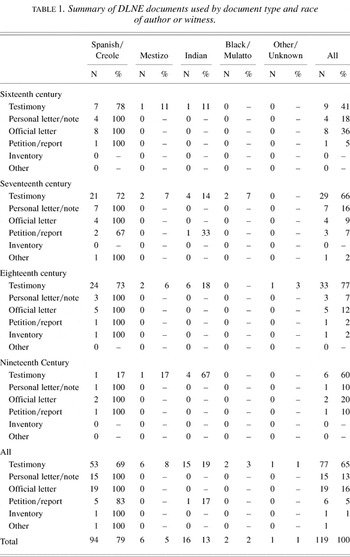
Thus, though DLNE is a written corpus, it is not a literary corpus (a collection of formal writing), and thus it does not necessarily reflect only the trained writing of the more formally educated. The documents in the DLNE are made up of four principal types: letters, court testimonies, inventories and wills, and petitions and reports.5
For a detailed description of the documents included, see Company Company 1994.
Summary of DLNE documents used by document type and race of author or witness.

I counted and coded all occurrences of salir and salirse in the DLNE and UNAM. In the DLNE, only documents that had an occurrence of salir(se) were included, leaving a total of 119 documents. The 16th-century DLNE corpus included 22 documents, yielding 62 instances of salir(se). The 17th-century corpus included 44 documents, with a total of 108 tokens. The 18th century included 43 documents with 77 tokens, and the 19th century had 10 documents and 14 tokens. The 20th-century UNAM corpus yielded a total of 289 occurrences of salir(se). Once the tokens were extracted, each was coded according to the independent variables of aspect, person, clause type, parallel processing, referent sex/animacy, referent number, and semantic context. Owing to the low number of tokens for the 16th through 19th centuries, detailed statistical analysis was not used on these occurrences. For the 20th-century data, however, GoldVarb 2001, a multiple regression variable-rule analysis program, was used to analyze the data, the results of which are given in the following section.6
For more information on GoldVarb, see Rand & Sankoff 1990.
RESULTS
Before moving on to the gendered ways in which salir(se) variation is manifested in Mexican speech, we must first establish that the use of the pronominal form is, in fact, optional. Synchronically, the pronominal form can be used, even prescriptively, in various contexts. Below is the 2001 Diccionario de la Real Academia Española (henceforth DRAE) definition for this form7
The Diccionario del español usual de México (Lara Ramos 1996:802) offers a similar, though less complete, definition of salirse, giving two meanings: 1) “to discontinue a certain behavior, line of action, or function, certain procedure: salirse del tema ‘change the topic,’ salirse de la norma ‘stray from the norm,’ salirse del carril ‘go out of the lane;’” and 2) “for a liquid to pass the limits of what contains it, or for what contains it to have some rupture through which the liquid passes….” This dictionary also gives a definition for the phrase salirse con la suya, which is defined as “To do as one wishes against what seems fitting to others.”
- intransitive. Pass from inside to outside. Salió de la casa a las ocho ‘She left the house at eight’. Used also as pronominal.
- intransitive. Show or initiate something unexpectedly. Salir con la pretensión, con la demanda, con la amenaza ‘Come out with the pretension, the lawsuit, the threat’. Used also as pronominal.
- intransitive. Move away from or separate oneself from something or be lacking in it in what is necessary or due. Salió de la regla, de tono ‘He went against the rule, the tone’. Used also as pronominal.
- pronominal. Said of the contents of a container: To spill due to a crack or break. El agua se salió del vaso ‘The water spilled out of the glass’.
- pronominal. Said of a liquid: Boil over. Se ha salido la leche ‘The milk has boiled over’.
- pronominal. Said of a container or depository: To have some crack or break through which the contents spill. Este cántaro se sale ‘This container spills’.
- pronominal. In some games, to do the moves or plays necessary to win.
- pronominal. archaic. Initiate intervention in a fight or a cause either as a fiscal or as a party.
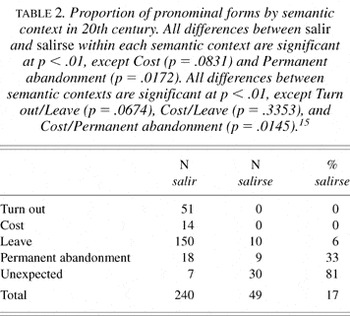
As we can see, the prescriptive use of salirse falls into two basic categories: unexpected (either physically or socially deviating from the expected or desired order of events, as in definitions 2–6), and not unexpected (definitions 1, 7, and 8). As Maldonado 1999 notes, this construction can be used to signal the subjective experience or interpretation of the speaker, indicating that the event or action was against her (or society's) expectations. He also correctly points out that “expectations are based on our knowledge about the canonical structure of world events, behavioral patterns of society and other kinds of norms. Events contradicting our world view are thus prompt to have negative connotations” (Maldonado 1993:549). The unexpected uses can be further understood as made up of both physically abnormal (4–6) and socially abnormal (2 and 3) events. Uses fitting definitions 1–6 all appear in my data, though not always in the pronominal form. I also found that salirse was sometimes used in contexts other than these six possibilities: with abrupt movements (included in tables with ‘unexpected’) and with permanent abandonment. The context of leaving an organization, which is the context most cited in recent literature (e.g. Silva-Corvalán 1994) as one in which the use of the pronominal form is obligatory, occurred only once in the data (indeed, in the pronominal form). Because of its relatively low frequency and semantic proximity to the noncontrastive ‘leave’, this occurrence was included in the ‘leave’ category. Furthermore, there were two larger semantic categories in which the pronominal form was never used: to end up or turn out, and to cost, as seen in example (1).8
These correspond to definitions 10, 18, 26, 27, 29 and 36, and 17 and 19 of DRAE 2001, respectively.
The extension of the use of the pronominal form in this context in New Mexico could be due to an acceleration of an internal change, in this case of salirse extension, resulting from the situation of contact with English (see Silva-Corvalán 1994).

Examples will be cited in the following manner: (Corpus document/page, year).
All other categories showed variation in clitic use, shown in Table 215
All p values given, except in Table 3, were obtained through chi-square tests.
Proportion of pronominal forms by semantic context in 20th century. All differences between salir and salirse within each semantic context are significant at p < .01, except Cost (p = .0831) and Permanent abandonment (p = .0172). All differences between semantic contexts are significant at p < .01, except Turn out/Leave (p = .0674), Cost/Leave (p = .3353), and Cost/Permanent abandonment (p = .0145).

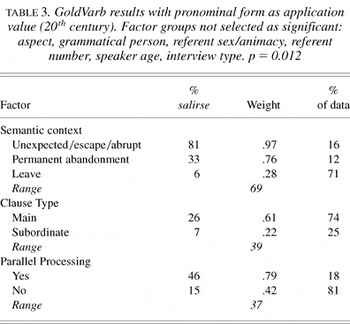
In order to explore the possible influence of other factors on the use of the pronominal form salirse in the 20th century, I subjected the data to multiple regression analysis using GoldVarb; the results can be seen in Table 3. GoldVarb is a computerized statistical program that allows the comparison of the influence of numerous noninteracting factors on a particular variable. Within each factor group – for example, semantic context – each factor must present variation. If a factor does not present variation in the dependent variable, then it must be excluded from analysis. This was the case, for example, with the semantic context of ‘cost’ (see ex. 1) in these data: It occurred only with salir, never with salirse. The removal of nonvariable factors is an important part of the analysis, for it ensures a greater likelihood of the correct identification of the hierarchy of constraints that affect the dependent variable only in contexts in which either variant of the dependent variable, in this case salir or salirse, could possibly be chosen.
GoldVarb results with pronominal form as application value (20th century). Factor groups not selected as significant: aspect, grammatical person, referent sex/animacy, referent number, speaker age, interview type. p = 0.012

Once nonvariable factors have been removed, the researcher must select an application value, which is one of the two variants of the dependent variable. In this case, I chose salirse.11
Had I chosen salir, GoldVarb would have produced the mirror image of Table 2, with those factors that favor disfavoring and vice versa, but with the same factor groups selected as significant and in the same order.
Besides inherent variation in nearly all semantic contexts, another reason to believe that the use of the pronominal form is indeed a pragmatic option not determined by semantics alone is that it appears significantly more often in main clauses than the bare form does. In Table 3, we can see that main clauses favor clitic occurrence with a weight of 0.61, and subordinate clauses strongly disfavor the clitic, with a weight of 0.22.12
Note that the GoldVarb results, with a p value of .012, did not reach statistical significance at the .01 level, but did at a .05 level, most likely owing to the small sample size. The term “parallel processing,” for this study, refers to presence of the same or the same expected clitic within the preceding two clauses.
Yet another factor pointing to the optional nature of clitic use is the statistically significant effect of parallel processing in contemporary data. Poplack 1980 found that the elision of /s/ in Puerto Rican Spanish was strongly favored by the elision of the previous /s/, and even more so by the elision of the previous two /s/s'. She called this phenomenon a “parallel processing effect” (Poplack 1980). Pereira Scherre (2001:91), who stresses the importance of “consider[ing] preceding markers across linear position as well as other important constraints,” found similar results in her study of /s/ aspiration and elision in Brazilian Portuguese.
For these data, I considered this same effect, counting as a possible source of parallel processing the presence of the same clitic form (with or without the same referent) as the one possible with salir(se) within the last two clauses of speech. I did not count discourse markers such as tú sabes ‘you know’ as independent clauses. In Table 3, we can see that this effect is statistically significant in the 20th-century data. The presence of the same form in the two preceding clauses favors the occurrence of the pronominal form salirse with a weight of 0.79, while its absence disfavors salirse with a weight of 0.42.13
In a recent study, which included ir(se) ‘to go’, salir(se), venir(se) ‘to come’, bajar(se) ‘to descend’, subir(se) ‘to ascend’, quedar(se) ‘to stay’ and caer(se) ‘to fall’, Aaron 2003 found a similar effect with these constructions in northern New Mexican Spanish.
Speaker sex and clitic variation
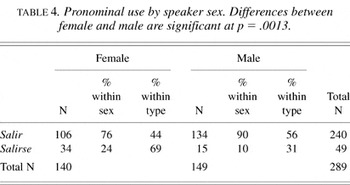
Now that we have sufficiently established that the pronominal/absolute choice is a true choice, we may consider it as a tool that differently gendered speakers may use in different ways, either qualitatively or quantitatively, in order to achieve the desired pragmatic effect. As shown in Table 4, women in the 20th-century sample used significantly more pronominal forms than men did. A total of 69% of all salirse occurrences were produced by female speakers. Furthermore, while men chose the pronominal form only 10% of the time, women chose it 24% of the time.
Pronominal use by speaker sex. Differences between female and male are significant at p = .0013.

These totals in themselves, however, tell us relatively little about how women and men are using this pronominal form. Does women's elevated use happen only in certain semantic or pragmatic contexts? Does one sex favor contexts that do not seem to allow variation? For this study, occurrences were divided into five semantic categories: (i) to cost, (ii) unexpected, (iii) permanent abandonment, (iv) to leave (noncontrastive with the nonpronominal form, with no apparent semantic value beyond the basic semantics of the verb), and (v) to turn out or end up. Examples 2–4 below provide instances of tokens in each category in which the pronominal form occurred. Examples for nonvariable contexts ‘cost’ and ‘turn out/end up’ can be found in (1) above.

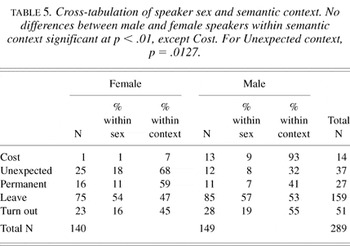
In Table 5, we can see that men do indeed seem to speak more about contexts in which variation does not occur. Though the total occurrence of salir(se) for women and men is about equal, at 149 and 140 tokens respectively, men win out in the nonvariable contexts, producing 55% of the ‘turn out’ tokens, and a whopping 93% of the ‘cost’ tokens. Women, on the other hand, win out in two of the large variable contexts, producing 59% of the ‘permanent’ tokens, and 68% of the ‘unexpected’ tokens. Both sexes were about even in their production of ‘leave tokens.’
Cross-tabulation of speaker sex and semantic context. No differences between male and female speakers within semantic context significant at p < .01, except Cost. For Unexpected context, p = .0127.

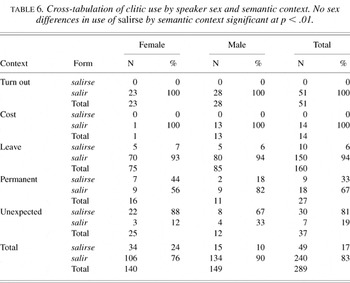
These semantic context preferences, however, do not tell the whole story. Women, within each variable context, favored the pronominal form more than men did in the same context. As Table 6 indicates, in the ‘permanent’ context, women used the clitic 44% of the time, while men used it only 18% of the time. Again, in the ‘unexpected’ context, women use the pronominal form 88% of the time, compared to men's 67%. Women show almost no difference from men in the use of the pronominal form in the ‘leave’ context, producing it only 1% more than men.
Cross-tabulation of clitic use by speaker sex and semantic context. No sex differences in use of salirse by semantic context significant at p < .01.

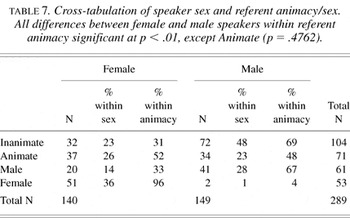
Why would women, speaking about the same semantic context as men, choose to use the pronominal form so much more often? A possible explanation for the elevated frequency of salirse in women's speech could be that they tend to have different topics of conversation than men. This does appear to be the case, as can be seen in Table 7. Here, we see that, while men were most likely to talk about inanimate objects (48% of all men's tokens), women were most likely to talk about women (36% of all women's tokens). Furthermore, men produced 69% of the inanimate referents and 67% of the masculine referents, and women produced 96% of the female referents. Only with animate (sex unknown) referents were the percentages for each sex about equal.
Cross-tabulation of speaker sex and referent animacy/sex. All differences between female and male speakers within referent animacy significant at p < .01, except Animate (p = .4762).

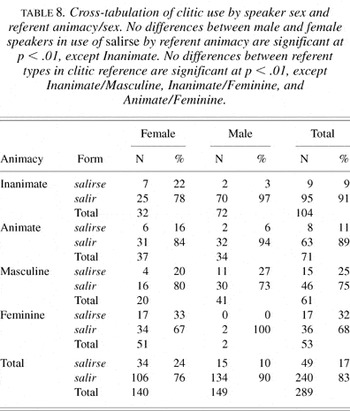
In Table 8, we can see that inanimates are the referent group least likely to take the pronominal form, at 9%, followed by animates at 11%, masculine referents at 25%, and feminine referents at 32%. Differences in topic choice, again, then, may partially explain the elevated relative frequency of salirse in women's speech. Interestingly, however, as we see in Table 8, women still produce more pronominal forms than men within the same category of inanimate, animate, and feminine referents. Only with masculine referents do men have a slight tendency to use the pronominal form more often than women.
Cross-tabulation of clitic use by speaker sex and referent animacy/sex. No differences between male and female speakers in use of salirse by referent animacy are significant at p < .01, except Inanimate. No differences between referent types in clitic reference are significant at p < .01, except Inanimate/Masculine, Inanimate/Feminine, and Animate/Feminine.

Social meanings
Thus far, we have seen that neither semantic context nor topic choice alone is an adequate explanation for the elevated use of the pronominal form by women. Given this fact, a pragmatic explanation would perhaps be the most plausible, especially given the pragmatic possibilities offered by energetic constructions such as salirse. Why, then, within this framework, would both female speakers and female referents exhibit such an elevated occurrence of the pronominal/energetic form? Let us look at a few examples with female referents and speakers from the UNAM corpus, shown in (5):

In these examples, we can see clearly the social implications of salirse, in which the female subject has done something displeasing to a higher authority of some sort, in these cases either a male lover or a parent. This context, of course, also happens with male subjects, but much less frequently. In (6), for example, the subject is male, though he is not a full-grown man but a boy:

Here, again, the pronominal form is used to indicate purposeful violation of authoritarian expectations, and it implies social and physical repercussions for this violation. Though this context with salirse is used for referents of both sexes, salirse in general is much more common with female referents (see Table 8).
As Maldonado notes, “The fact that se is used to mark some type of accidentality has been well pointed out in the relevant literature (Real Academia Española 1978, Benot 1910, Molina Redondo 1974, Moliner 1966, García 1975, Maldonado 1989)” (1993:531). Similarly, Schmitz argues that “the se me, se le construction is used with involuntary physiological or emotional reactions” (Schmitz 1966:431). Not surprisingly, then, this is the only contrastive semantic category that has been present since the 16th century in the texts I examined. Example (7) provides instances of this category for each time period, excluding the 19th century, which, owing to the extremely small size of the corpus, does not present any occurrences of salirse being used with this context:

These examples are, in fact, the prototypical example for what Maldonado 1989, 1993, 1999 terms “energetic constructions.” In energetic constructions, the expectations of the speaker play a part in the formation of the construction. In this case, the pronominal form is used when an event is either undesired or unexpected. A typical example of this phenomenon is with the verb caer(se) ‘to fall.’ If a ball falls off a table, it is most common to say La pelota se cayó de la mesa ‘The ball [se] fell off the table’. If, on the other hand, a ball falls from the hoop in a basketball game, an expected event perfectly natural according to physical laws, no clitic is typically used: La pelota cayó de la canasta ‘The ball [Ø] fell from the basket’ (Maldonado 1999).
In (7) above, the events described go against societal norms and thus are unexpected, though each case may have been anticipated by the speaker. This type of unexpectedness could be considered a social manifestation of what Talmy 1985 and Maldonado frame in physical terms as a “force dynamic”:
For changes to be able to take place, some type of energy must act on a determined element. Before the action takes place there can be some type of resistance that controls the state of the element that will be affected. This creates a situation of force dynamic, as Talmy (1985) proposes, in which the energetic element (the antagonist) imposes a change in another element (the agonist) by blocking or abating the force with which the element remained in a particular state, before the energy acted on it … . In this type of energetic construction there can also be an abstract confrontation of a force dynamic. In general terms, the natural expectations regarding different events in the world constitute the initial force which a specific event confronts. (Maldonado 1999:375)
As Maldonado notes, “The expectations [of the speaker] are based on the knowledge shared by a community about the canonical structure of world events, social behavioral norms, and other types of norms” (1999:380). A social interpretation of the use of the pronominal form in cases like those shown in (7) offers the clearest explanation, as well as a prototypical example of the energetic construction.
A diachronic perspective
The socially deviant context, as mentioned above, is the only one to appear in these data since the 16th century. Yet another reason to believe that the energetic construction with salirse was already present in the 16th century is that this – and only this – meaning is attested in the 1611 version of Tesoro de la lengua Castellana o Española (Covarrubias 1943:922). Here, salirse, listed together with the lexical entry salir, is used in the following way: “for a glass to salirse means it spills; salirse out of what has been established, to have regrets; salirse from the religion, renounce the habit.” This meaning is even clearer in the RAE usual 1780 (Real Academia Española 1780), which includes the following contrastive definitions:
Salir con la suya. To get what one attempts to, when there are barriers to accomplish it. In contentione vincere, voti compotem evadere.
Salirse con la suya. Stay stubbornly in one's point of view or behavior against the advice and desires of others. Contra ceterorum vota persistere, perseverare.
The second definition, which uses the pronominal form, contrasts with the first in that a social and moral implication is given to the action. Another piece of evidence for the established social/moral meaning of salirse can be found in the RAE usual 1791 (Real Academia Española 1791), which has an entry for the following proverb:
Salíme al sol, dixe mal, y oí peor. ‘I went out [me] into the sun, I said bad, and I heard worse.’
The definition for this entry says, “Refrain that denounces meetings and get-togethers in which things are whispered and outside groups are censured, and recommends staying inside and modesty.” The contradiction of social norms context appears to be both a very early and a quite widespread use of the pronominal form, and it has continued as such up to the present day. The current popular expression te sales ‘you exaggerate, you're going over the top’ is another example of this use. Synchronically, the socially deviant/unexpected context is the one that most favors the use of the clitic, with a GoldVarb factor weight of 0.97 (see Table 3).
Given the common social implications of salirse, it is interesting to note in quantitative terms the gendered way in which it has been used diachronically: it tends to refer to female behaviors and actions. This tendency is strikingly evident in a definition for salirse taken from the 1959 Diccionario de mejicanismos (Santamaría 1959:956, emphasis mine):
- Salirse, pronominal. For a woman to abandon the family house.
- Salirse uno del huacal, figurative expression. Take an aggressive attitude, lose patience, lack due composure.
- Salirse del fuste, Said of an excessively provocative and dishonest woman who insinuates more to a man than is appropriate.
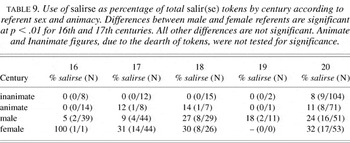
Remarkably, of the three uses of salirse listed in this dictionary, two of them are said to refer specifically to women. The data too show a consistently elevated level of use with animate female referents. As is shown in Table 9, the likelihood that a female referent will be involved in a salirse construction is higher than that for all other referents in my sample since the 16th century. One possibility is that this favoring of female referents could occur because, as women's behavior in Mexico is more strictly regulated and controlled than men's (and has been for many centuries in Western and many other cultures), they are more likely to be seen as overstepping social norms or expectations. In colonial New Spain, patriarchalism, though not monolithic, “was a powerful and persuasive ideology in society at large,” and served as the “dominant metaphor for a variety of hierarchies … that were organized upon the principles of patrons and clients and cut across social and ethnic boundaries” (Seed 1988:7). Women were, of course, divided by factors of race and class, and what was expected of a lady of the nobility was certainly different in both qualitative and quantitative terms from what was expected of a slave or servant (Gonzalbo 1985:12).
Use of salirse as percentage of total salir(se) tokens by century according to referent sex and animacy. Differences between male and female referents are significant at p < .01 for 16th and 17th centuries. All other differences are not significant. Animate and Inanimate figures, due to the dearth of tokens, were not tested for significance.

The world of women in New Spain was not static; as the ideals and exigencies of those with influence and power changed, so did the face of patriarchy (Gonzalbo 1985:12). Despite these differences and societal transformations, however, women across ethnic and class groups, and even across centuries, were united by the experience of patriarchal repression in its varied manifestations (Arenal & Schlau 1989:1; Gonzalbo 1985:12; Schlau 1996:183; Seed 1988:7). This force was often most clearly seen in ideals articulated in documents produced by colonial authorities, such as Inquisition documents like those in the DLNE. In these and other documents of the time, women were expected to be submissive to their husbands and superiors (Gonzalbo 1985:12), silent (Chinchilla 1996), secluded (Arenal & Schlau 1989:1), and inactive in public life and public spaces (Chinchilla 1996:37; Gonzalbo 1985:13). Along with social spaces, women's physical spaces were also limited:
Physical space in the home was extremely confined during this period [the16th, 17th, and 18th centuries]. A room of one's own was to be found only in some monastic cells. The quarters allotted to women, even in the homes of the nobility, were often cramped and easily accessible to men of the family and male servants. All domestic space was shared. Women were not allowed in all rooms and frequently had only cushions, not chairs, to sit on. Both the objects in the home and the women themselves belonged to the men. (Arenal & Schlau 1989:3)
These restrictions on the ideal woman's physical and social behavior produced in the literature “a social subject always in hiding, multifaceted and reticent, that almost never is revealed upon a first reading and that inhabits primarily the margins and lives in between the lines of masculine discourses” (Moraña 1996:8). These ideals had an enormous effect on how the behaviors and activities of real women in colonial Spanish America were perceived:
The living and discursive space of the colonial woman was always a limited confine controlled by strategies and rhetorics that assigned to her precise and unavoidable values and functions destined to confirm and strengthen the place of Power…. For this reason as well, her activity is always seen as transgressive, limited and belligerent, her modus operandi as allegorical, reticent or paradoxical, and her achievements like the tip of an iceberg whose base is sunk in the dark waters of a history that, like the riches of America, became foreign before it could begin to be her own. (Moraña 1996:7–8)
Despite the hegemonic nature of these discourses, it is a mistake to assume that these attempts at social and physical control of women's lives were always, or even mostly, successful; in practice, women were not always bound to these ideals. In fact, rich and impoverished women alike were often active in public life, including commerce, religion, and recreation (Gonzalbo 1985:13–14). However, since women in colonial Spanish America were less likely than men to be literate (Arenal & Schlau 1989), and their writings mostly remain unpublished, our access to the words and stories of these women is often not direct – it is often mediated by the pen of the literate males who transcribed women's words in documents like those in the DLNE. By both asking the questions and having ultimate control over the written product, male transcribers in the Inquisition maintained their hegemony, and through their language we find “as much revealed about social norms and hopes for each sex as in religious papers and dogma” (Schlau 1996:183).
In modern Mexico, these discourses have not disappeared (Boyer 1991:271). Pacheco Ladrón de Guevara (1993:32) invokes the laments of colonial poet Sor Juana Inés de la Cruz to describe the situation of women in the State of Mexico today, who, she argues, face injustice and inequality in employment, health, and education. Olivera Campirán (1992:274) notes that the few woman-dominated professional careers in Mexico State, such as secretary and model, are service-oriented, and “follow a model derived from patriarchal ideology and a work decision that is biological in nature, through which women are assigned to activities ‘proper to their sex.’”
“Proper” activities for Mexican women may continue to be more limited than for their male counterparts. In a study on the concept of female mental illness in modern Mexican society, Lagarriga Attias (1996:89) argues that “through the conceptions of mental illness suffered by women, we can better comprehend the images our culture creates about the nature of the feminine condition.” Noting an elevated incidence of insanity among women (versus men) in Mexican society, Lagarriga Attias suggests that this may be due to the fact that women are not allowed to ignore their social obligations and duties as women, and that, in all social classes, Mexican women are born into a culture in which to be a woman is to be devalued (Lagarriga Attias 1996:90).
The tendency in colonial and modern Spanish to use salirse to refer to women's actions appears to be yet another articulation of these patriarchal ideals and limitations, though less obvious and, because of this, perhaps more pervasive. It seems, however, that these gender differences in salirse use may be leveling out – perhaps owing to a change in hegemonic discourse, or perhaps owing to differences in the nature of the data; male referents slowly gained in relative frequency, and inanimates appeared as possible referents for the first time in my data from the 20th century.14
The possibility of inanimate referents, however, does seem to go back to the beginning of the energetic-absolute contrast with salir(se), as evidenced by the 1611 dictionary definition (Covarrubias 1943), in which salirse can also mean ‘to spill’. I found no evidence of this use, however, in the DLNE, perhaps owing to the infrequency of this context in the situations discussed in the documents examined.
CONCLUSIONS
I have looked at the ways in which salir(se) variation in Mexican Spanish is affected by and reflects societal gender norms. I found a notably higher use of the pronominal form among female speakers. This difference was in part explained by different choices made by women and men both in semantic content and in topic of conversation. While women were more likely to speak about unexpected situations in which the subject is defying sociocultural restrictions or permanent abandonment, men were more likely to talk about cost and results. Furthermore, while women preferred female referents, men preferred inanimate referents as topics. Interestingly, despite the fact that this study focused only on the use of one particular lexical item, the tendencies in topic preferences for each sex are in line with broader language-and-gender theories, which maintain that women are more likely to talk about people (or personal topics), while men are more likely to talk about things (or impersonal topics) (Coates 1993:118–19).
Alongside gender differences in the use of salir(se), I also found diachronic evidence for a favoring of female referents with the pronominal form, a combination that has been the most common since the 16th century. I hypothesize that this combination reflects the social reality in which Mexican women lived and continue to live, in which female behavior is more constrained and thus more likely to be seen as violating “the natural order of events.” This “natural order” may differ across classes, races, and generations, but it is ultimately reflected in repeated patterns in social communication or interaction such as writing or discourse.
These findings have implications both for linguistic theories of gender and for general cognitive grammar and pragmatics. My results support the hypotheses that women and men tend to employ different pragmatic options in discourse, and that these options reflect the social realities in which these speakers live. Moreover, these results show that, just as Maldonado 1999 suggests, even such small grammatical items such as se cannot be reduced to semantic or other linguistic factors alone. Instead, they must be considered as a functional tool that socially positioned individuals use in order to both express and create a particular social reality. In the case of salir(se), gender seems to be an important and telling factor in this creation.
References
REFERENCES
Aaron, Jessi Elana
(2003).
Me salí a caminar: Pronominal constructions with
intransitive motion verbs in northern New Mexican Spanish. In
Lofti Sayahi (ed.),
Selected proceedings of the First Workshop on Spanish
Sociolinguistics,
123–33.
Somerville, MA:
Cascadilla Proceedings Project.
Aguilar, Pepe
(1992).
Recuérdame Bonito.
Musart.
Arenal, Electa, &
Schlau, Stacey
(1989).
Untold sisters: Hispanic nuns in their own works.
Trans. Amanda Powell.
Albuquerque:
University of New Mexico Press.
Barlow, Michael, &
Kemmer, Suzanne (eds.)
(2000).
Usage-based models of language.
Stanford:
CSLI Publications.
Benot, Eduardo
(1910).
Arte de hablar, gramática filosófica de la lengua
castellana.
Madrid:
Librería de los Sucesores de Hernando.
Boyer, Richard
(1991).
Las mujeres, la “mala vida” y la política del
matrimonio. In
Asunción Lavrin (ed.),
Sexualidad y matrimonio en la América hispánica:
siglos XVI–XVIII,
271–308.
México, D.F.:
Grijalbo.
Butt, John, &
Benjamin, Carmen
(2000).
A new reference grammar of modern Spanish.
Malta:
NTC Publishing Group.
Cameron, Deborah
(1998).
Performing gender identity: Young men's talk and the
construction of heterosexual masculinity.
In Coates 1998,
270–84.
Chinchilla, Rosa Helena
(1996).
La voz acallada de la mujer en dos crónicas de la Nueva
España. In
Mabel Moraña (ed.),
Mujer y cultura en la colonia hispanoamericana,
35–49.
Pittsburgh:
Biblioteca de América, Instituto Internacional de Literatura
Iberoamericana, University of Pittsburgh.
Coates, Jennifer
(1993).
Women, men and language: A sociolinguistic account of gender
differences in language.
2nd ed.
London:
Pearson Education.
Coates, Jennifer
(1998) (ed.).
Language and gender: A reader.
Oxford:
Blackwell.
Company Company, Concepción
(1994).
Documentos lingüísticos de la Nueva España:
Altiplano central.
México:
UNAM.
Covarrubias Horozco, Sebastian de
(1943).
Tesoro de la lengua Castellana o Española: Según la
impresión de 1611, con las adiciones de Benito Remigio Noydens
publicadas en la de 1674. Ed. Martín de Riquer.
Barcelona:
S.A. Horta.
Diller, Anthony V.N., &
Khanittanan, Wilaiwan
(2002).
Syntactic enquiry as a cultural activity. In
N. J. Enfield (ed.),
Ethnosyntax: Explorations in grammar and culture,
31–51.
Oxford:
Oxford University Press.
Eckert, Penelope
(1998).
Gender and sociolinguistic variation.
In Coates 1998,
64–75.
Eckert, Penelope, &
McConnell-Ginet, Sally
(1998).
Communities of practice: Where language, gender, and power all
live.
In Coates 1998,
484–94.
Enfield, N. J.
(2002).
Ethnosyntax: Introduction. In
N. J. Enfield (ed.),
Ethnosyntax: Explorations in grammar and culture,
3–30.
Oxford:
Oxford University Press.
García, Erica C.
(1975).
The role of theory in linguistic analysis: The Spanish pronoun
system.
New York:
American Elsevier.
Gonzalbo, Pilar
(1985) (ed.).
La educación de la mujer en la Nueva España.
México, D.F.:
Ediciones el Caballito, Secretaria de Educación
Pública.
Gutiérrez, M. J., &
Silva-Corvalán, Carmen
(1993).
Spanish clitics in a contact situation. In
Ana Roca &
John M. Lipski (eds.),
Spanish in the United States: Linguistic contact and diversity,
75–89.
Berlin:
Mouton de Gruyter.
Hopper, Paul, &
Traugott, Elizabeth Closs
(1993).
Grammaticalization.
Cambridge:
Cambridge University Press.
Kemmer, Suzanne
(1994).
Middle voice, transitivity and the elaboration of events. In
Barbara Fox &
Paul Hopper (eds.),
Voice: Form and function,
179–230.
Amsterdam:
John Benjamins.
Klaiman, Miriam Holly
(1992).
Middle verbs, reflexive middle constructions, and middle voice.
Studies in Language
16:35–61.Google Scholar
Lagarriga Attias, Isabel
(1996).
Algunas concepciones populares sobre la locura femenina en
México. In
La mujer en México: una perspectiva antropológica,
87–95.
México:
Instituto Nacional de Antropología e Historia.
Langacker, Ronald W.
(1994).
Culture, cognition, and grammar. In
Martin Pütz (ed.),
Language contact and language conflict,
25–53.
Amsterdam:
John Benjamins.
Lara Ramos, Luis Fernando de
(1996).
Diccionario del español usual en México.
México:
Colegio de México, Centro de Estudios
Lingüísticos y Literarios.
Lope Blanch, Juan M.
(1976) (ed.).
El habla popular de la Ciudad de México. Materiales para su
estudio.
México:
UNAM.
Maldonado, Ricardo
(1989).
Se gramaticalizó: A Diachronic account of energetic
reflexives in Spanish. In
Proceedings of the Fourth Meeting of the Pacific Linguistics
Conference.
Eugene:
University of Oregon, Dept. of Linguistics.
Maldonado, Ricardo
(1993).
Dynamic construals in Spanish.
Studi Italiani di Linguistica Teorica ed Applicata
22:31–66.Google Scholar
Maldonado, Ricardo
(1999).
A media voz: problemas conceptuales del clítico se.
México:
Universidad Nacional Autónoma de México.
Mendikoetxea, Amaya
(1999).
Construcciones con se: medias, pasivas e impersonales. In
Violeta DeMonte &
Ignacio Bosque (eds.),
Gramática descriptiva de la lengua española 2,
1631–1722.
Madrid:
Espasa Calpa.
Molina Redondo, José Andrés de
(1974).
Usos de se: Cuestiones sintácticas y léxicas.
Madrid:
Sociedad General Española de Librería.
Moliner, M.
(1966).
Diccionario de uso del español.
Madrid:
Gredos.
Moraña, Mabel
(1996).
Introducción. In
Mabel Moraña, (ed.),
Mujer y cultura en la colonia hispanoamericana,
7–22.
Pittsburgh:
Biblioteca de América, Instituto Internacional de Literatura
Iberoamericana, University of Pittsburgh.
Olivera Campirán, Maricela
(1992).
Algunas consideraciones en torno a la condición social de
la mujer y su capacitación técnica en el estado de
México. In
Patricia Galeana (ed.),
La condición de la mujer mexicana, Tomo I,
269–78.
Mexico:
Universidad Nacional Autónoma de México, Gobierno del
Estado de Puebla.
Pacheco Ladrón de Guevara, Lourdes
(1993).
Las mujeres: Nuevos actores políticos. In
Patricia Galeana (ed.),
La condición de la mujer mexicana, Tomo II,
19–32.
Mexico:
Universidad Nacional Autónoma de México, Gobierno del
Estado de Puebla.
Pereira Scherre, Maria Marta
(2001).
Phrase-level parallelism effect on noun-phrase number agreement.
Language Variation and Change
13:91–107.Google Scholar
Poplack, Shana
(1980).
The notion of the plural in Puerto Rican Spanish: Competing
constraints on /s/ deletion. In
William Labov (ed.),
Locating language in time and space,
55–67.
Philadelphia:
University of Pennsylvania Press.
Poplack, Shana, &
Tagliamonte, Sali
(2001).
African American English in the diaspora.
Oxford:
Blackwell.
Rand, David, &
Sankoff, David
(1990).
GoldVarb: A variable rule application for Macintosh. Version 2.
Montreal:
Centre de recherches mathématiques, Université de
Montréal.
Real Academia Española
(1780).
RAE usual 1780.
Madrid:
Joachín Ibarra.
Facsimile reprint of the edition of La Biblioteca de la Real Academia
Española.
〈http://buscon.rae.es/ntlle/SrvltGUILoginNtlle〉
Accessed 12 April 2002.
Real Academia Española
(1791).
RAE usual 1791.
3rd ed.
Madrid: Viuda de Joaquín Ibarra.
Facsimile reprint of the edition of La Biblioteca de la Real Academia
Española.
〈http://buscon.rae.es/ntlle/SrvltGUILoginNtlle〉
Accessed 12 April 2002.
Real Academia Española
(1978).
Esbozo de una nueva gramática de la lengua española.
Madrid:
Espasa Calpe.
Real Academia Española
(2001).
Diccionario de la lengua Española.
Vigésima segunda edición.
〈http://www.rae.es/〉 Accessed 12 April 2002.
(Referred to as DRAE).
Santamaría, Francisco Javier
(1959).
Diccionario de mejicanismos, razonado; comprobado con citas de
autoridades, comparado con el de americanismos y con los vocabularios
provinciales de los más distinguidos diccionaristas
hispanoamericanos.
México:
Porrua.
Schlau, Stacey
(1996).
‘Yo no tengo necesidad que me lleven a la
Inquisición’: Las ilusas María Rita Vargas y
María Lucía Celis. In
Mabel Moraña, (ed.),
Mujer y cultura en la colonia hispanoamericana,
183–93.
Pittsburgh:
Biblioteca de América, Instituto Internacional de Literatura
Iberoamericana, University of Pittsburgh.
Schmitz, J. R.
(1966).
The se me construction: Reflexive for unplanned occurrences.
Hispania
49:430–33.Google Scholar
Seed, Patricia
(1988).
To love, honor, and obey in colonial Mexico: Conflicts over
marriage choice, 1574–1821.
Stanford:
Stanford University Press.
Silva-Corvalán, Carmen
(1994).
Language contact and change: Spanish in Los Angeles.
Oxford:
Clarendon Press.
Talmy, Leonard
(1985).
Force dynamics in language and thought. In
William H. Eiltort
et al. (eds.),
Papers from the Regional Meetings, Chicago Linguistic Society 21.2,
293–337.
Chicago:
Chicago Linguistic Society.
Tannen, Deborah
(1998).
Talk in the intimate relationship: His and hers.
In Coates 1998,
435.
Oxford:
Blackwell.
Torres Cacoullos, Rena
(2002).
Le: From pronoun to verbal intensifier.
Linguistics
40:285–18.
The Hague: Mouton.Google Scholar
Summary of DLNE documents used by document type and race of author or witness.
Proportion of pronominal forms by semantic context in 20th century. All differences between salir and salirse within each semantic context are significant at p < .01, except Cost (p = .0831) and Permanent abandonment (p = .0172). All differences between semantic contexts are significant at p < .01, except Turn out/Leave (p = .0674), Cost/Leave (p = .3353), and Cost/Permanent abandonment (p = .0145).
GoldVarb results with pronominal form as application value (20th century). Factor groups not selected as significant: aspect, grammatical person, referent sex/animacy, referent number, speaker age, interview type. p = 0.012
Pronominal use by speaker sex. Differences between female and male are significant at p = .0013.
Cross-tabulation of speaker sex and semantic context. No differences between male and female speakers within semantic context significant at p < .01, except Cost. For Unexpected context, p = .0127.
Cross-tabulation of clitic use by speaker sex and semantic context. No sex differences in use of salirse by semantic context significant at p < .01.
Cross-tabulation of speaker sex and referent animacy/sex. All differences between female and male speakers within referent animacy significant at p < .01, except Animate (p = .4762).
Cross-tabulation of clitic use by speaker sex and referent animacy/sex. No differences between male and female speakers in use of salirse by referent animacy are significant at p < .01, except Inanimate. No differences between referent types in clitic reference are significant at p < .01, except Inanimate/Masculine, Inanimate/Feminine, and Animate/Feminine.
Use of salirse as percentage of total salir(se) tokens by century according to referent sex and animacy. Differences between male and female referents are significant at p < .01 for 16th and 17th centuries. All other differences are not significant. Animate and Inanimate figures, due to the dearth of tokens, were not tested for significance.
 You have
Access
- 6
- Cited by