Introduction
Skuas are opportunistic predators that take a wide range of prey, but those that breed on most sub-Antarctic islands tend to feed mainly on burrowing petrels and/or penguins during their breeding season (Furness Reference Furness1987, Higgins & Davies Reference Higgins and Davies1996, Moncorps et al. Reference Moncorps, Chapuis, Haubreux and Bretagnolle1998, Mougeot et al. Reference Mougeot, Genevois and Bretagnolle1998). The Prince Edward Islands in the south-west Indian Ocean consist of two islands, Marion and Prince Edward, which are 20 km apart and support similar biotas (Gremmen & Smith Reference Gremmen and Smith2008, Ryan & Bester Reference Ryan and Bester2008). They are home to c. 10% of the global sub-Antarctic skua Stercorarius antarcticus (Lesson) population, but numbers of skuas on Marion Island have decreased over the past 20 years, whereas the Prince Edward Island population is stable (Ryan et al. Reference Ryan, Whittington and Crawford2009). It is unlikely that factors at sea have driven these island-specific population trends, thus we suspect that differences in food availability on the breeding islands are responsible, through differences in breeding success and/or recruitment (Ryan et al. Reference Ryan, Whittington and Crawford2009). There is a significant relationship between food availability and population trends in skuas (Furness & Hislop Reference Furness and Hislop1981, Hamer et al. Reference Hamer, Furness and Caldow1991, Phillips et al. Reference Phillips, Caldow and Furness1996); therefore, diet analysis is important to understand different population trends.
Analysis of persistent prey remains indicated that skuas breeding on Marion Island in 1987–88 fed mainly on penguins, with burrowing petrels comprising only 22% of prey in skua middens (Hunter Reference Hunter1990). This contrasts markedly with their diet on Prince Edward Island, where burrowing petrels comprised >95% of midden remains (Adams Reference Adams1982, Ryan et al. Reference Ryan, Whittington and Crawford2009). These differences in diet partly reflect the greater abundance of penguins on Marion Island (Ryan & Bester Reference Ryan and Bester2008), but they also result from the marked reduction in burrowing petrel numbers on Marion Island caused by introduced cats Felis catus L., which have never occurred on Prince Edward Island. Cats were taken to the newly established weather station on Marion Island in 1949 to help to control the house mice Mus musculus L. that were introduced accidentally by sealers in the early 19th century. However, the cats soon turned feral and started to eat large numbers of native birds, especially nocturnal, burrow-nesting petrels (Rand Reference Rand1954). By the 1970s, some 2000 cats were estimated to eat roughly 450 000 petrels each year, resulting in the local extirpation of some species (van Aarde Reference Van Aarde1980). By the late 1970s, the density of burrowing petrel nests on Marion Island was estimated to be 5–50-times lower than on Prince Edward Island (Schramm Reference Schramm1986). A programme was initiated to control cats, and by 1991 they were eradicated from Marion Island (Bester et al. Reference Bester, Bloomer, van Aarde, Erasmus, van Rensburg, Skinner, Howell and Naude2002).
Hunter (Reference Hunter1990) predicted that once cats were eradicated, the recovery of Marion Island’s burrowing petrel populations would result in an increase in the numbers of skuas breeding inland, away from penguin colonies. The breeding success of at least some burrowing petrels increased soon after cat eradication (Cooper et al. Reference Cooper, Marais, Bloomer and Bester1995) suggesting that the removal of cats should result in an increase in petrel populations. To assess the extent to which burrowing petrel populations have recovered, the prey remains of breeding skuas on Marion Island in 2010–11, two decades after cats were eradicated, were compared with those from 1987–88, near the end of the period when cats were present on the island (Hunter Reference Hunter1990). Our findings may also provide some insights into the reasons for the decrease in skua numbers on Marion Island over the past two decades (Ryan et al. Reference Ryan, Whittington and Crawford2009).
Methods
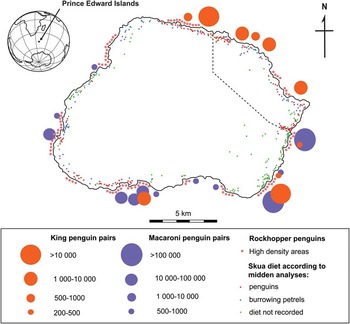
Breeding skuas often bring large prey items back to their nesting territory, forming middens. This is only a subset of their diet (Moncorps et al. Reference Moncorps, Chapuis, Haubreux and Bretagnolle1998), but in order to assess changes in diet compared to that reported by Hunter (Reference Hunter1990), who reported the main diet type based on midden contents at 42% of territories (n=878), it was necessary to use a consistent methodology in this study. The main prey items in midden contents were identified at 53% of skua territories found during a census of breeding skuas in December 2010 (n=450). The position of each skua nest was recorded with a GPS and the nest classified according to the most abundant prey items (penguins, burrowing petrels or other prey) after Hunter (Reference Hunter1990). The thickness of eggshell fragments was used to separate penguin eggs (thick shells) from petrel eggs (thinner shells), although almost all eggs in middens were from penguins. The distance from each skua nest to the nearest penguin colony with at least 100 pairs (Fig. 1) was regressed against the proportion of penguin remains found at each nest.
Marion Island showing sub-Antarctic skua nests of known diet according to midden analyses. The main study area was in the north-east (demarcated by the black line). Large penguin colonies are indicated by circles indicating colonies of different sizes (from Crawford et al. Reference Crawford, Cooper and Dyer2003a, Reference Crawford, Cooper, Dyer, Greyling, Klages, Nel, Nel, Petersen and Wolfaardt2003b, Reference Crawford, Whittington, Upfold, Ryan, Petersen, Dyer and Cooper2009).

Hunter (Reference Hunter1990) also recorded the composition of midden contents at 136 skua nests (15% of territories) on Marion Island. To obtain comparative data, midden remains and regurgitated pellets were collected at 101 nests (22% of territories) between Prinsloomeer and Bullard Beach on the north-east coastal region of the island (Fig. 1). Four checks were made of each nest: immediately post-hatching (mid- to late December), chicks 2–4 weeks old (early to mid-January), pre-fledging (mid- to late January) and post-fledging (early to mid-February). All midden remains and pellets were collected within 10m of each nest, collecting only relatively fresh prey remains (not sun bleached and with some soft tissue remaining) on the first sampling event. Most burrowing petrel prey remains were wings. Wing length was used to discriminate between blue petrels Halobaena caerulea (Gmelin) (>220mm) and Salvin’s prions Pachyptila salvini (Mathews) (<205mm). Kerguelen Lugensa brevirostris (Lesson) and soft-plumaged Pterodroma mollis (Gould) petrels were grouped together as their wings could not be discriminated with confidence.
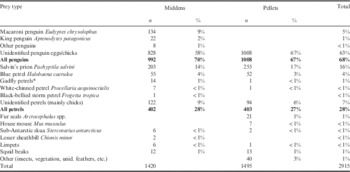
To assess the accuracy of Hunter’s (Reference Hunter1990) reliance on midden contents, midden remains were compared with those in the pellets collected at the 101 study nests in 2010–11. Pellet contents were analysed by identifying their contents to the lowest taxon possible and then each pellet was placed into one of three categories according to the dominant prey type: burrowing petrels, penguins or other prey (e.g. mice, seal remains, etc.; Table I). For nests with at least 20 pellet or midden samples, goodness-of-fit tests (chi-squared, with Yates’s correction for continuity, G tests or exact binomial probabilities) were used to assess whether the composition of remains at each nest deviated significantly from the population mean (the proportion of each prey type across the whole study area). Statistical analyses were conducted in Statistica (v. 10).
Prey remains of sub-Antarctic skuas in middens and regurgitated pellets collected in the study area on Marion Island during 2010–11. Most penguin egg and chick remains could not be identified to species level.

* Soft-plumaged Pterodroma mollis and Kerguelen petrels Lugensa brevirostris.
A rough estimate of the biomass of penguins and burrowing petrels potentially available to breeding skuas was calculated for each island (see supplemental Table S1 for population estimates and sources, found at http://dx.doi.org/10.1017/S0954102015000474). Penguin populations are fairly well known at the islands, and estimates from 2008 (Crawford et al. Reference Crawford, Whittington, Upfold, Ryan, Petersen, Dyer and Cooper2009) were used in these comparisons. Most burrowing petrel population estimates are crude guesses made during the 1970s and 1980s (see supplemental material for more details). At penguin colonies, skuas target mainly eggs and chicks, so available biomass was calculated as egg mass and chick mass, controlling for breeding success (see supplemental material for sources). The proportions of petrel and penguin prey biomass were compared with the proportions of petrel and penguin remains in skua middens at each island (Ryan et al. Reference Ryan, Whittington and Crawford2009; this study). The density of burrowing petrel prey at each island was calculated by dividing their biomass by the land area below 850m (Prince Edward Island is 850m high, and no petrels breed above 850m on Marion Island). Comparable density estimates for penguins were made assuming all penguins breed below 100m elevation.
Results
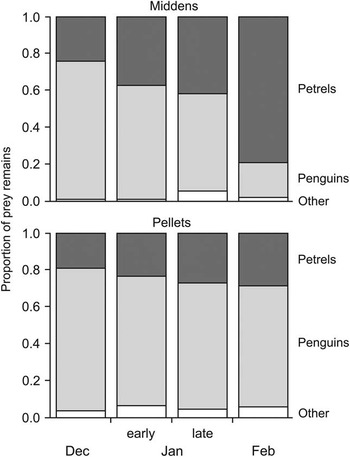
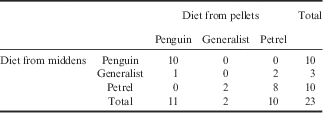
Penguins (68%) and burrowing petrels (28%) dominated the diets of skuas in the study area on Marion Island, together comprising 96% of prey remains in 2010–11 (Table I). Their proportions were similar in the midden and pellet data (Table I), although the proportion of penguin remains decreased as the breeding season progressed (Fig. 2; χ2=77.3, df=3, P<0.001 for midden contents; χ2=233.9, df=3, P<0.001 for pellets). Of the 62 nests where at least 20 prey remains were collected per nest, 47% of pairs mostly predated on penguins, 30% on burrowing petrels and 23% exhibited no significant preference for either prey type (compared against the sample average with goodness-of-fit tests). Pellets generally indicated the same preference for a given prey type as midden remains, with no disparities between penguin and petrel specialists (Table II). However, a higher proportion of specialists was inferred from midden remains (91%) than pellets (70%), possibly because pellets are more likely to contain prey captured at some distance from the breeding territory. Excluding generalist pairs, both pellet and midden remains indicated that 62% of skua pairs specialized on penguins compared to 38% on burrowing petrels.
Seasonal changes in prey composition among sub-Antarctic skua pellets at 101 nests in the main study area on Marion Island in 2010–11 (n=47–1150 midden remains and 293–446 pellets per sample period).

The number of skua pairsFootnote * with diet specializations inferred from pellet and midden data. ‘Generalist’ pairs did not deviate significantly from the overall proportion of prey remains using goodness-of-fit tests.
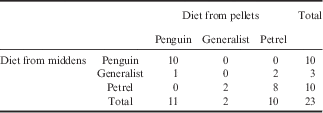
* Restricted to pairs with at least 20 prey remains in middens and 20 pellets.
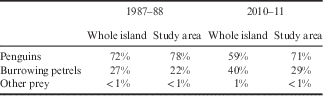
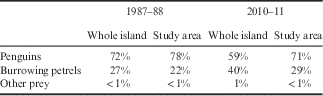
Categorizing skua pairs by the main prey type in their middens revealed only a modest change in diet composition in the two decades since cats were eradicated from Marion Island (Table III). Penguins dominated the diet at 59% of nests in 2010–11 compared to 72% in 1987–88 (Table III). However, this methodology is rather crude, only giving at best a rough indication of possible changes in breeding diet. Where more detailed data are available in the main study area, differences in midden remains were even less marked (71% were penguin prey remains in 2010–11 compared to 78% in 1987–88, Table III).
A comparison of the proportions of burrowing petrels and penguins found in skua middens in 1987–88 (Hunter Reference Hunter1990) and 2010–11 (this study). The whole island estimates were conducted by typing each midden to a predominant prey type, whereas the study area estimates were calculated by collecting, identifying and counting all prey remains.
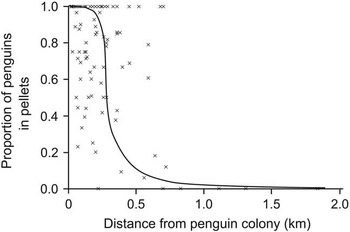
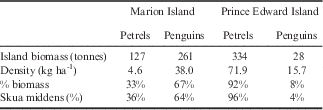
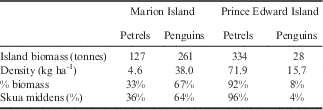
Of the 441 skua nests located on Marion Island in 2010–11, 69% were within 500 m of macaroni Eudyptes chrysolophus (von Brandt) and king penguin Aptenodytes patagonicus Miller colonies (Fig. 1), and of the remaining nests, 76% were within 500 m of the coast (93% overall). Skua pairs breeding close to penguin colonies tended to consume mostly penguin prey; the proportion of penguin remains in pellets decreased with distance from the nearest penguin colony (r 2 =0.16, P<0.001; Fig. 3). No relationship was found between skua diet and distance to the coast (a proxy for distance to the nearest southern rockhopper penguin E. chrysocome (Forster) colony because the latter breed along most of the coast; r 2 =0.01, P>0.05). The overall proportion of petrel remains in middens at Marion Island (36%) and Prince Edward Island (96%) was similar to the estimated proportions of available petrel prey at each island (33% and 92%, respectively, Table IV). The crude density of penguin biomass at Marion Island was more than twice that at Prince Edward Island, whereas burrowing petrel density is at least ten-times greater at Prince Edward than Marion (Table IV).
The relationship between the proportion of penguin remains in skua middens and the distance to the nearest penguin colony (with at least 100 pairs).

The approximate biomass of summer-breeding burrowing petrel and penguin eggs/chicks available to skuas at the two Prince Edward Islands, their densities per unit area (petrels <850m elevation, penguins <100m), and the percentages of petrels and penguins found in skua middens on Marion Island (this study) and Prince Edward Island (Ryan et al. Reference Ryan, Whittington and Crawford2009). See supplemental material for details.
Discussion
Skua diet was inferred from pellets and prey remains, both of which under-represent the contributions of soft-bodied prey items (Bearhop et al. Reference Bearhop, Thompson, Phillips, Waldron., Hamer, Gray, Votier, Ross and Furness2001, Anderson et al. Reference Anderson, Phillips, Shore, McGill, McDonald and Bearhop2009). However, direct observations of foraging skuas (Sinclair Reference Sinclair1980, personal observation) suggest that soft-bodied prey contribute little to the diets of skuas breeding on Marion Island, which mainly target penguins and petrels. Midden remains tend to bias towards larger prey, although very large prey items (such as adult penguins or seal carcasses) are too heavy to return to the territory; their presence in the diet is best indicated by the presence of feathers or fur in regurgitated pellets. The use of pellets is also biased to some extent because some prey types result in more pellets than others (Votier et al. Reference Votier, Bearhop, Ratcliffe and Furness2001). However, there is generally broad congruence between prey remains in sub-Antarctic skua pellets and middens (Moncorps et al. Reference Moncorps, Chapuis, Haubreux and Bretagnolle1998). Despite these sampling limitations, the biases inherent in comparing midden contents are consistent when comparing diets at the two islands in the 1980s and 2000s. We can, thus, conclude that there is little evidence of a marked change in the diet of skuas breeding at the Prince Edward Islands over the last two decades. In 2010–11, the burrowing petrels killed most frequently were Salvin’s prions and blue petrels, which are the same species that dominated skua diets during the 1970s and 1980s when cats were present on the island (Grindley Reference Grindley1981, Hunter Reference Hunter1990).
Breeding pairs of skuas often specialize on specific prey types (Green Reference Green1986, Ryan & Moloney Reference Ryan and Moloney1991, Votier et al. Reference Votier, Bearhop, Ratcliffe and Furness2004). The pellet and midden data from a pair generally indicated the same prey preference (Table II), demonstrating that midden contents provide a reasonable indication of the main prey type of skua pairs (Moncorps et al. Reference Moncorps, Chapuis, Haubreux and Bretagnolle1998). In 2010–11, almost twice as many skua pairs specialized on penguins (62%) than burrowing petrels (38%) on Marion Island, but the importance of penguins decreased over the breeding season. Two factors might account for this seasonal change in diet: i) chicks of macaroni penguins, the main prey of most penguin specialists, are more difficult to kill as they grow larger and macaroni penguin chicks fledge in late February (Crawford et al. Reference Crawford, Cooper and Dyer2003a), and ii) blue petrel chicks fledge in early February (Cooper & Brown Reference Cooper and Brown1990) providing a ready source of food for skua pairs that breed close to blue petrel colonies. Our skua samples are restricted to the mid-summer breeding season, and thus only indicate the relative availability of petrels at this season. Petrel predation by skuas may increase in late summer when most other summer-breeding petrel chicks fledge (Cooper & Brown Reference Cooper and Brown1990). Naïve chicks, especially of larger species such as white-chinned petrels Procellaria aequinoctialis L., are easier prey for skuas than adult petrels, and are frequently killed when they prepare to fledge in April–May. However, this does not affect the comparison of breeding skua diet before and after the eradication of cats because the time of sampling was the same in both periods.
We were surprised to find little change in skua diet considering that two decades have passed since cats were eradicated from Marion Island. Penguins still dominate the diets of most breeding skuas; penguins comprised 71% of midden prey remains in the core study area in 2010–11, only slightly less than that found in 1987–88 (Table III). The decrease in the proportion of penguin-dominated middens was more pronounced in the island-wide survey, from 72% in the 1980s (Hunter Reference Hunter1990) to 59% in 2010–11 (Table III). However, these surveys only sampled 42% (Hunter Reference Hunter1990) to 53% (this study) of pairs, and the increased proportion of petrels in the recent samples may be as much geographical as temporal. It is not known where Hunter (Reference Hunter1990) sampled nest remains, but in the 2010–11 season few nests were sampled in the south-east of Marion (Fig. 1), where penguins dominate skua diets particularly around the large penguin colony at Kildalkey Bay. In addition, the small decreases in the importance of penguins in Marion Island skua diet could result from decreases in penguin numbers over the study period. Since 1994, numbers of macaroni penguins (the species most often preyed upon by skuas) have decreased by c. 30% on Marion Island (Crawford et al. Reference Crawford, Whittington, Upfold, Ryan, Petersen, Dyer and Cooper2009).
The decrease in penguin remains in skua midden remains was mirrored by a slight increase in petrels (from 22% to 29% in the core study area and 27% to 40% island-wide; Table III). A more marked change was expected following the eradication of cats in 1990 (Bester et al. Reference Bester, Bloomer, van Aarde, Erasmus, van Rensburg, Skinner, Howell and Naude2002). Elsewhere, burrowing petrel populations have increased by c. 7% per year following the removal of introduced predators (e.g. Ryan et al. Reference Ryan, Dorse and Hilton2006), and by up to 20% per year where there is an adjacent, predator-free island that can provide a source of immigrants (Harper Reference Harper1983). Given that immigration is possible from Prince Edward Island only 22 km away, such rates of increase would result in a 4–40-fold increase in petrel populations over the 20 years since cats were eradicated. However, the large numbers of petrels breeding on Prince Edward Island may provide a greater social attractant for first-time breeders, limiting recruitment of petrels hatched on Marion Island. Further studies on the breeding success of burrowing petrels on Marion are needed to assess whether this is the case, or whether other factors (e.g. predation by mice, cf. Wanless et al. Reference Wanless, Angel, Cuthbert, Hilton and Ryan2007, Dilley et al. Reference Dilley, Davies, Bond and Ryan2015) has limited the recovery of petrel numbers on Marion Island. Either way, the fact that the proportion of petrels in skua diets has changed very little, especially given the decrease in penguins over the study period, suggests that petrel numbers have not recovered substantially following the eradication of cats from Marion Island.
Skua diets need not reflect relative prey availability, particularly if prey is abundant (Young Reference Young1978, Moncorps et al. Reference Moncorps, Chapuis, Haubreux and Bretagnolle1998, Mougeot et al. Reference Mougeot, Genevois and Bretagnolle1998). However, skua numbers on Marion Island have decreased since cats were eradicated (Ryan et al. Reference Ryan, Whittington and Crawford2009), suggesting that they do not have the option to be overly selective. In fact, the composition of skua prey remains on Marion and Prince Edward Island roughly match the estimates of burrowing petrel and penguin prey biomass available on the two islands during mid-summer (Table IV). Therefore, skua diets suggest that there has been little recovery in burrowing petrel numbers at Marion Island since cats were eradicated. The decrease in skua numbers at Marion Island, contrasting with the stable population at Prince Edward Island (Ryan et al. Reference Ryan, Whittington and Crawford2009) suggests that the increase in petrel numbers at Marion Island has been insufficient to offset the decrease in penguin prey over the last two decades.
Acknowledgements
We thank Cobus Cronje for assistance in the field. Digital elevation models were supplied by Ian Meikeljohn, Rhodes University. Ben Dilley kindly commented on a draft and assisted with figure preparation. The final draft was greatly improved by comments from two reviewers. Financial support was obtained from the South African National Antarctic Programme through the South African National Research Foundation with logistical support from the Directorate: Antarctica and Islands, Department of Environment Affairs.
Author contribution
PGR devised the project, supervised its execution and assisted with manuscript preparation. MC collected the field data, conducted preliminary analyses and produced the first draft of the paper.
Supplementary Material
A supplemental table and associated text and references describing the estimate of prey availability for skuas breeding on the Prince Edward Islands will be found at http://dx.doi.org/10.1017/S0954102015000474.