


Introduction
Unaccompanied asylum-seeking minors (UAM) survive a range of experiences and can demonstrate significant resilience and strength. However, UAM are exposed to high rates of traumatic events, which increases their risk of developing mental health difficulties, including post-traumatic stress disorder (PTSD; Fazel et al., Reference Fazel, Reed, Panter-Brick and Stein2012; Hodes et al., Reference Hodes, Jagdev, Chandra and Cunniff2008). UAM also encounter an absence of protective factors, such as a stable and predictable living environment and supportive family members who provide consistent care, which can render UAM more psychologically vulnerable, increasing the likelihood of mental health difficulties (Derluyn and Broekaert, Reference Derluyn and Broekaert2008). Exposure to further risk factors such as low social support and social withdrawal (Mitra and Hodes, Reference Mitra and Hodes2019; Trickey et al., Reference Trickey, Siddaway, Meiser-Stedman, Serpell and Field2012) and being bereaved by trauma (Pfefferbaum et al., Reference Pfefferbaum, Nixon, Tucker, Tivis, Moore, Gurwitch and Geis1999) increase the risk of developing chronic PTSD.
Children and young people are thought to be more vulnerable to the effects of trauma due to their ongoing social, emotional and neurobiological development (Lewis et al., Reference Lewis, Arseneault, Caspi, Fisher, Matthews and Moffitt2019; Lupien et al., Reference Lupien, McEwen, Gunnar and Heim2009). PTSD can lead to substantial distress and impacts social and educational functioning (National Institute for Health and Care Excellence, 2018) and it has been shown that if PTSD persists at 6 months post-trauma, it is unlikely that children will recover without intervention (Hiller et al., Reference Hiller, Meiser-Stedman, Fearon, Lobo, McKinnon, Fraser and Halligan2016). Providing acceptable and effective treatment is therefore crucial in supporting recovery and improving functioning.
Identification and treatment of PTSD are particularly important for children at risk of developing chronic PTSD (Hiller et al., Reference Hiller, Meiser-Stedman, Fearon, Lobo, McKinnon, Fraser and Halligan2016), such as UAM, and implementing effective and acceptable treatments for PTSD is a key component of mental health care for refugee children (Eruyar et al., Reference Eruyar, Huemer and Vostanis2018). Furthermore, Purgato et al. (Reference Purgato, Gross, Betancourt, Bolton, Bonetto, Gastaldon and Peltonen2018) have identified that providing access to appropriate psychosocial interventions for refugee children can reduce functional impairment.
Prevalence rates of PTSD have been shown to be higher in refugee children than in the general population of the receiving country and, within the refugee population, higher prevalence rates have been identified in UAM than in refugee children accompanied by their parents (Huemer et al., Reference Huemer, Karnik, Voelkl-Kernstock, Granditsch, Dervic, Friedrich and Steiner2009; Müller et al., Reference Müller, Büter, Rosner and Unterhitzenberger2019). Prevalence rates of PTSD in UAM are estimated to be up to 64% (Müller et al., Reference Müller, Büter, Rosner and Unterhitzenberger2019). Despite the increased vulnerability and high prevalence rates of PTSD in UAM, there are few studies investigating acceptable and effective interventions specifically for this population. Recent case study evidence supports the efficacy of narrative exposure therapy (NET) in UAM (Said and King, Reference Said and King2019) and the acceptability of treatments for PTSD among UAM.
Narrative exposure therapy
Narrative exposure therapy is a short-term treatment for PTSD, developed for people who have experienced multiple traumatic events (Schauer et al., Reference Schauer, Neuner and Elbert2011). NET draws on a number of key theories of trauma and memory, including dual representation theories of PTSD (Brewin et al., Reference Brewin, Dalgleish and Joseph1996; Metcalfe and Jacobs, Reference Metcalfe and Jacobs1996), emotional processing theory (Foa and Kozak, Reference Foa and Kozak1986), and the idea of fear networks (Schauer et al., Reference Schauer, Neuner and Elbert2011). NET makes use of a number of key processes including exposure and habituation, the reconstruction of autobiographical memory, contextualisation of trauma memories, emotional attunement between therapist and client and, increasingly, a focus on meaning-making. Its design to respond to multiple traumas and life events lends itself to support people experiencing symptoms of complex PTSD (Schauer et al., Reference Schauer, Robjant, Elbert, Neuner, Ford and Courtois2020).
NET includes four key stages: diagnosis and psychoeducation, constructing a lifeline of key life experiences, narration of the lifeline in chronological order, and re-reading the narration and signing the narration document (Schauer et al., Reference Schauer, Neuner and Elbert2011; Schauer et al., Reference Schauer, Neuner, Elbert, Landolt, Cloitre and Schnyder2017). NET acknowledges the impact of human rights abuses and the therapist does not remain neutral on these issues. NET additionally integrates the updating and repairing of attachment injuries through emotional exposure and therapist warmth alongside traditional updating of trauma memories (Schauer et al., Reference Schauer, Neuner, Elbert, Landolt, Cloitre and Schnyder2017). Acts of harm that were perpetrated (Hecker et al., Reference Hecker, Hermenau, Crombach and Elbert2015), losses experienced, and hopes held for the future can be included within the lifeline and narration. A more detailed description of its implementation is outlined by Onyut et al. (Reference Onyut, Neuner, Schauer, Ertl, Odenwald, Schauer and Elbert2005), Schauer et al. (Reference Schauer, Neuner, Elbert, Ertl, Onyut, Odenwald and Schauer2004), Schauer et al. (Reference Schauer, Neuner and Elbert2011), Schauer et al. (Reference Schauer, Neuner, Elbert, Landolt, Cloitre and Schnyder2017) and Schauer et al. (Reference Schauer, Robjant, Elbert, Neuner, Ford and Courtois2020). NET is recommended by national guidelines in the UK for the treatment of PTSD (National Institute for Health and Care Excellence, 2018) and has an established evidence base for the treatment of PTSD in adults from refugee backgrounds (Neuner et al., Reference Neuner, Schauer, Klaschik, Karunakara and Elbert2004; Robjant and Fazel, Reference Robjant and Fazel2010; Thompson et al., Reference Thompson, Vidgen and Roberts2018).
There is an increasing evidence base for NET in the treatment of PTSD in refugee children. Initial case study evidence highlighted the efficacy of NET in treating PTSD in children living in refugee settlements (Onyut et al., Reference Onyut, Neuner, Schauer, Ertl, Odenwald, Schauer and Elbert2005; Schauer et al., Reference Schauer, Neuner, Elbert, Ertl, Onyut, Odenwald and Schauer2004). Randomised controlled trials (RCTs) have since supported and extended these findings where NET has been shown to be superior to waitlist control (Ruf et al., Reference Ruf, Schauer, Neuner, Catani, Schauer and Elbert2010) and treatment as usual (Peltonen and Kangaslampi, Reference Peltonen and Kangaslampi2019). These results were found in treating PTSD in refugee children (Ruf et al., Reference Ruf, Schauer, Neuner, Catani, Schauer and Elbert2010) and multiply traumatised children, including those from refugee backgrounds (Peltonen and Kangaslampi, Reference Peltonen and Kangaslampi2019). Improvements noted were maintained at 12-month follow-up (Ruf et al., Reference Ruf, Schauer, Neuner, Catani, Schauer and Elbert2010). Stronger effects were identified for a decrease in re-experiencing symptoms and an increase in resilience in children and young people who received NET (Peltonen and Kangaslampi, Reference Peltonen and Kangaslampi2019).
A recent case series on the applications of NET identified additional functional improvements following NET including reduced self-harm, decreased anger outbursts and reduced aggression, improvement in school attendance, reduced substance misuse, and the development of positive relationships, in addition to decreased PTSD symptoms (Fazel et al., Reference Fazel, Stratford, Rowsell, Chan, Griffiths and Robjant2020). In this paper, young people were reported to have chosen NET over other trauma-focused therapies as they shared a preference for talking about all of their experiences, that it was helpful to know what was coming next, and that they wanted to create the lifeline. The authors also identified that NET may have a lower cognitive load than other trauma-focused therapies, as it aims to describe the original memory rather than potentially complex and abstract meanings attributed to the event, and may be more acceptable for clients with additional needs, such as autism spectrum conditions (Fazel et al., Reference Fazel, Stratford, Rowsell, Chan, Griffiths and Robjant2020). Recent evidence has also highlighted how interpreters can be used to deliver NET to encourage timely access to therapy for refugees in Western countries (Lambert and Alhassoon, Reference Lambert and Alhassoon2015; Lely et al., Reference Lely, Smid, Jongedijk, Knipscheer and Kleber2019).
The importance of understanding client experiences
Working with service users and understanding client experiences are important to help develop acceptable and effective treatments. This is in line with national guidelines for planning services (National Institute for Health and Care Excellence, 2011) and part of the duties of healthcare providers (Health and Social Care Act, 2012). Webb and McMurran (Reference Webb and McMurran2008) described how including service user perspectives may bring about service improvements, including treatment retention, and demonstrating inclusion and respect to clients from marginalised groups. Understanding client experience and working with service users in the planning, provision and evaluation of services has an essential role in ensuring that services are accessible, inclusive and acceptable to clients and meet their needs (Sheldon and Harding, Reference Sheldon and Harding2010).
In a qualitative study with unaccompanied minors and their carers, Majumder and colleagues explored experiences of mental health services in the UK. Themes emerged around young peoples’ understanding of mental health and perceived stigma of attending mental health services (Majumder, Reference Majumder2019). There were also reports of ambivalence about talking about the past and having negative experiences of therapy (Majumder et al., Reference Majumder, Vostanis, Karim and O’Reilly2018). It was hypothesised that this may be a consequence of peer group influences, mistrust of staff roles, beliefs about being open around women and fear of re-traumatisation. The therapeutic relationship was identified as being important to overcome some of these barriers.
The importance of taking time to build a trusting relationship was echoed in Graham and Johnson’s (Reference Graham and Johnson2019) qualitative study with young people in residential care, who had experienced multiple traumas and required additional support for behavioural and emotional difficulties. This study gathered young peoples’ perspectives on what therapeutic support would be helpful. This cohort also identified the importance of accessing support in a safe and comfortable therapeutic environment and having their choices heard and respected.
There have been some studies exploring client experiences of trauma-focused treatments for PTSD. Shearing et al. (Reference Shearing, Lee and Clohessy2011) completed a qualitative study exploring clients’ experiences of reliving as part of trauma-focused cognitive behaviour therapy (TF-CBT) for PTSD. This study identified key themes of overcoming ambivalence about engaging in reliving, reliving as painful but achievable, and perceived positive change following reliving. In a project exploring asylum-seekers’ experiences of TF-CBT for PTSD, Vincent et al. (Reference Vincent, Jenkins, Larkin and Clohessy2013) reflected on six key themes: staying where you are versus engaging in therapy, experiences encouraging engagement in therapy, experiences impeding engagement in therapy, importance of the therapeutic relationship, ‘losing oneself’ following traumatic experiences, and regaining life. These studies highlighted that, although trauma-focused treatments can be painful and difficult, clients felt that treatments were achievable and led to positive change, which helped address both clinician concerns about using reliving (Shearing et al., Reference Shearing, Lee and Clohessy2011) and client ambivalence about engagement in trauma-focused therapies (Vincent et al., Reference Vincent, Jenkins, Larkin and Clohessy2013).
Dittmann and Jensen’s (Reference Dittmann and Jensen2014) thematic analysis with young people who had experience of TF-CBT (Cohen et al., Reference Cohen, Mannarino and Deblinger2010) also identified that this therapy led to positive change among the majority of participants and that young people attributed the change to processing their trauma during re-living within TF-CBT The key themes identified included changing expectations [of therapy], sharing information and talking to a therapist, working through the trauma narrative, and change and change processes. The authors also considered the role of avoidance within the therapy process and the balance required among clinicians to encourage young people to talk about past events, while respecting their autonomy. The role of skills training in TF-CBT, as well as attunement of the therapist and the development of trust, were also acknowledged and considered to be an important facilitator of reliving.
There have been no qualitative studies published to date on clients’ experiences of NET, and this has been recommended as an area for future investigation (Vincent et al., Reference Vincent, Jenkins, Larkin and Clohessy2013). There is also limited published research examining treatments for PTSD specifically in UAM. This paper aims to explore unaccompanied minors’ experiences of NET as a trauma-focused therapy.
Method
Qualitative approaches are recommended within healthcare settings (NHS England, Reference England2017), are particularly relevant to clinical practice through developing an understanding of the process and outcomes of treatment (Silverstein et al., Reference Silverstein, Auerbach and Levant2006) and are important in newer areas of research and clinical practice (Barker et al., Reference Barker, Pistrang and Elliott2016). This project made use of interpretive phenomenological analysis (IPA). IPA is a qualitative methodology that aims to explore participants’ in-depth experiences in specific contexts (Smith et al., Reference Smith, Flowers and Larkin2009); incorporating both interpretation and description within the research process to advance understanding (Willig, Reference Willig2013). IPA was adopted as an approach for this study as it allows close exploration of participants’ experiences and offers the opportunity to enhance current understanding of a phenomenon.
Participants and procedure
Participants were four UAM receiving NET within a dedicated child and adolescent mental health service (CAMHS) for people from refugee backgrounds, within the National Health Service (NHS) in the United Kingdom. Clinicians working with UAM asked these clients whether they would be willing to participate in an interview about their experiences of NET. Interviews were completed within the clinic setting by a master’s student on placement within the service. Due to practical constraints, participants were at different stages of their treatment when interviews were conducted. Written, informed consent was gained at the start of interview. All clients receiving NET within the service participated in the interviews and were the first clients within this service to receive NET as part of a pilot implementation of this intervention. Table 1 provides brief demographic and trauma history data and information about sessions received. Preliminary feasibility, acceptability and effectiveness data for these four young people has been summarised in Said and King (Reference Said and King2019).
Demographic, trauma history data and information about NET sessions received

*At start of individual treatment; **interviews were conducted during treatment.
Clients were identified to have PTSD, assessed through clinical interview and standardised psychometric measures – the Child Revised Impact of Event Scale, 13-item version (CRIES-13; Children and War Foundation, 2005; Smith et al., Reference Smith, Perrin, Dyregrov and Yule2003) and the Child PTSD Symptom Scale for DSM-5 (CPSS-5; Foa et al., Reference Foa, Asnaani, Zang, Capaldi and Yeh2018) – at the start of individual psychological treatment. NET was implemented alongside other psychological interventions including psychoeducation, emotion regulation, sleep management, cognitive behavioural techniques, and other psychosocial support. Participants received between nine and 20 sessions of NET at the point of ending therapy.
Reflexivity statement
The authors of this paper are two qualified clinical psychologists (G.S. and D.K.) and one trainee clinical psychologist (Y.A.). Data were collected while the authors were trainee clinical psychologists and a master’s student on placement, respectively. The authors are passionate about supporting young people with PTSD to access evidence-based interventions. G.S. and D.K. were the treating therapists within this project and made the clinical decision to offer NET as the primary therapeutic intervention. This was with the understanding that NET would be effective in treating PTSD, given the young people’s past experiences of multiple traumatic events and being from refugee backgrounds, in line with the available evidence base.
The authors are aware that there can be limited access to evidence-based trauma-focused interventions in child and adolescent mental health services (Smith et al., Reference Smith, Dalgleish and Meiser-Stedman2018) and that this access appears to be further limited for unaccompanied minors (Mitra and Hodes, Reference Mitra and Hodes2019). In delivering this intervention, we were curious to learn about unaccompanied minors’ experiences of NET, which prompted conducting interviews to better understand their perspectives.
Therapy was delivered by G.S. and D.K., who are White and native English speakers. For three of the clients, therapy was delivered with the support of an interpreter. The interviews were conducted by Y.A., who identifies as ethnically Arab and culturally Muslim and is a native Arabic speaker. This enabled Y.A. to deliver two of the interviews in the participant’s preferred and first language without the mediation of an interpreter. Participant identity was withheld from G.S. and D.K. when reviewing the transcripts, although the participants were aware that their treating therapist would be reading their transcripts and that Y.A. worked closely with G.S. and D.K., which may have influenced their responses within the interviews.
Interviews
Semi-structured interviews were conducted by a researcher who did not deliver the intervention and lasted between 40 and 70 minutes. Interviews were conducted in clients’ preferred language. Two of the four clients chose to use their native language, and two chose to complete the interview in English, their second language. Interviews were audio recorded, transcribed verbatim and translated where required by the interviewer. Questions and prompts were open-ended as far as possible, in line with IPA principles (Smith and Osborn, Reference Smith and Osborn2003).
The interview guide was constructed to explore specific features of NET rather than therapy as a whole. The questions covered the following topics: experience of receiving information about PTSD and psychoeducation, initial reaction to understanding the nature of trauma-focused therapy, expectations of therapy and hopes for treatment, experience of NET including the lifeline and narration, reaction to the NET sessions, perceived outcomes of therapy, suggestions for what could be done differently, advice for other young people in a similar position and recommendations for therapists carrying out NET.
Analysis
In keeping with standard procedure within IPA (Smith et al., Reference Smith, Flowers and Larkin2009), analysis was completed in several stages. The first stage involved familiarisation with the transcript text and noting any thoughts which emerged while reading. The next stage involved identifying and labelling themes that exemplify each section of the text, which two of the authors, Y.A. and G.S., completed independently from one another.
Following this, the analysis was structured into groups of themes. Themes were clustered, re-labelled and organised in a way that made sense in the context of the original data. Key quotations were selected from within the transcripts to reflect the themes. Next, data were validated by having another researcher (D.K.) examine the master table of themes along with text excerpts to check data sources were appropriately clustered and corresponded to themes. This involved re-clustering and re-labelling of themes through the development of levels of analysis. The final subthemes were generated as a result of joint validation. Data were reviewed for negative cases, which were considered when clustering data into themes.
Results
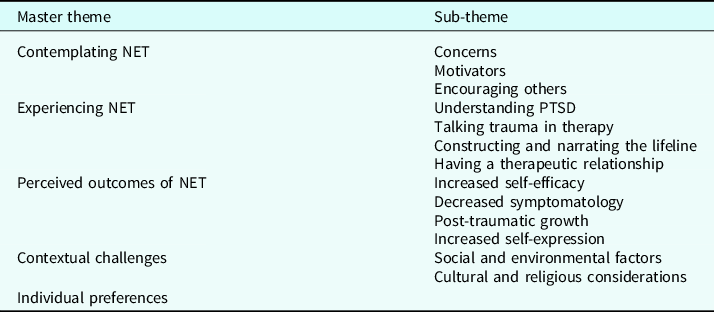
Five master themes and 14 sub-themes emerged from the transcript data. These are summarised in Table 2.
Summary of master and sub-themes

Master theme 1: Contemplating NET
This master theme summarises themes that emerged regarding the young peoples’ experiences before undertaking NET. This includes factors that worried the young people and others they considered motivating, prompting them to engage with NET.
There were three sub-themes within this master theme:
Concerns
Here the young people shared their worries and concerns about starting NET. The young people appeared to fear specific reactions or emotional experiences as a perceived consequence of talking about their past.
I was scared. I was scared in the first talking, but to trust someone … I was worried at the beginning [P3]
I was hesitant of course. I mean there were things that happened, one will think about it all over again [P4]
Motivators
The young people discussed what helped encourage them to attend sessions and engage with trauma-focused therapy, including what they hoped to gain or change through the process. The young people spoke about the impact of their symptoms on their day-to-day life, including at school, as well as their experiences of intense emotions and traumatic memories.
I used to have [lack of focus] at school. Like the most important thing that kept me committed to therapy is that I want to be a successful person in life. … Like bad thinking, it hinders your brain and prevents you from staying focused [P1]
… that hopefully one day when I talk about the past that I will be talking about normal stories not just like traumatic stories…. I just want to be friend with the memories I have [P2]
I wanted anything to help me to become more patient and, if something happens, I can deal with it using my brain not my temper [P4]
Encouraging others
Having received NET for some time, the young people shared what they would recommend to peers with similar difficulties contemplating starting NET.
Just leave the ’phone alone and go talk to someone, you are gonna feel more comfortable. You do not have to stay on the phone or to waste time, go and talk to someone, it’s gonna help you [P3]
If you go and talk and the time and everything, you’re gonna improve. If you have the first appointment and you still have problems, keep going few more times there and you will see … a lot of improves. Feeling, people around, the past, everything is gonna improve a lot; for good. [P3]
To fix your problems when you’re young; it’s better than neglecting them in the wrong way and walking away. Like from the start you try to solve the negative things, he will keep moving forward, it will push him to overcome phases. [P4]
Master theme 2: Experiencing NET
With this theme, the young people relayed their experiences of different aspects of NET. This included learning through psychoeducation, the process of engaging in a talking therapy, constructing and narrating their lifelines and forming a therapeutic relationship with their therapist.
There were four sub-themes within this master theme:
Understanding PTSD
This sub-theme illustrated what young people felt they understood about PTSD and their process of learning about their own mental health needs. The young people highlighted the normalising and, what appeared to be, empowering effect of the psychoeducation component of NET.
Now I have been explained to, and I kind of understand how it works, therefore now I may have some knowledge of it and, if I know someone who has PTSD, I can kind of help them. [P2]
At first I was thinking why me?? And then they explain to me all this why. Then, bit by bit, the picture started to become clearer and clearer for me. [P4]
Talking trauma in therapy
This sub-theme captures the young people’s experiences of discussing their trauma within NET. They spoke about finding the process emotional and challenging. They also highlighted the difference of talking about the trauma compared with their experience of living through the traumatic event.
The first time you talk about it, you might find it difficult. After I talk about the problem, the therapist writes it down, and in the next session she reads it all and I listen. I kind of get rid of it. Listening is easier than talking. It would be a big problem that is affecting me, when I talk about it at the beginning, it affects me. The next time I listen to it, it’s light. [P1]
I just find it so hard, I find it very emotional. I sometimes experience flashbacks, very strong … in the session, that sometimes [the therapist] had to remind me that I am here now or otherwise I am going to be sleeping in the past. [P2]
My experience was up and down. Sometimes was very stressful. Sometimes was good. Sometimes I cry, sometimes I laugh, it depends, ups and downs. [P3]
It was hard, but talking is never harder than what actually happened. I mean when you’re talking about the things that happened to you in the past it’s nothing like when you were actually in it at the time. You are talking about the PAST. Talking is hard but not harder than the experience itself. [P4]
Constructing and narrating the lifeline
This describes the young people’s experiences of talking through their narrative, integrating their pleasant and traumatic events as a whole, and the use of flowers and stones on their lifelines. They spoke about the specific process of learning more about themselves through narrating their lifeline.
When we talked during the lifeline, there were things I was not paying attention to and I was not guilty of. I was like in certain problems I would blame myself for it. But after we went through the lifeline from the very start, there are things I discovered about myself that I did not do anything wrong. [P1]
The helpful thing I found is that it makes you remind yourself about what actually you have been through in the past. It makes you understand more about the past and understand yourself and who you were better. [P2]
I mean you know part is good memories and part is bad memories. So, it was good, was helpful. [P3]
Having a therapeutic relationship
The young people shared their experience of developing a relationship with their therapist, including reflecting on the process of building trust within this relationship and the impact within therapy. They also spoke of the experience of sharing their story with someone else and the felt sense of safety when narrating past trauma within this therapeutic relationship.
Every time I come to meet ‘the therapist’ I feel relieved, I psychologically feel comfortable. Like sometimes after the session I would be a bit stressed, thinking and thinking, but when it’s time for the next appointment, I see ‘the therapist’ and I am relieved. [P1]
You know it’s a difficult thing to cope if you do not share with therapists, you’re gonna carry it with you forever. It is not worth it. So I would recommend to share with others so hopefully the problem will be solved. [P2]
The therapist who stay with you always, and said the past is in the past. She tries to keep you away from that. [P3]
I mean ‘thinking’ for me before was singular, after I share with the person, at least I have 2 ways of thinking; my own and the other person whom I shared with. And having them both can open up other ways of thinking for me. [P4]
Master theme 3: Perceived outcomes of NET
This master theme represents the changes the young people attributed to receiving NET. This included more confidence at managing their emotional experiences, a reduction in their PTSD symptoms, experiencing a sense of flourishing and learning from their experiences and becoming better able to express themselves.
There were four sub-themes within this master theme:
Increased self-efficacy
The young people described developing skills in regulating their emotions and responding to their thoughts and intrusive memories. They reflected on the sense of confidence they gained through the development of these skills which was described as feeling ‘in control’.
I kind of can control myself more and control how I feel. I mean yea, some bad thoughts come and go, and I am better able to handle it, even though they’re still there. [P2]
Like I am able to control my own memory, I can also withhold my emotions, like I can control them. [P4]
Decreased symptomatology
The young people discussed improvements in their PTSD symptoms and reflected on the impact this change had on their functioning. They attributed this to NET and outlined how this motivated them to continue with therapy.
It is extremely helpful. It benefits you on so many levels. It stores the problems you have been through in your life, so it does not come to you unexpectedly any moment, you do not suffer from them as before … therapy was helping me, that’s why I am still committed. The things I was receiving here were helpful. [P1]
… what I am feeling is less powerful … and now I just realize that the thought I am fighting is virtual and not real [P2]
Basically at the beginning it was different, when I finished it was different. I mean I had a lot of flashbacks, I was so upset with everyone, but with 12 appointments, there were lots of difference. I mean good things, for better. Things improved a lot. [P3]
Currently I am way better than before, for sure. Like my absent-mindedness was too much I used to think too much. The problems were not sorted properly in my brain; at any point of time they would hit me out of nowhere; things around you might happen and remind you of those problems. What is different now is that I can control them. When I want to think of them I would be able to, and when I don’t want to think, they would not hit me suddenly. [P4]
Post-traumatic growth
This sub-theme reflects the young people’s experiences of psychological growth and the strengths they developed and recognised through talking about their experiences in therapy. They identified resilience and increased orientation towards their future.
And the second thing is that my problems now have turned into strengths, something constructive. Now I became working to achieve a certain goal. They made me motivated to achieve my goals. [P1]
In session, I get the chance to get it out and I also receive a good response to it. Most importantly, I know now how to benefit from it. [P4]
Increased self-expression
The young people reported being better able to describe their thoughts and feelings and more comfortable expressing themselves.
Later it became normal and easier to talk. The thing I think of or feel I immediately say! [P1]
In the beginning, like I said, in the beginning it was really … like you say: ‘oh I am talking to someone’ and you worry about it. And then the worry can go. After the session you can see, the worries are gonna go. [P3]
I mean I used not to like to discuss such matters, I used to like to be alone (sit with myself). Therapy helped to open up and gave me support to come and talk in front of people, encouraged me a bit. I became more capable of expressing myself and talk about what I am thinking of. [P4]
Master theme 4: Contextual challenges
This theme presents some of the challenges the young people experienced within NET which appeared to be connected to their unique status as unaccompanied young people who are displaced. This included reflections on experiences of loss, isolation and adjusting to Western cultures.
There were two sub-themes within this master theme:
Social and environmental factors
The young people reflected on the added challenges of living in another country after fleeing conflict and persecution. They described the overwhelming demands of coping with this while adjusting to unfamiliar systems, without their family.
Even sometimes because you’re in expatriation, it’s harder… you do not know where the problems might come from. Like you are coming from your country and you have your own problems that you’re suffering from, you don’t know if you’re missing your family, you’re missing your friends, have other problems; like sometimes your brain cannot handle all of this. It is a difficult feeling! [P1]
Cultural and religious considerations
This theme captures some of the challenges experienced within therapy, such as working with a therapist of the opposite sex and working alongside interpreters. There appeared to be a sense of worry about discussing content which may bring about feelings of shame within a shared cultural background. The sense of conflict of seeking support outside of one’s religion or faith was also reflected on. This was understood by the researchers as part of receiving psychological support within a Western model of health and help-seeking.
I actually did not like the translation, but I got used to it because she started with us from the beginning, but I at first I was not much at ease with the idea of having an interpreter with us… I said because she understands me … Because some of the problems I have been through, in the Arab or African world, are considered big problems yet in this country they don’t perceive them this way, they might consider them normal. [P1]
I used to have some worries because the problem I am talking about … I mean … I have my god who knows me, and I am supposed to complain/talk to about my problems … because if I go back to pray to my god, he will help me. Like I sometimes feel like this, I feel that I might be doing something wrong! [P1]
I also was not used to look in a woman’s eyes at all, this I have overcome totally. [P4]
One thing maybe regarding the interpreter; like you know the Arabic language is so wide and it varies from a country to the other. I mean if it’s possible to have the interpreter from the same country, communication will be much better. [P4]
Master theme 5: Individual preferences
The young people shared what they felt might have improved their experiences of therapy. It was observed that the young people presented a range of suggestions, which appeared to be personal to each participant, but seemed to be unified in the need for additional comfort and security during a challenging therapy.
… like to be hugged sometimes … sometimes you are in need for things like that … Sometimes if there are people who’ve suffered from things like that … when the session is over, they should not let him leave just like that … do not let them go just with a hand shake, it’s not enough! [P1]
Maybe just prepare a good environment, you know, when you are talking maybe it’s good to have a nice room. Something to eat or drink; water or juice. For example, it’s too hot, maybe just turn the air condition on. You know, sometimes when you’re talking about the past and you feel too hot, it affects the emotions, it can drive you crazy. [P2]
Not to put pressure by asking a lot of questions. And maybe changing the place; like one appointment at one place and the next in another. [P4]
Discussion
This paper set out to explore unaccompanied minors’ experiences of narrative exposure therapy. NET was portrayed as a challenging process, but one which was highly valued by young people. The young people identified how the impact of their traumatic stress symptoms on their day-to-day life became a motivator to engage in therapy and recognised positive changes over the course of therapy. Challenging aspects of the therapy and suggested improvements were shared by the young people.
Here, we aim to discuss the findings in the context of social factors relevant for UAM not addressed within NET, therapy delivered alongside interpreters, the saliency of NET for UAM in this study, the therapeutic relationship, attachment and emotion regulation within NET, and NET in adolescence. The discussion will then review similar literature, limitations, and clinical and research implications.
It was reflected that aspects of participants’ experiences as unaccompanied young people were not fully addressed within therapy, such as living in forced expatriation without family support and facing multiple stressors. Unaccompanied minors, as refugee children, have a range of social and cultural needs that extend beyond their mental health, and therefore benefit from a multi-faceted package of support (Association of Clinical Psychologists – UK, 2020; Eruyar et al., Reference Eruyar, Huemer and Vostanis2018; Fazel and Betancourt, Reference Fazel and Betancourt2017; UNHCR, 2019).
Receiving an intervention with the support of interpreters appeared to bring up different experiences for participants within this project. The presence of an interpreter and feeling comfortable talking was one shared experience, while the nuance of someone of the same faith or cultural background hearing their trauma history was also discussed. There is documentation in the literature on how interpreter involvement can support interpretation of cultural meaning (Tribe, Reference Tribe2007), normalise the experience of therapy (Tribe and Thompson, Reference Tribe and Thompson2009b), and support effective delivery of trauma-focused interventions (d’Ardenne et al., Reference d’Ardenne, Farmer, Ruaro and Priebe2007a; d’Ardenne et al., Reference d’Ardenne, Ruaro, Cestari, Fakhoury and Priebe2007b). However, interpreter involvement may also impact the therapeutic relationship (Miller et al., Reference Miller, Martell, Pazdirek, Caruth and Lopez2005; Tribe and Thompson, Reference Tribe and Thompson2009a) and interpreter, as well as therapist, demographic factors are important to consider and address at the outset of therapy (Tribe and Keefe, Reference Tribe and Keefe2009).
Through exploring unaccompanied minors’ experiences, there was a noted salience of the specific features of NET which emerged in the data. This included an emphasis on placing the memories in autobiographical context and reflected how their experiences were now perceived as past events. Young people described the different emotional experience of first re-living a traumatic event and then hearing about the traumatic event when the therapist read the narration in the next session. The lifeline, including the process of talking about all life events, was acknowledged and the young people reflected how this enabled them to better understand themselves and to process their experiences more holistically. Adolescence has been identified as a time of becoming more aware of one’s self-concept and position in relation to others (Blakemore, Reference Blakemore2008; Sebastian et al., Reference Sebastian, Burnett and Blakemore2008; Weil et al., Reference Weil, Fleming, Dumontheil, Kilford, Weil, Rees and Blakemore2013) and it appears that using a lifeline in this therapy may support identity formation. The young people also described how they perceived their therapist as a facilitator introducing alternative perspectives and their experience of sharing their story and this being held within a safe therapeutic relationship. Therapist warmth and their active stance are considered key components when delivering NET with children and young people (Schauer et al., Reference Schauer, Neuner, Elbert, Landolt, Cloitre and Schnyder2017), which appears to have been recognised and valued by the young people in this project.
The importance of the therapeutic relationship is not unique to NET and has been acknowledged in multiple therapeutic approaches (Gilbert and Leahy, Reference Gilbert and Leahy2007; Lambert and Barley, Reference Lambert and Barley2001). It is considered important that young people with experiences of multiple losses value the therapeutic relationship within a trauma-focused therapy and appeared to benefit from this. Research literature documents that unaccompanied minors experience additional losses which can further impact emotional difficulties and that potentially violent separations from attachment figures can be additionally traumatic and contribute to further distress (Kobak et al., Reference Kobak, Zajac, Madsen, Cassidy and Shaver2016; Suárez-Orozco et al., Reference Suárez-Orozco, Bang and Kim2011). In other published research with multiply traumatised young people, forming a trusting therapeutic relationship in a safe and comfortable space is considered particularly important (Graham and Johnson, Reference Graham and Johnson2019). The young people within this project spoke of their losses of key attachment figures and their need for physical and emotional comfort while engaging with NET, as well as their experience of forming a trusting relationship with their therapist. NET acknowledges the importance of responding to attachment and security needs within therapy. When emotional networks are activated in NET, within a warm and empathic therapeutic relationship, healing of attachment injuries may occur (Schauer et al., Reference Schauer, Neuner, Elbert, Landolt, Cloitre and Schnyder2017).
One aspect to consider in relation to attachment is its association with emotion regulation (Gardner et al., Reference Gardner, Zimmer-Gembeck and Campbell2020; Mikulincer and Shaver, Reference Mikulincer and Shaver2019). The young people within this project described how NET supported their ability to cope with distressing emotions. There is emerging evidence that trauma-focused therapies lead to improvement in emotion regulation difficulties, without interventions targeted specifically at emotion regulation (van Toorenburg et al., Reference van Toorenburg, Sanches, Linders, Rozendaal, Voorendonk, Van Minnen and De Jongh2020). The young people reflected on how their improved ability to understand and cope with their emotions had an impact on their day-to-day life. This improvement was highlighted by participants when discussing their experiences of this therapy, along with improved sleep, concentration and reduction in intrusive memories. Themes emerged from the data outlining that the young people appeared to be suffering less from the difficulties that brought them into therapy, and that they appeared to have a gained a sense of emotional growth and increased resilience.
The changes the young people noticed over the course of therapy appear to be highly valued and participants emphasised the significance of receiving this therapy at this point in their lives, in their late adolescence. The significance of adolescence as a developmental period is highlighted within developmental psychology literature. Adolescence has been described as a ‘sensitive window of development’ (UNICEF, 2017) as a consequence of its sensitivity to experiential input and the impact this can have on the development of executive functions and social cognition (Blakemore and Mills, Reference Blakemore and Mills2014; Nelson et al., Reference Nelson, Jarcho and Guyer2016), highlighting enduring implications for mental health, wellbeing and learning. Research evidence has identified that PTSD will persist in most children and young people without appropriate treatment (Hiller et al., Reference Hiller, Meiser-Stedman, Fearon, Lobo, McKinnon, Fraser and Halligan2016). Considering the potential for positively influencing developmental trajectories through providing appropriate interventions within this sensitive window, offering interventions to unaccompanied minors during their adolescence, which may be shortly after their arrival in a receiving country, is particularly significant.
The findings in this report echo the findings in previous qualitative literature on service user experiences of trauma-focused therapy (Dittmann and Jensen, Reference Dittmann and Jensen2014; Shearing et al., Reference Shearing, Lee and Clohessy2011; Vincent et al., Reference Vincent, Jenkins, Larkin and Clohessy2013), where participants all described a challenging experience when proceeding with reliving but emphasised its value in their recovery, and highlighted the therapeutic relationship as helpful. Further similarities were identified by Shearing et al. (Reference Shearing, Lee and Clohessy2011), particularly the theme ‘overcoming ambivalence’, which had parallels with the theme of ‘contemplating NET’. Individual faith appeared to influence feelings about accessing talking therapy and whether it was an appropriate way of seeking support. Participants in the study of Shearing et al. (Reference Shearing, Lee and Clohessy2011) identified how their relationship with their trauma memories and ability to cope with their experiences changed over the course of trauma-focused therapy, which was a salient theme among participants within this project.
Dittmann and Jensen (Reference Dittmann and Jensen2014) presented the only other published finding of young peoples’ experiences of trauma-focused therapy. A number of parallels were identified with the themes which emerged in this paper. The themes in ‘contemplating NET’ appeared to reflect the experiences described in ‘changing expectations’, where young people might have initially been tentative about starting a new relationship or talking about their experiences, but identified different experiences once in therapy. Dittmann and Jensen’s theme ‘talking to the therapist and sharing information’ captures similar experiences to participants in this study, as identified in the sub-theme ‘having a therapeutic relationship’ where the young people described the value attributed to this relationship. The young people in both studies described their experiences of talking through their trauma as captured in the themes ‘working through the trauma narrative’ (Dittmann and Jensen, Reference Dittmann and Jensen2014) as well as ‘talking trauma in therapy’ and ‘constructing and narrating the lifeline’ in this project. Parallels were also noted where the young people in both studies attributed improvements to reliving their traumatic events in the themes ‘changes and change processes’ (Dittmann and Jensen, Reference Dittmann and Jensen2014) and ‘perceived outcomes of NET’. However, participants in this paper highlighted processes unique to NET such as using the lifeline and reading through the narration.
In the study of Vincent et al. (Reference Vincent, Jenkins, Larkin and Clohessy2013), which specifically explored adult refugee experiences of trauma-focused therapy, participants identified additional difficulties relating to their ability to trust services and feel hopeful about their outcomes. This did not emerge in the data of this project, which may be a consequence of participants in this study being earlier in the asylum process compared with adult refugees. There is documented evidence that a longer asylum process can lead to an exacerbation of PTSD symptoms and reduced quality of life (Laban et al., Reference Laban, Gernaat, Komproe, Schreuders and De Jong2004; Laban et al., Reference Laban, Komproe, Gernaat and de Jong2008), which may impact willingness to trust a new service.
In the studies of Majumder (Reference Majumder2019) and Majumder et al. (Reference Majumder, Vostanis, Karim and O’Reilly2018), unaccompanied minors were portrayed as being ambivalent about talking in therapy. These experiences are contrasted with the description participants in this paper shared regarding their willingness and ability to engage in therapy and form a trusting relationship with their therapist. This may be a consequence of having access to a trauma-focused intervention, where the rationale for talking about the past is emphasised, which did not appear to be the case for participants in Majumder (Reference Majumder2019) and Majumder et al. (Reference Majumder, Vostanis, Karim and O’Reilly2018). In published trials of NET for young people with complicated PTSD presentations, including unaccompanied minors, drop-out rates have been noted to be low (Peltonen and Kangaslampi, Reference Peltonen and Kangaslampi2019). Post-traumatic stress in unaccompanied minors has also been found not to improve with non-directive counselling (Mitra and Hodes, Reference Mitra and Hodes2019). This may offer an indication that unaccompanied minors may be more willing to engage in talking therapy where the rationale for talking about the past is clear. Dittmann and Jensen (Reference Dittmann and Jensen2014), who interviewed young people who had accessed TF-CBT, reported that a few young people found it difficult to talk about their experiences, were unsure of the value of this, and felt pressured to do so. However, this was a small sub-group of the sample, who also indicated that they would encourage other young people to attend this type of therapy as they were mindful that these experiences may be unique to them. It therefore appears important for the rationale for reliving to be made clear in trauma-focused therapy and to encourage an informed decision about proceeding with reliving.
Limitations
Participants knew that their therapist was aware of their involvement in the study and would be analysing the findings of this study. Despite assurances of anonymity and attempts to hide identifiable features from the data, it may be the case that some participants altered their responses out of a desire to appease their therapist, or due to anxiety related to being recognised in the data.
Two participants completed the interview in English, their second language. This may have impacted their self-expression and ability to fully convey their experiences.
Participants were interviewed during or shortly after the end of their therapy. If participants were interviewed at a long-term follow-up, they may have shared different experiences, particularly relating to perceived outcomes.
Unaccompanied minors come from a range of countries, backgrounds and experiences. This sample was heterogeneous and may not be fully representative of the population of unaccompanied minors, which may have impacted the findings.
As a qualitative project, this intended to offer an in-depth exploration of unaccompanied minors’ experiences of NET and the findings from this paper are not considered to be generalisable at a population level.
The participants in this study were all the young people offered NET as part of the pilot delivery of this intervention in the service. It is not clear whether data saturation was reached to fully capture the phenomenology of unaccompanied minors’ experiences of NET. It is possible that with more participants, analysis would have continued until data saturation was reached. Given the scarcity of publications presenting unaccompanied minors’ experiences of trauma-focused therapy, it was considered of value to present these findings.
Implications for clinical practice
This research outlined how talking about past traumatic experiences in a trauma-focused manner is acceptable to and valued by UAM experiencing PTSD.
Consideration of psychosocial factors, such as the asylum process and being separated from one’s family, is an important part of care for UAM, alongside trauma-focused therapy.
Sharing the rationale for trauma-focused work and supporting an informed decision about this therapy is a key part of delivering this intervention.
The value of offering this intervention during adolescence is significant and is recommended to be part of service planning and provision for UAM.
Interpreter training and clinician reflexivity about cultural dynamics within the therapy triad is an important part of delivery of interventions such as NET with UAM who require an interpreter.
Delivering NET in the context of a trusting and consistent therapeutic relationship is a key component and may also respond to difficulties related to multiple losses.
Young people in this project emphatically described how they valued this intervention, that they felt they benefited from it and that they would encourage other young people in a similar position to access this form of support. We hope this might offer clinicians confidence when considering whether to offer this intervention to UAM experiencing PTSD symptoms.
Recommendations for future research
-
Further research exploring unaccompanied minors’ experiences of trauma-focused therapy, particularly considering other types of trauma-focused therapy, and with more participants to aid data saturation is thought to be of value.
-
Further research evaluating the effectiveness of NET as an intervention for PTSD or complex PTSD in UAM would be beneficial.
-
Longitudinal research investigating the long-term impact of trauma-focused interventions, such as NET, on quality of life in UAM, education, employment, relationships and placement stability would contribute to professional understanding and care planning.
Conclusion
Narrative exposure therapy is an effective intervention for PTSD in refugees and asylum-seekers and it appears that unaccompanied minors consider this a meaningful and helpful intervention to receive. This paper shared insights on what it meant for unaccompanied minors to receive this intervention, the challenges they experienced, and the value of receiving it as adolescents. This is encapsulated in one young person’s quote stating ‘To fix your problems when you’re young; it’s better than neglecting them in the wrong way and walking away.’
Acknowledgements
We would like to thank the young people for their time, dedication, thoughtfulness and interest in participating in these interviews and throughout therapy. We are grateful to Dr Francesa Brady and Dr Eileen Walsh for their supervision, support and guidance in delivering this intervention. We would also like to thank the interpreters involved in service delivery.
Financial support
This research received no specific grant from any funding agency, commercial or not-for-profit sectors.
Conflicts of interest
None for any authors.
Ethical statements
The authors have abided by the Ethical Principles of Psychologists and Code of Conduct as set out by the BABCP and BPS. Ethical approval was not required for this paper as it was not deemed to be research, and represents service evaluation and development, as defined by the UK Policy Framework for Health and Social Care Research. However, all clients agreed to participate in an evaluation of their care via an interview and gave written informed consent.
Data availability
The data that support the findings of this study are available from the corresponding author, D.K., upon reasonable request.
Key practice points
-
(1) Narrative exposure therapy is an acceptable intervention for unaccompanied minors and well-received in relation to both their experience of therapy and perceived outcomes.
-
(2) Sharing the rationale for trauma-focused therapy with young people and delivering the intervention in the context of a supportive therapeutic relationship are key components of this therapy with young people.
-
(3) Offering this intervention in adolescence, including young people aged 16 and above, is important to young people and has the potential to positively influence long-term outcomes.
-
(4) Clinician consideration of cultural dynamics and appropriate cultural adaptations, working closely with interpreters, and interpreter training are essential components of intervention delivery.




Comments
No Comments have been published for this article.