Introduction
The interplay of the movement of persons, people, and ideas are essential for our understanding of the ebb and flow of human physical, cultural, and social evolution (Helms, Reference Helms and Schwartz1994; Urry, Reference Urry2007; White & Beaudry, Reference White, Beaudry, Majewski and Gaimster2009; Shellar, Reference Shellar2011). However, until quite recently, socio-analyses of cultural flux revolved mainly around the flow of objects rather than of persons. While the discipline has long been aware of the rich and varied evidence for cultural interaction over time, archaeology's concentration on measurable, object-based patterns may have unintentionally disconnected (at least partially) the dispersal of material culture from the mobility of the persons who actually moved it around (Huntington, Reference Huntington1996).
Recent advances in human mobility investigations based on aDNA and isotopic scientific analyses are currently providing unprecedented opportunities to investigate ancient socio-cultural flux directly from human remains (e.g. Evans et al., Reference Evans, Chenery and Fitzpatrick2006; Haak, et al., Reference Haak, Brandt, de Jong, Meyer, Ganslmeier and Heyd2008; Allentoft et al., Reference Allentoft, Sikora, Sjögren, Rasmussen, Rasmussen and Stenderup2015; Frei et al., Reference Frei, Mannering, Douglas Price and Birch Iversen2015b, Reference Frei, Villa, Jørkov, Allentoft, Kaul and Ethelberg2017; Kristiansen et al., Reference Kristiansen, Allentoft, Frei, Iversen, Johannsen and Kroonen2017; Price et al., Reference Price, Frei, Brinker, Lidke, Terberger and Frei2019). Consequently, it seems opportune to try to start investigating human mobility patterns in a new light. The purpose of this article is, therefore, to present a model of human individual mobility patterns as a means of facilitating comparison and future discussions of mobility studies between different prehistoric periods and regions.
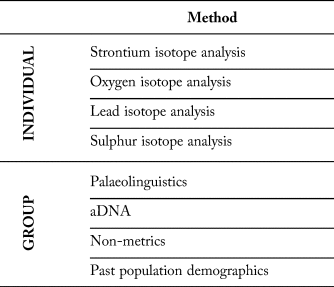
Present investigations of mobility can be divided into two main groups: 1) individual mobility, and 2) group mobility (Table 1). These groups differ from each other not only in the way human mobility is investigated but also, importantly, in the way information about mobility is provided. As the new body of scientific data is based primarily on human remains, we are dependent on the preservation of the record in terms of which human tissues are available for sampling if we are to identify the mobility of single individuals during different phases of life. Additionally, the level of detail in which single individuals can be investigated is particularly reliant on the span of potentially mobile time that each of the human tissues represent (i.e. different teeth, bone, hair, nails, and internal organs) (Müller et al., Reference Müller, Fricke, Halliday, McCulloch and Wartho2003; Eerkens et al., Reference Eerkens, Barford, Jorgenson and Peake2014; Frei et al., Reference Reiter, Frei, Suchowska-Ducke, Reiter and Vandkilde2015, Reference Frei, Villa, Jørkov, Allentoft, Kaul and Ethelberg2017; Knipper et al., Reference Knipper, Mittnik, Massy, Kociumaka, Kucukkalipci and Maus2017). Such detailed studies of single individuals are mostly based on isotope analyses; consequently, these mobility studies require the ancient movements to have occurred between isotopically different food catchment areas. People who drew sustenance from a single region (regardless of their own mobile or sedentary nature) will appear to be stationary according to isotopic analysis. Moreover, if mobile persons moved between isotopically-similar food catchment areas (e. g. Garnett, Reference Garnett1945: 139 on the preference of Linearbandkeramik farmers for loess soils), such movements would be difficult or even impossible to detect.
A brief overview of various means of identifying individual versus group mobility.

The aim of the present study is to provide a model for future discussions regarding the mobility of single individuals based on the current and constantly growing body of isotopic data.
Research Approach
We hold, as other researchers have (Urry, Reference Urry2007; Greenblatt, Reference Greenblatt and Greenblatt2010; Frankopan, Reference Frankopan2015; Marshall, Reference Marshall2015), that examination of the specific, categorical and quantifiable conditions surrounding human movement can be highly informative. Many useful attempts have been made to describe the social structure of mobile groups along a continuum (e.g. Beardsley et al., Reference Beardsley, Holder, Krieger, Meggers, Rinaldo and Kutsche1955; Murdock, Reference Murdock1967; Binford, Reference Binford1980). Other approaches (Kelly, Reference Kelly1992, Reference Kelly1995) involve the quantification of residential moves per year by average distance covered. However, it is arguable that, ‘the reality of a mobile existence is far more complex than the ordering principles used to describe it’ (Wendrich & Barnard, Reference Wendrich, Barnard, Barnard and Wendrich2008: 15). It seems that the most accurate means of modelling mobility is through a thorough examination of a variety of phenomena in combination with archaeological context. Notable examples of these defining criteria include:
1. Mobility (length of time, season);
2. Number of journeys;
3. Segment of the population which moved (as defined by gender, age, health, occupation, or social position);
4. General socio-political organization;
5. Logistics and available modes of transport.
In an ideal world, these fiveFootnote 1 categories (see discussion, e.g. Urry, Reference Urry2007; Wendrich & Barnard, Reference Wendrich, Barnard, Barnard and Wendrich2008; Cabana & Clark, Reference Cabana, Clark, Cabana and Clark2011; Adey et al., Reference Adey, Bissell, Hannam, Merriman and Sheller2014) should be investigated via multiple samples from multiple individuals from a site, region, and culture group who represent the full gamut of ages, sexes, and social levels. Unfortunately, the fragmentary nature of the archaeological record rarely includes material suitable for covering all parameters.
While both individual and group mobility data are inherently very different (as are mobility and migration), historically, archaeology has examined them in somewhat similar ways. Archaeologists have used both migration and mobility as catch-all categorizations for the causes of cultural change. The roots of this style of interpretation date back to culture-historical approaches and the drawing of Kulturkreise (‘culture spheres’; Frobenius, Reference Frobenius1898, Reference Frobenius1899) which characterized material culture as a proxy for language, ethnicity, and self-identity. However, the increasingly rigorous typologies and chronologies also made ‘les autres’ (‘the others’; Tordorov, Reference Tordorov1992) more apparent in terms of the style and manner of the items with which they were buried (Jockenhövel, Reference Jockenhövel1980, Reference Jockenhövel1991, Reference Jockenhövel and Jockenhövel1995; Wels-Weyrauch, Reference Wels-Weyrauch1989; Jockenhövel & Kurbach, Reference Jockenhövel and Kurbach1994).
In recent decades, advances in mobility research have created a broader understanding of how mobility—or potential mobility—functions in an increasingly connected world (see discussion of push/pull in Heberle, Reference Heberle1938; Lee, Reference Lee1966; cost/benefit in Sjastaad, Reference Sjastaad1962; and ‘motility’ in Kaufmann et al., Reference Kaufmann, Bergman and Joye2004). New methods in the field of isotopic tracing, such as the analysis of hair and fingernails, micro-sampling of multiple skeletal elements as well as the consecutive analysis of molars, has enabled scholars to create high-resolution timelines for individual human movements (Font et al., Reference Font, van der Peijl, van Wetten, Vroon, van der Wagt and Davies2012; Tipple et al., Reference Tipple, Chau, Chesson, Diego, Fernandez and Ehleringer2013; Knipper et al., Reference Knipper, Meyer, Jacobi, Roth, Fecher and Stephan2014; Frei et al., Reference Frei, Kristiansen, Allentoft, Wilson and Skals2015a, Reference Frei, Mannering, Douglas Price and Birch Iversen2015b, Reference Frei, Villa, Jørkov, Allentoft, Kaul and Ethelberg2017; Scharlotta, Reference Scharlotta2018). Studies of various cases of single individual mobility timelines can be combined with other group analyses, thereby allowing archaeology to gain a better handle on the complexity of the networks connecting human biology, ethnicity, culture, and heritage (Haak et al., Reference Haak, Brandt, de Jong, Meyer, Ganslmeier and Heyd2008; Knipper et al., Reference Knipper, Mittnik, Massy, Kociumaka, Kucukkalipci and Maus2017). In short, the course of academic dialogue is changing from producing evidence for movement to examining how different human mobilities either resemble or differ from each other across temporal and geographical barriers. Moreover, we are beginning to provide new and unprecedented information that can help us grasp why that movement first came about.
A Mobility Model
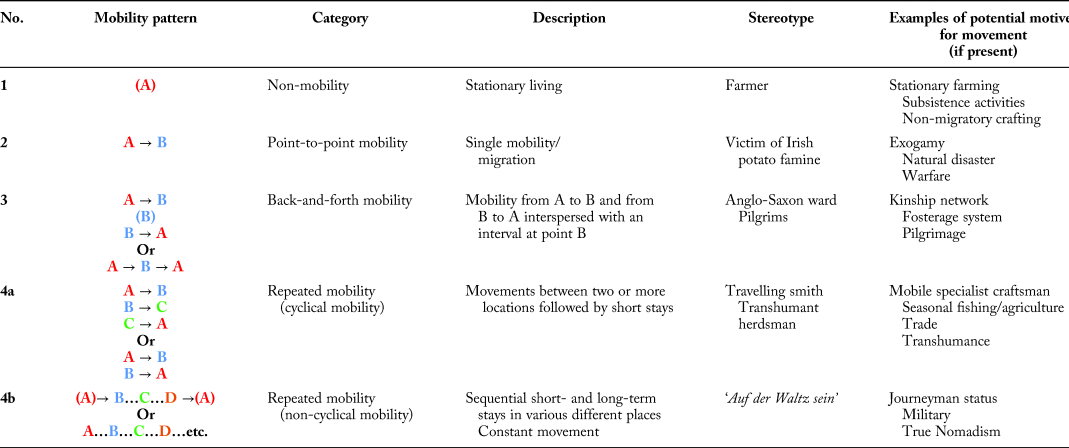
Thirty years ago, David Anthony criticized archaeologists for their approach to migration: ‘instead of developing the needed tools, archaeologists have avoided the subject’ (Anthony, Reference Anthony1990: 895). The increased temporal depth and breadth of mobility research coupled with better baseline coverage and new osteological techniques (e.g. Evans et al., Reference Evans, Montgomery, Wildman and Boulton2010; Frei, Reference Frei2013; Eerkens et al., Reference Eerkens, Barford, Jorgenson and Peake2014; Kootker et al., Reference Kootker, van Lanen, Kars and Davies2016; Frei et al., Reference Frei, Villa, Jørkov, Allentoft, Kaul and Ethelberg2017; Stewart et al., Reference Stewart, Gerlach, Gowland, Gron and Montgomery2017; Hoogewerff et al., Reference Hoogewerff, Reimann, Ueckermann, Frei, Frei and van Aswegen2019) have allowed archaeologists to address the five criteria for mobility assessment in an increasingly concrete fashion. Although there are (and always will be) holes in the record, we propose a mobility model composed of four over-arching mobility patterns which we have named as follows: 1) non-migratory; 2) point-to-point migratory; 3) back-and-forth; 4) repeated mobility, subdivided into 4a (cyclical mobility) and 4b (non-cyclical mobility) (see Table 2).
Mobility model: the schema proposes a series of five different patterns of human mobility.

The following consists of a series of short discussions exemplifying these four kinds of mobility patterns from the present (mainly European) data. Given the preliminary nature of this model and the vagaries of interpretation, we have intentionally produced broad categories containing overlapping elements. We anticipate that the model will require later re-evaluation as more data appear.
Non-mobility: The Case of Singen (Germany)
Within this type of mobility pattern, individuals are stationary in terms of migration and mobility. They tend to be born, live, and die within the same area or region. We propose that a stationary farmer would exemplify this pattern. Within archaeological contexts, this type of pattern is visible in individuals whose burial context and isotopic data both indicate local provenance without apparent signs of mobility. It also includes individuals whose isotopic values in different human tissues point to a local origin despite the presence of non-local archaeological associated material(s), other atypical styles/decorations, and/or manners of construction within a specific grave.
An example of the latter can be seen near Lake Constance at the cemetery of Singen (Hohentwiel). Although the site contains elements of Corded Ware, Bell Beaker, Urnfield, and La Tène cultures (Kimmig, Reference Kimmig and Krämer1958), Singen is best known for its Early Bronze Age finds (Krause, Reference Krause1988). While typological parallels for some of the objects (e.g. the daggers) have been found as far away as southwest Britain and in Brittany, Singen is particularly well known for the kind of metal used in the production of Early Bronze Age artefacts. The characteristic copper alloys used in what has become known as ‘Singen metal’ have been found along the Baltic and the Carpathian Basin (Krause, Reference Krause1988; Oelze et al., Reference Oelze, Nehlich and Richards2011). While the evidence for such far-reaching connections might lead one to expect a high proportion of non-locals at the site, strontium and oxygen isotope analyses conducted by Oelze et al. (Reference Oelze, Nehlich and Richards2011) suggest that the individuals they examined were overwhelmingly local. Even though the people from Singen clearly had contact with the outside world, in most cases, the mobility pattern exhibited by the inhabitants was non-migratory. Hence, this serves as an example of cultural exchange through means other than migration, where individuals seem to be local despite of the ‘non-local’ ancillary contextual evidence at the site. As studies of additional cemeteries within the region and the period as a whole come to fruition, and when additional samples—or perhaps even sequential samples from otherwise apparently ‘non-mobile’ people—become available, scholars may be able to shed more light on whether Singen represents a singular case or whether its non-mobility data forms part of a wider pattern.
Point-to-Point Mobility: The Case of the Skrydstrup Woman (Denmark) and the Capacocha Child Sacrifice in the Andes
A point-to-point mobility pattern can be distinguished from non-mobility through the single, unidirectional movement of the individual(s) concerned. Here we provide examples of individuals who appear to have moved either because of exogamy or pilgrimage/sacrifice. However, many other causes could result in this kind of mobility pattern, e.g. victims of warfare, famine/natural disaster or the need/desire to relocate for professional reasons.
An example of such type of mobility can be seen in the detailed mobility investigations of one of Denmark's well-preserved oak coffin burials: that the Skrydstrup Woman. The Skrydstrup female burial offered a unique opportunity for a detailed mobility study because the human remains consist of skeletal tissues as well as soft tissues like hair (Broholm & Hald, Reference Broholm and Hald1939). The Skrydstrup female was unearthed in 1935 from a burial mound dated to the Early Nordic Bronze Age period III (1300–1100 bc) (Frei et al., Reference Frei, Villa, Jørkov, Allentoft, Kaul and Ethelberg2017). Until recently, scholars assumed that she had local geographical origins because she was buried in the manner of the local elite. Frei and colleagues (Reference Frei, Villa, Jørkov, Allentoft, Kaul and Ethelberg2017) recently analysed dental enamel from her first and third molar as well as sequential hair segments (Skrydstrup Woman's total scalp hair length was over 60 cm) and were able to create a detailed timeline for her movements. All in all, the strontium isotope results indicate that Skrydstrup Woman moved from one geological area (represented by the signature from her first and third molars as well as part of her scalp hair) to another (represented by the remainder of her hair samples and a lower strontium isotopic signature in the third molar compared to the first molar). The detailed baseline study of the area combined with these values suggests that she most probably lived locally at the second location (Skrydstrup) until the end of her days. These results seem to imply that the Skrydstrup female might have been an example of what Bronze Age literature refers to as the ‘fremde Frau’ (‘foreign woman’; Jockenhövel, Reference Jockenhövel1991, Reference Jockenhövel and Jockenhövel1995), i.e. a woman who moved from one area to another as a means of creating and/or validating an economic-political alliance or kinship bonds between different—but related—social groups (Wels-Weyrauch, Reference Wels-Weyrauch1989; Bergerbrant, Reference Bergerbrant2007).
Regardless of the reason(s) why she moved, the results from the new analysis of Skrydstrup Woman suggest a single, unidirectional movement. In other words, a single migration. As this mobility coincided with Skrydstrup's early adolescence, exogamy is a potential cause for her individual mobility pattern. However, alternative scenarios might include unstable political/environmental situations, movement related to kinship networks or perhaps even adaptations to changes in the long-distance networks related to the metal trade (Ling et al., Reference Ling, Hjärthner-Holdar, Grandin, Billström and Persson2013, Reference Ling, Stos-Gale, Grandin, Billström, Hjärthner-Holdar and Persson2014; Melheim et al., Reference Melheim, Grandin, Persson, Billström, Stos-Gale and Ling2018).
Within specific contexts, we can expand our understanding of single point-to-point mobility to include a sacrificial element. If we move our focus from Europe to the Incan Empire, we find another interesting example of unidirectional movement. The capacocha rituals of the Inca involved the sacrifice of children and material goods to the gods as a way of alleviating the results of natural disasters or of honouring key events in the life of the Inca emperor (Reinhard & Ceruti, Reference Reinhard and Ceruti2015). The rituals included the selection of materials and young persons from various regions, their transport to Cuzco, and then further movements to places of particular ritual importance throughout the empire (Ceruti, Reference Ceruti2004). Against a backdrop of written sources that describe the practice of sourcing sacrificial victims for the capacocha ritual from throughout the Inca empire, Andrushko et al. (Reference Andrushko, Buzon, Gibaja, McEwan, Simonetti and Creaser2011) confirmed the presence of non-local child sacrifices by strontium isotope analysis of the children's human remains. The authors concluded that some of the children travelled or were brought to Cuzco Valley with the specific intent of being sacrificed. This conclusion had already been posited for the mummies from the Sara Sara (Peru) and Llullaillaco (Chile/Argentina) volcanoes in Wilson and colleagues’ (Reference Wilson, Taylor, Ceruti, Chavez, Reinhard and Grimes2007) examination of carbon, nitrogen, oxygen, and sulphur isotopes. These studies provide evidence for unidirectional travel ending in the demise of the victims.
Back-and-Forth Mobility: The Case of Haraldskær Woman (Denmark)
Back-and-forth mobility can be distinguished from a point-to-point mobility pattern by the simple fact that, in the former case, the mobile individual returns to their starting point, whereas, in the latter, they do not. A case study of back-and-forth mobility comes from the Danish pre-Roman Iron Age (500–0 bc) bog body of Haraldskær Woman. Recovered by peat cutters working near Vejle in Jutland in 1835 (van der Sanden, Reference van der Sanden1996), the body, which also became known as Queen Gunhild (a mistaken attribution to the Viking Age), is a well-preserved bog body (Glob, Reference Glob1969). Recent detailed strontium isotope analyses of the body's tissues (tooth enamel and scalp hair) and the wool textile recovered with the remains revealed a ‘there-and-back-again’ mobility pattern (Frei et al., Reference Frei, Mannering, Douglas Price and Birch Iversen2015b). While the 87Sr/86Sr ratios of Haraldskær Woman's tooth enamel suggest that she was likely to have spent her childhood within the area of present-day Denmark, the strontium isotope ratios from her scalp hair suggest that she undertook a long-distance journey shortly prior to her death. The authors suggest that she may have been on a kind of pilgrimage which could have been related to her end as an offering in the bog (Frei et al., Reference Frei, Mannering, Douglas Price and Birch Iversen2015b).
Repeated mobility
We have grouped together different kinds of repeated mobility in a single over-arching group. As a general rule, what we have termed ‘repeated mobility’ involves movements over an individual's lifespan between two (or more) areas. While there are several different forms that this kind of mobility can take, we have sub-divided the category into cyclical and non-cyclical mobilities.
Repeated (cyclical) mobility: the case of Nieder-Mörlen (Germany) and Ötzi (Italy)
Repeated (cyclical) mobility refers to repeated mobility either over a specific period or throughout a lifetime between different (but repeated) areas. This type of mobility can have many iterations, e.g. it can be seasonal and can involve either single individuals or groups.
Isotope analyses have been carried out in the surroundings of the site of Nieder-Mörlen (Hesse), an important and central area in the Early Neolithic (Gronenborn, Reference Gronenborn1999) in order to shed light on potential migration to the site (Nehlich et al., Reference Nehlich, Montgomery, Evans, Schade-Lindig, Pichler and Mike2009). Archaeologically, Nieder-Mörlen is of interest not only because of its long-term occupation (Schade-Lindig & Schmitt, Reference Schade-Lindig and Schmitt2003), but also because it shows clear changes in the style of pottery a few generations after the arrival of the first settlers, marking the earliest Flomborn phase of the Linearbandkeramik. The stable and radiogenic isotope analyses of teeth from several individuals buried at the site revealed a very complex mobility pattern (Nehlich et al., Reference Nehlich, Montgomery, Evans, Schade-Lindig, Pichler and Mike2009). The individuals investigated proved to be a combination of local and non-local people that point to a ‘cultural mix’ (Nehlich et al., Reference Nehlich, Montgomery, Evans, Schade-Lindig, Pichler and Mike2009: 1798). A group of non-local juveniles merits particular attention. Strontium isotope analyses combined with strontium concentrations (Nehlich et al., Reference Nehlich, Montgomery, Evans, Schade-Lindig, Pichler and Mike2009: 1793–95) of these juveniles from the population subset which the authors refer to as ‘Group III’ suggest mobility in early childhood between the ages of 4 and 6 years. The authors of the study note that this pattern resembles migration patterns in semi-nomadic pastoral societies in which the adults care for the cereal crops and the children are tasked with protecting the herds (Nehlich et al., Reference Nehlich, Montgomery, Evans, Schade-Lindig, Pichler and Mike2009 :1797). Based on these analyses and the archaeological context, the authors suggest that these juvenile individuals might have engaged in pastoral transhumance.
Another example of a similar type of mobility is suggested by the multi-isotopic investigation conducted on the prehistoric mummy found in 1991 in glacial meltwater along the Italian-Austrian border (Müller et al., Reference Müller, Fricke, Halliday, McCulloch and Wartho2003). Known as ‘the Iceman’ or ‘Ötzi’, this mummy has been intensively studied and has proved useful in providing information about the Neolithic-Chalcolithic transition in Europe. Müller and colleagues (Reference Müller, Fricke, Halliday, McCulloch and Wartho2003) conducted strontium, lead, and oxygen isotope analyses on Ötzi's skeletal and soft tissues to identify his potential mobility and provenance. The cross-disciplinary investigations on cortical and trabecular bone, dental enamel, intestinal wall, and the Iceman's stomach contents led the authors to suggest that Ötzi may have been engaged in repeated mobility, which the authors associate with transhumance (Müller et al., Reference Müller, Fricke, Halliday, McCulloch and Wartho2003: 865) between low-altitude settlements and summer grazing areas above the timberline. The authors posit this scenario due to the similar 87Sr/86Sr ratio of the Iceman's intestinal wall and that of his earliest tooth enamel. The later discovery of evidence for the violent death of the Iceman (Nerlich et al., Reference Nerlich, Peschel and Ergarter-Vigl2009; Maixner et al., Reference Maixner, Overath, Linke, Janko, Guerriero and van den Berg2013; Pernter et al., Reference Pernter, Gostner, Egarter-Vigl and Ruhli2007) has led other scholars to dispute Müller and colleague's transhumant shepherd hypothesis in favour of viewing Ötzi as a travelling elite (Gleirscher, Reference Gleirscher2004; Lippert et al., Reference Lippert, Gostner, Egarter-Vigl and Pernter2007).
Repeated (non-cyclical) mobility: the cases of the medieval Silk Road, Roman York, Viking Age Trelleborg, and La Tène Bohemia
This last sub-category of repeated mobility is characterized by movements between different areas which may be regular or irregular (i.e. they may be seasonal, or related to other phenomena, such as socio-political events or weather). This can be distinguished from the previous sub-category by the fact that this pattern does not show mobility within the same areas but may instead involve visiting new regions. The duration of the ‘stay’ in each area may vary and some of the areas (but not all) may be repeated.
An example of potential repeated mobility has recently been published in a study of urban versus nomadic communities along the medieval Silk Road in Uzbekistan, Kazakhstan, and Turkmenistan (second to sixteenth century ad) (Hermes et al., Reference Hermes, Frachetti, Bullion, Maksudov, Mustafokulov and Makarewicz2018). In their study, Hermes et al. (Reference Hermes, Frachetti, Bullion, Maksudov, Mustafokulov and Makarewicz2018) examined carbon and nitrogen isotopes of bone collagen as a proxy for dietary intake via isotopic niches. Assuming that urban populations could be distinguished by more limited dietary resources compared to nomadic groups, the authors conclude that low isotopic variation reflects urban groups, while an open and more opportunistic system of food production due to a more mobile lifeway will be reflected by a larger isotopic variation.
Isotopic diversity among frequent or well-travelled groups seems to be one of the only unifying factors other than find context. Results such as those from a second-century ad cemetery of ‘headless Romans’ uncovered in Driffield Terrace in York (UK) may be interpreted as representing the result of frequent movement associated with military service and recruitment (Müldner et al., Reference Müldner, Chenery and Eckardt2011). Evidence for a similarly diverse recruitment pattern is also visible in the varied origins of the persons buried at the tenth-century fortress of Trelleborg in Denmark, the stronghold of the Viking king Harold Bluetooth (Price et al., Reference Price, Frei, Dobat, Lynnerup and Bennike2011).
Similar patterns of high mobility within what are interpreted as warrior contexts have also been identified by Scheeres et al. (Reference Scheeres, Knipper, Hauschild, Schönfelder, Siebel and Pare2014) in three early La Tène (fourth/third century bc) cemeteries in Bohemia, namely Radovesice I, Radovesice II, and Kutná Hora. In this study, oxygen and strontium isotope analyses of human teeth were used to assess the validity of the so-called ‘Celtic migrations’. The data gathered from the mostly male cemetery population indicate that many of the individuals originated from different geological settings. This might be an indication that the deceased travelled with other warriors through a number of different areas before ending at the sites where they were buried.
Discussion
The current boom in studies of mobility combined with recent scientific advances in creating detailed timeline investigations of single individuals (Font et al., Reference Font, van der Peijl, van Wetten, Vroon, van der Wagt and Davies2012; Tipple et al., Reference Tipple, Chau, Chesson, Diego, Fernandez and Ehleringer2013; Eerkens et al., Reference Eerkens, Barford, Jorgenson and Peake2014; Knipper et al., Reference Knipper, Meyer, Jacobi, Roth, Fecher and Stephan2014; Frei et al., Reference Frei, Kristiansen, Allentoft, Wilson and Skals2015a, Reference Frei, Mannering, Douglas Price and Birch Iversen2015b, Reference Frei, Villa, Jørkov, Allentoft, Kaul and Ethelberg2017; Plomp et al., Reference Plomp, von Holstein, Koornneef, Smeets, Font and Baart2017) has created a new way of layering new questions regarding social dynamics. Here, we propose a simple model of different types of mobility that this new corpus of data appears to suggest with the aim of providing new tools with which we can discuss past mobility more in detail. The material allows for future expansion and refinement; the similarity of many of the categories and the resultant overlap would benefit greatly from comparison with more high-resolution data. Although, as discussed above, a plethora of studies have identified non-local people and, hence, mobility, the recent addition of a temporal element, such as can be achieved through sequential molar sampling or through the analysis of hair and fingernails, is still relatively novel. Knowing when people travelled in a human lifespan and tracing the pattern of their movements has allowed us to fulfil the criteria described above to a degree hitherto unknown within archaeological contexts. When detailed material is complemented by repeat sequential samples from individuals and more examples from an entire site or region, scholars will begin to make suggestions about the cultural mores associated with movement and non-movement across socio-demographic lines.
All told, the mobility patterns identified in the present model cleave to three over-arching kinds of mobility: non-mobility, single mobility/migration, and multiple movements. The causes of non-mobility and different types of mobility can be manifold. Non-mobility may include lack of sufficient funds or surplus, social obligations, health status, age, and social standing (serf, slave, landed gentry). Single, unidirectional movements may have been caused by marriage alliances; family movements; social, political, or economic instability; violence (enslavement, kidnapping); or health issues. By contrast, individuals who show evidence of multiple movement were likely to have been moving because mobility formed part of their employment, beliefs (ritual), or lifestyle. Although a warrior or soldier, herder, trader, or traveller within an extensive kinship network may present very different mobility patterns, they are all unified by the fact that their chosen occupation or social group(s) exhibit some form of mobility mandate.
Agency also has an important role to play within mobility patterns. Sociologists believe that social status is created by means of self-presentation to others through wealth, professional experience, or formal position (Veblen, Reference Veblen1899; Mead, Reference Mead1934; Goffmann, Reference Goffmann1959; Podolny, Reference Podolny2005). The causes of mobility intersect with the reception of foreigners along specific breaking points. The right to move or not to move is vastly different from an obligation to move or not to move (e.g. Cresswell, Reference Cresswell2012). The social reception of foreigners by a host society is predicated on whether travellers came (or were caused to come) because they were exercising a right, whether they had selected a particular lifestyle, or whether they were suffering a particular obligation (Shellar, Reference Shellar2018).
Let us take the example of the non-mobile people from Singen (Oelze et al., Reference Oelze, Nehlich and Richards2011). The fact that the overwhelmingly non-mobile inhabitants of that site were also interred with exotic goods not only underscores the importance of non-local materials or items in social negotiations (Vandkilde, Reference Vandkilde2007), but also exemplifies the ways the inhabitants expressed power. It seems that, in Singen, it was not through individual travel and the acquisition of non-local goods that one expressed one's social standing, but rather by causing exotica to be brought to one's own doorstep.
The causes of back-and-forth mobility are difficult to define as different reasons could spur a single to-and-from journey to a specific place of cultural, religious, or personal importance. Although this may be difficult to investigate within archaeology, the example of the bog body of Haraldskær Woman seems to indicate this type of mobility.
Repeated mobility, be it cyclical or more irregular (non-cyclical), can also be closely related to social status. For example, a peddler, small-scale trader, or migrant worker's identity and integration (or non-integration) into the society (or societies) with which they have contact can be defined by their transitory lifestyles. Modern ethnographic examples of travelling smiths, such as the West African Senufo Kule and the Inaden from northern Nigeria, show that both the profession and its mobile nature removed metalworkers from ‘normal’ society; in many cases, they formed a separate social category (Neipert, Reference Neipert2006). This could also be the case with warriors. Although contact with migratory workers or specialists was necessary for temporary collaboration, prolonged contact might involve severe social change (Neaher, Reference Neaher1979; Bollig, Reference Bollig and Rao1987).
Conclusion
We present a simple but, we hope, useful model of different types of human individual mobility as revealed through isotope analyses of archaeological human remains. The model consists of four main types of mobility: 1) non-migratory (no mobility), 2) point-to-point, 3) back-and-forth, and 4) repeated mobility. Our principal goal is to present a new dimension, based on the current scientific individual mobility data, which can provide a framework for discussing the impact different types of mobility had on society. It is our hope that it will facilitate cross-comparisons and, eventually, interpretations of the causes and influence of mobility in the past.
Even though the periods, regions, and people included in this discussion and model of (chiefly Old World) mobility differ widely, they share a particular emphasis on mobility—or non-mobility—as a definitive phenomenon. Individual mobility patterns are just that: individual. It is through the specific patterns represented by individuals as well as inter- and intra-group patterning comparisons that we will be able to further archaeological mobility research as a whole. We believe that the discipline can move from producing evidence of movement to examining how different human mobilities resemble or differ from each other across temporal and geographical barriers. Fortunately, the methodological developments within archaeological sciences/archaeometry of the last few decades have provided a great deal of evidence suitable for the study of mobility, and it is increasing exponentially. Moreover, we are beginning to see new and unprecedented information that can help us grasp why such movement first appeared. It is, therefore, expected that future refinements of the model will be necessary.
Acknowledgments
The research presented in this article has been made possible through the support of the Carlsberg Foundation through the projects entitled ‘Tales of Bronze Age Women’ CF-15 0878 and ‘Tales of Bronze Age People’ CF-18 0005 to Karin M. Frei. We are grateful to the editor Catherine Frieman as well as several anonymous reviewers for their very valuable and constructive comments which greatly helped to improve the manuscript.