The German documentation centre for art history, Deutsches Dokumentationszentrum für Kunstgeschichte – Bildarchiv Foto Marburg (DDK)
The photo archive of the German documentation centre for art history (DDK), is one of the largest scholarly image collections in the world focusing on art and architecture. It was founded in 1913 by Richard Hamann (1879–1961), the then newly appointed professor of art history at Philipps University in Marburg.Footnote 1 Having collaborated on a publication about Magdeburg Cathedral with Dr. Franz Stoedtner,Footnote 2 the founder of the Institut für wissenschaftliche Projection in Berlin, Hamann was a strong advocate of using photography to teach and research art history when he came to Marburg. He had also understood the demand for high-quality photographic reproductions of artworks, as well as for architectural photographs, among scholars, collectors, publishers and many others. With this in mind, Hamann not only established a print collection for teaching purposes,Footnote 3 but built up an image archive — consisting largely of original photographs (negatives) — or rather an image agency to distribute photographs around the world. To this end, Hamann undertook photographic tours across Europe (e.g. Germany, Belgium, France, the Netherlands, Italy, Greece, England, Poland and Russia) and further afield (e.g. Egypt and beyond). He also trained his students and staff in photography and sent them out to bring back documentary photographs of buildings, historical monuments and art works. But the collection also grew — and is still growing — through the acquisition of photographic archives from publishing companies or galleries and photographers’ estates.Footnote 4 Today, the photo archive comprises more than 2.8 million photographs, ranging from early salt paper, carbon, albumen or silver gelatin prints through glass and film negatives, as well as transparencies, to digital photographs. While these images are still widely used to illustrate objects in publications, the remit of the DDK has changed distinctly. Long serving as an image agency, it has evolved into an international research institution dedicated not only to issues and concerns in the field of art history, but also, and especially, to aspects of the history of photography. Within this new conceptual framework, the photographs held in the DDK's collection are no longer merely considered to be illustrations, but are treated both as objects of interest in their own right and as valuable sources for many disciplines.
Ludwig Bickell: Photographer and Monument Conservator
Since 1977, the DDK has housed almost 3,000 glass plates that were made between 1870 and 1901 by Ludwig Theodor Alexander Bickell (1838–1901).Footnote 5
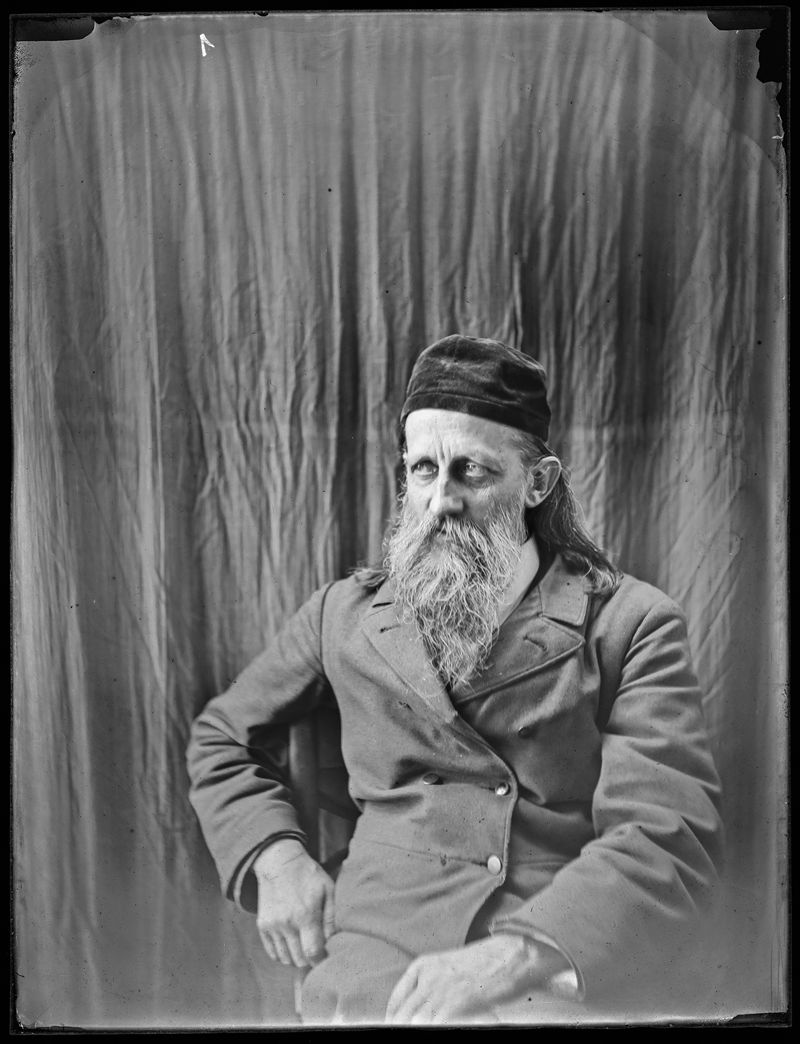
Ludwig Bickell, Self-portrait, around 1880, glass negative, gelatin dry plate, 21 x 16cm (call no. 810.492a, © Bildarchiv Foto Marburg).

These early negatives are a permanent loan of the Verein für Hessische Geschichte und Landeskunde (Society for Hessian History and Regional Studies). In 2013, they were included in the Verzeichnis national wertvolles Kulturgut des Landes Hessen (Directories of nationally valuable cultural assets in the State of Hessen) by the Hessian State Ministry for Higher Education, Research and the Arts.Footnote 6
Ludwig Bickell was born in Marburg in 1838.Footnote 7 He studied accounting and law in Marburg and Leipzig and entered the administrative services for a short time afterwards. His contemporaries described him as a rather difficult, often harsh, sometimes even quite unfriendly individual with a peculiar appearance, but passionate about culture and antiquities and eager to follow up on his ideals and beliefs.Footnote 8 He left his position as a civil servant at the age of 29 to become a private scholar — always short of funds —Footnote 9 and to dedicate himself to the cultural assets of Hessen (including timber-frame buildings, church organs and all kinds of handcrafted antiquities under threat from technological progress). Bickell eagerly collected objects and, in 1875, was appointed the first conservator of the antiquities collection of the Society for Hessian History and Regional Studies (this collection later became the basis of Marburg University Museum).Footnote 10 This duty was honourable, yet unremunerated. In 1892, Bickell received an honorary doctorate from the University of Marburg and was then appointed the first monument conservator of the district of Cassel. Thus, he became the first conservator of the State of Hessen and was finally granted a stable salary. Until his appointment, he had earned a livelihood mainly as a photographer.
Bickell bought his first camera in 1870 (many others were to follow) — when glass negatives had to be coated, sensitised, exposed and developed within a short period of time and therefore required having a portable dark room at the site of recording. The heavy and fragile glass plates had to be cut by a glazier and needed to be hand coated with collodion and used while the chemical layer was still wet.Footnote 11 Cameras and tripods were bulky and weighty, and exposure times were long. In many cases, Bickell jotted down exposure times, as well as specifications on the lenses or the aperture used, in a calendar that he carried with him.Footnote 12 For instance, on 8 and 9 September 1879, Bickell took photographs of Fritzlar Cathedral. For the outside shots, which were most likely taken in bright sunlight, he noted exposure times of 1 ½ to 1 ¾ minutes. For an interior photograph though, he recorded 25 minutes with a 14.2 aperture.Footnote 13
Bickell was profoundly interested in the natural sciences and physics and at the same time a very talented illustrator. His estate, which is housed at the State Archive of Hessen,Footnote 14 includes several detailed drawings of cameras or lenses with suggested improvements or inventions that he showed to or occasionally even sent to manufacturers. One drawing, dated 18 October 1878, however, is a precise design for the construction of a dark room in a horse-drawn carriage.
Bickell was not an ordinary commercial photographer. His studio was not open to the public. Portraits, the most important photographic genre in the field of commercial photography, are extremely rare in his archive. Instead, his photographs mirror his interest in historical monuments, buildings and antiquities. Many of the photographs show timber-frame buildings from the region around Marburg and Cassel, also constructional, especially sculpted elements, churches, church organs and religious artworks, sculptures, hand-forged or cast-iron objects (e.g. stove plates, candelabrums or door locks) as well as many other antiquities of the time. These photographs attest to his work as a conservator, and to his efforts to preserve and appreciate historic buildings and cultural assets. The value of these photographs as important historical documents is undisputed. They bear witness to artworks or monuments and moreover to their condition when photographed. In many cases, Bickell documented buildings that no longer exist — sometimes just after they were destroyed by a natural disaster or a fire, at other times immediately before or even during demolition — with the permission of the authorities.Footnote 15 Needless to say, many more of the documented objects have since been destroyed. Bickell not only recorded these demolitions, but often fought very hard against the practice of tearing down historical buildings by writing letters to the authorities or by publishing exceedingly critical articles.Footnote 16 If, however, he was unable to convince those overseeing monument preservation, he would at least photographically document such objects in what he called his Denkmäler-Archiv (‘archive of monuments’).Footnote 17 As such, the photographs of Ludwig Bickell have attracted much attention from both cultural heritage preservation and the history of art and architecture.
The Photographer's Work
Bickell's outstanding accomplishments in preserving and documenting Hessian cultural assets easily detract from his work as a photographer. Long before he received a state salary as conservator, Bickell offered his services as a landscape, architectural and arts and crafts photographer.Footnote 18 In 1877, he published a brochure in which he offered 264 ‘views of places, streets and buildings, architectural details, arts and crafts objects, painter's studies’.Footnote 19 Two hundred and four of these photographs were taken in Marburg. The leaflet gives plate size as 6 x 8 inches while the cardboard onto which prints could be mounted measured ¼ sheet. The price for mounted photographs was 1,20 Mark, for unmounted ones 1,05 Mark. Bickell offered his services ‘on order’ to ‘building and other authorities, for restorations of architectural and artistic monuments, for judicial purposes, photographs for scientific and technical purposes of all kinds’. Photographs were available in various sizes (6″ x 8″, 8″ x 10″, 12″ x 16″, 18″ x 24″). He also lent himself for the ‘exploration of individual sites for archaeologists, art historians and museums, on request with a written report, floor plans and the like’. Since the 1870s, the local publisher N. G. Elwertsche Verlagsbuchhandlung also sold several of Bickell's Marburg photographs. In 1883, the publisher edited an Album von Marburg (‘Album of Marburg’) with collotypes by Bickell. The ‘album’ was likely sold as single plates that could be compiled in a folder.Footnote 20 Many of the glass plates at the DDK bear traces of the preparations that Bickell made for such prints and book publications.
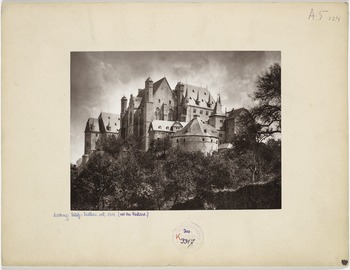
Ludwig Bickell, Landgrave Castle, Marburg, photograph: 1870s, collotype mounted on cardboard, around 1882, collotype: 15,6 x 19,2 cm, cardboard: 24.2 x 31.8cm (inv. no. 3317, © Bildarchiv Foto Marburg).

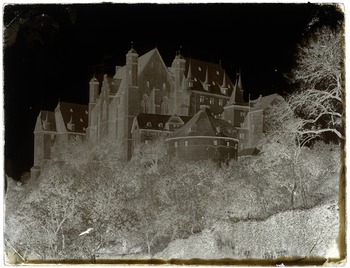
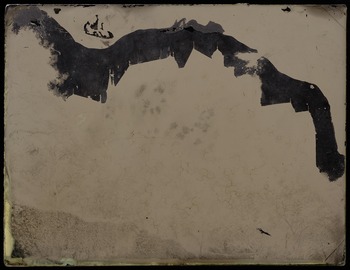
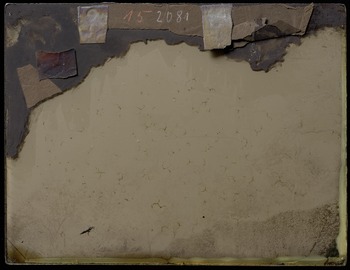
The varnished collotype in figure 2 shows Landgrave Castle in Marburg from the West.Footnote 21 It was made using a wet plate collodion negative in the format 6 x 8 inches (fig. 3.1, 3.2, 3.3). The negative shows retouching on both sides of the plate.Footnote 22 On the chemical layer side, retouching was executed using black paint or varnish and was far more precise than on the support side of the plate. Most likely, Bickell used a fine paintbrush to trace the silhouette of the building and the landscape and drew a line approximately 2 cm in width in order to produce a nice line separating the motif from the sky. On the support side of the glass plate, the sky is partially painted black, and partially covered by dark paper and metallic shimmering pieces. This suggests that Bickell's main concern was the sky.
Ludwig Bickell, Landgrave Castle, Marburg, 1870s, glass negative, wet collodion, retouched, 16 x 21cm, transmitted light (call no. 810.077, © Bildarchiv Foto Marburg).

Retouchings on chemical layer side, incident light.

Retouchings on support side, incident light.

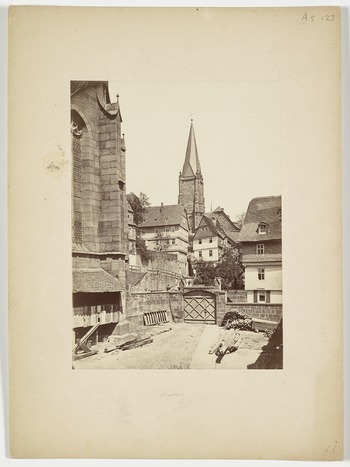
At the time, it was not possible to take photographs of landscapes with cloud formations in one negative due to the strong sensitivity of wet collodion to blue light. Thus, many of Bickell's unretouched negatives show collodion-induced streaks in those overexposed parts instead of a clearly emerging sky. If the negative had been copied out like this, or if a printing matrix had been made from this negative, these irregularities would have been visible in the print. Hence, the streaks were eliminated through retouching. Copying out a plate with a retouched horizon line and sky on albumen paper resulted in a fully monochrome appearance of the sky, as another print from another retouched wet collodion plate shows (fig. 4). The negative of Landgrave Castle would have produced a similarly vapid sky if simply copied out on photographic paper. Instead, it shows quite a dramatic sky with a cloud-like stratosphere. This addition of an atmospherically sky, which attests to the artistic quality of Bickell's prints, was done later during the collotype printing process.
Ludwig Bickell, Kugelgasse, Marburg, photograph: 1870s, albumen print mounted on cardboard, 1870s, photograph: 20,5 x 15cm, cardboard: 32 x 23.5cm (© Bildarchiv Foto Marburg).

Illustrations for Publications
Bickell not only created a photographic archive of historic monuments. As his plates demonstrate, he also used his photographs for his publications.
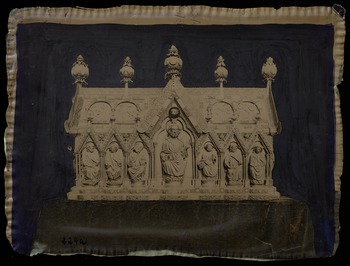
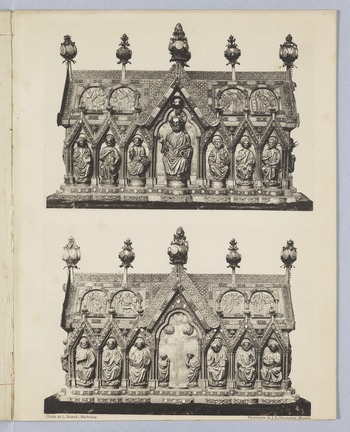
Figure 5 shows the retouched wet collodion layer that used to be affixed to a glass plate (approx. 6″ x 8″). The photograph of the holy shrine of Saint Elisabeth — and there are several plates of all four sides of the shrine — was taken inside Elisabeth Church in Marburg where the shrine is kept. Probably already contemplating how he would use the photograph, Bickell placed the shrine on a dark cloth. Nevertheless, the surrounding, overly detailed walls (still visible at the uncovered edges of the negative) distracted greatly from the object. To direct full attention to the shrine, Bickell retouched the negative, darkening the areas around the object with black paint or varnish. This technique enabled him to publish the shrine with a clean white background in his 1893 publication L’Église et la châsse de Sainte-Elisabeth à Marbourg, in which four photographs were reproduced as collotypes on two plates (fig. 6).Footnote 23 The collotypes were produced by J. B. Obernetter in Munich, whom Bickell had worked with also on other publications. But the use of collotypes in publications at that time was not self-evident.
Ludwig Bickell, Holy Shrine of St. Elisabeth, around 1892, glass negative, wet collodion (wet collodion layer without glass support), 15 x 19cm (call number: 810.224a, © Bildarchiv Foto Marburg).

Plate 1 (The Holy Shrine of Saint Elisabeth) of Ludwig Bickell, L’Église et la châsse de Sainte-Elisabeth à Marbourg, Extrait de la Revue de l'art chrétien (Bruges: Desclée, De Brouwer & Cie, 1892) (Universitätsbibliothek, Philipps-Universität Marburg, VIII B 131 c), 27.6 x 21.6cm.

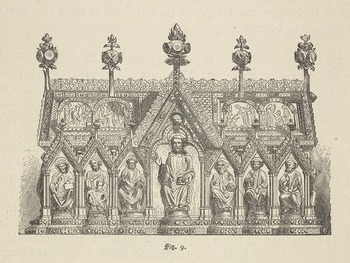
While the collotype was the best possible printing process of the time, it was also expensive. It was not yet possible to print high-quality reproductions of photographs together with text. Even though the letterpress halftone process was developed in the late nineteenth century,Footnote 24 it took many more years to achieve satisfactory quality. Up until then, photographic illustrations needed to be produced separately as plates (original photographs mounted onto plates or photomechanically printed plates) and were then bound into the book together with the pages containing text. In another publication, 10 years earlier, cost reasons seem to have prevented Bickell from using collotypes, and he commented quite outspokenly on this shortcoming. In his 1883 publication on the 600th anniversary of the consecration of Marburg's Elisabeth Church, he writes that unfortunately he was unable to use the collotype process, ‘which would have been at that time the most appropriate form to depict an impression of reality,’ but instead had to settle with most modest wood engravings, which were at least cut from photographs.Footnote 25 Figure 9 of the publication (fig. 7) shows a woodcut of the holy shrine of Saint Elisabeth that was most likely produced after the same photograph as the one that was included in the later publication.
(The Holy Shrine of Saint Elisabeth) of Ludwig Bickell, Zur Erinnerung an die Elisabethkirche zu Marburg und zur sechsten Säcularfeier ihrer Einweihung (Marburg: N. G. Elwert'sche Universitätsbuchhandlung 1883), fig. 9 (Universitätsbibliothek, Philipps-Universität Marburg, F I 983/10).

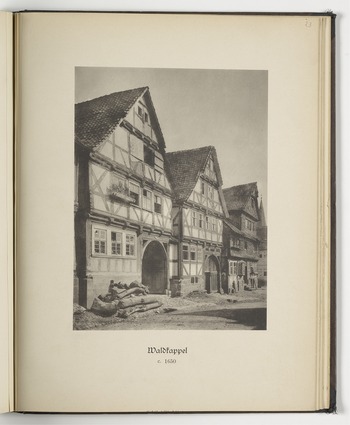
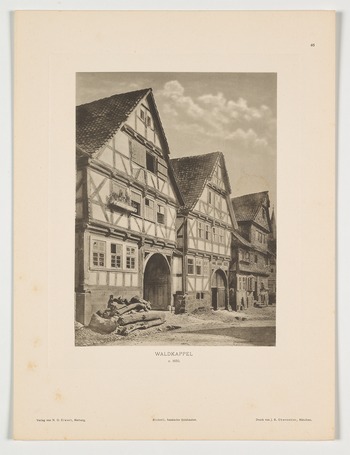
In 1887, Bickell published the first part of a three-volume publication on Hessian timber- constructed buildings.Footnote 26 The first volume contained 30 collotypes printed by J. B. Obernetter in Munich. Volumes Two and Three were published in 1891 and contained another 50 collotypes.Footnote 27 A second edition was printed in 1906 (five years after Bickell's death), in a much larger format with 50 selected collotypes. Many of the negatives used for these various publications are preserved at the DDK. Comparing the original plates and the different editions provides further insights into both the photographer's work and the publication processes and conventions of his time. While the 1887 and 1891 publications include many unretouched images of objects — with distracting backgroundsFootnote 28 or with no clouds in the sky (fig. 8.1)Footnote 29 — the 1906 collotypes exhibit a different aesthetic style, with objects displayed in front of white backgrounds and sometimes with clouds added to the skies (fig. 8.2).
Ludwig Bickell, Waldkappel, before 1887, from Ludwig Bickell, Hessische Holzbauten, No. 1 (Marburg: N. G. Elwert, 1887), plate 23, collotype, plate: 31 x 24cm, image: 20.5 x 15.2cm (Universitätsbibliothek, Marburg, 095 VIII B 91 u, 1).

Ludwig Bickell, Waldkappel, before 1891, from Ludwig Bickell, Hessische Holzbauten (Marburg: N. G. Elwert‘sche Verlagsbuchhandlung, 1906), plate 46, collotype, plate: 38.2 x 29cm, image: 25 x 18.2cm (private collection).

Ludwig Bickell's estate at the State Archive of Hessen contains an interesting document about the collotype production process. On 2 January 1892, J. B. Obernetter sent a letter to Bickell stating that a glass negative had cracked during the printing process.Footnote 30 He asks Bickell whether a duplicate would be available — even if only of smaller size. If none were available, he would ‘dust’ the original plate and retouch it carefully. The fact that this happened after about 450 copies had been printed clearly indicates that Obernetter literally printed from original glass plate negatives. How did he accomplish this? Do the plates bear traces of the printing process? Were the plates returned to the photographer afterwards? Obernetter's letter raises many questions that might be clarified by closely examining the glass plates, which are thus invaluable sources also for understanding and reconstructing historical printing processes.
The quality of the photographic reproductions was of greatest importance to Bickell. He sharply criticised other publications that did not live up to his expectations,Footnote 31 and hence had to meet his own demands. His two-volume book on the architectural and artistic monuments of Gelnhausen was released in 1901 after several years of painstaking work and only shortly before Bickell passed away.Footnote 32 This pictorial atlas contains 350 collotypes — produced by Sinsel & Co. in Leipzig. In the text, Bickell comments on his usage of photography as the best possible way to ‘objectively’ and ‘precisely’ illustrate such an inventory. He adds that the collotype printing process ‘would not harm the quality of the photographs in any way’.
From Wet to Dry: Early Glass Plates
Bickell's work belongs to a time when photographic processes and possibilities developed and changed quickly. His plates, which vary in format and size (6″ x 8″ to 12″ x 16″), bear witness to those times. He started using the wet collodion process, which required sensitising plates immediately prior to exposure, but around 1880, the first gelatin dry plates were introduced.Footnote 33 These had the great advantage of being manufactured industrially and were sold readily sensitised for exposure. Exposure times were much shorter and negatives could be developed unhurriedly back at the studio. This facilitated matters tremendously. Bickell seems to have tried out different early plates.Footnote 34 Looking at Bickell's glass negatives suggests that the new dry plate process needed many improvements on the way. Some plates in the collection are clearly gelatin dry plates, which, however, show strong detachments of the chemical layer.Footnote 35 Very likely due to this lacking adhesive force of the chemical layer, Bickell varnished some dry plates.Footnote 36 While this method was common for wet collodion plates, it ought not to have been necessary for dry plates.
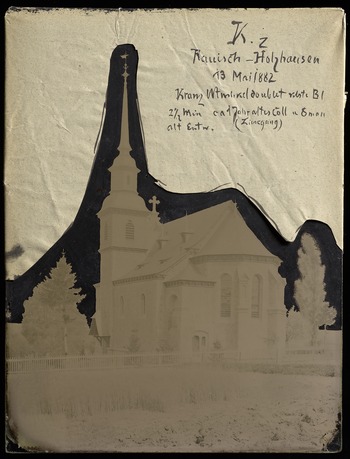
One plate in the collection appears to document the radical changes occurring at the time in a particular way. Figure 9 shows a wet collodion plate with the image of Rauischholzhausen Church. Bickell retouched the silhouette of the building and the surrounding vegetation with black varnish or paint and covered parts of the negative with paper in order to achieve a monochrome sky. More interestingly, however, he jotted down some practical notes onto the paper that covered the sky area. He commented as follows on the production of the negative: ‘K[irche]. z[u]. | Rauisch-Holzhausen | 13 Mai 1882 | Kranz Wtwinkeldoublet veste Bl[ende] | 2 ½ Min ca. 1 Jahr altes Coll. und 8 mon | alt Entw. (Liesegang)’. He refers to the motif and the precise date of the photograph: Church of Rauisch-Holzhausen, 13 May 1882. And he indicates which lenses and which aperture he used: a set of wide-angle lenses with a firm aperture. Finally, he notes that he had exposed the plate for 2 ½ minutes using one-year-old collodion and an eight-month-old developer from Liesegang. Why would he use old collodion and old developer? And why were these facts worth noting on the plate? Conjecture suggests that he may have already been using dry plates at that time but had perhaps returned to collodion because he was dissatisfied with the results of dry plates. He noted that he used old chemicals — hoping and indeed recording that they showed good results. Even if this hypothesis cannot be verified at this point, Ludwig Bickell's plates certainly merit further research from both conservation and photographic history perspectives.
Ludwig Bickell, Church in Rauischholzhausen, 13 May 1882, glass negative, wet collodion, retouched, 21 x 16cm (call no. 810.659, © Bildarchiv Foto Marburg).