Introduction
Organisational citizenship behaviour (OCB) has been a popular research theme in the academic field. For the last decades, scholars diligently researched on the associations between OCB and its potential impact on organisations as well as employees. Their research findings are fruitful and have contributed to the understandings of OCB’s formation and its influence in organisations. For instance, OCB may act as a behavioural enzyme, facilitating employee commitment, lower levels of absenteeism, higher levels of skills and therefore leading to higher productivity, enhanced quality and efficiency (Dalal, Reference Diefendorff, Brown, Kamin and Lord2005; Chang & Smithikrai, Reference Chatman2010; Golding, Reference Greenberg2010; Karam & Kwantes, Reference Kelley-Patterson and George2011). Interestingly though, the majority of these prior investigations and case studies are using business sectors (e.g., factory employees) and higher education institutes (e.g., universities employees) as research samples. Primary school teachers (PST) and their OCB at school do not draw much academic attention (see exceptions in: Cheng, Reference Creswell2004; Somech & Ron, Reference Spector2007; Kılınç, Reference Konovsky and Pugh2014; Somech & Oplatka, Reference Somech and Ron2015).
Previous studies have investigated the OCB from different regions based on cultural differences, finding a significant correlation between cultural differences and the OCB (Farh, Earley, & Lin, Reference Farh, Zhong and Organ1997: 288). The concept of the OCB is very similar to the Chinese traditional virtue. Specifically, a culture endowed with more inclination towards long-term orientation can be regarded as a culture with a higher degree of Confucianism (Cheng, 2015). In the comparison of Taiwan to Mainland China, Taiwan obtained a higher degree of power distance from collectivism towards individualism, masculinity, and uncertainty avoidance (Hofstede, Reference Hoy, Tarter and Kottkamp1991; Farh, Earley, & Lin, Reference Farh, Zhong and Organ1997; Farh, Zhong, & Organ, Reference George2004; Lin & Ho, Reference Lin and Chen2010). Teachers are a key factor for ensuring educational quality and success in the Taiwanese education system. The decrease in the birth rate has had a serious effect on educational institutions in Taiwan because the school-age population is now rapidly decreasing. Consequently, currently there is an oversupply of public school teachers and an overabundance of teacher graduates in Taiwan (Hung, 2011). However, the Taiwanese public school system is still largely dominated by hierarchical authority and high-stakes testing while remaining relatively resistant to various Western-style reforms (Shouse & Lin, Reference Smith2010). Moreover, the major sources of job stress amongst PSTs include teacher stress and related issues, such as redundancy, education reforms, and class and school cuts (Kyriacou & Chien, Reference Lambe, Spekman and Hunt2004; Lin & Ho, Reference Lin and Chen2010; Li, Reference Lin and Ho2013). Primary schools, as loosely structured nonprofit organisations that employ highly qualified professions, find it difficult to set and supervise specific quantitative goals for teachers (Somech & Oplatka, Reference Somech and Ron2015). A poll of Taiwan’s public school teachers found that ‘nearly one-third did not wish to continue teaching due to low pay, poor benefits, long hours, inferior work environment, few opportunities for promotion, and declining public respect and social status’ (Shouse & Lin, Reference Smith2010: 46). Thus, OCB is an issue for PSTs in Taiwan.
On the other hand, the framing of principal leadership and school improvement along Western lines has become even more curious and problematic due to Taiwan’s highly centralised Ministry of Education. Principals’ formal authority is weakened due to the impact of local committees as well as organisational demands for teacher empowerment. Principals are almost certain to find themselves in the middle of conflicts. The implication for Taiwan’s principals is that the more they strive to implement reform, the greater the risk they bear (Shouse & Lin, Reference Smith2010: 51). Moreover, the principal’s role is that of a symbolic parental figure for students, teachers, and parents, and the position is held in great respect in Chinese society in Taiwan (Smith, Reference Somech and Drach-Zahavy1997: 110–111). As principals acted likewise towards higher officials, Taiwan’s principals are thus confronted with a new and extremely daunting organisation situation (Shouse & Lin, Reference Smith2010), meaning it may be especially true that principals lack the skills to establish a culture conductive to OCB.
Previous research (Farh, Earley, & Lin, Reference Farh, Zhong and Organ1997) has examined the OCB against the backdrop of Chinese culture and society. Yet, most of the related research was based on theories and methods derived from the West. Interest in OCB has increased significantly amongst practitioners and scholars; however, the relationship of the OCB to principals’ leadership at primary schools has been much less studied, especially in Taiwan. Addressing this void is even more crucial as the primary school context has unique characteristics that call for a separate consideration of many concepts formed in relation to business organisations.
Although PST are found to play an influential and fundamental role in the academic system and their contribution to educate younger generation is widely recognised by the society (HMI, 2011), not so many scholars were interested in analysing the OCB of PSTs. For the same reason, what scholars know about PST’s OCB is also relatively limited. On the basis of such limitation, therefore, the concept of current research was conceived, in line with two specific objectives: (i) to examine and explain how personal differences and school principal’s leadership frames may affect the occurrence of OCB at primary schools; and, finally, (ii) to build a new theoretical framework for PSTs’ OCB. With these objectives in mind, the current research aimed to clarify the mechanism of OCB formation at school and explain what may help PSTs demonstrate more OCB.
OCB
OCB is generally defined as behaviour that goes beyond the formal requirements of the job and is beneficial to the organisation. OCB is also like an altruistic act, in which individuals contribute their efforts to either colleagues or organisations for selfless reasons (Chang & Smithikrai, Reference Chatman2010). Examples of OCB may include assisting colleagues with their tasks, devoting time to assist new entrants to the organisation, defending their organisational reputation, or even voluntary salary-cut to support the organisations. Broadly speaking, there are three major approaches to explain the formation of OCB, including: organisational justice theory, social exchange theory, and person-organisational fit. Each approach has its own merits and their key principles are briefed below:
Organisational justice theory
According to Greenberg (Reference Hair, Anderson, Tatham and Black1987), organisational justice is an individual’s perception of and reactions to fairness in an organisation. As individuals react to actions and decisions made by organisations every day, their perceptions of these decisions as fair (or unfair) have imminent impact on their subsequent attitudes and behaviours. For instance, when a school lacks fair management (e.g., unfair rota-shift calculation, inconsistent assessment criterions), both teachers and admin staff may have less working morale and lower commitment towards their jobs (because they feel being unfairly treated).
Social exchange theory
This theory postulates that all human relationships are formed by the use of a subjective cost-benefit analysis and the comparison of alternatives. What determines whether an individual stays or leaves in a relationship (or organisation) is the set of alternative relationships available (Blau, Reference Blau1964). If there are only few alternatives available to an individual, then that individual is more dependent on the relationship (or organisation) and thus more likely to stay (Konovsky & Pugh, Reference Kriftof1994; Jain, Giga, & Cooper, Reference Karam and Kwantes2011; Qureshi, Shahjehan, Zeb, & Saifullah, Reference Reynolds2011). Following this logic, if employees get on well with colleagues and are fully engaged at work, they are more likely to stay in the organisation and recognise their organisation highly. Similarly, when an organisation offers better working conditions (e.g., reasonable remuneration and sensible working hours), employees shall evaluate their organisation more positively and, very likely, demonstrate more OCB.
Person-organisational fit
Person-organisational fit refers to the compatibility between a person and the organisation, emphasising the extent to which a person and the organisation share similar characteristics and/or meet each other’s needs (Chatman, Reference Cheney1989). This fit can also be explained by need-supply and demand-ability fit. Kriftoff (Reference Kyriacou and Chien1996) clarifies that an organisation can supply a variety of recourses (e.g., financial, physical, psychological) and opportunities (e.g., task, interpersonal, growth) to a person. If such resources and opportunities meet a person’s needs, a need-supply fit is achieved. An organisation can also demand contributions from a person (e.g., effort, commitment, knowledge, skill, and ability). If personal contribution meets organisational demand, a demand-ability fit is then achieved. Kriftoff (Reference Kyriacou and Chien1996) further argues that good fit is the key to maintain the flexible and committed workforce, and that un-fit may generate negative impact to both employees and their organisations.
On the basis of aforementioned OCB theories, authors suggest that OCB is a crucial aspect of an employee’s behaviour, contributing to organisational performance as well as individual well-beings. Actually, a number of prior studies may have supplied preliminary evidence to support the suggestion above. To begin with, Podsakoff, Ahearne, and MacKenzie (Reference Podsakoff, MacKenzie, Lee and Podsakoff1997) found that higher OCB among employees was associated with more productivity and fewer defects. Spector (Reference Suazo and Stone-Romero2006) claimed that OCB was most likely to occur when employees were satisfied with their jobs, had high levels of affective commitment, felt they are treated fairly, and had good relations with their colleagues. Second, Bommer, Miles, and Grover (Reference Bommer, Miles and Grover2003) claim that OCB is contagious, as people who work in groups where people tend to demonstrate OCB are more likely to perform OCB themselves. Diefendorff, Brown, Kamin, and Lord (Reference Farh, Earley and Lin2002) also indicate that OCB is predicted by the roles of job involvement and work centrality. In short, OCB is favourable to both managers and organisations for its contribution to organisational effectiveness and dynamics.
Having said this, however, authors wonder whether these previous findings are applicable to the PST, as there may be some differences between OCB at primary schools and business organisations/enterprises. PST’s OCB is crucial for the primary schools as the construct relates to nonformally prescribed behaviours including PST’s exerting extra effort and time and taking the responsibility of school improvement individually (Hoy, Tarter, & Kottkamp, Reference Hsieh, Lang and Chen1991; Somech & Ron, Reference Spector2007). As many scholars have argued, given the many benefits of OCB, efforts should be made to place further studies investigating the relationship between OCB and the primary school in the Asian and collectivistic cultures. To being with, unlike private business sectors, primary schools do not operate on the principles of profits generation and competition. Second, compared to private enterprises, the structure of primary schools is relatively loose and their employees (PST) also have more flexibility and freedom at work (Lin & Chen, Reference Locke2006). For instance, PSTs have higher levels of autonomy in their teaching styles and assessment tasks, which are mainly based on personal expertise and academic experiences. Third, PSTs not only facilitate students learning at school but also provide extra support outside school. For example, they may visit students’ parents and discuss the needs and/or expectations from both students and their parents. These off-school activities do require higher levels of career commitment and, sometimes, the boundary between school duties and private life may become unclear.
Finally, PSTs receive their salary from local education authorities as opposed to direct from the school that employs them. Consequently, primary schools cannot use salary-cuts for sanctions nor salary-increments for praise. As one can imagine, the organisation–employee relationship for PSTs may lack the power of similar relationships from the general business and enterprise sector. For instance, salesmen may get an extra bonus for their outstanding success/performance, whereas monetary rewards are not common in the general primary school context. In short, perhaps because of these differences, employees from two organisations (i.e., primary school vs. business company) may possess dissimilar views of OCB and behave differently. For this reason, therefore, authors aimed to develop a new theoretical framework to describe and explain PST’s OCB (this aim will be further discussed in research framework and hypotheses).
OCB and PSTs
Until recently, scholars started to analyse OCB and carry out pertinent research in educational institutes. An interesting point is, the majority of these research’s samples were either general employees or high school teachers (e.g., Hsieh, Lang, & Chen, Reference Hung2010; International Labour Organization, Reference Irving and Bobocel2012). PSTs and their OCB at school do not draw much academic attention (see exceptions in: Cheng, Reference Creswell2004; Somech & Ron, Reference Spector2007; Kılınç, Reference Konovsky and Pugh2014; Somech & Oplatka, Reference Somech and Ron2015). Having said this, however, these prior studies have shed valuable light on the current research, and their findings may help describe and evaluate PSTs OCB. Findings of these prior studies are outlined below.
To begin with, Cheng (Reference Creswell2004) discovered that OCB were influenced by membership, support at work and job satisfaction. Cheng also explained that, without organisational justice, school teachers may refrain themselves demonstrating OCB at school. Somech and Oplatka (Reference Somech and Ron2015) and Kılınç (Reference Konovsky and Pugh2014) conducted similar OCB studies at schools, respectively. These two studies have challenged Cheng’s findings. Interestingly, however, organisational justice, support at work and job satisfaction did not act as antecedents of OCB as Cheng expected.
From a different perspective, International Labour Organization (Reference Irving and Bobocel2012) analysed the association between human resource management (HRM) practice at school and its impact on OCB. Different from prior studies that highlighted the efficacy of HRM practice, International Labour Organization stated that positive perception of HRM practice may not necessarily contribute to OCB formation. School teachers with positive perception on recruitment, placement, training, education, and career development were more likely to engage with OCB, whereas school teachers with positive perception on communication, support, retention, performance, and appraisal showed no influence on OCB formation. International Labour Organization also found that the interrelation between perception of HRM practice and OCB could be moderated by loyalty towards school and similarity of colleagues.
Broadly speaking, findings of the aforementioned studies may have conveyed three important messages: (i) OCB is a common phenomenon in educational institutes and OCB also exist at primary schools; (ii) OCB is important to both PSTs and their schools; (iii) OCB is associated with a number of factors, either psychological factors (e.g., loyalty towards the school) or physical factors (e.g., similarity of colleagues). In the current research, authors are particularly interested in three of these factors. For the sake of expedience, authors regarded these three factors as personal differences, including: school membership, loyalty towards the school, and similarity of colleagues. Based on the prior studies, these personal differences shall act as antecedents of and/or affect OCB. In addition, authors hypothesised that, if these personal differences acted as triggers to OCB, school principals and personnel managers should be able to identify these differences in advance and facilitate OCB at their schools more effectively. For this reason, therefore, authors added these three personal differences into theoretical framework, which was expected to help analyse and explain PST’s OCB (this point will be further discussed in research framework and hypotheses).
OCB: psychological contract and personal differences
When analysing the nature of three aforementioned personal differences, one may consider these differences as fixed or unchangeable factors. Taking loyalty for example, school principals (or personnel managers) cannot ask their employees to show loyalty towards their organisations, as such ask is not only unethical but also barely feasible in reality. For this reason, authors proposed to add a new variable (i.e., psychological contract) into the research framework, which was expected to moderate the association between personal differences and OCB. The reasons underlying this proposal are outlined below.
To begin with, the term psychological contract can be seen as a series of mutual expectations and needs arising from an organisation–individual relationship (Kelley-Patterson & George, Reference Kılınç2001; George, Reference Golding2009; Suazo & Stone-Romero, Reference Campbell2011) or as the sum of mutual expectations between the organisation and the employee (Meckler, Drake, & Levinson, 2003). Psychological contract may appear in different forms and have apparent influence on employees’ behaviour and performance in the organisation (Irving & Bobocel, Reference Jain, Giga and Cooper2002). Actually, a number of empirical studies have discovered that psychological contract may contribute to organisational dynamics and altruistic behaviour (e.g., Irving & Bobocel, Reference Jain, Giga and Cooper2002; Scholarios et al., Reference Seeck and Parzefall2009). From a managerial perspective, the enhancement of psychological contract is also economic in practice (e.g., human resource [HR] interventions) and its effect is readily visible (Seeck & Parzefall, Reference Shouse and Lin2008).
Second, psychological contract may be associated with both personal differences and OCB. For instance, psychological contracts are reciprocal as they are embedded in beliefs of mutual obligations existing in the context of the employee–employer relationship. Psychological contracts are concerned with exchange agreements between individuals and their organisations (Rousseau, Reference Scholarios, Van der Heijdan, Van der Schoot, Bozionelos, Epitropaki, Jedrzejowicz and Van der Heijde1998). Other scholars stated that psychological contract is often subjective and explicit, as individual employees tend to hold different views (or definitions) of such contract and then react to their organisations accordingly (Kelley-Patterson & George, Reference Kılınç2001). Nevertheless, psychological contract may also be implicit in that it is unspoken, unwritten and often only becomes apparent when it is breached, causing feelings of violation, for example, employees may start to feel disappointed about their organisation and then engage with counterproductive behaviour (Irving & Bobocel, Reference Jain, Giga and Cooper2002; George, Reference Golding2009). Following this logic, when such contract is achieved, employees may be less likely to engage with counterproductive behaviour and demonstrate more altruistic behaviours in the organisation.
In addition, a field research by Lin and Chen (Reference Locke2006) found that PSTs may have two types of psychological contract at school. The first type is about psychological contract of organisation, indicating how schools should perform and what service/policies should practice (i.e., from the perspective of PST’s expectation). The second type is about psychological contract of PSTs, indicating how schools have been managed and what service/policies have actually practiced at school (i.e., from the perspective of PST’s experiences and perceptions). Lin and Chen also developed a standardised scale to support their typology of psychological contract. Compared to traditional psychological contract scales (e.g., Herriot, Manning, & Kidd, Reference Hofstede1997), this new scale had higher scale reliability and was more capable to describe PSTs’ psychological experiences, attitudes, and feelings at school (Lin & Chen, Reference Locke2006). For this reason, authors decided to adopt Lin and Chen’s typology of psychological contact in the measurement, especially when the samples were also PSTs in the current research.
OCB and principal’s leadership frames
School principals (aka. headteacher) are usually senior figures and top managers of their schools. They are decision makers of the school management and development, by which their leadership can manifest itself in a variety of ways. A principal is like a chief executive officer of an organisation, overseeing all operations and business within the organisation, from personnel appraisal to curriculum initiatives, and from enrolment to student life. The role of principals is pivotal and comes with huge responsibilities. For instance, school principals are responsible for building goals, future vision and directions for both academic and administrative staff. There is an old proverb to illustrate the significance and leadership of school principals: as is the principal, so is the school. In sum, school principals are true leaders of their schools.
School principals usually share different leadership styles but they may have some certain characteristics in common, for example, a belief in shared governance, the ability to listen, and the ability to build consensus. Where they differ are probably the approaches (or tactics) they manoeuvre at their schools. Interestingly, Bolman and Deal (Reference Bolman and Deal1990) claim that good leaders are capable of adopting diverse leadership approaches. Depending on the circumstances (e.g., features of an organisation and employees’ demands), one approach may be more appropriate than another. Bolman and Deal then propose a multi-frame leadership model (aka. multiple leadership strategies). Bolman and Deal explain that in order for leaders to address complex and ambiguous problems, they should employ multiple frames (strategies) to seek creative solutions.
Specifically, there are four frames in their model, including: (i) Structural frame: focus on formal rules and hierarchy of the organisation. It further emphasises goals and efficiency, formal roles and relationships, and creates rules, procedures and hierarchies; (ii) HR frame: focus on the needs of the people within the organisation. HR leaders concentrate on feelings and relationships, and seek to lead through support and empowerment. They seek to align the needs of the organisation with individual needs; (iii) Political frame: focus on the ever-present conflict and manoeuvring by various groups and interests over an organisation’s finite resources. It views organisations as vibrant, forceful political venues where a multitude of individual and group interests vie for attention; and, finally, (iv) Symbolic frame: focuses on the intangible aspects of the organisation such as culture, myths, ceremony, and rituals (Bolman & Deal, Reference Bolman and Deal1990).
Bolman and Deal (Reference Bolman and Deal1990) argue that leaders tend to favour certain frames over others, but a single frame style may limit their ability to successfully address situations and solve problems. In addition to the single frame, leaders should utilise two- or multi-frames strategy. With multi-frames in mind, leaders are able to observe, evaluate, and form solutions from one or more different perspectives. In other words, several frames in combination will be most successful. Bolman and Deal (Reference Bolman and Deal1997) also contend that effective leaders are multi-framed, as they know they can utilise different frames to meet the situations/demands. This multi-frame leadership has provided the leader with more potential opportunities and solutions.
Until recently, scholars have become interested in principals’ leadership styles. They prudently investigated different leadership styles and examined the impact of such differences on school performance and employees. Their findings are meaningful and have shed lights on the current research. To begin with, Cheng (Reference Creswell2004) claimed that principals’ leadership style and commitment to school has shown positive impact on the organisational dynamics. Cheng continued that supportive leadership style can promote more OCB and increase teachers’ job satisfaction. In a similar vein, transformational leadership style may contribute to higher working morale and more OCB (Somech & Drach-Zahavy, Reference Somech and Oplatka2004; Kılınç, Reference Konovsky and Pugh2014; Somech & Oplatka, Reference Somech and Ron2015). ILO (Reference Irving and Bobocel2012) also found that, when a school principal operates a leadership style which emphasises fair HRM practice, employees are more likely to engage with OCB. Overall, these studies have jointly implied an important association between principal’s leadership style and teacher’s OCB at schools.
Research framework and hypotheses
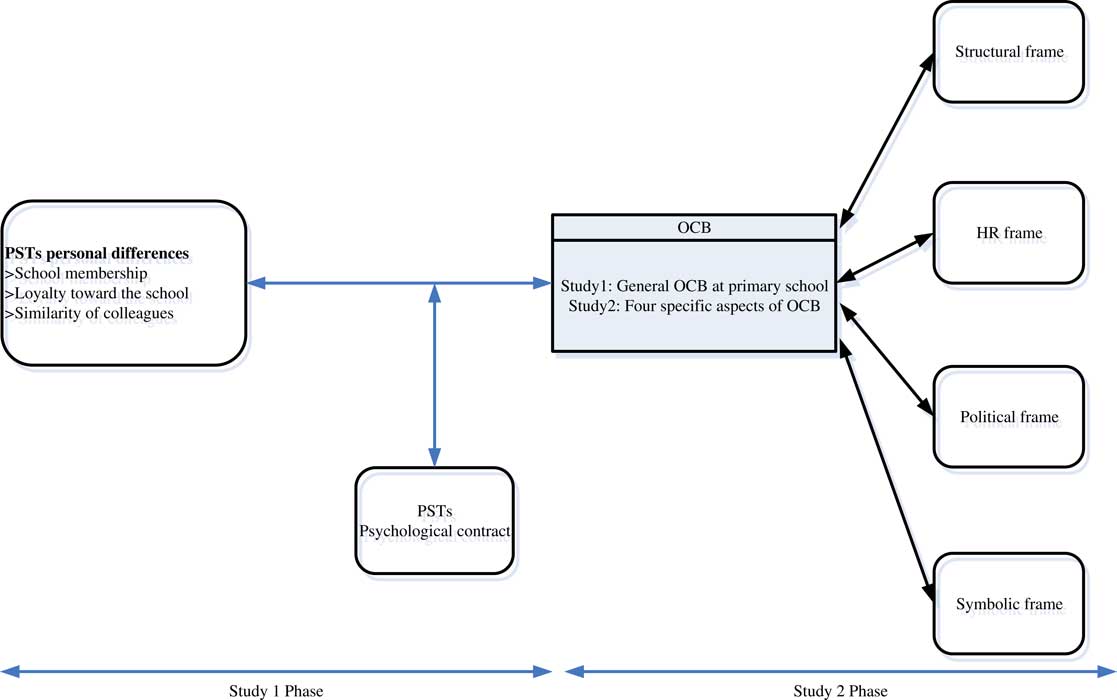
A review of the contemporary literature affirms that OCB within primary schools are associated with a number of factors, including: organisational membership, loyalty towards the organisation, similarity of colleagues, and leadership frames. Examining all of these factors within one series of studies was not feasible at this stage. Consequently, two research projects were conducted (see Figure 1, for the theoretical research framework). As Figure 1 shows, Study One analysed the relation between OCB, personal differences, and psychological contract (from a teachers’ perspective) and Study Two explored the relationship between OCB and leadership frames (PST’s perceptions of the principals’ leadership perspective).
Research theoretical framework. OCB=organisational citizenship behaviour; PST=primary school teachers

The proposed theoretical framework is important for a number of reasons. First, the framework is the first attempt of its kind and, if successfully verified, may contribute to an understanding OCB, and more specifically an understanding of OCB within a primary school context. Second, it may support personnel managers in their understanding of PSTs OCB within their school. Third, the framework includes reference to the role of the psychological contract in the PSTs OCB and so leads to two hypotheses, psychological contract should be associated with both OCB and personal differences, and that personal differences should influence both OCB and psychological contract. In operational terms, two hypotheses were proposed for Study One:
Hypothesis 1: Psychological contract may moderate the association between OCB and personal differences.
Hypothesis 2: Personal differences may influence OCB and the psychological contract.
Furthermore, in light of prior research claiming an important association between a principal’s leadership frames and teacher’s OCB, authors were keen to analyse differences between frames and how each frame affects OCB occurrence. As Bolman and Deal (Reference Bolman and Deal1997) explained the four leadership frames are different in essence, it is therefore reasonable to hypothesise that these four frames may interfere with each other in terms of facilitating OCB. Two hypotheses were proposed in Study Two:
Hypothesis 3: OCB is correlated with four leadership frames.
Hypothesis 4: Different leadership frames may interfere with each other in predicting OCB.
Study One
Research design
The education system in Taiwan is made of up to 14 years of schooling: 2 years of preschool education; 6 years of primary school; 3 years of junior high school; 3 years of senior high school, or vocational education. Currently it is compulsory for all children to attend school for 9 years: 6 years of primary school education and 3 years in junior high school. Ministry of Education in Taiwan has implemented 12 years of compulsory education since 2014. Moreover, a public PST can choose his/her school to work in serving 2 years (Ministry of Education, Reference Morgan2014). Therefore, PSTs are playing a influential and important role in the Taiwanese education system.
Due to the nonavailability of a database for the PSTs, it was difficult to construct a universe of PSTs and draw a random sample from it. Therefore, we adopted the procedure recommended by Lambe, Spekman, and Hunt (Reference Li2002) for data collection: in the first place, we identified a sample of personnel managers at each school who were likely to participate in the survey and we prescreened them a key informant approach was used to collect data (Campbell, Reference Chang and Smithikrai1955). Then we used a random sample technique of personnel managers as a seed sample. These personnel managers at each school were further asked to provide names of PSTs to enlarge the scope of subject recruitment. Therefore, a snowball sampling technique was used for identifying the informants (Creswell, Reference Dalal1994; Morgan, Reference Podsakoff, Ahearne and MacKenzie2008). This approach enabled me to access respondents who we would have otherwise not been able to locate.
Using PST as a research sample, an anonymous questionnaire survey will be conducted across 38 primary schools in Northwest Taiwan. Research participants were selected through a purposeful sampling procedure. Purposeful sampling is used to intentionally select individuals who can provide information for the understanding of a central phenomenon (Creswell, Reference Dalal1994). Two anonymous questionnaire surveys will be conducted, recruiting 600 PSTs, respectively. As the researcher is acquainted with some school managers and administrators, a snowball sampling technique will be employed to enlarge the scope of subject recruitment. To ensure the appropriateness of sample, only incumbent teachers are contacted via personnel managers and administrators whose responsibilities are for HRM of PSTs at each school. Questionnaires were distributed in booklet form, along with a cover-letter assuring anonymity and voluntary participation. The research aims were also briefly mentioned. A reminder letter was despatched 7 days after the initial invitation to boost the response rate. Questionnaires were then mailed back to the researchers. Among the 620 copies of questionnaires initially distributed, 574 were returned, of which 547 were useable (response rate=88.23%).
Characteristics of the subjects
All participants were incumbent PSTs. In all, 73.13% of these teachers were female, and 77.41% were graduates. There were three age groups, including: 30 years old and younger (15.53%), 31–40 years old (51.74%), and 41 years old and older (32.72%). There were four groups of working length (i.e., employment tenure), including: 5 and <5 years (28.52%), 6–10 years (28.33%), 11–15 years (23.40%), and 16 and >16 years (19.93%). In respect to the rank of position (from top to bottom), the figures were: PSTs with managerial roles (8.78%), PSTs with admin roles (21.02%), PSTs without admin roles or with class tutorship only (53.38%), and junior subject PSTs (16.82%).
Measurement
Study One adopted a cross-sectional approach to measure all variables simultaneously. An anti common method variance (CMV) strategy was also embedded in the measurement. To ameliorate the effects of CMV resulting from the utilisation of self-rated measures, the author collected the data in two stages. CMV emerges when self-rated measures are simultaneously used, as in some cases the observed relatiohsips between variables are inflated, jeopardising the reliability of data analysis (Podsakoff, MacKenzie, Lee, & Podsakoff, Reference Qureshi, Shahjehan, Zeb and Saifullah2003). A series of standardised scales were used, including:
PST’s psychological contract
Lin and Chen’s (Reference Locke2006) scale was used, which was composed of two subscales. The first subscale refers to a psychological contract of organisation, indicating how teachers think schools should perform and what services/policies should be practiced (i.e., from the perspective of PST’s). The second subscale refers to a psychological contract of PSTs, indicating how schools have been managed and what service/policies have actually been practiced within the school (i.e., the PST’s actual experiences and perceptions). For the sake of clarity, authors named the first subscale as expected psychological contract (EPC), and second subscale as perceived psychological contract (PPC). EPC had 20 items. Sample items included: the school should provide staff with safe working conditions and the school should provide sufficient resources, equipment, and relevant materials. Participants’ responses were recorded using a 5-point Likert scale (1=‘completely disagree’, to 5=‘completely agree’). Higher scores meant higher level of expectation, indicating that participants had stronger psychological contract expectation towards their schools. The internal consistency α was satisfactory (α=0.87). In contrast, the PPC had 24 items. Sample items included: the school has a good communication system and the school respects every single employee. Participants’ responses were recorded using a 5-point Likert scale (1=‘never’, to 5=‘always’). Higher scores meant more positive experiences and perceptions, indicating that participants had higher levels of psychological contract. The internal consistency α was satisfactory (α=0.84).
OCB
The teacher’s OCB scale (Cheng, Reference Creswell2004) was adopted to measure general OCB of PSTs. This scale was composed of 20 items. Sample items included: I am willing to make suggestions to the school and carry out administrative tasks with all my efforts and I always support and help new colleagues, even if they do not ask for help. Participants’ responses were recorded using a 5-point Likert scale (1=‘completely disagree’, to 5=‘completely agree’). Higher scores meant higher levels of OCB, indicating that participants demonstrate more OCB at their schools. The internal consistency α was satisfactory (α=0.94).
School membership
To measure PST’s membership at school, Cheney’s OID scale (Reference Cheng1983) was adopted, which was composed of five items. Sample items included: I often describe myself to others by saying that I work for my school and I am glad I chose to work for my school rather than other schools. Participants’ responses were recorded using a 5-point Likert scale (1=‘completely disagree’, to 5=‘completely agree’). Higher scores meant higher levels of membership, indicating that participants really believed they were members of their schools. The internal consistency α was satisfactory (α=0.92).
Loyalty towards the school
A standardised loyalty scale was used to measured PST’s loyalty towards their schools (Cheney, Reference Cheng1983). There were nine items in total. Sample items included: I am willing to put in a great deal of effort beyond normally expected to help my school to be successful and I feel very little loyalty to my school (reversed item). Participants’ responses were recorded using a 5-point Likert scale (1=‘completely disagree’, to 5=‘completely agree’). Higher scores meant higher levels of loyalty, indicating that participants demonstrated more loyalty towards their schools. The internal consistency α was satisfactory (α=0.94).
Similarity between colleagues
This variable was measured by Cheney’s (Reference Cheng1983) scale, which was composed of 11 items. Sample items included: I would describe my school as a large family in which most members feel a sense of belonging and I have a lot in common with others employed by the school. Participants’ responses were recorded using a 5-point Likert scale (1=‘completely disagree’, to 5=‘completely agree’). Higher scores meant higher levels of similarity, indicating that participants shared more similarities with their colleagues. The internal consistency α was satisfactory (α=0.94).
Back-translation procedure
There were five standardised scales used in Study One. The first two scales (i.e., psychological contract and OCB) were developed and validated in Traditional Chinese (official language in Taiwan), which was also the language used by the research sample. However, other three scales (i.e., school membership, loyalty towards the school, and similarity of colleagues) was originally developed and validated in English; hence, these three scales were translated into Traditional Chinese for the survey purpose, with a back-translation procedure to ensure language equivalence and appropriateness. Three experts were also invited to examine the validity and clarity of scale items. Revisions were then made accordingly.
CMV
Due to the cross-sectional design in the research, the likelihood of CMV bias may rise (Podsakoff et al., Reference Qureshi, Shahjehan, Zeb and Saifullah2003). In order to ameliorate the impact of potential bias, an additional social desirability scale (Reynolds, Reference Rousseau1982) was embedded within the survey (i.e., marker variable), to which the Pearson formula was applied to examine the correlation coefficients between social desirability scale and all variables (see details of CMV remedies in: Podsakoff et al., Reference Qureshi, Shahjehan, Zeb and Saifullah2003). To assess the potential for regression coefficient instability, collinearity diagnostics were conducted. Specifically, we calculated variance inflation factor scores, which measure the extent to which collinearity among the predictors affects the precision of a regression model in each step. Variance inflation is the consequence of multicollinearity. VIF scores of <10 typically are considered acceptable (Hair, Anderson, Tatham, & Black, Reference Hair, Black, Babin, Anderson and Tatham1998; Hair, Black, Babin, Anderson, & Tatham, Reference Herriot, Manning and Kidd2006).
We adopted Harmon’s single factor test to examine the potential CMV (Podsakoff et al., Reference Qureshi, Shahjehan, Zeb and Saifullah2003). All the research variables were Harman’s first merged into one factor, and the results showed poor fit, suggesting that one single factor of merging all variable was inappropriate for data analysis (χ2(236)=4875.65, p<.001, RMSA=0.21, NFI=0.65, CFI=0.67, IFI=0.67, SRMR=0.16). We then adopted an unmeasured latent construct method to measure the potential influence of CMV as recommended by Podsakoff et al. (Reference Qureshi, Shahjehan, Zeb and Saifullah2003). χ2 difference test was not statistically significant (△χ2(1)=3.63, not significant). Results were consistent with the findings of Harman’s single factor test. To simplify, the influence of CMV was very slim and hence the research data set should be accepted for further data analysis. Results showed that coefficients (α) were ranging from 0.18 to 0.59, and that no coefficient was close to (or higher than) 0.70. These statistical figures jointly indicated that CMV bias was unlikely to have occurred in the present research.
Findings of Study One
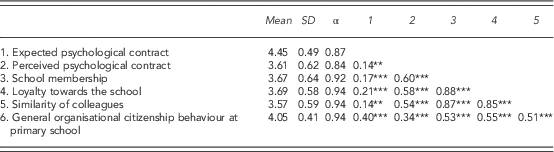
Intercorrelations (r), means (M), standard deviations (SD), and reliability (α) of all variables are reported in Table 1. These statistics show that OCB was positively correlated with a number of factors, including: EPC (r=0.40, p<.001), PPC (r=0.34, p<.001), school membership (r=0.53, p<.001), loyalty towards the school (r=0.55, p<.001), and similarity of colleagues (r=0.51, p<.001). Intercorrelations across other variables were also found significant (rs=0.14–0.88, ps<.01–0.001). These preliminary findings conveyed two important messages: (i) when OCB moves, other variables move along with it (i.e., correlation relationship); (ii) the significant intercorrelations provided sound foundations for further statistical analyses. Details follow.
Results of correlation analysis (Study 1)

Note. ***p<.05; **p<.01; *p<.05.
Hypothesis 1
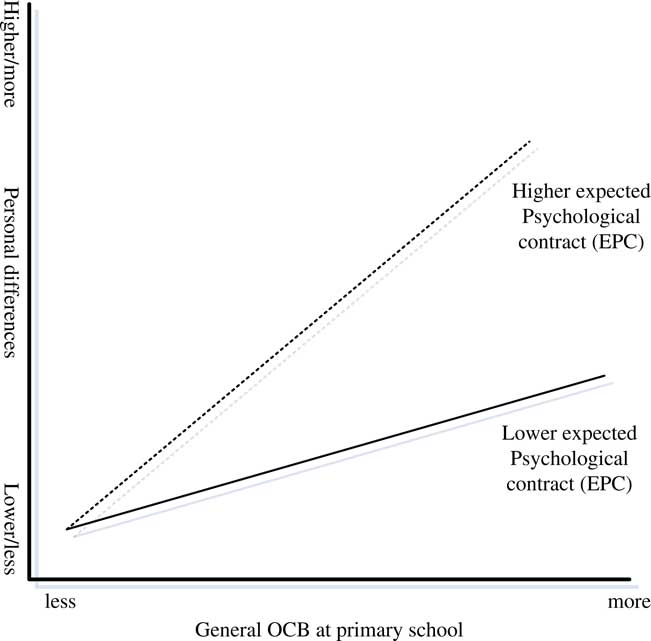
To examine the first hypothesis, a series of regression analyses were conducted. Two types of psychological contract (EPC, PPC) were regarded as potential moderators, OCB as outcome variables, and three personal differences as antecedents to OCB. Results showed that three personal differences were valid antecedents to OCB, including: school membership (β=0.08, p<.05), loyalty to their schools (β=0.28, p<.01), and similarity of colleagues (β=0.05, p<.05). EPC was also a valid antecedent to OCB (β=0.26, p<.01), but not PPC (β=0.01, not significant). In addition, school membership was significantly predicted by EPC (β=0.10, p<.05) and PPC (β=0.60, p<.001), loyalty toward the school was significantly predicted by EPC (β=0.15, p<.01) and PPC (β=0.58, p<.001), and similarity of colleagues was significantly predicted by EPC (β=0.08, p<.05) and PPC (β=0.50, p<.01). To sum up, EPC moderated the association between OCB and three personal difference (interaction ΔR 2 =0.23–0.36***) but PPC did not demonstrate such moderating effect (interaction ΔR 2 =0.05–0.08, not significant). To further explain EPC’s moderating effect, a concept figure was created (see Figure 2). In Figure 2, Y axis includes three personal differences, including: school membership (lower/higher), loyalty towards the school (less/more), and similarity of colleagues (less/more). For the sake of clarity, readings of three personal differences are not recorded on both X and Y axis.
Moderating effect of psychological contract. OCB=organisational citizenship behaviour

As Figure 2 shows, EPC facilitated OCB in line with personal differences. To be exact, when PSTs had higher levels of school membership, more loyalty toward the school and shared more similarity with their colleagues, they were more likely to demonstrate OCB. This phenomenon is most apparent for those with higher levels of EPC. In contrast, PSTs with higher levels of PPC did not show this moderating effect on the occurrence of OCB. Therefore, on the basis of these statistical figures, the first hypothesis is partially supported.
Hypothesis 2
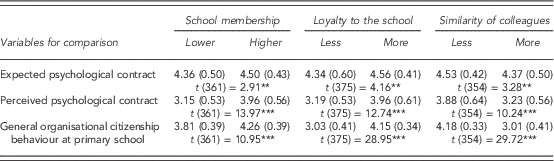
Due to the cross-sectional design, conventional regression analyses should not be adopted to examine the second hypotheses, the validity of the analysis may be compromised by linearity biases (e.g., it is problematic to define causal variables in simultaneous measurement. It is also difficult to detect the direction of causal effect). Hence, in order to examine whether personal differences have an influence on OCB, EPC, and PPC, a comparison analysis technique was utilised. In particular, in order to avoid the grey area effect during data interpretation, authors selected the top 33% and bottom 33% of entire sample from each personal difference variable. For instance, in terms of loyalty towards to the school, participants with more loyalty (top group) and less loyalty (bottom group) were selected for comparison (see Table 2). The same selection strategy was then applied to other variables, that is, school membership and similarity of colleagues.
Differences of personal differences (Study 1)

Note. ***p<.05; **p<.01; *p<.05.
As Table 2 shows, a series of independent samples t-tests were carried out, revealing a number of dissimilarities between conditions. Levene’s tests were conducted along with t-tests but no significance was discovered and hence omitted from Table 2 (for the sake of clarity). Major findings include: (i) PSTs with higher levels of school membership had higher EPC (t (361)=2.91, p<.01), higher PPC (t (361)=13.97, p<.001) and demonstrated more OCB at their schools (t (361)=10.95, p<.001); (ii) PSTs with more loyalty towards their school had higher EPC (t (375)=4.16, p<.01), higher PPC (t (375)=12.74, p<.001) and demonstrated more OCB at their schools (t (375)=28.95, p<.001); (iii) PSTs with more similarity had lower EPC (t (354)=3.28, p<.01), lower PPC (t (354)=10.24, p<.01) and demonstrated less OCB at their schools (t (354)=29.72, p<.001). These statistical figures may look erratic but all are suggestive of an important finding, that is, that personal differences were indeed crucial to EPC, PPC, and OCB. These figures also suggested that personal differences exerted influence over OCB and psychological contract. Hence, the second hypothesis was supported.
The authors adopted this comparison analysis technique as an alternative to conventional regression analysis, with the intention of clarifying the dissimilarity between conditions if such dissimilarity existed (similar strategies have been used in other studies, e.g., Cheng, Reference Creswell2004). It is important to note that the comparison analysis technique and a conventional regression analysis are predicated on different principles, a limitation well understood by the authors and thus findings are interpreted with caution. Further details are reported in the limitations and of the studies and future directions.
Study Two
Research design
Followed the same protocols as Study One, Study Two used PST as a research sample but participants were recruited from primary schools in Central Taiwan. The same sampling technique and questionnaire survey procedure were practiced as in Study One. Amongst the 550 copies of questionnaires initially distributed, 500 were returned, of which 488 were useable, resulting in a sound response rate (88.72%).
Characteristics of the subjects
All participants were incumbent PSTs. In all, 74.18% of these teachers were female. There were three age groups, including: 30 years old and younger (2.05%), 31–40 years old (13.52%), 41–50 years old (40.98%), and 51 years old and older (42.62%). There were four groups of working length (i.e., employment tenure), including: 2 and <2 years (4.10%), 3–10 years (32.79%), 11–20 years (45.29%), and >20 years (17.00%).
Measurement
A cross-sectional approach is adopted to measure all variables in Study Two, using two standardised scales. CMV is also diagnosed. Details follow:
OCB
The teacher’s OCB scale (Hsieh et al., Reference Hung2010) was adopted to measure four specific aspects of OCB. This scale was composed of four subscales, including: organisational identification (eight items; α=0.89), assisting colleagues (six items; α=0.90), job commitment and working morale (six items; α=0.81), and nonselfish behaviour (seven items; α=0.87). There were 27 items in total. Sample items from each subscale included: I am proud of being a member of my school, I am keen to share my work experiences with my colleagues in need, At school I tend to complete the tasks ahead of schedule, and At school I do not deal with personal business using school resources. Participants’ responses were recorded using a 5-point Likert scale (1=‘completely disagree’, to 5=‘completely agree’). Higher scores meant higher levels of OCB, indicating that participants demonstrated more OCB at their schools. The internal consistency α for all subscales was satisfactory (α=0.94).
Multi leadership frames
Principals’ leadership frame was measured by the Leadership Orientations Instrument (Bolman & Deal, Reference Bolman and Deal1990). There were four subscales to measure four specific frames of leadership, including: structural frame (eight items; α=0.92), HR frames (eight items; α=0.80), political frame (eight items; α=0.93), and symbolic frame (eight items; α=0.90). There were 32 items in total. Sample items from each subscale included: sets specific, measurable goals and holds people accountable for results, shows high sensitivity and concern for others’ needs and feelings, succeeds in the face of conflict and opposition, and serves as an influential model of Organisational aspirations and values. Participants’ responses were recorded using a 5-point Likert scale (1=‘completely disagree’, to 5=‘completely agree’). Higher scores meant higher levels of agreement, indicating that principals showed a specific leadership frame at school. The internal consistency α for all subscales was satisfactory (α=0.96).
Back-translation procedure
Two standardised scales were used in Study Two. The first scale (i.e., teacher’s OCB multi-scale) was developed and validated in Traditional Chinese, which was also the language used by the research sample. However, the second scale (i.e., Leadership Orientations Instrument) was originally developed and validated in English. Thus, this scale was translated into Traditional Chinese for the survey purpose, with a back-translation procedure to ensure language equivalence and appropriateness. Two experts were also invited to examine the validity and clarity of scale items. Revisions were then made accordingly.
CMV
Due to the cross-sectional design, all variables in Study Two were measured simultaneously, leading to the possibility of CMV bias (Podsakoff et al., Reference Qureshi, Shahjehan, Zeb and Saifullah2003). To examine the possibility of such bias, Harman’s one-factor diagnosis (test) was conducted. The rationale underlying the test is: if substantial CMV is present, either a single dominant factor would emerge, or one general factor would account for most of the covariance (>50% variance) in the independent and criterion variables (Podsakoff & Organ, 1986). Diagnostic results showed that five components emerged but variance (%) was relatively low (38%). After the rotation, the variance was even lower (25%). These statistical figures jointly affirmed that the possibility of CMV bias was relatively low in Study Two.
Findings of Study Two
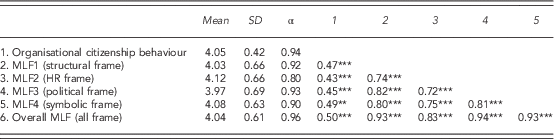
Intercorrelations (r), means (M), standard deviations (SD), and reliability (α) of all variables are displayed in Table 3. Specifically, we calculated VIF scores, which measure the extent to which collinearity among the predictors affects the precision of a regression model in each step. Variation inflation is the consequence of multicollinearity. VIF scores <10 are typically considered acceptable (Hair et al., Reference Hair, Black, Babin, Anderson and Tatham1998; Hair et al., Reference Herriot, Manning and Kidd2006). No VIF score exceeded 1.7. These statistics have shown a number of significant correlations between variables, providing a sound foundation for further examination of the research hypotheses.
Results of correlation analysis (Study 2)

Notes. MLF=multi leadership frames.
***p<.05; **p<.01; *p<.05.
Hypothesis 3
A series of correlation analyses are conducted to examine the relationships between OCB and multi leadership frames. Results have shown that OCB was associated with four different frames, including: structural frame (r=0.47, p<.001), HR frame (r=0.43, p<.001), political frame (r=0.45, p<.001), and symbolic frame (r=0.49, p<.001). These four correlation coefficients (r) were all significant and positive, indicating that, when OCB changes, these leadership frames may change in the same direction. Alternatively, when these leadership frames change, OCB will move along with frames accordingly. When all four leadership frames were put together and analysed as one, leadership frame was still positively correlated with OCB (r=0.50, p<.001). In other words, the statistical analysis provides considerable support for the third research hypothesis.
Hypothesis 4
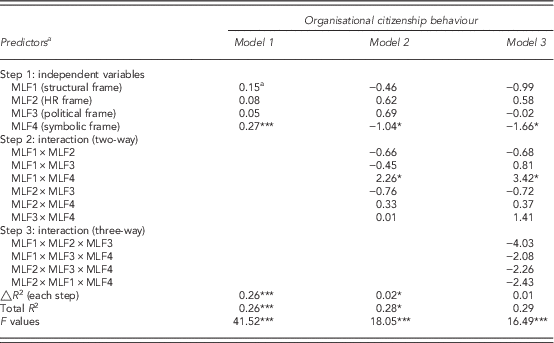
To examine the fourth hypothesis, a hierarchical regression analysis was conducted, with three steps embedded. The dependent variable was OCB, and the independent variables (aka. predictors) were four different leadership frames, including: structural frame, HR frame, political frame, and symbolic frame. In Step 1, these four leadership frames were entered as predictors (each frame stands alone). In Step 2, the interactions between two frames (two-way interaction) were entered as predictors. In the final step, the interactions between three frames (three-way interaction) were entered as predictors. Results are manifested in Table 4.
Results of hierarchical regression analyses (Study 2)

Notes. aStandardised regression coefficients (β) are shown in each equation. N=483.
MLF=multi leadership frames.
***p<.05; **p<.01; *p<.05.
In Step 1, when four leadership frames were entered into the regression equation, only symbolic frame significantly predicted OCB (β=0.27, p<.001). In Step 2, when six different interactions (two-way interaction) were entered into the regression equation, only the interaction between symbolic frame and structural frame significantly predicted OCB (β=2.26, p<.05). In Step 3, when four different interactions (three-way interaction) were entered into the regression equation, none of the variables significantly predicted OCB. That is, only one two-way interaction significantly predicted OCB and no three-way interactions could predict OCB significantly. Moreover, the regression coefficients of symbolic frame (as a predictor to OCB) reduced from 0.27 (Step 1), −1.04 (Step 2) to −1.66 (Step 3). The variance of adjusted R 2 has also shown a reduction pattern from Step 1 (△R 2=0.26, p<.001), Step 2 (△R 2=0.02, p<.05) to Step 3 (△R 2=0.01, not significant). In sum, the analysis provided ample evidence in support of the fourth hypothesis; that different leadership frames do interfere with each other in predicting OCB.
Additional analysis
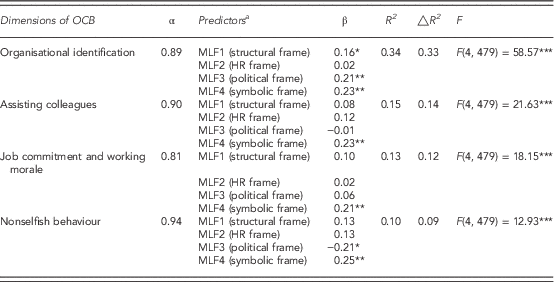
There were four specific aspects of OCB measured in Study Two, including: organizational identification (α=0.89), assisting colleagues (α=0.90), job commitment and working morale (α=0.96), and nonselfish behaviour (α=0.96). In order to clarify the relationships between OCB aspects and leaderships frames. Additional analysis was carried out. The four aspects of OCB were treated as dependent variables, whereas different leadership frames were treated as independent variables (aka. predictors). A series of multiple regression analyses were undertaken. The collinearity of four leadership frames were simultaneously examined and indicated that the possibility of collinearity bias was low (CI=30.30). Results of analyses are presented in Table 5.
OCB dimensions and predictors (Study 2)

Notes. aThe collinearity of four MLF predictors were checked (CI=30.30), indicating low possibility of collinearity bias.
MLF=multi leadership frames; OCB=organisational citizenship behaviour.
***p<.05; **p<.01; *p<.05.
As Table 5 shows, the first aspect of OCB (i.e., organisational identification) was significantly predicted by structural frame (β=0.16, p<.05), political frame (β=0.21, p<.01), and symbolic frame (β=0.23, p<.01). The second and third aspects of OCB (i.e., assisting colleagues, job commitment, and working morale) were only predicted by symbolic frame (βs=0.21, 0.23, ps<.01, respectively). The final aspect of OCB (i.e., nonselfish behaviour) was predicted by political frame (β=−0.21, p<.05) and symbolic frame (β=0.25, p<.01). Across four aspects of OCB, only symbolic frame remained as a constant predictor (Fs (4, 479)=58.57, 21.63, 18.15, and 12.93, ps<0.01, respectively). That is, only the symbolic leadership frame could predict every aspect of OCB.
General Discussion
OCB has been shown to have a profound influence on the productivity and the success of an organisation. The impact of OCB within schools warrants further exploration particularly in light of the significant role PSTs have on the developmental trajectories of young people in society. The current research, steered by findings from the corpus of literature in this field, elected to systematically examine personal differences and leadership frames in conjunction with their influence on OCB within a primary school context. This approach contrasts with that of its’ predecessors by synthesising findings in a way that appreciated that OCB within a primary school context may be multi-faceted and complex in nature. Consequently, the authors have used the findings from the two studies outlined above to generate a theoretical framework that offers a comprehensive account of PSTs’ OCB. In the current research, authors were interested in several related questions: what factors may encourage increased displays of OCB by PSTs in their workplace? Compared against employees from alternative occupations and organisations, do PSTs (school employees) require different vocational parameters or incentives to display OCB within their schools? Do different leadership frames (as executed by principals) facilitate OCB at school? Based on the findings from this research, the authors offer a number of answers to the questions posed, acknowledging that while these answers may not offer the only interpretation of the data, they do have a significant contribution to make. The findings go some way to bridge a number of the gaps evident in the literature to date and provide a sound foundation upon which future research can build. The findings facilitate an understanding of PSTs OCB in a number of important ways:
To begin with, authors understood that PST’s OCB may be associated with school membership (Cheng, Reference Creswell2004), loyalty towards the school (Bommer, Miles, & Grover, Reference Bommer, Miles and Grover2003a), similarity of colleagues (International Labour Organization, Reference Irving and Bobocel2012), psychological contract (Meckler et al., 2003; Lin & Chen, Reference Locke2006; George, Reference Golding2009), and principal’s leadership frames (Bolman & Deal, Reference Bolman and Deal1997; Somech & Oplatka, Reference Somech and Ron2015). On the basis of this understanding, a new theoretical framework to account for PST’s OCB was developed and examined (see Figure 1). Although the robustness of such a framework cannot be verified via a structural equation modelling technique (due to limitations with the research design), it is a framework that provides a blueprint to explain the occurrence of OCB within primary school contexts. The framework received preliminary support (i.e., statistically sound), and several meaningful interpretations are made. First, the statistical findings from both correlation and regression analyses have affirmed that three personal differences are important to the occurrence of OCB within primary schools. That is, when PSTs reported higher levels of school membership, greater loyalty toward the school and could observe high levels of similarity between themselves and colleagues, they were more likely to demonstrate OCB. It could be argued that this interpretation is an artefact of a cross-sectional design so to guard against this potential criticism further analyses were conducted (see Table 2). Further analyses revealed a dovetail effect whereby the findings from previous correlational/regression analyses and the present examination concur, thus lending considerable support to the suggestion that the personal differences reported by PSTs may indeed serve as antecedents of OCB at primary schools.
Second, only EPC was found to moderate the association between OCB and all three personal differences, indicating that PSTs with higher levels of EPC were more likely to demonstrate OCB at school. PPC did not demonstrate such a moderating effect. Authors proposed two possible explanations for this unexpected phenomenon: (i) PPC directly reflects the actual experiences of PSTs, whereas EPC is based primarily on expectations (or wishes) towards the school. PPC may be a better representation of reality rather than desire. It is possible then, that this disparity between actual experience and expectation underlies the difference in the two measures moderating properties. Alternatively, PPC does not act as a predictor/moderator to OCB; (ii) There may be factors underlying (or influencing) EPC and PPC, that are not measured in the current research, or (iii) there are more than two types of psychological contract for PSTs. Authors intend to conduct further investigations of this phenomenon in the future.
Third, there are four leadership frames measured in the current research but only symbolic leadership frame acted as a constant predictor for the four aspects of OCB at school. This has a number of interesting implications: (i) different leadership frames may interfere with each other. When school principals adopt multi leadership frames, they should be aware of possible consequences, for example, their leadership frames may not always promote the occurrence of PST’s OCB; (ii) Bolman and Deal (Reference Bolman and Deal1997), claim that effective leaders are multi-framed, because flexibility in leadership frame affords a leader with a range of operating frames that can be drawn upon to meet the demands of a given situation. However, based on the current findings, caution would be recommended in the concurrent use of multiple fames, rather, each situation may be better served by a single frame. That is, the second leadership frame should not be initiated until the first one is completed; (iii) neither the structural nor the HR frame predicted any aspect of OCB, implying that these two frames do not contribute to the occurrence of OCB.
Implications for practice
Personnel managers and school principals may discover that these findings have utility for the determination of future support mechanisms and the institution of new policies. The first challenge is to recognise and embrace the discovery that personal differences have a crucial role to play in OCB. However, such differences are difficult to manipulate directly, so in the first instance, managers may be best served by looking at the roles of the psychological contract and their own leadership frame. The theoretical framework developed here demonstrates that the psychological contract (especially EPC) can help moderate the association between personal differences and OCB, and that the principals’ own leadership frame is also highly relevant in the production of OCB (in particularly the symbolic frame). In short, EPC and the use of a symbolic frame emerge as major factors in the production OCB within a primary school context.
Moreover, as personal differences are important to OCB, principals and managers may wish to recognise this within their recruitment procedures (e.g., include a selection filter), such that candidates possessing the qualities identified as important for the development of OCB in school are employed. Finally, school managers should be aware that reliance on multi leadership frames does not necessarily promote OCB or indeed create conditions for effective leadership. Rather, the research suggests that using a single leadership frame is more likely to promote OCB within their primary school. This final suggestion runs counter to previous research (Bolman & Deal, Reference Bolman and Deal1997), but, is important to report given the impact of leadership frame on OCB.
Limitations of the studies and future directions
In Study One, authors adopted a comparison analysis technique to examine the second hypothesis. This technique is operated on the assumption that within heterogeneity does not exist across variables, such that statistical divisions and subsequent computations possess coherence. However, such an assumption may be contentious and may affect the validity of the data interpretation (if heterogeneity does exist). To overcome this potential problem, future researchers may elect to use a longitudinal design and so measure variables at different intervals, providing enhanced conditions for comparison and the analysis of causal relationships.
In both studies, for pragmatic reasons only incumbent PSTs (i.e., academic staff) were recruited. Nonacademic staff were largely excluded, including: administrators, secretaries, and other maintenance staff. This limitation is important because it fails to appreciate the employment context in its entirety. It is necessary to collect the experiences and responses from all employees within the school in order to make claims about OCB. It may be the case that academic and nonacademic staff have entirely different views of OCB and these differences may manifest in ways that promote or diminish the level of observed OCB. Another limitation of this study is the use of snowball sampling technique. Thus, we tried to construct an experimental situation that not only had ecological validity because it was representative of many PSTs to enrich the raw data set, but more importantly, an experimental situation that caused our sample to get involved in the task and assign relevant meaning to it (Locke, Reference Meckler, Drake and Levinson1986). However, the sample was not drawn at random and is prone to community bias as the initial respondents influence the final sample (Atkinson & Flint, Reference Atkinson and Flint2004). The sample in the study may not accurately reflect the population, and it may be difficult to estimate the required sample size as the population size is not known (Creswell, Reference Dalal1994; Morgan, Reference Podsakoff, Ahearne and MacKenzie2008). These limitations are worthy of attention in future research endeavours.
Conclusion
Using PSTs in Taiwan as a research sample, two studies were conducted to elucidate the mechanisms by which OCB manifests within primary school contexts. Study One analysed the relationship between OCB and PST’s personal differences and Study Two explored the relationship between leadership frames and the prevalence of OCB. Analysis revealed support for the proposed theoretical framework, affirming the existence of a relationship between OCB and personal differences. The differences included: school membership, loyalty towards the school and similarity of colleagues. These variables were moderated by PST’s psychological contract with their schools. In contrast to contemporary studies, Study Two discovered that different leadership frames interfered with each other when predicting OCB, and that only symbolic leadership frame predicted all aspects of OCB, including: organisational identification, assisting colleagues, job commitment, working morale, and nonselfish behaviour. The conclusion of the research could be generalised to the Asian and collectivistic cultures, more precisely to female teachers. In terms of the contribution this research makes to the existing OCB literature, findings from both studies not only identified factors that facilitate OCB at primary schools but also explained how personal differences and principal’s leadership frames affect its’ prevalence. Applications to HR practice and OCB theorising are also evidenced, the new theoretical framework presents opportunities for school principals and personnel managers to better understand OCB and work on strategies to maximise its’ occurrence within their schools.
Acknowledgements
The author is grateful for the sponsorship by the Ministry of Science and Technology in Taiwan (MOST104-2914-I-134-001-A1). The views and conclusions contained herein represent the author’s own and not the sponsor’s.