Introduction
In view of the expected increase in the number of people with dementia, elderly people in The Netherlands – as well as in other countries – are fearful of developing Alzheimer's disease (AD) or a similar dementing illness (Commissaris et al., Reference Commissaris, Jolles, Verhey, Ponds, Damoiseaux and Kok1993; Laforce and McLean, Reference Laforce and McLean2005). Recently, the Dutch Health Council reported that many elderly people perceive living with dementia as a state of severe suffering due to increasing dependence on others and the progressive loss of autonomy and identity (loss of self) (Cohen and Eisdorfer, Reference Cohen and Eisdorfer1986; Gezondheidsraad, 2002). As a result, an increasing number of elderly “at risk” are looking for ways to avoid a life with dementia. In The Netherlands and Belgium this has led people to complete a (written) advance directive, in which they refuse all medical treatment and/or request euthanasia in case they develop symptoms of dementia. The use of advance directives, and in particular advance requests for euthanasia, by patients with dementia remains a much-debated topic and involves several moral dilemmas (Hertogh et al., Reference Hertogh, de Boer, Dröes and Eefsting2006). One of the issues discussed in this debate is whether having dementia truly involves the anticipated suffering. This question can only be answered by listening to the voices of people with dementia themselves, who – until now – have been noticeably absent in this debate.
This state of affairs seems related to a more general negligence of the patient's perspective in dementia research. For long it was assumed that data collected from people with dementia themselves were unreliable because of their cognitive impairment, and therefore unusable (Aggarwal et al., Reference Aggarwal, Vass, Minardi, Ward, Garfield and Cybyk2003; Kitwood, Reference Kitwood1997; Nolan et al., Reference Nolan, Ryan, Enderby and Reid2002).
More recently there is increasing acknowledgement that people with dementia are able to express views, needs and concerns (Aalten et al., Reference Aalten, van Valen, Clare, Kenny and Verhey2005b; Clare, Reference Clare2003; Clare et al., Reference Clare, Roth and Pratt2005; Cotrell, Reference Cotrell1997; Phinney, Reference Phinney2002) and several researchers have stressed the importance of incorporating the subjective experience of people with dementia in research (Brod et al., Reference Brod, Stewart, Sands and Walton1999; Dröes et al., Reference Dröes2006; Keady et al., Reference Keady, Nolan and Gilliard1995; Kitwood, Reference Kitwood1997; Logsdon et al., Reference Logsdon, Gibbons, McCurry and Teri2002; Phinney, Reference Phinney1998) in order to better meet their needs for care (Sabat, Reference Sabat2002). Nonetheless, the number of studies dealing with the experiences of having and coping with dementia as expressed by the sufferers themselves has increased relatively slowly.
The main aim of this article is to gain a better understanding of how people with dementia experience and value their situation. Insight in these issues serves multiple goals. First of all, gathering information on the patient's perspective on living through dementia will help to test the above-mentioned assumptions in the general public with regard to the specific suffering that dementia involves. Secondly, focusing on the experiences of people with dementia can help those who live with a fear of dementia to develop a more realistic picture. Both of these aims are relevant in the light of the discussion on advance directives. Finally, as indicated above, the views of people with dementia are also of primary importance for the development of good care tailored to their needs. In order to achieve these goals the article provides an overview of the international literature on the experiences of living through dementia as expressed by those living with it.
Method
We explored the available clinical and scientific literature on the experiences of living through dementia as expressed by the sufferers themselves. No distinction as to the type of dementia was made, as many of the retrieved studies involve multiple types of dementia or do not specify the types of dementia involved.
Procedure
The international literature was searched using the most common scientific databases: PubMed (search date 14 September 2006) and PsycINFO (search date 14 September 2006). To identify as many papers as possible an extensive search without time limitations was conducted for both databases using combinations of multiple terms. Both “controlled terms” (MeSH in PubMed and Thesaurus in PsycINFO) and “free text terms” were used, and placed into four categories. The first category involved terms that capture all forms of dementia. A second category involved all terms related to aspects of “suffering” and “personal experiences” of dementia. As this paper focuses on the patient's perspective a third category was added to include different types of research. The last category involved terms that would include all papers written in Dutch, English, German and French. The databases were searched using “or-relations” within these categories; between categories “and-relations” were applied. (A detailed account of the searches conducted can be obtained from the corresponding author.)
The search resulted in a vast amount of potentially relevant papers. In order to determine their eligibility for inclusion, two of the authors independently assessed the identified studies by title and/or abstract. Because of the explorative character of the study, inclusion criteria as to type of publication were set broadly; scientific books, clinical reports and case studies were also included. Only publications describing aspects of dementia from the patient's perspective in the form of quotations, i.e. “as told by the dementia sufferers themselves,” were taken into account. The inclusion of ego-documents or biographies of people with dementia was restrained, because some of the authorships are debatable (Basting, Reference Basting2003). Articles concerned with descriptions of dementia as viewed by caregivers or proxies were therefore excluded as were articles based on an interpretation of experiences and quantitatively oriented papers not addressing the patient's perspective directly. In order to explore further, the reference lists of identified articles were searched for additional relevant articles. Papers pointed out to us by other researchers were also added. In cases of disagreement on the inclusion of papers, the authors who assessed the paper deliberated until they reached consensus.
Data analysis
All included papers were read carefully and analyzed for experiences of living through dementia. Our intention was not to give a full description of all details covered in these papers, but to provide a general thematic overview of what is known about experiencing dementia from the patient's perspective. Therefore all the relevant information was analyzed and categorized into several themes. This categorization was then discussed in the research group in order to reach consensus on completeness and clearness. The names of these themes are mostly terms that are also used in several of the retrieved papers. Careful analyses of the themes by the authors showed they all dealt in one way or another with two central themes: impact and coping. These central themes, along with the subthemes, were used to provide a clear structure of the results as presented in this paper. Most themes presented below are illustrated by examples and quotations from patients themselves, taken from some of the identified studies.
Results
The initial literature search provided us with a total of 2035 hits:1371 from PubMed, 448 from PsycINFO and 216 emerging in both databases. After careful selection only 289 could be included. Another 22 papers were added from other sources, such as reference lists, colleagues and other researchers, resulting in a total of 50 papers.
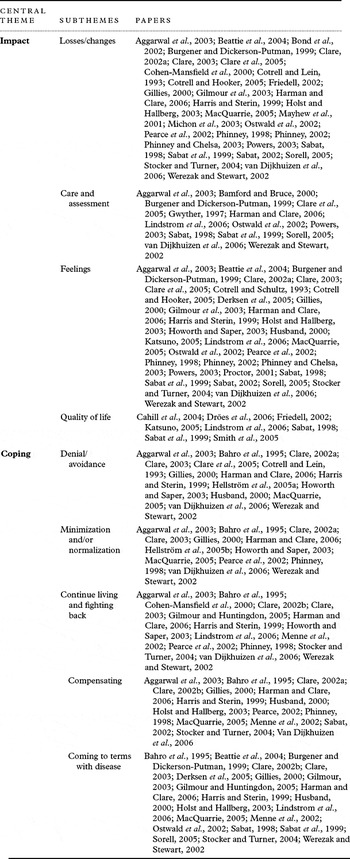
An overview of the two central themes and subthemes covered in the papers is presented in Table 1. We want to emphasize, however, that due to their close relationships, the identified (sub)themes are not mutually exclusive. The majority of the included studies cover multiple themes, and are therefore mentioned more than once.
Central themes and subthemes on living through dementia from the patient's perspective as covered in the literature.

Impact
Losses/changes
People who develop dementia often gradually realize something is wrong (Clare, Reference Clare2003). In the majority of the retrieved articles, attention is given to the changes that those afflicted notice, which are often expressed as losses. Memory loss is among the most serious concerns for most (Aggarwal et al., Reference Aggarwal, Vass, Minardi, Ward, Garfield and Cybyk2003; Clare, Reference Clare2002a; Clare et al., Reference Clare, Roth and Pratt2005; Cotrell and Hooker, Reference Cotrell and Hooker2005; Gillies, Reference Gillies2000; Gilmour et al., Reference Gilmour, Gibson and Campbell2003; Harman and Clare, Reference Harman and Clare2006; Harris and Sterin, Reference Harris and Sterin1999; Holst and Hallberg, Reference Holst and Hallberg2003; Lindstrom et al., Reference Lindstrom2006; MacQuarrie, Reference MacQuarrie2005; Mayhew et al., Reference Mayhew, Acton, Yauk and Hopkins2001; Ostwald et al., Reference Ostwald, Duggleby and Hepburn2002; Pearce et al., Reference Pearce, Clare and Pistrang2002; Phinney, Reference Phinney1998; Phinney, Reference Phinney2002; Phinney and Chelsa, Reference Phinney and Chelsa2003; van Dijkhuizen et al., Reference van Dijkhuizen, Clare and Pearce2006; Werezak and Stewart, Reference Werezak and Stewart2002), but many also experience difficulties with communication or verbalization (Aggarwal et al., Reference Aggarwal, Vass, Minardi, Ward, Garfield and Cybyk2003; Holst and Hallberg, Reference Holst and Hallberg2003; MacQuarrie, Reference MacQuarrie2005; Mayhew et al., Reference Mayhew, Acton, Yauk and Hopkins2001; Phinney, Reference Phinney1998; Phinney and Chelsa, Reference Phinney and Chelsa2003; Sabat, Reference Sabat1998) or orientation (Phinney, Reference Phinney1998; van Dijkhuizen et al., Reference van Dijkhuizen, Clare and Pearce2006). Also described are experiences of loss of control (Burgener and Dickerson-Putman, Reference Burgener and Dickerson-Putman1999; Clare, Reference Clare2003; MacQuarrie, Reference MacQuarrie2005; Michon et al., Reference Michon, Gargiulo and Rozotte2003), autonomy (Harris and Sterin, Reference Harris and Sterin1999; Holst and Hallberg, Reference Holst and Hallberg2003; MacQuarrie, Reference MacQuarrie2005; van Dijkhuizen et al., Reference van Dijkhuizen, Clare and Pearce2006) and independence (Beattie et al., Reference Beattie, Daker-White, Gilliard and Means2004; Cotrell and Lein, Reference Cotrell and Lein1993; Cotrell and Hooker, Reference Cotrell and Hooker2005; Gillies, Reference Gillies2000; MacQuarrie, Reference MacQuarrie2005; Powers, Reference Powers2003).
People with dementia speak about gradually losing abilities, skills or competency to execute formerly “normal” activities or work (Bond et al., Reference Bond, Corner, Lilley and Ellwood2002; Burgener and Dickerson-Putman, Reference Burgener and Dickerson-Putman1999; Cohen-Mansfield et al., Reference Cohen-Mansfield, Golander and Arnheim2000; Cotrell and Hooker, Reference Cotrell and Hooker2005; Gillies, Reference Gillies2000; Harman and Clare, Reference Harman and Clare2006; Harris and Sterin, Reference Harris and Sterin1999; Husband, Reference Husband2000; Phinney and Chelsa, Reference Phinney and Chelsa2003; Sabat, Reference Sabat1998; Sabat, Reference Sabat2002; Sorrell, Reference Sorrell2005; Stocker and Turner, Reference Stocker and Turner2004).
“Lose my mind, ability to know what is going on – I want to observe and feel part of life.” “There is nothing left when you lose your mind.” “Not be able to do anything . . . I don't want to lose everything.” (Cotrell and Hooker, Reference Cotrell and Hooker2005)
One paper addresses the actual loss of personal objects in nursing homes (Powers, Reference Powers2003). The impact of both this material loss and all the other more intangible psychological losses affects the person's self (Cohen-Mansfield et al., Reference Cohen-Mansfield, Golander and Arnheim2000; Cotrell and Hooker, Reference Cotrell and Hooker2005; Friedell, Reference Friedell2002; Harman and Clare, Reference Harman and Clare2006; Harris and Sterin, Reference Harris and Sterin1999; Sabat et al., Reference Sabat, Fath, Moghaddam and Harré1999). The loss of self and self-esteem has an effect on people's personality (Harman and Clare, Reference Harman and Clare2006; MacQuarrie, Reference MacQuarrie2005), their feelings of respect and human dignity (Friedell, Reference Friedell2002; Harris and Sterin, Reference Harris and Sterin1999), but also influences meaningful roles in relationships with others (Harris and Sterin, Reference Harris and Sterin1999).
“We used to be on equal footing with each other, a marriage of two accomplished people. Now, he is the caregiver and I am the caregiven.” (Harris and Sterin, Reference Harris and Sterin1999)
Relationships
The importance of relations with others is stressed in several accounts of dementia sufferers (Cohen-Mansfield et al., Reference Cohen-Mansfield, Golander and Arnheim2000; Derksen et al., Reference Derksen, Vernooij-Dassen, Gillissen, Olde-Rikkert and Scheltens2005; Gillies, Reference Gillies2000; Gilmour et al., Reference Gilmour, Gibson and Campbell2003; Gilmour and Huntington, Reference Gilmour and Huntington2005; Hellström et al., Reference Hellström, Nolan and Lundh2005a; Holst and Hallberg, Reference Holst and Hallberg2003; Michon et al., Reference Michon, Gargiulo and Rozotte2003; Ostwald et al., Reference Ostwald, Duggleby and Hepburn2002; Phinney and Chelsa, Reference Phinney and Chelsa2003; Sabat, Reference Sabat1998; Sabat et al., Reference Sabat, Fath, Moghaddam and Harré1999; van Dijkhuizen et al., Reference van Dijkhuizen, Clare and Pearce2006; Werezak and Stewart, Reference Werezak and Stewart2002). Some individuals with dementia realize there can be a difference between their own and other people's perception of what is happening:
“But aside from that I don't really have too much problem. At least I don't. Maybe other people do. You know, my wife and my kids, they probably find a big change or something.” (MacQuarrie, Reference MacQuarrie2005).
The opinion of others is of importance to many people with dementia (Harman and Clare, Reference Harman and Clare2006; MacQuarrie, Reference MacQuarrie2005; Michon et al., Reference Michon, Gargiulo and Rozotte2003), even to the extent that some of them express being worried about others finding out about their diagnosis or being afraid others won't listen to them (Gillies, Reference Gillies2000; Harman and Clare, Reference Harman and Clare2006; Husband, Reference Husband2000; Ostwald et al., Reference Ostwald, Duggleby and Hepburn2002; Stocker and Turner, Reference Stocker and Turner2004; Werezak and Stewart, Reference Werezak and Stewart2002), due to the possibility of stigmatization (Michon et al., Reference Michon, Gargiulo and Rozotte2003; Sabat, Reference Sabat2002), as is very well expressed by a woman with Alzheimer's:
“Can it be that the term ‘Alzheimer's’ has a connotation similar to the ‘Scarlet Letter’ or ‘Black Plague’? Is it even more embarrassing than a sexual disease?” (Sabat, Reference Sabat2002)
Experiences of imposed limitations (such as family members insisting they quit driving or family members taking over responsibilities) (Burgener and Dickerson-Putman, Reference Burgener and Dickerson-Putman1999; Sorrell, Reference Sorrell2005) or (fear of) increased supervision (Gilmour et al., Reference Gilmour, Gibson and Campbell2003; Michon et al., Reference Michon, Gargiulo and Rozotte2003; Werezak and Stewart, Reference Werezak and Stewart2002) by those around them are also described by people with dementia. Besides family members and other close relations, the way people are treated by medical personnel also influences their well being (Clare, Reference Clare2002a; Harman and Clare, Reference Harman and Clare2006; Proctor, Reference Proctor2001; Stocker and Turner, Reference Stocker and Turner2004; Werezak and Stewart, Reference Werezak and Stewart2002).
Care and assessment
People with dementia express both positive and negative experiences with care and assessment (Aggarwal et al., Reference Aggarwal, Vass, Minardi, Ward, Garfield and Cybyk2003; Burgener and Dickerson-Putman, Reference Burgener and Dickerson-Putman1999; Clare et al., Reference Clare, Roth and Pratt2005; Harman and Clare, Reference Harman and Clare2006; Powers, Reference Powers2003; Sabat et al., Reference Sabat, Fath, Moghaddam and Harré1999; Sorrell, Reference Sorrell2005; van Dijkhuizen et al., Reference van Dijkhuizen, Clare and Pearce2006; Werezak and Stewart, Reference Werezak and Stewart2002). Some feel that little information is communicated to them (Harman and Clare, Reference Harman and Clare2006; van Dijkhuizen et al., Reference van Dijkhuizen, Clare and Pearce2006) while many people with dementia believe that full disclosure of the diagnosis is “the right thing” (Ostwald et al., Reference Ostwald, Duggleby and Hepburn2002; Sorrell, Reference Sorrell2005). The way the diagnosis is communicated, however, can be a devastating experience (Werezak and Stewart, Reference Werezak and Stewart2002). Some indicate they notice or expect little effect from medication (Clare et al., Reference Clare, Roth and Pratt2005; Harman and Clare, Reference Harman and Clare2006; Lindstrom et al., Reference Lindstrom2006); nevertheless people with dementia express a hope that medication would help them (Lindstrom et al., Reference Lindstrom2006). Some people with dementia express enjoyment in receiving (day)care, but conversely others speak of a lack of stimulation with regard to activities and/or levels of contact with other people in a residential care setting (Aggarwal et al., Reference Aggarwal, Vass, Minardi, Ward, Garfield and Cybyk2003; van Dijkhuizen et al., Reference van Dijkhuizen, Clare and Pearce2006). Some people feel that they are constantly confronted with what they can't do (Sabat, Reference Sabat1998; Sabat et al., Reference Sabat, Fath, Moghaddam and Harré1999) and again others express concerns about safe handling and measures taken to protect personal belongings (Powers, Reference Powers2003). Interestingly enough, when it comes to outcome measures of care, the values and preferences of people with dementia may well differ from those of their caregivers, families and other relatives (Bamford and Bruce, Reference Bamford and Bruce2000; Gwyther, Reference Gwyther1997). Bamford and Bruce (Reference Bamford and Bruce2000), for example, concluded that “maximising a sense of autonomy” was a key outcome for people with dementia, which was relatively neglected in earlier studies.
Feelings
The onset of dementia involves a great variety of feelings that are described in many of the retrieved papers (see Table 1). Many experience feelings of fear, insecurity, confusion or disbelief when they start to realize “something is wrong”. This might even cause them to feel like they are “going mad” (Beattie et al., Reference Beattie, Daker-White, Gilliard and Means2004; Clare, Reference Clare2003; Clare et al., Reference Clare, Roth and Pratt2005; Derksen et al., Reference Derksen, Vernooij-Dassen, Gillissen, Olde-Rikkert and Scheltens2005; Harris and Sterin, Reference Harris and Sterin1999; Holst and Hallberg, Reference Holst and Hallberg2003; Husband, Reference Husband2000; Pearce et al., Reference Pearce, Clare and Pistrang2002; Phinney, Reference Phinney1998; Phinney, Reference Phinney2002; Powers, Reference Powers2003; Proctor, Reference Proctor2001; Sabat, Reference Sabat1998).
“I'm mad as hell . . . [Alzheimer's] is constantly on my mind.” (Sabat, Reference Sabat1998)
While for some having dementia brings confusion, shock, sorrow or anxiety (Gillies, Reference Gillies2000; Holst and Hallberg, Reference Holst and Hallberg2003; Howorth and Saper, Reference Howorth and Saper2003; MacQuarrie, Reference MacQuarrie2005; Ostwald et al., Reference Ostwald, Duggleby and Hepburn2002; Phinney and Chelsa, Reference Phinney and Chelsa2003; Sabat, Reference Sabat1998; Stocker and Turner, Reference Stocker and Turner2004; Werezak and Stewart, Reference Werezak and Stewart2002), others experience strong feelings of discontent like annoyance, anger, distress or frustration (Aggarwal et al., Reference Aggarwal, Vass, Minardi, Ward, Garfield and Cybyk2003; Beattie et al., Reference Beattie, Daker-White, Gilliard and Means2004; Cotrell and Schulz, Reference Cotrell and Schulz1993; Gillies, Reference Gillies2000; Gilmour et al., Reference Gilmour, Gibson and Campbell2003; Harris and Sterin, Reference Harris and Sterin1999; Holst and Hallberg, Reference Holst and Hallberg2003; Howorth and Saper, Reference Howorth and Saper2003; MacQuarrie, Reference MacQuarrie2005; Ostwald et al., Reference Ostwald, Duggleby and Hepburn2002; Phinney and Chelsa, Reference Phinney and Chelsa2003; Sabat, Reference Sabat1998; Sabat et al., Reference Sabat, Fath, Moghaddam and Harré1999). Not uncommon are feelings of embarrassment and humiliation (Burgener and Dickerson-Putman, Reference Burgener and Dickerson-Putman1999; Clare, Reference Clare2003; Gillies, Reference Gillies2000; Harris and Sterin, Reference Harris and Sterin1999; Sabat, Reference Sabat1998; Sabat, Reference Sabat2002), loneliness (van Dijkhuizen et al., Reference van Dijkhuizen, Clare and Pearce2006), or even isolation (Beattie et al., Reference Beattie, Daker-White, Gilliard and Means2004; Harman and Clare, Reference Harman and Clare2006; Katsuno, Reference Katsuno2005; Sorrell, Reference Sorrell2005), along with feelings of “letting oneself down,” “being different,” disintegration or inadequateness (Beattie et al., Reference Beattie, Daker-White, Gilliard and Means2004; Clare, Reference Clare2002a; Clare, Reference Clare2003; Gillies, Reference Gillies2000; Husband, Reference Husband2000; Lindstrom et al., Reference Lindstrom2006; Phinney and Chelsa, Reference Phinney and Chelsa2003; Sabat, Reference Sabat1998; Sabat et al., Reference Sabat, Fath, Moghaddam and Harré1999; Sabat, Reference Sabat2002; van Dijkhuizen et al., Reference van Dijkhuizen, Clare and Pearce2006), which result from the losses and disabilities they experience (Burgener and Dickerson-Putman, Reference Burgener and Dickerson-Putman1999; Clare, Reference Clare2003; Clare et al., Reference Clare, Roth and Pratt2005; Holst and Hallberg, Reference Holst and Hallberg2003; Husband, Reference Husband2000; Phinney, Reference Phinney1998; Sabat, Reference Sabat2002). Many express uncertainty about what the decline involves, how to evaluate changes, and what the future holds:
“I wonder if this is moving the thing forward a stage or whether it is one of those one-off things.” (Harman and Clare, Reference Harman and Clare2006)
For some, this uncertainty even results in a wish for their own death (Lindstrom et al., Reference Lindstrom2006; Ostwald et al., Reference Ostwald, Duggleby and Hepburn2002; Phinney and Chelsa, Reference Phinney and Chelsa2003). Only a few accounts of people who feel unconcerned or relatively “happy” with their situation were found (Holst and Hallberg, Reference Holst and Hallberg2003; Howorth and Saper, Reference Howorth and Saper2003). In one paper, feelings of hope with regard to positive effect of medication are described (Lindstrom et al., Reference Lindstrom2006). Feelings of being useless, becoming a burden for others, resulting for some in feelings of concern for their partner, are apparently more common (Clare, Reference Clare2003; Cotrell and Hooker, Reference Cotrell and Hooker2005; Harris and Sterin, Reference Harris and Sterin1999; Pearce et al., Reference Pearce, Clare and Pistrang2002; van Dijkhuizen et al., Reference van Dijkhuizen, Clare and Pearce2006; Werezak and Stewart, Reference Werezak and Stewart2002), which brings us back to the importance of others already mentioned under the heading “relationships.”
Quality of life
The impact of dementia on the quality of life of those afflicted is rated and described in various quantitatively oriented papers, but qualitative studies that incorporate transcripts of what people with dementia themselves said about experienced aspects of quality of life are scarce. In a few available studies (Cahill et al., Reference Cahill2004; Dröes et al., Reference Dröes2006; Friedell, Reference Friedell2002; Katsuno, Reference Katsuno2005; Smith et al., Reference Smith2005) people with dementia express that general well-being, cognitive functioning and being able to take part in activities, along with friendships, feelings of belonging or attachment, are important aspects of their quality of life. Droës et al. (2006) concluded that “being of use/giving meaning to life” is of central importance to people suffering from dementia, but is not mentioned by caregivers as a relevant domain of quality of life for people with dementia. In addition, Cahill et al. (Reference Cahill2004) showed that of 88 people with mild to moderate dementia, 67% claimed they enjoyed a very good or good quality of life; only 15% claimed to have a bad quality of life. A good quality of life was often generated by good contact with other people and the sense of being useful. Some people with dementia express both positive and negative effects on their quality of life caused by medication to treat memory loss (Lindstrom et al., Reference Lindstrom2006). Remarkably, a sense of being useful can also be achieved by taking part in Alzheimer's research (Clare, Reference Clare2003; Sabat, Reference Sabat1998; Sabat et al., Reference Sabat, Fath, Moghaddam and Harré1999).
“I must be one of the victims, I've got a chance to be one of the contributors. I feel quite good about that.” (Clare, Reference Clare2003)
Coping
Dementia obviously has a great impact on the lives of those affected. However, reactions to and explanations for these disease-related experiences can be profoundly different as already illustrated by the different feelings the disease can cause. People also have different ways of coping with the changes that are experienced. The impact on people's quality of life, as described above, also depends on these coping strategies.
Denial or avoidance
Some people are not able to accept the diagnosis of dementia and sometimes deny the symptoms (Aggarwal et al., Reference Aggarwal, Vass, Minardi, Ward, Garfield and Cybyk2003; Bahro et al., Reference Bahro, Silber and Sunderland1995; Clare, Reference Clare2002a; Cotrell and Lein, Reference Cotrell and Lein1993; Gillies, Reference Gillies2000; Harris and Sterin, Reference Harris and Sterin1999; Hellstrom et al., 2005a; Howorth and Saper, Reference Howorth and Saper2003; MacQuarrie, Reference MacQuarrie2005).
“No. I don't have any trouble with my memory. I don't have any trouble with my memory! People, other people might have trouble with my memory, but I don't have any trouble . . . As far as I am concerned, Alzheimer's is not bothering me at all.” (MacQuarrie, Reference MacQuarrie2005)
Others show signs of dissociation, like avoiding the term “Alzheimer's disease,” not wanting to know anything about the nature of the illness (Bahro et al., Reference Bahro, Silber and Sunderland1995; van Dijkhuizen et al., Reference van Dijkhuizen, Clare and Pearce2006), hiding it from others (van Dijkhuizen et al., Reference van Dijkhuizen, Clare and Pearce2006) or hoping it is something else than Alzheimer's (Werezak and Stewart, Reference Werezak and Stewart2002), even though they are aware of the diagnosis.
“I haven't thought so much about this memory lark, because it hasn't really affected me . . . When I read about that, it doesn't worry me. I don't think a lot about it, because I don't seem to walk around the wrong way or anything like that, you know, that's what I think . . . Well, I suppose I haven't thought about it really have I?” (van Dijkhuizen et al., Reference van Dijkhuizen, Clare and Pearce2006)
To protect themselves some people choose not to think or talk about it (Bahro et al., Reference Bahro, Silber and Sunderland1995; Clare, Reference Clare2003; Clare et al., Reference Clare, Roth and Pratt2005; Harman and Clare, Reference Harman and Clare2006; Husband, Reference Husband2000).
Minimization and normalization
Ways of coping with dementia are forms of resistance in which limitations are noticed but their implications are recontextualized using strategies often called minimization or normalization (Aggarwal et al., Reference Aggarwal, Vass, Minardi, Ward, Garfield and Cybyk2003; Bahro et al., Reference Bahro, Silber and Sunderland1995; Clare, Reference Clare2002a; Clare, Reference Clare2003; Gillies, Reference Gillies2000; Harman and Clare, Reference Harman and Clare2006; Hellström et al., Reference Hellström, Nolan and Lundh2005b; Howorth and Saper, Reference Howorth and Saper2003; MacQuarrie, Reference MacQuarrie2005; Pearce et al., Reference Pearce, Clare and Pistrang2002; Phinney, Reference Phinney1998; van Dijkhuizen et al., Reference van Dijkhuizen, Clare and Pearce2006; Werezak and Stewart, Reference Werezak and Stewart2002). Minimization occurs, for example, when people diminish or overcompensate the impact of the symptoms (Werezak and Stewart, Reference Werezak and Stewart2002):
“I think I am very fortunate. I have really managed to accept it and to say that I'm a lot luckier than a lot of other people. I could be a lot worse.” (Werezak and Stewart, Reference Werezak and Stewart2002)
We also speak of minimization when priority is given to other problems, like physical disabilities (Howorth and Saper, Reference Howorth and Saper2003). An example of normalization is given in the study by Bahro et al. (Reference Bahro, Silber and Sunderland1995) where an 80-year-old woman is presented, who despite the diagnosis of probable Alzheimer's disease, stated she was “fine” and referred to her memory problems as an age-related problem:
“This must be normal, I guess, for my age.” (Bahro et al., Reference Bahro, Silber and Sunderland1995)
Continue living and fighting back
Despite the impact of the disease, most people diagnosed with dementia, try to continue their lives in the best possible way (Aggarwal et al., Reference Aggarwal, Vass, Minardi, Ward, Garfield and Cybyk2003; Bahro et al., Reference Bahro, Silber and Sunderland1995; Clare, Reference Clare2002b; Clare, Reference Clare2003; Gilmour and Huntington, Reference Gilmour and Huntington2005; Harris and Sterin, Reference Harris and Sterin1999; Howorth and Saper, Reference Howorth and Saper2003; Lindstrom et al., Reference Lindstrom2006; Menne et al., Reference Menne, Kinney and Morhardt2002; Pearce et al., Reference Pearce, Clare and Pistrang2002; Phinney, Reference Phinney1998; van Dijkhuizen et al., Reference van Dijkhuizen, Clare and Pearce2006; Werezak and Stewart, Reference Werezak and Stewart2002). They do so, among other things, by sticking to daily routines (Clare, Reference Clare2002b; Harris and Sterin, Reference Harris and Sterin1999) and staying engaged in all sorts of activities (Aggarwal et al., Reference Aggarwal, Vass, Minardi, Ward, Garfield and Cybyk2003; Cohen-Mansfield et al., Reference Cohen-Mansfield, Golander and Arnheim2000; Phinney, Reference Phinney1998; Stocker and Turner, Reference Stocker and Turner2004) in order to maintain control over their lives (Bahro et al., Reference Bahro, Silber and Sunderland1995; Gilmour and Huntington, Reference Gilmour and Huntington2005). Some people with dementia state this means a constant struggle or fight with the disease and its symptoms (Clare, Reference Clare2002b; Clare, Reference Clare2003; Harman and Clare, Reference Harman and Clare2006; Harris and Sterin, Reference Harris and Sterin1999; Howorth and Saper, Reference Howorth and Saper2003; Pearce et al., Reference Pearce, Clare and Pistrang2002; Werezak and Stewart, Reference Werezak and Stewart2002).
“We'll fight it as long as we can.” (Clare, Reference Clare2003)
Others tend to cope by using humor (Aggarwal et al., Reference Aggarwal, Vass, Minardi, Ward, Garfield and Cybyk2003; Harris and Sterin, Reference Harris and Sterin1999; Stocker and Turner, Reference Stocker and Turner2004). There are also people who rely on medication and other medical services to fight the disease (Clare, Reference Clare2002b; Lindstrom et al., Reference Lindstrom2006; Pearce et al., Reference Pearce, Clare and Pistrang2002).
Compensating
Within their changing world people try to diminish the effects of the changes by compensating in several ways for the losses they experience (Aggarwal et al., Reference Aggarwal, Vass, Minardi, Ward, Garfield and Cybyk2003; Bahro et al., Reference Bahro, Silber and Sunderland1995; Clare, Reference Clare2002b; Harman and Clare, Reference Harman and Clare2006; Harris and Sterin, Reference Harris and Sterin1999; Holst and Hallberg, Reference Holst and Hallberg2003; Husband, Reference Husband2000; MacQuarrie, Reference MacQuarrie2005; Menne et al., Reference Menne, Kinney and Morhardt2002; Pearce et al., Reference Pearce, Clare and Pistrang2002; Phinney, Reference Phinney1998; Sabat, Reference Sabat2002; Stocker and Turner, Reference Stocker and Turner2004; van Dijkhuizen et al., Reference van Dijkhuizen, Clare and Pearce2006).
“You come up with all sorts of wrinkles [based on past experience] to make sure things get done efficiently and on time.” (Harman and Clare, Reference Harman and Clare2006)
Making use of memory aids like keeping lists, a diary or a calendar are some of the ways to compensate (Aggarwal et al., Reference Aggarwal, Vass, Minardi, Ward, Garfield and Cybyk2003; Gillies, Reference Gillies2000). Others try to keep an active mind by exercising their brain (Phinney, Reference Phinney1998) or use strategies to keep communication going (Harris and Sterin, Reference Harris and Sterin1999; MacQuarrie, Reference MacQuarrie2005). Within the process of compensating it is not uncommon for people with dementia to downgrade their expectations (Gillies, Reference Gillies2000; Pearce et al., Reference Pearce, Clare and Pistrang2002; van Dijkhuizen et al., Reference van Dijkhuizen, Clare and Pearce2006), for example by no longer attempting to perform certain tasks, focusing on things that one can do (Stocker and Turner, Reference Stocker and Turner2004) or deliberately withdrawing from activities (Aggarwal et al., Reference Aggarwal, Vass, Minardi, Ward, Garfield and Cybyk2003; Holst and Hallberg, Reference Holst and Hallberg2003; MacQuarrie, Reference MacQuarrie2005; Menne et al., Reference Menne, Kinney and Morhardt2002; Ostwald et al., Reference Ostwald, Duggleby and Hepburn2002; Sabat, Reference Sabat2002). Some seek help from family and relatives to compensate for their losses or turn to research outcomes in an attempt to better understand the losses (Clare, Reference Clare2002a; Gillies, Reference Gillies2000; Harman and Clare, Reference Harman and Clare2006; Harris and Sterin, Reference Harris and Sterin1999; MacQuarrie, Reference MacQuarrie2005; Pearce et al., Reference Pearce, Clare and Pistrang2002; Stocker and Turner, Reference Stocker and Turner2004).
Coming to terms with dementia
In order to come to terms with dementia people use a variety of coping mechanisms described above. Some express the importance of being informed of what is going on in order to be able to acknowledge and/or accept the diagnosis (Beattie et al., Reference Beattie, Daker-White, Gilliard and Means2004; Clare, Reference Clare2002b; Clare, Reference Clare2003; Derksen et al., Reference Derksen, Vernooij-Dassen, Gillissen, Olde-Rikkert and Scheltens2005; Gillies, Reference Gillies2000; Gilmour and Huntington, Reference Gilmour and Huntington2005; Harman and Clare, Reference Harman and Clare2006; Harris and Sterin, Reference Harris and Sterin1999; Husband, Reference Husband2000; MacQuarrie, Reference MacQuarrie2005; Ostwald et al., Reference Ostwald, Duggleby and Hepburn2002; Sorrell, Reference Sorrell2005; Stocker and Turner, Reference Stocker and Turner2004; Werezak and Stewart, Reference Werezak and Stewart2002).
“I'd rather know what it is. I think it is foolish to ignore that, and say, ‘No, I don't have that’ [Alzheimer's disease]. I find it much better to acknowledge the fact that you have it.” (Sorrell, Reference Sorrell2005)
Some experience the diagnosis as a confirmation of their suspicions (Derksen et al., Reference Derksen, Vernooij-Dassen, Gillissen, Olde-Rikkert and Scheltens2005). While some try to find pride and enjoyment in their past or present accomplishments (MacQuarrie, Reference MacQuarrie2005; Werezak and Stewart, Reference Werezak and Stewart2002), others find it important to be useful (Clare, Reference Clare2002b; Clare, Reference Clare2003; Gilmour et al., Reference Gilmour, Gibson and Campbell2003; Menne et al., Reference Menne, Kinney and Morhardt2002; Sabat, Reference Sabat1998; Sabat et al., Reference Sabat, Fath, Moghaddam and Harré1999; Stocker and Turner, Reference Stocker and Turner2004).
“As long as I can do something safely and do it properly, then I don't want to have to depend on somebody else. Because you feel useless then and I don't want to be useless.” (Menne et al., Reference Menne, Kinney and Morhardt2002)
Most try to balance hope and despair in an attempt to adjust to their situation (Clare, Reference Clare2002b; Gillies, Reference Gillies2000; Holst and Hallberg, Reference Holst and Hallberg2003). Some tend to rely on God's will (Lindstrom et al., Reference Lindstrom2006), but others end up in a process of mourning resulting in expressions of depression (Bahro et al., Reference Bahro, Silber and Sunderland1995).
Discussion
By describing the experiences of living with dementia, experiences that are derived directly from quotations from people diagnosed with dementia, this article is the first to give an overview of the views of people with dementia on this subject. It is clear that most people with dementia experience a great impact of the disease on their lives. The literature studied tells us that dementia implies much more than just memory loss and results in a variety of emotional reactions. This explains at least part of the high percentages of depression and anxiety diagnosed in this population (Aalten et al., Reference Aalten, de Vugt, Jaspers, Jolles and Verhey2005a; Reference Aalten, van Valen, Clare, Kenny and Verhey2005b; Reference Aalten, van Valen, de Vugt, Lousberg, Jolles and Verhey2006). However, the literature reviewed in this article shows a different picture than findings from traditional quantitative and observational studies that often report high prevalences of behavioral and psychological symptoms in dementia (Christie and Wood, Reference Christie and Wood1988; Cohen-Mansfield et al., Reference Cohen-Mansfield, Golander and Arnheim2000; Finkel and Burns, Reference Finkel and Burns2000; Reisberg et al., Reference Reisberg, Borenstein, Salob, Ferris, Franssen and Georgotas1987; Teri et al., Reference Teri, Larson and Reifler1988). This discrepancy might be explained in several ways. First of all, what is measured as behavioral problems in quantitative and observational studies is often labeled as ways of coping with the disease in qualitative studies. Secondly, the perspective of others might result in a different rating of behavior than experienced by the patients themselves. This demonstrates the importance of using multiple methods and complementary approaches in dementia research. Furthermore, these findings strengthen our opinion that people with dementia can and should be involved in research into good care adjusted to their needs (see also Dröes, Reference Dröes2007; Dröes et al., Reference Dröes2006).
Our study also aimed to test the assumptions of the general public with regard to living through dementia by confronting them with the “voices of people with dementia.” Although these assumptions are not directly addressed, the literature studied does give us a more balanced and subtle picture. Despite the fact that dementia is accompanied by a lot of negative feelings, the literature on the perspective of the patient offers no solid support to the widespread assumption that dementia is necessarily a state of dreadful suffering (Gezondheidsraad, 2002), or a disaster without consolation as some clinical psychologists suggest (Miesen, Reference Miesen, Jones and Miesen2004). Dementia is not a disease that appears overnight, overwhelming the person involved. Instead, it is often a process of insidious onset and gradual progression, allowing the person to adapt and adjust to their changing situation. Despite the impact of the disease, people do not undergo the process passively but try to learn to cope with its challenges in many different ways. These findings can help people with dementia to get a better picture of what their future might involve. Furthermore, the adaptive processes which people with dementia go through should be carefully considered in discussions on advance directives, because there is a good chance that, in the end, people with dementia will not act in accordance with their earlier values and anticipatory beliefs regarding a life with dementia (Hertogh et al., Reference Hertogh, de Boer, Dröes and Eefsting2007).
The finding that a proportion of the interviewees in the reviewed studies at times used emotion-oriented coping strategies (e.g. denial, avoidance, minimization, normalization, overcompensation; Lazarus and Folkman, Reference Lazarus and Folkman1984) supports the theoretical literature on coping with dementia that states that at least some of the people with dementia experience their disease as a threat which they try to keep out of their consciousness (Dröes, Reference Dröes1991; Verwoerdt, Reference Verwoerdt1976; Reference Verwoerdt, Miller and Cohen1981). However, the reviewed studies revealed that people with dementia also apply many different problem-oriented coping strategies, such as facing and compensating for the consequences of the disease, decreasing their aspiration level, and trying to maintain control over their life and to find other ways of being useful. This confirms their awareness of the disease and provides insight into the continuous effort that coping with the consequences of dementia demands. It is here that caregivers can step in. By learning to appreciate the sometimes odd or inappropriate behavior of people with dementia as possible coping strategies and not primarily as behavioral deficits, caregivers may be able to adjust their care to the perceived needs of people with dementia. Treatment based on the experiences of the person with dementia might relieve part of their suffering (Dröes, Reference Dröes1991; Kitwood, Reference Kitwood1997).
The importance of insight into the experiences of people with dementia is also expressed in a recent study by Steeman et al. (Reference Steeman, de Casterle, Godderis and Grypdonck2006). This (smaller) review study also addresses the insider's view of living with dementia but focuses solely on qualitative studies and is restricted to the pre- and post-diagnostic phase in early dementia. Nonetheless, their description of experiencing dementia as a transitional process, one that starts with the sensation that something is wrong and progresses into the integration of the disorder into one's life, is in line with the findings of our study.
Some remarks must be made with regard to the limitations of this study. First of all, despite the broadness of the terms used in the search strategy, 22 out of the 50 papers included in this study came from other sources (i.e. reference lists) than the list of titles resulting from the PubMed and PsycINFO searches. This suggests that these searches still missed some terms for retrieving all relevant papers. Although many of the 22 papers found elsewhere were registered in the searched databases, only a comprehensive list of search terms would have retrieved them through the search. Adding all these search terms would have resulted in a lot of non-relevant papers as well. We also noticed that some articles were not found because of the limited way they were indexed in the databases. The fact that one should not rely solely on predefined, protocol-driven search strategies but also use secondary strategies like citation tracking is a well-known phenomenon in literature studies (Greenhalgh and Peacock, Reference Greenhalgh and Peacock2005). By using these strategies and consequently looking beyond the databases, we expect to have covered most of the relevant literature.
Remarkably, all papers retrieved stem from Western countries. Part of this might be explained by the language restriction of the search (English, German, French, Dutch); although it is not unthinkable that non-Western studies are published in, for example, English or French. This raises the intriguing questions why literature from non-Western countries is lacking. One of the reasons could be that talking about the experience of dementia with the person directly affected by it might still be a taboo subject in these countries. A second limitation of this study lies in the fact that, for practical reasons, the literature search was not limited to nor specified different types of dementia. The article gives an overview of living through dementia in general. Specifications as to differences in personal experiences based on types of dementia can therefore not be made. In addition, it should be noted that the personal experiences as described in this article are all from people who, despite their condition, are still able to communicate their feelings relatively well, which indicates they are not (yet) in the advanced stages of the disease. Our findings should therefore not be generalized to all stages of dementia. On the other hand, it is also in these relatively earlier stages that people are thought to be most involved in their own care and planning for the future (Werezak and Stewart, Reference Werezak and Stewart2002). In order to improve future care and treatment, this group therefore seems to be the most appropriate one to investigate. Finally, as already mentioned before, the results were categorized into themes to provide a clear overview, not to summarize the experiences of dementia in detail. These themes are also closely related: in order to continue life with the impact of dementia one must in one way or another deal with its consequences. Different coping strategies emerge as a result of the various ways in which the situation is judged as stressful by those involved. Because of the mutual dependency of all aspects of living through dementia, we stress that other categorizations could also have been used.
Despite these limitations we feel the article provides a clear image of the experiences of living through dementia from the patient's perspective and provides an overview of the international literature that was not available before. The outcomes on living through dementia as described in this article might be of use or comfort to people who live with a fear of becoming demented. Also, the insight provides a good starting point for further studies into the adjustment of care to the subjective needs and wishes of people with dementia. The fact that people with dementia often find participation in research to be a positive experience – in the sense of positive feelings arising as a result of being heard or being useful (Clare, Reference Clare2003) strengthens the opinion that they should be involved –provides a good basis for this type of research. In the context of the debate on advance directives in dementia, this research should focus on the views of people with dementia on future care and treatment to elicit their thoughts on advance care planning. Combined with further research into the concerns that (older) people in general have about developing dementia, this will yield valuable insights for the debate on end-of-life care in dementia.
Conflict of interest
None.
Description of authors’ roles
C. M. P. M. Hertogh designed the study, supervised the data collection and analysis, and assisted in writing the paper. M. E. de Boer carried out the data collection and analysis, and wrote the paper. Assistance in writing the article was also obtained from R. M. Dröes, C. Jonker and J. A. Eefsting. I. I. Riphagen assisted in the formulation of the search strategy and preparation of the paper.
Acknowledgments
The study was supported by a grant from the Dutch Ministry of Health, Welfare and Sports, the “Zonnehuis” Foundation and the “Vivium” Care Associations.