The Great East Japan Earthquake of magnitude 9.0 occurred on March 11, 2011. The northeast coast of Japan suffered severe damage from powerful tsunami waves, which were responsible for over 90% of the deaths caused by this disaster. 1 Miyagi Prefecture (population, about 2.3 million; area, 7286 km2) lost the largest number of human lives, with 9587 dead and 1289 missing. 2 The commercial electricity supply stopped immediately after the shaking throughout all of Miyagi Prefecture. All disaster base hospitals switched to emergency electric power sources, which were limited to the minimum usage for clinical activities in each hospital.Reference Nakagawa, Furukawa and Kudo 3 , Reference Satomi 4
In disaster situations, securing to receive critically injured victims, having advanced facilities for emergency treatment, and having a transport system for nationwide evacuation were specified as conditions for designation as a disaster base hospital in 1996 by the Japanese Ministry of Health, Labour and Welfare. 5 To fulfill advanced emergency treatment (eg, triage, diagnosis, and preliminary treatment), it is essential to have sufficiently functioning radiology diagnostic devices, such as X-ray and computed tomography (CT) scanners, in case of emergency electric power generation. The guideline also specified that disaster base hospitals “are able to keep utilities such as water and electricity functioning.” 5 However, how much of each supply (how many days’ supply) should be prepared was not specified. According to a survey conducted in 2010 provided by Miyagi Prefecture disaster base hospitals under the auspices of a Ministry of Health, Labour and Welfare Health Security and Crisis Management Measures general research project, 7 of 14 hospitals (50%) had 2 or more days’ supply in reserves, 6 hospitals (42.9%) had 1 day, and 1 hospital (7.1%) had none for electricity-related supplies (liquid fuel) before the Great East Japan Earthquake.Reference Kudo, Furukawa and Nakagawa 6 It was also not mentioned how much emergency electric power would be needed to operate radiology diagnostic devices and how to allocate limited emergency electric power to continue operation at disaster base hospitals.
Within this context, we conducted an investigation aimed at identifying the management of emergency electric power generation after the Great East Japan Earthquake and whether radiology diagnostic devices were operational under emergency electric power and the reason if not at disaster base hospitals in Miyagi Prefecture at the time of the disaster.
Methods
All 14 disaster base hospitals in Miyagi Prefecture were asked (a request in writing was sent) between February and March 2013 to provide a written evaluation of the management of emergency electricity and radiology diagnostic devices during the days after the Great East Japan Earthquake. The questionnaire covered the following topics: (1) the kind of fuel (oil or gas) used to generate emergency electricity that was prepared before the earthquake; (2) the date when the commercial electricity supply resumed after the earthquake; (3) usual electric power consumption, potential emergency electric power generation estimated before the earthquake, and actual electric power generation during the disaster; (4) pre-disaster plan for management and allocation of emergency electric power; and (5) numbers of radiology diagnostic devices (X-ray, CT, and magnetic resonance imaging [MRI]) that were operated by use of emergency electricity and the reason if these devices did not operate.
Results
Valid responses were received from all 14 hospitals (100%).
Preparedness and Actual Management of Emergency Electric Power
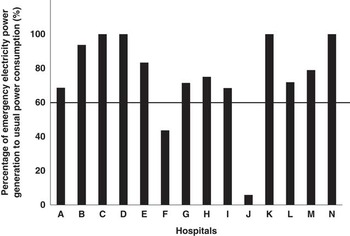
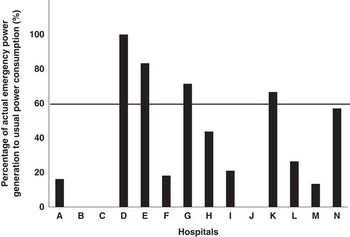
Eleven of 14 hospitals had an emergency electric power system that used oil only and 3 hospitals had a co-generation system that used oil and gas. Commercial electricity supply resumed within 3 days after the earthquake at 13 of 14 hospitals and on day 5 at 1 hospital. Twelve of 14 hospitals had estimated more than 60% of the potential emergency electric power generation before the Great East Japan Earthquake (Figure 1). Actual emergency electric power generation was lower than that of pre-disaster estimates in most of the disaster base hospitals (Figure 2). Only 4 of 11 hospitals were able to generate 60% or more of the usual power generated under emergency electric power (the actual power generation in 3 hospitals was unclear because of confusion at the time of the disaster).
Estimation of Emergency Electric Power Generation Potential Before the Great East Japan Earthquake. The percentage of emergency electric power generation potential to usual electricity consumption at each disaster base hospital.

Actual Emergency Electric Power Generation During the Acute Phase of the Great East Japan Earthquake.The percentage of actual emergency electric power generation to usual electricity consumption at each disaster base hospital (actual emergency electric power generation at 3 hospitals was unclear).

Operation of Radiology Diagnostic Devices
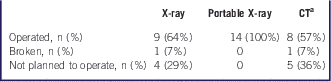
Portable X-ray devices were functional at all 14 disaster base hospitals under emergency electric power during the acute period of the disaster. Conventional X-ray devices operated at 9 of 14 hospitals (64%; Table 1). The main reason that conventional X-ray devices did not operate was that hospitals had not planned to use these devices with emergency electric power sources. CT scanners operated at only 8 of 14 hospitals (57%; Table 1). The main reason that CT scanners did not operate was also that hospitals had not planned to use these scanners with emergency electric power sources. MRI devices operated at only 6 of 14 (43%) hospitals. While the main reason was that hospitals had not planned to use these devices under emergency electric power sources, other reasons included broken devices and safety issues.
Proportion of Radiological Diagnostic Devices in Operation and Reasons for Not Being in Operation

a CT, computed tomography.
Pre-Disaster Plan for Management and Allocation of Emergency Electric Power
Only 2 of 14 (14%) disaster base hospitals had a pre-disaster plan for management and allocation of emergency electric power, and conventional X-ray and CT scanners operated at both of these hospitals under emergency electric power during the acute period of the disaster.
Discussion
The commercial electricity supply recovered within 3 days after the Great East Japan Earthquake at most of the disaster base hospitals in Miyagi Prefecture, and emergency electric power generation began at all institutions immediately following the disaster, but was lower than pre-disaster estimates. Radiology diagnostic devices could not be operated at approximately 40% of the hospitals, with the main reason being the lack of a pre-disaster plan of management and allocation of emergency electric power. This is the first report to focus on the importance of emergency electric power at disaster base hospitals to continue medical treatment during the acute phase of a major disaster.
The Japanese Ministry of Health, Labour and Welfare established criteria for designation as a disaster base hospital in 1996, specifying conditions related to utilities, including electricity. 5 However, it was not mentioned how many days’ supply was sufficient. Survey results show that electricity supply was restored within 3 days after the disaster at most of the disaster base hospitals. The Ministry of Health, Labour and Welfare revised the criteria in 2012 to a 3 days’ supply of self-sufficient generators and the ability to generate 60% of the usual power consumption by emergency electric power sources. 7 The long-term provision of an emergency power supply to the entire facility is ideal, but may be impractical in most institutions. On the other hand, electrical supply resumed within 3 days after the earthquake in the great East Japan earthquake, and transportation of heavy oil to the affected area started on the second or third day of the earthquake. Thus, we conclude that a heavy oil stockpile of 3 to 5 days is reasonable considering cost and benefit. Radiology diagnostic devices such as X-ray and CT scanners are essential, are the minimum equipment required for ordinary emergency care of critically ill patients, and are likely to be required for the management of victims critically injured in future disasters. On the other hand, however, portable X-ray devices can be charged with low electric power and could actually be operated at all of the disaster base hospitals in Miyagi Prefecture under emergency electric power. Portable X-ray devices may be able to cover most of the functions of conventional X-ray devices, especially during the period following a disaster if the conventional X-ray devices are unable to function. Thus, portable X-ray devices may be useful in disaster medicine.
Conventional X-ray and CT scanners require substantial amounts of electric power when activated. Thus, disaster base hospitals risk a total blackout when activating these radiology diagnostic devices. Hospitals without a plan to allocate emergency electric power would likely not be able to activate these devices. In the present study, only 2 of 14 hospitals had a pre-disaster plan to allocate emergency electric power to operate radiology diagnostic devices. Both conventional X-ray and CT scanners operated at the 2 hospitals under emergency electric power. The 2 hospitals, which did provide emergency power to radiology diagnostic devices, minimized the use of elevators and restricted the area supplied by air-conditioning systems in order to allocate emergency power to radiology devices. This suggests that meticulous advance planning for the allocation of emergency electric power is needed to be able to operate radiology diagnostic devices under emergency electric power after a large-scale disaster. (A comparison of power consumption of radiology diagnostic devices is shown in supplemental Table 1).
The medical community has gradually begun to recognize the importance of a business continuity plan (BCP). Based on predictions of various emergencies, a BCP determines what activities need to be performed to prepare for a disaster. A BCP also includes the methods and means for ensuring continuity of business in an emergency to minimize damage to business property and to facilitate continuation of core business and early recovery.Reference Roberts and Molyneux 8 - Reference Yutani and Nakatani 11 The Joint Commission and other accrediting and licensing bodies in the United States 12 do not require hospitals to disconnect from utility power during generator tests, which is only designed to test the ability of the generator to start and supply electrical power. Therefore, the generator test does not provide any information on how well a hospital may continue to operate when relying on generator power. If the licensing and accrediting bodies required hospitals to disconnect from utility power on a regular basis, it would be revealed which pieces of equipment will work when relying on generator power. This would be important for enhancing hospital preparedness. Regional and nationwide cooperation is also important. Thus, a pre-disaster plan is needed for a regional and wide-area transportation system to provide appropriate diagnostic examination and treatment for patients in affected areas. Recently, the Ministry of Health, Labour and Welfare stated that all disaster base hospitals should develop a BCP by March 2012 and that a plan for allocation of emergency electric power should be included in the BCP of disaster base hospitals. Not only electricity, but also water and gas are important utilities for disaster base hospitals to continue their operations, and these utilities would be limited in the event of a large-scale disaster. Thus, a BCP including allocation of these important utilities may be required for disaster base hospitals.Reference Kudo, Furukawa and Nakagawa 6
Limitations
This study was based on survey results obtained from disaster base hospitals, and each hospital referred to data elicited from process records (event chronologies), reports, and other materials at the time of the Great East Japan Earthquake. Consequently, these data may not be exhaustive, owing to confusion at the time of disaster. It can be expected that there were some cases not fully diagnosed, such as missed injuries in unconscious trauma patients, because diagnostic imaging was not available. However, it is difficult to prove actual or perceived harm to patients because a control group did not exist in the same situation of the disaster.
Conclusions
This study found that most of the disaster base hospitals in Miyagi Prefecture after the East Japan Earthquake were not able to operate radiology diagnostic devices, such as conventional X-ray and CT scanners, under emergency electric power. Although portable X-ray devices can be substituted for conventional X-ray devices when the conventional X-ray devices are not functioning, CT scanners may not be replaced and could be essential for disaster base hospitals to treat critically injured disaster victims during the acute period of a large-scale disaster. Hospitals must create multidisciplinary teams to prioritize power needs to ensure a logical and systematic method for reducing power to other areas of the hospital and to understand the impact of reducing power to any area. A pre-disaster plan to manage and allocate emergency electric power, as a part of a BCP, may be one solution to ensure operation of a CT scanner. It is extremely important for disaster base hospitals to develop a BCP to prepare for future disasters.
Acknowledgments
Data were collected from the disaster base hospitals in Miyagi Prefecture (Sendai City Hospital, Kesennuma City Hospital, Tome Citizen Hospital, Kurihara Central Hospital, Osaki Citizen Hospital, Sendai Red Cross Hospital, Ishinomaki Red Cross Hospital, Katta General Hospital, Tohoku Pharmaceutical University Hospital, Saka General Hospital, South Miyagi Medical Center, Tohoku University Hospital, Sendai Medical Center, Tohoku Rosai Hospital). The authors are grateful to Yayoi Okano, a research administrator in the Department of Neurosurgery, and Shizuka Osaki, a clinical research coordinator in the Department of Neurosurgery and Emergency and Critical Care Medicine, Tohoku University Hospital.
Funding and Support
This research was funded by Daiwa Securities Health Foundation 2011; SENSHIN Medical Research Foundation 2011; Special Project Research 2012 of the International Research Institute of Disaster Science, Tohoku University; Marumo Fund 2012; Daiwa Life Welfare Foundation 2012; Takahashi Industrial and Economic Research Foundation 2012; a Grant-in-Aid for Scientific Research of Challenging Exploratory Research (No. 24659794) from the Japanese Ministry of Education, Culture, Sports, Science and Technology; Pfizer Health Research Foundation 2013; and Manoa DNA and Takaya Yokokawa.
Supplementary material
To view supplementary material for this article, please visit http://dx.doi.org/10.1017/dmp.2014.134