




No CrossRef data available.
Article contents
A new electronic assay enables ultrasensitive detection of diverse biological analytes—nucleic acids, proteins and small molecules—on a single integrated circuit
Published online by Cambridge University Press: 18 October 2012
Abstract

Development of universal biosensors based on electrical readout is currently limited by the difficulty of electrical signal transduction upon capture of neutral analytes. Kelley and co-workers demonstrate an elegant approach wherein an amplified electrical current flows to a multiplexed electrode array in proportion with the binding of nucleic acids, proteins, and small molecules—regardless of their inherent charge. Here we present a commentary on the strengths and limitations of this method.
Information
- Type
- Commentaries
- Information
- Copyright
- Copyright © Materials Research Society 2012
References
1.
Soleymani, L., Fang, Z., Sargent, E., and Kelley, S.O.: Programming the detection limits of biosensors through controlled nanostructuring. Nat. Nanotechnol. 4, 844 (2009).Google Scholar
2.
Ziegler, A., Koch, A., Krockenberger, K., and Großhennig, A.: Personalized medicine using DNA biomarkers: a review. Hum. Genet. 131, 1627 (2012).Google Scholar
3.
Rifai, N., Gillette, M.A., and Carr, S.A.: Protein biomarker discovery and validation: the long and uncertain path to clinical utility. Nat. Biotechnol. 24, 971 (2006).Google Scholar
4.
Iliuk, A.B., Hu, L., and Tao, W.A.: Aptamer in bioanalytical applications. Anal. Chem. 83, 4440 (2011).Google Scholar
5.
Das, J., Cederquist, K.B., Zaragoza, A.A., Lee, P.E., Sargent, E.H., and Kelley, S.O.: An ultrasensitive universal detector based on neutralizer displacement. Nat. Chem. 4, 642 (2012).Google Scholar
6.
Lapierre-Devlin, M., Asher, C.L., Taft, B.J., Gasparac, R., Roberts, M.A., and Kelley, S.O.: Amplified electrocatalysis at DNA-modified nanowires. Nano Lett. 5, 1051 (2005).CrossRefGoogle ScholarPubMed
7.
Drummond, T.G., Hill, M.G., and Barton, J.K.: Electrochemical DNA sensors. Nat. Biotechnol. 21, 1192 (2003).Google Scholar
8.
Zeglis, B.M. and Barton, J.K.: DNA base mismatch detection with bulky rhodium intercalators: synthesis and applications. Nat. Biotechnol. 2, 357 (2007).Google Scholar
9.
Wang, H., Bhunia, A.K., and Lu, C.: A microfluidic flow-through device for high throughput electrical lysis of bacterial cells based on continuous dc voltage. Biosens. Bioelectron. 22, 582 (2006).CrossRefGoogle ScholarPubMed
10.
Plaxco, K.W. and Soh, H.T.: Witch-based biosensors: a new approach towards real-time, in vivo molecular detection. Trends Biotechnol. 29, 1 (2011).Google Scholar
11.
Lapierre, M.A., O'Keefe, M., Taft, B.J., and Kelley, S.O.: Electrocatalytic detection of pathogenic DNA sequences and antibiotic resistance markers. Anal. Chem. 75, 6327 (2003).Google Scholar
12.
Soleymani, L., Fang, Z., Sun, X., Yang, H., Taft, B., Sargent, E., and Kelley, S.O.: Nanostructuring of patterned microelectrodes to enhance the sensitivity of electrochemical nucleic acids detection. Angew. Chem. Int. Ed. (International ed. in English). 48, 8457 (2009).Google Scholar
13.
Gasparac, R., Taft, B.J., Lapierre-Devlin, M., Lazareck, A.D., Xu, J.M., and Kelley, S.O.: Ultrasensitive electrocatalytic DNA detection with 3D nanoelectrodes. J. Am. Chem. Soc. 126, 12270 (2004).Google Scholar
14.
Soleymani, L., Fang, Z., Kelley, S.O., and Sargent, E.H.: Integrated nanostructures for direct detection of DNA at attomolar concentrations. Appl. Phys. Lett. 95, 143701 (2009).Google Scholar
15.
Yao, W., Wang, L., Wang, H., Zhang, X., and Li, L.: An aptamer-based electrochemiluminescent biosensor for ATP detection. Biosens. Bioelectron. 24, 3269 (2009).Google Scholar
16.
Zuo, X., Song, S., Zhang, J., Pan, D., Wang, L., and Fan, C.: A target-responsive electrochemical aptamer switch (TREAS) for reagentless detection of nanomolar ATP. J. Am. Chem. Soc. 129, 1042 (2007).CrossRefGoogle ScholarPubMed
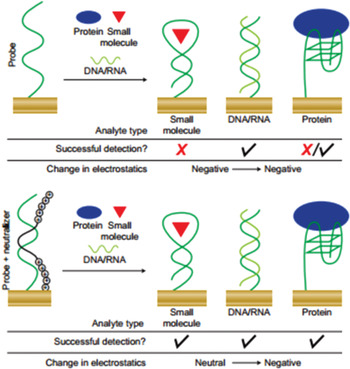
Figure 1. Summary of the NDA sensor- Small molecules, nucleic acids, and proteins displace the neutralizer strand of the NDA probe revealing the negative charges of the DNA capture strand. Reprinted by permission from Macmillan Publishers Ltd: [Nature Chemistry (DOI: 10.1038/NCHEM.1367), copyright (2012)].
 You have
Access
Universal sensors—sensors that analyze a variety of biomolecules including nucleic acids, proteins, and metabolites—have significant potential to be used in medical diagnostics and therapeutic decision making, medical research, environmental monitoring, and drug screening. Development of sensing technologies applicable to these areas of applications relies on creating and combining new and advanced materials, devices, molecular probes, and signal transduction techniques that offer a unique combination of sensitivity, specificity, multiplexing, analysis time, and integration. Recent advances in technologies that combine top-down and bottom-up fabrication have led to the development of micro-/nano-systems that integrate several biosensors with optimal sensitivity, dynamic range, and analysis time in a single microsystem.[ Reference Soleymani, Fang, Sargent and Kelley 1 ] In addition, different classes of molecular probes including nucleic acids,[ Reference Ziegler, Koch, Krockenberger and Großhennig 2 ] antibodies,[ Reference Rifai, Gillette and Carr 3 ] and aptamers[ Reference Iliuk, Hu and Tao 4 ] have been identified, designed, and synthesized to provide selective capture of a variety of analytes relevant to disease management, pathogen detection, and identification of pharmaceutical and recreational drugs. In spite of these advances, the unavailability of a one-step and label-free signal transduction method that is applicable to ultrasensitive analysis of all relevant analyte classes on a single platform has slowed down the development of universal sensors. In Nature Chemistry, Kelley and co-workers demonstrate an elegant approach wherein an amplified electrical current flows in proportion with the binding of nucleic acids, proteins, and small molecules to a multiplexed array of sensors (Fig. 1).[ Reference Das, Cederquist, Zaragoza, Lee, Sargent and Kelley 5 ]
Summary of the NDA sensor- Small molecules, nucleic acids, and proteins displace the neutralizer strand of the NDA probe revealing the negative charges of the DNA capture strand. Reprinted by permission from Macmillan Publishers Ltd: [Nature Chemistry (DOI: 10.1038/NCHEM.1367), copyright (2012)].
Biosensing platforms that translate a biorecognition event to a detectible signal directly—without the use of labels—present several advantages over their labeled counterparts due to simpler, more rapid, and less reagent-exhaustive operation. The majority of label-free signal transduction strategies used in electrical and electrochemical biosensors, with sufficient sensitivity for direct sample analysis, report on the redox nature or the inherent charge of the target analyte.[ Reference Lapierre-Devlin, Asher, Taft, Gasparac, Roberts and Kelley 6 – Reference Wang, Bhunia and Lu 9 ] As a result, these systems are unable to assess neutral analytes such as a variety of proteins and small molecules. In addition, their detection sensitivity is significantly dependent on analyte charge. Electrochemical aptamer beacons—surface-immobilized aptamer probes modified with a redox label—have been developed to translate the binding-induced conformational changes of DNA aptamers to an electrical signal and can be used to detect a variety of targets regardless of their inherent charge. However, the non-catalytic nature of these assays results in limited sensitivity for nucleic acid detection.[ Reference Plaxco and Soh 10 ]
In their recent publication, Kelley and co-workers engineer a unique method for label-free signal transduction, the neutralizer displacement assay (NDA), which demonstrates application-relevant sensitivity with three classes of analyte. NDA is based on dual-purpose neutralized analyte capture probes that are immobilized on biosensor surfaces for selective analyte capture and subsequent electrochemical signal transduction. Upon selective analyte capture, these NDA probes undergo structural changes that reveal an overall negative charge on the electrode surface. To translate these negative charges to an electrical signal, the authors elegantly combine NDA probes with a previously developed electrocatalytic reporter system based on electrostatic redox complexes.[ Reference Lapierre, O'Keefe, Taft and Kelley 11 ]
In order to create an ultrasensitive universal detector, the authors engineer a chip-based microsystem that integrates three systems pioneered in the Kelley group: the NDA, the nanotextured microelectrode (NME) array,[ Reference Soleymani, Fang, Sun, Yang, Taft, Sargent and Kelley 12 ] and the ruthenium hexamine/ferricyanide electrocatalytic reporter system.[ Reference Lapierre, O'Keefe, Taft and Kelley 11 ]
In this paper, a 20-plex array of individually accessible nanotextured microelectrodes are fabricated by a combination of lithographic and electrochemical techniques on a semiconductor substrate. This multiplexed electrode arrangement allows individual electrodes to be modified with different analyte capturing NDA probes. The NDA probes associated with all analyte classes are composed of two complementary nucleic acid strands that contain precisely tuned single or double base pair mismatches. The first strand is a thiolated DNA-based capture probe, which is immobilized on gold/palladium NMEs through noble metal–thiol chemical bonds (capture strand). The second strand is a peptide nucleic acid molecule conjugated with cationic amino acid residues (neutralizer strand). Upon any analyte capture—small molecule, nucleic acid, or protein—the neutralizer strand is released, revealing the negative charges of the capture strand. The catalytic reporter system—comprised of a positively charged redox molecule that electrostatically binds to the DNA backbone—is ideally suited for readout of the revealed negative charges.
Kelley and co-workers had previously demonstrated the electrocatalytic detection of nucleic acids in clinical and biological samples using a variety of nanoscale and nanostructured electrode arrays and had achieved a record sensitivity of 10 aM.[ Reference Gasparac, Taft, Lapierre-Devlin, Lazareck, Xu and Kelley 13 , Reference Soleymani, Fang, Kelley and Sargent 14 ] However, like several other electrochemical assays, these were limited to target analytes with an inherent negative charge and had not been applied to label-free analysis of uncharged small molecules or proteins. The NDA assay overcomes these limitations and allows the electrocatalytic readout system to be extended to the detection of uncharged analyte. The authors design the capture strand of the NDA probe to be specific to different analytes. For small molecule detection, DNA aptamer capture strands enable cocaine and adenine triphosphate (ATP) detection at detection limits of 1 µM and 1 µg/mL, respectively. Furthermore, a thrombin-specific aptamer was designed and integrated into the NDA probe to demonstrate protein detection with 10 fM sensitivity.
Although the reported nucleic acid and protein detection limits are among the best ever reported, further optimization is necessary to improve the detection limit of small molecules into the nanomolar range.[ Reference Yao, Wang, Wang, Zhang and Li 15 , Reference Zuo, Song, Zhang, Pan, Wang and Fan 16 ] The real challenge will be to improve or sustain the analyte sensitivity and specificity when heterogeneous clinical samples containing closely related analytes—single base pair mismatched DNA, small molecule analogues such as ATP, cytidine triphosphate (CTP), guanosine triphosphate (GTP), and uridine triphosphate (UTP)—are analyzed in the presence of electroactive and charged background materials.
The rapid pace of discovery and innovation in biomarker identification, molecular probe design, fabrication of hybrid nano/microsystems, and signal transduction methods are resulting in new and advanced biosensing platforms with the potential to revolutionize healthcare. The ability to analyze a single sample—using one fully integrated platform—for a variety of analyte classes has several applications in infectious disease diagnosis, cancer management, and environmental monitoring. The NDA-based technology is especially important for sensing applications in resource-poor and developing regions where using one inexpensive electrical readout instrument instead of several different instruments including plate readers, polymerase chain reaction machines, and immunoassay analyzers may be the only feasible solution for delivering advanced diagnostics.