


“[Putin] is now just a real KGB agent. He doesn’t pretend anymore to be a democratically devoted person.”
—Former Prime Minister Mikhail Kasʹianov, May 2022.Footnote 1
In July 2019, large protests erupted in Moscow in response to the authorities’ decision to prohibit most independent candidates from running in city council elections. As tens of thousands of Muscovites took to the streets in what was the largest sustained protest movement since 2011–12, President Vladimir Putin’s government responded true to form: quickly and violently, sending in police to disperse those gathered on the streets and detain protestors.Footnote 2 More than 1,400 were arrested during a single rally, and “five journalists covering preelection protests in Moscow were physically attacked by police.”Footnote 3
Additional repressive measures followed over the course of the next few years. Russia’s 2012 law mandating that NGOs that engage in “political activity” (and later, media outlets) and receive foreign funding publicly identify themselves as “foreign agents” was expanded so many times that by 2021 it applied to anyone in “pretty much any form of contact with foreign entities.”Footnote 4 Similarly, the number of political and religious prisoners rose from 195 in 2018 to 349 in 2020.Footnote 5 In 2021, Putin’s most prominent critic, the late Aleksei Navalʹnyi, was arrested; the authorities responded to the ensuing street protests with sweeping detentions of over 23,000 individuals.Footnote 6 In June, the opposition leader’s Anti-Corruption Foundation was designated an “extremist” organization, “effectively preventing anyone associated with it from running for office.”Footnote 7 Crackdowns such as these led The Financial Times to declare “a new era for a regime now extending into its third decade. After 20 years in which Putin’s rule was propped up first by economic prosperity and then by pugnacious patriotism, his government has now pivoted to repression as the central tool of retaining power.”Footnote 8
As we now know, the restrictions on independent thought and political dissent that characterized the first two decades of Putin’s rule were merely a foretaste of what was to come in the wake of Russia’s full-scale invasion of Ukraine in February 2022. Soon after the commencement of hostilities, the State Duma passed laws criminalizing the spread of “deliberately false information” about Russia’s military operations, “publicly discrediting” its armed forces, or calling for the imposition of international sanctions on Russia. During the debates over this legislation, the Duma’s chairman, Viacheslav Volodin, warned that this package of laws “will force those who lie and make statements discrediting our armed forces to suffer a punishment, and a very harsh one at that.”Footnote 9 True to those words, Russian courts have meted out prison sentences of up to fifteen years for crimes as trivial as calling the war a “war.” Victims of the law include the former mayor of Ekaterinburg, who was arrested for simply uttering the phrase “the invasion of Ukraine”; an opposition politician, Ilʹia Iashin, who was sentenced to eight and a half years in prison for disseminating the inconvenient but obvious truth that Russian (as opposed to Ukrainian) forces engaged in rampant killings of civilians in the Ukrainian town of Bucha; and the 70-year-old co-chair of the Nobel Peace Prize-winning NGO Memorial, Oleg Orlov, who received two and a half years in prison for writing an article that accused the Russian army of committing “mass murder.”Footnote 10 Overall, 200,000 Internet resources were blocked and more than 20,000 people were detained for political reasons over the course of 2022, most of them for expressing anti-war positions.Footnote 11
Nor has repression eased up as the war dragged on into its fourth year. In perhaps the most absurd of a series of legal cases designed to stifle the expression of anti-war sentiment, a father received a two-year jail term in March 2023 because his daughter drew a picture in her elementary-school art class containing the phrases “No to War” and “Glory to Ukraine.”Footnote 12 That same month, a museum and cultural center named after one of the Soviet Union’s most respected dissidents, Andrei Sakharov, was evicted from its premises and forced to close.Footnote 13 By the end of the year, 53 foreign and international NGOs had been designated “undesirable organizations” and shuttered.Footnote 14 So many Russians have been jailed for collaborating with the enemy that the FSB’s First Investigative Department has needed to double its staff.Footnote 15 Moreover, legislation passed by the Duma in July 2025 that will return to the FSB the ability to run its own pretrial detention centers openly acknowledges the following: “With the beginning of the special military operation, the number of suspects and [those] accused of treason, confidential cooperation with a foreign state, international or foreign organization, and espionage has increased significantly.”Footnote 16 In fact, according to the chair of the Duma’s Security and Anti-Corruption Committee, this number has increased by a factor of four since 2015.Footnote 17
In the world of academia, an 18-year-old was expelled from St. Petersburg University in January 2024 for a social media post referring to the “imperial nature of the war” dating back to when she was still in the tenth grade; a little over a year later, she was sentenced to nearly three years in prison for continued expressions of anti-war sentiment.Footnote 18 And in the realm of culture, a playwright and a theater director were arrested in 2023 (and sentenced to six years in prison a year later) on the spurious charge of “justifying terrorism” in the form of a play that had been funded by the Ministry of Culture and staged three years earlier.Footnote 19 As Alexander Baunov sums it up, “Russia has transformed … from a dictatorship of deception to a dictatorship of fear and then, after the invasion of Ukraine in 2022, into an outright dictatorship of terror, akin to the one that exerted an iron grip on the Soviet Union for much of the 20th century.”Footnote 20
In the minds of many observers, the underlying source of this ever-harsher crackdown is obvious: the KGB origins of Russia’s current regime and, in particular, its leader. In fact, ever since Putin came to power in 1999, it has been commonplace to attribute Russia’s steady drift away from democratic governance to, first, the president’s deliberate and purposeful choices, and second, a rise in the number of former military and security officers—the siloviki—engaged in the governance of the country. (The same attributions, as will be shown below, are common in regard to the Kremlin’s decision to invade Ukraine.) Michael McFaul, for instance, succinctly summarizes the first part of this narrative when he writes, “Putin chose to reduce the power of democratic institutions and increase the power of autocratic institutions. A different leader in power in Russia in 2000 could have made a different set of choices.”Footnote 21 In regard to the second part of this narrative, Angus Roxburgh, among others, locates the roots of Putin’s choices in his former profession. “[T]he stifling of the media, the establishment of the ‘vertical of power’ and appointment of Putin’s cronies to key jobs,” among other undemocratic actions, he writes, all represent the product of a man “acting true to type, confirming his own phrase: there is no such thing as an ex-Chekist.”Footnote 22
In somewhat greater detail, this meta-narrative maintains that former KGB Lieutenant-Colonel Vladimir Putin came into office determined to “place the tasks of national government within a military-security framework.”Footnote 23 In practice, this meant installing former colleagues from the KGB in positions of power and authority throughout the polity and economy. Having spent their professional lives defending a highly authoritarian state, these individuals naturally possessed little respect for civil liberties or appreciation of pluralistic politics. As McFaul opines, Putin’s network of “former KGB comrades” whom he appointed to key positions “shared many normative commitments nurtured from their KGB days, but democracy and transparency were not among them.”Footnote 24 As a result, these powerful siloviki steadily transformed the semi-democracy that they inherited from Boris Elʹtsin into a repressive “militocracy.”Footnote 25
While certainly open to criticism, this narrative possesses at least two prima facie strengths. First, as a vignette from the high politics that took place in the summer of 1999 vividly illustrates, imputing an illiberal ethos to the KGB has been commonplace in Russia for decades. While laying the groundwork for a handpicked candidate to succeed Elʹtsin as president, Kremlin insiders approached Igorʹ Malashenko, the general director of Russia’s premier independent television network (NTV), about throwing its support behind Putin. After a dinner with the Kremlin’s choice for the post, however, Malashenko decided against doing so on the basis of a single feature of Putin’s persona. The KGB was “all about control. Anything you control is safe,” he later explained. “Anything you don’t control by definition represents a threat—that is their mental framework, and a KGB officer is always a KGB officer.”Footnote 26
A second strength of this narrative is that not only are Putin and many members of his successive cabinets former KGB agents, but numerous analyses of the composition of broader swaths of the Russian elite consistently find large numbers of siloviki in their ranks. For instance, immediately after his presidential inauguration in 2000, Putin added a new administrative layer to Russia’s federal system consisting of seven territorial “super-districts” and appointed high-ranking military-security officers to head five of them. Siloviki comprised 42% of the second-tier personnel in those districts as well.Footnote 27 In regard to the ruling stratum as a whole, our recalculations of findings generated by Olʹga Kryshtanovskaya on the demographic origins of the key executive and legislative bodies of the federal government show that the share of siloviki increased from a mere 4.4% in 1988 to 13.9% in 2002, and then grew to 20.5% in 2008.Footnote 28 While these percentages are well below the 25% and 32% that Kryshtanovskaya originally reported for 2002 and 2008, respectively, they nonetheless represent considerable shares of Russia’s political elite.Footnote 29
More recent analyses of various elite sectors produce estimates of silovik penetration that are comparable to these figures. One investigation reports that nearly one-fifth (16 out of 85) of Russia’s governors in 2016 had previously worked in the Ministry of Internal Affairs (MVD), Federal Security Service (FSB), Federal Guard Service, KGB, procuracy, or Ministry of Defense.Footnote 30 Another study finds that almost 30% of cabinet positions during Putin’s first presidential term and just over 25% during his second term consisted of individuals with previous careers in the “power ministries.”Footnote 31 Finally, a third study examines the backgrounds of governmental and economic elites (selected using two different methods, positional and reputational, that are commonly used in elite research) in both 2010 and 2020. It finds that the percentage of siloviki (defined as either active-duty officers or “silovik-civilians”) in each of those four subsamples ranges between 29% and 39%.Footnote 32
The ability of elite militarization to account for Russia’s descent into an extreme form of authoritarianism under Putin, however, depends not just on the frequency with which powerful actors in Russia (such as Igorʹ Malashenko) have advanced such an account or the number of siloviki in positions of power, but even more fundamentally on the answer to a prior question: Do Russians who have spent much of their careers in uniform actually possess a distinctly illiberal worldview that sets them apart from other elites? In research based on the 2016 wave of the Survey of Russian Elites (SRE), we have shown that highly placed members of Russian society with professional backgrounds in the military or law enforcement were indeed less supportive of many of the core principles underlying political pluralism and individual rights, on average, than those with purely civilian resumés.Footnote 33 In this article, we replicate some of our previous analyses using data collected in the 2020 wave of the SRE. In addition, we go beyond those analyses by exploring whether these groups possess differing attitudes toward various concrete forms of the exercise of civil liberties, as well as toward the type of political system they consider to be most appropriate for Russia.
Consistent with the findings of our previous study, our analysis of survey data from 2020 finds that siloviki exhibit significantly less favorable attitudes toward a wide variety of abstract principles related to representative government, civil liberties, and the rule of law than do their lifelong civilian counterparts.Footnote 34 Moreover, the same pattern holds in regard to concrete manifestations of those principles, such as the desired level of government control of the Internet and the justifiability of various forms of protest. Finally, we find that slightly less than one in twelve siloviki regard western-style democracy as most appropriate for Russia, whereas slightly more than one in four civilians would prefer to live under that alternative form of government. Our findings thus provide uniform support for interpretations that attribute the Putin regime’s intensifying crackdown on political pluralism and civil liberties since his return to the presidency in 2012 to the professional backgrounds of many of its members.
Our article proceeds as follows. First, we discuss the worldview of siloviki as it has been expounded by leading academics, show how these concepts are frequently used to explain both Russia’s descent into authoritarianism and the Kremlin’s decision to launch a full-scale invasion of Ukraine, and present several criticisms of such explanations. Second, we provide details about the data used in this project—the eighth wave of the SRE conducted in the spring of 2020—and how we define and operationalize our core concepts. Third, we investigate differences between high-ranking siloviki and their civilian counterparts with regard to the merits of liberal democracy in terms of both abstract principles and concrete manifestations of those principles. And fourth, we conclude by summarizing our findings and drawing out their policy implications for both Russian citizens and western governments.
Siloviki and Democracy
Experts on Russian politics have long maintained that siloviki are generally imbued with an anti-democratic and illiberal ethos. Distinguished scholars such as Amy Knight, Olʹga Kryshtanovskaya, and Brian Taylor argue that service in the KGB, the conventional military, or any of the country’s other security agencies socializes an individual into a worldview characterized by the terms gosudarstvennichestvo and derzhavnostʹ. Footnote 35 Taylor succinctly captures both of these value systems when he writes: “siloviki in general, and the Chekists in particular, are more likely than elites from other backgrounds to be both adherents of a strong state internally (in Russian, gosudarstvenniki) and of a strong Russia internationally (derzhavniki). Liberal democracy is at best a lower priority, and more likely perceived as a threat to political order and stability.”Footnote 36 In greater detail, gosudarstvenniki view vibrant political pluralism and guarantees of civil liberties with skepticism. Equating democracy with indecision and weakness, they instead prefer authoritarian governance characterized by a “strong hand” and maintain that “[a] strong state should also control the economy, at least its natural resources… .”Footnote 37 Derzhavniki adhere to the view that Russia must preserve its status as a great power that plays a major role in international affairs. They also harbor a generalized distrust of the liberal west. As a result, they view conflict and competition with Europe and the US as inevitable and embrace Russia’s role as defender of the non-western world against “Anglo-Saxon” aggression and depredation.Footnote 38
Such assessments of the worldview and policy preferences of siloviki constitute a core component of a larger body of research that we elsewhere have dubbed the “militocracy paradigm.” As we document in a 2018 review essay, journalists and policymakers alike have extensively used Putin’s background in the KGB for at least four descriptive purposes (conceptualizing the protagonists in Russia’s presidential elections, identifying an influential faction in Kremlin decision making, describing the criteria used by Putin in personnel selection, and characterizing changes in the composition of the business elite) and equally as many explanatory purposes (accounting for heightened authoritarianism, conflict in US-Russian relations, Russia’s military aggressions against Georgia and Ukraine, and economic mismanagement).Footnote 39 In this regard, we show that many prominent Russian and American journalists accept the conclusions reached by Knight, Kryshtanovskaya, and Taylor and advance them as the primary explanation of the “rollback of Russian democracy” under Putin.Footnote 40
Putin’s KGB past continues to serve as a catch-all explanation in journalistic coverage of Russia in more recent years as well. For instance, the in-depth analysis by The Financial Times quoted in the introduction attributes “the unprecedented severity of the police measures” being implemented in early 2021 to “the outsized influence that hardline former military and security service officials now have on the president.”Footnote 41 The same is equally true of Moscow’s decision to launch its full-scale invasion of Ukraine in 2022. Former Moscow correspondent Serge Schmemann, for example, asserts that Putin “wields his power through a coterie of strongmen, the ‘siloviki,’ who still view the world through the old Soviet prism of paranoia and ignorance… . They never reconciled themselves to the loss of Russia’s status as a great power or bought into the notion that the people, the faceless narod, could be anything other than their subjects.”Footnote 42 Another former Moscow correspondent, David Remnick, similarly gives Putin’s prior career pride of place in his characterization of the president and his goals. “Putin came to power, in 1999, advertised not as a man of ideology but as a figure of rude health and managerial competence,” he writes. “In truth, he was a man of the K.G.B., trained to view the West, particularly the U.S., as his enemy, and to see conspirators everywhere trying to weaken and humiliate Russia.”Footnote 43 In a Washington Post article that matter-of-factly describes Putin as having “spent his life crushing [freedom],” Robyn Dixon just as matter-of-factly contends that “Putin’s career as a KGB officer has long explained his approach as president.”Footnote 44
Core tenets of the militocracy paradigm similarly infuse a recent work at the intersection of journalism and scholarship: Catherine Belton’s voluminous Putin’s People: How the KGB Took Back Russia and Then Took on the West. One notable feature of the book is that it conceptualizes members of the former KGB, both those still on active duty in one of its successor organizations and those who have left government service, as a unified corporate actor. In her explanation of the Kremlin’s selection of Putin as Elʹtsin’s desired successor in 1999, for instance, Belton writes: “Instead of falling to what they believed was a coup by forces from the Communist past, what the Elʹtsin Family had in fact succumbed to was a creeping coup by the security men. Under siege from all sides, they’d had little choice but to reach an accommodation with the KGB.”Footnote 45 Most centrally for our purposes, Belton describes Elʹtsin as a committed democrat who unwittingly undid the main accomplishment of his presidency by selecting a former KGB agent as his successor. The “security-services men” around Putin, she writes, “believed that the overriding achievement of the Elʹtsin era—the establishment of basic democratic values—had brought the country to the brink of collapse…. Instead of seeking to strengthen democratic institutions to tame the helter-skelter excesses of the Elʹtsin years, they intended to dismantle democracy—purely to consolidate their own self-serving power.”Footnote 46 Throughout her narrative, in fact, Belton places ex-KGB agents of every rank and generation in the camp opposed to freedom, democracy, and peace with the west.
Like many analysts, Belton treats such conclusions as so obvious that they do not require demonstration. To be fair, however, exactly how one might empirically evaluate whether the KGB origins of these men—as opposed to, for instance, Russia’s traditional autocratic culture, nostalgia for lost empire, the deleterious legacy of communism, or the pressures of international competition—truly represent the source of their political behavior is not self-evident. One reasonable approach is to examine the results of opinion surveys that compare large numbers of siloviki with similarly situated civilians. Our previous review of research taking that approach during both Elʹtsin’s tenure in office and Putin’s first two presidential terms concludes that such surveys “consistently find that officers in Russia’s military and security agencies were less liberal and less supportive of political pluralism than were civilian elites… . [S]iloviki were, relatively speaking, more authoritarian and illiberal during those two decades… .”Footnote 47 Moreover, we then conduct an original—and more fine-grained—analysis of survey data collected during Putin’s third presidential term that reveals a continuation of previous patterns: “As was the case in both the 1990s and 2000s, elites with professional backgrounds in one or more of Russia’s force structures were less supportive of political pluralism and individual rights in 2016 than were those with purely civilian resumés. In addition, active-duty officers were even less liberal than either their retired former colleagues or lifelong civilians.”Footnote 48
Notwithstanding the support it receives in qualitative social science, in-depth journalism, and survey research, however, the conventional wisdom to the effect that political values intrinsic to the Soviet KGB as an organization have significantly shaped the Putin-era political system has always had its skeptics—and still does. For instance, both Bettina Renz and Oxana Gaman-Golutvina have long questioned whether siloviki can be regarded as ideologically uniform or even significantly more illiberal than their civilian counterparts.Footnote 49 In addition, Renz and Kirill Shamiev endorse Petra Schlieter’s conclusion that the causal arrow should be reversed. The elite recruitment strategies pursued by Elʹtsin, Putin, and Medvedev have all been “determined by the presidents’ authoritarian political outlook, and not vice-versa,” Shamiev and Renz write. “Once a Russian president’s commitment to democratic ruling erodes, he tends to hire personally loyal specialists with security experience instead of civilian professionals with broader skillsets and social networks.”Footnote 50
Timothy Frye takes yet another approach to questioning the conventional wisdom on this subject. While conceding that “Putin’s background in the KGB is not irrelevant,” he cautions that “drawing a line between Putin’s work experience in the KGB and his policies is not so straightforward. Many Russians have become cynical nationalists without ever having served in the KGB.”Footnote 51 Utilizing the similar political trajectories of Turkey, Hungary, and Venezuela in recent years as evidence, Frye goes on to assert that “[t]he kinds of easy references to Putin’s background or mentality used to support many arguments about contemporary Russia often crumble on closer scrutiny.”Footnote 52
Even if one is not persuaded by Renz’s and Frye’s arguments on this score, it is certainly possible that Russia’s security services socialized their employees into an illiberal worldview during the Soviet and immediate post-communist periods but have ceased to do so more recently. In addition, it is also possible that civilian elites have become less supportive of democracy, producing a convergence in values between the two groups. (Indeed, the vituperative anti-westernism and bellicosity that former President Dmitrii Medvedev—an individual with an exclusively civilian background—has consistently expressed since the launch of Russia’s full-scale invasion of Ukraine suggests that this might have occurred.Footnote 53 ) For both sets of reasons, periodic checks on the extent to which elites in Russia with backgrounds in the security services still differ from their “civiliki” counterparts are needed.
Data and Methodology
To assess whether siloviki still possess attitudes that differ substantially from those of their civilian counterparts, we utilize data from the eighth wave of the SRE. The SRE consists of a series of surveys spanning nearly thirty years that is currently on deposit with the Inter-university Consortium for Political and Social Research at the University of Michigan (Study #3724).Footnote 54 The 2020 data consist of interviews conducted in February and March with 245 Moscow-based elites. The sampling frame includes individuals in the following seven subgroups: the legislative and executive branches of government, the military and security agencies, state-owned enterprises, private businesses, scientific and educational institutions with strong international connections, and the media. Respondents were selected on the basis of positional criteria using a quota sample, with an emphasis on identifying elites connected in some way with foreign policy issues.Footnote 55
All respondents are influential in their respective spheres. The founder of the SRE, William Zimmerman, explains that “those classified as elites had to have occupations that suggested a prima facie expectation that they would have substantial potential to affect policy.”Footnote 56 In the legislative and executive branches, they are members of the State Duma and Federation Council; heads and deputy heads of federal governmental departments; federal ministers and deputy ministers; and members of the Presidential Administration at the level of advisor or higher. In the armed forces and security agencies, they hold the rank of colonel or higher. In the economic sector, the respondents are owners, managing directors, and key administrators of major private firms; and directors and deputy directors of state-owned enterprises and state corporations. Finally, in academe and the media, they are employed as chancellors, vice-chancellors, directors, and deputy directors of universities and research institutes; and editors and deputy editors of important print and broadcast outlets.
All respondents are Moscow residents. Yet, as Zimmerman et al. argue, “[r]restricting the sample to Moscow [and thereby excluding regional elites] is unlikely to result in statistical bias, given Moscow’s disproportionate impact on national political decision-making.”Footnote 57 The survey was implemented by Bashkirova and Partners, a Moscow-based polling firm, mostly through face-to-face interviews (86.1%); computer-assisted web interviewing was used to interview the remaining one-seventh of the respondents (13.9%). Of the initial pool of 300 respondents, fifty-five refused to participate in the survey, producing a response rate of 81.7%.Footnote 58
In order to code respondents as either siloviki or lifelong civilians, we follow the guidelines introduced in our analysis of data from the 2016 SRE.Footnote 59 First, we draw on the definitions of both the power ministries and their employees that are provided by Brian Taylor: “those state agencies in which the personnel generally wear uniforms and in which some people carry guns. More precisely, these bodies are military, security, or law enforcement bodies that possess armed units or formations. People with power ministry backgrounds are referred to as siloviki.”Footnote 60 (It should be noted that in our conceptualization, political appointment as the head or deputy head of a force structure represents service in the national leadership and thus in and of itself does not qualify a person as a silovik.) Second, in line with recommendations that we advanced in a previous publication, we coded individuals as siloviki only if they possessed a minimum of three years of combined service as an officer in the military or one of the other power ministries (such as the FSB, KGB, MVD, procuracy, or Ministry of Civil Defense and Emergency Situations [MChS]).Footnote 61
And third, we identify siloviki in our sample on the basis of two sets of demographic questions contained in the 2020 SRE. First, respondents were asked: “Did you serve in the armed forces, were you only in the reserves, or did you not serve at all?” If respondents answered that they had served in the military, the interviewer asked if they were “an officer, a sergeant or a conscript,” as well as how many years they had served in the armed forces. Second, respondents were asked the following two questions concerning other employment: “Have you ever served as an officer in any other force structures, such as the FSB, KGB, MVD, procuracy, or MChS?”; and if yes, “How many years in total did you serve in these institutions?”Footnote 62 Based on these questions, 57 individuals were identified as having served as officers in the military, the security agencies, or some combination of the two. We then recoded nine of the 57 as civilians: eight who reported serving as officers but only for two years or less and one who refused to state how long he had served.Footnote 63 Conversely, two respondents were transferred to the silovik category due to their having been included in the sample as part of the military-security subgroup.Footnote 64 Hence, in the final analysis, 50 of our respondents (20.4%) were coded as siloviki and 195 (79.6%) as lifelong civilians.
In order to measure respondents’ orientations toward core principles of liberal democracy, we rely on five questions that were similarly utilized in our analysis of data from 2016.Footnote 65 In addition, we examine responses to three questions that have not previously been used in studies of this kind. Two of them ask about concrete manifestations of civil liberties, and one asks respondents to reflect on Russia’s political system as a whole. All of the questions used in this study are listed in Table 1 (Table 1).
The five original questions address representative government, civil liberties, and the primary functions of the judiciary. The first one draws its inspiration from Robert Dahl, who argues that the ability of a wide range of political actors to compete for support is one of the key components of a democracy.Footnote 66 Since a vibrant and competitive party system is crucial for such “public contestation” to take place, this question gauges the extent to which Russian elites value party competition.
Survey Questions Used to Measure Support for Liberal Democracy

Table 1 Long description
Eight survey questions are listed as measures of support for liberal democracy among Russian elites, grouped by theme. Representative government is measured by agreement that competition among political parties strengthens the political system. Civil liberties are assessed through agreement about prohibiting public expression of dangerous ideas and a rights-versus-order placement question where respondents choose a position between order at any price and protecting citizens’ rights. Rule of law is captured with two contrasting statements about protecting individual rights even if guilty people go free versus protecting society even if innocent people are imprisoned. Newer items add attitudes toward government regulation of internet content, framed as a scale from complete government control to complete freedom from government control. Political participation is measured by rating how justifiable several protest activities are, including petitions, boycotts, sanctioned and unsanctioned demonstrations, strikes, and social media protest. A final item asks which political system is most appropriate for Russia, offering options ranging from the pre-perestroika Soviet system to a Western-style democracy. The table provides question wording and response formats rather than results, so it does not indicate levels of support or changes over time.
Source: Survey of Russian Elites, Moscow, Russia, 1993-2020.
Note: Questions 1–2 and 4–5 use a five-point scale, with the key being: 1. Completely agree, 2. Mostly agree, 3. Neither agree nor disagree, 4. Mostly disagree, and 5. Completely disagree.
The next set of questions focuses on civil liberties. Question 2 asks respondents about the necessity of safeguarding the public from exposure to dangerous ideas, and question 3 probes respondents about the extent to which citizens’ rights should be curtailed in the pursuit of order. We include these questions because, as Dahl explains, in a democracy all citizens must have the ability not only to formulate their preferences but also to freely “signify their preferences to their fellow citizens and the government by individual and collective action.”Footnote 67 We then probe respondents’ views about whether a judicial system should function primarily according to liberal or communitarian values. Specifically, questions 4 and 5 assess the extent to which elites prioritize the protection of individuals from the state or the protection of society from criminals.
The first two of the new questions used in this study draw their inspiration from James Prothro and Charles Grigg, whose survey of registered voters in two US cities found widespread agreement about core principles of democracy (such as majority rule and minority rights) when expressed in abstract terms but a lack of consensus “on more concrete questions involving the application of democratic principles.”Footnote 68 Following their lead, we incorporate questions that explore respondents’ commitments to democratic principles when their specific application is at issue. Question 6 solicits respondents’ views regarding the proper degree of government control of the Internet, while the sub-components of question 7 explore their views regarding the justifiability of six different types of protests. The final new question, #8, asks respondents to select the type of political system that is most appropriate for Russia. Respondents could choose from among four different alternatives that ranged from the USSR under Leonid Brezhnev to western-style democracy.
Results
Core Principles of Liberal Democracy
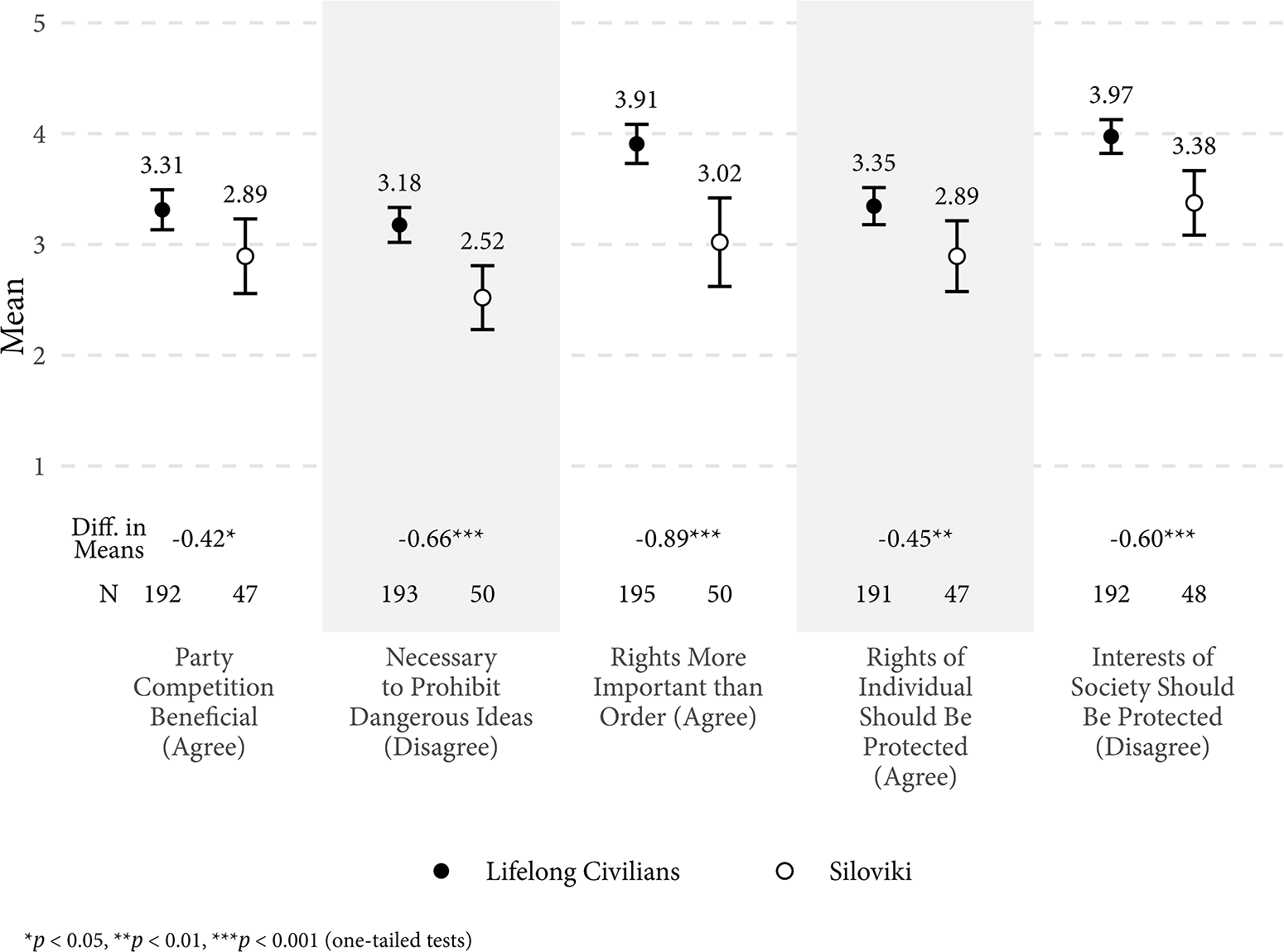
Our first set of results (displayed in Figure 1) shows that siloviki exhibit significantly less favorable attitudes toward all of the core principles undergirding liberal democracy that we examine than do their lifelong civilian counterparts. For each question, the mean differences between the fifty siloviki and the 195 respondents with no background in the force structures range from a minimum of 0.42 to a maximum of 0.89 on a five-point scale, and all differences are significant at the 5% level or better. Responses to our first question dealing with representative government reveal that lifelong civilians view party competition as somewhat more beneficial, on average, than do their silovik peers. Regarding civil liberties, responses to question 2 indicate that civilians oppose the prohibition of dangerous ideas to a greater extent than do those who have worn epaulettes. Responses to question 3 reveal that civilians prioritize individual rights more highly than societal order by a wide margin (Mean = 3.91), whereas siloviki value the two equally, on average (Mean = 3.02).Footnote 69 In regard to the rule of law, the civilian mean of 3.35 on question 4 indicates that they are slightly more likely than not to favor the protection of individual rights “even if guilty people sometimes go free,” whereas the silovik mean of 2.89 indicates that they are slightly less likely than not to take this position. Our fifth and final finding concerning core principles is that civilians are very unwilling to tolerate having “innocent people sometimes end up” in prison for the sake of protecting “the interests of society” (question 5); in fact, their mean score of 3.97 is the highest across all five questions. In contrast, the silovik mean of 3.38 signifies that they are only slightly unwilling, on average, to tolerate such an outcome (Figure 1).
Differences in Means between Civilian and Silovik Levels of Support for Core Principles of Liberal Democracy, 2020.

Concrete Manifestations of Liberal Democracy
One manifestation of a commitment to civil liberties in practice is represented by an individual’s position on the state’s control of the Internet. Immediately after Elʹtsin appointed him to head the FSB in 1998, Putin expressed the view that this new medium presented dangers to Russia. “A huge quantity of information circulates on its networks,” he stated in an interview with the newspaper Kommersant. “Of course, the FSB does not intend to bring the Internet under its control, but it does bear in mind that modern means of telecommunications could be used to harm the country’s security.”Footnote 70 Paradoxically, during Putin’s first twelve years in power, the Kremlin exercised effective control over all of Russia’s major television networks but allowed cyberspace to remain largely freewheeling and unfettered. After the outbreak of mass anti-Putin demonstrations triggered by rigged parliamentary elections in December 2011, however, the Kremlin launched a series of efforts to restrict Internet freedom.Footnote 71 Moreover, the president’s views on the subject became more alarmist. At a “media forum” held in April 2014, for instance, a self-identified blogger prefaced a question (undoubtedly planted) with the claims that “the U.S. controls the Internet” and that “the American president [possesses] unilateral authority to shut down communication networks all over the world,” to which Putin responded: “Everything that you have just said is completely true … everything goes through servers that are located in the U.S., everything is controlled there.”Footnote 72 Laws and regulations enacted since then require telecommunications companies to store (and grant the FSB access to) user data, and also require Internet service providers to install tracking software and equipment that reroutes data to a central location, among other measures.Footnote 73 Their ultimate goal is the creation of what the Kremlin dubs a “sovereign Internet.”Footnote 74 In fact, the latter was declared to be an official “National Development Goal” in a decree signed by Putin in May 2024.Footnote 75
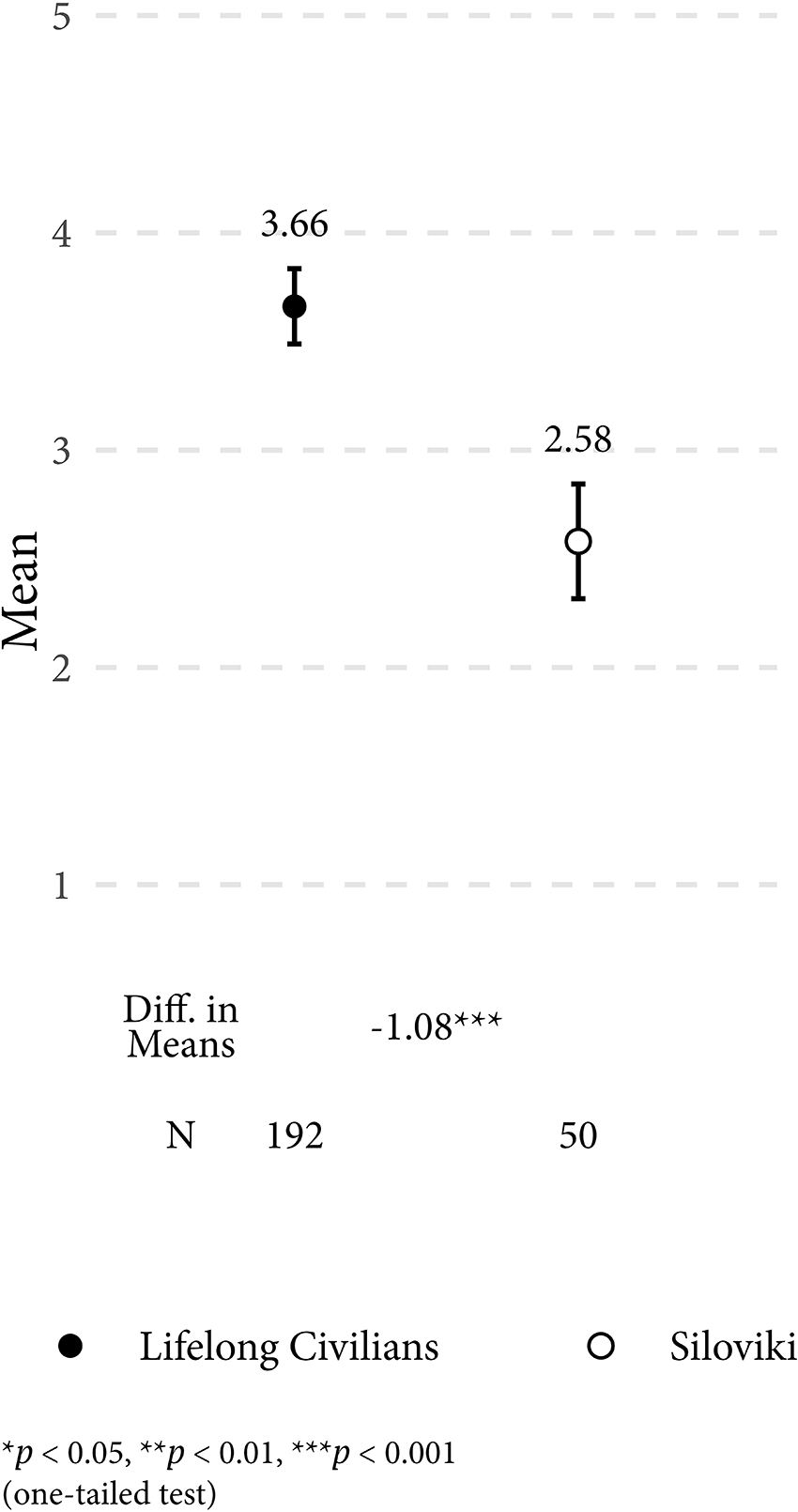
Difference in Means between Civilian and Silovik Levels of Opposition to Government Regulation of the Internet, 2020.

Do Putin’s alarmist views and these various restrictive laws ultimately derive (at least in part) from the socialization that Kremlin leaders received during their years of service in the KGB? Data from the 2020 SRE suggest that this is the case. As is displayed in Figure 2, lifelong civilians are considerably more likely than not to support the view that “Internet content should be completely free of governmental control” (Mean = 3.66), whereas siloviki are somewhat more likely than not to support the opposite view that “Internet content should be under the complete control of the government” (Mean = 2.58). Moreover, the difference of means between these groups of 1.08 points represents fully 27% of the range of the scale, is significant at the 0.1% level, and is much larger than any of the differences between the two groups that were reported in Figure 1 (Figure 2).
Another way to evaluate our respondents’ approval or disapproval of expansive civil liberties as they are practiced in real life is by probing views on the justifiability of various forms of protest. As Graeme Robertson writes, the aforementioned protest movement of 2011–12 “prompted a transformation in the Russian leadership’s political strategy aimed at aggressively reasserting control” over society.Footnote 76 In tandem with a suite of other measures, the government began cracking down on single-person demonstrations in 2012, but such efforts intensified during the COVID pandemic under the guise of health and safety regulations. New tactics included grouping together several individuals protesting separately about the same issue in order to treat them as a single unauthorized rally, sending provocateurs to join solo demonstrators and thereby draw in police involvement, and arresting protestors for using “prefabricated structures,” such as cardboard figures.Footnote 77 Moreover, as was discussed above, the state’s intolerance of protest has become particularly pronounced since the onset of full-scale war with Ukraine. After Navalʹnyi’s death in an Arctic penal colony, for instance, the authorities initially threatened not to release his body to his mother unless she agreed to a secret burial outside of Moscow.Footnote 78 When his funeral finally took place a week later, mourners seeking to attend were met by “hundreds of metal security barriers, blockading the entrance to the church and nearby Borisovsky Cemetery,” as well as “a huge force of riot police, deployed to ensure that President Vladimir Putin’s charismatic rival was buried with as little fanfare as possible.”Footnote 79
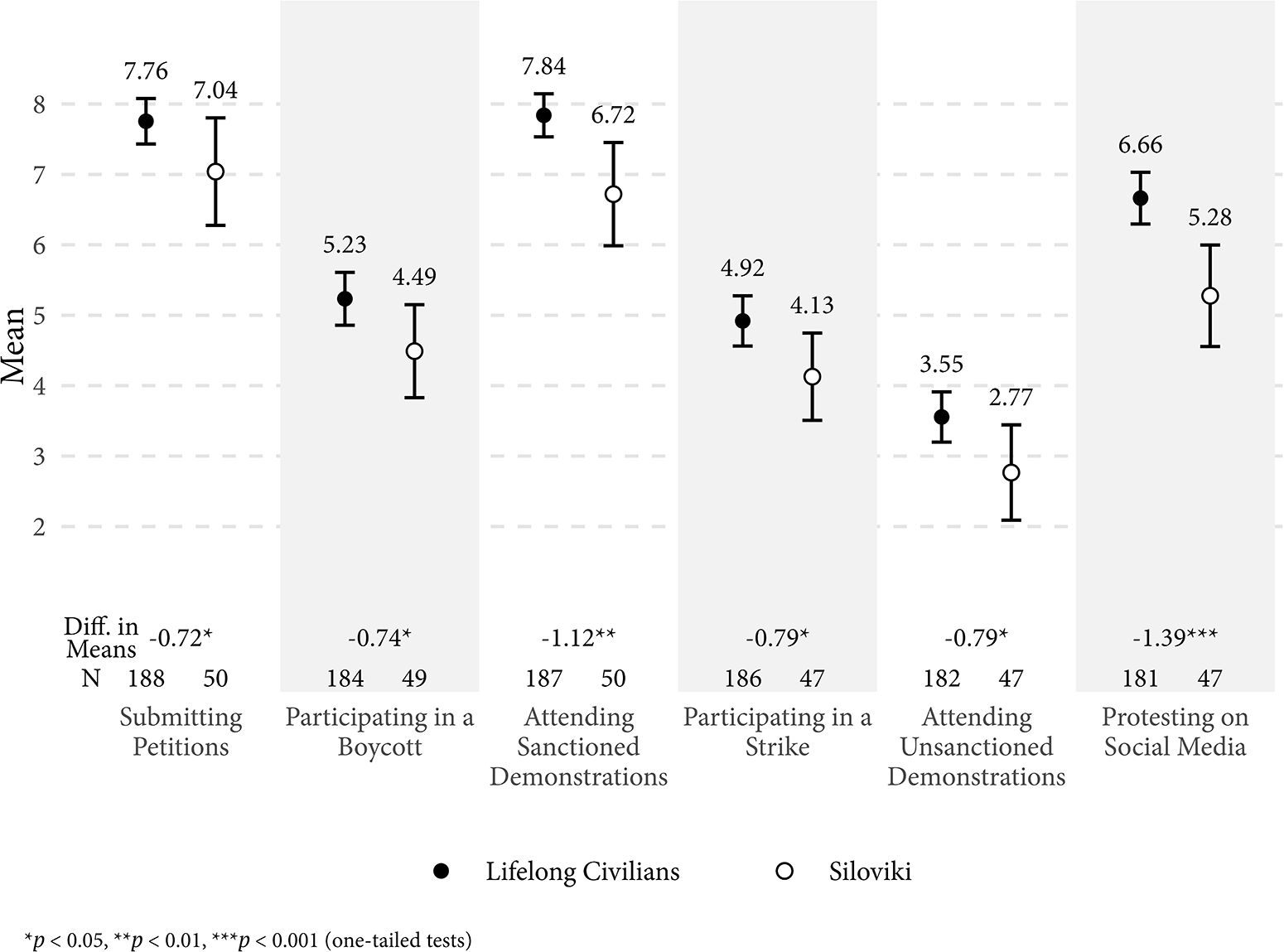
Differences in Means between Civilian and Silovik Views on the Justifiability of Protests, 2020.

Figure 3 Long description
Six panels sit side by side, alternating white and pale grey, each holding two point estimates with vertical error bars. The vertical axis is labelled Mean and runs from 2 to 8. A filled dot marks lifelong civilians and an open dot marks siloviki, as given in the legend below. Reading left to right the means are 7.76 against 7.04 for submitting petitions, 5.23 against 4.49 for participating in a boycott, 7.84 against 6.72 for attending sanctioned demonstrations, 4.92 against 4.13 for participating in a strike, 3.55 against 2.77 for attending unsanctioned demonstrations, and 6.66 against 5.28 for protesting on social media. The civilian estimate is higher in every panel and its error bars are consistently narrower. Printed beneath each panel are the difference in means, ranging from minus 0.72 to minus 1.39, the two sample sizes, and significance markers. A footnote gives the significance thresholds.
Again, has support for such clampdowns on public protest disproportionately existed among the siloviki in the Putin administration? Responses to all six sub-components of question 7 suggest that it has. As the results displayed in Figure 3 show, lifelong civilians, on average, rate each mode of expressing political discontent as more justifiable than do siloviki. The mean differences between the two groups range from 0.72 to 1.39 on a ten-point scale, and all are significant at the 5% level or better. The largest gaps are observed in attitudes toward participation in demonstrations sanctioned by the government (with a difference in means of 1.12) and especially protests on social media (with a difference of 1.39). The latter result dovetails nicely with the result reported in Figure 2: siloviki are much more wary of an unfettered Internet than are civilians (Figure 3).
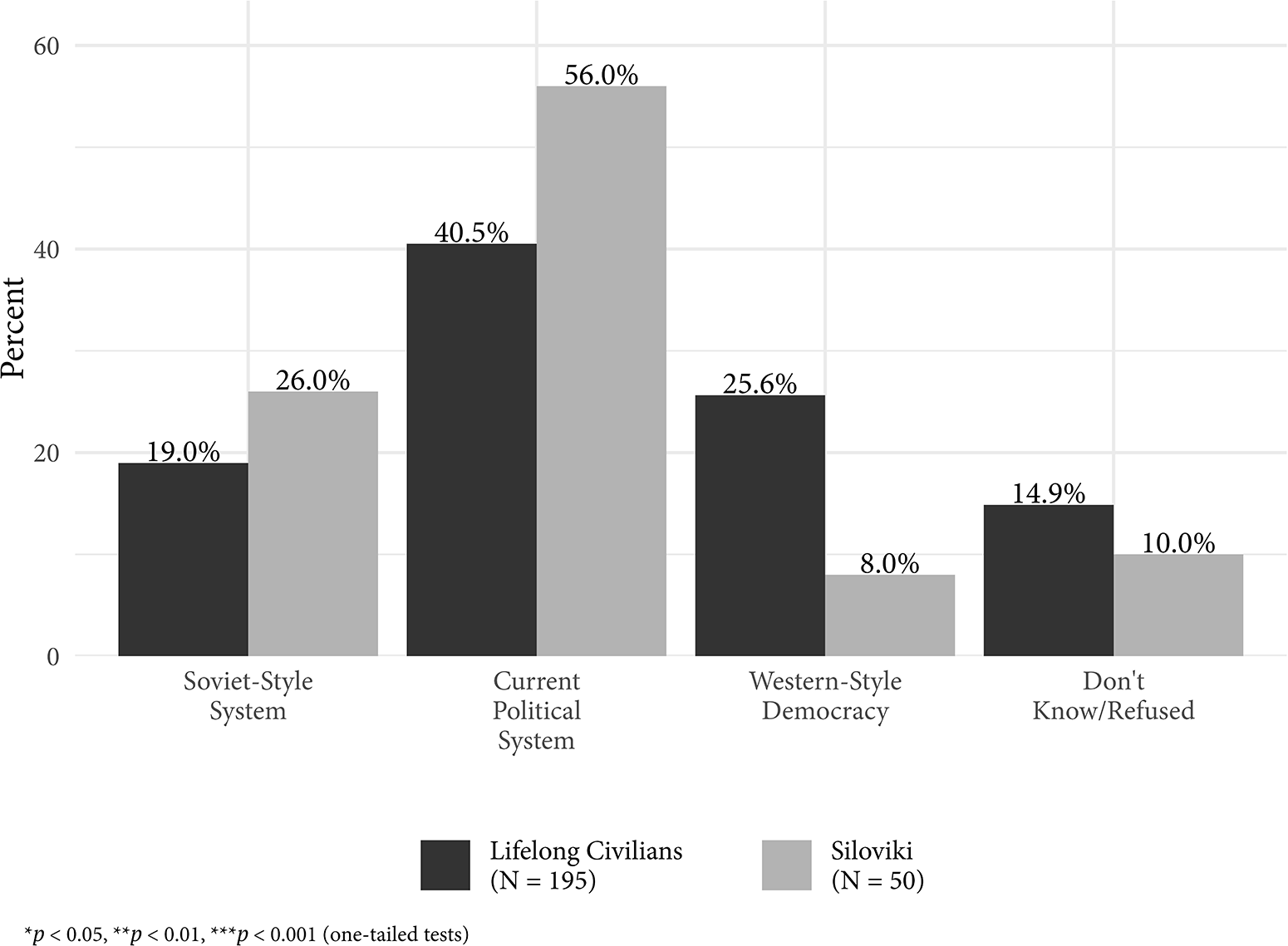
Differences between Civilian and Silovik Views on the Most Appropriate Political System for Russia, 2020.

Western-Style Democracy, Putinism, or Soviet Communism?
Finally, we observe significant differences between respondents with prior careers in the military and security agencies and those whose previous employers were exclusively civilian in their responses to the question, “What type of political system, in your opinion, is most appropriate for Russia?” Specifically, Figure 4 reveals four noteworthy findings. First, a much higher share of lifelong civilians (25.6%) selected “Western-style democracy” from among the four options than did siloviki (8.0%).Footnote 80 Put differently, one in four civilians regard western-style democracy as most appropriate for their country, compared to not even one in twelve siloviki. Second, slightly over half of elites from the power ministries (56.0%) viewed the country’s current authoritarian system as most suitable for Russia, compared to just two-fifths of lifelong civilians (40.5%). Third, slightly less than one in five civilians (19.0%) view some form of Soviet communism as most suitable, whereas slightly more than one in four siloviki (26%) hold this view. A chi-square test reveals that the subgroup differences displayed in the figure are highly unlikely to be the product of random chance (χ2 = 9.45, df = 3, p = 0.024)Footnote 81 (Figure 4). Fourth and finally, it is notable that more than three times as many siloviki would prefer a return to some form of Soviet communism (26.0%) than desire a transition to genuine democracy (8.0%). In contrast, more civilians would exchange Putinism for the greater freedoms of western-style democracy (25.6%) than would swap it for Soviet rule (19.0%).
These four sets of findings serve to reinforce those displayed in Figures 1, 2, and 3. Even beyond their greater propensity to assess liberal democratic principles negatively—whether formulated abstractly or concretely—less than half of our silovik respondents see any need for political change away from Putinism, and only a small slice of those individuals even purport to favor liberal democracy as the ultimate goal of such change.
Conclusions
Above we document the Putin regime’s ever-harsher crackdown on freedom of speech, freedom of thought, and dissent over the course of the past decade—developments that are also reflected in the country’s Freedom in the World Scores. From an already dismal 27 (out of 100) in 2012 (the year that Putin returned to the presidency), Russia’s score has monotonically declined ever since: to 23 in 2014, 20 in 2016, 19 in 2021, 16 in 2022, and 12 in 2024.Footnote 82 Russia’s descent from soft authoritarianism toward what some regard to be totalitarianism and/or fascism strikes many as having a simple root cause: The KGB was a repressive organ serving a totalitarian state and one of its former agents, a person imbued with its values, has ruled the country since 1999.Footnote 83
Such an interpretation is, of course, oversimplified; the evolution of a country’s political system is always the product of numerous historical, economic, and international factors. Nevertheless, our analyses of the political values of hundreds of individuals who were either governing Russia or influential outside of government in 2020 uniformly validate an explanation rooted in the professional backgrounds of the country’s leadership. Specifically, we find that elites with career histories in one or more of Russia’s numerous force structures are, on average, significantly less supportive than lifelong civilians of various core principles that undergird representative government, civil liberties, and the rights of the individual. In addition, the same pattern holds true with regard to support for more than a half-dozen concrete manifestations of those principles. Specifically, former and current military and security officers are more supportive of state control of the Internet and view various forms of protest activity as substantially less justifiable than do elites lacking professional experience in a force structure. Finally, siloviki are far less likely to prefer western-style democratic governance and considerably more enamored of Russia’s current authoritarian political system than are civilians. What is perhaps most noteworthy is that three times as many siloviki would prefer a return to the Soviet past than the creation of a western-style democracy, whereas more civilians would prefer their country to transition to genuine democracy than favor a restoration of any type of Soviet rule.
In short, what surveys of Russian elites have uncovered in previous decades persists in the present decade as well: Individuals with professional experience wearing epaulettes are considerably less sympathetic toward liberal democracy in all its forms and manifestations than those who previously worked exclusively in civilian employ, and only a negligible fraction of siloviki even express a desire to live in a truly democratic political system. In fact, this general pattern of political values holds across every survey question that we examine. Perhaps the fact that more recent waves of former security officers entering the Russian elite still possess the illiberalism that characterized the Soviet KGB should not be regarded as surprising. As Kimberly Marten writes, after the collapse of communism, “the KGB and its military intelligence counterpart, the Main Intelligence Directorate (GRU) of the Soviet Armed Forces General Staff, were never reformed… . [T]he new pieces of the old organisation were never purged of old thinkers or forced to change their organisational mindsets.”Footnote 84
Our results possess clear policy implications for all those with an interest in the country’s democratization after Putin departs the Kremlin, whether they be average Russian citizens, wealthy “oligarchs,” or foreign governments. First, all of these actors should think twice before casting their votes, donating their money, or otherwise lending any kind of support to a candidate for office who hails from a security or law enforcement agency. Second, if a future Russian president were to decide to undertake a major campaign of democratization, he would be wise to purge the ranks of government of siloviki to the maximum extent possible. Elite turnover of this sort would almost certainly serve to enhance the prospects that levels of political and civic freedoms might return to those that existed during the perestroika years of the late 1980s or the even more freewheeling 1990s. Third and finally, when the time comes for that hypothetical future reformer to select a desired successor as president, he should follow former NTV head Igorʹ Malashenko’s example and apply a simple decision rule to the search process: Ex-KGB agents need not apply.
Funding for the 2020 wave of the Survey of Russian Elites on which this project is based was provided by the National Science Foundation (Grant No. SES-1742798); the Arthur Levitt Public Affairs Center and Office of the Dean of Faculty at Hamilton College; and the Weiser Center for Emerging Democracies, Weiser Center for Europe and Eurasia, Center for Political Studies, and Department of Political Science at the University of Michigan. We appreciate the comments received at presentations given at the Swedish Defence Research Agency (FOI) in November 2021 and the 54th Annual Convention of the Association for Slavic, East European, and Eurasian Studies (ASEEES) in November 2022. We are grateful to Ani Abrahamyan, James Bryan, Fabian Burkhardt, Catherine Chen, Kirill Chmel, Kirill Kalinin, Tae Hyun Lim, Brian Taylor, Olesya Tkacheva, and Meredith Wilf for valuable feedback. We also acknowledge the excellent research assistance provided by Arielle Sher, Naval Lappalainen, Hannah Lipskar, Stuart May, and Huzefah Umer and support by the Sidney Wertimer Professorship for Excellence in Advising and Mentoring at Hamilton College.
Sharon Werning Rivera is the Sidney Wertimer Professor of Government and Director of the Russian Studies Program at Hamilton College. She specializes in the post-communist countries of Eurasia with a focus on Russia, and her articles have appeared in Perspectives on Politics, Post-Soviet Affairs, Europe-Asia Studies, Problems of Post-Communism, and Demokratizatsiya, among others. She is the Principal Investigator of the Survey of Russian Elites, which is on deposit with the Inter-university Consortium for Political and Social Research at the University of Michigan.
David W. Rivera is an Associate Professor of Government at Hamilton College and a member of the International Advisory Board of the Survey of Russian Elites. He has authored or co-authored articles on Russian foreign policy, presidential leadership and democratization, and the militarization of the Russian elite that have appeared in Problems of Post-Communism, Post-Soviet Affairs, Perspectives on Politics, Political Science Quarterly, and Russian Politics, among others.
Alexander Nemeth graduated from Hamilton College in 2022 with degrees in World Politics and French and Francophone Studies. In 2020, he co-authored a report on the 2020 wave of the Survey of Russian Elites with Professor Sharon Werning Rivera and several other Hamilton students. He also participated in a summer research group directed by Rivera and sponsored by the Arthur Levitt Public Affairs Center at Hamilton College.


 Open access

