Jaqueline Tyrwhitt (1905–83) was a British town planner, editor and educator who was at the centre of a group of people who shaped the post-war modern movement.Footnote 1 Her contribution, especially to the evolution of the planning arm of modernism, is insufficiently appreciated because she willingly subordinated her energies to the service of others, as ‘the woman behind the man’. In addition, her work transcended national and disciplinary boundaries, making it a challenge to see the connections she helped to establish. This article illuminates the significant contributions she made to transnational discourse on modern urban planning and design from 1941 to 1951. This is when she formulated her synthesis of utopian planning ideals, grounded in the bio-regionalism of the Scottish visionary Patrick Geddes and informed by European modernism. Her hybrid grew into the Geddessian branch of the planning arm of the post-war modern movement. In addition to uncovering Tyrwhitt's hidden voice, the article also uses the biography of a transnational actor as a vehicle to analyse the emergence of the concept that urbanism encompasses both the global and the local.
The article begins by examining Tyrwhitt's thinking on planning practice and pedagogy as it had evolved through 1945. It then considers her role in the revival of transnational networks of scholars and practitioners concerned with post-war reconstruction, as she joined the inner circle of the Congrès International d'Architecture Moderne (CIAM), and embarked on her academic career in North America. The article concludes at the 8th CIAM congress, held outside London in 1951, where Tyrwhitt presented her concept of the urban constellation, and the need for centres of community – the crucibles of democracy – at every ‘scale level’ from the local to the global. The broader context for this concept was Julian Huxley's philosophy for the United Nations Educational, Scientific and Cultural Organization (UNESCO): ‘a scientific world humanism, global in extent and evolutionary in background’, preserving variety in unity.Footnote 2 By this time Tyrwhitt's formulation of the Geddessian line of modernist planning thought had helped steer CIAM discourse toward a ‘new humanism’ and post-modern globalism.
The transnational life of Jaqueline Tyrwhitt: early influences
Several factors shaped the cosmopolitan perspective that Tyrwhitt brought to bear on British planning. She was born in Pretoria, South Africa, where her architect father worked for the Public Works Department – following a stint in China – and raised in London from age two. Her education at St Paul's Girls School (1918–23), where she studied the classics and learned French and German, prepared her to move among countries and languages in pursuit of her interests; as a young woman she ‘always crossed over to the Continent at least once during the year’.Footnote 3 Tyrwhitt's aspiration to study history at Oxford was thwarted for financial reasons. She studied horticulture instead, and spent a year (1924–25) at the Architectural Association to prepare for a career as a garden designer, which was an acceptable profession for an upper-middle-class woman who had to earn a living. She continued her studies under the famous gardener Ellen Willmott, an amateur horticulturalist who cultivated 100,000 species from all over the world at her estate, Worley Place. Tyrwhitt's education in the classics, horticulture and design shaped her holistic perspective, in which she integrated artistic and scientific – and fundamentally evolutionary – ways of understanding the world.
Tyrwhitt was keenly aware of her status as a member of a family that descended from the original English gentry, ‘who remained as of old without seeking wealth in trade’.Footnote 4 Many served in the military instead; Tyrwhitt's immediate family was distinguished by its service to the country, notably in the Far East. She travelled to Shanghai in 1934 to visit her brother, an army officer stationed there.Footnote 5 His example moved Tyrwhitt to dedicate her own life to service. In 1931 she became assistant organizer for the League of Industry. She left the League in 1935 in order to study ‘the association of agriculture with industry’ at Dartington Hall, which Leonard and Dorothy Elmhirst modelled on Rabindranath Tagore's experimental school, Sriniketan, an Institute of Rural Reconstruction. Dartington Hall combined new methods of farming and forestry, and the creation of related industries, with a progressive boarding school and promotion of the arts and crafts. The Elmhirsts hosted a variety of social and artistic groups there, including both Bauhaus émigrés and Political and Economic Planning (PEP), a research organization. Dartington Hall is probably where Tyrwhitt was first influenced by Geddes. She decided to study Geddes’ approach to regional and town planning under E.A.A. Rowse at the School of Planning and Research for National Development (SPRND) (1937–39). However, Tyrwhitt's sense of duty led her to enlist in the Women's Land Army when England entered World War II. Tyrwhitt thrived in the Land Army, where she managed a sawmill in the New Forest and enjoyed rural life, while staying close to friends at Dartington Hall and PEP.
Planning theory and pedagogy: wartime experience
When Rowse enlisted in late 1940, he recruited Tyrwhitt to become his deputy. In January 1941, Tyrwhitt, then 36, returned to London in the midst of the blitz to take on this responsibility, becoming director of research of the Association for Planning and Regional Reconstruction (APRR), a new organization formed to carry on the research work of Rowse's school. ‘This was the heroic period of planning surveys in Britain’, Tyrwhitt recalled. ‘I was an ardent disciple of Patrick Geddes, . . . and during the war years I . . . [worked] hard . . . at APRR developing cross-disciplinary survey techniques that could be put into practice for the physical re-planning of postwar Britain.’Footnote 6 The bombing of Britain by Nazi Germany produced an immediate need to rebuild ‘blitzed’ and nearby blighted areas; the government estimated the need for more than 2,000 planners for this purpose. In 1942, backing from the War Office enabled APRR to reorganize SPRND as the School of Planning and Research for Regional Development (SPRRD), with Tyrwhitt as interim director, to run a Correspondence Course in Town Planning for members of the armed forces. The Correspondence Course, which Tyrwhitt ran practically single-handedly beginning in the fall of 1943, provided a framework for her to systematize the surveys she was developing, a requisite for realization of the ideal human environment.Footnote 7
Tyrwhitt based the course on Geddes's approach, focusing on: ‘the need to be interdisciplinary, the use of the region as a planning unit, the necessity of a holistic approach, and the importance of economic and social factors’.Footnote 8 But she also incorporated ideas from European modernism, forging a fusion of Geddesian and CIAM principles. Tyrwhitt was introduced to modernism through her membership in the Modern Architecture Research (MARS) group, the British section of CIAM, which had been greatly inspired by the arrival in England of many émigré Bauhaus teachers and students since the 1930s, notably Bauhaus founder Walter Gropius, Laszlo Moholy-Nagy, Serge Chermayeff and Sigfried Giedion, CIAM secretary general. Giedion in particular exerted a strong influence on Tyrwhitt, with whom he began a life-long collaboration a couple of years after they met in New York in 1945.
Tyrwhitt articulated her synthesis of Geddessian and CIAM principles in her article ‘Town planning’, in the inaugural issue of The Architect's Yearbook of 1945, a new journal co-founded and edited by MARS member architect Jane Drew. The editorial board of The Architect's Yearbook was committed to showing how the utopian social-aesthetic ideals of the European modernists in the 1930s could be adapted to post-war conditions in Britain. The Architect's Yearbook, along with Architectural Review and Architectural Design, created the forums for debate in Britain about the future direction of modernism, which, it was generally agreed, needed to go beyond the functionalist credo of CIAM's Athens Charter, which Le Corbusier had written based on discussions at the 4th CIAM congress in 1933. ‘Town planning’ describes Tyrwhitt's contribution to that debate at a time when the MARS group became the most active of the far-flung CIAM chapters, and ‘the principal British conduit for international contacts with modern architects abroad’.Footnote 9 Her formulation of the Geddessian (as opposed to the Corbusian) branch of modernist planning thought prefigured and helped steer CIAM's general turn toward the social dimensions of urban planning by 1950–51.
Tyrwhitt acknowledges the limits of pre-war CIAM principles by presenting town planning as a synoptic discipline encompassing: The Region, The Neighbourhood, Work, Food, Health, Education, Transport, Leisure and Holidays – not simply the four ‘urban functions’ of Dwelling, Work, Recreation and Transportation stipulated in the Athens Charter. In doing so she addresses Lewis Mumford's earlier critique of the CIAM approach as ignoring the crucial cultural and civic role of cities.Footnote 10 Tyrwhitt begins by de-emphasizing a focus on towns, as planning for ‘towns of many sizes can be countenanced, provided . . . that, at one level, they fit into the general framework of the region and, at the other level, they are suitably differentiated into coherent neighbourhood units’. Such planning requires an interdisciplinary team. Tyrwhitt argues, however, that it makes no difference whether the team leader is ‘an architect, an engineer, a geographer, a sociologist, an archeologist, a doctor of medicine, an economist, or a lawyer. The purpose of the team is to see the region always as a whole and, by pooling the individual knowledge and skill of its members, to enable a balanced and dynamic development continually to take place.’ The planning team accomplishes its aim through regional surveys ‘distributed as widely as possible’. The survey information, depicted in explanatory maps, photographs and diagrams, provide those ‘who want to take part in re-planning their home area . . . a reasonable basis for informed criticism and judgment of local town planning proposals’. This method would also assist members of parliament to evaluate anticipated national planning proposals.Footnote 11
In making her case Tyrwhitt invoked ‘the space–time scale of our generation [that] has been grandly set forth by Giedion and needs interpretation in all forms of physical planning if we are to become masters of our own technical abilities [emphasis added]’.Footnote 12 Humanistic mastery of those technical abilities – dramatically advanced by the world war, which both propelled and heightened awareness of global interdependence – depends on ‘intimate neighbourhood life . . . [that] breeds social consciousness and civic responsibility’. Tyrwhitt argues: ‘The life of the future needs the two contrasts in scale expressed in the same plan: a sense of space, freedom of movement, scope for expression, together with closely knit neighbourhood life.’ She connected the need for this contrast in scale to lessons learned on the home front and English traditions: ‘The wardens’ posts and fire-fighting parties have taught us much. Not least that some form of common meeting-place is a great asset to every group of neighbours. This is only a development of the English collegiate tradition of the “common room”.’ Footnote 13
Tyrwhitt also advocated what Rowse had deemed a ‘preventative medicine’ approach to planning based on the example of the Peckham Health Centre, founded by Dr Scott Williamson and Dr Innes Pearse in 1935 in a working-class neighbourhood of London, and based on the concept of positive health promoted by the League of Nations Committee on Health (and ratified in the constitution of the World Health Organization when it was established in 1948).Footnote 14 Pearse actively participated in discussions hosted by APRR, reporting on the results of ‘The Peckham Experiment’ and their research on the relationships between soil, the quality of food and nutrition and human health.Footnote 15 ‘From food to health; to a place for people overflowing with exuberant vitality, not passively relieved that they are free from sickness’, Tyrwhitt extolled the contribution of the Centre:
The work of the Peckham Health Centre has shown that positive health can only be encouraged by the full and free development of the varied potentialities of each individual . . . It is the result of an active life in an environment rich in varied opportunities for mental and physical development and for free and friendly social intercourse . . . It is on these lines that we can imagine our neighbourhood environments of the future. Facilities that will be communally owned and communally run by the local people, with the doctors moving about as part of the social make-up of the whole.Footnote 16
CIAM adopted the idea of the civic benefit of ‘some form of common meeting-place’, rendered as ‘the CORE’, or centre of the city, as the theme for its 8th congress in 1951, where the Peckham Health Centre was hailed as a model civic centre (as discussed below).
Planning theory and pedagogy: post-war transnational networks and practice
In January 1946 SPRRD began a series of intensive completion courses for returning soldiers. In the autumn an Overseas Correspondence Course was launched. Summarizing her career in 1954 Tyrwhitt wrote: ‘This is the work Tyrwhitt likes to think she may be remembered for. It qualified 170 men for active service in town planning and got them into the field at the time the British Town Planning Act of 1947 needed them.’Footnote 17 Many of these students went on to positions of leadership in the new planning agencies, ministries and academic departments then being created in Britain and its former territories, where they applied Tyrwhitt's lessons in seminal projects and in new schools of planning.
Tyrwhitt designed her post-war course with a new perspective which she described in her article, ‘Training the planner’, in the 1946 reference book, Planning and Reconstruction:
A planner must be able to being able to see the social life of a town and its physical pattern as one related whole . . . He must also know the effect of any change in one part of the town upon the life of the whole. Not only must he know this, but he must be able to anticipate how the town will grow or alter . . . and he must, as importantly, know [the people's] requirements. Finally, a plan is a design and the planner must be a designer; not the stage designer who presents an illusion, but the creative artist who not only sees what is in terms of what could be, but has the power to set this down in such a manner that his vision is shared and understood by others [emphasis added].Footnote 18
Tyrwhitt's new perspective on the aesthetics of planning was the direct result of her visit to North America in the spring of 1945. She went there to report on the plans being made for post-war Britain, on behalf of the British Ministry of Information and the Canadian Wartime Information Board, who sent her on a lecture tour of Canada in the spring of 1945. Jacob Crane, then director of the US National Housing Agency's International Office, knew Tyrwhitt through the International Federation of Housing and Town Planning (IFHTP) and arranged to extend her tour to include US cities, ensuring that she met leaders in the planning movement.Footnote 19 Many ‘housers’ and planners already knew Tyrwhitt based on her work in England during the war.Footnote 20 Moreover, Tyrwhitt's membership in the MARS group ensured that she received a ‘warm welcome from CIAM exiles in the US’. She recalled that meeting Lazlo Moholy-Nagy, then directing the ‘New Bauhaus’ school in Chicago, had a profound affect on her:
Although I had an architectural background, my mind was almost wholly occupied with the social and economic aspects of the problem, and the world of art was deliberately disregarded. My contact with Moholy-Nagy in Chicago changed all that, and when I met him again in New York with Giedion, I experienced a sort of conversion, somewhat similar to suddenly ‘getting religion’. My eyes were opened. I continued my former work but with a different viewpoint.Footnote 21
Tyrwhitt took full advantage of opportunities to participate in transnational discourse as progressive reformers renewed their international ties in the context of the new UN organizations, in academic exchanges and gatherings of experts and policy specialists.Footnote 22 In September 1946 she attended the first post-war IFHTP congress in Hastings, England, where she re-established contact with Catherine Bauer, who was there representing the US National Housing Agency. A significant outcome of that congress was a resolution to establish a housing and planning unit within the UN.Footnote 23 In November 1946, at UNESCO's first General Session, zoologist Julian Huxley, secretary of the Preparatory Commission and director general during 1946–48, enthusiastically endorsed a similar proposal ‘to set up an international organization to study the problems for Home and Community Planning [i.e. for Human Ecology] on a world scale’ as a programme of UNESCO.Footnote 24 Tyrwhitt was keen on the idea of working with UNESCO, individually or through CIAM – which hoped to become a corresponding organization of UNESCO.Footnote 25
Tyrwhitt strengthened her international connections as it became increasingly clear that she would have to leave England, which emerged from the war facing serious economic problems and enduring financial austerity through the late 1940s. During this time, openings for women in the workplace created by the war closed in favour of returning veterans. When Rowse returned from his wartime service in 1947, Tyrwhitt helped him develop a one year full-time Diploma Course, which SPRRD launched that September. In July Tyrwhitt stepped down from SPRRD in his favour, although she retained her role as APRR director of research until 1949. In late 1947, Tyrwhitt, aged 43 and unmarried, was both free and forced to join the tide of European intellectuals looking for new opportunities in North America. She promoted her pragmatic, project-based approach to planning education to an international audience through her article ‘Training the planner in Britain’, in the IFHTP newsletter in December 1947, which described its principles as linking theory to practice: ‘lecture (the theory of planning), survey (the discovery of the problem), analysis (the appreciation of the problem), designing the plans (the solution of the problem), and implementing the plans (realization of the ideal) are part and parcel of one process’.Footnote 26
Tyrwhitt found a position as a visiting lecturer on English town planning at the New School for Social Research in New York – an institution which facilitated the migration of modernist ideals to the US, initially by providing a haven for European scholars and artists endangered by the NazisFootnote 27 – for the spring semester 1948, thanks to prominent ‘houser’ Charles Abrams, who befriended Tyrwhitt during her visit there in 1945. Abrams wanted Tyrwhitt's help in developing a proposal for a one-year planning programme at the New School, where he also taught, based on the APRR course. As soon as she arrived in New York in mid-March, Tyrwhitt became swept up in a flurry of activity with new colleagues, old friends and the many people she met through Abrams, her host during her stay, whose house was a lively salon for progressive artists, intellectuals, students and activists.Footnote 28 Tyrwhitt's views on Britain's approaches to planning education and legislation found a ready audience.
Catharine Bauer – then lecturing on housing at Harvard while her husband, William Wurster, was dean of the MIT School of Architecture – came to New York to attend Tyrwhitt's first lecture, on Surveys for Planning. The next day Bauer took Tyrwhitt on a tour of recent housing projects. En route the ‘conversation ranged over the wide and international field of housing’, and Tyrwhitt observed: ‘“houses versus flats” is as perennial and as unsatisfactory an argument with us [in England] as “public versus private housing” is here. The “versus” is rubbish in both cases.’ But that topic, she was happy to report, ‘led us onto an interesting discussion on the possibilities and values of accommodation shared in common between groups of neighbours as the grass roots of democratic training in citizenship’. Footnote 29
Tyrwhitt admired a mixed use project in Queens, the only place visited with ‘shops, picture theatre and community buildings being developed in association with housing’. This was now being accepted as essential in England, Tyrwhitt explained. ‘Our somewhat extensive experience between the wars of building large housing estates without such amenities as part of the original plan has convinced us of the economic and social value of planning and erecting the “neighbourhood” as a whole.’ Like Bauer and Abrams, Tyrwhitt was appalled by Stuyvesant Town in Manhattan – built under state enabling legislation in 1946 for returning veterans –’where 8,800 apartments are being erected on 75 acres in blocks of 12 and 13 stories . . . [to be] a nightmare of sanity . . . a few shops on the periphery . . . but otherwise NOTHING’.Footnote 30
Abrams featured Tyrwhitt's constructive criticism in his column in the Post-Home News Housing Adviser. ‘Miss Tyrwhitt seemed particularly disturbed about the lack of the neighbourhood atmosphere in the projects’, Abrams wrote. ‘They were more like dormitories than communities’, and she noted the danger of ‘regimentation’ in large projects, saying: ‘You have too many orders and too many rules.’ Europeans had learned in the war that such over-regimentation leaves no room for the important activity of children's play. She explained: ‘The only playground that could really keep the children off the streets was the bombed site, where there was adventure accompanied by dirt and danger.’ Noting that the only free play area in Stuyvesant Town was ‘a supervised fenced-off asphalt playground with a formal array of equipment, she predicted: ‘The children will run up against authority at every turn and I wouldn't blame them a bit if they sought refuge in the streets nearby. I hope some of your empty lots will be ready to receive them.”Footnote 31 This was eight years before Jane Jacobs famously presented a similar critique, at the first Conference on Urban Design at Harvard's Graduate School of Design (GSD), which Tyrwhitt helped CIAM president José Luis Sert organize soon after he became dean and she joined the faculty.Footnote 32
The timing was opportune for Tyrwhitt to contribute to US housing policy debate as the 1937 authorizations under the Wagner-Steagall Act – which Bauer helped write, and was based partially on the English experience – had expired. Abrams and Bauer were working to shape the new legislation then under consideration by the US Congress, the Housing and Slum Clearance Act, which was passed in 1949.Footnote 33 Tyrwhitt played a key role in renewing the cross-fertilization of Anglo-American planning ideas that had been interrupted by the war.
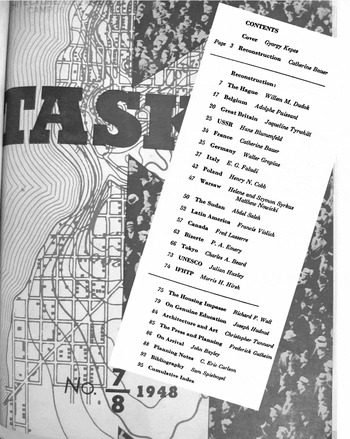
In April 1948, both Abrams and Tyrwhitt were invited to speak at Harvard, where Gropius was director of the GSD Architecture Department. Martin Meyerson, then a graduate student in planning at GSD, invited Tyrwhitt to contribute to the first post-war issue of the journal TASK (7/8, 1948), which he was editing. ‘It was a very, very small universe’, Margy Meyerson his wife and co-editor, recalled. ‘Through one way or another almost everybody knew each other or of each other.’Footnote 34 The Meyersons dedicated TASK 7/8 to reconstruction worldwide, gathering material from ‘European countries devastated by the war; Latin America on the threshold of industrialization; two colonial outposts in Africa; and nations as fundamentally different in economic structure as Britain, the USA, and the USSR’, and they included statements from IFHTP and UNESCO. For this issue, Gyorgy Kepes, the Hungarian born protégé of Moholy-Nagy then teaching at MIT, was art adviser; and the Editorial Council included Bauer and Sert. In her introduction, Bauer noted that transnational organizations such as IFHTP, UN and UNESCO (and CIAM) were instigating the post-war ‘revival and intensification’ of ‘broad-based international fellowship and cross-fertilization in this field’. To suggest the larger ‘significance of this interplay’ Bauer cites Huxley's philosophy for UNESCO: ‘The unifying of traditions in a single common pool of experience, awareness and purpose is the necessary prerequisite for further major progress in human evolution.’Footnote 35
In her article Tyrwhitt tempered Bauer's enthusiasm, ‘for it is a difficult period for British planners to bear with equanimity’. Tyrwhitt explained:
Here at long last, we have within our grasp the means to plan, in the shape of the 1947 Town and Country Planning Act, and it turns out to be but a mirage – an image of what can be – one day, not now, not for a long time yet. And yet you across the Atlantic, with the economic means but lacking the law, must, in your way, feel as frustrated as we do.Footnote 36
Huxley, however, was optimistic about UNESCO's work ‘to improve man's relations to his physical environment’. The concerns of housing and planning, particularly the emergency needs of reconstruction in war-devastated Europe and Asia, would fall to UN's Economic and Social Council and UNESCO would be ‘closely associated with the scientific and artistic aspects of this work’. UNESCO was ‘planning a survey of education of town and country planners, designers and architects . . . [and] stimulating the international exchange of views concerning the modernization of curricula in these subjects, both in the social sciences and in schools of design’. An International Centre for Home and Community Planning to be established by the UN and UNESCO, planned to take form in 1948, never materialized, however.Footnote 37
Planning theory and pedagogy: Geddes as a guide
It was in this context that Tyrwhitt seized the opportunity to remind planners of the relevance of Geddes’ ideas – which were greatly influenced by the teachings of evolutionary biologist Thomas Huxley, Julian's father – to the current worldwide task of urban reconstruction and renewal. She selected extracts from Geddes’ Reports on Indian Cities (commissioned 1915–19) for publication as Geddes in India, with an Introduction by Lewis Mumford, Geddes's best-known disciple, and a Preface by Dr H.V. Lanchester, who had worked with Geddes there. Tyrwhitt explained that her task was to ‘choose passages that clearly illustrated the practical application of those town planning principles for which Patrick Geddes stood’. These principles included ‘diagnosis before treatment’ (survey before plan) and ‘conservative surgery’, a process that respects local traditions and build on their strengths. These extracts highlighted Geddes’ concept of ‘bio-regionalism’.Footnote 38 That is ‘what makes this book particularly apt and timely for the days ahead’, Mumford declared. ‘In short, one cannot appreciate Geddes's regionalism unless one also appreciates his internationalism, his universalism . . . What he says about India has a lesson for other lands.’Footnote 39
A collage of the journal TASK, 7/8, and its table of contents. Courtesy of the Frances Loeb Library, Harvard Graduate School of Design.

Tyrwhitt clearly intended the publication of Geddes in India – which coincided with India's independence from the British Empire – for ‘practical application’ in the realization of the new social order UNESCO would help foster, based on Huxley's philosophy of ‘scientific world humanism, global in extent and evolutionary in background’.Footnote 40 ‘Environment and organism, place and people, are inseparable’, Geddes wrote. Speaking through Geddes’ words, Tyrwhitt urges architects and urban planners to learn from the ‘wisdom of the East’ how to look at the world holistically and imagine a new social-aesthetic ideal:
[T]he cause of the frequent aesthetic failure of our results . . . is due to the lack of harmony between the advancing phases of western ‘science’. Each of the various specialists remains too closely concentrated upon his single specialism, too little awake to those of others . . . In the east, on the other hand, it has been the glory of the historic sages and ancient rulers to concentrate their minds and efforts upon life as a whole. As a result, civic beauty in India has existed at all levels, from humble homes and simple shrines to palaces magnificent and temples sublime. In city planning then, we must constantly keep in view the whole city, old and new alike in all its aspects and at all its levels [emphasis added].Footnote 41
Tyrwhitt underscored this lesson through the photographs she selected, taken by Anthony Denny during the war as well as aerial views, to illustrate the qualities Geddes admired in India: ‘The transition in an Indian city from narrow lanes and earthen dwellings to small streets, great streets, and buildings of high importance and architectural beauty, form an inseparably interwoven structure.’Footnote 42
Percy Johnson-Marshall, who was director of the Patrick Geddes Centre for Planning Studies in Edinburgh, considered Geddes in India to be among ‘the most significant books of the time’.Footnote 43 Geddes in India had an immediate and reverberating impact on transnational discourse on urbanism by coming to the attention of key actors. It influenced New York based architect Albert Mayer, for example, who reviewed the book favourably in the journal American City soon after its publication.Footnote 44 Mayer was then advising Indian Prime Minister Nehru on a pilot community development project. He went on to design the master plan for the new Indian city of Chandigarh, and advise the Ford Foundation on its community development programme in India.
Planning theory and pedagogy: Geddes as a guide II
Back in England in mid-1948, Tyrwhitt produced a new edition of Geddes’ Cities in Evolution, originally published in 1915, that was clearly aligned with Huxley's vision for UNESCO. Tyrwhitt produced her widely read abridged version (published in London in 1949 and in New York in 1950) on behalf of APRR, and in collaboration with Geddes’ son, Arthur. In her introduction Tyrwhitt explains the contemporary relevance of this book – out of print for more than a generation – in ecological terms:
Perhaps it is only now . . . that the time is really ripe for the reprinting of this book . . .Now that not only the work of the Peckham Health Centre, but almost every book published on popular psychology, give overwhelming evidence of the profound effects of the opportunities available in the immediate environment upon the physical and mental development of the individual.Footnote 45
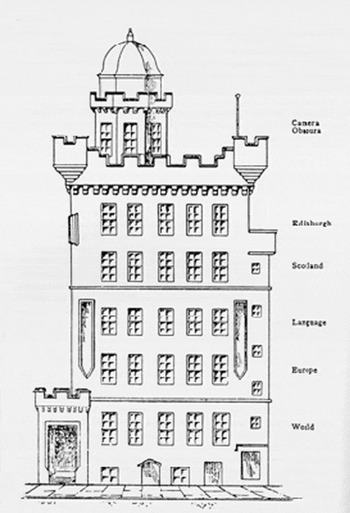
Tyrwhitt highlights the currency of Geddes’ emphasis on civic education, namely the value of civic surveys and exhibitions; and the need for permanent centres for civic studies – such as his Outlook Tower in Edinburgh – ‘in each city, where the inter-relation of the past, present and future of that locality, and the interaction of world events and local life can be constantly refreshed and made manifest to the ordinary citizen, as the very basis of citizen participation in town planning’. The prototypical Outlook Tower described in Cities in Evolution provides the citizen with ‘a vision and comprehension of the possibilities of his own city’, Tyrwhitt writes. ‘This is something that, with all our discussions on the need for and value of “citizen participation” in town planning has yet to be given a trial.’Footnote 46
To enhance its value, Tyrwhitt and Arthur Geddes omitted five chapters from the book that were dated. ‘These deletions are well justified’, wrote Mumford, who considered their edition ‘both greater and less than the original text’, ‘fortified’ with new ingredients; ‘and for a generation that hardly knows Geddes, except at second hand, these additions more than make up for the losses’.Footnote 47 One addition is part of a lecture Geddes gave on the Valley Section – ‘the human landscape seen from river source to sea’ – at the New School in 1923. Tyrwhitt explains that it is difficult to find a description of this concept in Geddes’ writings. The lecture is included to elucidate references to the Valley Section in the book, and as an example of his empirical ‘method of deductive observance’.Footnote 48 Also included are illustrations from Geddes’ second Cities and Town Planning Exhibition, with text drawn from the catalogue of the first exhibit of 1910. An appendix consists of: Geddes’ description of his ‘Notation of Life’ diagram; an essay by John Turner and W.P Keating Clay on his ‘thinking machine’ diagrams as ‘an early general systems’ model; Geddes’ final lecture at the University of Dundee; one of his talks to his young children; and a brief biography. ‘With the help of this supplemental fare, a representative part of Geddes's essential thought on cities and civilizations is now for the first time at hand’, affirmed Mumford, who summarized Geddes’ message as: ‘See for yourself; understand for yourself; act on your own initiative on behalf of the community of which you are a part.’Footnote 49
Drawing of Geddes’ Outlook Tower.

Tyrwhitt had an opportunity to place these ideas into international discourse when she returned to the New School in October 1948 to give another set of lectures – fittingly a comparative perspective on ‘Town & Country Planning in Britain and the US’ – and help launch the new degree course in planning in the spring term of 1949. Serendipitously, the annual conference of the American Society of Planning Officials opened in New York the day after she arrived. Tyrwhitt joined the conversation at a session on Training the Planner (at which ‘the growing pains and adolescent confusion of the new and rapidly growing profession’ were evident).Footnote 50 The proceedings report: ‘Miss Jaqueline Tyrwhitt, from England, stated that training for town and country planning in her country even many years before the present Labor government, had not been geared to “what exists” but to “what might be. We train people forward, and not backward”, she added.’ Tyrwhitt also asked ‘When does citizen participation come in?’ In that regard she ‘referred to the “museum” and the “outlook tower” in the proposals of Patrick Geddes, which could stand much more thoughtful exploration in meeting today's needs and wants.’ Tyrwhitt was much in demand as a speaker during her stay in New York, where her views ‘found ready echo among the “young planners” searching for direction’.Footnote 51 Appropriately, for her final lecture at the New School in February 1949, Tyrwhitt reprised Geddes’ talk there a quarter century earlier.Footnote 52
When Tyrwhitt returned to London she completed her last project for APRR, compiling the Town and Country Planning Textbook (1950) – the first comprehensive textbook on town and country planning in Britain, which was based on Tyrwhitt's correspondence course materials. She is explicit about the humanistic synthesis of Geddesian and pre-war CIAM social-aesthetic ideals this book represents: ‘The Patrick Geddes's triad “place, folk, work” and the four points of the CIAM Charte d'Athenes “living, working, developing mind and body, circulating” are fully treated, and, though the purpose of the book is to impart technical information, there is a constant warm under current of enthusiasm for the well-being of a lively and diversified humanity.’Footnote 53 Historian Michael Hebbert asserts that Tyrwhitt's own contributions to this collection ‘capture perhaps better than any other the bracing sense of what could be achieved by a scientific regional planning which tackled land use and social and economic problems not piecemeal but holistically as elements of a single community design’.Footnote 54
Transnational networks: Tyrwhitt and CIAM discourse
Tyrwhitt explained how she arrived at this holistic approach to community design: ‘My association with CIAM gave me a new perspective. I realized that without a structurally creative imagination even the best collection, analysis and synthesis of place, folk and work could not result in a worthwhile habitat for man.’Footnote 55 Tyrwhitt's formulation of a Geddesian line of modernist thought evolved in the late 1940s, as she became an active participant in CIAM congresses. She had an immediate albeit unacknowledged impact on post-war CIAM discourse. By the early 1950s, members of the younger generation of CIAM, notably from the MARS group, known as Team Ten, adopted the Valley Section as the conceptual framework for their principles of a ‘new’ humanistic modern urbanism.
Tyrwhitt helped the MARS group organize the first post-war, and 6th, CIAM congress, which was held in the fall of 1947 in Bridgwater, England. Ten years had passed since the previous congress; now ‘it was necessary to reformulate the goals of CIAM and to renew broken contacts’.Footnote 56 Giedion's ideas on the need for modern architecture to express a ‘new monumentality’ – with expressive forms responsive to people's desire for ‘buildings that represent their social, ceremonial and community life’ – served as the basis for this congress. Footnote 57 Giedion's desire to restore relations between the sciences, art and the humanities, and his call for a new type of specialist able to conceive problems in relation to the whole resonated with Tyrwhitt's social-aesthetic perspective, notably as expressed in her publication, Geddes in India, that year. The Bridgwater congress marked a turning point in their relationship; Tyrwhitt ‘subsequently became intimately involved in his life works, as translator/rewriter/editor of eight major books published in English between 1951 and 1970’. The first of these, A Decade of New Architecture resulted from the Bridgwater congress.Footnote 58
After APRR closed, in the summer of 1949 Tyrwhitt strengthened her ties to the MARS group, participating in CIAM 7 in Bergamo Italy (where the discussion of integration of the arts continued), assisting MARS director Max Fry in running the CIAM summer school (which explored collaboration among architects, planners and artists), and going into partnership with MARS group co-founder Wells Coates. Tyrwhitt explained to Sert, with whom she now corresponded regularly on CIAM affairs, that she and Coates were ‘hoping for jobs that may enable us to put some of our ideas on creative group work into practice [emphasis added]’. She also had ‘one or two attractive invitations’ to come to the States in the spring, although nothing that would pay her way. Tyrwhitt was determined to return to the US, though, and made the trip in April 1950 even though the job that got her a visa – guiding an international study tour with Abrams – had fallen through. Abrams helped her get by, arranging a commission for her to write an article on housing for the UN. Otherwise, she spent her time reinforcing her contacts, meeting with Mumford in New York, who advised her editing of Geddes’ texts, and with colleagues at Yale, Harvard and MIT, where she worked with Giedion, a visiting lecturer that term, on final details of A Decade of New Architecture.Footnote 59 Tyrwhitt's work on this book – which she produced when Giedion grew frustrated with lack of response from CIAM members – is significant as it ‘is also an important document on the postwar history of the CIAM, a period during which Giedion's influence on the congresses noticeably grew’.Footnote 60
Giedion no doubt helped convince Sert to use CIAM funds to hire Tyrwhitt to help produce a book on town planning based on the CIAM grid (grille CIAM d'urbanisme), which Le Corbusier and the ASCORALFootnote 61 group had produced for comparative analysis of town plans in terms of the four urban functions specified in the Athens Charter. Tyrwhitt attended a CIAM meeting at Sert's New York office in June 1950 where this contract was approved, and the programme for the 8th CIAM congress, to be held in 1951 in England, was also discussed.Footnote 62 CIAM leaders had asked the MARS group to organize the next congress in recognition of their contribution to the further development of modernist principles. It had been agreed at Bergamo that the theme for the 8th congress would be establishment of a Habitat Charter (La Charte de l'Habitat), based on the CIAM grid. But the MARS group suggested an alternative: the theme of ‘the CORE’, or civic centre. In advance of the June meeting, Tyrwhitt and Alberto Iriarte, of Sert's staff, adapted the CIAM grid to analyse the CORE, using London as a model, thereby integrating the two themes (and resolving potential conflict within the organization). She was then delegated to submit the approved model to the MARS group's CIAM 8 planning committee, which Coates chaired, at its July meeting. Subsequently, the programme for CIAM 8 and the town-planning book project evolved interactively – and transnationally – and merged.
Tyrwhitt began collecting materials for the CIAM book that summer, meeting with Le Corbusier in Paris, the Finnish architect Alvar Aalto when he passed through London and Swedish and Dutch CIAM colleagues in Amsterdam, where she attended an IFHTP meeting. Her life was ‘fairly hectic’, she informed Sert, as she was also co-ordinating production of the CIAM 8 brochure and working with Coates on the town planning exhibition for the Festival of Britain in 1951. Fortunately, her networking in North America paid off: in July Tyrwhitt accepted an offer to teach planning at Yale in the spring term 1951. This would provide both an income and a convenient base to work with Sert in New York. Sert now asked Tyrwhitt to take over the job of collecting material since ‘the majority of contributions should come from Europe, anyhow’, and she had more opportunity than he would to ‘see the people involved’. In the event that she encountered a lack of response from CIAM members, Sert suggested that they ‘do a smaller book on the CORE of the city which would summarize the work of the next Congress’. Tyrwhitt objected to that idea, as ‘it would be a pity to finalize a book on the CORE before we have had the 8th Congress’, and proposed instead producing it in two parts: ‘one half to be ready at the 8th Congress and the other to be prepared . . . very quickly after it’. Sert relied on Tyrwhitt's judgment, as he was spending much of his time in Colombia, SA, where his firm was designing master plans for cities. Sert also hoped that Giedion could arrange another visiting lecturer position that would pay his way to the US: ‘It will be easier if the three of us are together here’, indicating the crystallization of this influential triumvirate by the summer of 1950 – and the role of transnational academic networks in facilitating their collaboration.Footnote 63
In November, Sert wrote to Tyrwhitt and Giedion urging that they immediately switch to the civic centre publication, possibly titled ‘“The Core of the Community” or “Centres of Community Life”.’ He needed Tyrwhitt, and the materials she had collected, in New York so that ‘a dummy of the book could then be presented to the Congress in July, practically in final shape, leaving some space for additions that the Congress would advise’. Tyrwhitt responded that she would bring whatever materials she could with her but ‘it will mainly be ideas, as – in general – everyone here is still busy with just housing and schools’. In closing Tyrwhitt set some limits: ‘PS I've not actually said I'd like to work with you on the new book – but you know this is so, and I'm sure some fixed times can be arranged.’Footnote 64
The heart of the city and the urban constellation
In addition to teaching at Yale and working with Sert on the CIAM book, in the spring of 1950 Tyrwhitt worked for Giedion, who was teaching in Zurich, on a variety of publications. She did not consider her work for Giedion, which she did in her ‘free’ time, at nights and on weekends, as a chore, since she learned a lot from it. It was a task for Giedion that led Tyrwhitt to an important analytic insight: a further development of Geddes’ concept of the conurbation. This occurred when Tyrwhitt visited Kepes in Cambridge one weekend to collect some images for the third (1953) edition of Giedion's book, Space, Time and Architecture. Kepes gave Tyrwhitt a guided tour of his exhibition at MIT, The New Landscape, where he assembled a collection of scientific images that were made with innovative visualization technology such as x-ray machines, stroboscopic photography, electron microscopes, sonar, radar, high-powered telescopes and infrared sensors. Tyrwhitt recalled that these ‘photographs of the heavenly constellations; . . . of microscopic biological life; . . . of plant cells; . . . of whirlpools and deserts and mud flats; . . . of inorganic crystalline formations’, inspired her to come up with the concept of ‘the urban constellation’ to describe the dynamic relationship of cities, villages and towns, organized around ‘a vital city centre’. She explained: ‘Both in the pictures of organic life and of inorganic matter – whether on the scale of the universe or of the molecule – one could discern a subtle orientation of apparently independent units towards a nucleus, that could be distinguished from the others by its difference, though not necessarily by its size.’Footnote 65
An invitation to speak at the American Institute of Architects convention in Chicago in May provided Tyrwhitt the opportunity to try this concept out. Her talk, ‘The next phase in city growth – the urban constellation’, was very well received. MIT dean of humanities, John Burchard, wrote to her with his compliments – which encouraged her to develop these ideas further at the CIAM 8th congress in England in early July. Footnote 66 It is well known that Tyrwhitt played a major role at CIAM 8, and in editing the companion book, Heart of the City: Towards the Humanization of Urban Life, published in 1952, but it is not fully appreciated that this book was the result of her year-long project with Sert, and that the majority of its contents was developed well before the congress. Tyrwhitt's contribution to the discussion at CIAM 8 and to the book is substantial and integrative. It is based on her analysis of numerous historical and contemporary examples of urban centres, at various scales and from many countries, distilled, discussed and disputed in her classes at Yale, North American lecture tours, meetings with Sert and correspondence with Giedion.
At CIAM 8 Tyrwhitt chaired the session on the ‘Background of the core’, which addressed the social dimension of civic centres. In her remarks Tyrwhitt critiqued as too simplistic the prevailing view that ‘the conurbation is a manifestation of disease; the neighbourhood unit is a symbol of health; and the region is the area in which health may be regained’. Alternatively, she introduced the urban constellation: ‘a new term to the planning dictionary . . . which seems to . . . clarify both the problem and the lines of solution.’ Tyrwhitt points to the genealogy of this concept, citing to ‘Reclus in France, Christaller in Germany, [and] Dickinson in England’ who had observed the same relationships but differed in their interpretations. She concluded: ‘One thing is clear: That this urban relationship – this urban constellation – only functions when there is a vital city centre to which all parts of the constellation have access.’Footnote 67
Nodding to Giedion, Tyrwhitt adds: ‘The relationship between the parts of the urban constellation is something that must be considered both in time – a normal lifetime – and in space – the range of movement within the urban constellation (or the region).’ Although the big city, residential neighbourhood, small town or country village is ‘but part of the whole, each is – to some extent a complete entity and therefore must have its own heart or nucleus or Core’. And at each ‘scale-level’ of community, what is meant by ‘the Core’ is not ‘a group of civic buildings together with their related open spaces’, but rather, the gathering place of the people . . . Somewhere, whether planned or not, a place exists that provides a physical setting for the expression of collective emotion [emphasis added].’ Counter to the New Towns programme being implemented in Britain at that time, Tyrwhitt advised that the ‘cure for our . . . amorphous modern cities’ is not to be found in urban decentralization along garden city lines but ‘is more readily achieved by the creation of new Cores – new concentrations of activity – that express the special values of each scale of grouping (and each phase of human life), than by endeavouring to slice the whole area into village neighbourhoods: by a visual emphasis upon centres of integration rather than upon bands of separation’.Footnote 68
Tyrwhitt's hand is evident in the invitations to a doctor, a sociologist, an economist, a government official and an historian to guide the discussion at CIAM 8. Giedion attested:
No speech of the Congress was followed more attentively than the address of Dr Scott Williamson, who, starting from a study of group medicine in his Peckham Health Centre, had created a veritable Core whose vitality was due to the opportunity given to the members to develop spontaneously the latent talents that lay hidden within each of them.Footnote 69
Here Giedion is echoing Tyrwhitt's words from 1945, when she declared: ‘It is on these lines that we can imagine our neighbourhood environments of the future.’
Conclusion
Giedion affirmed that the Hoddesdon congress ‘heralded the final period of CIAM, in which it would concentrate more and more on social aspects of urban planning: first in the formation of the city centre and, in the following congresses, on the human habitat’.Footnote 70 Tyrwhitt clearly had much to do with steering CIAM in that humanistic direction. She infused a thread of modernist planning thought with Geddes’ ecological views, treasuring local characteristics while envisioning a global community, based on co-operation and in harmony with nature. Tyrwhitt would continue to develop this line of thought – as she criss-crossed the globe carrying ideas East and West – in her collaborations with Giedion, as well as in her work with Marshall McLuhan in Toronto, with the UN in India and South-East Asia, with Sert and Meyerson launching the new field of urban design at Harvard and in the international discourse on sustainable development which she helped the Greek planner Constantinos Doxiadis conduct from the mid-1950s to the mid-1970s, through the journal Ekistics and the Delos Symposia, which built widespread support for the UN to hold its conferences on the environment (1972) and human settlements (Habitat 1976).
By 1951 at age 46 Tyrwhitt had become, like Geddes earlier in the century, a highly mobile world citizen-scholar with innumerable personal contacts, an influential agent of transnational urbanism. She exerted her influence through discourse defining urban planning as a profession; developing planning pedagogy and related publications; and facilitating the dissemination and cross-fertilization of planning ideas through transnational networks and organizations. Tyrwhitt pursued an academic career as a way to balance the freedom she desired with the security she needed. But she faced barriers due to her lack of traditional academic credentials and her gender. She realized that her efficiency, not her intellect, was her meal ticket, as she confided to Giedion: ‘If one is to work in a profession that is mainly men, one has to be better at some parts of it at least – and the men don't resent superiority in routine efficiency. They do resent any show of superiority in mental capacity.’Footnote 71 Tyrwhitt overcame this obstacle by cannily using her efficiency, her drive and her energy to maintain a position within the elite transnational academic community of modernist architects, planners, artists and intellectuals, where she could safely wield her intellect from behind the scenes. The sacrifice she made in exchange was to lead a nomadic lifestyle, the life of a transnational urbanist.