Introduction
Late-life repartnering is an emerging phenomenon among functionally independent widows and widowers of mid to high socioeconomic status (Davidson, Reference Davidson2001) and is expected to expand with the ongoing increase in life expectancy (Brown et al., Reference Brown, Lee and Bulanda2006). Widows and widowers aged 65 years and older, who live longer after the death of their lifelong spouse, seek to fulfill basic human needs such as companionship, love, and sexuality, which can be achieved by repartnering (Carr, Reference Carr2004a). Most research on the phenomenon refers to individual perspectives (e.g. Davidson, Reference Davidson2001), whereas dyadic (Koren and Eisikovits, Reference Koren and Eisikovits2011) and intergenerational perspectives are scarcer (e.g. Koren and Simhi, Reference Koren and Simhi2015).
The phenomenon includes three main forms; remarriage, cohabitation, and living apart together (LAT) (e.g. de Jong Gierveld, Reference de Jong Gierveld2004). Some studies related to it broadly, including persons above age 50 (Brown et al., Reference Brown, Lee and Bulanda2006) or above age 55 (de Jong Gierveld, Reference de Jong Gierveld2004). Others (Koren and Eisikovits, Reference Koren and Eisikovits2011) restricted the phenomenon to the “official-old-age” as determined by mandatory retirement age. The phenomenon has become more common and accepted in modern individualistic cultures (De Jong Gierveld, Reference de Jong Gierveld2004) when compared to more traditional collectivist cultures. Within cultures located between tradition and modernity, such as Israel, late-life repartnering is becoming more accepted as a legitimate choice in old age but is not officially recognized (Koren and Eisikovits, Reference Koren and Eisikovits2011). This fact is strengthened by the lack of available statistics regarding the prevalence of repartnering in old age in Israel. In the United States, adults aged 65 years or older represented about 6% of all remarriages in 2010. In addition, approximately 4% of unmarried couples above age 50 were cohabiting (Brown et al., Reference Brown, Lee and Bulanda2006). Drawing on the Living Arrangements and Social Networks Survey (the Netherlands) of men and women aged 55 to 89 years (N = 4,494), a total of 21% repartnered (de Jong Gierveld, Reference de Jong Gierveld2004).
Gender differences and similarities were found regarding prevalence of repartnering (e.g. de Jong Gierveld, Reference de Jong Gierveld2004), in motivations for repartnering and reasons for not repartnering (e.g. Carr, Reference Carr2004a), in chances of repartnering with health problems, and in living arrangement preferences (e.g. Davidson, Reference Davidson2002). A higher percentage of men repartnering (41%) compared to women (10%) (de Jong Gierveld, Reference de Jong Gierveld2004) might be explained by men repartnering with younger women (Carr, Reference Carr2004a). Whereas widowers explained their lack of repartnering by cultural sanctions, which viewed repartnering as a betrayal of the deceased wife (Bennett et al., Reference Bennett, Arnott and Soulsby2013), widows reporting enjoying their sense of liberation, and preferred not to schedule their lives around a new husband (Davidson, Reference Davidson2001). Widows who reported a fairly good lifelong marriage were more open to repartnering than those who experienced either extremely good or bad lifelong marriages (Carr, Reference Carr2004a). Furthermore, when widows repartnered, they sought someone to go out with, whereas widowers sought someone to come home to, to fulfill the emotional and instrumental void following the loss of their lifelong spouse. In addition, men with health problems and good financial resources were found to have a greater chance of repartnering, whereas women with health problems had a greater chance if they had a supportive social network (Davidson, Reference Davidson2001). Nevertheless, motivations for repartnering were not necessarily related to instrumental support or economic stability; both widows and widowers repartnered for emotional closeness when levels of social support from friends and family were low (Carr, Reference Carr2004a).
In a study by de Jong Gierveld (Reference de Jong Gierveld2004), most of the repartnered men had remarried, whereas most women had chosen LAT. Such gender differences regarding living arrangement preferences were found to be related to motivations for repartnering. Men preferred living under the same roof to receive gender-based household services, whereas women preferred separate living arrangements to avoid having to provide such services and having to nurse a chronically ill partner (Davidson, Reference Davidson2002). Other findings indicated that men in LAT and women cohabitating found ways to accept their living arrangement in spite of it not being their preference when the repartnered relationship was characterized by emotional closeness, but not when it was characterized by emotional distance (Eisikovits and Koren, Reference Eisikovits and Koren2010).
Research on children's and grandchildren's perspectives of their parent’s/grandparent's late-life repartnering is scarce. One study revealed that although offspring did not perceive the new partners as a replacement for parenthood or grandparenthood, they did perceive them as a replacement for the parent's or grandparent's couplehood (Koren and Lipman-Schiby, Reference Koren and Lipman-Schibi2014). Therefore, despite the disadvantages of late-life repartnering perceived by some offspring, they were able to accept it if it was good for their repartnered parent or grandparent (Koren and Simhi, Reference Koren and Simhi2015).
Late-life repartnering in this article refers to both widows and widowers who repartnered to one another in Israel, at or above the official retirement age (65 for men and 60 for women), and after being widowed from a lifelong spouse with whom they had raised a family including children and grandchildren. This enables examination of gender differences regarding the experience of widowhood from the perspective of both men and women who repartnered in old age and from the perspectives of their offspring, if they addressed the issue of coping with widowhood in their interviews.
Widowhood in old age
The rate of widowhood increases dramatically at the age of 65 years and older for both women and men (Central Bureau of Statistics, Statistical Abstract of Israel, 2014) and is considered one of life's most stressful events (Carr, Reference Carr2004b). Whereas bereavement represents the personal psychological experience following spousal death and is associated with grief and mourning, widowhood refers to a change in social status from being married to being widowed. It involves social consequences that have personal impact on both widowed men and women (Bennett et al., Reference Bennett, Smith and Hughes2005). Thus, bereavement and widowhood are associated despite their differences (Martin-Mathews, Reference Martin-Matthews2011).
Gender similarities and differences were found in studies on widowhood referring to cohorts born at the beginning of the 20th century (Hansson and Stroebe, Reference Hansson and Stroebe2007). These findings could be explained by gender differences regarding identity formation in young adulthood. These differences resulted in distinct social and familial roles for men and women belonging to these cohorts. Thus, when entering widowhood, they had to learn to perform the unfamiliar gender-based functions that the spouse had fulfilled.
Gender differences in adjustment to late-life widowhood relate to several aspects: widowhood prevalence (Central Bureau of Statistics, Statistical Abstract of Israel, 2014), social support and personal growth (Martin-Matthews, Reference Martin-Matthews2011), health and mental health (Stroebe et al., Reference Stroebe, Stroebe and Schut2001), psychological responses (Bennett et al., Reference Bennett, Smith and Hughes2005), financial issues (Hansson and Stroebe, Reference Hansson and Stroebe2007), resilience (Bennett, Reference Bennett2010), and vulnerability.
The percentage of widows aged 65 years and older in Israel is more than three times higher than the percentage of widowers – 45% and 13%, respectively (Central Bureau of Statistics, Statistical Abstract of Israel, 2014). A similar situation exists in the United States, where, of all the men in the 65+ age group, less than one in five are widowers whereas nearly half the women in this age group are widows. Widowers were found to be more passive, receive more support (Bennett et al., Reference Bennett, Smith and Hughes2005), and have smaller networks and less involvement with friends and family compared to widows (Martin-Matthews, Reference Martin-Matthews2011). Widows were found to be more active and to give more support to others (Bennett et al., Reference Bennett, Smith and Hughes2005). Although both men and women who were newly widowed reported depression, it took widowers twice as long as widows to recover (Stroebe et al., Reference Stroebe, Stroebe and Schut2001). Furthermore, in men over 55, widowhood increased the risk of suicide (Corcoun and Nagar, Reference Corcoun and Nagar2010). In addition, gender differences in favor of widows were found also regarding health. Although widows reported a higher rate of medical symptoms than widowers, no differences were found between married and widowed women, whereas widowed men reported significantly higher rates of medical symptoms than married men (Stroebe et al., Reference Stroebe, Stroebe and Schut2001).
Regarding financial resources, women appear to be more vulnerable to the economic consequences of spousal loss because, as was common to cohorts born at the beginning of the 20th century, these women were financially dependent on their husbands throughout their married lives (Hansson and Stroebe, Reference Hansson and Stroebe2007). However, despite possible decrease in income, they experienced personal growth (Martin-Matthews, Reference Martin-Matthews2011). Both men and women referred to selfishness but in very different ways. When trying to cope with their grief, widowers associated selfishness with self-pity at having been left alone. Widows, however, who were experiencing independence for the first time, considered themselves selfish if they were unwilling to give up this new-found freedom (Davidson, Reference Davidson2001). Furthermore, one way in which women were able to cope was by feeling comfortable being alone (Bennett et al., Reference Bennett, Smith and Hughes2005).
Resilience and vulnerability following widowhood
From the above review, it can be concluded that in most aspects, widows seem to be more resilient than widowers, who seem to be more vulnerable. “Resilience” means maintaining a relatively stable, healthy level of psychological, and physical functioning following a traumatic experience, such as the death of someone close (Bonanno, Reference Bonanno2004). “Vulnerability” means sensitivity to perturbation and the capacity or incapacity to adapt after the exposure to stress (Gallopin, Reference Gallopin2006), such as the death of someone close. Thus, vulnerability refers to transformation whereas resilience refers to preservation (Gallopin, Reference Gallopin2006).
As mentioned earlier, although spousal loss for both men and women usually coincides with a significant decline in positive emotions (Stroebe et al., Reference Stroebe, Stroebe and Schut2001), more recent research has shown that when the pre-loss state was characterized by extreme resilience or extreme marital strain, no significant decline in positive emotions was found due to spousal loss (Ong et al., Reference Ong, Fuller-Rowell and Bonanno2010). In research on coping following loss in general and spousal loss in particular, resilience is typically the most common outcome observed for both genders (Bonanno, Reference Bonanno2012). Although women could be perceived as being more resilient than men in response to widowhood, some men were also found to be able to achieve resilience as an older widower after being in a vulnerable state. The resilience of some widowers can be explained by personal characteristics. Some achieved resilience gradually, whereas others became resilient following a turning point. Social support was found to be instrumental in both types of cases (Bennett, Reference Bennett2010).
Meaning, well-being, and personal growth
Older married men and women were found to experience a higher sense of meaning in life compared to the widowed (Koren and Lowenstein, Reference Koren and Lowenstein2008). Men were usually happier being married whereas women's well-being and sense of freedom usually increased with widowhood (Bennett et al., Reference Bennett, Smith and Hughes2005). No change in positive emotion was found when the pre-loss relationship was extremely good or bad (Ong et al., Reference Ong, Fuller-Rowell and Bonanno2010), but when both women and men had been extremely dependent on their deceased spouse, widowhood was an opportunity for personal growth (Carr, Reference Carr2004b).
Gender differences and similarities regarding widowhood and repartnering in old age led to the choice of a (critical) feminist gerontology perspective as the theoretical framework for this article.
Theoretical framework: (Critical) feminist gerontology
A feminist framework was chosen because gender differences were examined regarding social experiences of widowhood along with psychological experiences of bereavement. Critical gerontology was chosen because of its critique on social influences (Ray, Reference Ray1996), which coincides with late-life repartnering as a phenomenon that is yet to be recognized as an acceptable option for widows and widowers in Israel (Koren and Eisikovits, Reference Koren and Eisikovits2011). It was chosen also because of its philosophical foundations and empirical methodologies being consistent with the qualitative research method used here, in contrast to traditional gerontology (Ray, Reference Ray1996).
Feminist gerontology has more than one definition. However, there is a consensus that it aims to understand how both gender and age shape late-life experiences (Calasanti, Reference Calasanti2004). It is commonly referred to as double marginality due to older women simultaneously experiencing the disadvantages of old age along with female oppression (Freixas et al., Reference Freixas, Luque and Reina2012). Others claim, however, that feminism is not a study of women only but rather views men and women in relation to one another (Calasanti, Reference Calasanti2004). As such, feminist gerontology focuses on gender and gender relations and how the social constructions of old age influence the lives of old persons (Ray, Reference Ray1996). Examining widows and widowers who repartnered with each other and comparing them might provide such understandings.
Whereas feminist gerontology explores: “how gender relations influence men and women over the life course into old age” (Calasanti, Reference Calasanti2004, p.108), (critical) feminist gerontology points to feminists’ blind spots on age; for example, that gender inequalities become less relevant with aging (Silver, Reference Silver2003), and points to gerontology's blind spots on old women; for example, disregarding their unique characteristics in comparison to old men (Calasanti, Reference Calasanti2004). It calls for critical analysis of the social forces on men and women with more focus on issues that are change oriented and less focused on describing the status quo (Hooymen et al., Reference Hooymen, Browne, Ray and Richadson2002). The study of widows and widowers, who repartnered with each other in old age, focuses on change from the status quo of expecting old people to remain alone after the death of their lifelong spouse (Koren and Eisikovits, Reference Koren and Eisikovits2011).
Previous studies examining the experience of widowhood did not refer to those who repartnered in old age (e.g. Carr, Reference Carr2004b) and others did not compare men and women in relation to one another (e.g. Bennett, Reference Bennett2010). Neither did they examine these issues in a cultural context located between tradition and modernity, such as Israel. Thus, the following research questions were asked: (1) How do repartnered widows and widowers experience their widowhood prior to repartnering in relation to each other? (2) How is this expressed among partners within couples? (3) How do second and third generation offspring react to their parents’/grandparents’ coping with the widowhood prior to their repartnering, if at all?
Method
The findings presented here are part of two larger studies on the meaning of late-life repartnering. One was conducted from a dyadic perspective (Koren and Eisikovits, Reference Koren and Eisikovits2011) and the other from an intergenerational family perspective (Koren and Lipman-Schibi, Reference Koren and Lipman-Schibi2014). A qualitative approach based on grounded theory principles was used to capture the experience of the participants as individuals, as part of a couple (Eisikovits and Koren, Reference Eisikovits and Koren2010), and/or as part of a multigenerational family. The perspective of the partners’ offspring gives the opportunity to present how they, as a third party, perceived the way their parent/grandparent responded to widowhood and how their perceptions did or did not coincide with the older partners’ perspectives. Both studies were approved by the Ethics Committee of the University of Haifa Research Authority.
Participants and recruitment
Criterion sampling (Patton, Reference Patton2002) was used for both larger studies to locate the repartnered participants, according to the following criteria: age when entering the relationship (65+ for men and 60+ for women); late-life family stage (repartnering after widowhood/divorce, having adult children with families of their own and after retirement); formality of the relationship and living arrangements including remarriage, cohabitation, or LAT; independence in daily functioning, and adequate fluency in Hebrew to provide in-depth descriptions. In both studies, both partners had to agree to participate, and in the second study, a child and grandchild from each side had to agree to participate. Participants for both larger studies were identified using connections with informal networks and through the assistance of professionals working with or having access to the relevant population throughout the country, such as neighborhood clubs for older persons.
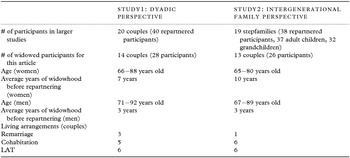
Findings are based on data from couples who repartnered following widowhood (see Table 1 for demographic information).
Demographic information

Most men in each dyad in both studies had been widowed for a shorter period of time than their partners. However, in study1, two of the women had been widowed for a shorter period than their current partner. In two couples in study1, and one couple in study2, both partners had been widowed for the same length of time. Participants in both studies perceived themselves to be in good to very good health and reported their socioeconomic status as middle to upper-middle class. All were Jewish. Most declared themselves as secular, about a quarter as traditional, and the rest as religious.
Data collection procedures
An interview guide was developed for each study according to its purpose, drawing on key issues identified in the literature on repartnering in old age. The interview guides for both studies included the same opening question (Spradley, Reference Spradley1979). Study1 focused on the dyad whereas study2 asked the same opening question from an expanded family perspective. The interview guide for study1 included the following content areas: late-life repartnering, the experience of old age, and significant life events. For each content area, probing questions were used to receive the relevant information (Kvale and Brinkmann, Reference Kvale and Brikmann2008). An example of a question in the content area of late-life repartnering was: “How is your repartnering relationship compared to your lifelong marriage?” An example of a question in the content area of the experience of old age was: “Please tell me about your experience of growing old.” An example of a question in the content area of significant life events was: “Please tell me about turning points in your life.” The interview guide for study2 included three versions, one for each generation, with the same content areas; late-life repartnering and intergenerational relationships in the family. An example of a probing question in the content area of intergenerational relationships in the family for the partner version was: “Please tell me about your current relationship with your offspring compared to before repartnering and after losing your spouse.” An example of a probing question in the content area of late-life repartnering in the child/grandchild versions was: “How do you feel about your parent’s/grandparent's repartnering?”
Data for the theme of responses to widowhood were obtained mainly while asking the opening question: “Please tell me the story of your late-life repartnering.” In study1, the majority of the participants began by talking about their lifelong marriages and the loss of their spouse, before moving on to their current repartnering relationship. In study2, the participants’ reference to their parent's or grandparent's loss of spouse was not necessarily at the beginning of the interview. The findings for this article were obtained by enabling participants to tell their story as they chose, consistent with qualitative research principles.
Each of the participants signed a letter of consent after reading a brief explanation of the study and how confidentiality would be ensured. Each interview was conducted separately to enable each participant to discuss unique experiences freely, and lasted 1.5 to 2.5 hours each. This allowed participants to introduce material that might not have emerged in joint interviews, especially when discussing sensitive topics or criticizing their partner (for more details see: Eisikovits and Koren, Reference Eisikovits and Koren2010).
Data analysis process
This was based on grounded theory methods of analysis (Strauss and Corbin, Reference Strauss and Corbin1990) along with dyadic-analysis principles (Eisikovits and Koren, Reference Eisikovits and Koren2010). Therefore, although interviews were conducted separately, they were analyzed on individual and dyadic levels for overlaps and contrasts (for more details see Eisikovits and Koren, Reference Eisikovits and Koren2010). The first stages of dyadic analysis were identical to grounded theory analysis on the individual level, which included making comparisons and asking questions to conceptualize data by identifying segments of meaning and giving names to various units, also known as open coding (Strauss and Corbin, Reference Strauss and Corbin1990). The next step was to discover categories by grouping concepts and putting data back together in new ways, also known as axial coding. This resulted in constructing themes through shifting back and forth between the various levels of analysis (Strauss and Corbin, Reference Strauss and Corbin1990). To derive a descriptive narrative by selecting a core category, the same procedure was followed for the other member of the dyad. Then notes were taken on overlaps and contrasts between the narratives of each member. This included examining how each cross-case theme and subtheme, which emerged on the individual level, was addressed by each member of the family and/or couple, to derive a third perspective, which is a combination of individual perspectives of the partners (Eisikovits and Koren, Reference Eisikovits and Koren2010) or of the family members. This resulted in a grounded model presented in the findings section.
Trustworthiness was achieved in several ways. First, verbatim transcriptions of audio-recorded interviews enabled verification with the original. Second, the researchers of the larger studies simultaneously performed separate analyses. The identified themes were compared and negotiated until agreement was achieved. Third, peer debriefing was achieved by a group of colleagues familiar with qualitative methods, who asked provocative questions relating to the analysis. This provided additional insights beyond those of the researchers (Patton, Reference Patton2002). Fourth, negative case analysis, which emphasized the exceptional cases, was performed (Patton, Reference Patton2002). The exception in this article refers to the absence of gender differences. Fifth, dyadic analysis served to ensure trustworthiness similar to triangulation; the more sources available for interpreting data, the more reliable the findings become. In addition to the researcher's interpretation of each individual partner's and/or offspring's quotes, an additional interpretation was derived by combining the individual perspectives. This was both enriching and limiting, because the individual interpretations were interdependent, and therefore mutually restrictive (Eisikovits and Koren, Reference Eisikovits and Koren2010).
To present the experience from a dyadic and/or intergenerational perspective, the data from study1 are presented using quotes from both partners for each theme addressed, and for study2, offspring quotes are also presented when relevant. All quotes were translated from Hebrew and identifying details have been altered to maintain confidentiality.
Partners from study1are labeled as: man – M, woman – W. For example, the male partner of couple3 is labeled: couple3M. Family members from study2 are labeled as: man-CM, man's daughter-DM, man's son-SM, man's granddaughter-GDM, man's grandson-GSM, woman-CW, woman's daughter-DW, woman's son-SW, woman's granddaughter-GDW, woman's grandson-GSW. For example, the man's son of family8 is labeled: family8SM.
Findings
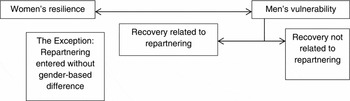
When responding to the opening request to tell their story of late-life repartnering, participants began by referring to their experiences of losing their lifelong spouse. Gender differences were found. Women's experiences included building new lives and enjoying a new sense of independence. They lived active lives, indicating a relatively stable, healthy level of psychological, and physical functioning following the death of their husband. Thus, such experiences were consistent with resilience. The men however, experienced difficulty in overcoming their loss in spite of receiving support from their families. Thus, such experiences were consistent with vulnerability. Variations were found for the men's experiences but not for women’s, as illustrated in Figure 1.
A grounded model of response to widowhood and loss of lifelong spouse.

One side presents women's resilience and the other side presents men's vulnerability. Men's vulnerability was found to vary between cases in which repartnering was related to recovery and cases in which it was not. When repartnering was not related to recovery, a process of becoming resilient could be identified. The exception, regarding the absence of gender-based differences, is also presented.
For each of the themes, two quotes are presented, the man's illustrating vulnerability, and the woman's illustrating resilience. When the participants are from study2, the intergenerational study, quotes from offspring are also presented, when relevant. The quotes used for illustrating each of the themes are representative of both samples (of study1 and study2) and were chosen according to data richness. Thus, the inclusion of additional quotes would be superfluous.
Recovery related to repartnering
The following quotes illustrate couples characterized by men who experienced vulnerability while living without a partner before repartnering.
The man's narrative:
First, my wife passed away. We had been married 44 years; a very happy marriage and I couldn't accept it. I remained alone. The children were very good and supportive. They came and everything, but [short silence] it just wasn't right. It was awful, I lost a tremendous amount of weight and you could say I was on the verge of depression and after a while, after a year or two, friends offered to introduce me to a woman and I said no, I can't accept this, I’m not ready for it, so the situation [of despair] continued until I met her [my current partner]. How did I get to know her? We had a neighbor and after my wife passed away, they adopted me, invited me down in the evening for coffee. I found her there. I started [laughs] to suspect something, and then my neighbor said: “She's really something, an outstanding woman, and great homemaker, very friendly, very popular. She's devoted. You can't bring her [your deceased wife] back, and look, your situation is deteriorating’. (study1: couple3M, age 77, cohabitating 6 years, widowed 3 years prior to repartnering)
The man focuses on the very difficult experience of losing his spouse of 44 years. In spite of receiving support from his family and neighbors, he reports loneliness, depression, physical neglect, weight loss, and lack of motivation even to consider repartnering. Once he accepts the difficulty of his situation and the need for immediate intervention, the words: “so the situation [of despair] continued until I met her” indicates that his partner's appearance becomes his salvation and indicates his turning point toward recovery. The overall narrative is one of devastation, vulnerability, and subsequent rescue by meeting his new partner.
His partner's narrative:
How did we meet? We met through friends. The truth is, we became widowed almost at the same time. He lives in the apartment building where good friends of mine live. When the year of mourning was over, they came to me and said: “You must meet him.” I said: “It's out of the question,” I lived with my husband for 39 years, I’m from the old generation, one man in a lifetime and that's it and I don't want to hear about it, I have children and grandchildren. They are not always by my side, but when I became widowed, I also started volunteer work to keep busy. Once I recovered, it [volunteer work] was the first thing I did. I was widowed very suddenly; my husband died of a heart attack and the shock was tremendous of course, and I didn't want to hear, and didn't want to hear, and didn't want to hear [of repartnering]. Two years later, I had a hip operation, I was partially physically disabled, I still used a cane, and she [my friend] set me up, I got a lot of encouragement from my daughters-in-law; that's the truth. (study1: couple3W, age 66, cohabitating 6 years, widowed 2.5 years prior to repartnering)
The woman begins by emphasizing that she and her current partner became widowed at about the same time. However, in contrast to her partner's vulnerability, she was able to manage well on her own after a period of bereavement. She achieved this by doing volunteer work, which was sufficient for her well-being. Her recovery after her husband's sudden death emphasizes her resilience. At first, she did not want to consider repartnering. This might be an indication that she succeeded in building a new life without necessarily needing a partner. Before telling us that her neighbor “set her up” with her current partner, she adds: “I had a hip operation, I was partially physically disabled, I still used a cane.” The reason for this statement and its location within her narrative could be interpreted in several ways. It might indicate that it made her realize the potential benefits of a new partner as someone who could assist her in future times of need. It might have been a way to justify repartnering to herself and to her family, also explaining why she added; “I got a lot of encouragement from my daughters-in-law.”
Both partners were widowed at around the same time and both received support from family, friends, and neighbors, the man maybe even more that the woman. However, the woman's narrative emphasizes resilience whereas the man's emphasizes vulnerability. Both repartnered to improve their situation. Although the woman experienced disability due to her hip operation, she repartnered from a position of resilience whereas the man acted from a position of vulnerability.
The following quotes illustrate another man's vulnerability from the perspectives of three generations in his family; the man, his son, and his granddaughter.
The man's perspective:
. . .my life changed drastically [with my wife's death] from being full to being empty. Empty, empty, I functioned like a machine, now that she [my partner] is here, my heart is somewhat full. I feel like a person, before I felt I was in transition waiting to leave [the world]. That's it; now I feel like a whole person (study2: family8CM, age 67, cohabitation 2 years, widowed 1 year prior to repartnering)
Similar to the man in study1, this man describes a vulnerable emotional state after his wife's death. By comparing three points in time – before losing his wife, becoming a widower, and after meeting his partner – the man emphasizes the contrast between feeling empty and feeling full, between functioning as a whole person versus functioning as a machine. Being in a state of waiting to die provides clear evidence of how vulnerable he was after his wife's death. Although he does not return to feeling completely full as he had felt with his lifelong spouse, feeling “somewhat” full with his current partner is an improvement from feeling empty. It enables him to experience being a whole person again.
His son's narrative provides additional evidence regarding his father's emotional state after losing his wife and before becoming involved with his current partner:
. . . .I didn't want to lose him too, he simply withered away, and the worst was when he sent us pictures of a dead rose; a rose that withered along with him. (study2: family8SM, age 41)
The metaphor of the dead rose helped the son to understand his father's emotional state and what might happen if the situation continued. Thus, the son emphasizes how vulnerable his father was after losing his spouse. This was a wake-up call that something had to change. It helped the son accept his father's choice to repartner because he did not want to lose him in addition to losing his mother.
The man's 12-year-old granddaughter illustrates the change in her grandfather's emotional state:
Before he got to know his girlfriend he [silence], but now he's happy. Beforehand, he was not only not happy; he was sad. (study2: family8GDM, age 12)
The granddaughter emphasizes her grandfather's vulnerable emotional state before repartnering using a double statement: “he was not only not happy; he was sad.”
The son and granddaughter strengthen the man's illustration regarding his emotional vulnerability after losing his wife and reinforce how repartnering helped change it for the better. The perspectives of his offspring, which are in keeping with his own, strengthen the findings of men's vulnerability versus women's resilience when recovery is related to repartnering.
The woman's narrative illustrates resilience after her husband's death:
I didn't expect to find someone, I wasn't looking at all. When my husband died, I understood that I would be like this till the end of my life. [. . .] I didn't feel restricted [. . .] there are things I like to do. I do this kind of art work, for example, it gives me a lot of satisfaction, and I like to work in the garden, and I love my children and grandchildren. I thought I’d continue like this. And then I met him, only a year after my husband died [. . .] and then our relationship began. (study2: family8CW, age 66, cohabitation 2 years, widowed 2 years prior to repartnering)
Similar to the woman in study1, this woman describes a process of coming to terms with becoming a widow. She describes how, after realizing that she would remain spouseless, she began to look at the benefits of her situation, that there was nothing to restrict her from doing things that made her feel good like working in the garden and enjoying her family. Repartnering was not part of her plan and when it occurred, she had already maintained a relatively stable, healthy level of psychological and physical functioning following her husband's death (Bonanno, Reference Bonanno2004).
The two cases, each from a different study, illustrating a similar state of men's vulnerability and women's resilience adds to the trustworthiness of the findings. Although the partners of the couple in study1 both repartnered two years after losing their spouses, whereas in study2, the man repartnered sooner after his wife's death in comparison to his partner, they were each interviewed after being together for two years. Thus, they both retrospectively described how they had coped with their widowhood.
The next variation represents how men's recovery from bereavement was not necessarily related to repartnering but gender differences related to dealing with the loss of a lifelong spouse are evident.
Recovery not related to repartnering
The following quotes illustrate another variation of men's vulnerability and women's resilence. What characterizes this variation is that the men's recovery was achieved regardless of the repartnering.
The man's perspective:
You can ask whoever you want, I took outstanding care of her [my deceased wife]. Doctors came here and saw how difficult things were. When she passed away, a void was created. There was nothing, no one to take care of, I woke up at night and couldn't sleep, I made puzzles of a thousand pieces till slowly I looked like a drunk and I didn't know what I wanted, till I adapted to the situation. I had no choice, you either keep on grieving or you overcome and want to live. There are two options and I decided to live. I called a girl from a dating advertisement in the newspaper. I went out with several, till I met her [my current partner]. I never thought that I would move in with another woman. I thought of dating but no more than that, and now we are a happy couple. (study1: couple15M, age 77, cohabitation 1.5 years, widowed 4 years prior to repartnering)
The man's vulnerability is created by the combination of devoted care for his wife and the void created after her death. He uses this as a justification for continuing with his life by casual dating, not necessarily for repartnering. The use of the grammatical second person brings the interviewer (and thus the reader) closer to the pain which brought him to a turning point – to the realization that life must continue. The first turning point was dating other women and the next was establishing a meaningful new relationship when this had not been his initial intention. Moving from vulnerability to resilience following a turning point (Bennett, Reference Bennett2010) strengthens the notion that he recovered from his loss regardless of the repartnering.
His partner's quote illustrates resilience following the loss of her lifelong marriage:
I didn't want to meet and go out with anyone afterwards [loss of spouse]. I never felt better. I was alone and my friends and acquaintances wanted me to meet with men but I said no, things are good for me. All the hours of the day aren't enough for me to do everything I want. (study1: couple15W, age 74, cohabitating 1.5 years, widowed 4 years prior to repartnering)
This couple met by chance, and their relationship unintentionally developed into repartnering. From the woman's narrative, it is clear that, after losing her husband, she was able to build a fulfilling life which did not necessarily include a new partner relationship. Similar to the other women, she describes resilience.
Both partners were widowed at the same time, were able to build a life for themselves after their losses and did not consider repartnering as an option for dealing with their loss. However, although the man's narrative illustrates moving from vulnerability toward resilience following a turning point (Bennett, Reference Bennett2010), the differences lie in the emphasis of each: The woman emphasizes fulfillment whereas the man emphasizes emptiness.
The next variation illustrates the exception, which is a way of strengthening the rule in qualitative research.
Gender similarities to widowhood and repartnering
Whereas the responses to widowhood and repartnering of most couples differed according to gender, the following couple illustrates gender similarities, which is an exception:
When I was first widowed, I didn't think about having a girlfriend. I was very busy with my carpentry; I didn't have time for other things (study1: couple4M, age 91, LAT 4 years, widowed 7 years prior to repartnering).
In contrast to the other men participants, this man coped by being active, (i.e. through his carpentry). Similar to most women, he does not describe vulnerability.
His partner's coping is described as follows:
A short time after my husband passed away, I sat alone, a few friends came by and then I accepted it [loss of my husband], but I never thought of looking for someone. I never thought I’d find someone that I would want. (study1: couple4W, age 84, LAT 4 years, widowed 11 years prior to repartnering)
The woman describes a normative process of bereavement ending with her realization that she must accept her husband's death and continue with her life independently, regardless of repartnering.
Both partners describe resilience in coming to terms with the loss of their spouses – the man by continuing his interest in carpentry, and the woman by accepting her situation. Repartnering did not play a part for either of them in their recovery.
Discussion
The opening sentence in Leo Tolstoy‘s Anna Karenina, “Happy families are all alike; every unhappy family is unhappy in its own way,” reflects the findings of this article. The women's experiences described resilience without variations, whereas the men's experiences described vulnerability with variations. Some of the men were able to build a new life only after finding a new partner. There were those for whom recovery and repartnering were simultaneous but unrelated. For these men, repartnering was a major source of renewed meaning, although their recovery was not presented as dependent on it. Deriving a grounded model indicates that a pattern was identified, thus distinguishing between a personal and a public problem (Calasanti, Reference Calasanti2004, p. 107). This is consistent with discussing these findings in light of a (critical) feminist gerontology perspective.
Previous studies referred to gender differences regarding repartnering. Those findings indicated that women refrain from repartnering for various reasons, mainly because they do not want to look after another person and do not want to give up their freedom, whereas men more frequently wish to, and do, remarry (Davidson, Reference Davidson2002). Other studies identified that the intention to repartner is not necessarily related to gender but rather to social support. Both widows and widowers with weaker social ties tend to repartner (Carr, Reference Carr2004a). Findings presented here indicate that both widows and widowers repartnered despite receiving social support. The innovation of the current findings is that gender differences are not manifested by the choice of repartnering itself because all of the participants lived in such a relationship at the time of participating in the study. Rather, gender differences are manifest in dealing with the loss of a lifelong spouse among those who repartnered.
Although resilience is typically the most common outcome observed following the death of a spouse (Bonanno, Reference Bonanno2012), findings here indicate gender differences. The women tended to experience resilience whereas the men tended to experience vulnerability. This coincides with Carr's suggestion that instead of adopting the “who suffers more” approach, studies should address vulnerability or resilience to loss when examining gender differences (Carr, Reference Carr2004b). The claim that men grieve and women do not is not being made here. Discussing these findings refers to how resilience, i.e. the preservation of a relatively stable, healthy level of psychological and physical functioning following the death of a spouse (Bonanno, Reference Bonanno2004) was achieved, and/or how vulnerability, as the capacity or incapacity to adapt to the death of someone close was achieved by transformation (Gallopin, Reference Gallopin2006).
A possible explanation for why repartnered women tended to experience resilience might be related to the mid-high socioeconomic status which characterizes those who repartnered in later life (Davidson, Reference Davidson2001). In contrast to aspects such as social and familial ties (Martin-Matthews, Reference Martin-Matthews2011) and health and mental health (Stroebe et al., Reference Stroebe, Stroebe and Schut2001), in which widows are better off than widowers, widows appear most vulnerable to the economic consequences of spousal loss (Hansson and Stroebe, Reference Hansson and Stroebe2007). However, when financial resources are not an issue, there is no reason for widows to be vulnerable.
A broader explanation refers to gender roles related to culture and cohort. Within more traditional cultures and societies located between tradition and modernity, such as Israel, gender-based roles in family and society are emphasized (Lavee and Katz, Reference Lavee and Katz2003). Furthermore, women and men belonging to cohorts born within the first half of the 20th century were expected to get married to experience an intimate sexual relationship (Adams, Reference Adams2007). In an attempt to explain the findings presented in this article, gender inequalities within those cohorts throughout the life course are presented. Inequalities relate to identity formation in young adulthood, social roles (Sorell and Montgomery, Reference Sorell and Montgomery2001), and mental health (Eagly et al., Reference Eagly, Eaton, Rose, Riger and McHugh2012).
Identity formation for men was perceived as developing individuality whereas for women, identity formation was thought to be developed through the intimate relationship with their husband. As such, social roles practiced within the family were strictly divided according to gender; women were responsible for homemaking and for the well-being of family members whereas men were responsible for providing financially for their family through employment (Sorell and Montgomery, Reference Sorell and Montgomery2001). Throughout the life course, feminist studies have indicated that women's life situations, especially the homemaker role, are perceived as making them more vulnerable to mental illness such as depression. This could be explained by women's social oppression in comparison to men, who were found less vulnerable to mental illness in young adulthood and middle age because of greater social power gained by being the family breadwinner (Eagly et al., Reference Eagly, Eaton, Rose, Riger and McHugh2012).
Findings of this study indicate that, in old age, gender inequality seems to change in favor of women. Their roles within the family that have served as a source of oppression throughout their married lives (Freixas et al., Reference Freixas, Luque and Reina2012) have provided them with skills needed beyond retirement from paid employment. Men, on the other hand, who have enjoyed the benefits of built-in domestic help throughout their married life (Adams, Reference Adams2007) find themselves helpless when entering widowhood. Furthermore, women's skills in constructing meaningful, close, emotional relationships continue to provide support in widowhood, whereas men, who depended on their wives for their emotional and social support, find difficulty in this domain (Davidson, Reference Davidson2001). Beyond grief due to losing a lifelong companion, widowed women continue to benefit from their husband's financial provisions by receiving their part of his pension plan. Thus, women do not lose what they received instrumentally in marriage, whereas men do. For women who were born within the first half of the 20th century, individualism could contradict nurturance, thus creating ambivalence (Adams, Reference Adams2007). These older widowed women, however, no longer have to face such ambivalence. The widows who participated in this study found ways to preserve their autonomy within a new partner relationship (Koren and Eisikovits, Reference Koren and Eisikovits2011). Regarding mental health, the findings of this study indicate that widowed women demonstrated resilience in dealing with the loss of their spouse. Most of the men, on the other hand, were able to deal with widowhood and continue with their lives by repartnering. This is consistent with previous findings, indicating that it takes men twice as long to recover from depression due to spousal loss in late life in comparison to women (Stroebe et al., Reference Stroebe, Stroebe and Schut2001).
Reversal of power relations in favor of women in old age is hereby suggested. Such a reversal is explained by a life course experience of oppression (Freixas et al., Reference Freixas, Luque and Reina2012) and of learning how to cope and survive along with the traditional role of family relations that are a central and familiar aspect of women's lives. Men, however, experience a change in social status, from being the breadwinner, which gave them power within the spousal relationship, to being retired, when they no longer have this role (Silver, Reference Silver2003). Losing their lifelong spouse was yet another loss they had to compensate for by developing homemaking skills and close social relationships that were new to them. As such, men and women are viewed in relation to one another (Calasani, Reference Calasanti2004). Women experience social and psychological continuity by having the opportunity to continue familiar practices such as homemaking. Men experience social discontinuity due to loss of social power along with retirement (Silver, Reference Silver2003) and personal discontinuity by having less experience of managing familial issues (Davidson, Reference Davidson2004). Furthermore, the higher percentage of widows (43%) in comparison to widowers (10%) (Martin-Matthews, Reference Martin-Matthews2011) indicates that widowhood for women is a more normative life event than for men. This might help ease widows’ coping and adjustment because they have a larger social group in a similar situation with which to identify. As such, widows are more likely to develop adaptation and behavior norms than widowers.
The findings illustrate how social constructions influence the lives of older persons (Ray, Reference Ray1996). The roles that contributed to women's oppression at younger ages contribute to their resilience in old age, whereas roles that provided patriarchal power to men at younger ages contribute to their vulnerability in old age. It is possible that gender inequality reversal in old age might enhance resistance to the patriarchal order of society (Silver, Reference Silver2003). It might be anticipated that when the younger generations in society today, born toward the end of the 20th century and at the beginning of the 21st century, become old, such gender reversal will be less apparent because these younger generations are experiencing more similarity in social roles by gender in the home and the workplace (Carr, Reference Carr2004b). However, in Israel, as a society culturally located between tradition and modernity (Lavee and Katz, Reference Lavee and Katz2003), division of roles by gender might not change as much as anticipated within modern societies and accordingly, gender reversal might not decrease as rapidly. Nonetheless, further investigations are called for regarding the social and personal conditions that enable gender inequality reversal in old age.
Limitations and recommendation for future research
The aims of the larger studies did not include investigating the processes of dealing with widowhood. These were obtained as a by-product when participants told the stories of their lifelong marriages when asked about repartnering. As such, identifying strategies of dealing with widowhood as resilience or vulnerability was determined through data analysis. Obtaining findings in such a manner is based on the inductive principle of qualitative research, which is characterized by not knowing in advance what the data analysis will reveal and by keeping an open mind for findings that were not previously anticipated (Patton, Reference Patton2002). Therefore, what might appear to be a limitation is actually a natural outcome of qualitative data analysis.
Another limitation is that the sample was not systematically chosen according to all criteria relevant for understanding strategies for dealing with the loss of a spouse, to allow, for example, comparison between short- and long-term widowhood. Nevertheless, these findings can be the basis for further investigation. No systematic information was obtained about the quality of the lifelong marital relationship or about well-being prior to the loss, and therefore it might not have been possible to determine resiliency based on if and how emotional and physical functioning was maintained (Bonanno, Reference Bonanno2004). However, most participants did provide the relevant information. Future studies, designed specifically for understanding widowhood among persons who repartnered in old age, should consider all relevant variables.
Implications
Despite these limitations, the innovation of these findings lies in gender differences found between widows and widowers in dealing with widowhood, when both had repartnered. Although double marginality is experienced by older women (Freixas et al., Reference Freixas, Luque and Reina2012) the findings here show that this is not always necessarily true. By referring to men and women in relation to one another (Calasanti, Reference Calasanti2004), women experience inequality reversal in their favor under some circumstances. The exploration of gender differences in dealing with loss of a lifelong spouse might contribute to theory development in feminist gerontology and in practice. Counselors should be aware of gender inequality reversal among older widows and widowers when counseling older widowed persons and their families, to be able to address the unique needs of widowers in comparison to widows.
Conflict of interest
None.
Acknowledgment
Part of the research reported in this article was supported by a grant from the Israel Science Foundation – ISF GRANT NO. 1583/11