Introduction
Recent years have witnessed a proliferation of studies that examine the interface of religion and several outcomes in sub-Saharan Africa, including maternal service utilization, child mortality, fertility, contraceptive behaviour and sexual behaviour (Garner, Reference Garner2000; Agadjanian, Reference Agadjanian2001; Takyi, Reference Takyi2003; Smith, Reference Smith2004; Odimegwu, Reference Odimegwu2005; Trinitapoli, Reference Trinitapoli2006; Trinitapoli & Regnerus, Reference Trinitapoli and Regnerus2006; Gyimah, Reference Gyimah2007; Gyimah et al., Reference Gyimah, Takyi and Addai2006, Reference Gyimah, Takyi and Tenkorang2008, Reference Gyimah, Tenkorang, Takyi, Adjei and Fosu2010, Reference Gyimah, Kodzi, Emina, Adjei and Ezeh2012; Doctor et al., Reference Doctor, Phillips and Sakea2009; Manglos & Trinitapoli, Reference Manglos and Trinitapoli2011). The focus on religion as an independent variable is partly reflective of two main motivational factors. The first is its growing influence and centrality in the African social fabric (Gallup International, 2000; BBC News, 2005; Pew Research Center, 2010; Manglos, Reference Manglos2010) and the second is the increasing recognition that religion provides a unique perspective on life that bears significantly on several behavioural outcomes. Indeed, several studies in the US demonstrate that various measures of religion are typically associated with a variety of healthy and desirable outcomes (Ellison et al., Reference Ellison, Hummer, Comier and Rogers2000; McCullough et al., Reference McCullough, Hoyt, Larson, Koenig and Thoresen2000; Koenig, Reference Koenig2001; Hummer et al., Reference Hummer, Ellison, Rogers, Moulton and Romero2004).
Although there are considerable variations across countries, more than half of the population in sub-Saharan Africa identify as Christians, 13% as Muslims and 29% as Traditional African believers (Pew Research Center, 2010). Notwithstanding the burgeoning literature on religion in sub-Saharan Africa, there is little empirical work on its connectedness with attitudes to premarital sex, perhaps due to data constraints. While attitudes to premarital sex may be influenced by several factors, the importance of religion to the discourse cannot be underestimated. In the US, for example, religious values and practices have been shown to shape adolescents' sexual values and behaviours (Rostosky et al., Reference Rostosky, Wilcox, Wright and Randall2004; Regnerus, Reference Regnerus2007; Uecker, Reference Uecker2008). By providing standards to judge and guide behaviour, religion provides a social control function such that religious persons act in ways that often conform to social norms. For many young people, religious values and messages may be the principal moral compass guiding their attitudes and values on sexual decision-making.
Understanding how religion affects sexual attitudes is particularly salient in the sub-Saharan African context, where religion permeates social life (Pew Research Centre, 2010), and young people have become the focus of HIV intervention programmes. Ever since the emergence of HIV, sub-Saharan African has become the face of the disease and young people have been squarely placed at the centre of the discourse. According to UNAIDS (2008), about 1.9 million Africans became newly infected with HIV in 2007 while about 1.5 million died from the disease. Young people are the most affected partly because of misinformation, lack of knowledge, low use of preventive services and involvement in risky sexual behaviour (Tenkorang et al., Reference Tenkorang, Jones and Gyimah2010; Gyimah et al., Reference Gyimah, Tenkorang, Takyi, Adjei and Fosu2010, Reference Gyimah, Kodzi, Emina, Adjei and Ezeh2012). In spite of this, young people are also seen as a ‘window of hope’ because of their great potential for positive change of attitudes and behaviours (Guiella & Madise, Reference Guiella and Madise2007). Past research elsewhere supports a strong relationship between sexual attitudes and sexual behaviours among young people (Moore & Davidson, Reference Moore and Davidson2006; Fisher, Reference Fisher2007; Weeden & Sabini, Reference Weeden and Sabini2007; Luquis et al., Reference Luquis, Brelsford and Rojas-Guyler2011). Those with more liberal attitudes to sex have been found to be more likely to indulge in high-risk sexual behaviours. Thus, understanding the correlates of premarital sexual attitudes may be important for policies aimed at sexual behavioural change.
The paucity of studies on religion and premarital sexual attitudes in sub-Saharan Africa stems in part from the scarcity of requisite data to engage the subject matter. There is, however, a substantial literature on the subject in the United States where highly religious individuals have been found to have more conservative views on same sex-marriages, extramarital affairs and premarital sexual relationships (Koenig, Reference Koenig2001; Smith, Reference Smith2003; Uecker, Reference Uecker2008). Although no religion promotes premarital sex in its central tenets, the theology and praxis of religious groups differ in their commitment and condemnation of premarital sexual relations (Cochran & Beeghley, Reference Cochran and Beeghley1991; Cochran et al., Reference Cochran, Chamlin, Beeghley and Fenwick2004). In general, Pentecostal and Evangelical faiths have been found to associate with the view that premarital sex is wrong. Also, the only forms of sexual relations permitted in Islam are those between a husband and wife (Halstead, Reference Halstead1997; Addai, Reference Addai2000). Given denominational differences in proscription of, and sanctions against, premarital sex, some have argued that the generalization linking religiosity and premarital sexual attitudes is overly simplistic for ignoring the variability in denominational views (Cochran & Beeghley, Reference Cochran and Beeghley1991; Cochran et al., Reference Cochran, Chamlin, Beeghley and Fenwick2004). Using US data and guided by reference group theory, Cochran and colleagues (Reference Cochran, Chamlin, Beeghley and Fenwick2004) found that the effect of religiosity was more pronounced among morally conservative faiths.
The present study uses a hitherto untapped data set among young people in the urban informal settlements (commonly called slums) of Nairobi to investigate the applicability of this theoretical model in an African setting. The study extends existing work by examining the effects of religiosity on premarital sexual attitudes and whether there is variability between morally conservative and non-conservative Christian denominations. The study focused only on Christians in this context because almost nine out of every ten persons in Kenya are Christians with Muslims constituting less than 10% of the population (Kenya National Bureau of Statistics & ICF Macro, 2010).
Theoretical background
The study draws largely on many aspects of reference group theory. The theory has a long history in the social sciences dating back to Herbert Hyman when the term was used to denote groups used as standards. A reference group can be any group from which one seeks acceptance, and to promote this acceptance, one acts in ways that conform to the acceptable standards of the group. According to Shibutani (Reference Shibutani and Rose1962, p. 132), a reference group is ‘an audience consisting of real or imaginary personifications to whom certain values are imputed. It is an audience before whom a person tries to maintain or enhance his standing’. The group thus serves as a source of motivation for the individual's behaviour to which they refer for evaluation of past behaviour and directives for current and future ones.
The theory has been widely applied in different fields but its utility for our purposes stems from the underlying idea that one's behaviour and attitudes are decisively shaped by the groups in which they participate. Such groups provide both normative and comparative functions. The normative function deals with the ability of the group to establish and enforce norms while in the comparative capacity, the group serves as the standard by which members evaluate themselves and others. Beeghley and colleagues (Reference Beeghley, Bock and Cochran1990, p. 263) have specified five conditions under which individuals employ membership groups as reference by arguing that ‘the degree to which a group or collectivity serves as a reference point for an individual is a positive and additive function of: (1) the degree of similarity between the status attributes of an individual and other members, (2) the degree to which an individual's values and beliefs correspond to those of other members, (3) the degree of clarity in a group's or collectivity's values and beliefs, (4) the degree to which an individual engages in sustained interaction with the members of a group or collectivity, and (5) the degree to which an individual defines other members as significant others.’
In several studies, it has been demonstrated that religious groups meet these criteria and therefore constitute important reference groups for dedicated followers (Beeghley et al., Reference Beeghley, Van Velsor and Bock1981, Reference Beeghley, Bock and Cochran1990; Cochran & Beeghley, Reference Cochran and Beeghley1991). As Hummer and colleagues (Reference Hummer, Ellison, Rogers, Moulton and Romero2004) point out, one of the key functions of religious communities is to shape the norms of individual members through behavioural regulations that are specified in sacred teachings, reinforced through authoritative messages from leaders and solidified through social interactions in the religious community. In our context, the religious messages that generally assert the immorality of premarital sexual relations could influence adolescents' attitude on the subject. However, while all Christian faiths proscribe premarital sex, they vary in their emphasis as well as sanctions for offenders (Smith, Reference Smith2004). The opposition tends to be more radical among theologically conservative religious groups such as Pentecostals and Evangelicals.
Based on studies in South Africa, Garner (Reference Garner2000) identified four key variables in religious organizations that may account for their power to shape the sexual behaviour of followers as: indoctrination, fostering religious/subjective experiences, exclusionary practices concerning non-members and socialization processes. In KwaZulu, he observed that non-Pentecostal congregations displayed less intensity and interest on each of these and not only were they more likely to overlook church teachings on sexuality but their leaders were also less inclined to control members' sexual behaviour. Theologically conservative denominations on the other hand often internalize more negative messages about non-marital sex and the sanctions against sexual misconduct tend to be more severe. While the more liberal religions can tolerate offending members with the hope that they will turn a new leaf, offenders in proscriptive faiths are often expelled or excommunicated. For conservative religious groups, therefore, non-marital sexual relations are wrong, and those who engage in such behaviour are sinners who can be saved only through penitence.
As Cochran and colleagues (Reference Cochran, Chamlin, Beeghley and Fenwick2004) note, however, there are also differences within religious groups on the degree of members' commitment to official doctrines. Within each faith, highly embedded members are not only more likely to follow official doctrines but also more likely to use religion as a reference group. Cochran & Beeghley (Reference Cochran and Beeghley1991) have argued that religiosity is the mechanism through which members of religious groups operate as reference groups. Members who attend religious service more often, for instance, will be more likely to be exposed to doctrinal prohibitions and will have certain shared norms and values with other devout members. Presumably, such individuals may become more exposed to teachings on sexual immorality. Through continuous reinforcement of religious teaching, such members form primary groups, which in turn provide norms and role expectations for each other.
Thus, to the extent that a religious group constitutes a reference group, its teachings on premarital sex should significantly influence members' attitudes. Using data on young people in the informal neighbourhoods of Nairobi, the following hypotheses have been developed. First, young people who identify with more proscriptive faiths will be more likely to have conservative views on premarital sex. Second, the highly religious, as measured by religiosity, will be more likely to have conservative views, and finally, taking into account denominational proscription and sanctions, the effect of religiosity should be more pronounced among the conservative denominations. The study is among the few, if any, to explore the applicability of this theoretical model in an African setting, and more so among impoverished urban youth. The next section provides a background context of the Nairobi informal settlements.
The Nairobi informal settlements
The focus on young people in the Nairobi informal settlements stems from several considerations. Rapid urban growth amidst economic stagnation and poor governance has impeded the ability of governments in many developing countries to provide the basic infrastructural needs of the urban population (UN-Habitat, 2003). In much of sub-Saharan Africa, this has resulted in a situation where a significant proportion of the urban population lives in impoverished urban settings characterized by high unemployment, crime and poverty (UN-Habitat, 2003). It has been estimated that over 60% of Nairobi residents live in low-income settlements that constitute only 5% of the residential area (Mugisha, Reference Mugisha2006). These neighbourhoods are characterized by congestion, high levels of unemployment, inadequate social services, extreme poverty, insecurity, crime and hopelessness.
The Korogocho and Viwandani informal settlements, where the present study was conducted and part of the Nairobi Urban Health and Demographic Surveillance System (NUHDSS), are characterized by these problems (APHRC, 2002). For example, while flush toilets are widely used in Nairobi, only 1.5% of households use a flush toilet in the two slum communities. Likewise, while 71% of households in Nairobi have electricity, the comparative figure is only 14% for households in these areas. Similarly, only 5% of households have piped water in their residence or compound compared with more than 50% in Nairobi. The overwhelming majority (95%) of households cook in the same room they use as a sleeping room. The neighbourhoods are littered with filth as only 5% of households have access to hygienic garbage disposal services. The poor living conditions are exacerbated by low employment. Among men aged 18 years and above, only 11% in Korogocho and 15% in Viwandani are in salaried employment, and about half of women are without any income-generating activity.
Young people make up a considerable proportion of the population in the informal settlements because of the history of high fertility and the selective rural–urban migration. The limited economic opportunities and marginalization predispose these young people to problem behaviours and risky sexual behaviours (see Ndugwa et al., Reference Ndugwa, Kabiru, Cleland, Beguy, Egondi, Zulu and Jessor2011; Gyimah et al., Reference Gyimah, Kodzi, Emina, Adjei and Ezeh2012). Although the age at sexual initiation has declined in many parts of urban sub-Saharan Africa, the age at first marriage has increased over time (Brockerhoff & Brennan, Reference Brockerhoff and Brennan1998; White et al., Reference White, Cleland and Carael2000), resulting in a lengthy exposure during which adolescents are susceptible to poor sexual decision-making. For instance, adolescents in the slums of Nairobi have been found to initiate sex about 3 years earlier and are twice as likely to have multiple sexual partners than their counterparts in the non-slum parts of the city (Zulu et al., Reference Zulu, Dodoo and Ezeh2002). Multiple sexual partnership and early sexual intercourse have many dire consequences, including STIs, unwanted pregnancies and births and their associated risks, as well as high maternal and child morbidity and mortality.
Data and Methods
This paper draws on data collected under the Transition-To-Adulthood (TTA) project nested on the longitudinal Nairobi Urban Health and Demographic Surveillance System (NUHDSS) conducted by the African Population and Health Research Center (APHRC). The NUHDSS covers nearly 72,000 people living in 28,000 households in Korogocho and Viwandani informal settlements in Nairobi city. Both settlements are located about 5–10 km from the city centre and 3 km from each other. The TTA was designed to follow young people aged 12–22 years for 3 years to identify protective and risk factors in their lives and to examine how these factors are related to various markers of the transition to adulthood. In the NUHDSS, field workers collect information from all households within the Demographic Surveillance Area every 4 months on a wide range of issues including: reproductive aspirations (e.g. parenthood, marriage) and other concerns (e.g. worry about HIV/AIDS, getting a job, marriage, finishing school, employment); living arrangements and nature of interactions with parents, guardians, teachers and peers; involvement in youth groups (e.g. religious and social groups); involvement in risky behaviours (e.g. early sexual debut and delinquency).
The NUHDSS database provided the sampling frame that was used to randomly select young people aged 12–22 in the two informal settlements. During the first wave of the 3-year study (November 2007–June 2008), 4058 randomly selected adolescents (50% males) aged 12–22 were interviewed. A detailed description of the sample may be found in other publications (e.g. Beguy et al., Reference Beguy, Kabiru, Zulu and Ezeh2011; Kabiru et al., Reference Kabiru, Beguy, Crichton and Zulu2011). Ethical approval was given by the Kenya Medical Research Institute's ethics review board. Signed or verbal consent was obtained from all respondents. For respondents aged 12–17 years, parental consent was also obtained. The complete questionnaire was translated from English to Swahili and administered in Swahili, the language mostly spoken in the study area. The analysis reported here is based on only those affiliated with a Christian religion because questions on religious practice and religiosity were not asked of the unaffiliated. This restriction yielded an analytic sample of 2846 respondents.
Measures
The response variable for this study is ‘attitudes to premarital sex’. It is derived from questions that asked young people whether they agree or disagree that men and women should remain virgins until marriage. A binary variable was created from this, whereby those who agree that men and women should remain virgins until marriage (conservative view) were coded 1 and those who disagree were coded zero. The main explanatory variable is ‘religion’, whereby three different measures (affiliation, membership of religious clubs and religiosity) were employed, each of which ascertains a different but somewhat related dimension of religious involvement and commitment. A historical problem faced by scholars of religion has been the construction of a denominational classification scheme (Smith, Reference Smith1990; Steensland et al., Reference Steensland, Park, Regnerus, Robinson, Bradford Wilcox and Woodberry2000). One of the most useful classifications devised has been to place the Christian groups along a continuum from theologically conservative to liberal. Based on doctrinal teaching and ideological flexibility, two main Christian groups are distinguished: Pentecostals/Evangelicals and non-Pentecostal Christians. The non-Pentecostal group is made up of Catholics (55%) and Protestants (45%). The limitations of this dichotomy are recognized given the theological differences within the broad categorizations.
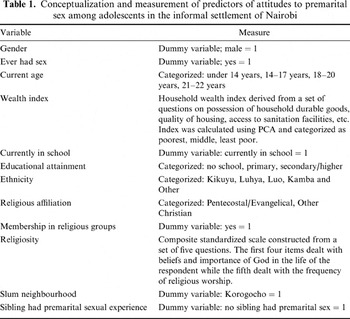
An index of religiousness was also included to capture both the intrinsic and extrinsic forms of religiosity. The index was ascertained from questions asking respondents to rate, on a scale of 1–4 (not important, somewhat important, important, very important), how important it is to them to: (a) believe in God, (b) rely on religious teachings, (c) rely on religious beliefs, (d) turn to prayers when they have a problem, and (e) the frequency of religious attendance in the past month. These items were standardized and summed into an index with an alpha reliability of 0.75. The third measure on religion is a binary variable on whether they belong to a religious club. Appropriate controls included in the models are socioeconomic and demographic factors. These include household wealth, current age, education, place of residence, ethnicity, if they have ever had sex, if any of their siblings had premarital sex and gender. Table 1 presents the conceptualization and operationalization of the variables included in the analysis.
Conceptualization and measurement of predictors of attitudes to premarital sex among adolescents in the informal settlement of Nairobi

Analytic strategy
The cases are unevenly distributed over the binary response variable, attitudes to premarital sex (86% vs. 14%). Hence, the logit or probit link functions, which assume a symmetrical distribution, may produce biased estimates. Given this, a complementary log-log regression was chosen, which is better suited for asymmetrical distribution (Long, Reference Long1997). It has the form:

where y is the likelihood of agreeing that women and men should remain virgins until marriage, x denotes the predictors and β represents the coefficients associated with predictor variables. For intuitive interpretation, the estimated coefficients are transformed through exponentiation, where coefficients greater than one indicate higher likelihood of agreeing that men and women should remain virgins until marriage, while the reverse holds if the coefficient is less than 1. The analysis begins with a description of all the theoretically relevant variables. Bivariate analyses involving each of the covariates and the outcome variable are then presented. In the multivariate models, the net effect of the variables on religion is first explored, and then the models are run separately for the proscriptive and less-proscriptive faiths.
Results and Discussion
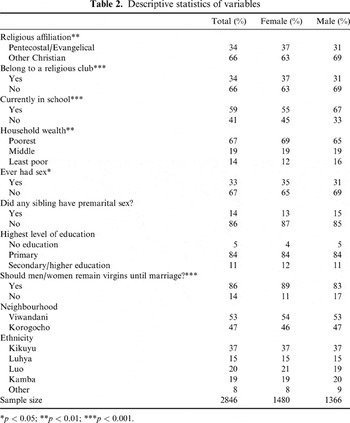
The sample ranged in age from 10 to 22 years with a mean of 16.63 years; 48% were male and 52% female. As shown in Table 2, about a third of the sample is sexually active but this proportion is higher among females than males. In terms of educational attainment, more than half (59%) are currently in school. With respect to highest level of educational attainment, about 84% have primary education and only 12% have at least secondary education, which is not surprising given that most of them are still in school. In terms of household wealth, about two-thirds are classified in the bottom third and only 14% are in the top third. With respect to affiliation, just about a third of the sample indicated affiliation with a Pentecostal/Evangelical religious body but there are significant gender differences. Overall, the sample is very conservative with respect to attitudes to premarital sex, with about 86% agreeing that men and women should remain virgins until marriage. Female respondents are, however, more likely agree compared with males. Geographically, the sample is almost evenly distributed in the two neighbourhoods of Korogocho (47%) and Viwandani (53%).
Descriptive statistics of variables

*p<0.05; **p<0.01; ***p<0.001.
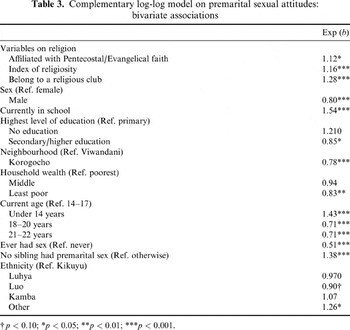
Table 3 presents the bivariate results involving all the covariates. All the variables tapping into the different dimensions of religion have significant associations with attitudes to premarital sex. Starting with affiliation, Pentecostals are about 12% more likely to have conservative views on premarital sex compared with non-Pentecostal Christians. Higher levels of religiosity and membership in a religious club also associate with more conservative views. For religiosity in particular, a standard deviation increase is associated with a 16% increase in conservative views regarding premarital sex. With respect to the control variables, some interesting patterns are noticeable. Older adolescents, as well as those with at least secondary education, the least poor, Korogocho residents, and those who have ever had sex are less likely to agree that men and women should remain virgins until marriage.
Complementary log-log model on premarital sexual attitudes: bivariate associations

†p<0.10; *p<0.05; **p<0.01; ***p<0.001.
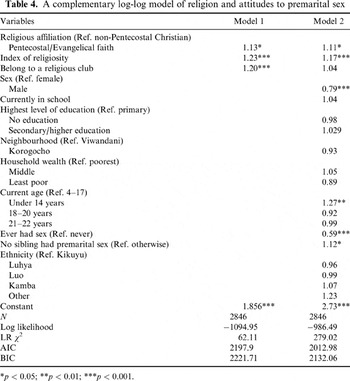
Overall, the bivariate findings discussed above indicate a significant effect of religion on premarital sexual attitudes and are similar to studies elsewhere (Koenig, Reference Koenig2001). However, because these are unadjusted, it was not possible to assess their net effects. Table 4 presents the multivariate results with two nested models. Model 1 assesses the effects of the three variables on religion, while Model 2 examines their net effects adjusting for the control variables. Model 1 shows the significance of religious factors on attitudes towards premarital sex suggesting their independent effects. Young people who identified as Pentecostal are more likely to have conservative views on premarital sex compared with their non-Pentecostal peers. Further, those belonging to a religious club, as well as the highly religious, are more likely to have conservative views regarding premarital sex. This is probably because adolescents who attend religious services may regularly receive more frequent religious messages against premarital sex and their greater religious commitment may also make them more likely to accept religious teachings on sexual immorality. More importantly, it is also probable that they have a network of equally religious friends who serve as reference groups by providing normative and regulatory functions.
A complementary log-log model of religion and attitudes to premarital sex

*p<0.05; **p<0.01; ***p<0.001.
Model 2 explores whether the religious differences persist after controlling for the background variables. The fit statistics (AIC, BIC, LR) suggest a significant improvement over Model 1. Model 2 shows that the positive relationship between religiosity and conservative attitudes to premarital sex remains significant when the effects of known correlates are statistically controlled. Although there is some attenuation of the effects, Model 2 is consistent with prior research elsewhere that the highly religious and those affiliated with Pentecostal faiths have more conservative attitudes to premarital sex. Other significant predictors in the model include sex, age, sexual experience and slum location. Compared with females, males are less likely to agree with the view that men and women should remain virgins until marriage. Also, those who have ever had sexual intercourse are less likely to support the view that sexual intercourse should occur within marriage.
Although intuitively appealing and consistent with prior research, the implicit assumption in Model 2 is the uniformity of the religiosity effect across religious faiths. In this case, it assumes that the effect of religiosity on premarital sexual attitudes is the same across Pentecostal and non-Pentecostal groups. As argued earlier, this may be an untenable assumption given the denominational differences in doctrines and sanctions on premarital sex. Given that religiosity serves as the mechanism through which religious groups serve as reference groups, its effect is likely to be different depending on denomination. Thus, while higher levels of religiosity are associated with more conservative views on premarital sex as discussed above, the effects are likely to be pronounced among religious groups with stricter sanctions (Pentecostals) on the subject.
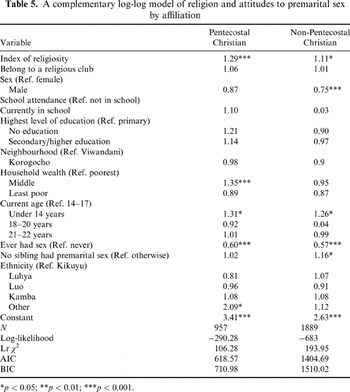
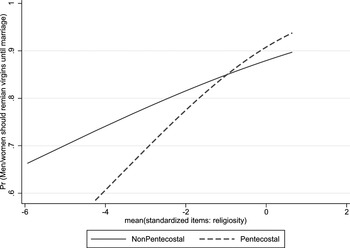
This hypothesis is addressed in Table 5, which presents the results separately for Pentecostal and non-Pentecostal faiths. The equality of the religiosity effect is compared using Paternoster and colleagues' (Reference Paternoster, Brame, Mazerrolle and Piquero1998) approach, which is a special case of the more general statistical interaction effects. While the direction of religiosity is consistent in both groups, the magnitude of the effect is larger among Pentecostals (z=2.00), where a standard deviation increase in religiosity is associated with a 29% increase in conservative views on premarital sex compared with only an 11% increase among non-Pentecostals. In sum, the pattern of results presented in Table 5 supports the hypothesis that the relationship between religiosity and premarital sexual attitudes is more pronounced among theologically conservative denominations. Figure 1 depicts the predicted probabilities involving affiliation–religiosity interaction controlling for all the observed covariates (coefficients are not presented here). At higher levels of religiosity, Pentecostals are significantly more likely than non-Pentecostals to agree that men and women should remain virgins until marriage.
A complementary log-log model of religion and attitudes to premarital sex by affiliation

*p<0.05; **p<0.01; ***p<0.001.
Predicted probabilities of agreeing that men/women should remain virgins until marriage: religiosity–affiliation interaction.

Conclusion
Notwithstanding the relevance of religion to the African social fabric, there is a dearth of research examining the interconnectedness of religion and premarital sexual attitudes, perhaps due to data constraints. Guided by studies elsewhere and using recent data among young people in the informal settlements of Nairobi, this study examined various facets of religion on premarital sexual attitudes. Using reference group theory, it was hypothesized that those who identify with highly conservative faiths will have more negative views on premarital sex. It was also hypothesized that higher levels of religiosity will associate with conservative views, and finally, building on the first hypothesis a religiosity–affiliation interaction was hypothesized such that the effect of religiosity will be more pronounced among conservative faiths.
In general, it was found that attitudes to premarital sex were very conservative with only 14% of respondents agreeing that sex before marriage was acceptable. Re-visiting the theoretical framework and hypotheses, the findings provided support for them. First, those associated with Pentecostal faiths where liturgical messages are more conservative, were found to hold more conservative views about premarital sex than their non-Pentecostal peers. Also, higher levels of religiosity associated with conservative attitudes to premarital sex. Using reference group theory, the effect of religiosity was also found to be more pronounced among the highly proscriptive religions, which is congruent with studies elsewhere. The findings support the notion that religion has a significant effect on premarital attitudes. Those who participate in religious activities more frequently tend to be intensely exposed to moral values that shape their attitudes to premarital sex. It is thus likely that the impact of religion on premarital sexual attitudes is mostly a function of the moral values it impacts, which include the idea that sex is reserved for marriage. However, given varying denominational prescription and sanctions, it is also likely that attitudes may be shaped by official doctrines such that those in more proscriptive faiths will have stronger views on the subject than those in less proscriptive faiths.
The findings suggest directions for future research. First, there is the need for a nuanced examination of the various non-Pentecostal denominations. The limitations of the data made it impossible to distinguish among them. Homogenizing non-Pentecostal faiths, as has been done in this study, conceals subtle but important liturgical differences that could significantly bear on premarital sexual attitudes. Also, given the cross-sectional nature of the data, we strongly caution against causal inferences. There is the possibility of selection bias in the sense that those with liberal views on premarital sex may choose to affiliate with less proscriptive faiths to overcome cognitive dissonance. Thus, the cross-sectional nature of the data does not allow the direction of causality to be examined, an issue that could be best explored with longitudinal data.
These limitations notwithstanding, the study provides empirical validation of the importance of religion on attitude formation. The application of the reference group theory in a sub-Saharan African context demonstrates its generality and appropriateness beyond a Western context. Although not always the case, behaviour often reflects established attitudes and as such, behaviour change should begin with attitudinal change. Young people in the informal settlements of Nairobi have been found to face unique challenges in their transition to adulthood. Considering the correspondence between attitudes and behaviour, one can argue that those with conservative attitudes towards premarital sex will be less inclined to engage in high-risk sexual behaviours. This implies that policymakers should not minimize the role of religion when considering viable adolescent sexuality initiatives. Although it is unclear from the study which aspect of religion is more influential to behavioural change, religion should be incorporated into adolescent sexuality programmes by involving religious organizations.
Acknowledgment
The authors acknowledge the Social Science and Humanities Research Council of Canada's (SSHRC) standard research grant to Stephen Gyimah. The study was initiated when Stephen was a sabbatical fellow at the APHRC, Nairobi. The Transitions-To-Adulthood study is part of a larger project on Urbanization, Poverty and Health Dynamics at APHRC funded by the Wellcome Trust. The authors are grateful to their colleagues at APHRC for their contributions, and to the participants in the study.