

Artifacts found on the surface of an archaeological site are frequently used as a proxy for unexcavated subsurface remains. This is especially true of survey projects or those focused on settlement patterns, where excavating test trenches at a large number of sites is unfeasible and where archaeologists make the assumption—implicit or explicit—that artifacts from the surface of the site are closely related to those that remain belowground. In this way, surface artifacts are used for everything from seriation and determining cultural affiliation to making inferences about the people who lived at a site. Surface artifacts have been widely used in settlement pattern studies and landscape archaeology (e.g., Bevan and Conolly Reference Bevan and Conolly2009; Billman Reference Billman1996; Bintliff Reference Bintliff2005; Dunnell and Dancey Reference Dunnell and Dancey1983; Wandsnider Reference Wandsnider, Alcock and Cherry2004; Willey Reference Willey1953; Wilson Reference Wilson1988; Zvelebil et al. Reference Zvelebil, Green, Macklin, Rossignol and Wandsnider1992), sociopolitical reconstruction (e.g., Sherman et al. Reference Sherman, Balkansky, Spencer and Nicholls2010; Whalen and Minnis Reference Whalen and Minnis2012; Winter-Livneh et al. Reference Winter-Livneh, Svoray and Gilead2010), resource and commodity acquisition (e.g., Barrientos et al. Reference Barrientos, Catella and Oliva2015; Wilkinson Reference Wilkinson1989), population estimates (e.g., Ortman Reference Ortman2016), and mapping of social networks (e.g., Mills et al. Reference Mills, Clark, Peeples, Haas, Roberts, Hill, Huntley, Borck, Breiger, Clauset and Shackley2013), to name just a few examples. Contract archaeology projects also acquire a very large quantity of artifacts from surface contexts, and researchers can use data from these projects to address a bevy of archaeological questions (e.g., Ortman et al. Reference Ortman, Varien and Gripp2007). Projects that rely on surface data typically use a type-proportion model whereby the frequency of one type of artifact of a certain class (e.g., lithics, ceramics) is compared to the frequency of other types in different contexts to make inferences about changing human behaviors across space and through time. Such studies frequently rely on the untested assumption that surface assemblages closely match those that remain buried. This article presents a unique opportunity to test these assumptions using statistical analysis.
Dating sites based on their surface assemblages can be trickier than it may seem at first glance because site formation processes can affect surface and buried deposits in different ways. In general, the surface of an archaeological site is more dynamic than buried levels since an undisturbed stratigraphic level of a site captures a relatively short period of time that is capped by the layers of soil or construction on top of it. As such, the artifacts found in a layer can be expected to date from its period of occupation. Site formation processes must always be considered, however, as a buried level at a site may have been exposed on the surface for a long period of time (Dunnell and Dancey Reference Dunnell and Dancey1983), but at sites with complex architecture, a site surface may be capped very rapidly. Contrast this with the surface of a site, which may represent centuries or even millennia of occupation and reuse and where a slew of site formation processes such as erosion and modern disturbance may bring artifacts from various periods to the surface, resulting in a complex palimpsest where artifacts from several different occupations can potentially be mixed together on the site surface (Barton et al. Reference Barton, Bernabeu, Emili Aura, Garcia, Schmich and Molina2004; Davies et al. Reference Davies, Holdaway and Fanning2015; Fanning and Holdaway Reference Fanning and Holdaway2001; Fernández-López de Pablo and Barton 2015; Wandsnider Reference Wandsnider, Rossignol and Wandsnider1992; Zvelebil et al. Reference Zvelebil, Green, Macklin, Rossignol and Wandsnider1992). This poses a significant, but rarely addressed, problem to the interpretation of archaeological sites based on surface artifacts alone, and its implications are especially important for sites where cultural refuse may be rapidly accumulated and capped while a site is actively occupied, but where the latest layers of the site can sit exposed for a very long time after abandonment.
While surface artifact assemblages have long been used to seriate sites (Lewarch and O'Brien Reference Lewarch and O'Brien1981; O'Brien and Lyman Reference O'Brien and Lyman1999), several studies in recent decades have applied statistical techniques to surface assemblages in order to better understand occupational sequences and site formation processes (Christenson Reference Christenson1994; Fanning and Holdaway Reference Fanning and Holdaway2001; Holdaway et al. Reference Holdaway, Shiner and Fanning2004; Ortman et al. Reference Ortman, Varien and Gripp2007; Roberts et al. Reference Roberts, Mills, Clark, Haas, Huntley and Trowbridge2012; Steponaitis and Kintigh Reference Steponaitis, Kintigh, Williams and Stoltman1993). Seriation methods often assume that a site was occupied for a relatively short time (or for multiple short times), but this is frequently not the case. If formation processes allow a mixture of artifacts from various time periods to appear on the site's surface—not at all an uncommon occurrence—it can be very difficult to date a site through seriation alone. Several authors in recent decades have sought to overcome this problem and sort out mixed or long-term assemblages using various statistical means. Steponaitis and Kintigh (Reference Steponaitis, Kintigh, Williams and Stoltman1993) developed and tested two algorithms (type presence and type frequency) to estimate the maximal occupation dates of a site based on ceramic types with known manufacture dates. Their model built upon mean ceramic dating (MCD), a method developed by Stanley South (Reference South1977) for seriation in historical archaeology. Steponaitis and Kintigh caution that their method would not work in multicomponent or mixed assemblages. Along similar lines, Christenson (Reference Christenson1994) applied MCD to a precontact setting, the Kayenta Anasazi in the U.S. Southwest, and by comparing MCD dates to contexts dated through tree-ring dating he showed that MCD can be useful and accurate in a precontact setting where the precise manufacture dates of any given ceramic type are not known. In a different vein, Fanning and Holdaway (Reference Fanning and Holdaway2001; Holdaway et al. Reference Holdaway, Shiner and Fanning2004) have shown that, even in a setting where soil erosion is high, the type distribution of lithic surface scatters is not significantly impacted, although they caution against viewing surface scatters as intact living floors that represent a specific short-term occupation. Indeed, by obtaining radiocarbon dates from hearth features, they (Holdaway et al. Reference Holdaway, Shiner and Fanning2004) showed that there was a persistence in the use of place in their study area because individual hearths often dated to decades or centuries apart, and, using this knowledge, they were better able to understand the deposition of lithic scatters as representing millennia of repeated occupation rather than being a single site dated to a well-defined period of time.
Other authors have used advanced statistics to understand the sequence of sites that were occupied for long periods of time, a common shortfall of traditional seriation. Roberts et al. (Reference Roberts, Mills, Clark, Haas, Huntley and Trowbridge2012) developed a method that they called “chronological apportioning” and applied it to data from Arizona to better model regional settlement histories using ceramics. Bayesian statistics have also been applied to surface ceramic data. Ortman et al. (Reference Ortman, Varien and Gripp2007) use such statistics to examine a very large dataset consisting of more than 3,000 sites in southwestern Colorado. Their dataset was collected for heritage management purposes rather than archaeological research, posing a number of problems. Using Bayesian methods to overcome some of the problems present not only in this dataset but common to surface archaeology in general, the authors find that their model may be of particular use to archaeologists who work with legacy or heritage management data for settlement pattern analysis. Taken together, these studies offer attempts to circumvent some of the inherent problems in surface artifact scatters and are especially relevant to landscape archaeology and settlement patterns.
The purpose of this article is to test the reliability of using surface data as a proxy for the types and quantities of artifacts that would be found in excavations at a site, were they to be done. While the studies discussed above are all focused on obtaining accurate and detailed information from the surface of archaeological sites, none explicitly tests whether the distribution of artifacts found on a site's surface reliably predicts the distribution of artifacts that remain in the ground. The current study is unique in that surface artifact distributions are compared to excavated assemblages from the same site using statistical means, thereby testing the implicit assumption that surface artifacts can accurately date archaeological sites using traditional relative dating methods.
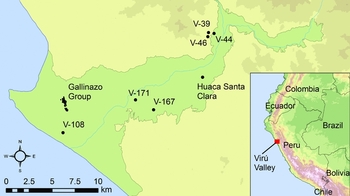
This article draws from a large and high-quality ceramic dataset collected by James A. Ford (Reference Ford, Ford and Willey1949) and his colleagues in the Virú Valley of Peru (Figure 1), a relatively small valley of ca. 185 km2 that cuts through the arid coastal plain of northern Peru. These data were collected as part of the Virú Valley Project, a multi-institutional research project conducted in the 1940s. This project included archaeologists from the American Museum of Natural History, Columbia University, Yale University, the Field Museum, and the Smithsonian Institution and was designed to offer a major contribution not only to the archaeology of Peru, but also to archaeological method and theory more broadly. The project collected a massive amount of data, which was published in a series of volumes (Bennett Reference Bennett1950; Collier Reference Collier1955; Ford Reference Ford, Ford and Willey1949; Ford and Willey Reference Ford, Willey, Ford and Willey1949; Strong and Evans Reference Strong and Evans1952; Willey Reference Willey1953). Surface collections were made at over 250 sites throughout the valley, and deep stratigraphic excavations were carried out at over two dozen sites. Chronology was a major focus of the project and all members worked together to develop a unified ceramic typology.
Sites discussed in this article. The Gallinazo Group is not used in this analysis but is included here for reference.

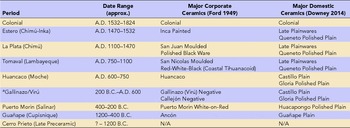
While all of the scholars involved in the project addressed chronological issues, it was James A. Ford (Reference Ford, Ford and Willey1949) who was responsible for the bulk of the chronological work. Ford cross-correlated the ceramic assemblages from all excavation trenches to produce a master chronology for the valley and then used this as a basis for seriating surface collections from throughout the valley. Thus, the utility of using surface artifacts to date archaeological sites was central to Ford's (Reference Ford, Ford and Willey1949) work. Gordon R. Willey (Reference Willey1953) was responsible for summarizing the culture history and the settlement patterns of Virú. Willey worked together with Ford to conduct surface surveys and make artifact collections at some 283 sites throughout the valley.Footnote 1 Ford's subsequent seriation then formed the basis for Willey's own dating sequence. Together with his project colleagues, Willey divided the valley's history into nine time periods, each of which coincided with wider north coast cultural expressions (Table 1). Willey's study was and continues to be hugely influential for settlement archaeology, and the dating scheme he proposed for Virú was a significant contribution to the archaeology of the north coast of Peru.
The Nine Time Periods Used by the Virú Valley Project (Willey Reference Willey1953), Their Approximate Date Range, and the Main Corporate and Domestic Ceramic Types in Use during Each Period.

Note: Corporate ceramic types are from Ford (Reference Ford, Ford and Willey1949); domestic ceramic types are from Downey (Reference Downey and Millaire2014) and are a condensed form of Ford's types. Contemporary north coast cultural expressions are listed in brackets where they differ from Virú period names. Dates are derived from Downey and Millaire (Reference Downey and Millaire2015), Koons and Alex (Reference Koons and Alex2014), Quilter (Reference Quilter2014), Willey (Reference Willey1953: 37), and Zoubek (Reference Zoubek1997). The Cerro Prieto and Guañape periods are poorly dated in the valley.
a This period was originally called “Gallinazo” by the Virú Valley Project, and this name continues to be widely used. Following Jean-François Millaire (Reference Millaire, Millaire and Morlion2009a), I prefer to use the term “Virú,” the name given by Rafael Larco Hoyle (Reference Larco Hoyle1945) for the distinctive style of negative-painted corporate ware diagnostic of this period. Both names are listed here for clarity.
For Ford (Reference Ford, Ford and Willey1949:51, Reference Ford1952), artifacts found on the surface of a site represented the mean or average date for that site, except in the case of any site with very deep stratigraphy. Ford (Reference Ford, Ford and Willey1949:35-37) was primarily concerned with dating the structures at a site but did so by dating the site itself through ceramic seriation, making the assumption that the ceramics at a site closely matched the architecture or, if they dated to different periods, the two could be parsed out. Ford arrived at this conclusion by comparing assemblages collected from the surface of sites with controlled stratigraphic excavations by Strong and Evans (Reference Strong and Evans1952), Collier (Reference Collier1955), and some of his own test trenches.Footnote 2 Ford (Reference Ford, Ford and Willey1949:35) saw it as only logical for surface artifacts to represent the mean site date, and he held onto this view strongly (Ford Reference Ford1952), but he never specified any statistics or method that he used to compare surface artifacts to subsurface ones, and it is difficult to tell whether he systematically compared the surface artifacts from a site to the subsurface ones. To reframe Ford's claim as a hypothesis, the distribution of artifact types from a site surface will be the same as the distribution of artifacts collected from all levels of excavations, except at sites with deep stratigraphy.
As part of an extended critique, Bennyhoff (Reference Bennyhoff1952:232) took exception to this hypothesis and argued that surface ceramics from a site generally date the last time period of that site, not an average date for the entire settlement history. Bennyhoff noted that, despite Ford's claims that excavations were conducted at 28 sites, he published data from only nine of these sites, making it difficult to test these claims. Bennyhoff highlighted several cases where Ford's own assessment of a site's date range did not coincide with the excavations made at that site and other cases where the surface assemblage dated that site's terminal period rather than the mean date. Ford (Reference Ford1952) very briefly rebutted Bennyhoff's detailed critique by emphasizing that the evidence used to date surface assemblages was chosen very carefully by project members and by reiterating that most sites are shallow and, therefore, the surface assemblages date the mean age of the site. However, it remains that Ford never published data to support these claims, making it difficult to accept this at face value.
In this article, I test Ford's hypothesis that the surface ceramics from a site represent the mean or average date for the entire site. In doing so, I address a larger problem in archaeology: when determining a relative date for an archaeological site using seriation, are artifacts found on the site's surface a reliable proxy for those that would be recovered in excavations, were they to be conducted? While Ford never published data to support his hypothesis, the data collected by himFootnote 3 and his colleagues in Virú offer a large and high-quality dataset to test this hypothesis. Using these data, as well as data from recent excavations at Huaca Santa Clara, I am able to test Ford's (Reference Ford, Ford and Willey1949) claims that surface assemblages represent the mean date of a site and, in turn, the hypothesis that surface ceramic assemblages are reliable for dating the prehispanic occupation(s) of sites in the absence of chronometric dating or intensive excavations. I find that Ford's hypothesis is not supported in all cases, but the situation is complex because the relative date indicated by the surface assemblage of most sites is similar to the relative date of assemblages from the upper layers of stratigraphic excavations. Moreover, this study shows the usefulness of revisiting legacy datasets while at the same time highlighting problems that accompany the use of such data.
COMPARING SURFACE AND SUBSURFACE ASSEMBLAGES
The methods used to test Ford's (Reference Ford, Ford and Willey1949) hypothesis are relatively straightforward. Ford's primary role in the Virú Valley Project was to collect and classify a sample of ceramic artifacts found on the surface of sites throughout the valley.Footnote 4 Ford's colleagues William Duncan Strong, Clifford Evans, and Donald Collier (Collier Reference Collier1955; Strong and Evans Reference Strong and Evans1952) excavated deep stratigraphic trenches at several sites throughout the valley. These trenches were excavated in arbitrary levels, typically 25 cm deep, and were intended to demonstrate how ceramic assemblages changed through time. Ford also made small excavation trenches at a few sites to test the reliability of his surface collections. Ford and his colleagues worked closely together to develop a standardized typology that they used to classify all ceramics, taking measures to minimize inter-observer error. Each scholar described this typology separately with the most detailed version (Strong et al. Reference Strong and Evans1952) being published as an appendix to Strong and Evans (Reference Strong and Evans1952). These descriptions were detailed enough to allow other archaeologists in the region to employ the same typology in their own studies.
For this study, I compare the surface and excavated artifacts from the same site using a condensed version of the standardized Virú Valley Project typology described above. Data were collected from Ford's unpublished archives (.F673, Papers of James Ford, Division of Anthropology, American Museum of Natural History; these data were used with permission), from tables published in Collier (Reference Collier1955), and from data collected by Jean-François Millaire's excavations at the site of Huaca Santa Clara.Footnote 5 All data on surface collections come from Ford's archives. Only domestic wares were considered because corporate wares from earlier time periods are very poorly represented in surface collections and because evidence points to corporate and domestic wares developing along different timescales (Downey Reference Downey2014; Downey and Millaire Reference Downey and Millaire2015). Domestic wares were condensed into six types, representing four long-lived traditions in Virú: (1) Guañape Plain, (2) Huacapongo Polished Plain, (3) Castillo Plainwares (including the contemporary Gloria Polished Plain sub-type), and (4) Late Plainwares (including the contemporary Queneto Polished Plain sub-type);Footnote 6 see Table 1 for the relative date and period for each type. Detailed descriptions of these traditions and of the reasons why this modified typology was chosen are available elsewhere (Downey Reference Downey2014). Several of these types were used for very long periods, especially Castillo, which remained quite similar for over one millennium (Donnan Reference Donnan, Millaire and Morlion2009). Such long-term trends in ceramic style complicate any seriation of this material because multiple time periods—as defined by corporate ceramics and political cultures—may be represented by the same ceramic type. This has little bearing on the study at present, however, because the ceramic types used are standardized across all contexts and, at present, I am more concerned with comparing these contexts than I am with dating each site.
In total, I am able to compare surface and excavation data from seven sites; these represent four earth-mound sites in the lower and middle valley and three rock-walled sites on the hillsides of the Queneto Quebrada.Footnote 7 Although excavations were conducted at over two dozen sites during the course of the Virú Valley Project, most of these cannot be included here due to data incompatibilities. The primary issue is that neither Ford nor his colleagues made surface collections at most sites where excavations took place (or collections at these sites produced a very small sample of artifacts), and therefore, comparable surface and excavation data are available only for a few sites. Fieldwork to make such collections was not presently feasible and was deemed unnecessary considering that several robust contexts were available.
Only three of the sites where Ford excavated test trenches can be used here because most of these excavations were either very limited or were conducted at sites with very small surface assemblages that are not statistically meaningful; I test here Ford's excavations at V-39, V-44, and V-46. Collier's stratigraphic cuts at several midden sites provided good data on long-term ceramic trends, and surface collections were also made at most of these sites. I am able to include only three sites, however, because of various problems encountered by Collier (Reference Collier1955), most notably being the theft of several bags of uncataloged artifacts from the site of V-272. These sites are V-108, V-167, and V-171. Finally, excavations by Jean-François Millaire at the site of Huaca Santa Clara (V-67), a site where Ford collected a large surface assemblage, provide an additional data source. Millaire ensured that ceramic sherds were classified using the same types that were described by Ford and his colleagues. These sites are located throughout the valley and offer a good cross section of the types of site found in Virú.
The Virú Valley is typical of the coastal plain in northern Peru. The coast of Peru is an arid desert strip that runs between the Andean foothills to the east and the Pacific Ocean to the west. The area receives essentially no rainfall in an average year, although periodic El Niño Southern Oscillation (ENSO) events can bring catastrophic torrential rain every seven to 20 years (Moseley Reference Moseley2001). This environment is thought to be stable throughout the Holocene. The Virú River is one of several east–west river systems that run from the Andes to the ocean, and irrigation canals have expanded each river to a wide valley system. The middle and upper Virú Valley is bordered by steep-sided rocky slopes and quebradas that form alluvial fans full of sub-angular boulders. Erosion through direct, though rare, rainfall likely affects all sites throughout the valley. Looting activity is also common at all sites in the valley.
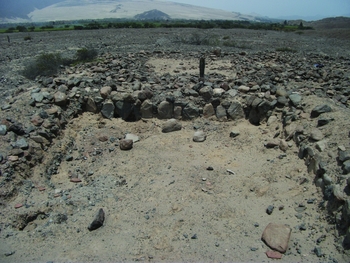
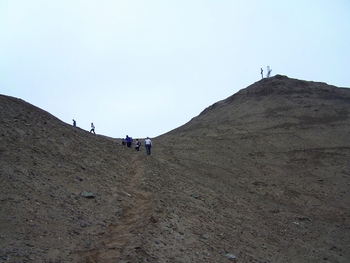
Site formation processes are little studied in Virú. Anthropogenic formation processes can be expected to be similar at all sites: structures may consist of simple walled residential houses or adobe pyramid mounds but, in all cases, floors will be built up using fill, plaster, and adobes, and some structures can attain a significant height either through intentional building-up or through a tell-like formation of architecture and refuse. Many sites were reused as prehispanic (and in some cases modern) cemeteries after the site was no longer occupied and burials within the floor of houses were common in some periods. The sites of V-39, V-44, and V-46 are all rock-walled residential settlements located on the alluvial fan of the Queneto Quebrada (Figure 2; Willey Reference Willey1953). Each site is built directly on the desert floor, and there is little vegetation and no soil formation. ENSO rains have cut channels through each site, but outside of these channels, there is likely to have been little water movement. The site of Huaca Santa Clara (V-67) is a large adobe structure on top of a steep rocky outcrop in the middle valley (Figure 3; Millaire Reference Millaire2004). There is no water source at the site, and fluvial transformation of artifacts is unlikely. While windblown sand covers some parts of the site there is no soil formation to speak of. The sites of V-108, V-167, and V-171 are all adobe structures that rise several meters above the valley floor in lower Virú (Willey Reference Willey1953). Such sites in the valley are generally dry and unaffected by irrigation canals or aquifers that are on the valley floor. Soil probing at a nearby site suggests that adobe structures in the lower valley were originally built on sand dunes that have been built up and expanded by construction (Millaire and Eastaugh Reference Millaire and Eastaugh2011, Reference Millaire and Eastaugh2014). Windblown sand typically accumulates at such sites, sometimes to a depth of several meters. These site formation processes offer context to the discussion below.
A large room at V-39, a typical site in the Queneto Quebrada.

Main platform of Huaca Santa Clara (V-67).

Statistics and Data Used
There are several ways to compare the surface and subsurface ceramic remains from any given site. One method is to compare the frequency or percentage of ceramic types between various contexts. This is essentially what Ford did. Ford (Reference Ford, Ford and Willey1949:44–47, Figure 4) compiled data from stratigraphic excavations conducted by Strong and Evans (Reference Strong and Evans1952), Collier (Reference Collier1955), and from Cut A at the site of V-60, which he excavated himself. He converted all data to the percentage of types from each strata and graphed these systematically using bars whose width represented the percentage of each type. He created a master chart by interdigitating each stratum from every site so as to represent all excavation cuts and the valley's entire ceramic sequence on a single graph.Footnote 8 He subsequently used this master graph to seriate all surface collections. All percentages, both from surface and excavated assemblages, were based on sherd count rather than minimum number of vessels. Ford (Reference Ford, Ford and Willey1949:37) recognized that the quantity of sherds does not necessarily accurately represent the quantity of vessels since larger vessels will produce more sherds and thinner vessels will break more easily. He dismissed this issue because he thought that vessel size and thickness changed through time and that the percentage of types therefore remained valid for dating, and because he did not consider this potential inaccuracy to affect his primary goal of dating assemblages. Ford (Reference Ford, Ford and Willey1949:34–35) noted that efforts were made to ensure that surface ceramics were collected from a large area of each site so as to be representative of the total assemblage and not just of a small number of large pots. Some of the Virú Valley Project ceramic material is available at the project members’ respective institutions, but an unspecified quantity of this material is effectively lost,Footnote 9 and it would therefore be difficult to convert the sherd count to another more reliable quantifier, such as minimum number of vessels (MNV). That said, excavated and surface ceramics alike tend to be highly fragmentary in the Virú Valley and, at present, there is no reason to think that there is a systematic difference in the sherd counts between excavated and surface collections.
From what I am able to tell, Ford never systematically compared the surface and excavated data from any single site and did not employ statistical tests to confirm the goodness of fit between different contexts. Rather, he felt that the surface was a reliable indicator of subsurface artifacts at shallow sites because these had very little accumulated refuse and because site formation processes acted differently at different parts of each site, such that a living floor representing an occupational period may be variously buried and exposed at different parts of the site (Ford Reference Ford, Ford and Willey1949:35). He indicated that stratigraphic excavations were made at most sites with deep cultural stratigraphy. Moreover, although he does not say so explicitly, Ford appears to have come to the conclusion that surface ceramics reliably dated sites without deep stratigraphy by visually comparing the master excavation graph described above with percentage bar graphs created for each surface assemblage. Such a method can be productive, although it is more qualitative than strictly quantitative. Indeed, in the analysis presented below, I consider the percentage of types in various surface and excavated contexts but do so on a site-by-site basis, rather than in the valley-wide way that Ford appears to have done.
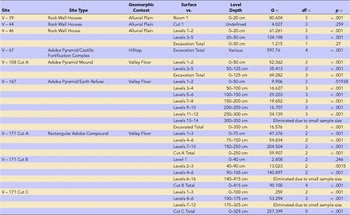
In addition to this more qualitative method, I statistically test the association between surface and subsurface assemblages at each site using the G-test, a statistic that uses the chi-square distribution (McDonald Reference McDonald2014a:54, 68; Sokal and Rohlf Reference Sokal, Rohlf and Freeman1981). Originally developed for biostatistical applications, the G-test compares the observed frequencies of count data to expected frequencies and serves as a more robust form of the chi-squared test of independence, and is applicable to archaeological data. There are two variants of the G-test, the goodness-of-fit test and the G-test of independence. Both tests compare observed frequencies in an R × C table to expected frequencies and operate using the same equation, but the goodness-of-fit test uses theoretically derived expected frequencies whereas the test of independence derives expected frequencies from the dataset itself. The formula for the G-test is
 $$\begin{equation*}
G = 2\mathop \sum \limits_i {O_i} \cdot \ln \left({\frac{{{O_i}}}{{{E_i}}}} \right)
\end{equation*}$$
The G-test of independence is used for all statistics throughout this article (Table 2). Calculations were made using a spreadsheet developed by McDonald (Reference McDonald2014b). The test calculation produces a statistic, G, with degrees of freedom equal to the number of rows minus one, multiplied by the number of columns minus one.Footnote 10 The spreadsheet automatically compares this statistic to the chi-square distribution to produce a p-value; any p-value of less than .05 was considered significant. Significant p-values indicate that the observed and expected frequencies do not match making it likely that the contexts are independent and that the surface assemblage is not simply a random sample of the subsurface artifacts. Ford's hypothesis cannot be upheld in such cases.
Summary of Site Context and Results of G-test Comparison between Surface and Successive Excavation Units.

In all cases, I compare the surface ceramic assemblages to the entire subsurface assemblage (i.e., all levels added together from a single stratigraphic cut). If Ford's (Reference Ford, Ford and Willey1949) hypothesis that a surface assemblage represents the mean cultural date of the entire site is to be upheld, there will be no statistically significant differences between the surface and excavated assemblages. In cases where data is available for multiple excavation levels, I test the surface against both the upper and lower levels with the hypothesis that, if the surface assemblage is skewed toward a later date in time, then it will be more similar to upper levels than to lower. These tests are performed for each site individually below. As will be seen below, the results from the G-test are inconsistent, resulting in varying acceptance and rejection of Ford's hypothesis. However, qualitative comparison of frequency bar graphs between surface and excavated contexts shows that surface types do line up with excavation levels moderately well, except at sites with very deep stratigraphy, and this means that an archaeologist would likely arrive at a similar relative date for both contexts in a ceramic seriation, despite the lack of statistically significant correlations between the differing contexts.
V-39
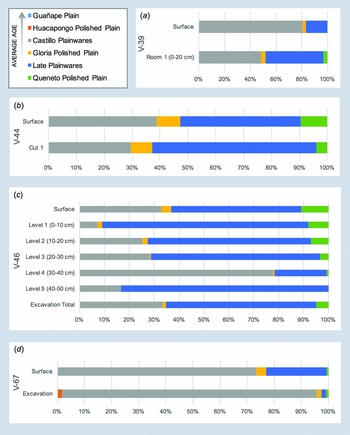
V-39 is a small rock-walled village in the Queneto Quebrada that Willey (Reference Willey1953) dated to the Middle and Late Virú periods. Ford excavated a small trench 20 cm into Room 1 at this site; excavation data are from Ford's archival notes for the site. Ford did not describe the geological or archaeological context of this trench. See Figure 4a for the domestic ware types present at the site and for their distribution. The subsurface and surface assemblages are significantly different (G = 80.604; df = 3; p < .001; Guañape and HPP eliminated due to small numbers); in this case, the surface distribution actually skews toward the earlier Castillo type, rather than the Late Plainware that is abundant in excavations. That the surface dates earlier than the upper layers of excavation runs contrary to what should be expected, and it is not clear why this is so. Ford's hypothesis that the surface assemblage of a site represents its mean cultural date cannot be supported at V-39 because earlier types are actually overrepresented on the surface.
Surface and excavated ceramic distribution for sites V-39, V-44, V-46, and V-67 (Huaca Santa Clara). All graphs are 100 percent stacked bar graphs, with the percentage of each type represented by the size of its respective bar. Types are standardized across all graphs and are arranged from Guañape Plain (leftmost bar, when present) to Queneto Polished Plain (rightmost bar, when present) following the approximate sequence by which types were introduced into the Virú Valley sequence.

V-44
V-44 is a rock-walled site at the base of the large, rocky Queneto Quebrada that Willey (Reference Willey1953:317) dated to the La Plata period and interpreted as being a community center with a residential settlement. Ford excavated a small trench at this site, which he called Cut 1; excavation data are available in Ford's field notes. This trench was cut across the south wall of the building and cleared to floor level, but Ford did not provide additional details about excavation contexts (.F673, Papers of James Ford, Division of Anthropology, AMNH). See Figure 4b for the domestic ware types present at the site and for their distribution. For V-44, the surface and subsurface distributions are quite similar; indeed, there is no significant difference between them (G = 4.027; df = 3; p = .259). In this case, Ford's hypothesis is supported, and surface ceramics are a good proxy for subsurface ceramics; however, the excavated artifact quantity is quite small and may be from only one level.
V-46
This small site in the Queneto Quebrada consists of rock-walled enclosures built on terraces. Willey (Reference Willey1953:300) dated this site to the La Plata Period. Ford excavated a small test trench extending 50 cm into this site (Figure 4c); excavation data are from Ford's field notes. Ford excavated five arbitrary 10-cm-thick levels at this site (.F673, Papers of James Ford, Division of Anthropology, AMNH). Level 0–10 cm was in an ash-filled room just below two looted burials. Level 10–20 cm cut through rubbish that largely consisted of ash, and Ford noted that some material from looted graves may be present at this level. Level 20–30 cm consisted of ash and a large quantity of sherd material, and a fire pit with charcoal was uncovered. The ash fill layer ended in level 30–40 cm and was followed by rock and soil fill to create a level room since this site was built on a hillside. Finally, excavation was stopped at level 40–50 cm, which was primarily soil fill; Ford noted that an ash deposit near the center of the room was chosen to extend the cut, but I cannot find any additional mention of this or any data associated with it. For the current analysis, I compare the surface assemblage to the entire excavated assemblage, to the top 20 cm of excavation, and to the lower 30 cm of excavation. For Ford's hypothesis to be supported, the surface assemblage needs to be similar to the entire excavated assemblage.
The surface is significantly different from the aggregate total of all excavation units (G = 63.632; df = 3; p < .001; Guañape and Huacapongo Polished Plain types eliminated due to small numbers). This indicates that Ford's hypothesis that surface ceramics represent the mean cultural date of the site cannot be supported. The surface ceramic assemblage is also significantly different from the upper levels (Levels 1–2 combined; G = 61.261; df = 3; p < .001) and from the lower levels (Levels 3–5 combined; G = 134.198; df = 3; p < .001). That these differences are significant is a little surprising, however, considering the distribution of ceramic types (Figure 4c). In overall distribution, the surface appears to be quite similar to the total excavation distribution; this likely led Ford to conclude that the surface was a good proxy for the excavated levels. The statistically significant differences cannot be overlooked, but they are likely the result of two minor types, Gloria and Queneto, appearing in higher numbers than expected; when these types are added to their parent type (Castillo and Late Plainware, respectively), the distribution between the surface and the aggregate total of all excavations is not significant (G = 1.215; df = 1; p = .27). This result indicates that Ford's hypothesis can be supported for V-46.
Huaca Santa Clara (V-67)
Huaca Santa Clara is one of six castillos, natural hills topped with large ceremonial, administrative, and military structures located in the middle valley (Downey Reference Downey2014; Millaire Reference Millaire2004, Reference Millaire, Millaire and Morlion2009b). Huaca Santa Clara lies on a large isolated hill on the valley floor in a strategic location and consists of four large adobe platforms, one on top of the hill and the other three on natural terraces. Willey (Reference Willey1953:225–226) dated the site to the Huancaco period based on Ford's surface collection, and this site was thought to be a key location of the supposed Moche takeover of the Virú Valley. Millaire (Reference Millaire2004, Reference Millaire, Millaire and Morlion2009b) conducted extensive excavations within various architectural contexts at the site and found that it was actually a large Virú administrative center and town with minor occupations in the Huacaco and later periods. Millaire found evidence not of a violent Moche conquest at this site but, rather, of a more gradual transition from Virú to Huancaco. Huaca Santa Clara is an ideal location to test Ford's hypothesis because it has large ceramic samples from both surface and excavated contexts.
Excavation strategies at Huaca Santa Clara were designed to obtain samples from across the site rather than focus on deep stratigraphic trenches and, for this reason, I consider it most useful to analyze all excavation data together. There is a much larger proportion of Late Plainwares on the surface of Huaca Santa Clara compared to the aggregate total of all excavated contexts (Figure 4d).Footnote 11 The two contexts are significantly different (G = 597.76; df = 4; p < .001). This result indicates that, in the case of Huaca Santa Clara, the surface ceramic assemblage is not a good proxy for the subsurface ceramics. Instead, Late Plainwares are overrepresented on the surface; this is logical, as later ceramics should be more common than earlier ones on the surface of an undisturbed site, but this pattern is not observed at all sites. Ford's hypothesis is not upheld for Huaca Santa Clara because the surface assemblage represents late types in far greater quantity than excavated frequencies predict.
V-108
V-108 is a rectangular adobe-brick structure located in the sandy flats of the lower Virú Valley, 1 km from the coast. Collier (Reference Collier1955:30, Table 1) excavated two cuts (A and B) at this site and dated it to the La Plata Period. I only include Cut A, a 1.5-m-×-3-m trench cut into a refuse mound. The top 30 cm consisted of shell and faunal remains in a sand and ash matrix, followed by 60 cm of a sandy fill with adobe rubble and soil with less shell and faunal remains than above (Collier Reference Collier1955:30–31). This sandy fill layer continued from 60–120 cm but with fewer inclusions, and a sterile windblown sand layer extended from a depth of 120 cm to the limit of excavations at a depth unspecified by Collier.
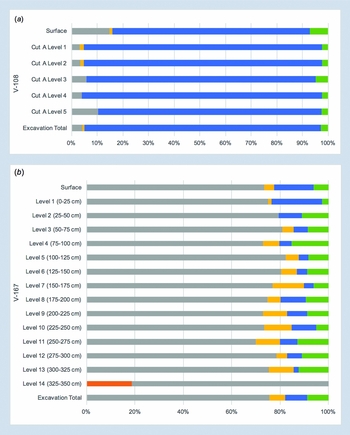
Based on the distribution graph (Figure 5a), it appears that the surface of V-108 is not very similar to any level of the excavation. Indeed, the surface is significantly different from the excavation total (G = 69.282; df = 3; p < .001). The surface is also significantly different from levels 1–2 combined (G = 52.362; df = 3; p < .001) and from levels 3–5 combined (G = 35.413; df = 2; p < .001). Although the earlier ceramic Castillo type is present at this site in much lower quantities than Late Plainwares, it is more abundant on the surface than it is in any excavation level, an unexpected pattern and the opposite of what was observed at Huaca Santa Clara. It is possible that there is a slightly earlier component at this site that was detected in surface collections but was not detected by the single excavation trench compared here; Ford (Reference Ford, Ford and Willey1949) made two surface collections at this site—which I have combined here—and presumably covered its full extent. Nevertheless, while the differences observed here are statistically significant, they are minor, and the site primarily contains Late Plainwares and the surface and all excavation levels date securely to late periods.
One hundred percent stacked bar graphs showing the surface and excavated ceramic distributions for sites V-108 and V-167. All graphs use same legend and ordering as Figure 4.

V-167
V-167 is a large, low earthen mound located in the lower valley on the south side of the river, near the large site of Huancaco. Collier (Reference Collier1955:55, Table 8) described the site as consisting of two small pyramid mounds and one refuse mound. Collier excavated one 3-m-×-4-m trench (Cut A) in the center of the refuse mound and dated all but the lowest layers to the Tomaval PeriodFootnote 12 (Figure 5b). Collier did not detail the archaeological or geological contexts of this cut but noted that midden refuse and ceramic sherds were abundant to very abundant in levels 1–12 and rare in levels 13–14, while a 75-cm-deep test pit below layer 14 exposed only a compact and mottled brown clay layer that was sterile (Collier Reference Collier1955:55-57). Collier did note that an adobe wall with no apparent floor was encountered between a depth 50 cm and 150 cm and that a thin (2–3 cm) layer of shell and charcoal was encountered at a depth of 265 cm in layer 11, a layer that contained a large number of sherds.
While the surface distribution appears to be similar to the aggregate total of all excavated contexts, they are significantly different (G = 16.576; df = 3; p < .001), and Ford's hypothesis is not supported. This site is ideal for comparing the surface distribution against the distribution from specific excavation levels to test whether the surface is more similar to upper levels and less similar to lower ones (Table 2); indeed, this is the case, but the surface is significantly different from all excavated levels, although the difference is not large between the surface and the uppermost levels. In the case of V-167, the surface assemblage is a relatively good proxy for the upper levels of the site but is not a good proxy for the lower levels. Once again, although the surface and excavated distributions are significantly different when measured statistically, they are broadly similar; Castillo sherds dominate both the surface and subsurface assemblages.
V-171
V-171 is a large rectangular compound in the lower valley, south of the river. Collier (Reference Collier1955:49–52, Tables 5–7) excavated three trenches here and found evidence that the site had been in continual use from Guañape times through to the end of the Estero Period. Following Ford (Reference Ford, Ford and Willey1949), Collier considered the surface ceramic assemblage at the site to date to the Estero Period. Collier's three stratigraphic excavation cuts offer perhaps the best opportunity in Virú to examine the relationship between surface and subsurface ceramic assemblages because they follow the pattern that is expected for an undisturbed, long-term occupation, where earlier types become gradually more prominent in the lower levels of excavation. Still, it is necessary to test this pattern against Ford's surface collection from the site. I test the surface assemblage against each of Collier's three cuts separately because there is no reliable way to merge them into one.
Collier described the archaeological and geological strata at this site in greater detail than at the other sites discussed in this article. He also provided accurate profile drawings for each cut, which was not done for the other sites; these should be consulted for a thorough understanding of the contexts at V-171. Cut A is a 2-m-×-4-m trench in the center of a small mound that rose 1.4 m above the valley floor and was cut adjacent to a tapia wall (Collier Reference Collier1955:49). The upper 140 cm of excavation was fill but contained three strata of dark earth, with a layer of adobe rubble encountered at a depth of 75 cm. The tapia wall ended at a depth of 140 cm—level with the valley floor—with no evidence of a floor. Cultural material continued to be encountered in a matrix of mottled yellow-brown clay fill that transitioned to a gray-brown sand until a depth of 250 cm. The excavation was continued to a depth of 325 cm, but no further cultural strata were encountered. Cuts B and C were carried out in the central mound of the site, which was a 15-m-×-40-m mound that rose 1.1 m above the valley floor (Collier Reference Collier1955:52). Both had similar stratigraphy that consisted of alternating layers of brown earth (not further described but likely a loam), yellow-brown clay, and sandier soils (Collier Reference Collier1955: Figure 23). These layers were of varying compaction and sometimes mottled together. Cut B was 2 m × 4 m and extended to a depth of 415 cm. Ceramics were abundant to a depth of 140 cm and became sparser in deeper levels until almost none were encountered in levels 15–16 (365–415 cm). Collier considered the lower 250 cm of fill to have accumulated very slowly over several major periods of occupation, leading to the overlap of ceramic styles from different periods. A small looter's pit cut into levels 1–3 (to a depth of about 75 cm), but Collier felt that it did not displace ceramics within these levels. Cut C, a 3-m-×-6-m trench that was excavated to a depth of 450 cm, was located just south of cut B in order to confirm the cultural stratigraphy of cut B (Collier Reference Collier1955:52–54). The top 125 cm contained abundant ceramic material, but ceramics were sparser below with the exception of level 8 (200–225 cm), which contained abundant sherds. No ceramics were encountered below 300 cm, although evidence of human occupation in the form of shells, ash, and burned clay continued to level 15 at a depth of 400 cm. The soils became very wet below 375, and Collier estimated that the water table was no more than a meter below the limit of excavation.
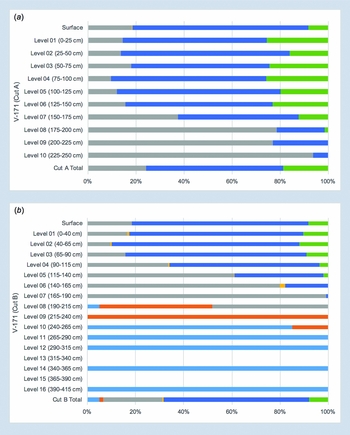
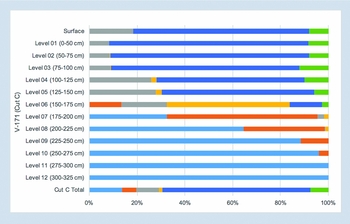
Collier's Cut A at V-171 is, at first appearance, the most similar to Ford's surface collection, but the surface is significantly different from the subsurface total (Figure 6a; see Table 2 for all statistics). The surface is also significantly different from each of the levels of Cut A. Cut B shows a considerably different ceramic distribution in the lower levels than in the upper levels (Figure 6b), and it is therefore not surprising that the surface is significantly different from the excavation total for the cut (G = 90.100; df = 4; p < .001). Viewing the frequency distribution, the surface appears most similar to the upper levels of the cut; indeed, the surface distribution is not significantly different from the level 1 distribution (G = 2.808; df = 2; p = .246; Guañape, HPP, and Gloria excluded due to low numbers), but is significantly different from levels 2–3 combined (G = 13.023; df = 2, p = .0015) and from levels 4–6 combined (G = 140.897; df = 2; p < .001). The surface distribution could not be tested against the lower excavation levels due to small sample numbers, but it is readily apparent that the ceramic distribution in the lower levels are remarkably different from the surface distribution (with a much higher percentage of earlier types in the lower levels). The distribution of Cut C is similar to Cut B (Figure 7). The aggregate total for Cut C is significantly different from the surface collection for the site (G = 257.399; df = 5; p < .001), from levels 1–3 combined (G = .259; df = 2; p < .001; Guañape, HPP, and Gloria excluded), and from levels 4–6 combined (G = 53.294, df = 3; p < .001; Guañape and HPP excluded). As with Cut B, the lower levels of Cut C cannot be tested using the G-test or the Chi-Square test, but these levels contain much higher proportions of earlier ceramics than the surface does.
One hundred percent stacked bar graphs showing the surface and excavated ceramic distributions for cuts A and B at site V-171. All graphs use same legend and ordering as Figure 4.

One hundred percent stacked bar graphs showing the surface and excavated ceramic distributions for cut C at V-171. Graph uses same legend and ordering as Figure 4.

In summary, in nearly all cases, the surface distribution of V-171 is significantly different from the entire subsurface distribution of any excavation cut, therefore refuting Ford's (Reference Ford, Ford and Willey1949) hypothesis that the surface assemblage represents a mean measure of the subsurface assemblage. However, the surface assemblage is also significantly different from nearly any level of excavation. While this would suggest that the surface assemblage is not a good proxy for the subsurface assemblage at this site, when considering the actual distribution of each cut, the surface assemblage dates to roughly the same time as the upper levels of excavation. A large site like V-171 is complex and was surely built and occupied in stages; Cut A is excavated in a different mound from Cuts B and C, and the former appears to date much later and to have been used for a shorter period of time than the latter two (Collier Reference Collier1955). The surface assemblage cannot detect these nuances in the occupational history of a site; nor does it appear to detect in any way the fact that there were much earlier (Guañape and Early Virú) occupations at the site.
DISCUSSION AND CONCLUSIONS
Ford (Reference Ford, Ford and Willey1949) developed the hypothesis that surface ceramic assemblages represent the mean ceramic date of the site. This hypothesis is not entirely supported; in almost all cases, the surface of any site was significantly different both from the average subsurface distribution (calculated by summing together all excavated levels) and from any individual level of excavation. Still, it is not possible to reject this hypothesis outright because significant correlations do exist in several cases. Moreover, despite the lack of statistically significant differences in most cases, the frequency distribution of types across the different contexts follows an expected pattern: the distribution of types on a site's surface is generally similar to the distribution of types from all excavated contexts at shallow sites and similar to the uppermost layers of deeper sites.
This finding has significant implications for archaeological dating and particularly for the archaeology of regions. Surface artifacts are commonly used to date archaeological sites through seriation (Lyman and O'Brien Reference Lyman and O'Brien2006). Seriation methods rely on the ratio of artifact types or attributes in an archaeological unit of interest (e.g., site, excavation block, etc.) to establish relative dates for the unit. Typological sequences and regional seriation sequences have typically been established for many decades such that an archaeologist can be expected to date a site based on a few diagnostic types and their a priori knowledge of the local artifact sequence. For regional survey, this often means surface data. The results presented here highlight the need for caution. An archaeologist may well uncritically date a surface site based on the proportion of types he or she finds on the surface, and a comparison with the proportion of types in excavated contexts would confirm this result: based on the frequency of types alone, the surface seems to be a reasonably good proxy for the upper ~100 cm of subsurface remains, at least at sites whose formation processes match those described here. At the sites presented here the surface and near-surface excavation levels would be dated to the same time period if dated by their type proportions. In other words, qualitatively the surface and subsurface match, except at sites with very deeply buried levels.
Nevertheless, the results here show that the surface distribution of sites does not closely match subsurface distributions in a quantitative or statistically significant sense. Typically, the surface distribution at the sites examined here is different from all excavation levels combined (which can be considered the overall site average) but is also different from most individual excavation levels except for the uppermost levels at a few sites. Can we trust a seriation that is based entirely on the ratio of different types of ceramic found on a site's surface? While not often acknowledged, several authors have recognized the problems inherent in dating ceramic assemblages and have devised methods for obtaining more accurate results from surface ceramic artifacts (Christenson Reference Christenson1994; Ortman et al. Reference Ortman, Varien and Gripp2007; Roberts et al. Reference Roberts, Mills, Clark, Haas, Huntley and Trowbridge2012; Steponaitis and Kintigh Reference Steponaitis, Kintigh, Williams and Stoltman1993). Bayesian analysis (Ortman et al. Reference Ortman, Varien and Gripp2007) offers the greatest promise for deriving accurate dating results from surface ceramic assemblages. Bayesian analysis uses prior knowledge of a distribution to create a probabilistic model that, in its archaeological application, can determine the probability that an observed assemblage fits into the prior known sequence. The Virú Valley is the ideal location to seriate sites using Bayesian analysis because of the large and standardized dataset collected by the members of the Virú Valley Project: the known distribution of types can be derived from stratigraphic trenches, and Bayesian analysis can then be used accurately to seriate surface assemblages. The present article highlights the need for such an analysis because it shows that type-proportion seriation methods are not preferable because surface assemblages fail to accurately represent subsurface assemblages and therefore fail to accurately date the site's occupation period.
Interestingly, at shallow rock-walled sites in the Queneto Quebrada (V-39, V-44, V-46), the surface distribution actually dates slightly earlier than the subsurface distribution, and the surface of V-108 and V-171—both deeply stratified sites—dates somewhat earlier than the upper levels of excavation. The surface distribution at V-167 is roughly similar to all subsurface levels, while the lower levels of V-171 contain large quantities of earlier wares that do not appear on the surface of that site. The Huaca Santa Clara (V-67) surface assemblage is skewed toward later periods, as can be expected because the ceramics from later periods should be more common on the surface than the ceramics from earlier periods. These discrepancies highlight an important point: site context must always be taken into account. Not only are Virú sites subjected to varying site formation processes, looting is also extremely common in the valley (Contreras Reference Contreras2010). Looting was common even when Ford conducted his survey, as seen in his field notes and in site descriptions published by Willey (Reference Willey1953), and looting has continued unabated in the decades since. Among other problems, looting impacts surface collections because buried artifacts from looter's pits are frequently scattered on a site's surface such that the area around a pit may have a distribution of artifacts that dates earlier than undisturbed parts of a site, even if the different parts of the site were abandoned at the same time. This may account for the cases in Virú where a site's surface appears to date earlier than excavated levels. It is difficult to suggest generalized solutions to this problem other than to emphasize that site context can never be neglected when an archaeologist decides whether to accept or reject the relative date of a site based on the seriation of artifacts collected from its surface. This highlights another problem with using surface data for traditional seriation techniques because much of the data may be residual, and types from different levels and occupations may be comingled on the surface.
Beyond the merits of this analysis as a case study of a single coastal Andean valley, it should also serve as a cautionary tale of the limits of using the seriation of surface data to date sites without excavation. In the cases presented here, there is no consistent skew in the dates indicated by ceramic types, and there is no way to account for the variability. Although I contend that surface ceramic assemblages are a reasonable proxy for subsurface contexts in the Virú Valley, because the approximate date indicated by surface ceramics is generally similar to the approximate date indicated by excavated contexts, this is not necessarily the case in other regions, and the surface of a site cannot be reliably trusted to indicate the true age of that site without test excavations. There is greater reliability if one limits their dating of a site to very general time periods, such as the centuries-long traditions used here, than if one attempts to date a site to specific periods or sub-periods based solely on surface finds.
This study tested the hypothesis developed by Ford (Reference Ford, Ford and Willey1949) that ceramic collections made from the surface of sites in the Virú Valley of Peru represented the mean or average date of occupation at the site where the collection was made, except in rare cases of sites with very deeply buried layers. Employing a standardized typology and using both the G-test of independence and a visual comparison of the frequency of types, the distribution of ceramic artifacts between surface and subsurface or excavated contexts was compared from seven sites from the valley. Ford's hypothesis was not upheld in all cases, but there was no consistent skew or pattern in the data, making it difficult to reject outright Ford's hypothesis. In most cases, the distribution of ceramic types on the surface of a site showed statistically significant differences to the distribution of sites from the excavated contexts. Despite these differences, the frequency of types between the varying contexts was generally similar except at sites with deep stratigraphy, where the deepest layers dated earlier than the shallow layers and the surface. Because of this, were the surface and subsurface assemblages dated through seriation, they would date to the same general time period, with the exception of deeply buried assemblages. This study cautions against regional studies simply accepting a site date obtained through the seriation of artifacts collected from the site's surface without testing the reliability of such dates through excavation. This study also highlights the importance of considering site formation processes when dating sites through the seriation of surface artifacts.
Acknowledgments
I would first of all like to acknowledge the help, support, and ideas of Jean-François Millaire from the conception to the completion of this project. I am also grateful to Charles Spencer and the American Museum of Natural History for providing access to the papers of James Ford, which form the basis of this article. I also appreciate Dr. Spencer's comments on an earlier version of this article. The research discussed here was undertaken while I was a doctoral candidate at the University of Western Ontario and portions of this article were written while I was under the support of the Ontario Graduate Scholarship and the Western Graduate Research Scholarship. I would like to thank James Keron for his help and advice with statistics, as well as Theresa Topic, Lisa Hodgetts, Chris Ellis, and Micha Pazner for their guidance throughout this project and their comments on an earlier version of this article. Jose Gutierrez saved me much trouble by kindly translating the abstract into Spanish. I would like to thank three anonymous reviewers for their input, which significantly improved this article. Finally, I must acknowledge the support and friendship of Flannery Surette, who gave me many ideas throughout this project, and the love of Stacey Guy, whose support helped me to finish it. Permits were not required for the work conducted in this analysis.
Data Availability Statement
Excavation data from sites V-39, V-44, and V-46, as well as all data from surface contexts, are reproduced in a modified form from the archives of James Ford and are available on file at the American Museum of Natural History (.F673, Papers of James Ford, Division of Anthropology, AMNH). Excavation data from Huaca Santa Clara (V-67) is provided courtesy of Jean-François Millaire and is on file at the University of Western Ontario. Excavation data from sites V-108, V-167, and V-171 are reproduced from a published volume by Donald Collier (Reference Collier1955). In all cases these data have been modified using a condensed typology and are provided in supplemental materials attached to this article. These data, as well as the details on the condensed typology and additional data on corporate and domestic ware ceramics in the Virú Valley, are also available as supplemental files at http://ir.lib.uwo.ca/etd/2687/.
Supplementary Material
To view supplementary material for this article, please visit http://doi.org/10.1017/aap.2016.2.