


Introduction
The construct of perseveration reflects the tendency to engage in a behavior even when it is no longer rewarding nor produces the expected consequences (Serpell, Waller, Fearon and Meyer, Reference Serpell, Waller, Fearon and Meyer2009). Scientific work has found that perseveration is related to numerous types of psychopathology; for example, obsessive-compulsive disorder (OCD) is characterized, in part, by perseverative cognitive (e.g. deficits in executive functioning and cognitive flexibility; Spiro, Feltovich, Jacobson and Coulson, Reference Spiro, Feltovich, Jacobson, Coulson, Duffy and Jonassen1992) and behavioral processes (e.g. obsessive thoughts, checking rituals; Frost, Sher and Green, Reference Frost, Sher and Green1986). Similarly, generalized anxiety disorder involves perseverative worry about various life events in the absence of problem-solving oriented behavior (Mennin, Heimberg, Turk and Fresco, Reference Mennin, Heimberg, Turk and Fresco2005; Schut, Castonguay and Borkovec, Reference Schut, Castonguay and Borkovec2001), and, in certain instances, depression can be maintained by a perseverative rumination about negative mood states (Nolen-Hoeksema, Wisco and Lyubomirsky, Reference Nolen-Hoeksema, Wisco and Lyubomirsky2008; Watkins and Mason, Reference Watkins and Mason2002). These types of findings, across the psychopathology literature suggest that various forms of excessive or heightened perseveration are often related to greater degrees of personal distress and human suffering (Martin and Davies, Reference Martin and Davies1998).
Perseveration shares conceptual overlap with personality constructs of perfectionism and persistence (Serpell et al., Reference Serpell, Waller, Fearon and Meyer2009). Both perfectionism and persistence have also similarly been linked to various forms of psychopathology (Serpell et al., Reference Serpell, Waller, Fearon and Meyer2009). Serpell and colleagues (Reference Serpell, Waller, Fearon and Meyer2009) have offered a novel, integrative conceptual account that suggests perseveration is distinct from, but related to, perfectionism (a disposition to regard anything short of perfection as unacceptable) and persistence (willingness to engage in a distressing task linked to a reward contingency),
Interestingly, perseveration has not been widely investigated in relation to models of panic psychopathology. It is possible that individuals experiencing acute physical or psychological symptoms of anxiety or panic who have a tendency to perseverate on negative mood states will exacerbate and prolong their emotional symptoms. In this way, perseveration may place certain individuals at greater relative risk for intensifying adverse emotional events (e.g. panic attacks) via heightened attention focused on negative affect and/or physiological states. Related work in the depression literature has, in fact, shown that individuals primed with a negative mood state perseverate on depressive thoughts significantly longer than individuals primed with a positive mood state (Hawksley and Davey, Reference Hawksley and Davey2010). Perseveration also may be related to the maintenance of panic psychopathology. Specifically, recurrent application of safety-seeking or avoidance behaviors may prevent the disconfirmation of excessive or unrealistic fears among persons with, or at risk for, panic psychopathology (Salkovskis, Reference Salkovskis and Salkovskis1996; Salkovskis, Clark, Hackmann, Wells and Gelder, Reference Salkovskis, Clark, Hackmann, Wells and Gelder1999). In line with such findings, recent work has found that perseveration is significantly related to greater levels of phobic anxiety and somatization symptoms (Serpell et al., Reference Serpell, Waller, Fearon and Meyer2009).
Together, perseveration may be relevant to our understanding of both the etiology and and maintenance of panic psychopathology. Yet, to our knowledge, there has not been a direct test as to whether perseveration: (a) varies as a function of panic attack history, or (b) offers unique explanatory value in terms of anxious and fearful responding to panic-relevant somatic perturbation. It is noteworthy that while we propose that perseveration may play a role in both cognitive and behavioral response styles associated with the development and maintenance of panic psychopathology, the perseveration scale of Serpell and colleagues’ (Reference Serpell, Waller, Fearon and Meyer2009) Persistence, Perseveration, and Perfectionism Questionnaire (PPPQ) focuses largely on behavioral aspects of perseveration. However, such behavioral tendencies are not mutually exclusive from cognitive factors in that the perseverative attention and behaviors encompassed in perseveration are likely determined by a set of core underlying cognitive components that differ from those underlying persistence (Serpell et al., Reference Serpell, Waller, Fearon and Meyer2009).
The overarching aim of the present study was to explore the potential explanatory role of perseveration in terms of panic-relevant processes. Specifically, it was hypothesized that persons with a recent (past 2 years) history of panic attacks compared to persons without such a history would report greater levels of perseveration as a result of either a learned and/or inherited vulnerability profile (Brown, Reference Brown1994). Past 2-year history was selected as an inclusionary criterion as it provides a relatively conservative estimate of panic attacks and helps ensure the observed effects are not due to panic disorder itself (Brown, Reference Brown1994). Second, it was hypothesized that perseveration would uniquely predict subjective anxious and fearful responding to laboratory-induced bodily sensations using a 10% carbon-dioxide biological challenge procedure. In particular, we expected that higher levels of perseveration would significantly and uniquely predict greater levels of: (1) global DSM-IV panic attack symptoms, as well as cognitive and physical symptom subscales, and (2) subjective anxiety focused on bodily sensations in response to the procedure. These effects were expected to be distinct from shared variance with persistence and perfectionism (Serpell et al., Reference Serpell, Waller, Fearon and Meyer2009), as well as the variance accounted for by sex, negative affectivity, history of panic attacks, and behavioral (mirror-tracing; e.g. Strong et al., Reference Strong, Lejuez, Daughters, Marinello, Kahler and Brown2003) and self-report (Distress Tolerance Scale; Simons and Gaher, Reference Simons and Gaher2005) indices of distress tolerance. Each of these factors could potentially account for any observed relation between perseveration and the panic-relevant criterion variables.
Method
Participants
The current study data were collected as part of a larger laboratory investigation focused on panic attacks and emotional vulnerability. The present analyses are novel and not previously published. Participants were 88 adults (62.5% women; M age = 22.40, SD = 7.1) recruited from the greater Burlington, VT community. Consistent with demographic characteristics of the State of Vermont (State of Vermont, 2008), 90.9% of the sample identified as Caucasian, 3.4% Asian, 2.3% Hispanic/Latino, 2.3% biracial, and 1.1% “other”. Participants were included in the current study on the basis of: (a) being between the ages of 18–65; and (b) endorsing either a past 2-year history of nonclinical, unexpected panic attacks or no lifetime history of panic attacks. Participants were excluded from the current study based on evidence of: (a) current or past cardiopulmonary (chronic) illness (e.g. chronic obstructive pulmonary disease; asthma); (b) current acute respiratory illness (e.g. bronchitis); (c) pregnancy (by self-report); (d) seizure disorders; (e) current psychotropic medication use; (f) alcohol or substance dependence in the past 6 months; (g) lifetime diagnosis of panic disorder; (h) current suicidal ideation; (i) past participation in a CO2 study; and/or (j) limited mental competency and the inability to give informed, written consent. These exclusionary criteria were employed to help ensure the safety of the participants during the biological challenge (Zvolensky and Eifert, Reference Zvolensky and Eifert2000).
As determined by the Structured Clinical Interview – Non-Patient Version for DSM-IV (SCID-N/P; First, Spitzer, Gibbon and Williams, Reference First, Spitzer, Gibbon and Williams1994), 27.7% (n = 23) did not meet criteria for any Axis I psychopathology, while 25.0% (n = 22), 15.9% (n = 14), and 14.8% (n = 13) met for one, two and three Axis I diagnoses respectively. The most common lifetime mood and anxiety diagnoses among the participants were: major depressive disorder (39.7%, n = 35); generalized anxiety disorder (18.2%, n = 16); social anxiety disorder (14.7%, n = 13); specific phobia (11.4; n = 10); and obsessive-compulsive disorder (10.2%, n = 9). In addition, 58.0% (n = 51) of participants met criteria for past 2-year history of unexpected nonclinical panic attacks.
Measures
Structured Clinical Interview-Non-Patient Version for DSM-IV (SCID-N/P; First et al., Reference First, Spitzer, Gibbon and Williams1994). The SCID-N/P was administered to assess whether participants met criteria for a history (past 2 years) of nonclinical, unexpected panic attacks, lifetime psychopathology (and past 6 months for substance dependence for purpose of study exclusion criteria), and to assess for current suicidal ideation (see exclusionary criteria). In the present study, approximately 20% of SCIDs were chosen for review at random by the Principal Investigator (E. C. B.), with zero disagreements recorded.
The Big Five Inventory (BFI; John and Srivastava, Reference John, Srivastava, Pervin and John1999). The BFI is a 44-item self-report measure assessing the Big Five personality traits (i.e. Extraversion, Agreeableness, Conscientiousness, Neuroticism, and Openness; John, Reference John, Buss and Cantor1989). The current study utilized the Neuroticism subscale of the BFI (BFI-N: e.g. “is depressed, blue”) to index participants’ general tendency to experience negative mood states (α = .89 in the present sample).
Persistence, Perseveration, and Perfectionism Questionnaire (PPPQ; Serpell et al., Reference Serpell, Waller, Fearon and Meyer2009). The PPPQ is a 22-item self-report measure where participants rate items indexing Persistence (e.g. “I tend to keep going with a long task until it is complete, rather than giving up quickly”), Perseveration (e.g. “I keep trying to sort out problems in a relationship, even if I know it's not going to survive”), and Perfectionism (e.g. “When calling a tradesman to arrange for him to come to my home, I would make sure I had all the relevant paperwork and measurements ready”) on a 5-point Likert scale (1 = “Not at all true of me” to 5 = “Totally true of me”). The PPPQ measures three distinct factors and that each has adequate internal consistency (Persistence α = .76; Perseveration α = .64; and Perfectionism α = .70) and adequate test-retest reliability (Persistence: r = .89; Perseveration: r = .79; and Perfectionism (r = .79). Internal consistency for the PPPQ in the current sample was adequate for all three subscales (Persistence, α = .80; Perseveration, α = .74; and Perfectionism, α = .71).
Distress Tolerance Scale (DTS; Simons and Gaher, Reference Simons and Gaher2005). The DTS is a 15-item self-report measure, in which respondents indicate, on a 5-point Likert-type scale (1 = “strongly agree” to 5 = “strongly disagree”), the extent to which they believe they can experience and withstand distressing emotional states (Simons and Gaher, Reference Simons and Gaher2005). The DTS encompasses four types of emotional distress items including: perceived ability to tolerate emotional distress (e.g. “I can't handle feeling distressed or upset”), subjective appraisal of distress (e.g. “My feelings of distress or being upset are not acceptable”), attention being absorbed by negative emotions (e.g. “When I feel distressed or upset, I cannot help but concentrate on how bad the distress actually feels”), and regulation efforts to alleviate distress (e.g. “When I feel distressed or upset I must do something about it immediately”, Simons and Gaher, Reference Simons and Gaher2005). Higher scores reflect higher levels of DT (Simons and Gaher, Reference Simons and Gaher2005). In the current investigation, we employed DTS total score, which displayed strong internal consistency in the present sample (α = .94).
Mirror-tracing (Quinn, Brandon and Copeland, Reference Quinn, Brandon and Copeland1996; Strong et al., Reference Strong, Lejuez, Daughters, Marinello, Kahler and Brown2003). The mirror-tracing task is a behavioral index of cognitive tolerance for psychological frustration and related distress (Quinn et al., Reference Quinn, Brandon and Copeland1996). The task requires participants to use a computer mouse to trace objects on the computer screen, as if viewing them through a mirror. Specifically, a computerized version in which the mouse is programmed to move in reverse direction, meaning that when the participant moves the mouse to the left, for example, the computer cursor moves to the right. The task is comprised of two practice trials, followed by an experimental trial, during which participants trace a star as if viewing it through a mirror (Strong et al., Reference Strong, Lejuez, Daughters, Marinello, Kahler and Brown2003). When the mouse moves outside of the lines, a buzzer sounds loudly. Participants are encouraged to try their best and are told that they may discontinue at any time. Participation in the mirror-tracing task has been associated with an increase in physiological arousal and self-reported frustration (Krantz, Manuck and Wing, Reference Krantz, Manuck, Wing and Matthews1986; Matthews and Stoney, Reference Matthews and Stoney1988). DT on the mirror-tracing task (MT-DT), as in past work (Krantz et al., Reference Krantz, Manuck, Wing and Matthews1986), was defined as the length of time (number of seconds) participants engaged in the experimental trial.
Laboratory assessment. The Diagnostic Sensations Questionnaire (DSQ; Sanderson, Rapee and Barlow, Reference Sanderson, Rapee and Barlow1988, Reference Sanderson, Rapee and Barlow1989) is a self-report index that was used to assess DSM-IV panic attack symptoms immediately following the offset of the carbon dioxide-enriched air. This measure is frequently used in challenge work (Forsyth, Eifert and Canna, Reference Forsyth, Eifert and Canna2000; Schmidt, Forsyth, Santiago and Trakowski, Reference Schmidt, Forsyth, Santiago and Trakowski2002; Zvolensky, Lejuez and Eifert, Reference Zvolensky, Lejuez and Eifert1998); the current assessment of panic symptoms is therefore consistent with past biological challenge studies. Ratings for the DSQ are made on a 9-point Likert-type scale (0 = not at all to 8 = very strongly felt). The DSQ lists DSM-IV panic attack symptoms, and as in past studies (e.g. Sanderson et al., Reference Sanderson, Rapee and Barlow1989; Zvolensky et al., Reference Zvolensky, Lejuez and Eifert1998), was used to measure fear reactivity to bodily sensations (Sanderson et al., Reference Sanderson, Rapee and Barlow1989). In the present investigation, as in past work (Zvolensky et al., Reference Zvolensky, Lejuez and Eifert1998), we used the DSQ-total score, as well as separate indices of DSQ-physical and DSQ-cognitive symptom ratings, as criterion variables. The DSQ demonstrated strong internal consistency in the present sample (DSQ-total, α = .94; DSQ-physical, α = .85; and DSQ-cognitive, α = .93).
Subjective Units of Distress Scale (SUDS; Wolpe, Reference Wolpe1958). Participants were asked to rate their level of distress (0 = no distress to 100 = extreme distress) both before the challenge procedure (baseline) and after (post-challenge). Baseline SUDS ratings were subtracted from post-challenge SUDS ratings in order to obtain a difference score, which was used as an index of participants’ subjective distress in response to the challenge.
Apparatus
The CO2-enriched air administration was conducted in an 8 × 10 ft. sound attenuated room, containing a chair and desk in the Department of Psychology at the University of Vermont. An intercom allowed participants to communicate with the experimenter in the adjacent room during the CO2-enriched air administration. A one-way mirror and video camera allowed experimenters to directly observe session events. A computer video camera in the participant room recorded the session.
Procedure
Individuals responded to community advertisements (e.g. newspaper advertisements, flyers) about a study on emotion and completed a brief telephone screen. Interested participants were then scheduled for a baseline session in the laboratory to determine eligibility. Upon arrival, interested participants first completed a consent form. The SCID-N/P and the medical screening form were then administered to determine eligibility based on the criteria identified above, and participants completed the self-report measures and mirror-tracing task. Eligible participants were then invited to complete a second session (scheduled on a separate day in the following 2 weeks). Participants completed a 4-minute inhalation of 10% CO2-enriched air, which served as the biological challenge and was used as a means to induce physical sensations associated with panic (e.g. breathlessness, increased heart rate). Eligible participants were compensated $10 for their participation in the baseline session and $20 for their participation in the experimental session. Participants deemed ineligible for the experimental session were compensated $10 for their participation in the baseline session.
Data analytic plan
First, zero-order correlations were computed for primary predictor and criterion variables. Second, a one-way ANOVA was computed in order to determine if there was a significant difference in perseveration among those with and without a panic attack history. Finally, a series of hierarchical multiple regression analyses were conducted to examine relations between perseveration and panic-relevant responding to the challenge. At step one of each of the models, sex, group status (2-year history of unexpected nonclinical panic attacks coded yes/no), and negative affectivity were simulatenously entered as a block. At step two of each of the models, DTS and MT-DT were simulatenously entered as a block; these distress tolerance variables theoretically share overlap with perseveration (Leyro, Zvolensky and Bernstein, Reference Leyro, Zvolensky and Bernstein2010), and were therefore selected on an a priori basis as covariates. At step three, the three subfactors of the PPPQ (perseveration, persistence, and perfectionism) were simulatenously entered as a block. The criterion variables were DSQ-total, DSQ-physical, DSQ-cognitive, avoidance, and SUDS. Overall, this analytic model permits evaluation of the unique explanatory value of perseveration in relation to the criterion variables (Sechrest, Reference Sechrest1963).
Results
Zero-order associations among theoretically-relevant variables
Please see Table 1 for a summary of zero-order correlations and descriptive data among all studied variables. PPPQ-perseveration was significantly correlated with both PPPQ-persistence (r = .59, p < .001; 34% shared variance) and PPPQ-perfectionism (r = .61, p < .001; 37% shared variance). Additionally, PPPQ-persistence and PPPQ-perfectionism were significantly correlated (r = .61, p < .001; 37% shared variance).
Descriptive data and zero-order correlations among theoretically-relevant variables
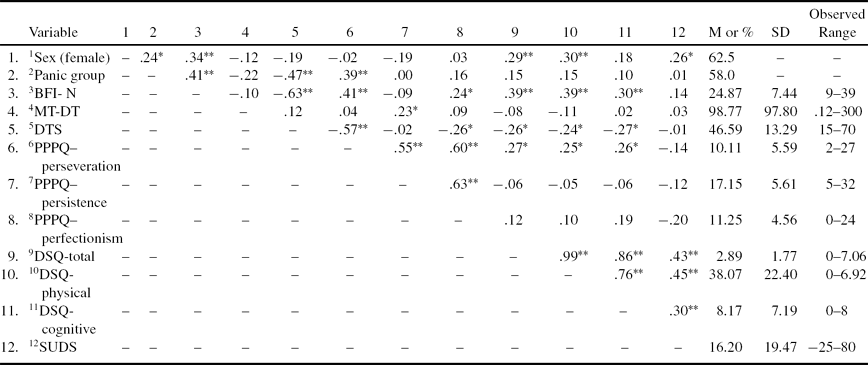
Notes. N = 88. *p<.05; **p<.01. 1Sex (1 = male, 2 = female); 2Two-year history of unexpected nonclinical panic attacks coded (no = 1, yes = 2); 3Big Five Inventory-Neuroticism Scale (John and Srivastava, Reference John, Srivastava, Pervin and John1999) was used to index negative affectivity; 4Time spent on mirror-tracing Task (Strong et al., Reference Strong, Lejuez, Daughters, Marinello, Kahler and Brown2003); 5Distress Tolerance Scale (Simons and Gaher, Reference Simons and Gaher2005); 6–8Persistance, Perseveration and Perfectionism Questionnaire (Serpell et al., Reference Serpell, Waller, Fearon and Meyer2009); 9–11Diagnostic Symptoms Questionnaire (Sanderson et al., Reference Sanderson, Rapee and Barlow1989; 12Subjective Units of Distress Scale (Wolpe, Reference Wolpe1958) difference score.
PPPQ-perseveration demonstrated a significant relationship with DTS (r = -.55, p < .001), but not MT-DT (r = .09, ns). PPPQ-perseveration also demonstrated a significant relationship with panic attack group status (r = .38, p < .05) and negative affectivity (r = .38, p < .05), but not sex (r = .02, ns).
Panic attack group differences in perseveration
As hypothesized, there was a significant main effect in regard to perseveration among those with (M = 11.92, SD = 5.74) and without (M = 7.62, SD = 4.28) a history of panic attacks (F[1, 85] = 15.33, p < .001); those with panic attacks reported greater levels of perseveration.Footnote 1
Hierarchical regression analyses
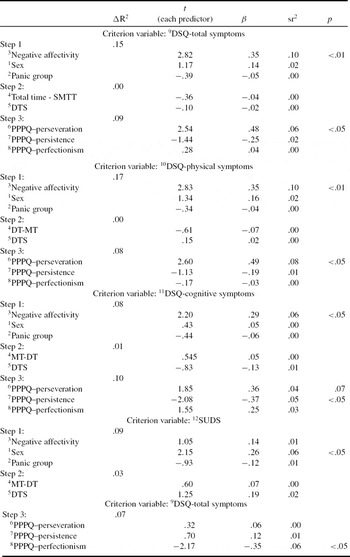
Table 2 provides a summary of the hierarchical multiple regression analyses. In terms of DSQ-total, step one of the model accounted for 15.4% of the variance (F(3, 69) = 4.20, p < .01), with negative affectivity (β = .35, t = 2.82, sr2 = .10, p < .01) being the only significant predictor. Neither DTS nor MT-DT were significant predictors at step two of the model. The final step of the model accounted for an additional 8.7% of unique variance (F(8, 64) = 2.56, p < .05). Here, PPPQ-perseveration was the only significant predictor (β = .48, t = 2.54, sr2 = .08, p < .05).
Persistence, perseveration, and perfectionism in the prediction anxious and fearful responding

Notes: β = standardized beta weight; sr2 = Squared semi-partial correlation; 1Sex (1 = male, 2 = female); 2Two-year history of unexpected nonclinical panic attacks coded (no = 1, yes = 2); 3Big Five Inventory-Neuroticism Subscale (John and Srivastava, Reference John, Srivastava, Pervin and John1999) 4Time spent on mirror-tracing task (Strong et al., Reference Strong, Lejuez, Daughters, Marinello, Kahler and Brown2003) 5Distress Tolerance Scale (Simons and Gaher, Reference Simons and Gaher2005); 6–8Persistence, Perseveration and Perfectionism Questionnaire (Serpell et al., Reference Serpell, Waller, Fearon and Meyer2009) 9–11Diagnostic Symptoms Questionnaire (Sanderson et al., Reference Sanderson, Rapee and Barlow1989); 12Subjective Units of Distress Scale (Wolpe, Reference Wolpe1958) difference score.
For the DSQ-physical symptoms, step one of the model predicted 16.5% of the variance (F(3, 69) = 4.53, p < .01), with negative affectivity being the only significant predictor (β = .35, t = 2.83, sr2 = .10, p < .05). Neither MT-DT nor the DTS were significant predictors at step two. Step three of the model accounted for an additional significant 8.4% of variance (F(8, 64) = 2.70, p < .05). At this step, PPPQ-perseveration was the only significant predictor (β = .49, t = 2.6, sr2 = .08, p < .05).
For the DSQ-cognitive symptoms, step one accounted for a significant 8.1% of the variance (F(3, 69) = 2.03, p = .12). At this step, negative affectivity was the only significant predictor (β = .29, t = 2.2, sr2 = .06, p < .05). DTS and MT-DT were not significant predictors at step two. Step three accounted for a statistically significant 9.5% of additional variance (F(8, 64), p = .08). Here, PPPQ-perseveration demonstrated a non-significant trend (β = .36, t = 1.9, sr2 = .04, p = .07) while PPPQ-persistence (β = –.37, t = –2.1, sr2 = .05, p < .05) was a significant (negative) predictor.
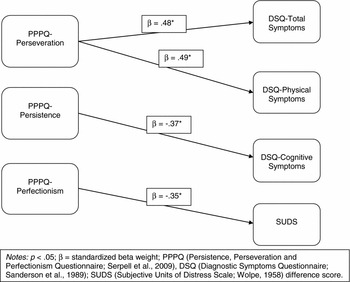
Lastly, step one predicted a significant 8.8% of the variance in SUDS (F(3, 68) = 2.19, p = .10), with sex being the only significant predictor (β = .26, t = 2.15, sr2 = .06, p < .05). Females relative to males reported greater anxiety focused on bodily sensations. Neither MT-DT nor the DTS were significant at step two. Step three significantly predicted an additional 6.6% variance (F(8, 63) = 1.74, p = .11). PPPQ-perfectionism was the only significant (negative) predictor (β = –.35, t = –2.2, sr2 = .06, p < .05).Footnote 2 Please see Figure 1 for a summary of findings.
Diagram of regression findings

Discussion
Consistent with the prediction, individuals with, compared to without, a current history of panic attacks reported significantly greater levels of perseveration. Follow-up analyses found no such similar differences for persistence or perfectionism. This perseveration-panic attack result is generally in line with past work documenting a significant relation between this construct and greater propensity for more intense anxiety symptoms (Serpell et al., Reference Serpell, Waller, Fearon and Meyer2009), as well as theoretical models that suggest perseverative behavior may characterize, in part, risk and maintenance vulnerability for panic psychopathology (Salkovskis, Reference Salkovskis and Salkovskis1996; Salkovskis et al., Reference Salkovskis, Clark, Hackmann, Wells and Gelder1999). Based upon these findings, future work could usefully further address the nature of perseveration among individuals with panic attacks. As one example, it would be useful to understand whether the content of these individuals’ perseveration is general or content-specific. As another example, it would be useful to attempt to identify whether or not panic attacks prospectively predict greater levels of perseveration or vice versa.
A second aim of the present investigation was to examine the predictive (incremental) validity of perseveration in terms of anxious or fearful responding to panic-relevant bodily sensations induced by a laboratory-based biological provocation. Results were partially consistent with a priori expectation. As hypothesized, perseveration was significantly predictive of total panic attack symptoms as well as the physical panic attack symptoms. These effects, reflecting 6% and 8% of variance (see Table 2), were evident above and beyond the variance accounted for by the other predictors at levels 1 and 2 in the model. Thus, while the effect size for perseveration was relatively small, it is noteworthy that the variance accounted for was evident beyond that of a variety of other predictors (e.g. negative affectivity) as well as shared variance with persistence and perfectionism. In contrast to expectation, perseveration demonstrated a non-significant trend for intensity of cognitive panic symptoms, accounting for 4% of variance. One potential reason for this finding is that just four DSM-IV panic attack symptoms listed on the DSQ focus on cognitive symptoms. While this measurement approach is consistent with current diagnostic standards (American Psychiatric Association, 2000), it may limit variability in response options for cognitive versus physical symptom reporting. Alternatively, it may be that perseveration is indeed more relevant to physical aspects of panic symptom expression, particularly within the context of a carbon dioxide biological challenge procedure. Future work is needed to replicate and extend the current results with a larger sample as the lack of statistical signficance for the cognitive panic attack symptoms may also be affected by statistical power. In total, these laboratory findings conservatively suggest that perseveration may be relevant to the expression of some, but not all, aspects of panic attack symptoms.
Interestingly, in this same biological challenge model, lower levels of persistence were significantly predictive of greater levels of endorsed intensity ratings for cognitive panic symptoms. Also, surprisingly, lower levels of perfectionism, but not perseveration, demonstrated a significant effect for anxiety focused on bodily sensations. Here, perfectionism has been identified as more of a heterogeneous construct, encompassing facets of both perseveration and persistence (Serpell et al., Reference Serpell, Waller, Fearon and Meyer2009). In the current sample, perfectionism, as indexed by the PPPQ, may perhaps be viewed as an adaptive trait, given its inverse relationship to anxiety focused on bodily sensations.
Although not the primary aim of the current study, it is interesting to comment on the interrelations among perseveration, persistence, and perfectionism. Serpell et al. (Reference Serpell, Waller, Fearon and Meyer2009) have suggested that these three constructs are distinct, but related to one another. Our data are in accord with this perspective. The shared variance between these constructs was indeed moderate, ranging from 34% to 37% (Serpell et al., Reference Serpell, Waller, Fearon and Meyer2009). Notably, perseveration also was significantly negatively related to perceived ability to tolerate emotional distress, but not a behavioral index of distress tolerance (mirror tracing). These findings provide additional and novel construct validity for the perspective that perseveration is related to numerous aspects of emotion (e.g. perceived distress tolerance) and self-regulation (e.g. persistence), but is not redundant with them (Serpell et al., Reference Serpell, Waller, Fearon and Meyer2009).
Overall, the present data provide initial evidence that perseveration may serve as a unique risk candidate for more intense panic symptoms in response to the induction of uncomfortable bodily sensations. Yet, the mechanism(s) linking perseveration to some aspects of panic attack phenomena remain unclear. One possibility is that perseveration may promote more adverse emotional events (e.g. more frequent and intense negative affect as a consequent of perseverative behavior), resulting in a learned and exacerbated fear response to interoceptive stimuli associated with these events. It also may be possible that elevated levels of panic symptoms may promote a perseverative (e.g. avoidant) response style in an effort to regulate noxious experiential states (Salkovskis, Reference Salkovskis and Salkovskis1996). Elucidating the mechanisms linking risk and maintenance factors to panic psychopathology and their specific roles in onset and course of symptoms will facilitate theoretical refinement of etiological models and thereby guide the development of more integrated models of panic etiology.
Several limitations of the study qualify the present findings. First, the homogeneity of the sample, in terms of race and ethnicity, limits the generalizability of the results. Future studies could be directed at the study of perseveration in relation to panic psychopathology among more diverse samples. Second, the use of the PPPQ, a self-report index, presumes that the responder is able to accurately reflect upon the goal they are working towards and whether it is rewarding (e.g. persistence) or maladaptive (e.g. perseveration). It is, therefore, possible that individuals underrated their levels of perseveration, while inflating their levels of persistence. However, the authors of the index aim to diminish this possibility by employing similar statements for these scales, modified just slightly to reflect their distinguishing features (e.g. persistence: “. . .even if it takes a long time”; perseveration: “. . .even if I know it's not going to survive”). Despite this formatting, there may be utility in exploring alternative measurement approaches for perseveration and persistence that are not self-report in nature (e.g. laboratory tasks). For example, perseveration in relation to neuropsychological functioning is typically examined via tasks that focus on cognitive, rather than behavioral, inflexibility (e.g. Wisconsin Card Sorting Task; Heaton, Chelune, Tallen, Kay and Curtis, Reference Heaton, Chelune, Tallen, Kay and Curtiss1993), yet shares conceptual overlap with the definition proposed by Serpell and colleagues (Reference Serpell, Waller, Fearon and Meyer2009) in that it is also characterized by inability to maintain or alter a behavior to fit the given circumstances or expectations of what is appropriate. Therefore, extension of our findings may be strengthened through the use of neurocognitive assessments as indices of perseveration; however such tasks were developed to identify significant cognitive impairments (e.g. executive functioning deficits), and may therefore be less sensitive to perseverative styles observed in the current population.
Third, the present design does not permit causal-oriented hypothesis testing. Although an attempt to strengthen confidence in the observed findings was achieved by the experimental design and by controlling for theoretically-relevant factors, causal directions of the observed relations cannot be fully determined. Finally, research in the area of laboratory provocation tasks has not uniformly demonstrated that individuals with panic attack and panic disorder histories always exhibit greater anxious responding in response to such a procedure (e.g. Freire, Perna, and Nardi, Reference Freire, Perna and Nardi2010; Schmidt and Trakowski, Reference Schmidt and Trakowski2004). It is, therefore, possible that our findings may represent somewhat conservative estimates of the relations between perseveration and panic-relevant responding, or represent a relationship unique to a set of participants for whom provocation procedures indeed illicit panic. Thus, generalizibility of our findings may be limited and future studies could focus on replicating and extending these findings to other, perhaps naturalistic, settings. Thus, while the present laboratory design can help to isolate theoretically relevant processes as they unfold in “real time” (Zvolensky and Eifert, Reference Zvolensky and Eifert2000), such data will need to be extended to vulnerability processes in naturalistic settings and across longer periods of time.
Acknowledgements
This research was supported by grants (1 F31 DA024919-03) awarded to Ms Leyro, (1 F31 MH080453-01A1) awarded to Dr Berenz, Dr Smits (1 R01 DA027533-01), and Dr Zvolensky (1 R01 DA027533-01; 1 R01 MH076629-01).



Comments
No Comments have been published for this article.