Introduction
Bilingual proficiency in early childhood has been found to be related to children's advance in academic performance (Genesee & Lindholm-Leary, Reference Genesee, Lindholm-Leary and Hornberger2008), social-emotional skills (Sun et al., Reference Sun, Yussof, Habib Mohamed, Rahim, Bull, Cheung and Cheong2018c), and cognitive ability (Weber, Johnson, Riccio, & Liew, Reference Weber, Johnson, Riccio and Liew2016). In many bilingual societies, the key to achieving a good command of dual languages probably lies in children's heritage language (HL) development. In the case of HL maintenance, bilingual children are usually immersed in the input-rich societal language environment (as English language learning for Hispanic–English bilinguals in the US), while they are exposed to a less favorable HL learning environment on average (Montrul, Reference Montrul2018). HL refers to “a socio-politically minority language, acquired as a first language during the first years of life, as in sequential bilinguals, or simultaneously with the majority language since birth, as in simultaneous bilinguals” (Montrul, Reference Montrul2018, p. 530). HL could be either children's home languages, or languages significant to certain communities due to a sense of inherited cultural connection (Cummins, Reference Cummins2005).
Singapore is one of the countries that is facing the mentioned balance issue (Sun, Yin, Amsah, & O'Brien, Reference Sun, Yin, Amsah and O'Brien2018b). The country has four official languages: English, Mandarin, Malay, and Tamil. English has a higher social status as the language for inter-ethnic communication and access to international science, technology, and business arenas. HLs (i.e., Mandarin, Malay, and Tamil), which are called ‘mother tongue language’ in the Singaporean context, are described as ‘cultural ballasts’ responsible for the transmission of cultural knowledge that anchors Singaporeans to their ethnic roots in a globalized world (Bokhorst-Heng, Reference Bokhorst-Heng and Blommaert1999; Pakir, Reference Pakir, Alatis and Tan2001). When parents have a choice between vernacular and English-medium schools, many would choose English-medium schools to provide their children with English competency and an eventual competitive advantage in the workplace (Dixon, Reference Dixon2009). The rise of ‘English-dominant’ bilinguals fuels concerns about the loss of the HL (Pakir, Reference Pakir2007). According to the Singapore Department of Statistics (2010), only 32.2% of Indian and 42.2% of Chinese preschool children speak their HL at home, and the percentage of Malay preschool children speaking Malay at home dropped by 18.3% (to 71.8%) over ten years. Consequentially, studies have found a substantial gap between children's English and HL proficiencies (Sun et al., Reference Sun, Yin, Amsah and O'Brien2018b).
From the first year at kindergarten, the HLs are taught as subjects in the majority of Singaporean kindergartens, while the rest of the curriculum is conducted in English (Dixon, Reference Dixon2009). Given the trend of a home language shift to English, preschools are poised to play an increasingly more important role in cultivating children's early HL proficiency. As most schools provide only 45 to 60 minutes for HL teaching each day, it is crucial to address the effectiveness of teachers’ HL instructional approaches and ensure high-quality language exposure in class. A recommended method from the Ministry of Education is a ‘bilingual approach’ for primary school HL teachers (Ministry of Education, 2010; Tan, Reference Tan2004). Following this approach, it was suggested that HL teachers use English to teach lower primary school students who have little or weak HL proficiency. In a pilot study, the use of English has been reported to facilitate primary school students’ understanding and communication in Mandarin, to help them clarify their learning needs, and to increase their interest and class participation (Tan, Reference Tan2004). No further information regarding the optimal quantity and type of English use to support HL instruction was given, not to mention the impact of such an approach on children's language and cognitive development. The details of the approach would be critical as this would act as a guide for HL teachers. Besides implementation, Tan (Reference Tan2004) addressed teachers’ and parents’ resistance to the bilingual approach in HL classes, due to the concern that the amount of English use could come at the expense of the time for HL instruction and input. The practitioners’ concerns and the governmental promotion of the bilingual approach in Singapore reflect the contrary attitudes towards code-switching in (child) language development worldwide (Turnbull & Dailey-O'Cain, Reference Turnbull and Dailey-O'Cain2009; Wei & Martin, Reference Wei and Martin2009).
Before discussing the effects of code-switching on children's language development, it is necessary to have a clear definition of the linguistic phenomenon. Code-switching (CS) refers to an alternation between languages, either within (intra-sentential switching) or between (inter-sentential switching) sentences or utterances (Myers-Scotton, Reference Myers-Scotton and Hogan2011). In language class, the switching between the target language and another language are usually found to be short and temporary, with the target language dominating the instructional time (Probyn, Reference Probyn2015). The CS in the classroom setting could occur within a speaker's utterance(s) (i.e., one single speaker within one interaction) or between different speakers (i.e., across separate interactions in separate contexts throughout the class or with two people speaking two languages). There is consensus that language input is significantly related to bilingual children's language development (De Houwer, Reference De Houwer2007), and CS is considered a unique feature of their daily input (Place & Hoff, Reference Place and Hoff2011). The value of CS has been debated in the extant literature and a mixed perception of the use of CS in classrooms exists amongst educators and curriculum specialists (Chavez, Reference Chavez2016; McMillan & Rivers, Reference McMillan and Rivers2011). One school of thought espoused early on considered CS as an indication of confusion or linguistic incompetence. According to the Unitary Language System Hypothesis, the lexical and grammar systems for bilingual children first exist in a unitary language system, before gradually developing into two different language systems via language differentiation (Genesee, Reference Genesee1989). Researchers argued that CS leads to confusion during this differentiation period. This view was applied to bilingual education in the recommendation to keep both languages separate by using only the target language (Aitchison, Reference Aitchison1991). Such complete immersion in the target language was expected to reduce the interference of the stronger language (Howatt, Reference Howatt1984) and to guarantee sufficient target language output (Ellis, Reference Ellis1988).
More recent studies failed to confirm the Unitary Language System Hypothesis, instead suggesting that young bilingual children do distinguish the two language systems, with systematic CS attempts that preserve the grammatical structure of each language (Yow, Tan, & Flynn, Reference Yow, Tan and Flynn2018). In a recent experimental study, Antón, Thierry, and Duñabeitia (Reference Antón, Thierry and Duñabeitia2015) compared the common pedagogical approaches (one language–one subject vs. mixed-language approach) in facilitating the learning of new words and concepts with adults and children, and did not find any support that a one subject–one language approach was more beneficial than the mixed-language approach. Rather than confuse learners, the use of CS in classrooms has been related to positive learning environments and outcomes for young bilingual learners (Nhan & Lai, Reference Nhan and Lai2012; Shegar & Rahim, Reference Shegar and Rahim2005). Several lines of support for teachers’ CS are found in the literature. For instance, it has been suggested that teachers’ use of CS promotes the comprehension of the weaker language through the instruction given in their dominant language (Kiranmayi, Reference Kiranmayi2010; Madriñan, Reference Madriñan2014; Sert, Reference Sert2005). This is because learners can tap into their knowledge of the stronger language to facilitate understanding of the weaker language, thus increasing the association between words in the two languages (Madriñan, Reference Madriñan2014; Parama, Kreiner, Stark, & Schuetz, Reference Parama, Kreiner, Strak and Schuetz2017). For instance, Hamman (Reference Hamman2018) demonstrated in her case study how a bilingual teacher used an English–Spanish cognate chart that was created with students to teach vocabulary. Besides the instructive motivation, researchers have also identified the affective potential of CS. For instance, Roberts (Reference Roberts2017) proposed that, since children's stronger language are linked to their personal and cultural identity, allowing children to tap into their L1 may provide them with a socio-emotional boost to learning the target language. Restricting children to use only the target language in class, on the other hand, would cause frustration for those children who are struggling with the language and might lead to a negative classroom learning climate (Cook, Reference Cook2001; Widdowson, Reference Widdowson2003). In brief, given that CS is a natural occurrence in bilinguals, such an approach has been argued to lead to a more conducive learning environment and better learning outcomes (Cahyani, deCourcy, & Barnett, Reference Cahyani, de Courcy and Barnett2016). This aligns with the recent discussion on ‘translanguaging’ which, in bilingual classrooms, refers to “dynamic discursive exchanges in which teachers and students engage as they draw on and choose from multiple languages and language varieties” (Gort & Sembiante, Reference Gort and Sembiante2015, p. 9). Notably, translanguaging extends from CS, positing that, instead of deciding which setting-appropriate language to use, one can communicate by drawing from one's entire linguistic repertoire (Creese & Blackledge, Reference Creese and Blackledge2015). In pedagogical terms, translanguaging creates learning opportunities and enhances the linguistic richness of the class, thereby supporting students’ language awareness, multilingual competence, and inter-cultural disposition (Creese & Blackledge, Reference Creese and Blackledge2015; García & Wei, Reference García and Wei2014).
Positive effects of teachers’ CS extend from children's language development to their development of cognitive skills (e.g., Nicolay & Poncelet, Reference Nicolay and Poncelet2013, Reference Nicolay and Poncelet2015). Recent studies of L2 bilingual school programs reveal favorable influences of children's exposure to language switching in formal instructional settings on their cognitive development for executive control (e.g., Barac & Bialystok, Reference Barac and Bialystok2012; Nicolay & Poncelet, Reference Nicolay and Poncelet2013, Reference Nicolay and Poncelet2015). Nicolay and Poncelet (Reference Nicolay and Poncelet2013, Reference Nicolay and Poncelet2015) found that the French–English bilingual education children received when they were three years old predicted their better executive control outcomes (e.g., non-verbal selective attention and cognitive flexibility) when they were eight years old, as compared to their monolingual peers. In the L2-bilingual education program, children are taught academic subjects through the medium of the L2 (e.g., English) for a substantial portion of the school day (e.g., 75% of classroom hours in kindergarten, first, and second grade, and 50% in third grade), meaning that they have to switch between the two languages used at school during instruction. The authors attribute the children's enhanced executive control processes to their exposure to language switching imposed through bilingual instruction. They view this educational environment as a form of daily training for children's non-verbal executive control skills, leading to sharpened executive control development.
The brief review above demonstrates the multi-faceted associations between teacher's CS and children's development in language and cognition. In the following sections, we specify these short-term and long-term associations between CS and early childhood development, and expand on the influence of specific types of CS (i.e., intra-sentential and inter-sentential) on children's language output in class, HL vocabulary development, and cognitive benefits. As no particular theory could cover the influence of CS on both learning process and outcome, we have employed specific hypotheses (i.e., the Adaptive Control Hypothesis; Green & Abutalebi, Reference Green and Abutalebi2013) to examine the three aspects of children's performance. As there are only a couple of studies that have been conducted on early bilingual learners in the preschool context, the following literature review also includes findings on early bilingual learners in the home setting or older bilingual learners (i.e., in primary school and onwards) in the school setting.
Teacher's CS and children's language output in class
As a unique feature of bilingual children's language input, would the CS in adults’ input impact children's language output immediately? In other words, are bilingual children sensitive to the adults’ CS? The Modeling Hypothesis suggests that bilingual children's CS is directly related to the CS in their input. Comeau, Genesee, and Lapaquette (Reference Comeau, Genesee and Lapaquette2003) tested the hypothesis with six French–English bilingual children (average age 2;4) during their play sessions with an experimenter. The assistant engaged a low rate of CS (M = 15%) in the first and third session, while using a high rate of CS (M = 40%) in the session in between. The results revealed that these young bilinguals were able to adjust their rates of CS in accordance with the experimenter on a turn-by-turn basis. The researcher explained the association from both the perspectives of the discourse features of input (Lanza, Reference Lanza, Cenoz and Genesee2001) and of the statistical properties of the input (Comeau et al., Reference Comeau, Genesee and Lapaquette2003). According to the former, bilingual children's CS can be related to the discourse styles and strategies of their parents, who would use speech acts to signal to what extent the CS is acceptable on a specific occasion (Lanza, Reference Lanza, Cenoz and Genesee2001). The different use of CS across families and across occasions may result in children's variation in CS use. From the perspective of the statistical properties of the input, children are sensitive to the frequency and type of CS in the input, being able to extract statistical regularities and to produce their output correspondingly to the input online.
So far, no study has been found to examine the Modeling Hypothesis with natural data obtained from the HL class at preschool. The few case studies that examined teachers’ CS in early language class were pedagogy oriented, and teachers’ CS has been found to affect child bilingual learners’ class engagement. The qualitative study conducted by Lin (Reference Lin2012) demonstrated that teachers’ intra-sentential CS activated child English learners’ noticing and schematic knowledge in Chinese. When exploring the results from 93 children taught by three teachers in China, the research found that children learned an English language game more readily and efficiently when intra-sentential CS was used by the teachers. The positive effect of teachers’ CS on children's language learning was also found by Gort and Sembiante (Reference Gort and Sembiante2015). They observed three teachers (one lead teacher and two assistant teachers who supported the lead teacher on alternating weeks) and 17 Spanish–English bilingual children during ‘Show-and-Tell’, and examined the impact of the teachers’ bilingual approach on preschoolers’ classroom talk. Each of the two teachers would engage in a specific language model when co-teaching, one in Spanish (L1) and the other in English (L2), to carry out inter-sentential CS through coordinated and parallel discursive practices. The two teachers have used collaborative bilingual recasting, language brokering and the concurrent translation of each other's language. The results demonstrated that teachers’ CS helped children to tap into their existing L1 knowledge to gather information for them to think, understand, communicate, and construct the meaning of concepts in the L2, allowing them to learn and produce more output in their L2.
The above studies shed light on the potential influence of teachers’ CS on bilingual preschoolers’ oral language output in class. The current study examines the association between teachers’ CS and children's CS according to the Modeling Hypothesis, with video data obtained from the HL classes of Singaporean kindergartens.
Teacher's CS and children's vocabulary development
Only a couple of studies have investigated the impact of adults’ CS on children's vocabulary development in their early childhood (Conboy & Montanari, Reference Conboy, Montanari, Nicoladis and Montanari2016), and the majority have focused on parent and child interaction at home. Findings from the few studies on the relationship between parents’ CS and young children's vocabulary learning are equivocal: some studies found a negative association (Byers-Heinlein, Reference Byers-Heinlein2013); some studies found no relation (David & Wei, Reference David and Wei2008; Place & Hoff, Reference Place and Hoff2011); while other studies found a positive relation (Bail, Morini, & Newman, Reference Bail, Morini and Newman2015). In Byers-Heinlein's (Reference Byers-Heinlein2013) study, parental self-reported frequency of Canadian children's exposure to parental CS significantly predicted smaller receptive vocabulary for 1.5-year-old bilinguals, and marginally smaller productive vocabulary for 2-year-olds. The author argued the findings from the perspective of speech processing, and assumed that parental CS would change the reliability of the statistical cues (e.g., rhythmicity) that promote vocabulary learning. The disruptions might cause misleading cues, making it difficult for bilingual children to accurately extract words from the input. Bail and colleagues (Reference Bail, Morini and Newman2015) proposed an alternative hypothesis that parental CS might facilitate young children's word learning by providing them with explicit translation equivalents. They examined this alternative hypothesis with twenty-four English–Spanish speaking caregiver–child dyads, and they did not find that the parental CS had a negative impact on children's productive vocabulary. On the contrary, a significant positive correlation was identified between parental intra-sentential CS and children's vocabulary.
The positive impact of intra-sentential CS on vocabulary development is in line with the findings for older learners in the school setting (Lee & Macaro, Reference Lee and Macaro2013). Sixth-grade primary school students in Korea were found to benefit from intra-sentential CS (e.g., to explain the target English word in Korean or provide a translation equivalent) for their English vocabulary learning. Lee and Macaro explained such a positive association with the Revised Hierarchical Model (Kroll & Stewart, Reference Kroll and Stewart1994), and proposed that children's existing lexical concept representations in Korean would gradually link to their lexical representations in English with the assistance of intra-sentential CS, and that the link would promote children's vocabulary learning. Researchers in the school context have specifically stressed the contingency issue of teacher's CS. They argued that effective CS is dependent on teachers’ anticipation of children's language needs and preferences (Gort & Sembiante, Reference Gort and Sembiante2015), echoing Ahmad's and Jusoff's (Reference Ahmad and Jusoff2009) statement that CS is a deliberate strategy to be used by teachers. Garcia (Reference García2009) advocated for careful, purposeful planning rather than random or spontaneous CS, and argued that, if teachers code-switch without an explicit instructional purpose, children's language learning might be affected (also see Ballinger & Lyster, Reference Ballinger and Lyster2011; Corcoll, Reference Corcoll2013). Purposeless CS might take away time that could be spent in the target language (Kersten, Steinlen, Tiefentahl, Wipperman, & Mattsson, Reference Kersten, Steinlen, Tiefentahl, Wipperman, Mattsson, Kersten, Rohde, Schelletter and Steinlen2010). As the amount of time spent with speakers of the target language corresponds proportionately to the number of known words in the target language for bilingual children (Ballinger & Lyster, Reference Ballinger and Lyster2011; Marchman, Fernald, & Hurtado, Reference Marchman, Fernald and Hurtado2010), teachers should use CS appropriately in class in order to maximize the use of the target language. Besides being able to provide appropriate input based on children's needs, purposeful CS also might be used to manage the classroom (Ahmad & Jusoff, Reference Ahmad and Jusoff2009), to provide affective support to the students (Roberts, Reference Roberts2017), and to ensure children's comprehension of the target language (Celik, Reference Celik2003; Madriñan, Reference Madriñan2014).The contingency concern (i.e., purposeful planning) implies that it would be necessary not only to quantify teacher's CS use frequency, but also to examine the specific functions of such CS to see whether it has an instructional purpose. Most of the existing studies regarding CS and early child language have focused only on the impact of parental CS frequency on children's vocabulary learning. The current study examines preschool teachers’ CS through the lens of perceived CS functions as well, in the hope of providing additional insight to the mixed results that researchers have identified so far.
Teachers’ CS and children's cognitive flexibility
There is substantial evidence supporting the association between bilingualism and executive control processes. Based on the Inhibitory Control (IC) model (Green, Reference Green1998), a control mechanism is engaged to direct attention and manage the joint activation of a bilingual's two languages (Dijkstra, Van Jaarsveld, & Ten Brinke, Reference Dijkstra, Van Jaarsveld and Ten Brinke1998; Marian & Spivey, Reference Marian and Spivey2003). That is, both bilinguals’ languages remain active even when only one language is in use, requiring the individual to constantly monitor the languages in the environment in order to make decisions about which language to use and which to inhibit. This linguistic control is proposed to be achieved through executive control processes that include inhibition and cognitive flexibility (Barac, Bialystok, Castro, & Sanchez, Reference Barac, Bialystok, Castro and Sanchez2014). Therefore, bilinguals’ language experience in managing and resolving linguistic conflict is believed to enhance these cognitive processes, and there is evidence demonstrating bilingual advantages in executive control from early childhood (e.g., Bialystok & Martin, Reference Bialystok and Martin2004; Blumenfeld & Marian, Reference Blumenfeld and Marian2014; Carlson & Meltzoff, Reference Carlson and Meltzoff2008; Crivello et al., Reference Crivello, Kuzyk, Rodrigues, Friend, Zesiger and Poulin-Dubois2016; Dong & Li, Reference Dong and Li2015).
One of the key language experiences that has been attributed to bilingual cognitive advantages is that of CS. Cognitively, CS involves the constant management of resources from both languages to react and flexibly amend language choices to cater to communicative needs during language production and comprehension (Hofweber, Marinis, & Treffers-Daller, Reference Hofweber, Marinis and Treffers-Daller2016). Both language switching and cognitive task switching have been shown to activate similar frontal brain regions, lending support to the neural association of CS with executive control (Abutalebi & Green, Reference Abutalebi and Green2008; Weissberger, Gollan, Bondi, Clark, & Wierenga, Reference Weissberger, Gollan, Bondi, Clark and Wierenga2015), and behavioral studies support this association as well (e.g., Hartanto & Yang, Reference Hartanto and Yang2016; Hofweber et al., Reference Hofweber, Marinis and Treffers-Daller2016; Prior & Gollan, Reference Prior and Gollan2011; Soveri, Rodriguez-Fornells, & Laine, Reference Soveri, Rodriguez-Fornells and Laine2011).
Specific to the effects of CS, more recent theoretical frameworks such as the Adaptive Control Hypothesis (Green & Abutalebi, Reference Green and Abutalebi2013) posit that bilinguals’ engagement in different interactional contexts that vary in the types of CS could result in different degrees of adaptive alterations of cognitive control abilities due to the varying cognitive demands that each interactional context implicates. Within this hypothesis, there are three main types of interactional contexts that bilinguals engage in: (1) in the dual-language context, bilinguals use and switch between the two languages within the same context (e.g., both languages are used at school) and CS occurs at the sentential level (inter-sentential CS). As high linguistic control is necessitated in this context, a higher demand is placed on cognitive control. (2) In a single-language context, both languages are used separately in different contexts (e.g., one language at home and another in school). As less CS occurs in this context, it is proposed that a bilingual's cognitive control is engaged to a lesser degree. (3) In the dense CS context, both languages are used within the same utterance (intra-sentential switching), and cognitive control is demanded to a lesser degree as well, due to the opportunistic use (rather than careful control) of both languages. Supporting this hypothesis, Hartanto and Yang (Reference Hartanto and Yang2016) found that the types of CS (inter-sentential vs. intra-sentential) predicted bilingual adults’ switching costs: higher reported engagement in the inter-sentential CS context predicted cognitive switching advantages, while higher engagement in the intra-sentential CS context predicted disadvantages. The finding indicates that engagement with different types of CS matters, as some types (inter-sentential switching) are more cognitively demanding than others (intra-sentential switching), leading to enhanced cognitive benefits (Green & Abutalebi, Reference Green and Abutalebi2013).
Although there is current evidence supporting the hypothesized relation between CS activity and executive control, most of the relevant studies have been focused on adult bilinguals (but see Kang & Lust, Reference Kang and Lust2019) through self-reports of CS frequency (but see Yim & Bialystok, Reference Yim and Bialystok2012; Weissberger et al., Reference Weissberger, Gollan, Bondi, Clark and Wierenga2015). In the current study, we examine naturalistic CS by teachers and children in classroom environments, as well as behavioral measures of children's non-verbal cognitive task switching.
Research questions and hypotheses
The review on the impact of adults’ CS on children's early development revealed that there is (1) a scarcity of research on CS use at preschool on early bilinguals, (2) equivocal findings on the association between CS and children's early vocabulary development, and (3) a lack of investigations on the contingency of CS used in the preschool setting, together with investigation of the frequency of teacher's CS use. In the current study, naturalistic data from preschool classrooms are used to fill these gaps, and we explore the frequency and perceived functions of CS in the HL classes, seeking to understand if and how CS can be beneficial to children's early vocabulary and cognitive development. We focus on both the immediate (i.e., children's language output in class) and distal (i.e., children's development in vocabulary and cognition) effects of teacher's CS over an academic year in preschool. We address the following questions:
Question 1: What is the relation between HL teachers’ CS and children's CS in class?
Hypothesis 1: Following the Modeling Hypothesis and the experimental findings on adult-child CS interaction, we propose that there would be a significant positive association between teachers’ CS and children's CS in terms of frequency.
Question 2: What is the relation between HL teachers’ CS and children's HL vocabulary development?
Hypothesis 2: The literature reveals neither a leading hypothesis nor unanimity in findings on the relationship between adults’ CS and young children's vocabulary development. As inferred from findings in primary school and onwards, we expect that the significance of the association between teachers’ CS and preschoolers’ HL vocabulary development might be affected by the teacher's purposes (instruction-oriented or habituation-oriented) of adopting CS in class.
Question 3: What is the relation between HL teachers’ CS and children's development in cognitive flexibility?
Hypothesis 3: Based on the Adaptive Control Hypothesis, we hypothesize that children's cognitive flexibility may be related to teachers’ CS use. In particular, children's development in cognitive flexibility might be positively and significantly related to teachers’ inter-sentential CS frequency.
Methodology
Participants
For this study, 20 HL teachers’ video-recorded classroom data was extracted from a wider set of observational data collected as part of a larger longitudinal study examining early childhood development in Singapore (Singapore Kindergarten Impact Project OER 09/14 RB). The Nurturing Early Learners Framework for Mother Tongue Languages (Ministry of Education, 2013b) serves as a guide for these HL classes’ design. One expressed objective is the promotion of HLs as a ‘living language’ that children use often and confidently (Ministry of Education, 2013a). In line with studies emphasizing the importance of encouraging children's target language output as part of language acquisition (Walsh, Reference Walsh2002), the guiding principles advocate for interactive HL teaching and learning strategies, and emphasize the importance of addressing and catering to learners’ diverse needs. Activities including songs, rhymes, games, and shared book-reading are commonly conducted in the HL classes at preschool. Moreover, children are told stories about the traditions and customs for their better ethnic cultural awareness and appreciation. Seventeen of the participating classrooms were recruited from public preschools where HL classes are conducted for one session within four-hour preschool programs, and the other three classrooms were from bilingual immersion programs where HL is a medium of instruction and used 50% of the time each day.
Among the 20 HL teachers observed, 10 taught Mandarin, 6 taught Malay, and 4 taught Tamil. We selected and matched these teachers based on a few criteria: age, education qualifications, teaching experience, and language proficiencies in English as well as their respective HLs. Eighteen teachers provided their background information, such as teaching experience and educational degree, while two did not return the forms. Teachers’ average age was 37.12 (SD = 9.66), and all had a diploma in early childhood education or a bachelor's degree. On average, the respondents had taught at the preschool level for over 10 years (SD = 4.87), with self-reported proficient use of the HL (M = 5.96, SD = 1.01 on a scale of 7) and fluent use of English (M = 4.64, SD = 1.46).
There were 173 participating bilingual students across the classrooms of the 20 observed HL teachers, with 90 boys and 83 girls. There were 114 Chinese, 28 Malay, and 31 Indian students, reflecting the general composition of the Singapore population. Parental consent for children's participation was obtained through forms. Children were recruited when they were in the first year of kindergarten, and their mean age at initial assessment was 4 years and 9 months (SD = 3.76 months). All were assessed a second time on vocabulary and cognitive flexibility approximately one year later at kindergarten 2 (M = 5 years 10 months, SD = 3.56). Children's familial socio-economic status varied significantly. Most of the children's parents obtained a college degree (mother's education;Footnote 1M = 7.15, SD = 2.59, ranking from ‘No qualification’ to ‘Doctorate degree’), where parent's education was defined as the highest education qualification obtained by the mother, with household income ranging between S$6500Footnote 2 to S$6999 per month (M = 12.5, SD = 6.44, range = 0–19, given an S$500 increment between each income level). As the recent estimates for poverty for households in the Singapore was S$2500 (Donaldson, Loh, Mudaliar, Kadir, & Wu, Reference Donaldson, Loh, Mudaliar, Md. Kadir and Wu2013), the majority of the families in the current sample were well above the poverty line.
Data collection and coding
The video-recorded classes were coded and analyzed to explore potential instances of CS in the HL classes, where language separation is usually expected and bilingual interactions often avoided (De Silva, Reference De Silva1997; Tan, Reference Tan2004). Preliminary analysis of the video data, and preliminary reference to teacher responses on a HL teacher questionnaire disseminated as part of the Singapore Kindergarten Impact Project (SKIP, nd), reflected observed and reported occurrences of unplanned English use by both teachers and children in the HL classrooms. Teachers in the sample classrooms were equipped with a microphone to capture their verbal interactions with the children. For the current study, approximately 20-minute-long video segments (M = 18 minutes and 9 seconds) featuring HL instruction were derived, with one or two segments for each teacher. These videos were transcribed using the Codes for the Human Analysis of Transcripts (CHAT) conventions. A set of conventions were prepared to standardize the delimiting of utterances and the completion of transcripts in CHAT format based on the literature (MacWhinney, Reference MacWhinney2000; Ratner & Brundage, Reference Ratner and Brundage2016). The video segments (> 10% of the total transcriptions) of each HL were double-transcribed and coded using a coding scheme developed for this study (see ‘Appendix’). Two independent coders per HL were trained to use the coding scheme, and a 20-minute-long video per HL was used to check their inter-rater reliability at the levels of CS types and context-inferred reasons. Regarding the CS types, Cohen's κ values are 0.86 for Mandarin, 0.90 for Malay, and 0.97 for Tamil. In terms of the context-inferred CS reasons for teachers, the κ values are 0.91 for Mandarin, 0.97 for Malay, and 0.97 for Tamil. The research assistants who observed the classrooms, transcribed the recordings, and coded the transcriptions had university degrees in psychology, early childhood education, and other related fields. They were additionally provided with training in conducting classroom observations, the use of the CHAT format, and the use of the CS coding scheme until inter-rater reliability was reached, as described.
The CS coding scheme
A coding scheme was developed (see ‘Appendix’) based on the existing literature and preliminary data analysis for two main reasons: to observe the frequency of teachers’ and children's CS in the HL preschool classrooms, and to infer the potential reasons why teachers may code-switch. Frequency counts of teachers’ and children's CS were distinguished by type: HL-only, English language only (inter-sentential CS), and mixed language utterances (intra-sentential CS). In this study, CS was observed within one person's speech, and between speakers, as previously mentioned. The next section details how teachers’ context-inferred CS reasons were coded using the scheme.
Teachers’ context-inferred CS for instructional support
Reasons often cited to account for teachers’ use of children's stronger language to support target language instruction are for ensuring comprehension, managing language use, using ritualized language, providing affective support, and conducting classroom management. When teachers explained or translated HL words or concepts in English (Celik, Reference Celik2003; Ministry of Education, 2010; Mukhlis & Yussof, Reference Mukhlis, Yussof, Ting, Kayad, Jerome and Rethinasamy2014), they were inferred as attempting to ensure comprehension in children. When teachers switched to HL in response to children's English, ‘dispreference’ (Gafaranga, Reference Gafaranga, Bullock and Toribio2009), reflective of disapproval of the children's language, was inferred. Such ‘dispreference’ is interpreted as an implicit effort at managing children's language use towards eliciting more HL. Preliminary observations of the local classrooms also reflected ritualized language (Kersten et al., Reference Kersten, Steinlen, Tiefentahl, Wipperman, Mattsson, Kersten, Rohde, Schelletter and Steinlen2010) as a common instructional tool. The use of ritualized language was thus coded to determine whether teachers’ efforts at redirecting children's language use to HL were through encouraging them to use words, phrases, or songs they are exposed to on a routine basis. Teacher's CS may also provide affective support to the students in language classes (Cook, Reference Cook2001; Roberts, Reference Roberts2017; Widdowson, Reference Widdowson2003). As most of our bilingual preschoolers are English dominant bilinguals (Dixon, Reference Dixon2009; Sun et al., Reference Sun, Yin, Amsah and O'Brien2018b), English would be used to manage the children's frustration in HL class, and to encourage them to better participate in HL class activities. When teachers repeated children's use of English, they were considered to acknowledge children's attempts of participation. Classroom management was coded when teachers used English to discipline children, and to provide instructions for task completion (Ahmad & Jusoff, Reference Ahmad and Jusoff2009; Enama, Reference Enama2016).
Teachers’ context-inferred CS due to habitual use
While most studies assess teachers’ CS in terms of their instructional purposes, we sought to also observe teachers’ more ‘spontaneous’ CS (Corcoll, Reference Corcoll2013), as it is considered a common practice for bilinguals (Creese & Blackledge, Reference Creese and Blackledge2010; Wei & Martin, Reference Wei and Martin2009). As HL teachers in Singapore are usually bilinguals themselves, we considered the possibility that they may lapse into habitual use of English, as observed from the preliminary coding of our video data. A common underlying qualification made by studies advocating for CS in language classrooms is the ‘principled’ (Celik, Reference Celik2003) or ‘judicious’ (Enama, Reference Enama2016) use of the stronger language in the target language classroom. This highlights that the recommendation is not to indiscriminately code-switch in all contexts but to consider if children are struggling, and would thus benefit from tapping into their stronger language. Hence, we were keen to distinguish between teachers’ instruction-oriented and habit-oriented CS, to be able to observe if there were different effects on children's participation and language output in the HL classrooms.
Measures
HL receptive vocabulary
The Bilingual Language Assessment Battery (BLAB) was used to assess children's HL receptive vocabulary. This locally designed task is similar to the Peabody Picture Vocabulary Task (Dunn & Dunn, Reference Dunn and Dunn2007) in format and has been widely used in Singapore (e.g., Rickard-Liow & Sze, Reference Rickard-Liow and Sze2009; Yeong & Rickard-Liow, Reference Yeong and Rickard-Liow2012). In an iPad version of the task, children listened to an audio-recorded word and selected one of four pictures on the iPad screen that matched the word in each trial. Children first completed three practice trials with corrective feedback, followed by 80 experimental trials increasing in difficulty level. The dependent measure was the total number of correct responses on the experimental trials.
Cognitive flexibility
Dimensional Change Card Sort (DCCS; Slotkin et al., Reference Slotkin, Kallan, Griffith, Magasi, Salsman, Nowinski and Gershon2012) is a well-validated measure and has been used extensively to assess the development of cognitive switching in children and adults (Weibe, Reference Wiebe2014; Zelazo, Reference Zelazo2006). For this study, the DCCS task included both the standard version as well as the developmental extension (DEXT) version that followed it. These are both suitable to test children with mental ages from three to seven years old and have been used across studies examining children's cognitive switching (e.g., Carlson & Meltzoff, Reference Carlson and Meltzoff2008; Kao, Nayak, Doan, & Tarulllo, Reference Kao, Nayak, Doan and Tarullo2018). The standard version presented practice blocks, where children were instructed to choose, by key press, one of two pictures at the bottom of the computer screen that matched the shape or color of a target object presented at the top of the screen. Oral and visual cues were provided in each trial. Children were assigned to the ‘shape first’ condition or the ‘color first’ condition to counterbalance possible order effects. In the ‘shape first’ condition, children first completed a ‘match by shape’ practice block for eight trials, followed by a ‘match by color’ practice block for eight trials, and vice versa for children in the ‘color first’ condition. Corrective feedback was provided only during the standard version. Following that, children did the DEXT version where children were presented with the pre-switch, where they were given the same task rule as the preceding practice block. This was then followed by a post-switch block, where the children were presented with a different task rule from the pre-switch block. Lastly, the children completed two mixed blocks, in which the ‘shape’ and ‘color’ rules were intermixed. Each mixed block consisted of 30 trials, where the ‘shape’ rule predominates (23 out of 30 trials per block). Accuracy scores and reaction time data were collected. Scoring for this task is based on established criteria and a standardized formula from the National Institutes of Health Toolbox Cognition Battery (NIHTB-CB; Weintraum et al., Reference Weintraub, Dikmen, Heaton, Tulsky, Zelazo, Bauer and Fox2013; Zelazo, Reference Zelazo2006). Based on the NIH criteria for scoring, if an individual's accuracy level is <= 80%, the final computed score is their accuracy score (maximum score of 5). If their individual accuracy levels are > 80%, the final computed score is a combination of their reaction time score and accuracy score (Sum(AccuracyScore + ReactionTimeScore); maximum score of 10). Higher scores indicate better task performance in demonstrating cognitive flexibility. This standardized scoring has been applied in research studies that have used the DCCS task to measure cognitive flexibility (e.g., Kao et al., Reference Kao, Nayak, Doan and Tarullo2018).
Non-verbal intelligence
Raven's Colored Progressive Matrices was used to assess children's non-verbal intelligence (Raven, Reference Raven1947). It comprised three sets of 12 items (Sets A, AB, and B). Within each set, items were arranged in order of increasing difficulty. In each item, a pattern with a missing element was presented in matrix format (either 2 × 2, 3 × 3, 4 × 4, or 6 × 6). Children were asked to select the element that completed the pattern from a set of alternatives. Administration of each set was terminated when children made four consecutive incorrect responses. The dependent measure was the total number of correct responses (raw scores) across all three sets. A higher score denotes higher performance in non-verbal intelligence.
Data analysis
Pearson correlation was used to address the first research question of examining the relationship between teachers’ CS and children's language output in class. Linear mixed-effects regression models (using the lme4 package in R) were used to explore the second and third research questions, which examined the relationship between the type of CS (i.e., inter-sentential and intra-sentential) and the development of HL vocabulary and cognitive flexibility. Compared to traditional approaches such as ANOVA, the linear mixed-effects regression model is better at handling clustered datasets with missing values (Baayen, Davidson, & Bates, Reference Baayen, Davidson and Bates2008). In the current study, we had missing values in children's outcomes measures due to their absence during testing and technical issues. In addition, we needed to consider the random effects due to sampling issues as children were recruited based on schools and classes.
Two mixed models were built for the two dependent variables: K2Footnote 3 children's HL vocabulary and cognitive flexibility. Nine covariates were included in the model to examine their effects on K2 vocabulary and cognitive flexibility. These covariates include two class-level variables that measure teachers’ inter-sentential CS and teachers’ intra-sentential CS, and the seven student-level variables that measure maternal education, children's non-verbal intelligence, ethnicity, class type, English proficiency, and their HL vocabulary and cognitive flexibility at K1. All covariates were standardized to allow for better interpretation.
As children were drawn based on classes, this purely nested design of students within the class is appropriate for mixed-effect models. A random intercept model with no covariates, generally referred to as the null model, was first built to examine the variance participation at student and class levels. Next, covariates were included in the model, followed by random slope models. One covariate was specified as a random slope one at a time to build the list of random slope models. As the variances for these slopes was small and not at a significant level, the final model includes only random intercept without random slope. (For a more detailed discussion on random-effect factors, review the relevant literature; e.g., Barr, Levy, Scheepers, & Tily, Reference Barr, Levy, Scheepers and Tily2013; Blom, Paradis, & Duncan, Reference Blom, Paradis and Duncan2012; Sun, Steinkrauss, Wieling, & de Bot, Reference Sun, Steinkrauss, Wieling and de Bot2018a).
The Akaike Information Criterion (AIC; Akaike, Reference Akaike1974) was used to choose the best model. As it is not restricted to the model nesting, a lower AIC indicates a better model. We have assessed whether the models with all the fixed and random effects factors (i.e., with random intercept and random slope) would be significantly better than the null models (i.e., the models with the random effect factor and the dependent variables) using AIC. The final model has the lowest AIC (i.e., AIC changes ⩾ 2), which demonstrates that the more complex model is warranted with a better fit. In comparison to the null model, the AICs of HL vocabulary model and the cognitive flexibility model have decreased substantially. Q-Q plots were carried out for the two final models to ensure that the residuals of models are normally distributed.
Results
In the following sections, the descriptive findings regarding teachers’ and children's CS, and children's vocabulary, switching flexibility, and background are reported. Following that, the relationship between teachers’ CS and children's CS in HL class is presented. Finally, findings are presented on the relationship between teachers’ CS and children's development in HL vocabulary and cognitive switching flexibility.
Descriptive findings
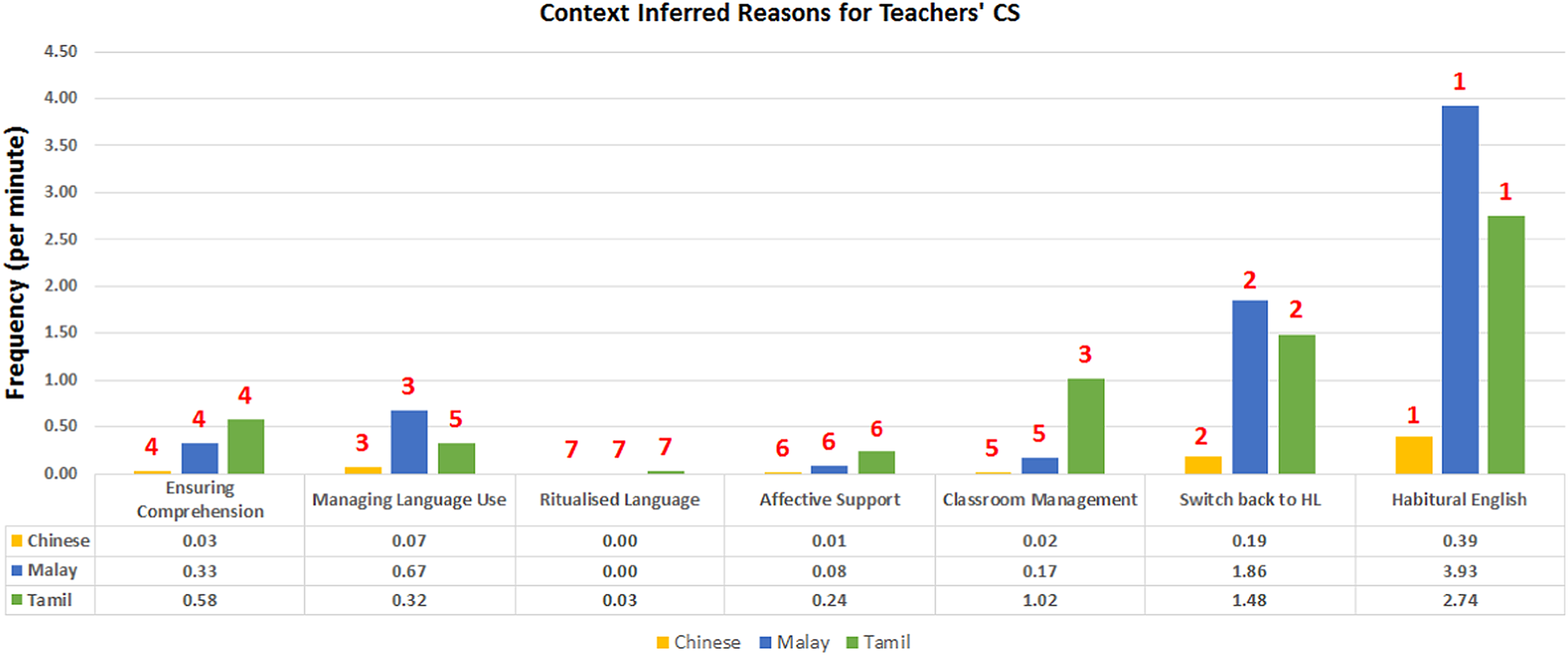
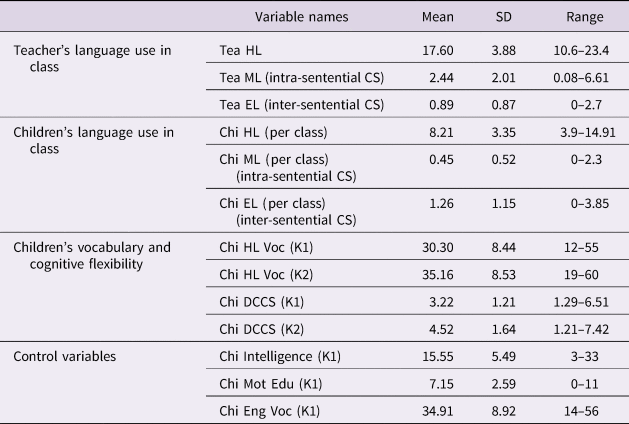
The descriptive statistics of the teachers’ language use and children's language use, outcomes, and background are summarized in Table 1. The potential context-inferred reasons for teacher's CS are displayed in Figure 1. Since the length of the observed sessions may influence teachers’ and children's frequency of CS, we have calculated the data by aggregating teachers’ language use as frequency of utterances per minute. For the children's data, it is calculated by obtaining the mean of the children's aggregated frequencies of utterances, from children within the same class. Paired-samples t-tests were conducted to compare teachers’ and children's frequencies of using different types of utterances, as well as to compare children's performances in vocabulary and cognitive flexibility at the first and second year of kindergarten.
The reasons for teacher's CS in HL classes. Ranked ordering of reasons appears above the bars.

Teachers’ language use and children's language use, outcomes, and background

Notes. Tea HL = teacher's utterances in heritage language per minute; Tea ML (intra-sentential CS) = teacher's utterances with mixed English and HL words per minute; Tea EL (inter-sentential CS) = teacher's utterances in English language per minute; Chi HL (per class) = children's utterances in heritage language per class per minute; Chi ML (per class) (intra-sentential CS) = children's utterances with mixed English and HL words per class per minute; Chi EL (per class) (inter-sentential CS) = children's utterances in English language per class per minute; Chi HL Voc = children's heritage language receptive vocabulary in the first and second year of kindergarten; Chi DCCS = children's cognitive flexibility in the first and second year of kindergarten; Chi Intelligence (K1) = children's non-verbal intelligence score in the first year of kindergarten; Chi Mot Edu (K1) = mother's highest degree level; Chi Eng Voc (K1) = children's English receptive vocabulary in the first year of kindergarten.
The results in Table 1 demonstrate that HL teachers have used HL-only utterances most frequently in class (M = 17.60, SD = 3.88), followed by intra-sentential CS utterances (M = 2.44, SD = 2.01) and inter-sentential CS utterances (M = 0.89, SD = 0.87). There were significant differences in the frequencies of teachers’ utterance types (i.e., Tea HL vs. Tea ML, t(19) = 13.78, p = .00; Tea ML vs. Tea EL, t(19) = 3.99, p = .00). In general, CS takes a small proportion of teacher's language use in HL class. Nevertheless, the variation among teachers in CS is substantial. Some teachers used intra-sentential CS only 0.08 times per minute, while others used as many as 6.61 times per minute. Children's language use pattern is similar to that of teachers. They have used substantially more HL-only utterances (M = 8.21, SD = 3.35) than inter-sentential CS utterances (M = 1.26, SD = 1.15) and intra-sentential CS utterances (M = 0.45, SD = 0.52). Compared to their teachers, they seem to prefer inter-sentential CS. The differences in the frequencies of using the three utterance types are significant for children as well (i.e., Chi HL vs. Chi EL, t(19) = 7.98, p = .00; Chi EL vs. Chi ML, t(19) = 2.87, p = .01).
Children's language and cognitive flexibility grew rapidly. Their HL receptive vocabulary increased significantly from the first year (M = 30.30, SD = 8.44) to the second year of kindergarten (M = 35.16, SD = 98.53), (t(123) = 7.79, p = .00), and so did their Dimensional Change scores from kindergarten 1 (M = 3.22, SD = 1.21) to kindergarten 2 (M = 4.52, SD = 1.64), (t(133) = 9.43, p = .00). Furthermore, children's English vocabulary size is significantly larger than their HL vocabulary at K1, indicating they were more English dominant in general (t(157) = 5.80, p = .00). The overall picture of children's vocabulary and cognitive flexibility demonstrates large individual variation.
The context-inferred reasons for teachers’ CS are shown in Figure 1. A striking similarity in the reasons for teacher's CS is seen across the Mandarin (Chinese), Malay, and Tamil classes. Although teachers’ actual use per minute in each HL classroom varied substantially, the rankings of the seven reasons are exactly the same for Mandarin and Malay teachers, which also largely overlap with that of Tamil teachers, with only two reasons in a different order. Habitual English use (including use of “ok”) and switching back to HLs were two major reasons for teachers to code-switch in HL classes. CS was seldom used for ensuring children's comprehension or providing affective support.
Teacher's CS and children's language output in class
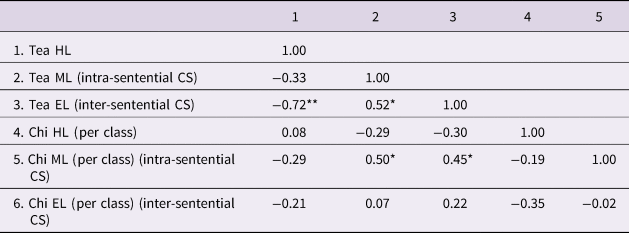
To address our first research question, we examined the relationship between teachers’ HL, intra-sentential CS, inter-sentential CS, and children's language output per class in the same three categories. Pearson correlations were computed to check the associations between the variables and the results are provided in Table 2. Teachers’ HL frequency per minute is significantly and negatively correlated to their own inter-sentential CS (r = –0.72, p = .00). The result indicates that, the more a teacher speaks in HL, the less she would speak English in class. Two types of teachers’ CS are significantly and moderately correlated: the more a teacher uses intra-sentential CS, the more she would also use inter-sentential CS (r = 0.52, p = .02).
Pearson correlations of the teachers’ and children's language use in HL class

Notes. Tea HL = teacher's utterances in heritage language per minute; Tea ML (intra-sentential CS) = teacher's utterances with mixed English and HL words per minute; Tea EL (inter-sentential CS) = teacher's utterances in English language per minute; Chi HL = children's utterances in heritage language per class per minute; Chi ML (intra-sentential CS) = children's utterances with mixed English and HL words per class per minute; Chi EL (inter-sentential CS) = children's utterances in English language per class per minute.
Greater teachers HL use did not elicit more child HL production. Teachers’ CS, on the other hand, may influence their students’ CS. Both teachers’ intra-sentential CS and inter-sentential CS frequencies were moderately and significantly correlated with children's intra-sentential CS frequency (r = 0.50, p = .05, and r = 0.45, p = .03). To sum up, teachers who code-switched more often gave less HL input to children per minute. Their CS was related to children's intra-sentential CS but not HL output frequency.
Teacher's CS and children's HL vocabulary and cognitive flexibility
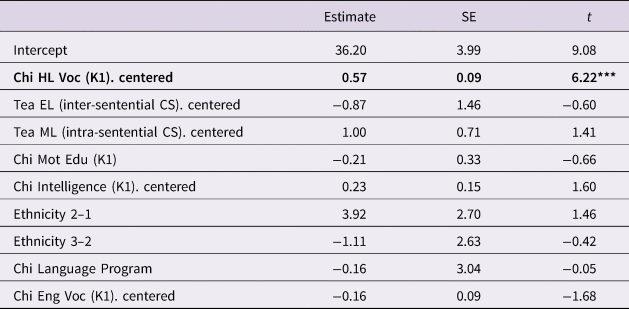
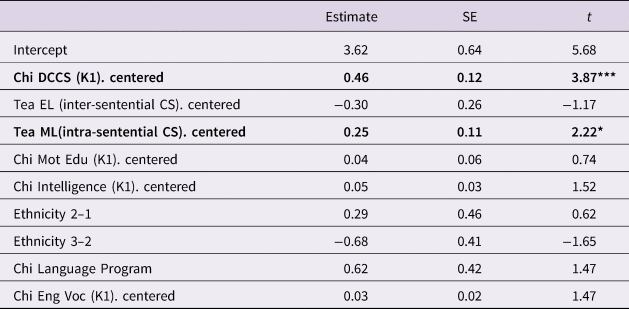
To address our second and third research questions, we examined the extent to which type(s) of teachers’ CS predicted children's development in HL vocabulary and switching flexibility. As shown in Table 2, teachers’ HL frequency and their inter-sentential CS frequency are highly correlated (r = −0.72), therefore we excluded one of the two variables from the mixed effects model in order to avoid multicollinearity issues. As our focus is the impact of teacher's CS on children's HL vocabulary and cognitive flexibility, we maintained teachers’ inter-sentential CS in the mixed effects models. The results for the fixed-effect factors are presented in Table 3 and Table 4. The dependent variables in our two models were children's HL vocabulary and cognitive flexibility in the second year of kindergarten. The independent variables included teacher's language use (i.e., inter-sentential CS and intra-sentential CS), mother's educational level, children's non-verbal intelligence, the categorical variable for ethnic language group (Malay group as the reference level), program type (i.e., HL-as-a-subject program vs. bilingual program), and children's English vocabulary, along with children's HL vocabulary or cognitive flexibility score in the first year of kindergarten.
Fixed part of the model for children's HL receptive vocabulary at K2

Notes. Chi HL Voc = children's receptive vocabulary in heritage language at kindergarten 1; Tea EL (inter-sentential CS) = teacher's utterances in English language per minute; Tea ML (intra-sentential CS) = teacher's utterances with mixed English and HL words per minute; Chi Mot Edu (K1) = mother's highest degree level; Chi Intelligence (K1) = children's non-verbal intelligence score in the first year of kindergarten; Ethnicity 2–1 = Malay vs. Chinese; Ethnicity 3–2 = Indian vs. Malay; Chi Language Program = whether the child is in a bilingual or monolingual program; Chi Eng Voc (K1) = children's English receptive vocabulary in the first year of kindergarten. ***p < .001.
Fixed part of the model for children's cognitive flexibility at K2

Notes. Chi DCCS = children's cognitive flexibility score; Tea EL (inter-sentential CS) = teacher's utterances in English language per minute; Tea ML (intra-sentential CS) = teacher's utterances with mixed English and HL words per minute; Chi Mot Edu (K1) = mother's highest degree level; Chi Intelligence (K1) = children's non-verbal intelligence score in the first year of kindergarten; Ethnicity 2–1 = Malay vs. Chinese; Ethnicity 3–2 = Indian vs. Malay; Chi Language Program = whether the child is in a bilingual or monolingual program; Chi Eng Voc (K1) = children's English receptive vocabulary in the first year of kindergarten. *p < .05, ***p < .001.
Table 3 summarizes the results of the second research question. The whole model explained 41.31% of the variance of children's HL receptive vocabulary score at K2, out of which 37.15% was attributable to the fixed-effects only. Children's receptive vocabulary score at kindergarten 1 was positively and significantly associated with children's receptive vocabulary score at kindergarten 2. Neither teacher's inter-sentential CS frequency nor teacher's intra-sentential CS frequency was found to be significantly related to children's receptive vocabulary development in their HL, which is in line with the non-significant results of the previous studies (David & Wei, Reference David and Wei2008; Place & Hoff, Reference Place and Hoff2011).
Table 4 shows the predictors of children's cognitive flexibility. The whole model explained 32.48% of the variance of children's cognitive flexibility at K2, out of which 31.34% was attributable to the fixed-effects only. Teachers’ use of intra-sentential CS was found to positively and significantly (p = .03) influence children's cognitive flexibility development, while the relation between teacher's inter-sentential CS and children's cognitive flexibility is non-significant. Children's cognitive flexibility at K1 was positively and significantly related to children's cognitive flexibility at K2.
Discussion
The current study examined the impact of teacher's CS on children's language behaviour, HL vocabulary, and switching flexibility. Previous studies have shown that the frequency and the type of CS may influence learners’ language behaviour and executive processes. However, it remained unclear whether such insights obtained from older language learners in the school setting or young children in the home setting are applicable for children as young as four to five years old at preschool. Examining the associations between HL teachers’ CS and the children's language and cognitive growth allowed us to verify the existing findings and explore the specific effects underlying teachers’ CS.
Teachers’ CS and children's language output in class
Our finding is in line with the Modeling Hypothesis that bilingual children are sensitive to the statistical properties of their input and are able to extract the language feature and adjust their own CS frequency according to their interlocutor's CS use (Comeau et al., Reference Comeau, Genesee and Lapaquette2003). The results extend our understanding of bilingual children's CS output from an experimental setting to an early HL instructional setting. It is worth noting that type-wise (inter-sentential CS vs. intra-sentential CS), we were unable to identify the corresponding associations between teachers’ CS and children's CS. Both teachers’ inter-sentential and intra-sentential CS were only significantly correlated to children's intra-sentential CS. The explicit illustration of the ‘asymmetric pattern’ of the CS type association is beyond the scope of the current study, as we have not analyzed teachers’ and children's CS turn by turn. Nevertheless, such a finding confirms the insight of previous studies that teachers’ CS may have specific pedagogical value for children who are at the initial stage of their second or foreign language learning (e.g., Gort & Sembiante, Reference Gort and Sembiante2015; Lin, Reference Lin2012).
In the current study, when teachers code-switched (either within or across the utterance), children were capable to mix their HL and English in their utterances, so as to negotiate meaning and try to communicate in HL classrooms with the help of their dominant language. It implies that teacher's CS input has the potential to be an effective instructional support for encouraging increased HL use, at least at the mixed language level. In other words, teachers’ CS did not result in greater English-only utterances by children, but instead increased children's own output with CS. With children's output, teachers are able to provide feedback to further scaffold their HL development (Swain, Reference Swain, Cook and Seidlhofer1995; Walsh, Reference Walsh2002). In the current study, teachers’ HL use varied substantially in frequency, and we could not find a significant relationship between their HL-only utterances and children's HL utterances, implying that to ‘fill in’ the HL class with HL-only utterances may not necessarily lead to more HL output from children.
Teachers’ CS and children's vocabulary development
The long-term effect of teachers’ CS on children's HL vocabulary development seems to be less promising. Neither inter-sentential CS nor intra-sentential CS are found to significantly associate with children's HL vocabulary performance in the second year of kindergarten. The results are in line with the non-significant findings of David and Wei (Reference David and Wei2008) and Place and Hoff (Reference Place and Hoff2011), and fail to lend support to either the negative association found by Byers-Heinlein (Reference Byers-Heinlein2013) or the positive relation found by Bail and colleagues (Reference Bail, Morini and Newman2015). These results seem to deviate from the arguments advocating for the benefits of teachers’ CS on children's language development (e.g., Lee & Macaro, Reference Lee and Macaro2013). However, it would be inadequate to conclude on this topic without considering the context within which teachers code-switched. In the current study, teachers were assumed to predominantly code-switch due to habitual reason, rather than out of instructional concerns (e.g., to ensure comprehension or to provide affect support). The prevalent use of ‘habitual English’ leaves us to wonder whether children's vocabulary learning would have been more positively affected by contingent and instructional CS catering to children's language learning needs (Celik, Reference Celik2003; Enama, Reference Enama2016).
These findings lend support to the view that teacher's CS should not be random or spontaneous, but rather be used carefully and purposefully (e.g., Garcia, Reference García2009). Based on this view, it has been argued that, if teachers code-switched without an explicit instructional purpose, children's language learning might be affected (Corcoll, Reference Corcoll2013). Our current findings suggest that teacher's CS might not be useful for children's language development unless it is used carefully, strategically, and deliberately as an instructional approach. Future studies may examine how the quality and type of teacher CS can affect children's linguistic development especially in instructional contexts, to provide empirical evidence to the advocated translanguaging approach.
Teacher's CS and children's development in cognitive flexibility
Our result, which demonstrates that children's cumulative exposure to CS in class is positively and significantly related to their non-verbal cognitive flexibility over time, supports recent evidence showing cognitive gains for children enrolled in bilingual immersion programs. In longitudinal studies conducted by Nicolay and Poncelet (Reference Nicolay and Poncelet2013, Reference Nicolay and Poncelet2015), eight-year-old bilingual children demonstrated significant advantages in non-verbal executive control processes after three years of education in bilingual immersion programs, as compared to their monolingual peers. Findings from these studies were seminal in demonstrating that children's prolonged exposure to a bilingual education could be considered as a form of cognitive training for their non-verbal executive control skills, due to the need to constantly monitor and switch between the two languages. Along with the evidence from this study, it appears that children's naturalistic exposure to CS through educational means could be associated with significant gains in executive control over time.
Interestingly, our results found that teacher's intra-sentential CS, but not inter-sentential CS, was significantly and positively related to children's cognitive flexibility in the second year of kindergarten. This is in contrast to our initial hypothesis, which was predicted based on the Adaptive Control Hypothesis (Green & Abutalebi, Reference Green and Abutalebi2013). According to this theoretical framework, it is proposed that bilinguals who have higher engagement of inter-sentential CS should demonstrate more cognitive control proficiency due to the high level of linguistic control that is demanded and necessitated in this context. Comparatively, lesser linguistic and cognitive control are implicated in the intra-sentential CS context due to the opportunistic manner in which both languages are used, and engagement in such a context might not be associated with the same degree of cognitive control proficiency. Green and Abutalebi defined intra-sentential CS as “speakers routinely interweave their languages in the course of a single utterance” (Reference Green and Abutalebi2013, p. 518). When examining this definition, it leaves us to wonder whether the ‘routine’ use of CS might be similarly applied to young bilingual children in the present case, who are at the early stages of bilingual acquisition and who have lesser experiences and proficiencies in using both languages. Our findings can be understood based on the Processing Rich Information from Multidimensional Interactive Representations (PRIMIR) developmental framework for linguistic processing (Curtin, Byers-Heinlein, & Werker, Reference Curtin, Byers-Heinlein and Werker2011). According to this framework, young children have to actively calculate the linguistic properties and be sensitive to the pragmatic use of linguistic registers during language processing. As such, exposure to teachers’ intra-sentential CS might be more demanding than inter-sentential CS as bilingual children need to monitor the linguistic input, separate the codes that belong to different languages, and switch between them constantly. This mixing of linguistic codes could disturb the rhythms and patterns within utterances, making language processing challenging. The implied higher cognitive load may explain why intra-sentential CS is significantly and positively related to children's development in cognitive flexibility in our case.
While it is worth noting that our results showed a positive association of teacher's CS with children's non-verbal cognitive flexibility, which is one of the three types of executive control (Miyake et al., Reference Miyake, Friedman, Emerson, Witzki, Howerter and Wager2000), the examination of other types of executive control, such as inhibition, may lead to a different result. For instance, Kang and Lust (Reference Kang and Lust2019) found that advantages in bilingual children's verbal aspect of executive control are not attributable to their CS behavior but rather to their bilingual language proficiency instead. Future directions in this field should consider examining the association between early exposure to different types of CS in the instructional context with young bilingual children's development of executive control processes.
Limitations and implications
The current study has several limitations. First, although we considered an ecologically valid variable of classroom talk, causal relationships cannot be derived from the results due to the correlational nature of the data. Future studies might consider adopting an experimental design with a larger sample size to verify teachers’ and children's CS frequency and CS type in different types of HL programs. In addition, classroom discourse was recorded from a teacher's microphone, and without the ability to record each child's CS individually one cannot specify the influence of CS behavior on individual learners. A second limitation of the current study is the limited recordings of the teachers within a singular context of HL instruction, such that our transcription may not holistically reflect teachers’ language behaviors across the academic year. Researchers may consider conducting multiple observations over time with the same teacher, to capture the potential modification of CS behavior as children gain language proficiency. Finally and importantly, the current study only includes receptive vocabulary as a measure of children's HL proficiency. Future studies might assess children's language and literacy skills in different domains (e.g., phonology and syntax), in order to holistically reveal the impact of the teachers’ CS on children's early development. Despite these limitations, our study highlights how naturalistic linguistic environments can impose cognitive demands that influence language usage as well as general cognitive processing. It sheds light on the language–cognition interface, and is theoretically significant in providing initial validation of related frameworks (e.g., the Modeling Hypothesis) that aim to address how the linguistic environment and exposure to it can shape language skills and cognitive development. It also indicates the complex nature and influence of teachers’ CS as a classroom practice. If used purposefully, CS has the potential to contribute to children's language and cognitive development. However, if used randomly, it may take away from the time that the teacher speaks in HL, which could adversely affect children's vocabulary learning. From our findings, it is observed that children's productive language is modeled after teachers’ CS patterns. Thus, teachers should be aware of their CS behavior and monitor their own language use carefully.
Conclusion
The current study addressed the relationship between teachers’ CS in HL class and preschoolers’ language output, HL vocabulary development, and cognitive flexibility. While the use of CS as an instructional approach has been widely debated internationally, findings from this study weigh in on this debate. The current findings imply that teachers’ CS may affect children's frequency of intra-sentential CS as suggested by the Modeling Hypothesis. However, teacher's CS was not found to be associated with children's development in HL vocabulary over one academic year. It might be due to teachers’ purposes of using CS, as many of them are found to use CS habitually and without instructional intentions. Our study also revealed that the typology of CS, intra-sentential CS in particular, is positively and significantly related to the development of children's executive control. Classroom environments with such CS require children to process and switch within different languages, hence strengthening their cognitive control network. Collectively, these findings imply that the reasons for CS might need closer examination, as children's exposure to CS may affect their linguistic skills and cognitive development.
Acknowledgments
This work was supported by the National Institute of Education [OER 09/14 RB; SUG 12/16 SH]. The authors would also like to thank the research assistants of the Singapore Kindergarten Impact Project for data collection.
Appendix
Coding scheme of teachers’ and children's CS