Introduction
Welfare rights are the ‘promised land’ of the welfare state (Ben-Arieh and Gal, Reference Ben-Arieh and Gal2001), the cornerstone of its grand vision of combating disease, idleness, ignorance, and squalor (Dean, Reference Dean2015). They are meaningful, however, only as far as they are taken up (Weiss-Gal and Gal, Reference Weiss-Gal and Gal2009). Over the last decades, social policy researchers have dwelled on the issue of non-take-up of social benefits and services, providing us with rich empirical evidence to the prevalence of non-take-up, particularly of means-tested benefits and services (Finn and Goodship, Reference Finn and Goodship2014; Van Mechelen and Janssens, Reference Van Mechelen and Janssens2017). Moreover, social policy scholars have developed sophisticated multi-level theoretical models of the factors affecting non-take-up at the client, administration, and benefit scheme levels (van Oorschot, Reference van Oorschot1991; Reference van Oorschot, Ben-Arieh and Gal2001).
The present article contributes to this literature by shedding direct light on the role of take-up agents, a term used here to define professionals or semi-professionals who actively help clients realise their rights as a central part of their organisational mission. Take-up agents, such as welfare rights advisers, clearly play a central role in the process of realising welfare rights (see, e.g. Dean etal., Reference Dean, Goodlad and Rosengard2000; Bateman, Reference Bateman2006; Wiggan and Talbot, Reference Wiggan and Talbot2006; Gibbons and Foster, Reference Gibbons and Foster2014). However, scholarly work on take-up rarely examines their work in detail. This literature either treats these actors indirectly (van Oorschot, Reference van Oorschot, Ben-Arieh and Gal2001) or focuses on their impact (see Wiggan and Talbot, Reference Wiggan and Talbot2006). The few studies that do focus on the practices of take-up agents are mostly limited to the voluntary sector (for notable exceptions see Dean etal., Reference Dean, Goodlad and Rosengard2000; Ratzmann, Reference Ratzmann2019).
In light of this gap, the current article models the role of take-up agents in the process of realising their clients’ welfare rights. Assuming a multi-level perspective of non-take-up (van Oorschot, Reference van Oorschot, Ben-Arieh and Gal2001), our starting point is that these agents constitute another key player which influences the claiming process and the non-take-up phenomenon. Relying on semi-structured interviews with twenty-five take-up agents from the public, business, and non-profit sectors in Israel, we systematically analyse the tools and strategies they use. Our findings show that to achieve their goals, take-up agents use one or more of these keys: knowledge, networking, emotions, and power.
The contribution of this article is three-fold. Firstly, it examines the role of take-up agents and systematically models what they actually do and the strategies they follow. This examination attracts attention to other actors than policymakers, administrators, and clients and unfolds the logic of a major, yet currently still underexplored, actor in the take-up process. In particular, it demonstrates that take-up agent interacts and affects both the clients and administrators’ behaviours. Secondly, the article applies the perspective of this central actor to the understanding of the take-up process. Due to their institutional role, located between the administration and the clients, take-up agents not only provide a unique perspective on barriers to take-up, but also shed light on the ways these barriers are negotiated. In doing so, they bring to the fore the informal and relational aspects of the take-up process. Lastly, our explorative examination invites discussion on the proper role of such intermediary services in the take-up process, as well as the responsibility of welfare states in funding and regulating them. All of these can serve social policy scholars, policy makers, and professionals to better design and implement take-up-related policies.
Theoretical framework
Non-take-up of welfare rights occurs when people legally entitled to welfare benefits and services do not receive them in full (van Oorschot, Reference van Oorschot, Ben-Arieh and Gal2001; Weiss-Gal and Gal, Reference Weiss-Gal and Gal2009). Empirical studies indicate that non-take-up represents a significant social problem, particularly with targeted selective programs. Beyond attempts to estimate its scope, recent years have seen efforts to study and model the factors leading to non-take-up, leading to the understanding that it is a complex process linked to a broad range of interacting barriers (van Oorschot, Reference van Oorschot, Ben-Arieh and Gal2001; Finn and Goodship, Reference Finn and Goodship2014; Van Mechelen and Janssens, Reference Van Mechelen and Janssens2017).
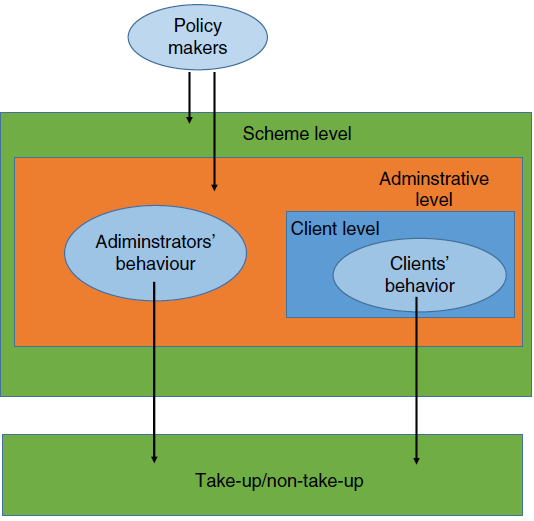
Following seminal work by van Oorschot (Reference van Oorschot1991; Reference van Oorschot, Ben-Arieh and Gal2001), social policy researchers (e.g. Van Mechelen and Janssens, Reference Van Mechelen and Janssens2017) have highlighted three, interrelated levels of take-up barriers: (1) the scheme level, which constitutes the playing field on which both claimants and officials operate in order to successfully complete the take-up process; barriers associated with this level are, for example, means-tested programmes, involving complex and ambiguous rules; (2) the administrative level, which refers to programme implementation; administrative barriers include, poor communication with clients and treatment experienced as demeaning; and (3) the client level, which refers to the cognitive, psychological and social capacities with which claimants approach the process; client-level barriers include lack of reliable information about entitlement and the processes required to exercise it, and lack of social networks. Importantly, according to van Oorschot (Reference van Oorschot, Ben-Arieh and Gal2001), full explanation of non-take-up requires us to take into account barriers operating on all these levels, as well as the interrelated behaviours of three players – policy makers, administrators and clients – that both shape and are shaped by the broader context of the three levels (see Figure 1).
Multi-level model of take-up barriers.
Source: Van Oorschot, Reference van Oorschot, Ben-Arieh and Gal2001: 247.

This multi-level model of take-up barriers has enriched the understanding of non-take-up and the multiple, interrelated ways to reduce it. However, one key player that has often been omitted from such models is take-up agents –professionals or semi-professionals who, as part of their organisational mission actively assist claimants to take up their rights. Located outside the benefit-granting agencies, these third parties, working in the public, private, or voluntary sector act as intermediaries between clients and administrators and provide independent welfare rights advice and support (Finn and Goodship, Reference Finn and Goodship2014). These agents are another important player, alongside policy makers, administrators and clients, who can influence the chances of successfully completing the take-up process.
Despite their key role, so far the work of take-up agents has received relatively little theoretical and empirical attention, with most social policy studies treating them indirectly, as incidental to the client, administration, and scheme levels, or as triggers for claiming (van Oorschot, Reference van Oorschot1991; Reference van Oorschot, Ben-Arieh and Gal2001). Moreover, their work has been often lumped with unprofessional and occasional forms of take-up assistance (e.g. by family, friends and neighbours; Buck and Smith, Reference Buck and Smith2015).
The scant literature that deals directly with take-up agents tends to focus on their impact. Conducted mainly in the UK and US and mostly with reference to healthcare, these studies suggest that agents represent an additional level that affects take-up by helping clients overcome barriers, thereby leading to higher take-up rates (Wilson and Amir, Reference Wilson and Amir2008); financial gains (Adams etal., Reference Adams, White, Moffatt, Howel and Mackintosh2006); and even improvement in health, psychological and other quality of life and social inclusion dimensions (Greasley and Small, Reference Greasley and Small2005; Moffatt and Scambler, Reference Moffatt and Scambler2008; Allmark etal., Reference Allmark, Baxter, Goyder, Guillaume and Crofton-Martin2013). The gains from these take-up services are particularly high when marginalised groups are involved (Wiggan and Talbot, Reference Wiggan and Talbot2006; Moffatt and Mackintosh, Reference Moffatt and Mackintosh2009).
These evaluative studies demonstrate that take-up agents have a key role in the claiming process. What do we know, however, about the way they operate? Hitherto, social policy scholarship has not delved into this question (although see Dean etal., Reference Dean, Goodlad and Rosengard2000; Ratzmann, Reference Ratzmann2019). Partial answers come from related disciplines, including social work scholarship on case advocacy, which shows us that although limited in extent, social workers’ take-up practices are diverse. They include informing clients of their rights, coaching them to self-learn their rights, representing them in committees, and helping them with filling out forms (Bateman, Reference Bateman2006; Weiss-Gal and Gal, Reference Weiss-Gal and Gal2009).
The work of take-up agents can be also inferred from the socio-legal literature on the role of legal agents and its effects on legal proceedings. Most of this research is focused on court proceeding, not on administrative take-up. An important exception, however, is the study of lawyers and paralegals in non-profit legal centres. Recent UK studies on legal advice agencies in the voluntary sector demonstrate the complex and dynamic role of these agents and the way they work ‘in the borderlands of law’ (McDermont and Kirk, Reference McDermont and Kirk2017) to creatively translate complex and technical legal issues into manageable ones (McDermont, Reference McDermont2013; Farr and Cressey, Reference Farr and Cressey2019). McDermont (Reference McDermont2013) and McDermont and Kirk (Reference McDermont and Kirk2017) refer to such creative practices as ‘acts of translation’ and stress that they not only enable individual citizens to take up their rights, but also enable agencies to do policy work by turning individual cases into matters of public concern (McDermont, Reference McDermont2013; Forbess and James, Reference Forbess and James2014).
In sum, although the existing social policy and socio-legal literature show that take-up agents can play a key role in the claiming process, so far, they tell us relatively little on what take-up agents do in practice, and this knowledge is mostly limited to the voluntary sector. To fill this gap, this study builds on the existing theoretical knowledge and takes a step forward in systematically studying the work of take-up agents in voluntary, market and public settings. This is done by adopting a qualitative approach for charting how take-up agents perceive their role and the tools and strategies they use vis-à-vis clients and administrators in the context of the Israeli social security system.
The case: Israeli take-up agents
In Israel, social security benefits are granted mostly through the National Insurance Institute (NII). Although originally founded on the universal Beveridgean model and inspired by social-democratic thinking, in recent years the Israeli social security system has moved towards a more (neo-)liberal, targeted model. This is evident in particular in the low level of social spending relative to other OECD welfare states, as well as in poorer performance in tackling poverty and inequality (Gal, Reference Gal and Aspalter2017).
The Israeli take-up agents’ arena, particularly in the domains of social security, has changed considerably over the last decades. In Israel’s first decades, based on the British model of Citizens Advice Bureau, take-up agents included mainly publicly funded general advice services at the municipal level (Finzi etal., Reference Finzi, Bronstein, Bar-Ilan, Baruchson-Arbib, Rafaeli and Ravid2012) alongside relatively few private sector lawyers who specialised in social security, mainly in the realm of workers’ disability. However, in recent decades, this arena has grown significantly and has become more diverse and controversial.
According to Levy (Reference Levy2014), it is made up of three types of actors. First, voluntary take-up organisations, who are based on semi-professionals working alongside professionals, mainly lawyers or social workers. The organisations help citizens realise welfare rights in a wide range of social domains, particularly in the realms of disability and poverty. In the social security domain, these organisations deal with both social insurance and social assistance schemes, although latter is more at the core of their activity. Second, for-profit take-up firms, who have recently become a dominant actor in the disability benefits field, where potential profit is relatively high. Sixteen medical rights companies are currently operating in this market. Another key for-profit type of agent are private lawyers, the only professionals allowed to physically accompany claimants in medical committees and represent them in appeals. The third and largest type are state-funded take-up agencies that are mostly under the supervision of the Ministry of Labour, Social Affairs, and Social Services and are operated by local welfare departments or municipalities. These agencies, similarly to the voluntary ones, touch upon a wide range of social domains, with particular attention given to schemes targeting people living in poverty. In addition, the NII has recently contracted with two firms to provide take-up advice and support services.
Methodology
The data for this article are drawn from semi-structured interviews with twenty-five take-up agents conducted from 2017-18. Participants were collected through purposive sampling techniques, while efforts were made to cover the organisational and professional diversity both between and within sectors. Four of the interviewee were with the voluntary sector, eight were with for-profit agents, and thirteen were with state-funded agencies (five with local welfare agents, four with municipal rights centre agents, and four with NII contractor agents). Seventeen interviewees were with females and eight with males. Ten were social workers, seven were lawyers, one was a physician, and the remaining seven were academics. At the agents’ request, six of the interviews were group interviews involving two or three participants.
All interviews were based on an interview manual that included topics and questions written by the authors and validated by two other researchers. The interviews were focused on cash benefits targeted at people living in poverty (such as social and housing assistance) and disability-related schemes, all of which have some significant discretionary elements. The topics and questions were initially driven by the existing theoretical literature, and modified and adapted after a pre-test of the first three interviews. They included the perceived role of the agents, barriers in the take-up processes, practices applied to overcome these barriers, and the agents’ relations with clients, administrators and other actors. During the interviews, the participants were encouraged to reflect on their take-up activities, while follow-up questions were used to focus the discussion around these specific topics. Each interview was recorded, transcribed, and anonymised. The researchers ensured informed consent and obtained ethical approval from their university ethics committee.
The interview transcripts were analysed thematically (Braun and Clarke, Reference Braun and Clarke2006). This involved careful reading of each transcript while identifying initial thoughts and meaningful statements; breaking each transcript down into units of meaning; coding these units; and clustering similarly coded statements by themes. This iterative process was accompanied by ongoing reflective discussion between the authors with the aim of fine-tuning the thematic map.
Interviews and analyses were conducted in Hebrew while quotes were translated into English at the writing stage. In order to ensure accuracy, the authors double-checked the translation. Lastly, to establish trustworthiness (Morse, Reference Morse2015; Nowell etal., Reference Nowell, Norris, White and Moules2017), audit trail and peer debriefing strategies were applied and rich quotations from participants’ accounts were provided.
The four keys to welfare rights
The interviews demonstrate that take-up agents use a variety of strategies and tools in their interaction with both their clients and the administration. In particular, the narratives of our participants suggest four keys that they use in their day-to-day practice: knowledge, networking, emotions, and power.
The knowledge key
The first and somewhat evident strategy take-up agents follow involves using unique knowledge for taking-up rights. In most cases, agents use not only formal knowledge about the eligibility rules, but rather covert and tacit knowledge of the type that requires practical experience and intimate acquaintance with the welfare system. This knowledge includes, for example, internal guidelines for decision makers on how to determine the acceptability of documents or detailed criteria for determining a specific disability.
Often, agents view their mastery of knowledge, especially of the covert and tacit type, as their chief relative advantage over ‘ordinary’ clients and other players. Such covert and tacit knowledge can be particularly important in ‘difficult’ cases, which do not clearly fall into existing legal categories of eligibility. Such cases require higher levels of professional knowledge to persuade the authorities to rely on analogies to prior administrative or judicial cases in order to establish an interpretation of the rules that favours their clients.
Such unique knowledge is manifested, for example, in the context of demonstrating disability in the medical committee, which is a key determinant of eligibility for disability benefits and is considered a complex area combining legal-bureaucratic and medical knowledge. Take-up agents active in this area – mainly private firms and lawyers – explain that ordinary people usually do not understand how to handle themselves in these committees. They tend to emphasise their pain, for example, although this aspect is meaningless for the committee’s decision. Accordingly, the agents provide clients with knowledge on how to talk less about pain and more about functioning:
Ordinary people go to the National Insurance and say, if they are not represented by XXX, for example, ‘My shoulder hurts, I can’t do anything at home, I have to sleep on this side at night’ […]. OK, but this gives them no disability percentages, because there are no disability rates for pain or for fatigue or for being unable to help your wife around the house. Disability percentages are given for movement constraints. And our doctor knows and our experts know… and they coach the client before the committee…
Some of the agents emphasised that the knowledge on take-up is separate and distinct from other professional areas. One of the participants from the medical rights firms stressed that not only ‘ordinary’ clients but also ‘ordinary’ professionals, such as lawyers and doctors, would not be able to deal with the take-up process because they lack that unique knowledge on how exactly take up work. Moreover, the use of such covert and tacit knowledge lead agents to develop internal training processes reminiscent of the apprenticeship model. Thus, in addition to the theoretical study of entitlement conditions (including their covert aspects), a key element in the training of new employees is gaining practical experience, supported by ongoing updates on rights and the systems that grant them.
However, while all take-up agents rely heavily on unique knowledge, there are considerable differences among them in the way this knowledge is perceived, accumulated, and implemented. For example, some agents, particularly in the market setting, view their knowledge as a product they are ‘selling’, or as of one for-profit firm manager explained, ‘it’s like giving away the KFC recipe’. Conversely, other agents see their role as making this knowledge as accessible as possible by disseminating information to clients or to the community. For instance, one of the interviewees told us about their campaign of pressuring the administration to make their internal rules and procedures available on their websites.
The networking key
Another key that agents use in their daily practices is networking. Sometimes networking is based (at least initially) on the personal networks of workers and volunteers, but in most cases take-up organisations strive proactively to create and cultivate institutional and sustainable networking with benefit-granting agencies.
Often, the personal and organisational contact with the agency is required in order to overcome relatively simple bureaucratic hurdles. In these cases, the fact that the agency enables a communication channel with the agent substitutes for the lack of such a channel with the client. A lawyer in one of the advocacy organisations describes this as follows: ‘The first thing agents do is get the mobile phone number of people in National Insurance who are key players there. I think one of the greatest advantages I have achieved as a person who is not one of the clients is that I had someone to talk to in National Insurance’. In simple cases, the communication channel provides detailed and reliable information about the clients and their standing with the agency, which they cannot always obtain by themselves.
Networking is particularly helpful in complex cases that do not clearly match legal provisions, where administrators have extensive latitude. In these cases, informal contact with the agency helps agents understand how administrators interpret the case’s factual and legal basis, provide them with more detailed information about the client, point to the case’s uniqueness, and suggest that it meets the entitlement conditions. In doing so, agents also situate clients in their broader social context. As a lawyer in an advocacy organisation said, ‘The lives of people in poverty are extremely complex. They cannot be reduced to this or that form… And nobody has the resources to discuss all these complexities’.
Among the participants, the use of networking was much more prominent in interviews with agents from the public and third sectors. Some even saw their access to the bureaucracy as their relative advantage over the for-profit agents. Crucially, however, these non-market take-up agents differed themselves in the way they perceived the appropriateness of using networking. For some, this key was perceived as levelling the playing field for more marginalised clients with lower social capital. Conversely, other non-market agents were ideologically opposed to developing networking at the organisational level, arguing that such structure vests the power in the organisation rather than in the clients, and that it undermines the bigger mission of systemically reforming the administration in order to make it accessible to all, with no need for intermediaries.
The emotional key
Alongside knowledge and networking, the take-up agents we interviewed saw their work as including also a significant emotional component – both with their clients and with the administration. On the client level, the emotional key relates to the agents’ role in both persuading the clients to start the claiming process and keeping them engaged in it, despite their stress, fear, and despair. The emotional work with clients also includes restraint and channelling of anger and aggressive behaviours, believing that such behaviour might antagonise the administrators and side-track the take-up process. To avoid that, the agents try to explain the bureaucratic process to their clients and help them frame their arguments in accordance with its logic, as described by a municipal rights centre employee:
Clients often feel dissatisfaction [but] find it very difficult to express it coherently. And it comes out like a string of swearwords… But if you sit down to talk to them they have very substantial arguments that are highly meaningful for their life, for community life. And it’s really about taking their arguments and helping them analyse them in a way that policymakers in the municipality or whoever… to help them be heard, really.
As part of their emotional work, agents also instruct their clients on how to behave and what exactly to say to administrators. This is how a medical rights take-up lawyer described it:
Some people arrive all charged up, hating the committee doctor, which does nobody any good…. Preparation means ‘give him the respect he deserves’, ‘cooperate’, ‘be verbal’…. And sometimes I realize that my client will never understand some of the things, no matter how much I explain. And in these cases, we try to take over the committee and be those who push the client aside for a moment and explain everything.
On the administration side, the agents recognise that administrators’ emotions towards their clients also play an important role in the take-up process. Therefore, they try to portray their clients as morally ‘deserving’ recipients, for example by stressing their responsible behaviour and lack of control over their situation, or by stressing their needs and helplessness, thereby evoking a sense of compassion toward their clients.
For some agents, this is especially important with low-status citizens such as non-Jews (mainly Israeli-Palestinians), people living in poverty, etc. In portraying their clients as ‘deserving’ recipients, the agents believe that they ‘relegate’ the authorities’ trust towards them and convert it into trust in their clients. Note that a key aspect of the entitlement process is a game of trust, with the authorities constantly fearing deceit. In such an emotional context, agents (mainly from the public and third sectors) are often trusted by authorities, and this trust is assumed by the agents to extend to their clients. Such extension of trust can be decisive in complex cases, where officials have extensive discretion. According to an advocacy lawyer, the officials ‘perceive themselves as wanting to serve those who deserve it, those whose misfortune is not their fault. They therefore trust us to do the filtering. They trust the XXX NGO… and at some point they also get to know us, and they see what cases we submit to them…’
Here again, we identify some controversies among agents with regard to playing the emotional or vulnerability card. Some agents oppose it ideologically, arguing that social benefits and services are a matter of entitlement rather than charity, and therefore the take-up process should be based on argument of universal rights. Other interviewees based their opposition on the claim that such arguments are simply not effective in a bureaucratic setting. Still many others saw the emotional key as not only ethical but also effective, since the bureaucratic system, eventually, is operated by humans and not machines. These agents believe they should use whatever effective tools they have to help their clients take up their rights.
The power key
The fourth key take-up agents commonly use is power. According to our agents’ accounts, their help in the take-up process involves not only the use of knowledge, networking and emotional work, but also the use of power vis-à-vis state agencies, usually in an indirect, non-threatening way. Such use compensates for the relatively low power of clients in their encounters with administrators.
One relatively benign way of applying pressure on the agency is communicating the message that the client is not alone but has ‘backing’. This message can be delivered by accompanying the clients in meetings with the authorities, or more subtly by signing letters and submitting claims on the client’s behalf. For instance, according to a municipal rights centre director, ‘when we needed to show that there’s a certificate here [and not just something the client wrote], we placed our own signature [to prove] that the man was here, consulted an expert or a lawyer’. According to the agents, this communicates to the officials that the client is advised by an experienced and knowledgeable player, who will make sure that the client will not give up before taking up all his or her rights.
Another way of pressuring officials, used mainly by civil society agents, is recruiting media organisations or politicians. This is aimed at communicating to the authority that the client is not only backed by a skilled player, but that the eyes of the public and policymakers are on him or her. Agents use this form of leverage both on the local scale (with municipal officials, for example) and on the national scale (such as parliamentary lobbying and publishing newspaper articles).
Similarly, agents make use of legal procedures to pressure authorities. This tool is applied mainly by organisations with well-developed legal departments, such as advocacy organisations and lawyer firms, who frequently submit appeals to administrative tribunals and courts, and sometimes even to the Supreme Court. For example, after a housing authority did not treat an advocacy organisation seriously, the organisation strategically filed a series of lawsuits. According to the agent, this led the authority to treat its claims seriously, obviating the need for litigation.
These forms of power pressure were summed up by an advocacy lawyer as giving the authority a ‘headache’: ‘I believe the courts may be included in the larger ‘headache’ category. The headache includes the media, the courts, and parliamentary committees’.
Discussion
This study set out to examine what take-up agents actually do. Our findings reveal that in order to bring their clients into the ‘promised land’ of the welfare state (Ben-Arieh and Gal, Reference Ben-Arieh and Gal2001), all take-up agents — irrespective of organisational or professional settings — wield four main keys: knowledge, networking, emotions and power. All shape the behaviours of both clients and administrators. In contrast to their clients who are ‘one-shotters’, take-up agents are ‘repeat players’ in the take-up process (Galanter, Reference Galanter1974). As such, they can accumulate much knowledge on how rights are realised in practice: who exactly is entitled, what is the most effective way to claim, and what are the levels of flexibility and leverage in the process. In this sense, take-up agents are aimed at mitigating the learning and information costs of the claiming process (Hernanz etal., Reference Hernanz, Malherbet and Pellizzari2004; Alexandrova and Grishina, Reference Alexandrova and Grishina2007; Herd and Moynihan, Reference Herd and Moynihan2019). The take-up agents’ organisational capacities and their status as repeat players also allow them to build personal and institutional networks and use power to pressure the administrators. In all these cases, the agents in many ways substitute for the clients’ lack of knowledge, networks and power and upgrade their capacity (Galanter, Reference Galanter1976). The study also shows that take-up agents use emotional tools both in their relations with their clients and in their relations with the bureaucracy.
These findings reinforce Kirwan’s emphasis on the emotional aspects of take-up work in the voluntary sector (Kirwan, Reference Kirwan2016: 464), showing that they are evident also in the work of state and for-profit agents. This emotional work may also indicate that take-up agents act as ‘cultural brokers’ on behalf of marginal groups, including minority ethnic communities, characterised not only by lower power leverage but also by reduced tacit linguistic or cultural knowledge (Ratzmann, Reference Ratzmann2019).
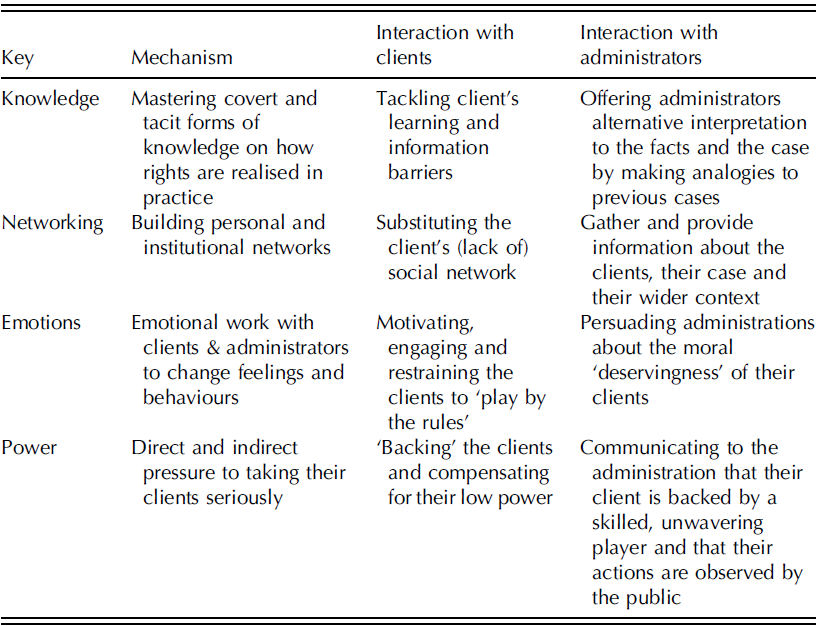
The four keys to take-up summarised in Table 1 highlight that the work of take-up agents is not only about mastering the formal language of bureaucracy (i.e., establishing necessary facts and legal arguments) but rather involves much informal and relational work. They highlight the fact that from the agents’ perspective bureaucracy, including that of the welfare state (Graham, Reference Graham2002; Hasenfeld, Reference Hasenfeld2009), is made of humans – for good or ill. As such, the ability to successfully claim social rights, especially with those with high selectivity and discretionary elements, is very much dependent on personal relationships, feelings and power relations.
The four keys to realising welfare rights

This perception rejects the Weberian ideal-type model of modern bureaucracy as a legal, rational, formal, impersonal, and dehumanised project (Serpa and Ferreira, Reference Serpa and Ferreira2019). It resonates the scholarship on street-level bureaucracy, which views front-line officials as often making decisions based on judgment on deservingness in the context of social relations (Maynard-Moody and Musheno, Reference Maynard-Moody and Musheno2000; Altreiter and Leibetseder, Reference Altreiter and Leibetseder2015; Djuve and Kavli, Reference Djuve and Kavli2015). Such social relations include, interalia, stigmatic discourses around welfare dependency and disability (Baumberg, Reference Baumberg2016). Our findings suggest that take-up agents understand these social relations, leading them to use social networks, emotional work and power relations with both clients and administrators.
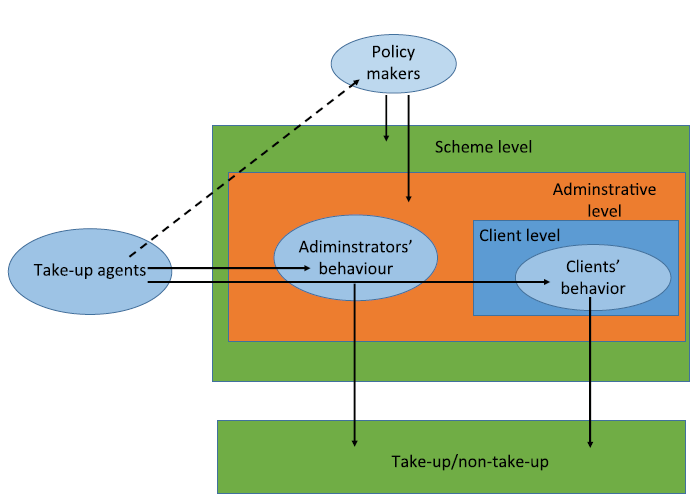
Referring back to van Oorschot’s (Reference van Oorschot1991; Reference van Oorschot, Ben-Arieh and Gal2001) multi-level model, we argue that take-up agents should be included in the model alongside policy-makers, administrators, and clients. As illustrated by the solid arrows in Figure 2, their role involves direct influence over both clients and administrators’ behaviours (the broken arrow suggests that their role might also involves direct influence over policy-makers, as shown in other studies; see Herd and Moynihan, Reference Herd and Moynihan2019). The effectiveness of take-up agents is based on their ability to build a unique expertise that draws on their mastering of all of these keys. This distinctive expertise derives, to significant extent from their nature as repeat players who can benefit from accumulated, covert and tacit knowledge, from networking, from their ability to do the emotional work with clients and officials and from gearing up organisational power.
Incorporating take-up agents in Van Oorschot’s (Reference van Oorschot, Ben-Arieh and Gal2001) multi-level model.

Take-up agents are important because of their role in recognising and overcoming barriers to take-up – on the side of either clients or administrators – in the specific case they are handling. They bridge over gaps in clients’ knowledge, perceptions, and attitudes, they influence their behaviours, and also influence administrators’ behaviours by sorting out the relevant facts and arguments and mitigating unfavourable perceptions and other obstacles that may emerge due to the characteristics of the administrative level.
Importantly, however, although this analysis implies a degree of homogeneity or similarity in the way that take-up agents share the ‘keys’ of their trade, the findings also point to some differences between take-up agents on issues such as readiness to disseminate knowledge; the appropriateness of using the networking key; the ability and readiness to play the emotional card; and the types of power used. A possible explanation for these differences might lie in the different understandings of their roles and ethos based on their broader goals and organisational logics. Naturally, sectoral logic plays a role here: business organisations are more likely to treat their knowledge as a commercial secret than voluntary or public organisations. Relatedly, while some agents see take-up as an end to itself, other see it as a vehicle for wider goals of personal and social change. The differences in using the keys may also reflect different perceptions of the relationship with the state authorities – with some agents adopting more adversarial relations while others tending to more cooperative ones. These differences may also be influenced by the institutional capacities of the take-up agents, as each organisation uses the strategies that represent its relative advantage, with non-market agents relying more on the social networking key, while market agents relying more on their knowledge and expertise in the specific area.
Unpacking the central role of the take-up agents in the realisation of social rights raises the question whether they are a policy problem or solution. On the one hand, it could be argued that in an ideal situation, the welfare state has no need for external take-up agents. According to this line of argument, take-up agents are necessary only as long policy makers have failed to tackle take-up barriers in other levels, particularly at the administrative and scheme level. Our findings, on the other hand, suggest that even if the state systems would operate optimally, these agents still have a key role in helping claimants to cross the borders into the ‘promised land’. This is particularly so once we take into consideration the complex barriers of some ‘hard-to-reach’ groups, including minority ethnic communities, refugees and asylum seekers and some religious groups (Ratzmann, Reference Ratzmann2019).
Arguing for the key role of take-up agents does not mean overlooking their potential drawbacks, including the risk that welfare rights advocacy might disempower as much as empower claimants by negating their ‘own understanding and experience of how problems might be solved’ (Dean, Reference Dean2015: 119). Concomitantly, it does not necessarily mean shifting the burden to the market and voluntary sectors. On the contrary. Identifying the complexity of the take-up process, combined with the need to rely on intermediaries, requires us to think about the state’s responsibility in this field either through direct provision of take-up services or through regulating this market to ensure that it is accessible and affordable. This conclusion is even more apparent considering the fact that in recent years, various welfare states, including the UK, have significantly reduced the state’s involvement in this market (Morris and Barr, Reference Morris and Barr2013; Kirwan, Reference Kirwan2016). This reduction raises a question mark regarding the ability of those states to properly deal with non-take-up in the near future.
Limitations and future directions
This research made initial steps in modelling the work of take-up agents and incorporating it in a well-established multi-level modelling of non-take-up. It also has limitations, however, which call for future research and theorisation. Being based on a small-scale, heterogeneous sample, this study is exploratory in nature. Future research should examine our initial insights through larger samples, both qualitative and quantitative. One important direction for such research is to further examine the diversity of take-up agents and typologise the various ways they use and mix different tools and strategies based on factors such as agents’ sectoral logic, goals and ethos, and their relationship with state authorities. Another direction is to examine differences across countries and in particular to typologise take-up regimes and examine their fit to our current understanding of welfare state regime. Finally, future studies should also examine the perspective of other stakeholders, mainly policy makers, state administrators and service users. The latter is of great importance as numerous studies (e.g. Naden etal., Reference Nadan, Roer-Strier, Gemara, Engdau-Vanda and Tener2018) have shown that often, there is a substantial gap between professionals’ and clients’ perspectives.
Acknowledgements
We would like to thank Ami Asher for language editing, and Prof. John Gal for his helpful comments on an earlier draft of this article. We would also like to thank Noam Tarshish, Nofar Mazursky and Haya Jandaly for their excellent research assistance.