INTRODUCTION
As concern mounts over the influx of millions of immigrants into the United States, it is worth recalling that large-scale immigration has been an ongoing theme in American history. The nineteenth century, for instance, recorded large increases in the absolute numbers of immigrants. By the 1880s, immigrants had grown to 5,703,790 from a mere 151,824 sixty years earlier. In 1910, they represented 14.7% of the U.S. population, and between 1890 and 1920 a total of 18,218,761 people immigrated to the country. One hundred years later, looking at the comparable thirty-year period, from 1970 through 2000, we find that 21,300,119 immigrants came to the United States, and currently they represent 11.7% of the population (Daniels Reference Daniels2002, pp. 124–125; Larsen Reference Larsen2004, p. 1; U.S. Department of Homeland Security 2004, p. 5). But the debate over immigration has never been just about numbers. Who immigrants are and their possible effects on society have tended to worry Americans more. Going back to immigration at the turn of the twentieth century, we find that the Central, Southern, and Eastern Europeans who constituted the bulk of the stream were feared and disliked because Americans worried that they would not be able to assimilate (Gossett Reference Gossett1963; Persons Reference Persons1987; Cose Reference Cose1992; Daniels Reference Daniels1997; Hing Reference Hing2004). But, contrary to expectations, over time, they did. Nevertheless, today, similar fears are being expressed, and, superficially, the situation seems the same as one hundred years ago; so the eventual assimilation of present-day immigrants might seem to be a foregone conclusion. But a key difference is that, today, most immigrants are not White. Indeed, when undocumented immigration—the other key difference from turn-of-the-twentieth-century immigration—is taken into account, we see that most contemporary immigrants are of Hispanic origin. Because the ethnic and racial diversity of the present stream is much broader than anything seen a century ago, assimilation is an even more pressing issue now than it was then. The country's capacity to fully accommodate not just the ethnic variation represented by Central, Southern, and Eastern Europeans, but also the more profound differences represented by contemporary non-White immigrants has yet to be demonstrated. There are signs that, in fact, this assimilation might not happen as predicted by theory. Instead, immigrants may change U.S. society in unexpected ways.
Although possibilities along these lines are numerous, three questions revolving around race stand out. First, since U.S. society's entrenched, dichotomous conception of race appears at odds with the diversity represented by current immigration, the problem of how race will be conceptualized in the future arises. This is a fundamentally important issue because it establishes the parameters within which the society will attempt to incorporate native minority groups and the new ones being introduced by immigration. That is, the conceptualization of race will affect the question of assimilation. The present essay will examine this second very important question, arguing that immigration is leading to social complexity. The failure of traditional assimilation models to completely absorb Blacks helped lead to the creation of multiculturalism, which fundamentally represents anti-assimilationism and has been greatly expanded by the massive, diverse immigrant population.Footnote 1 But as Blacks achieve upward mobility, many continue to adhere to traditional notions of assimilation that have revolved around a Black/White framework. These disparate realities cause upwardly mobile Blacks to experience ambivalence regarding the reality of their mobility, and skepticism over whether it amounts to complete acceptance. Consequently, and concordant with growing social complexity, Blacks have a foot in two worlds: both contributing to an increased multiculturalism and also reinforcing the Black/White dichotomy. The assimilation of Black immigrants into this dichotomy serves as a good indication of its continuing salience. Immigration also raises a third, crucial, issue of future race relations since, historically, these have revolved tightly around Blacks and Whites. Any alteration in the conceptualization of race, possibly driven by changing demographics, will necessarily render these intergroup dynamics more complex, creating new opportunities for coalition building, but also producing conflict among a notably wider range of groups than only Blacks and Whites.
THE IMMIGRATION BACKGROUND
Immigration to the United States has been rising steadily since the end of World War II. Although restrictive immigration legislation remained intact, rising American prosperity, coupled with the end of the war and the Great Depression, created more favorable conditions for immigrants. Average annual immigration in the decade from 1946 through 1955 stood at 197,153, compared to 32,727 in the previous decade. Immigrant numbers hovered in the mid-200,000 range until the 1960s and increased sharply after implementation of the 1965 Immigration Act. Average annual figures for the 1970s, 1980s, and 1990s totaled 424,820, 463,153, and 641,629, respectively. By 2005, legal immigrants totaled, on average, almost 1 million per year (U.S. Department of Homeland Security 2005, p. 5). Including undocumented immigrants expands these numbers significantly, since estimates place their inflow at about 550,000 per year, for a total population of 12 million (Martin and Midgley, Reference Martin and Midgley2006, p. 5; Passel Reference Passel2005). In 2005, this figure represented one-third of the 37 million immigrants living in the United States (Passel Reference Passel2005).
As indicated above, the composition of the immigrant pool rivals its size as a source of concern for some Americans. Although Europeans dominated the immigrant stream in the first two-thirds of the twentieth century, Hispanics, Asians, Caribbean-origin foreigners, and Africans are overrepresented in the post-1965 immigration stream. In the decade from 1900 to 1909, 92% of all immigrants originated in Europe, but by 2005 that proportion had declined to 16%. In contrast, the Latino, Asian, and Caribbean proportions have steadily risen since the 1970s. Between 1971 and 2004, Asia, Latin America, and the Caribbean accounted for 34%, 33%, and 11%, respectively, of all immigrants. The top five source countries in 2005 confirm this shift, consisting of, in order, Mexico (157,992), India (79,140), China (64,921), Russia (60,395), and the Philippines (57,656) (U.S. Department of Homeland Security 2005, p. 5). Geographically speaking, these immigrants have tended to cluster in California, New York, Florida, Texas, New Jersey, and Illinois. However, the Latino population, historically concentrated in the Southwest, has increasingly dispersed nationwide in response to stepped-up border enforcement and the lure of jobs. Measures meant to deter undocumented immigrants from crossing the Mexican border have failed and, ironically, convinced these immigrants to settle permanently in the United States. Increasingly, this means moving to nontraditional destinations. The demographer William Frey, has shown, for example, that between 2000 and 2004 southeastern and New England states (along with Tennessee and South Dakota) experienced the fastest growth in their Latino populations. Taken together, the average Latino growth rate in Arkansas, South Carolina, Georgia, and North Carolina was 36%; New Hampshire and Maine averaged a 32% growth rate over the same four-year period (Frey Reference Frey2006).
This growth, and that of immigrants in general, is driven by economics: immigrants' desire to better their lives and U.S. employers' demand for labor.Footnote 2 But immigration policy since the 1960s has consciously favored humanitarian concerns over economic concerns, emphasizing the reunification of immigrant families in the United States. Reflecting this fact, in 2005, 58% of visas given to legal residents fell into the “family” category, but only 22% were employment based. Many of the latter were highly skilled immigrants, and most of these were Asians (especially Indians). These workers also figured prominently among the 1,300,000 migrants who entered the country as “Temporary Foreign Workers”—especially under the HIB category (workers with specialty occupations) (U.S. Department of Homeland Security 2003). On the other hand, 30% of immigrants possess less than a high school education, and the figure is even higher (45%) among low-wage workers—a category dominated by undocumented immigrants. Overall, these data point to a bifurcation of the immigrant population, since 28% (29% of the native-born) are college educated; but a much higher proportion (30%, compared to 1% of the native-born) lacks a high school education (Capps et al., Reference Capps, Fix, Passel, Ost and Perez-Lopez2003). The latter are concentrated in such occupations as farming, cleaning, construction, and food preparation (Passel Reference Passel2005).
IMMIGRATION AND THE CONCEPTUALIZATION OF RACE
Although immigration discourse is often manifestly economic in nature, race is a powerful subtext. This occurs because race remains a central organizing principle in U.S. society, despite arguments to the contrary. Immigrants enter a society that has been changed in important ways by the civil rights movement, but these changes have altered, not eradicated, manifestations of racial consciousness. In large part the idea that race is no longer important derives from survey data tracking trends in racial attitudes, which show an increasing embrace of abstract principles of equality by White Americans. For instance, 96% of Whites in 1995, as opposed to only 32% in 1942, agreed that Black and White children should attend the same schools. Similarly, in 1944, only 45% of White Americans agreed that Blacks should have as “good a chance as White people to get any kind of job,” but, by 1972, 97% expressed such sentiments. Trends with respect to White support on issues such as segregated transportation and Blacks' use of public space parallel these findings (Schuman et al., Reference Schuman, Steeh, Bobo and Krysan1997, pp. 104–105). Other surveys confirm these findings. A 2001 Washington Post/Harvard University/Kaiser Foundation study, for instance, revealed increasing White optimism on racial matters. Asked whether they were worried that by the end of the twenty-first century Whites would constitute a numerical minority, 72% of Whites responded “not at all” (Washington Post et al., 2001, p. 26). In 1995, a study by the same survey group had asked: “During the last ten years, do you think tensions between racial and ethnic groups in this country have increased, decreased, or stayed about the same?” At that time, 45% of White Americans in the sample gave the pessimistic answer, but six years later, in the 2001 survey, the proportion fell to 27%.Footnote 3 A 2007 Gallup Poll charting long-term trends in racial attitudes produced similar results. One question asked: “Do you think that relations between Blacks and Whites will always be a problem for the United States, or that a solution will eventually be worked out?” In December 1963, 53% of White Americans gave the optimistic response “eventually worked out.” In June 2007, 56% of Whites gave that response. In contrast, Blacks have steadily become more pessimistic: in 1963, 70% of Blacks gave the optimistic response, but only 43% did so in 2007 (Gallup Poll 2007). Undoubtedly, the increased number of minority individuals who have attained prominent public posts has bolstered this optimism. Barack Obama's campaign for the 2008 presidency is especially noteworthy in this respect, since many White Americans view it as an indicator of the extent to which racial attitudes in the United States have changed (Beinart Reference Beinart2007).
Countering these positive trends, however, is a host of data showing the limited nature of changes in racial attitudes and the continuing centrality of race. This apparent contradiction can be explained in a number of ways. First, data point to a persistent gap between White Americans' agreement with abstract principles of equality but reluctance to fully support policies that will actualize these principles. For instance, Bobo (Reference Bobo, Smelser, Wilson and Mitchell2001, p. 269) has shown that, though Whites endorse equality of schooling, regardless of race, significantly fewer endorse federal government efforts to ensure this outcome. Furthermore, the endorsement of equality is highly sensitive to the makeup of schools, since Whites are much less likely to send their children to mostly Black schools. Similar patterns emerge with respect to jobs and residential segregation. In the case of the latter, it is well-known that, though White Americans endorse the principle of freedom of residential choice, Blacks, especially, remain highly segregated from Whites. Frey and Myers, for instance, have calculated that the mean index of dissimilarity between Blacks and Whites across 287 metropolitan areas stands at 58.7—significantly above the 44.2 for Hispanics and 42.9 for Asians. But Black/White segregation is much higher in the hypersegregated cities of the Midwest and Northeast. Good examples are Gary, Illinois, and New York City, where the indices are 87.5 and 83.7, respectively (Frey and Myers, Reference Frey and Myers2005). Data such as these, combined with the positive trends noted above, support the notion of a public/private split in matters of race, discussed by sociologist Orlando Patterson. He argues that the public sphere has seen significant improvement in the area of race, but not so the private sphere, where social distance between the races remains great (Patterson Reference Patterson2006, p. A23). This argument parallels Bobo's data showing a tendency toward White distancing as the proximity and/or the size of the Black population grows. In light of these arguments, increased rates of Black/White intermarriage signify less change than at first appears because such alliances represent a minority tendency within a very small proportion of all marriages (U.S. Bureau of the Census 2000; Frey Reference Frey2003).
These data show that race matters, and the Black/White framework endures, even in an age of mass, diversified immigration. Over time this immigration will increasingly impact the American consciousness, leading to an enhanced understanding of U.S. society's variegated nature. But, on the whole, the society is not yet at the point where the existing diversity of racial and ethnic groups has erased the Black/White logic that frames thinking about race. On one level, this point seems counterintuitive, since in some areas of the country Blacks are now a minority among minorities; and, following the requirements of federal law, Americans have become familiar with what historian David Hollinger has referred to as the ethnoracial pentagon of groups: Blacks, Whites, Asians, Hispanics, and Native Americans (OMB 1994; Hollinger Reference Hollinger1995). But fundamental social organizational principles, especially ones rooted in centuries of history, cannot change rapidly, which typically results in a lag between demographic shifts and traditional conceptualizations. Moreover, the demographic shifts that some view as ushering in a multicultural America are uneven, since they most strongly affect the edges of the country. As Patterson (Reference Patterson1994) notes, the Whiter hinterlands retain their traditional conservative character. Changes in American conceptualizations of race will likely occur more quickly near the edges than in the hinterlands, but even the putatively multicultural areas continue to evince bimodal racial splits. It was telling, for instance, that the 1992 Los Angeles riots were characterized in Black/White terms, despite the participation of large numbers of Hispanics as offenders and Koreans as victims (Johnson et al., Reference Johnson, Farrell and Guinn1997). Similarly, though the Black population is declining in that city as the Hispanic and Asian populations surge, the results of the first O. J. Simpson trial were largely viewed in Black and White terms. Network news signified this most vividly by presenting, split screen, Black/White reactions to the Simpson verdict. Few newscasters solicited the reactions of Hispanics and Asians. The nature of the crime, which touched on one of U.S. society's primal racial fears, undoubtedly accounted for some of this narrow Black/White focus. But it also likely reflected the entrenched, reflexive tendency to view racial issues through a bipolar lens.
These observations on the limitations of attitudinal data underscore the extent to which the primary axis of racial tension continues to lie along the Black/White divide. To a surprising extent, Blacks continue to be excluded from full participation in the society, while immigrants are more routinely included. The existence of an ethnoracial pentagon does not mean that White Americans regard all minority groups as equals. Employment practices illustrate this because White employers express a persistent preference for immigrants over African Americans. They attribute this preference to a belief that the former exhibit more desirable work habits than do African Americans. Also, the claim is made that the latter possess a sense of entitlement and demand higher wages (Wilson Reference Wilson1996; Perez and Dade, Reference Perez and Dade2007).Footnote 4 That White employers also sometimes express a preference for West Indian immigrants over African Americans does not negate the argument for the continuing centrality of the Black/White axis as the nexus of racial tension (Kasinitz and Rosenberg Reference Kasinitz and Rosenberg1996; Waters Reference Waters1999) . It only means that African Americans—especially males—are especially stigmatized. But West Indians' advantage over African Americans is weak since recent research has shown that employers pay darker-skinned immigrants 15% less than their lighter-skinned (and taller) counterparts (Hersch Reference Hersch2006). More specifically, Waldinger (Reference Waldinger1996) has shown that West Indians may enjoy advantages over African Americans, but only in limited segments of the labor market where discrimination by White employers renders this advantage tenuous. A segment of the immigrant African population exhibits higher levels of education than do either West Indians or African Americans. However, they often earn less than their educational qualifications would predict (Amissah Reference Amissah1996; Dodoo Reference Dodoo1997; Kollehlon and Eule, Reference Kollehlon and Eule2003); and African immigrants with lower levels of education fare worse of all, often managing to find work only in the underground economy (Stoller Reference Stoller and Foner2001). These facts point to underlying similarities between African Americans, Africans, and West Indians, and these similarities become even more clear as members of the three Black populations interact with other Americans in the larger society (Dodoo Reference Dodoo1997; Vickerman Reference Vickerman1999; Arthur Reference Arthur2000).
The attitudes exhibited by immigrants provide further evidence for the continued salience of the Black/White divide. Although immigrants are certainly aware of the ethnoracial pentagon, it is also true that in incorporating into the society they are reacting to preexisting social structures. Immigrants do not enter an America that is a blank slate on which they can arbitrarily inscribe their own racial views. Instead, they typically find themselves being shaped by the Black/White framework. They have to respond to it in one way or another—whether this means accepting, rejecting, or trying to ignore it. Many variables determine which of these strategies immigrants will adopt, and the choices are not necessarily mutually exclusive, since a group may choose more than one strategy. Relevant variables include premigrant socialization into American culture; racial worldviews and experiences, prior to migration; national origin; color; age; location; and size of the immigrant group. The first factor is particularly important because the global reach of the U.S. media has disseminated this country's racial attitudes worldwide. Foreigners know of and may be influenced, before migration, by U.S. society's negative attitudes toward Blacks (Johnson et al., Reference Johnson, Farrell and Guinn1997, p. 1063; Geis Reference Geis2007). Among other examples, Hollywood films featuring Black actors perform poorly outside of the United States, which some commentators attribute to anti-Black racism among foreigners (Cieply Reference Cieply2007). A second example—notable because it drew widespread coverage within the United States—of foreign-based, anti-Black bias concerns comments in 1990 by Japanese Minister of Justice Seiroku Kajima comparing U.S. society's reception of Blacks to that received by prostitutes who move into affluent neighborhoods (Williams Reference Williams1990). More recently, in 2001, Japanese Prime Minister Yushiro Nakasone attributed social problems in the United States to low IQ scores among Blacks and other minorities (Bowen Reference Bowen2001). Although these views may not represent those of Japanese and other Asians as a whole, they jibe with sentiments current within the United States, and it would be surprising if foreigners did not pick up on them. Ironically, some negative portrayals of Blacks are produced by Blacks themselves, through aspects of hip-hop culture. These tend to be quite influential abroad, since, as anthropologist Livio Sansone (Reference Sansone2003) argues in Blackness Without Ethnicity, African American culture strongly influences notions of Blackness globally. The overall point is that immigrants arrive in America with racial images formed from a combination of U.S. media portrayals and their own worldviews and experiences. Although these could facilitate acceptance of the existing racial order in some immigrants (particularly where dark skin is stigmatized in the country of origin), many others reject or attempt to ignore it.
The attitudes of Hispanics toward the Black/White dichotomy are particularly instructive since this group exhibits a number of different responses to the situation. One interpretation of the 2000 Census data is that a sizeable proportion of Hispanics (42%) are attempting to ignore or reject the Black/White dichotomy by choosing Other when responding to the racial-identity question. This makes sense, considering the phenotypical and geographical diversity of the Hispanic population. As is well-known, race operates on something of a sliding scale in many Latin American countries, with the concept embodying not just phenotype, but also such factors as occupation, education, and class. In effect, Latin American views of race are often antidichotomous, and this causes problems of adjustment in the United States, where racial choices are stark (Van den Berghe Reference Van den Berghe1967; Fears Reference Fears2001; Sansone Reference Sansone2003; Tafoya Reference Tafoya2004). But it would be a mistake to conclude that Hispanics, in general, are attempting to ignore the Black/White dichotomy, since an even larger proportion (48%) consider themselves White, and only 2% claimed Black as a racial identity in the 2000 Census. Analysis of these data by Tafoya (Reference Tafoya2004) has shown that Hispanics who claim a White racial identity are, on average, better educated, wealthier, more likely to be employed, and more apt to claim an American identity than are Hispanics who choose an Other race label. In short, these Hispanics equate being White with success and have embraced the Black/White dichotomy. As Tafoya puts it:
The differences in characteristics and attitudes between those Hispanics who call themselves White and those who identify as some other race, suggests they experience racial identity as a measure of belonging: Feeling White seems to be a reflection of success and a sense of inclusion. The fact that changeable characteristics such as income help determine racial identification among Latinos, versus permanent markers such as skin color, does not necessarily mean that the color lines in American society are fading
(Tafoya Reference Tafoya2004, p. 3).Younger Hispanics in cosmopolitan areas such as New York City are helping to ensure the persistence of color lines by coalescing with African American culture as a means of achieving success. This counterintuitive process is somewhat at odds with segmented assimilation theory, which argues that second-generation youth assimilate along three alternative tracks: upwardly into the White majority, laterally when they remain primarily within their own group, or downwardly into a purported Black “underclass” (Portes and Zhou, Reference Portes and Zhou1993; Portes Reference Portes1996). The theory captures the reality that some immigrants do, in fact, conceive of assimilation in terms of avoiding Blacks—especially those in the inner city (Fears Reference Fears2001; Swarns Reference Swarns2006; Economist 2007). But the assumption of a fixed Black underclass, characterized by an unchangeable oppositional identity, is questionable. Criticizing this assumption, Kasinitz et al. (Reference Kasinitz, Waters and Mollenkopf2002) have shown that second-generation Hispanic youth in New York City are increasingly embracing inner-city Black culture and leveraging this choice into success. Instead of being a liability, this culture is becoming an alternative pathway to upward mobility, as Hispanic youth tackle the Black/White dichotomy by melding aspects of Black culture with their own to produce a hybrid culture. Reggaeton, the mixture of dancehall reggae, hip-hop, and Puerto Rican culture, is a good example of this process. While this hybrid culture is, by definition, mixed compared to Hispanics who identify themselves as White, these Hispanic youth are preserving and amplifying identifiably Black cultural forms.
Considering all this, it may be said that current immigration is posing a serious challenge to America's centuries-old conceptualization of race. The volume and diversity of the newcomers may yet force changes in this framework, but the Black/White dichotomy is proving to be surprisingly resilient. Immigrants are forcing greater recognition of America's long-standing racially and ethnically diverse landscape, but they are not sweeping away the society's traditional ranking of groups. Instead, many immigrants are accommodating themselves to this ranking, joining it at various levels and making it more complex. This is not to suggest the existence of a fixed system in which Blacks are forever trapped at the bottom of U.S. society; they have experienced real upward social mobility since the 1960s (Wilson Reference Wilson1980). Much data show that, in many ways, Blacks are better off now than they have been at any time in the country's history, but it goes too far to suggest, as some writers have, that U.S. society has become color-blind (Steele Reference Steele2002). The structures of inequality, and the tendency to negatively evaluate Blacks, continue to exert a powerful influence on society. As I discuss in the next section, although Blacks are experiencing increasing upward mobility, they cannot take for granted that this necessarily translates into complete acceptance. In many ways, upwardly mobile Blacks continue to be judged by prevailing racist ideas, especially as these are reinforced by the social problems being experienced by other segments of the community (Feagin and Sikes, Reference Feagin and Sikes1994; Kennedy Reference Kennedy1997). In the color-blind view of the world, the America of the future will be characterized by a neutral ordering of groups, where racial or ethnic characteristics will be of little social consequence. It is difficult to disagree with this as an ideal, but its realization is not soon forthcoming, because historical practice and the exigencies of social life inevitably lead to social ranking (Van den Berghe Reference Van den Berghe1997; Weber Reference Weber and Hughey1998). In U.S. terms this means ranking along the society's line of weakest resistance: race. Rather than erasing Black/White lines, immigration is likely to elaborate on this basic theme by partially or fully incorporating some new non-White immigrants, but few Blacks, into the White population. Indications are that the White population will somewhat diversify but most non-Black minorities will form an intermediate stratum between the White and Black populations (Bonilla-Silva Reference Bonilla-Silva2004; Lee and Bean, Reference Lee and Bean2004; Tafoya Reference Tafoya2004; Zhou Reference Zhou2004). Overall, as I argue in the next section, upward mobility is unlikely to facilitate society's complete acceptance of Blacks. This, and immigrants setting themselves apart from Blacks, will probably result in the continuation of a relatively distinct Black identity (even though Blackness, itself, is likely to be diversified by immigration). At the same time, immigration is presenting multiculturalism as an alternative mode of incorporation into the society. In the end, therefore, the United States of the future presents a complex picture of continuity and change.
ASSIMILATION RECONSIDERED
Assimilation is a second issue that is being influenced by the continuing surge of immigrants. It could be argued that this is the central issue in all immigration debates, since underlying such discussions is the basic question of how immigrants will incorporate into U.S. society. Phrased in stark terms, immigration debates pose the question of whether newcomers will become “American” or change America into something different. These concerns can be traced throughout the various waves of immigration to the country, but they were not always obvious. Americans remained fairly relaxed about questions of assimilation so long as most immigrants originated in northwestern Europe, for they assumed that these immigrants would eventually assimilate into the White majority. However, as the immigrant stream increasingly diverged from northwestern Europe, concern over the assimilability of immigrants became a more public, contentious issue. In the nineteenth century, the Irish, the Chinese, and especially immigrants from Central, Southern, and Eastern Europe, elicited scorn and alarm. From the viewpoint of the native-born, assimilation, defined as the disappearance of immigrants into a presumed Anglo-Saxon mainstream, was required; but they doubted that non-Western European immigrants could attain this ideal (Bash Reference Bash1979; Dinnerstein et al., Reference Dinnerstein, Nichols and Reimers1990; Cose Reference Cose1992; Daniels Reference Daniels1997; Hing Reference Hing2004). Rejecting this Anglo-conformity, immigrant spokesmen in the first two decades of the twentieth century proposed the melting pot and cultural pluralism as more liberal models for organizing relationships between the native-born and immigrants. The melting pot, advanced by Israel Zangwill in 1908, resurrected an idea proposed by French immigrant, J. Hector St. John de Crevecoeur, over one hundred years earlier. In De Crevecoeur's famous reading, the American consisted of an amalgamation of the various northern European nationalities that had migrated into the country (De Crevecoeur Reference De Crevecoeur1986, pp. 69–70). Zangwill essentially agreed with this assessment but wished to include Central, Southern, and Eastern Europeans, and he advocated greater mutuality in the mixing process. Where Anglo-conformity required the active subordination of immigrants into a passive, receiving White majority, the melting pot proposed a cooperative effort by both the native-born and immigrants to achieve mixing on a middle ground. The outcome of this process—more liberal than Anglo-conformity, since it required greater concessions from the White majority—would be a new type of individual: the American (Zangwill Reference Zangwill1909). Cultural pluralism, which Herbert Kallen advocated in the second decade of the twentieth century, was more liberal still, since it required immigrants to assimilate in only some areas of their lives. Aside from this economic and political incorporation, the theory pushed for immigrants to remain culturally separate from the White majority (Kallen Reference Kallen1924).Footnote 5
Significantly, Blacks went virtually unnoticed in the ferment surrounding discussions of immigrants and assimilation in the early decades of the twentieth century.Footnote 6 In actuality, almost two decades before Kallen, W. E. B. Du Bois had proposed a version of cultural pluralism in his 1897 essay “The Conservation of Races” (Du Bois Reference Du Bois, Blight and Gooding-Williams1997). But its relative obscurity typified the deliberate silence surrounding Black assimilation. Accounting for this, John Higham has argued that, ironically, Blacks were too different to be encompassed by even the theoretically liberal melting-pot and cultural-pluralism models. The fact is that, though many native-born Americans disliked Eastern, Central and Southern Europeans, phenotypically and culturally these immigrants were quite similar to White Americans. They could advocate the distancing implicit in cultural pluralism precisely because such immigrants were already partially accepted (Higham Reference Higham1975; Lieberson Reference Lieberson1980). Blacks, only a half-century removed from slavery, could claim no such acceptance, and this rejection has had major consequences for modern-day immigrants. Nathan Glazer has argued persuasively that U.S. society's persistent failure to completely absorb its Black population was crucially important in the post-civil rights revival of cultural pluralism after its decades-long quiescence (Glazer Reference Glazer1997).Footnote 7 But cultural pluralism's new guise, multiculturalism, is much broader and stronger than cultural pluralism ever was. One reason for this is the large size and marked diversity of the current immigrant stream. This ethnic and racial diversity is beyond anything ever faced by U.S. society, and raises, more urgently than before, the question of whether and how immigrants can assimilate.
The answers to these questions are complex because assimilation is complex, but, as discussed above, it refers to a process whereby people who are outsiders to a society gradually become absorbed into it so that they lose their distinctiveness (Alba and Nee, Reference Alba and Nee1997, p. 863). The process takes place over several generations, is multifaceted, varies inversely with discrimination, and involves an important subjective element. Of chief importance here is that outsiders and members of the majority group must agree on the desirability of assimilation (Stepick et al., Reference Stepick, Grenier, Castro and Dunn2003). Full assimilation is achieved when a minority or immigrant group has been accepted into the target group without reservation; no question then remains as to whether they are full members of the society (Reuter Reference Reuter1941). From this perspective, multiculturalism is not simply another mode of assimilation but, rather, a rival model for organizing relationships between groups. It is anti-assimilation, in the sense that it downplays the need for immigrants (and minorities, in general) to dissolve into the White majority. Instead, as Hollinger maintains, multiculturalism presents a range of options whereby minorities may choose whether to affiliate or not with the dominant culture (Hollinger Reference Hollinger1995). As noted above, these options are most available in large metropolitan areas, especially those located along the edges of the country, but the existence of multiculturalism has not erased traditional assimilation. Specifically, Anglo-conformity—the expectation that immigrants and minorities will be absorbed into the dominant culture—still very much exists in the hinterland, to be sure, but also in those areas that are said to be multicultural. Consequently, modern-day America is witnessing a tussle between rival modes of organizing relationships between the various groups within society (Patterson Reference Patterson1994).
This tussle exists because immigrants and Blacks are utilizing both models in adjusting to the society, and the Black/White issue plays a prominent role in both. Glazer is correct that U.S. society's failure to completely absorb Blacks served as a major impetus to the growth of multiculturalism, and immigrants are increasing the scope and intensity of the process. Consistent with their desire to succeed in America, many immigrants seek complete assimilation and, as shown above, they conceive of this in Anglocentric terms. The problem is that most are non-White, and U.S. society has a poor track record assimilating such individuals. As a result, skepticism abounds regarding whether contemporary immigrants might replicate the experiences of earlier European immigrants. Instead, multiculturalism is viewed as being a more likely outcome (Portes and Zhou, Reference Portes and Zhou1993; Glazer Reference Glazer1997; Tuan Reference Tuan1998; Neckerman et al., Reference Neckerman, Carter and Lee1999; Navarro Reference Navarro2007).Footnote 8 Meanwhile, some Blacks see in multiculturalism possibilities for thriving in a society that has long rejected them. Certainly, this is true of separatists, but even some upwardly mobile Blacks who fall squarely within the mainstream, faced with persistent discrimination, have soured on the possibility of complete assimilation.Footnote 9 The loss of enthusiasm for residential integration among some middle-class Blacks is a good example of this fact (Reeves Reference Reeves2001). But many other Blacks—perhaps most—continue to pursue the civil rights ideal of integration—really a form of Anglo-conformity that presumes the existence of a White mainstream, with Blacks as outsiders. Problematically, as I argue in the next section, many of these Blacks attain upward mobility only to find that complete assimilation still eludes them.
ASSIMILATION AMONG MIDDLE-CLASS BLACKS
The Black middle class features prominently in investigations of assimilation among Blacks, because their upward mobility is taken as a sign that they are experiencing this process (Thernstrom and Thernstrom, Reference Thernstrom and Thernstrom1997). A viewpoint such as this makes sense, up to a point, because upward mobility is a central feature of groups that have attained assimilation (Alba and Nee, Reference Alba and Nee1997). The problem lies in the tendency to equate such mobility with assimilation when, in reality, assimilation is a much larger process. To put it another way: upward mobility is a necessary but not a sufficient condition for achieving full assimilation into U.S. society, because assimilation exceeds mobility. Even when Blacks attain upward mobility, they still face the subjective problem of gaining acceptance and overcoming their own anger at instances of rejection. Stepick et al., writing about the assimilation of Cubans in Miami, express the situation well:
For an immigrant to assimilate, to become an American, he or she must receive respect and acceptance from the rest of America, from the established residents. Similarly, whether an immigrant group becomes accepted does not depend solely on what the immigrants say or do. Rather, it unfolds from the interaction between immigrants and established resident Americans, those who were born and raised in the United States, who view themselves as the real or mainstream Americans
(Stepick et al., Reference Stepick, Grenier, Castro and Dunn2003, p. 26).Other writers—notably Neckerman et al. (Reference Neckerman, Carter and Lee1999) and Lacy (Reference Lacy2004)—have shown, well, how problematic assimilation is for middle-class Blacks. Essentially, these writers argue that middle-class Blacks must reconcile their desire for upward mobility, the continuing rejection by White Americans, and the resentment of less successful Blacks. Neckerman et al. (Reference Neckerman, Carter and Lee1999) argue that they resolve these pressures by attempting to maximize their opportunities within the existing constraints through the development of a “minority culture of mobility.” An important aspect of this, as Lacy shows, is the cultivation of a Black identity to help cope with the peculiar pressures faced by successful Blacks.
To investigate some of these issues for African Americans, the writer conducted a study of upwardly mobile Blacks in an affluent Washington, D.C., suburb.Footnote 10 This historically White, suburban county has seen rapid population growth and diversification, with the Asian and Hispanic populations more than doubling since 2000. Blacks, although having increased only 30% over the same period, currently constitute 20% of the county's population. Reflecting its general affluence, the county's median household income in 2000 stood at $65,960, with a poverty rate of only 4%. Black households reflected this affluence, with a median household income of $55,799, and 90% of Blacks had graduated from high school, with 25% possessing a B.A. or higher. Only 7% fell below the poverty line. If anything, the random sample of fifty-nine Blacks who form the basis of the study in question was even more affluent, since 48% earned more than $75,000 per year, and 46% had obtained a B.A. or higher.
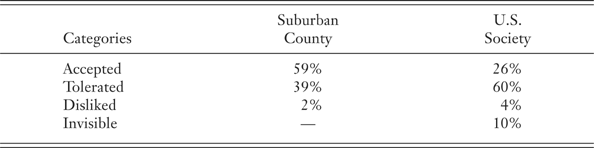
Considering this profile, Blacks in this county would be expected to view themselves as assimilated into the community. To gain deeper insight into the issue, I posed a number of questions designed to elicit the respondents' definition of and attitudes toward the assimilation process. For instance, I asked their opinions of Louis Farrakhan (assuming his to be a noted example of an anti-assimilationist stance), whether they were optimistic regarding their chances in America, and how they could boost their chances of succeeding. Essentially (reflecting Neckerman et al.'s and Lacy's arguments), the Blacks I studied enjoyed living in the county because of its high quality of life (see Table 1), rejected separatism, and believed strongly in the possibility of upward mobility through a combination of hard work, education, and affirmative action. However, they expressed skepticism that upward mobility necessarily equals complete acceptance and pointed to persistent racial discrimination. Marcel,Footnote 11 a soldier, illustrated some of these themes. Asked about possible role models for Blacks, he responded:
I suppose, if I had to talk to someone and encourage them, I would have them observe and talk to other Blacks who have basically helped themselves and gotten their education. To me, that has been the advantage I mentioned before that my wife and I have been able to exploit; and we found that until you do that it severely limits you. I can't say there is any famous person or anything else I would have them pattern after. Simply look for other Blacks who have found avenues to get their higher education and follow.
Perceptions of the Reception of Blacks in Suburban County and U.S. Society

Source: Interviews
Note: The question asked respondents to rate, for the county and U.S. society, as a whole, whether they think Blacks are accepted, tolerated, disliked, or invisible.
This response jibed with his support for Farrakhan's self-help rhetoric but rejection of notions of separatism:
He is trying to achieve … a better sense of unity and of achievement among Blacks. I think he would like to see that. I think he has a lot of problems with some to the issues … where Blacks are … primarily seen in lower level, lower skilled jobs—things of that nature. But by the same token I don't think racial bias is any fairer going the other way than it is toward Blacks, and I don't care for the racial sentiment—the anti-White sentiment—that … Farrakhan is known for.
However, the respondents' upward mobility and general appreciation for quality of life in the county told only part of the story. Race continued to constrain them, so that, though most felt more accepted relative to U.S. society as a whole (see Table 1), they also faced persistent rejection in many ways. Their separateness was both objective and subjective. For instance, a sizeable minority argued that Blacks are only tolerated in the county, but this paled next to the 60% who held a similar view regarding the society as a whole. Overall, about three-fourths of the respondents believed that U.S. society holds a negative view of Blacks. With respect to the county, it is noteworthy that, though residential integration is the norm for the Black population, respondents had mostly Black friends.Footnote 12 Moreover, the Black population is noticeably concentrated in the eastern end of the county. This is not accidental, because many respondents perceived the more rural western end of the county as unwelcoming to Blacks, and claimed to avoid it. The same was true of the southeastern section of the county. These sentiments were not only a matter of perceptions but also derived from direct experience. Many respondents complained about forms of discrimination, ranging from poor treatment in public (e.g., in stores) to verbal harassment based on race. Below, I present a sample of the respondents' opinions.
Monica, whose work allowed her to travel throughout the county, related the unease she felt as a Black person in some areas. Of one particular area, she noted:
There's Whites down there that just, you know, they don't like to deal with Black people…. You get that whole feeling, like you're being watched; and you know, they drive them big old trucks with the Confederate flags on them and it's just like: OK, no, you stay there, I'll stay on my side…. You know, I've been with … friends of mine who are White and who have made comments like: “Whoa you know [Monica], this is … a redneck area and you don't really want to be down here….” And I mean when the person said that to me I was like: man! … I'm from []; I didn't know this stuff still exists down here, you know, and then for somebody White to tell me that: it's just like: OK!
Race also proved to be problematic in the integrated areas where most Blacks live. For instance, Marietta, a successful saleswoman, related a painful experience while out shopping:
I went to a [trade show] … and they had several merchants and things basically soliciting their services … ; and it was just the difference, you know, between … my [friend] and I walking to different merchants and them blatantly ignoring us: you know, giving a lot of attention to, say, White people…. [In] one particular incident…. I was looking at a photographer's portfolio and he basically ignored me. He was dealing with a woman, a White lady, who walked off, and I stood there. He didn't say hello to me; he didn't acknowledge me. He continued straightening up and I was the only woman, the only person looking at his portfolio at the time. He didn't bother to acknowledge me. So my best friend and I really observed that…. It was just like … Black people just weren't greeted. I'm not saying all the merchants were like that, and that some weren't unbiased in the way they treated [us]; [but some] looked at us like maybe we might not be able to afford their services.
Russell, a manager, referred to similar experiences:
There have been occasions when my wife and I have gone into some stores that are privately owned in the area and have not received assistance. I mean just walk into the stores, and people look at you as if you are not supposed to be there and continue on with what they are doing. I've seen that not only in the [] area but also at []; and even some of the larger grocery stores.
Alexandra, a White respondent, corroborated the views of some of the Black respondents. She regarded race relations in the county negatively, and I asked her why she thought this to be the case:
I mean any place … when you're looking carefully enough to get, you know, aware of the environs around you…. I've seen it at restaurants before where, you know … they'll see an African American person and they'll just, you know, pretend … like … a White couple was there before them; or, you know, small things that you just happen to take notice of.
Respondents also reported bad job-related racial experiences, ranging from hate speech to lack of promotion. Lorna related an instance of the former:
I've … ridden in a truck … with a White person who had no idea I was African American, and she was talking about how she would never have a Black person in her house unless they were going to clean and stuff…. I let her blabber on and on, and then I said: “You know what? I am African American.” I said, “I am offended,” and as soon as I got there [to headquarters] I went directly to the [boss]. I … was like: “Keep her away from me 'cause I don't want to get in trouble.” … I was so disgusted that I had to ride in the truck with her … for all that time. It's still there. It's still there, and I see it all the time.
The respondents' opinions on affirmative action underscored the extent to which they viewed society's embrace of Blacks skeptically. Many argued that the policy is problematic but necessary to achieve upward mobility in the face of continued racial discrimination. I coded the respondents' views into three categories: strongly support, strongly oppose, and ambivalent. Overall, 56% expressed strong support, 42% voiced ambivalence, and only 2% strongly opposed the policy. Moreover, 30% wanted to keep affirmative action as is, 35% would modify it, and 30% wanted to expand it. Only 5% of respondents thought the policy should be eliminated. In a typical response, Annette, who lived in one of the county's most exclusive neighborhoods, argued that Blacks are only “tolerated”:
There's not much they can do about it. We're here and I don't think we're going anywhere, but there's definitely some deep-rooted problems of hatred and I think a lot of it is sort of glossed over and covered up but it's definitely a problem.
IMMIGRANTS AND ASSIMILATION
While African Americans are continuing to experience problems fully assimilating into U.S. society, and some immigrants are opting for the multicultural alternative, other immigrants are reinforcing the Black/White dichotomy. Recall that, while 42% of Hispanic immigrants apparently reject the dichotomy by claiming an Other identity, 48% choose the dichotomy by opting for a White identity (Tafoya Reference Tafoya2004). Intermarriage trends reinforce this conclusion, since, to the extent that such marriages occur (7% of all marriages), they show Hispanics and Asians to be amalgamating with the White population at significant levels. In contrast, few Blacks intermarry with Whites. Census data show that Hispanics account for approximately one-half of all interracial marriages in the United States, and Asians account for a further 30% of such marriages. In contrast, only 14% of interracial marriages—10% if only the dominant trend of intermarriage with Whites is considered—involve Blacks (U.S. Bureau of the Census 2000). William Frey's analysis of these marriages by state demonstrates similar trends. For instance, in California, Hispanics account for 46% and Asians account for 31% of mixed-race marriages; Blacks account for only 4%. Similarly, Hispanics comprise 41% and Asians 38% of interracial marriages in New York, but only 8% of such marriages involve a Black individual (Frey Reference Frey2003). If intermarriage is the good indicator of assimilation sociologists believe it is, then Hispanics and Asians are assimilating noticeably better than are Blacks (Gordon Reference Gordon1964; Frey Reference Frey2003).
The assimilation of Black immigrants into U.S. society also provides evidence for the maintenance of the Black/White dichotomy. Although the country's Black population is still overwhelmingly native-born, in recent years, an increasing number of African immigrants, together with the larger, long-standing West Indian population, have been diversifying Blackness. This is particularly evident in a number of the cities in which these immigrants have settled. For instance, 43% of Fort Lauderdale's Black population is West Indian; in Miami, this figure stands at 34%. Boston and New York City each have approximately the same percentages of West Indians and Africans combined (26%). Furthermore, Black immigrant growth in some of these cities is very high. Minneapolis-St. Paul, for instance, recorded a 628% increase in its African population between 1990 and 2000. Philadelphia saw a 221% spurt during the same period, and the West Indian population of Atlanta increased by 323% (Logan and Deane, Reference Logan and Deane2003, p. 4).
Ultimately, as is the case with immigrants in general, the question underlying these increases is how Black immigrants will assimilate. Theoretically, they could incorporate neutrally as “Americans.” This would reflect the conception of American identity that emphasizes adherence to a distinct set of values (Gleason Reference Gleason, Thernstrom, Orlov and Handlin1980; Smith Reference Smith1988; Lipset Reference Lipset1996). Alternatively, Black immigrants could claim a variety of different racial/ethnic labels. Although the latter cannot be completely ruled out, most of the foregoing possibilities are only hypothetical, since U.S. society tends to impose Blackness on West Indians and Africans. Because it groups these immigrants with African Americans, there is little chance that the former will be able to assimilate neutrally as “Americans,” and even less that they will become “White.” Generally speaking, assimilation theory has concentrated on the assimilation of minority groups into the White majority and neglected the possibility that minority groups may assimilate into each other (Alba and Nee, Reference Alba and Nee1997; Waters and Jimenez, Reference Waters and Jimenez2005). However, U.S. society's tendency to group immigrant Blacks and African Americans together increases the probability of just such assimilation occurring.
The groups' spatial distribution illustrates how the social structure enhances this possibility. Africans and West Indians tend to experience the same high levels of segregation from White Americans faced by African Americans, but the spatial distance between the three Black populations is relatively less (Vickerman Reference Vickerman1999; Arthur Reference Arthur2000; Logan and Deane, Reference Logan and Deane2003). This spatial proximity facilitates interaction on every level between the groups, and this interaction builds upon preexisting, long-standing, historical and cultural ties between African Americans, Africans, and West Indians. For instance, aspects of African culture—so-called “African survivals”—can be readily identified in the West Indies and the United States. Religion-based examples in the islands include Voodoo in Haiti and Myalism in Jamaica; and in the United States the Gullah language has been traced back to its West African source (Herskovits Reference Herskovits1958; McCrum et al., Reference McCrum, Cran and MacNeil1986; Chevannes Reference Chevannes1998). Flowing in the other direction, we find long-standing attempts by West Indian Rastafarians to repatriate to Africa (Nettleford Reference Nettleford1972; Onishi Reference Onishi2001). Furthermore, cultural interchange between Black America and Jamaica lead, first, to the creation of modern popular music on that island and, later, to reggae's influence on the creation of hip-hop in the United States. As mentioned previously, Sansone has shown how Black America and Jamaica serve as producers of a Black culture that is consumed globally; but, ultimately, all the various forms of New World Black music can been traced back to West Africa (Clarke Reference Clarke1980; Goldman Reference Goldman2000; Sansone Reference Sansone2003; McBride Reference McBride2007).
The residential segregation experienced by African Americans, Africans, and West Indians reflects the racial discrimination encountered, as Blacks, by the three groups, and this discrimination, along with the cultural and historical ties mentioned above, facilitate the convergence of the groups (Dodoo Reference Dodoo1997; Vickerman Reference Vickerman1999; Arthur Reference Arthur2000; Halter Reference Halter, Waters and Ueda2007). But other factors render this convergence bumpy and problematic. The literature has mostly discussed these problems in terms of West Indian/African American relations because West Indians have migrated to the United States for well over a century, while African migration to this country is largely a post-1960s phenomenon. The problems stem from a number of sources: the tendency in West Indian societies, rooted in Black majority status and postcolonial ideology, to minimize open discussion of race; West Indian societies' relatively complex conceptualization of race compared to the United States; and an immigrant mentality that downplays race in favor of achievement to validate the decision to migrate. These realities have led to a degree of misunderstanding between African Americans and West Indians, but this is counterbalanced by the high degree of friendly interaction occurring between the two groups (Reid Reference Reid1939; Henriques Reference Henriques1957; Nettleford Reference Nettleford1972; Traub Reference Traub1982; Basch Reference Basch, Sutton and Chaney1987; Green and Wilson, Reference Green, Wilson, Irish and Riviers1990; Vickerman Reference Vickerman1999; Bashi Reference Bashi2007).
Relationships between African immigrants and African Americans are more problematic because the former population is relatively new; Africans, in their own countries, experience some of the same cultural and structural forces affecting West Indians; they possess higher levels of human capital than do either African Americans or West Indian immigrants; and Islam could serve as an alternative kernel (to a more inclusive Black identity) around which identity could coalesce. Focusing especially on the third factor, Logan and Deane wonder whether “common problems associated with race will outweigh differences linked to national origins” (Logan and Deane, Reference Logan and Deane2003, p. 12). They show that though the three Black populations cluster closer together relative to White Americans, spatial distancing, overlapping with human capital characteristics, is also discernible between Blacks. This is particularly true of African immigrants who enjoy notably higher levels of education than African Americans and West Indians, much higher household incomes than African Americans, and who are more likely to reside in well-off White neighborhoods. To take one statistic: 29% of Africans possess a college degree, compared to 20% of West Indian immigrants and 18% of African Americans (Logan and Deane, p. 11).
Some of the literature shows that these spatial and human capital differences are accompanied, in Africans, by distancing behavior. For instance, Ungar (Reference Ungar1995), Arthur (Reference Arthur2000), and Kusow (Reference Kusow2006) demonstrate that African immigrants parallel West Indians in experiencing difficulties adjusting to the racial climate in the United States relative to their homelands. One consequence of this is that many Africans cultivate ties to their homelands. All of this results in a degree of ambivalence where relations with African Americans are concerned (Ungar Reference Ungar1995; Stoller Reference Stoller and Foner2001). Furthermore, the focus on Muslim identity in the United States in the post-September 11, 2001, period gives the many African immigrants who are Muslims an alternative to Blackness where identity is concerned (Elliott Reference Elliott2006; Lydersen Reference Lydersen2006).
These counter indicators to assimilation into the African American population must be considered alongside factors facilitating the process. The binding strength of the aforementioned historical and cultural ties between the various Black populations cannot be underestimated. For instance, though Muslim identity could rival Blackness as a basis for identity among African immigrants, the problem seems less clear-cut when it is remembered that 50% of native-born Muslims (20% of all Muslims in the United States) are African American (Pew Research Center 2007, p. 1). Among West Indian immigrants, the parallel situation is that they, like most African Americans, are overwhelmingly Protestant and display a tendency toward high levels of religiosity (Henke Reference Henke2001). More pointedly, American churches, through missionary activities, religious broadcasts, music, and West Indians studying in American seminaries, have strongly influenced the expression of worship in much of the Caribbean. The upshot is that, though West Indians often start their own churches after migrating to the United States, many fit comfortably into American churches (whether Black-led or not). On a broader structural level, we find that, overall, foreign-born Blacks comprise only approximately 8% of the country's Black population (U.S. Bureau of the Census 2004).Footnote 13 This small size tends to limit their potential for effective social and political action apart from the African American community. Moreover, continuing racial discrimination against Blacks, per se, tends to create a community of common interests among various individuals of African ancestry. The behavior of second-generation Black youth—especially important because they illustrate the trajectory that assimilation is likely to take—demonstrates the consequences of this sense of community. Despite some resistance from parents, these youth, both West Indian and African, are increasingly overlapping and merging with African American youth to produce a hybrid Black culture (Waters Reference Waters and Portes1996; Arthur Reference Arthur2000; Vickerman Reference Vickerman and Foner2001; Kasinitz et al., Reference Kasinitz, Waters and Mollenkopf2002; Bashi Reference Bashi2007). Quite likely, the coming decades will see an acceleration in the rate of this syncretization.
RACE RELATIONS
In addition to conceptualizations of race and the shape of assimilation, immigration also promises to influence race relations. This is inevitable because the character (and size) of the stream are so at odds with the Black/White nexus that has framed race relations in this country. Of course, the U.S. population has always been diverse, and the struggles of non-Black minorities helped to shape race relations in important ways. For instance, Hing (Reference Hing2004) has shown how immigration policy sought systematically to exclude Asians and nonfavored Europeans from U.S. society. But the unique experience of Black slavery and its violation of cherished American ideals served as a constant reminder of the hollowness of American democracy. Moreover, the wrenching nature of the Civil War, revolving around slavery as it did, and the traumas of the civil rights movement, only tended to further entrench the historical focus on Black/White conflict. Until now, the entrenchment of this conflict has allowed Americans to predict, with reasonable accuracy, likely future racial patterns based on what transpired in the past. But new immigrants disrupt this certainty because they do not share that past (Elliott Reference Elliott2007). Specifically, the argument is that the Black/White conflict remains unresolved, but future race relations cannot be only about Blacks and Whites. Instead, race relations will be complex, revolving around shifting coalitions and conflict between groups bent on pursuing their own perceived interests.
Logically, these complexities show up most clearly in the (mainly) coastal regions where immigrants have been settling in large numbers over the past four decades. The political behavior of African Americans and immigrant Blacks in New York City is one example of burgeoning complexity in intragroup relations. In that city, assertions of specific West Indian interests—e.g., on matters pertaining to immigration—have increased as the foreign-born population has grown. The result has been a degree of tension between immigrant politicians and the African American political establishment. But, as noted above, overall, the weight of common interests between West Indians and African Americans constricts the range of political diversity where the two groups are concerned (Green and Wilson, Reference Green, Wilson, Irish and Riviers1990; Foerster Reference Foerster2004; Rogers Reference Rogers2004).
Complexity on a grander scale manifests itself in inter- as opposed to intragroup relations. On that level, as with West Indians and African Americans, we find both actual and potential coalition building and conflict. This distinction becomes necessary because, though conditions leading to either conflict or comity are widespread, in many instances these outcomes lie in the future. In other cases, conflict or coalition building are present realities. The triggering mechanism appears to be demographic transition, with some groups declining in numbers and influence while others are rising. Such circumstances tend to produce conflict, but that is only one aspect of the picture, since the groups may still have common interests around which they can coalesce (Johnson et al., Reference Johnson, Farrell and Guinn1997).
Southern California—especially in such cities as San Francisco and Los Angeles, with surging Latino and Asian but declining Black populations—illustrates these trends. The multiple racially tinged propositions introduced in the state during the 1990s demonstrate the results of population shifts in a multicultural environment. Proposition 187, approved on November 8, 1994, attempted to bar undocumented immigrants from receiving an education at public institutions and to restrict their use of emergency health care services and receipt of welfare. Proposition 187 also criminalized the making of identification documents for the purposes of obtaining state benefits, and required service providers to report suspected undocumented immigrants to the Attorney General. Not surprisingly, only 31% of Hispanics, many of whom perceived the measure as being aimed at them and strongly opposed the proposition, voted in favor. In contrast, 64% of Whites, 57% of Asians, and 56% of Blacks supported the proposition (Martin Reference Martin1995, p. 259). Two years later, Proposition 209, which sought to bar the use of affirmative action, revealed a realignment of ethnic alliances. Most White Californians (63%) embraced the proposal, but minority groups voiced even stronger, unanimous disapproval. Most Hispanics (76%), Blacks (74%), and Asians (61%) voted against the proposal (American Civil Rights Institute 1997). A further realignment occurred in 1998, when Proposition 227 sought to eliminate bilingual education in public schools. As with Proposition 209, Whites strongly supported (67%) the measure, but Asians also voiced strong support (57%). Almost one-half of Black voters sampled (48%) also supported the proposal, and Hispanics voiced the least support (37%) (Los Angeles Times 1998).
Focusing on the relationship between Hispanics and Blacks sheds more light on the social complexity that will likely characterize race relations in the future. This focus reveals present comity and conflict but, ominously, grounds for much more future conflict. Hispanic/Black comity is rooted in the reality that the two groups often find themselves in similar social circumstances. For instance, census data show that a similar proportion of both groups live in poverty, and it is not surprising that an equal proportion of Blacks and Hispanics opposed Proposition 209. Both groups believe that affirmative action benefits minority groups, but, as noted by writers such as Rodriguez (Reference Rodriguez2002) and Vaca (Reference Vaca2004), such surface similarities can lead to an overestimation of the strength of the Hispanic/Black alliance. In reality, population shifts in some areas have led Hispanics to perceive themselves as being slighted by Blacks on a range of issues, from lack of bilingual educational services to political representation; and some blacks fear that they are losing jobs to Hispanic immigrants. These semtiments have resulted in much conflict between the groups in Los Angeles and Durham(Johnson et al., Reference Johnson, Farrell and Guinn1997; Economist 2007).
The potential for continued conflict into the future is real. McClain and Stewart (Reference McClain and Stewart1998, p. 170), for example, have shown that, although a near majority of Blacks perceive themselves as having the most in common with Hispanics, a majority of Hispanics (and Asians) believe that they have the most in common with Whites. Access to jobs is, perhaps, the most potentially problematic issue. The key difficulty here is that employers express a marked preference for Hispanics over Black workers. The literature addressing the extent to which the influx of Hispanics might be displacing Black workers has produced contradictory findings. Some of it notes that U.S. workers (including Blacks) may be avoiding areas with high concentrations of immigrants; however, in other areas competition is producing conflict (Borjas Reference Borjas1999; LeDuff Reference LeDuff2001; Lim Reference Lim and Waldinger2001; Neal and Bohon, Reference Neal and Bohon2003; Swarns Reference Swarns2006). Potentially, employer favoritism could fuel this latter outcome—especially in areas of nontraditional Hispanic settlement in the Southeast, where Blacks have predominated historically. This potential is rooted in attitudes such as that demonstrated by an employer interviewed in Charlottesville by Vickerman in 2005 as part of a study on hiring patterns.Footnote 14 Asked about his satisfaction with his employees, he stated the following about a Hispanic worker:
I had one fellow … who's got to be in his 40s, I'd say. He has six children. He is an incredible worker. He comes on time every day. I don't have to tell him what to do. He will work by himself and … works so hard. I mean, watching [him] is exhausting. He works hard and he whistles all the way through. Very happy, you know. I don't know what to attribute that, but it might be a hundred degrees in that area…. I [might be] yelling at him saying I need silverware, you know. I need silverware. I need these dishes, … and, you know, he takes it all in stride; and he works right up until sometimes 3:00 or 4:00 o'clock in the morning, and then he comes back the next day. He could work seven days a week…. He really, actually, would love the overtime.
The same employer was less enthusiastic about Black and young White workers. Commenting on the former, he stated:
I haven't had much success. I hate to say it…. I've searched my soul as to why it's this way. A lot of African Americans I've had have ended up having substance abuse problems.
These results mirror those found by researchers in other parts of the country and stem from a combination of employers' desire for low-cost labor, Latinos' immigrant work ethic, prevailing prejudices against Blacks, and bad experiences with some Black workers (Turner Reference Turner1991; Wilson Reference Wilson1996; Engstrom Reference Engstrom, Murphy, Blanchard and Hill2001; Holzer Reference Holzer, Smelser, Wilson and Mitchell2001). The various threads are difficult to disentangle. For instance, some employers interpret Blacks' desire for a higher wage than that paid to undocumented Hispanic workers as pushiness on the part of the former (Perez and Dade, Reference Perez and Dade2007). Overall, these economic realities bode ill for Black/Hispanic relations in the future, but cannot be said to completely describe such relations, since, as noted above, other issues may produce comity.
CONCLUSION
The broadening of tensions between minority groups that has characterized U.S. society since the reintroduction of mass, diversified immigration in the 1960s has modified, not swept away, underlying Black/White polarization. Evidence does not support the notion that the United States has become or is becoming color-blind. Indeed, the thrust of the previous argument is that, if anything, immigration is making the society more color conscious. But that is not the same as saying that Black/White polarization cannot be mitigated. The key to achieving this is to give Blacks and other minority groups an increasing stake in the society. Although, as shown, even upwardly mobile Blacks continue to feel the weight of race, they are very aware of, and eagerly embrace, increasing opportunities for upward mobility. Among the Blacks in the suburban county studied, this was evident not just in their financial success, but also in their conviction that upward mobility is possible through hard work and education. These factors may not be able to solve all of their social problems, but they create a solid foundation for constructing a desirable quality of life. Even if complete acceptance continues to elude upwardly mobile Blacks and other minorities, they may still derive a sense of contentment from what they are increasingly able to achieve through their own efforts.