At least two examples of Spanish samian ware have been identified from Britain, at Silchester and Catterick, and the possibility of other finds has been considered at London and Milton Keynes.Footnote 55 This potential source needs to be taken into account in British samian studies as a possible new area of distribution for the Spanish potters. Unfortunately the ware is not easy to identify; in the absence of a stamp or decoration the fabric and slip of the Spanish wares can easily be mistaken for those of South Gaul. The sherd from Silchester and a stamped dish from Stockstadt on the German limes, as well as the stamp from London discussed below, are all in fabrics which without other features would seem typically South Gaulish.Footnote 56
Two certain findspots are too few to postulate a definite trade in Spanish samian and it is probably safer, at least until further examples are identified, to suggest that they may have reached Britain among the personal baggage of an immigrant or visitor, as Hartley and Dickinson concluded for the piece from Catterick.Footnote 57 It should be noted, however, that there was considerable trade to Britain in amphora-borne Spanish commodities, from both Baetica in the south and Catalonia in the north-east,Footnote 58 and that other pottery (the pre-Flavian wares noted below, for example) might be transported in the same cargoes.
SILCHESTER (CALLEVA ATREBATUM)
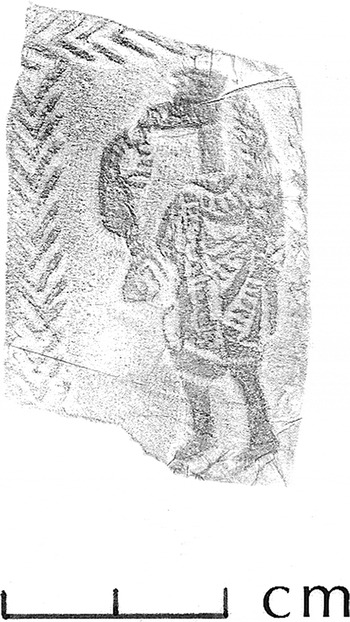
The Silchester sherd comes from a bowl of form Dragendorff 37 (fig. 7). It was recovered from the excavations carried out by the Society of Antiquaries between 1890 and 1909, and no closer provenance is recorded. It was not included in Thomas May's excellent but selective publication of the Silchester potteryFootnote 59 and was only recognised as a Spanish product when a full catalogue of the samian from Silchester was prepared for Reading Museum in 1997.Footnote 60 The surviving design consists of a panel bordered by straight bands of chevrons, containing an anthropomorphic figure of the jackal-headed deity Anubis. He wears a short tunic, decorated at the neck and sleeves, which shows his human hands, legs and feet, and carries a wreath in the right hand and a palm branch in the left. There are several images of Anubis in the Spanish repertoire,Footnote 61 but it is not possible to attribute this one to a specific workshop; it is probably of Flavian–Trajanic date.
Drag. 37 in terra sigillata hispanica from Silchester. Scale 1:1. (Rubbing by Joanna Bird, courtesy of Reading Museum)

CATTERICK (CATARACTONIUM)
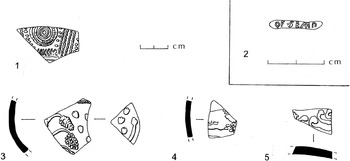
A small fragment of a Drag. 37 bowl (fig. 8, No. 1), unfortunately unstratified, was recovered from a context with the site reference ‘Area J and K Black U/S’, and identified as the product of a Spanish workshop from its very distinctive style of decoration.Footnote 62 The design consists of a small panel defined by four vertical wavy lines, with the panel probably being repeated round the bowl. It contains a pair of small plain roundels set in a corded double medallion, which is flanked by a vertical row of ovoid beads, with a band of horizontal chevrons below. The decoration is characteristic of the potteries at Tricio (Tritium Magallum) in the Rioja, in the Roman province of Hispania Tarraconensis,Footnote 63 and a date in the Flavian–Trajanic period is likely.
No. 1: Drag. 37 in terra sigillata hispanica from Catterick (after Hartley and Dickinson Reference Hartley, Dickinson and Wilson2002); No. 2: stamp on Drag. 33 from London (after Hartley and Dickinson Reference Hartley and Dickinson2011); Nos 3–4: Drag. 37 and No. 5: handle, possibly Drag. 39, from Little Woolstone (after Pengelly Reference Pengelly and Marney1989). Scale: No. 2 at 1:1, remainder at 1:2. (Drawn by Joanna Bird)

LONDON (LONDINIUM)
A further possible piece of Spanish samian comes from London. It was originally in the Guildhall Museum, without accession number, and is now in the Museum of London; no details of its findspot are known. It is a Drag. 33 cup, with a stamp reading OF.SEMP, and is assigned to the potter Semp˗ ii (fig. 8, No. 2). Hartley and Dickinson note that the fabric is ‘in the range for La Graufesenque, though the stamp itself looks remarkably like an Iberian one’, and cite a stamp illustrated by Mezquiriz de Catalan as a parallel.Footnote 64 They suggest a date range c. a.d. 70–100.
MILTON KEYNES
A Spanish source was suggested for four sherds from Little Woolstone, Milton Keynes (site MK109); they were recovered from a ditch (F12/44) which may have been recut and was broadly dated from the Belgic period to the late second century.Footnote 65 The sherds represent two or three vessels (fig. 8, Nos 3–5), comprising one or two small examples of Drag. 37 and a flat moulded handle fragment, identified as possibly Drag. 39. All are in a distinctive rather coarse orange-red fabric with eroded surfacesFootnote 66 and were noted by Hartley and Dickinson in their report on the Catterick piece.
fig. 8, No. 3, consists of two sherds from the same bowl, with a beaded border above a grape-vine, probably composed of individual bunches of grapes, fringed roundels or rosettes, and what may be a knobbed festoon. fig. 8, No. 4, has part of an animal, perhaps a lion, running to left, and may or may not be the same pot as No. 3. fig. 8, No. 5, comes from a flat handle, with fragmentary decoration of scrolls and stems. Pengelly wrote that the decoration on the four sherds ‘might suggest an origin at one of the Spanish production areas such as Rioja’, where there are similar curved motifs and bunches of grapes, and cited possible parallels illustrated by Mayet.Footnote 67 No. 4 (Pengelly's no. 30) was submitted for thin-section analysis by Maurice Picon at the Laboratoire de Céramologie at Lyon; he reported that the fabric was not a product of any of the known Spanish kilns and suggested it was more reminiscent of the products of East Gaul, possibly the Argonne.Footnote 68
While the size of the bowls is more characteristic of South Gaulish and Spanish examples of Drag. 37, there are parallels for the individual motifs among the East Gaulish potteries. Similar grapes were used, for example, by the Satto-Saturninus group at Chémery, at Lavoye in the Argonne, and by the ‘F-Master’ at Dinsheim-Heiligenberg,Footnote 69 while the festoon recalls smaller knobbed festoons, one of them composed of narrow crossed cornucopias, used at La Madeleine.Footnote 70 The possible lion is too incomplete for comparison. The flat handle fragment (fig. 2, No. 5) is noted as possibly form Drag. 39 and mould-decorated versions were made in the Spanish workshops.Footnote 71 East Gaulish examples of Drag. 39 are normally undecorated or decorated in barbotine technique, but other moulded handles have occasionally been recorded, including the handle of a patera with similar decoration from Dinsheim-Heiligenberg.Footnote 72 Although no precise parallels have been found, the motifs and the fabric analysis combine to indicate a probable origin for these sherds in one of the East Gaulish potteries rather than in Spain, with a likely date in the Hadrianic–Antonine period.
Apart from amphorae, which were traded for their contents, the only other pottery previously known to have reached Britain from Spain consists of a small number of fine colour-coated cups and beakers, occasionally decorated with rouletting but more usually with a variety of plant-derived and abstract barbotine motifs; these formed part of a relatively small-scale trade in fine wares from a number of potteries in Gaul, Italy, Spain and the Rhineland from the conquest period up to c. a.d. 75/80.Footnote 73 Their distribution is sparse and is mainly confined to southern Britain; the fabrics are consistent with an origin in Baetica, while there is evidence that they were transported in the same ships as Baetican olive-oil amphorae of form Dressel 20.Footnote 74 The sherds of Spanish samian ware make an interesting addition to this evidence for contact between Britain and Spain in the Roman period.
ACKNOWLEDGEMENTS
We would like to thank Brenda Dickinson and Hedley Pengelly for their help in preparing this paper and David Bird for reading and commenting on a draft of the text. Jill Greenaway at Reading Museum kindly checked the Silchester archive for any further information on the provenance of the Spanish sherd.