Most Australian universities are currently in the process of developing institution-wide responses to enhance Indigenous Australian content in undergraduate curricula. Approaches to this task vary from one university to another according to teaching models, capacity and institutional culture and history. One Australian university began this task by mapping how, where and why Indigenous perspectives, issues and content are included in undergraduate curriculum. This article reports on the findings of the mapping of Indigenous content and approaches to teaching at University of Technology, Sydney, (UTS) and thereby contributing a strengths-based approach to the task of developing successful ways to bring Indigenous perspectives and issues within undergraduate curricula.
Aboriginal Studies: ‘Them’, ‘Us’ or ‘Our’?
The development of ‘Aboriginal Studies’ as a discrete area of study varies across institutions. In many cases, the development of Aboriginal Studies has serviced ideological arguments for self-determination and self-representation. In the sandstone, disciplinary clustered universities, this often involved an arm wrestle with anthropologists for places like Aboriginal education centres to assume the role of teaching about ‘us’ from the 1990s. A decade earlier, in the 1970s and early 1980s, several training programs developed, largely disentangled from wider intellectual currents save for concerns to address disadvantage and the intellectual project of liberation and empowerment through education, to grow capacity among Aboriginal workers and create better educational and health opportunities for one's own people and community (see Norman, Reference Norman2004, Reference Norman2012). The University of Sydney Koori Centre (see Mooney & Cleverley, Reference Mooney and Cleverley2010), for example, assumed teaching an ‘Aboriginal Studies’ major formerly attached to the Anthropology Department (to much fanfare and furrowed brows); a decade or more earlier, they developed the training program for what were then Aboriginal Education Assistants (AEAs), who were based in New South Wales (NSW) schools; and the UTS developed an Aboriginal Adult Educators program to address the identified crisis in literacy and numeracy among Aboriginal adults. These programs, in turn, caused ripples in institutions — not least because they sponsored the presence of Aboriginal people and empowered Aboriginal people as agents of change. For example, from the 1970s, at the initiative of then Dean, Hal Wootten, the law school at the University of New South Wales created pathways for several leading Aboriginal activists to gain formal qualifications. While not immediately recruited to the academy, those individuals, as public intellectuals, challenged the prevailing discourse about Aboriginal people and shaped government, the judiciary and Aboriginal civil society institutions. Paul Coe, Gary Williams, Judge Bellear, and former head of the first Aboriginal Affairs department in NSW from 1980 and later Magistrate Pat O’Shane, and many others, are just a few names who serve to illuminate the presence of Aboriginal people in the academy at this time who were heading up the Aboriginal Legal Service, the newly created 1981 state government Aboriginal Affairs portfolio, and land councils.
From the late 1990s, the mandating of ‘Aboriginal Studies’ in undergraduate teacher education and some health areas by the relevant professions has seen those subjects taught between the faculty and the Aboriginal education centre. More recent developments in the higher education sector have seen the creation of senior executive leadership positions, such as Deputy Vice-Chancellor (Indigenous Strategy and Services) at the University of Sydney and Pro-Vice Chancellor (Indigenous Education) at The University of Queensland, among a few others. The presence of Indigenous leadership at the executive level has contributed to the move away from the Aboriginal education centre model to a more widely disbursed presence of Aboriginal people across the faculties, student support and external engagement areas. The teaching of ‘Aboriginal Studies’, while once thought best located within an Aboriginal space, is now mostly taught by Aboriginal academics in faculty settings in alignment with the relevant discipline and professional practice.
In the author's experience, the success of ‘Aboriginal Studies’ elective subjects, or suite of subjects that might constitute a major, is difficult to sustain. Often, we find our small cohort are made up of international exchange students from the north and from the humanities and social sciences, while students in other disciplines are confined by limited elective options and focused on subjects that maximise career opportunities. There are notable exceptions: academics at the University of Melbourne have developed a successful Australian Indigenous Studies Program that boasts high undergraduate enrolment, an honours program and higher degree research enrolment.
The relegation of Aboriginal content to elective subjects, professionally mandated subjects or courses specifically for Aboriginal undergraduates potentially leaves the overwhelming majority of undergraduates (at the author's institution at least) without any exposure to Australian Indigenous perspectives either in relation to their discipline, professional practice or notions of cultural competency. That is to say, it is largely unknown what (or how, or why) Indigenous content is introduced, and the strengths and lessons we might gain from understanding this further. The mapping of Indigenous Studies at the UTS that this article reports on unexpectedly revealed many innovative and interesting approaches to including Indigenous content and perspectives, and the challenges and limits. Before turning to elaborate these examples and approaches to embedding Indigenous perspectives and content, it is necessary to briefly canvass the discussion that has contributed to the development of an inclusive curriculum across the higher education sector.
Literature Review
From a national perspective, the most recent and comprehensive review of higher education flagged inclusive frameworks at institutions of tertiary education as crucial in increasing the number of skilled workers available within Australia and thus to increasing national productivity. Sounding a tone of caution for the future prosperity and global competiveness of the nation, The Review of Higher Education: Final Report (December 2008) notes that, ‘research commissioned for the review on future demand for higher education predicts that, from 2010, the overall demand for people with higher education qualifications will exceed supply’ (Bradley, Noonan, Nugent, & Scales, Reference Bradley, Noonan, Nugent and Scales2008, p. 9). The Bradley Review emphasised that targeting under-represented groups will be a necessary step in meeting demands for a qualified workforce:
To increase the numbers participating [in the acquisition of undergraduate qualifications] we must also look to members of groups currently under-represented within the system, that is, those disadvantaged by the circumstances of their birth: Indigenous people, people with low socio-economic status, and those from regional and remote areas. Participation by these groups has been static or falling over the last decade (Bradley et al., 2008, pp. xi–xii).
Indigenous Australians are considered one of the most under-represented groups in higher education in Australia, along with students from remote parts of Australia and students from low-economic backgrounds:
In 2007 . . . participation of Indigenous people was 1.3 per cent (compared with representation in the population of 2.2 per cent) . . . Given the projected shortfall in the number of suitably qualified people to meet Australia's workforce needs over the medium to long term, the failure to capitalise on the abilities of all Australians is a significant economic issue for the nation. It is also a matter of serious concern that individuals are discouraged from participating in, or denied access to, the economic and social opportunities which higher education provides. Some comparable countries have also become concerned about this issue and have recently improved their performance in this area (Bradley et al., 2008, p. 10).
Broadly, the national education situation suggested by the report is one of complex inequity for Indigenous Australians; according to measures of access, participation and representation, and success and retention, Indigenous student rates remain well below rates for non-Indigenous students.
For the purposes of this study, a crucial section within the Review of Higher Education report links under-representation, inequitable access, and low performance to the questions of knowledge production and valuation that ‘cultural competency’ frameworks aim to address:
Addressing access, success and retention problems for Indigenous students is a matter of the highest priority. Indigenous Australians suffer high levels of social exclusion. Higher education is one way of allowing them to realise their full potential. To do this, higher education providers must not only address their learning needs but also recognise and act on issues such as the culture of the institution, the cultural competence of all staff — academic and professional — and the nature of the curriculum. (Bradley et al., 2008, p. 33)
The Aboriginal and Torres Strait Islander Higher Education Advisory Council (ATSIHEAC) began the process of developing a framework for considering Indigenous curriculum issues from 2008. Grote's (Reference Grote2008) ‘Principles and Practices of Cultural Competency: A Review of the Literature’, prepared for the Council, is an essential resource for understanding the evolution of perspectives and strategies on the adaptation of Indigenous Australian-inclusive frameworks at the university level.
Of the three major factors that Grote cites as having been identified as ‘obstructions to the delivery of culturally competent services’, only the second factor appears to be able to be directly addressed by attention to resources or changes to curricula (such as the integration of Indigenous Australian perspectives and content):
1. organisations that fail to employ a sufficient number of personnel with culturally and linguistically diverse (CALD) backgrounds in influential positions and other staffing levels;
2. systems which are inappropriately orientated and designed to meet the needs of CALD clientele; and
3. practitioners or individual service providers who lack the skills to communicate and engage effectively with clientele who come from CALD backgrounds (Grote, Reference Grote2008, p. 15).
As Grote details, all three points are critically interrelated phenomenon: both as service providers (of education) and as institutions oriented towards the renewal of service providers (through the development of skilled professionals), every university will have to contend with these obstructions. As service providers, universities can look to their hiring practices, resources and curricula, and teacher training practices. Cultural competency frameworks, graduate attributes, and other embedded policies can prepare students to provide culturally appropriate services beyond the classroom.
A University of Western Australia (2011) report on an ‘Indigenous Cultural Competency Pilot Project’ opposes the competency-based approach, which ‘cultivate[s] a broader and sophisticated understanding of “culture” through applying a power-sensitive analysis’, to ‘traditional “trait-based” approaches that can have limited use when presented in a stand-alone format’ (pp. 3–4).
The pilot program is primarily aimed at staff members rather than students, and may be considered an example of a ‘non-integrated’ approach insomuch as the ‘Courageous Conversations about Race’ workshops, ‘Indigenous Dialogues’ workshops, and field trips take place beyond the bounds of normative institutional functioning for participating staff, academics, and faculty.
The parallel elements of the project's framework (learning and teaching) should not necessarily be considered to be complementary. Nakata, Nakata, Keech, and Bolt (Reference Nakata, Nakata, Keech and Bolt2012), for example, suggest that although ‘Indigenous Studies programs are generally managed by Indigenous academics and where possible are taught by Indigenous academics . . . demand often outstrips the availability of Indigenous academics. For this reason, there continues to be a high number of non-Indigenous academics teaching Australian Indigenous Studies courses’ (p. 122). This point goes to Grote's emphasis on the distinction between curricula-building and teacher training/resource availability.
The University of Western Sydney (UWS) set out ‘to develop and implement a learning and teaching framework for the new compulsory Indigenous Graduate Attribute’ (Badamani Centre for Indigenous Education, 2012, p. 11). The UWS Graduate Attribute is described as a ‘framework to enable . . . graduates [to] appreciate the culture of Indigenous Australia and gain skills for working productively with Indigenous communities’. The Report highlighted the learning outcomes in terms of ‘communication, social, cultural, leadership and partnership skills, which will assist graduates working and interacting with Indigenous Australians’ (Badamani Centre for Indigenous Education, 2012, p. 3). They identified the ‘flow-on’ benefits from the Project as recognition of Indigenous knowledge in teaching and research programs and improved support and outcomes for the University's Indigenous students from staff and other students.
There is no research that details quantitative and qualitative approaches to the inclusion of Indigenous content. The above reports refer to frameworks and, as Grote (Reference Grote2008) notes, although inclusive curricula built around cultural competency frameworks acknowledge the imperative to incorporate Indigenous Australian perspectives and content, ‘agreeing on exactly what constitutes knowledge and awareness of diverse cultures has generated considerable debate and contestation’ (p. 9). It is likely that this ‘contest’ also reflects the relatively newness of wider approaches to enhancing Indigenous-related content in undergraduate curricula. The apparent ambiguity may also be symptomatic of the difficulties that arise when generating an implementable policy within differentiated and multidisciplinary institutions. This ambiguity may also be understood to be a result of the future-oriented nature of this undertaking at institutional, regional, and national levels. Having said that, this article refers to research very much at the local institutional level and should be read as a contribution to not only the further development of initiatives at the UTS, but also to the wider discussion about the production of knowledge.
Mapping Indigenous Content Across the UTS
The ‘Mapping of Indigenous studies across the UTS’ was commissioned to inform initiatives as set out in the Indigenous Education Strategy 2011–2014 and UTS Strategic Plan 2009–2018. These initiatives are given specific detail in the UTS Indigenous Education and Employment Policy (IEEP). Under the IEEP this project specifically addresses ‘Objective 4’: ‘Develop Indigenous competency amongst its students by striving to create an environment in which all UTS students have the opportunity to gain knowledge of Indigenous Australians’ (UTS, 2013). The project's primary alignment falls within the above stated major initiative:
3.1: Expand the opportunity for students across UTS to gain knowledge of Indigenous Australians.
3.1b (Success Indicator): Development and maintenance of an across-UTS record of Indigenous studies subjects and Indigenous content. (UTS, 2013)
Methodology
There have been three stages to the task of mapping Indigenous studies/perspectives in the curricula: developing a dataset, distributing a survey, and in-depth interviews.
The initial phase of the project involved the development of a dataset of UTS subjects where course content description explicitly indicated some relationship with or focus on Aboriginal and Torres Strait Islander content. Research and data collection primarily occurred within the ‘detailed subject description’ available for most course listings within the online UTS Handbook 2013. A series of generic and discipline-specific research terms was used to search for Indigenous-related content; terms included ‘Aboriginal’, ‘Indigenous’, ‘Traditional’ (as in Traditional Knowledge), ‘Colonial’, ‘Native’ (as in Native Title), ‘Mabo’, as well as derivatives and others that yielded similar results. The dataset was checked against active and inactive degrees and courses to establish a final listing.
Due to the generic nature of the search, it was unlikely to comprehensively capture all Indigenous Studies content or the full range of resources and classroom activities that take place across the UTS. While initial data revealed very little about the classroom implementation of Indigenous-oriented content and perspectives, it assisted in the identification of potential interview participants and produced some insight into the ‘public face’ of Indigenous Studies at the UTS.
The next phase involved gathering more detailed descriptions of the qualitative implementation of Indigenous Studies. A survey was developed using the free online resource ‘Survey Monkey’ to request information from academics at the UTS regarding their current or potential use of Indigenous content and perspectives within their teaching strategies and curricula. This survey also invited interested participants to be interviewed on these matters. Following a request to the Meeting of Associate Deans (Teaching and Learning) in late October 2012, the Deans identified participants for the survey based on their knowledge of the resources and focuses of their faculty. The survey was also circulated on UTS Staff Notices.
Data from the survey are reproduced below, along with analyses of interviews with participants who agreed to speak more specifically on classroom implementation. Other interview participants were also recruited, based on their faculty role. These interviews were transcribed and are analysed below, lending vividness to the quantitative data collected in stage 1.
Indigenous Studies Mapping Project: Database
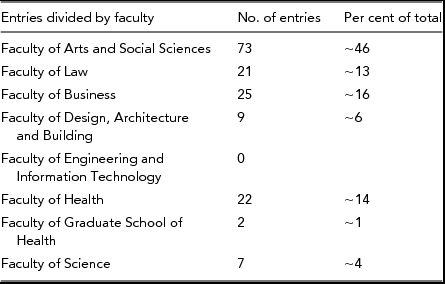
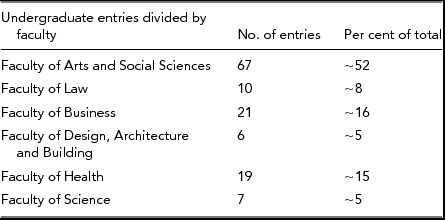
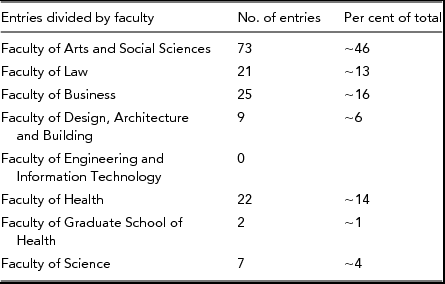
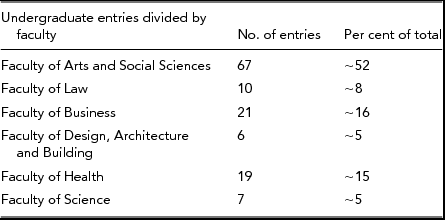
The first stage of the report involved the development of a dataset of UTS subjects where course content description explicitly indicates some relationship with or focus on Aboriginal and Torres Strait Islander content. However, subject descriptions do not comprehensively capture Indigenous Studies content or the range of resources and classroom activities that take place across the UTS. While interesting data have emerged, it tells us very little about the classroom implementation of Indigenous-oriented content and perspectives. In addition to assisting in the identification of research participants, this broad research has produced some insight into the ‘public face’ of Indigenous Studies at the UTS. The compilation reveals Indigenous-related content as it may appear to potential students or employees, or other organisations interested in programmatic structure of such content. The database currently contains 159 entries at the undergraduate and postgraduate levels (see Table 1) and 130 entries at the undergraduate level (see Table 2).
Faculties’ Entries in the Database at Undergraduate and Postgraduate Levels
Faculties’ Entries in the Database at Undergraduate Level
Purpose, Pedagogy and Professional Practice
This section of the report draws on responses by academic staff to a survey, and in-depth interviews with selected respondents. The self-selecting interview participants were from the Law, Health, Business, DAB, FASS, Science and EIT faculties. Twenty-nine survey responses were analysed and 19 in-depth interviews conducted with academic teaching staff across the UTS faculties. The in-depth interviews with colleagues were semi-structured, with emphasis on dialogue and critical reflection on approaches to the teaching of Indigenous Studies/perspectives/issues. I have chosen to use language that broadened discussion with colleagues rather than risk defining or prescribing the Indigenous Studies ‘project’ that colleagues were being asked to discuss and reflect upon. Therefore, in referring to approaches to teaching, I used the language ‘studies’, ‘issues’ and ‘perspectives’ so as to avoid defining the approach to teaching. Further discussion points raised included views on the skills required, with reference to specific areas of study, to develop competency in the Indigenous perspectives, studies or issues area; and issues encountered when teaching Indigenous Australian issues and perspectives. The transcribed interviews were then manually coded and themes identified.
The audit, survey and in-depth interviews revealed that Indigenous-related content and approaches to teaching Indigenous perspectives/studies/issues vary enormously across the disciplinary and professional practice areas of study at the UTS. The reason, or purpose for including Indigenous perspectives or content in curriculum was the key issue that emerged in the interviews. Academics highlighted how they include Indigenous perspectives, content, issues in the curriculum and barriers to this.
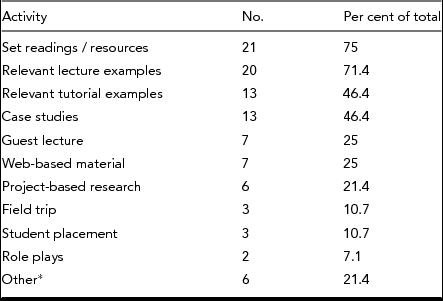
Aboriginal Studies/perspectives/issues find their way into the classroom in different ways, for different reasons. The survey showed that the inclusion of readings/resources and examples in lectures rated as the highest, followed by relevant examples in tutorials and case studies. Survey respondents nominated the activities that best reflected Indigenous-related content, perspectives or material in their teaching (see Table 3).
Activities Reflecting Indigenous-Related Content, Perspectives or Material
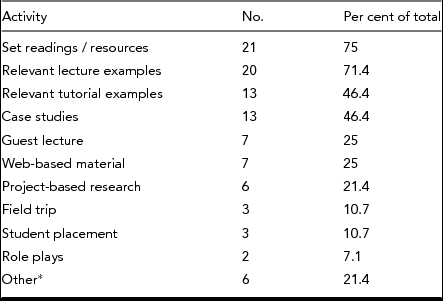
Note: *Film screenings, newspaper clippings, case study, debates and ‘life experience’ were nominated as reflecting the Indigenous Studies material, content or perspectives in the teaching.
The purpose or reason participating UTS academics include Indigenous perspectives, material and content in the curriculum was inspired by a combination of the following:
• to advance disciplinary knowledge;
• as critical preparation for professional practice; and
• to address social justice issues.
How participating UTS academics came to include Indigenous perspectives and material in their subjects reflects a host of influences. The predominant factor was experience as a practitioner (e.g., as a nurse, lawyer, Aboriginal health worker, teacher, land economist) before joining the academy. But this reflected more than a professional connection: they drew on their own life experience, personal connections with Aboriginal communities/family and field of research.
Therefore the purpose and the how and why for including Indigenous perspectives in teaching by UTS academics reflects the personal and intellectual and is informed by both practice and research. In contrast to all survey and interview participants, one respondent viewed Indigenous content as ‘not relevant to my subject material’ and the inclusion of Aboriginal-related content ‘lip-service to political correctness at the expense of content that contributes to the course aims’. The respondent argued ‘if students want Indigenous content, they should . . . take an Indigenous studies class’.
Advance Disciplinary Knowledge
For the purposes of this article, discipline refers to the academic area of study that incorporates types of knowledge, expertise, studies, approaches and research areas within a specific field. With the exception of subjects conceived of as ‘Aboriginal Studies subject’, that is, part of a submajor or mandated core in the curriculum (e.g., teacher education), Aboriginal Studies/perspectives was viewed as critically intersecting disciplinary knowledge. Participating academics spoke of Aboriginal content/perspectives variously functioning to decolonise knowledge, to provide anti-colonial critique, to contest historical narratives that underpin disciplinary traditions, to offer theoretical critique, and engage the politics of knowledge production. The inclusion of Indigenous material, perspectives and resources, and the disciplinary intersection this offers, was also seen in the context of social change: as generating new knowledge to improve social conditions for Indigenous people.
One colleague, teaching Arts Management in the School of Management, Faculty of Business (Hall completed her MA on ‘the Political Nature and Agency of Aboriginal Art’ and in her PhD examined historic sites of the colonial encounter in Central Adelaide; her research seeks to recast these historic sites from an Indigenous perspective and understanding of sites with the view to reconciliation) explains her approach to teaching Aboriginal perspectives as an ‘integrated approach’. (The subjects included Dr Hall's reflections on her approaches to including Indigenous content in the subjects Arts and Cultural Industries, Arts Organisations Management, Arts and Cultural Policy, and Popular Culture and the Experience Industries. ‘Experience industries’ refers to the change from a manufactured, purchased goods to purchased services — leisure in particular — and the purchase of experience). She explained in an interview: ‘Indigenous art culture is of particular interest and should be taught for a whole range of social, political reasons . . . but for the arts it should be taught because it's one of the most vibrant parts of the arts sector.’
For this colleague, she ‘saw [her] role as being able to position Indigenous cultural practices and artists within the larger industry. . .’. The ‘integration’ approach sees her bring Aboriginal content into her teaching because, as she argues, Indigenous art is critical to the field. She explained this in the interview:
I’m not teaching any Indigenous subjects . . . I’ve chosen to put Indigenous material, teach Indigenous perspectives, promote Indigenous art and culture, because, [the] Indigenous arts sector is one of the most vibrant areas of arts in Australia. It's incredibly distinctive. It's being drawn upon all the time from tourism to government soft-diplomacy . . .
In this configuration, the Aboriginal art sector is viewed as central to the Australian art story and therefore content is absolutely necessary. Indigenous content also brings critical perspective to bear on any consideration of building audiences, disenfranchised audiences, and issues of access across a range of areas.
Similar views were shared by law academics interviewed for this research. Undergraduate legal studies does not include specialised Aboriginal-focused subjects, although in at least two subjects the inclusion of Indigenous material is substantial and reflects the particular interests and concerns of the subject coordinators. For example, for the subject ‘Perspectives in Law’, Indigenous-relevant topics are covered over the semester in three ways: the intersection of Indigenous law and the English legal tradition, contemporary social justice issues and the law, and in relation to access. A host of teaching strategies and resources are used, and for the most part, Indigenous perspectives as knowledge and social justice enrich and deepen students’ understanding of English law.
Another colleague teaching in property economics makes a very similar argument: he takes as a starting point that any focus on land, property, ownership, value and property rights in Australia must, by necessity, include Aboriginal and Torres Strait Islander perspectives. In his teaching he seeks to ‘broaden their horizons; to force them to look at different interpretations and perspectives on land . . . vis-à-vis the supplanted western perspectives of freehold culture that prevails in the city’. The central idea was that ‘Aboriginal perspectives on land expose the traditions that underpin concepts of property and the particular land regimes in Australia’.
Deborah Szapiro, working in animation in the Design school explained that she wants students to think about Indigenous Australians and Indigenous perspectives worldwide. Szapiro posited that the Western animation model, with the individual director/producer at the centre, is disrupted by Indigenous community-centred animation projects. In her view, rather than the work of an individual, emphasis on collaboration and (often across generations) story telling about people and place is what characterises Indigenous animation. Animation in Indigenous community settings is often about using the medium to share information.
These examples were repeated in interviews with many academic colleagues: they asserted that the inclusion of Indigenous perspectives serves to not only create greater awareness of Indigenous issues, but also challenges conceptualisations of disciplinary knowledge.
Pedagogy
All of the research participants spoke not just of purpose, but how. How colleagues approached teaching Aboriginal issues, perspectives or studies revealed a complex interplay between choice of examples, of careful consideration of one's speaking position, and careful attention to building respectful relationships in the classroom. Several academics, mostly Indigenous academics teaching elective and core Aboriginal Studies subjects, spoke at length about their concern and sensitivity in relation to the learning environment, and sensitivity to ensure topics facilitated constructive conversations that struck a suitable balance between ensuring the safety of students and avoided causing distress or confrontation for students. Sensitivity about the choice of materials was mostly in relation to ensuring that all students, Aboriginal and non-Aboriginal, were able to confidently and constructively engage in dialogue.
Continuing the theme of creating safe learning environments, non-Aboriginal academics highlighted efforts to discourage the assumption there were no Aboriginal students in class. That is, to encourage students to be more sensitive of the feelings and the likely presence of those often referred to as ‘them’. This point also necessarily brings Aboriginal students into the discussion. However, it was also acknowledged that Aboriginal students should not be expected to be the font of all things ‘Aboriginal’.
Whereas Aboriginal academics spoke about the importance of creating safe learning environments, several non-Indigenous academics highlighted their unease in introducing or speaking knowledgeably about Indigenous material or perspectives. They spoke about this perceived difficulty in two ways. One was in relation to speaking position and the other in relation to how they perceived the students’ interest in authenticity of experience and perspective.
Several academics highlighted the importance of Aboriginal ‘voices’, resources and authored material as critical to bringing Indigenous perspectives to the classroom. This account was not limited to non-Aboriginal academics, but rather referenced the importance of ‘first-hand’ exposure to Indigenous perspectives and experience, which could take the form of guest lectures by Aboriginal academics or professional/community experts and other similar experiences through field trips and placements. Colleagues highlighted what they perceived as a yearning from students to hear less academic analysis and rather experience affect through first-hand testimony.
Several academics highlighted similar points and two mentioned student feedback, where the point was raised that Indigenous people should be teaching Aboriginal content or issues. However, this assertion was also disputed by some academics. For example, a lecture and tutorial focus on ‘Indigenous customary law’ does not mean a class on that topic — it is more an investigation of its interaction with the dominant legal system. That is to say, the content is less focused on ‘Indigenous issues’ as such.
Aboriginal academics all highlighted in their approach to teaching Aboriginal Studies elective and core subjects the importance of ‘safety’. They all spoke of the strategies they brought to the classroom to ensure ‘learners feel safe’. This included careful choice of resources ‘so it isn't always confrontational’. One academic said ‘we don't deal directly with issues that might be sensitive’ for Aboriginal students with lived experience of removal, for example, and for non-Aboriginal students to also feel safe and not ‘blamed’ or marginalised in the classroom. Aboriginal academics coordinating Aboriginal Studies subjects emphasised strategies to actively engage students — such as through classroom debates, small group discussion, use of a variety of media, and bringing humour to the classroom. Aboriginal academics who were interviewed all emphasised careful consideration of the possible hurt or sense of exclusion that non-Aboriginal students may feel when discussing Aboriginal issues. This sensitivity about inclusion was expressed in part in the following: ‘. . . we all have a connection to place, even if it's a different connection. It might not be the same one but we all have it, we all identify something as being home’.
The discussion, based around Aboriginal Studies subjects, both core and elective, emphasised ‘moving privilege’, ‘transformation’, ‘challenging long held views’, and ‘appreciation of different perspectives and voices’. Another Aboriginal Studies teacher emphasised the importance of students hearing a ‘mixture’ of voices between academic and ‘community’ arguing: ‘I think [students] do want to hear community voices’, and further, ‘I think it's easier to break down an issue if somebody's actually dealing with it, if somebody's involved in a land rights dispute and they come in and talk about that . . . first hand’ and also added, ‘but you still need the academic interpretation’.
While the definition and the possible contest over who and what is a ‘community’ member in many settings is contested, the intention in the context of the teaching of Aboriginal Studies for this particular staff member is clear. She elaborated:
A community voice is where you’re at the coalface, and you can convey to students the passion and provide an insight to the students that they won't get from texts, so there's something about an emotional, intimate exchange that takes place when you hear from someone who is immediately impacted.
In another setting, a science colleague teaching in the Nursing program in consultation with his Aboriginal health academic colleague developed an Aboriginal-specific case study. The case study involved a very brief profile: name, personal history and what the patient presented with. Students were asked to chase up further details in order to elaborate on the few facts they were given. The case study, one of several throughout the subject, was designed to develop the students’ understanding of the fundamental physiological and anatomical basis of disease, along with the drawing out of the particular circumstances of disease for different social and cultural groups. This case study was of a 36-year-old woman patient, ‘Chris Saunders’, who has had diabetes for 10 years. In conversation with the health professionals, she mentioned that her doctor is at the AMS.
It is assumed that students are familiar with the Aboriginal Medical Health Service (AMS) and if they are not the tutor is on hand to explain. The patient presents with symptoms consistent with kidney disease and students are required to demonstrate their understanding of the disease by the way they appropriately test and diagnose. A small and critical piece of information is the patient's age: she is awfully young to have kidney disease. The purpose of the case study, in alignment with the subject learning objectives, is to understand disease. By incorporating a case study with challenging demographics, the case study developers aspired to ‘plant a seed’. While the case study developers acknowledged that the teaching staff don't have the expertise, the time or the brief within this subject to unpack the wider social, political, historical context, they anticipate the character they have created through the case study will ‘reappear’ in other subjects for wider critical discussion. But at this stage the age difference and the Aboriginal health service and hospital support services will be considerations in responding to disease management.
One law academic also emphasised classroom activities. In previous offerings of the subject, students debated recognition of Indigenous customary law. A more useful and less polarising approach was subsequently taken where students discuss together the pros and cons rather than having the class pitted against one another and a definitive answer arrived at. Critical classroom dialogue encouraged more complex analysis. One difficulty identified was the limitations of resources; in this example:
. . . trying to find more metropolitan material to get students away from thinking that it's only an issue for the Northern Territory or Western Australia and to think about Indigenous law operating in a contemporary sense . . . but it's hard to find examples of those sorts of things [aside from] circle sentencing.
One means by which non-Aboriginal academics introduced material and perspectives into their curriculum was through reference to their professional practice. Several academics spoke at length about the success of bringing examples from their own professional practice into the classroom.
Professional Practice
The majority of research participants highlighted the link between their professional practice or industry experience and curriculum design. This was particularly highlighted in terms of being able to draw on professional practice experience as examples in lectures and tutorials. Academic staff observed that students particularly appreciated the ‘real life’ examples as both highlighting the relevance for their future career and because these examples provided an ‘authentic’ access point to Aboriginal experiences. In this, ‘authentic’ referred to the difference between ‘book knowledge’ and ‘real world experience’. Academics reported a sense of confidence when drawing on examples from their own professional experience and sense of being able to confidently and authoritatively provide students with ‘real life’ accounts.
Using examples from professional practice modelled how students could make the link between disciplinary knowledge and their future career. One academic explained, ‘because of the work that I’ve previously done it's a lot easier for me to draw on examples that I already am very familiar with’. Another health academic explained her approach to including Indigenous content in the palliative care subject. With reference to resources developed for undergraduate teaching, the approach was to draw on two stories from her clinical work. In the case studies, the service where she worked was aware of the limited referrals of Indigenous clients despite the fact that she was working in a rural area with a higher than national average of Aboriginal residents. Her service investigated why there was limited uptake of the palliative care service and went on to hold a number of community forums. This example in the context of teaching is taken up as an example of community engagement. She shares with students the insights and observations she arrived at through the consultations. These extended to understanding the legacy of institutionalisation and the perception that palliative care removed loved ones from a caring family environment. The account of the community consultation highlights how conversations, the process of explaining how palliative care works, ‘changed all of our relationships dramatically . . . and it was all from a conversation’.
The recounting of the experience of the consultation process contains multiple lessons for students; at the least, the importance of opening up conversations, strategies for community engagement, and critical reflection about the sorts of assumptions practitioners might make. She felt students were really engaged and were able to comprehend the approach. This was evident when she reflected on the fact that students ‘would have liked to talk about it for an awful lot longer and the students themselves were talking about the fact that they felt pretty under confident in how they would manage some of those conversations and how they would work’.
Skills
Academics were keen to highlight the skills they viewed as necessary to deal meaningfully and respectfully with Aboriginal people. These skills included knowledge of and the ability to seek out local Indigenous communities and organisations, and the ability to sensitively and confidently consult with the relevant local Indigenous community.
In the Law faculty, academics interviewed highlighted more generalist skills:
To develop the understanding that everybody has a culture. Starting with that preliminary idea that whatever classroom — whether we’re talking about Indigenous issues or culture, linguistically diverse issues or whatever, or the law itself. We tend to think about the law as not having a culture and yet it does. It has a very specific culture. I’d really like them to take that from this subject that the law has a particular culture and hence it operates in a particular kind of way with people from different backgrounds.
In the realm of animation, it was argued Indigenous animation offers a new way of doing and thinking about the production and purpose of animation. The use of Indigenous animation in the classroom was viewed as a ‘two-way’ process that needs to be grounded in fostering collaborations between the university and community and the inclusion of material that may come from that collaboration in the classroom.
Barriers to Including Indigenous Perspectives and Material
One colleague, from Law, spoke of her ‘surprise’, at least initially, at ‘student resistance to Indigenous content’; however, as Indigenous material became a significant component of the assessment, students were more motivated and engaged.
Similarly, in Property Economics the lack of interest in Indigenous content was lamented. The subject coordinator reflected that a small number — about five to six students per year — actually think, ‘this is an area of property which I didn't know existed, an area I would be interested in finding out more about or pursuing a career’. Of the vast majority, a level of cynicism among the student cohort when Indigenous land concerns are discussed was observed: ‘. . . there's always a rumble in the classroom, there's always some backchat’. Another take on the student learning process:
It's probably one of those subjects that students won't necessarily have a full handle on why they’re doing it . . . they don't get why they’re doing it so much when they’re 21, but it will really dawn on them, maybe, when they’re 31 or 41 and they start to think about the world a little bit differently.
Several colleagues spoke about their anxiety and perceived lack of skills in their approach to teaching. This was also reflected in professional practice, although with important lessons. As one nursing colleague highlighted, the anxiety among health practitioners in dealing with Aboriginal-related issues is also evident in the academy. She cited an example of a medical doctor she invited to address Aboriginal health workers and the Aboriginal Medical Service about pain management. She recalled him confessing to her that ‘he had never felt so nervous’ and was deeply fearful that he would ‘say something wrong’. The ‘fear’ that was felt and witnessed among health professionals is also shared, in her account, by health academics. She says, ‘There's always a huge willingness and wanting to do this well, but there's definitely a fear from the non-Indigenous members to say, Well how am I going to do this and do it well?’ The Nursing academic cited her professional experience as being assisted by open and honest dialogue with Aboriginal health professional colleagues who offered guidance and support in her dealings with Aboriginal communities.
As the Nursing program develops curriculum to support the Indigenous graduate attribute for Indigenous professional cultural competency, the project leader explained that the feedback is ‘definite willingness to try and make this real and happen across all the curriculum, but there is a real worry about how to do it in an appropriate way, and a really respectful way . . . people are worried about language, about getting the language right’. She concludes that ‘we can . . .but we do need support and guidance on how to do it in a really optimal way’.
Another participant, an Arts manager and academic, highlighted the difficulty regarding effective teaching, such as working with Aboriginal people outside the context of experience, exposure, friendships, and working relationships. She says:
How on earth do you teach the complexities of Aboriginal life in terms of how things might be negotiated or the particular pressures upon Indigenous people in the way that they operate more broadly? I think it must start with education and it must start with people developing ordinary relationships with others, seeking them out and opening [your own eyes].
A Law faculty academic who was interviewed said that a practitioner, who, for example, is working with a mining company and is needing to understand Indigenous land: ‘. . . the principle skill that you would need is the ability to translate in a cross-cultural setting’. Second, she argued, ‘law students are encouraged to think that law is a homogenous body, but really it's not’; she says students ‘have to understand there's such a thing as non-translatability . . . that there are just features of Anglo-Australian law that are antithetical to Indigenous Australian law’.
Conclusion
The majority of academics interviewed for this project have pursued the embedding of Indigenous content in their subjects as interested individuals with a sense of the intellectual project and the professional skills graduates will require in order to positively and effectively work with/for Aboriginal people. They have drawn on examples from their own experience in the field and their research. In this sense the content is driven by the interest, passion and commitment of individual lecturers. However, there is no guarantee that Indigenous material or content will continue to be included once that interested individual is no longer coordinating a subject. In other instances, academic staff cited disinterest from the student body, anxiety among colleagues to confidently teach Indigenous material, limited scope to assess Indigenous-related content, and shortage of quality resources and curriculum building guides.
As universities move closer towards enhancing Indigenous-related perspectives, and content more generally, the identification of local level champions will be critical to this new chapter in the development of Aboriginal Studies in the academy. The clear link that this research identifies between professional practice, research interests and teaching Aboriginal content highlights the importance of recruitment to advancing graduate attribute projects. The research also highlighted the focus of Aboriginal academics in the teaching of Aboriginal Studies subjects, and the emphasis placed on pedagogy. There was limited emphasis on links between engaging or developing Indigenous scholars in discipline areas outside of Aboriginal Studies or in relation to professional practice.
This mapping of curriculum at UTS has been useful in identifying interested academics, to build networks and momentum for productive conversations about pedagogical, professional practice and disciplinary approaches to create change as opportunities arise. Networks such as those funded by the Office for Learning and Teaching (OLT) and, in particular, the Australian Indigenous Studies Learning and Teaching Network, are critical forums for sharing experiences beyond the local institution and advancing Indigenous scholarship.
Acknowledgments
Eddie Hopely worked as an extremely capable research assistant with the author on this project. The mapping research was funded by the Office of the Deputy Vice-Chancellor and Vice-President (Teaching, Learning and Equity), the University of Technology, Sydney, Professor Shirley Alexander.
About the Author
Dr Heidi Norman is a Senior Lecturer in the Communications Program at the University of Technology, Sydney. Her research area is Australian Indigenous Studies (land rights, politics, cultural values, economic development, and sport); politics, history and Australian history. Her work has included a political history of the New South Wales Aboriginal Land Rights Act, the New South Wales Aboriginal Rugby League Knockout and tertiary Aboriginal Studies. She is a descendant of the Gamilaroi nation of northwest New South Wales.