Introduction
In an era of profound economic distress, economic interdependence, and rapid technological change, the social, economic, and political integration of marginalized populations is a topic high on the agenda of European societies and contemporary democracies writ-large. In the specific area of employment, European governments, including the European Union (EU), have recently come to advocate the use of active labor market policies (ALMPs) to enhance the efficiency of labor markets and to foster social cohesion. But do ALMPs work? And what does it mean for them to ‘work’?
Active labor market policies are designed to help people find and hold on to jobs. By influencing the market behavior of individuals,Footnote 1 especially of those marginal to the labor market, they are intended to produce desirable macroeconomic outcomes, such as lower wage pressures (lower wages in equilibrium) and lower unemployment and vacancy rates.Footnote 2 Though these presumed economic effects of ALMPs have become a primary focus of debates among political economists and policymakers, the narrow focus on labor market behaviors and outcomes neglects the important role that such policies can play in shaping other desirable outcomes.
Based on a broadened conception of how labor market policies shape behavior, I argue that ALMPs enhance social cohesion by enhancing people’s opportunities and motives to interact with social others. Because ALMPs improve social ties and perceptions of social inclusion, the consequences of labor market policies for society and polity thus go beyond their economic role in managing labor market outcomes and also help to sustain a healthier, happier, and socially connected society. Put simply, by improving the private lives of labor market outsiders and those they interact with, they provide significant positive externalities that are typically overlooked by analysts.
By examining the connections among welfare policies, labor market status, and private social behavior, this study provides a novel and broadened lens for understanding what it means for public policies to work. This lens combines elements from several hitherto unrelated literatures on the comparative political economy of labor market policies, the impact of public policies on citizen behavior, and the study of social ties. Viewing policies through this lens means paying systematic attention to policy feedback on mass publics; it also broadens the theoretical frame of this perspective by developing a systematic conception of the micro-level consequences of policies for people’s private lives, rather than exclusively their political behavior. Specifically, this conception is based on the idea that labor market policies have systematic effects on psychological processes and social interactions that are connected to, but also more multifaceted than labor market behavior narrowly defined.
Based on data measuring states’ spending on ALMPs and people’s social behavior collected in 17 European countries in 2002–03, the analyses reveal that states’ investment in labor market policies shape citizens’ social lives in systematic ways. Individuals in countries with a greater commitment to ALMPs report more extensive social ties and a reduced sense of social exclusion than individuals in countries that spend less on such policies. These positive consequences of ALMPs are not of equal magnitude across all individuals, however. In particular, the results show that the positive impact of labor market policies on the breadth and depth of people’s social ties as well as people’s perceptions of social inclusion is more powerful among individuals who are labor market outsiders.
The paper proceeds as follows. The next section discusses the political, psychological, and economic dimensions of (un)employment and labor market policies, and develops a model of how labor market policies can affect people’s social lives. I subsequently examine the effects of ALMPs (at the level of countries) and people’s experiences in the labor market (at the individual level) on reports of social embeddedness. The final section discusses the findings and suggests future avenues for research on unemployment and labor market policies in the industrialized democracies.
The politics of unemployment and active labor market policy in Europe
Unemployment has long been a key challenge for policymakers in modern market economies, largely because it constitutes a profoundly distressing experience that produces considerable individual and collective costs and important political consequences. These consequences have long worried European governments, at least since the days of the Great Depression and Germany’s descent into fascism. And although Europe experienced prolonged periods of close to full employment in the aftermath of World War II, joblessness started to rise yet again in the second half of the 1960s and continued to rise well into the 1990s.
As a result, European voters have consistently placed unemployment at the top of the list of their countries’ most pressing problems. This concern is sensible in the eyes of political scientists, as the fortunes of governments and the legitimacy of political systems are thought to be rooted in the material well-being governments can provide for their citizens.Footnote 3 As a consequence, researchers have long sought to understand the political determinants of variable unemployment rates across countries and over time (cf. Iversen and Soskice, Reference Iversen and Soskice2006a).Footnote 4 As part of this research agenda, scholars in recent years have also started to focus on understanding the impact that specific policy instruments have on employment patterns, regardless of the partisan color of governments that implement them.
Policymakers and scholars alike have become particularly interested in the design and efficacy of labor market policies to remedy shortcomings in the labor market, in particular by states facing international competition (Garrett and Lange, Reference Garrett and Lange1991; Boix, Reference Boix1998). The EU’s systematic attempt to coordinate labor market policies in the form of the European Employment Strategy is but one of the more recent signs of this increased interest in the efficacy of labor market policies.Footnote 5 The general category of ‘labor market policies’ has come to be differentiated into ‘active’ and ‘passive’ labor market policies. ALMPs aim to improve the chance of employment or earning prospects for individuals who have difficulty entering or remaining in the labor market; passive labor market policies aim to provide income support (replacement income) to the unemployed or early retirees absent the attempt to directly improve labor market performance.Footnote 6
Though the political factors shaping the incidence and kind of labor market policies in the OECD countries are by now fairly well understood (e.g. Janoski, Reference Janoski1990, Reference Janoski1994; King, Reference King1995; Boix, Reference Boix1998; Swank and Martin, Reference Swank and Martin2000; Martin and Swank, Reference Martin and Swank2004; Rueda, Reference Rueda2005, Reference Rueda2007), the question of whether they actually achieve their desired ends through various interventions in how people learn skills or search for jobs remains open to debate. Specifically, political economists have vigorously debated the question of how best to measure and evaluate the implementation of labor market policies – that is, whether labor market policies work as designed, or work at all. The primary aim of such studies has been to ascertain the consequences of various policy schemes for employment and wages both at the macro-level of aggregate economic outcomes and the micro-level of individual workers (see, e.g., Jackman et al. (Reference Jackman, Pissarides and Savouri1990), Layard et al. (Reference Layard, Nickell and Jackman1991), Calmfors (Reference Calmfors1994, Reference Calmfors1995), Jackman (Reference Jackman1994), Calmfors and Skedinger (Reference Calmfors and Skedinger1995), Scarpetta (Reference Scarpetta1996), Nickell (Reference Nickell1997), Elmeskov et al. (Reference Elmeskov, Martin and Scarpetta1998), Nickell and Layard (Reference Nickell and Layard1999), Calmfors et al. (Reference Calmfors, Forslund and Hemström2004), Bradley and Stephens (Reference Bradley and Stephens2007); see also the reviews in Heckman et al. (Reference Heckman, LaLonde and Smith1999) and Kluve et al. (Reference Kluve, Card, Fertig, Góra, Jacobi, Jensen, Leetmaa, Nima, Patacchini, Schaffner, Schmidt, van der Klaauw and Weber2007)).Footnote 7
Analyses of the impact of labor market policies on economic outcomes are based on common and straightforward assumptions about individuals’ (and firms’) behaviors. Put simply, the underlying idea is that policies shift people’s incentives to acquire new skills, look for a job, or register for placement services, and that they act on firms’ incentives and opportunities to hire additional or new workers. A number of micro-level studies have examined whether these assumptions are in fact warranted by establishing, for example, how individuals’ participation in specific active labor market programs (training, job-search assistance, placement, and so on) affects their employment and earnings after leaving the program.Footnote 8 Suffice it to say for present purposes, and to summarize what has become a voluminous literature, the results are mixed at best and frequently contradictory. Though some studies conclude that ALMPs lower the natural or equilibrium rate of unemployment or real wage pressures, others report no such effects. Similarly, studies of specific programs in individual countries, both at the macro- and the micro-level, come to quite varied conclusions about the efficacy of specific programs for labor market outcomes.Footnote 9
Though this is not the place to judge the macro- and micro-economic effects of labor market policies writ-large, it is clear that policymakers have paid increasing attention to these policies because they see them as critical ingredients for creating jobs and filling them more effectively – in short, because they assume that policies matter for macro- and micro-economic outcomes. More importantly for present purposes, a key assumption underlying the presumed impact of these policies on the economy is that they affect individuals’ attitudes, skills, and behaviors, and that this, in turn, ensures a more effective and efficient functioning of labor markets. Thus, despite differences in findings, virtually all studies on the consequences of labor market policies focus narrowly on how they influence economic outcomes.
Jobs and full employment are clearly important in and of themselves, and critical yardsticks for assessing the efficacy of labor market policies. At the same time, it is important to note that European policymakers also have come to see creating jobs and preventing joblessness as a means to another end: social cohesion.Footnote 10 In 2005, the EU Council specified and integrated guidelines for developing policies aimed at enhancing growth and job creation. These included, very explicitly, the importance of implementing employment policies that were aimed at strengthening social cohesion and inclusion. The EU’s explicit expression that the desired effects of ALMPs go beyond the labor market itself is not new. In fact, across the OECD countries, the provision of ALMPs is typically justified on both efficiency and equity grounds by policymakers (Machin and Manning, Reference Machin and Manning1999), as ALMPs target the long-term unemployed and those most disadvantaged in the labor market. Put simply, policymakers often see ALMPs as a means to achieve multiple ends: creating and sustaining social ties and inclusive societies as well as effective and efficient labor markets.
This emphasis on social cohesion in the design of the European Employment Strategy implies that policymakers also expect or least hope that the effects of ALMPs extend beyond the labor market and have a positive influence on people’s social lives. Whether this is indeed the case, is an open question. Though some political economists have noted that there is a social dimension to unemployment and participation in labor market policy programs (e.g. Raaum et al., Reference Raaum, Torp and Zhang2002), to date, assessments of the impact of ALMPs that take social and not purely economic effects into account simply do not exist (Kluve et al., Reference Kluve, Card, Fertig, Góra, Jacobi, Jensen, Leetmaa, Nima, Patacchini, Schaffner, Schmidt, van der Klaauw and Weber2007).
ALMPs and social behavior
Thinking about the potential effects of ALMPs on social relations means conceptualizing their effects broadly and beyond the confines of the labor market per se. Speaking generally, social relationships are typically distinguished with regard to their existence, number, frequency, and nature. Social integration (or isolation) refers to the existence or quantity of social ties or relationships: ‘A person’s degree of social integration/isolation is a function only of the number of relationships s/he has with other people or the frequency of interaction with those people’ (House et al., Reference House, Umberson and Landis1988: 203).Footnote 11 Aside from the existence and frequency of interaction, researchers also distinguish the nature of the relationships with an eye toward ‘relational content’, which refers to the functional nature or quality of social relationships, such as social support, which pertains to the positive, potentially health promoting or stress-buffering, aspects of relationships such as instrumental aid, emotional caring or concern, and information (1988: 302). Finally, scholars of social ties have distinguished between actual and perceived social ties to characterize the quality and quantity of social embeddedness (Barrera, Reference Barrera1986).
How, then, do active labor market programs come to shape social ties?Footnote 12 Though the documented consequences of social integration and support are manifold, the literature on the antecedents of social integration is relatively sparse and holds few clues. This literature has traditionally focused predominantly on biological, psychological, and socio-structural factors, conceptualized and measured at the individual level to explain the existence and nature of social ties. In addition, some researchers have examined what role the characteristics of communities play (for a classic review of the literature, see House et al. (Reference House, Umberson and Landis1988)).
Though public policies are curiously absent from existing research on factors that shape social ties, there is good reason to assume that they matter (Pilisuk and Minkler, Reference Pilisuk and Minkler1985). And even though political scientists have not typically sought to examine how public policies and social behavior are connected, they have trained their sights on the nexus between policy and political behavior. In particular, they have asked why and how government programs and public policies affect civic and political engagement (for a review, see Mettler and Soss (Reference Mettler and Soss2004)). This research program on policy feedback effects has been focused mostly on the USA, with a focus on specific government programs such as Social Security, benefits for military veterans, as well as means-tested social programs (e.g. Soss, Reference Soss1999; Mettler, Reference Mettler2002; Campbell, Reference Campbell2003). Outside of the USA, Sweden has been a well-examined case, with a focus on the differential impact of universal and targeted programs on political behavior (Kumlin, Reference Kumlin2004; Kumlin and Rothstein, Reference Kumlin and Rothstein2005).
We build on this emerging research program here. The general notion underlying studies on policy feedback is that the designs of policies shape people’s attitudes toward government, their partisan and ideological orientations, and patterns of political participation (Campbell, Reference Campbell2008).
Thus, if public policies indeed have feedback effects for political behavior, and if ALMPs affect how people spend their time or think about themselves and their work, as economic studies assume and as I will argue below, then there is also good reason to assume that the effects of such policies may go beyond narrowly defined and specific labor market-related attitudes and behaviors. In fact, as I will argue and demonstrate below, public policies, such as labor market programs, have significant and systematic effects on people’s social lives, both among targeted populations and those they come in contact with.
Effects of ALMPs among labor market outsiders
Existing studies of the effects of labor market policies typically focus on the labor market behavior of specific target groups (the unemployed, or particular groups of the unemployed or underemployed, such as younger, older, or less-skilled workers). For a useful conceptual and empirical shorthand, and following recent work on labor market status and political behavior (cf. Svallfors, Reference Svallfors2006; Rueda, Reference Rueda2007), I label individuals in these groups labor market ‘outsiders’ (and others ‘insiders’). Who is included in these groups can vary by specific programs, but inevitably, individuals who are unemployed, underemployed, or otherwise precarious in the labor market – that is, without secure employment – are included.Footnote 13
Active labor market programs such as training schemes are intended to elevate the skills profile of outsider groups, and job placement services are intended to enhance the efficiency of matching processes of demand and supply in the labor market for specific individuals. At the level of individual workers, these programs are expected to affect incentives to act in a particular way. Specifically, expectations about the effects of ALMPs are based on the presumed differences in utility between the two labor market states of employment and unemployment that are at the heart of economic models of job search and skill acquisition (e.g. Oswald, Reference Oswald1986; Devine and Kiefer, Reference Devine and Kiefer1991). Such models presume that lower levels of subjective well-being among the un- or underemployed leads to discouragement, lower levels of skill acquisition, inferior performance in job interviews, and eventually a lower probability of job offers and successful job searches. In the long run, this is expected to decrease effective labor supply and concomitantly produce higher wage levels and unemployment rates in the economy (Layard et al., Reference Layard, Nickell and Jackman1991; Darity and Goldsmith, Reference Darity and Goldsmith1996). ALMPs are expected to counteract these negative psychological effects of outsider status by reducing people’s labor market insecurity and increasing the efficacy of job search behavior (Oswald, Reference Oswald1986; Devine and Kiefer, Reference Devine and Kiefer1991; Carling and Richardson, Reference Carling and Richardson2004).
Though this is certainly plausible, the question at hand is whether labor market policies also shape behaviors that are not directly related to the labor market. I posit that they do. To begin, I assume that people’s actions are the result of their (individual-level) characteristics and predispositions (here, their willingness or ability to be involved socially), as well as the situational constraints that affect the odds that they will act on their predispositions. Translated into the context of this paper, I posit that labor market policies affect the social behavior of target groups in two ways: first, they affect people’s motives to be involved socially with others; and second, they shape people’s opportunities for interaction with social others.
First, defining motives broadly to encompass people’s predispositions to engage social others, ALMPs are expected to reduce the psychological burden of labor market marginalization among targeted populations, and in particular, reduce the chances that such individuals will feel socially excluded. Specifically, I hypothesize that ALMPs enable individuals by elevating their skills, enhancing their information about employment, improving their job search skills, and placing them in temporary or permanent employment. In doing so, they can alleviate the distress associated with being an outsider and to enhance the self-efficacy of targeted groups (cf. Korpi, Reference Korpi1997). This, in turn, should enhance subjective social ties, since happy people are likely to feel better about their social relations (cf. Diener and Oishi, Reference Diener and Oishi2005).Footnote 14
Second, labor market policies increase opportunities for social interaction. Job creation (temporary employment) and retraining programs require individuals to interact with others in work settings as well as with agents of the public bureaucracy, even if sometimes only temporarily. If ALMPs increase people’s chances of going on interviews and finding employment – put very simply, if it enables (or compels) them to leave their home and interact with people in work-related and other social situations – then they also should be expected to contribute to greater opportunities to interact socially with work colleagues, for example, and others they come in contact with as a consequence of participating in these programs. These enhanced opportunities for social interaction increase the odds that social ties are created among those participating in such programs and those they come in contact with. For example, interactions in a variety of non-work settings (such as after work activities, membership in social clubs, and so on) may be the consequence of interactions at work or in training programs. In this way, then, labor market policies would also engender positive consequences for people’s social connectedness.
These two routes by which labor market policies are expected to affect people’s social lives dovetail with the growing stream of research on policy feedback, which has argued that policies can have positive consequences via so-called ‘interpretive’ effects – that is, by shaping citizens’ sense of their role, status, and identity – as well as ‘resource’ effects, through which policies furnish resources and incentives that shape behavior (Pierson, Reference Pierson1993; see also Mettler, Reference Mettler2002). Analogously, then, in the context of this study, opportunities for interaction produced by labor market policies can be seen as a resource effect, whereas the effect of such policies on people’s sense of self vis-à-vis their social environment (motives for interaction) can usefully be classified as an interpretive effect.Footnote 15
Effects of ALMPs on labor market insiders
Though these presumed positive consequences of ALMPs should be particularly well defined among labor market outsiders, it is logical to assume that they also affect the opportunities for social interaction with individuals whose position in the labor market is not threatened. Put simply, labor market outsiders interact socially, both with other outsiders and insiders. That is, when labor market outsiders gain temporary employment, enroll in training programs, or interact with public sector bureaucracies, they interact with social others on a regular basis, and these social others include labor market insiders. And since there are many more labor market insiders than outsiders in the population as a whole, it is realistic to presume that labor market outsiders interact with insiders on a regular basis. Though I expect the effect of active labor market programs on social ties to be better defined among labor market outsiders, I also expect ALMPs to boost social ties writ-large.Footnote 16
An alternative hypothesis: the unintended consequences of labor market policies
The supposition that ALMPs potentially enhance people’s social ties is arguable for two related reasons. First, active labor market programs may either be ineffectual in achieving desired outcomes; or second, participation in active labor market programs and interactions with welfare state institutions can plausibly induce negative reactions on the part of targeted populations. Regarding the former, a long stream of research on policy design and implementation suggests that ALMPs may not have much of an effect on people’s behavior, largely because of slippage between the formulation and design of policies and ultimate outcomes. In particular, the implementation process (and related organizational and bureaucratic behavior) across various levels of government, as well as differences in administrative structures across countries can prevent or modify the translation of policy objectives into intended outcomes on the ground (Winter, Reference Winter2003; see also Peters, Reference Peters1978).
Related to this, welfare state policies and services can be designed with the best of intentions, but ultimately produce both negative and positive effects on targeted populations. Recent research on citizens’ use of welfare services has shown that welfare institutions have differential effects, depending on whether they are so-called ‘customer’ or ‘client’ institutions. Welfare state institutions that pertain to ALMPs, such as public jobs agencies, for example, typically fall into the category of client institutions. Such institutions empower bureaucrats at the expense of citizens, and they have been found to have negative effects on people’s political attitudes (Kumlin, Reference Kumlin2004: 60–61; see also Soss, Reference Soss1999; Kumlin and Rothstein, Reference Kumlin and Rothstein2005).Footnote 17 Thus, if interactions with welfare state institutions, especially as they relate to employment, induce negative reactions on the part of out outsiders, then they may also diminish any potentially positive effects.
Jointly or singly, none of these arguments and pieces of evidence is sufficiently strong to argue against the putative positive effects of labor market policies on social behavior, but they do point to a perhaps contradictory view of how ALMPs may affect people’s social lives. Together, they suggest that the positive effects of ALMPs may be counteracted by the ineffectual implementation of such policies or the aggravating effects resulting from people’s interaction with welfare state institutions. As a consequence of these meso-level processes not considered formally here, we might not observe any connection between ALMPs at the macro-level and people’s social networks at the micro-level. Which of these perspectives holds sway is an empirical question I turn to next.
A model of the impact labor market policies and on people’s lives
Based on these considerations, I develop a model of social behavior that contains two components: first, the macro-political context (in the form of ALMPs) in which citizens live, work, and interact; and second, individuals’ labor market status (insider/outsider). The model posits that these two factors have independent effects, but also that labor market policies may affect people differently, depending on their status in the labor market. First, I assume that ALMPs affect levels of social interaction in society writ-large. They are intended to enable workers by asking them to become actively engaged in developing new skills, finding permanent employment, or working on a temporary basis in a subsidized or other kind of position. This means that ALMPs oblige people to interact with others through training, job search, and work-related situations. Though the effects of ALMPs should be more pronounced among program participants, there is also reason to believe that the social effects of ALMPs affect both insiders and outsiders. After all, outsiders interact with both insiders and other outsiders, and any effect that boosts social networks should well increase interactions overall, rather than be limited exclusively to the particular group of outsiders. On average, this should produce individuals with more opportunities and greater motivations to interact socially outside the home, and social ties should therefore be more extensive in countries with greater commitment to ALMPs.
Second, labor market outsiders should report lower levels of social connectedness than insiders. This expectation about people’s social connectedness is based on voluminous bodies of research in various corners of the social sciences. At least since the economic depression of the 1930s, social scientists have reported consistently negative effects of adverse labor market experiences on people’s well-being (Bakke, Reference Bakke1933; Eisenberg and Lazarsfeld, Reference Eisenberg and Lazarsfeld1938; Brenner, Reference Brenner1973; Diener, Reference Diener2000).Footnote 18 Most importantly, for the purposes of this study, a lack of regular employment has been found to be associated with a loss of social support and a sense of social isolation (Jahoda, Reference Jahoda1982; Turner, Reference Turner1995; Sen, Reference Sen1997).
Third, to investigate whether the impact of public policies on social behavior is more pronounced among labor market outsiders, I build on existing models in organizational psychology that connect adverse labor market experiences with a variety of outcome variables, such as mental and physical well-being, as well as work and workplace attitudes (see the extensive review in Sverke and Hellgren (Reference Sverke and Hellgren2002)). In these models, labor market experiences are expected to affect behavioral and attitudinal outcomes, but the strength of this relationship is modeled as being, in part, contingent on important moderators, including individual (personality) differences, situational constraints, and social support. I build on this research by adding an important political variable: a country’s labor market policy regime (Figure 1).
An integrated model of unemployment, active labor market policies, and social integration (adapted from Sverke and Hellgren, Reference Sverke and Hellgren2002).

Consistent with the discussion of the potential effects of labor market policies above, it is important to note that both the quantity and the quality of active labor market programs can be expected to matter. Specifically, countries vary both in the amount of spending they contribute to these programs (quantity), but also in what they spend this money on (quality). In particular, countries vary in the extent to which expenditures are geared toward developing people’s skills. Though active labor market programs are clearly designed to enhance workers’ skills in some countries, in others the programs tend to act more as residual welfare state programs. Thus, it is reasonable to posit that, in countries where the training and skills components are emphasized, labor market outsiders should have enhanced opportunities for social interaction at work, and individuals may have an additional reason for feeling better about their participation and about their place in society at large. As a result, perceptions of social inclusion and social connectedness should depend, in part, on the degree to which real skills are created within the pool of labor market outsiders.
Taken together, then, the model posits that people will engage in different kinds of social behaviors, depending on their status as labor market insiders or outsiders and the quantity and quality of labor market policies in place in a country. Specifically, a greater commitment to ALMPs and being a labor market insider should boost individuals’ social connectedness. And though the model proposes that labor market policies shape social behavior, it does not expect that they will affect everyone equally. Instead, it assumes that the effect of labor market policies will be different for outsiders and insiders: ALMPs will have a stronger effect on subjective and objective social ties of outsiders.
Analysis
Data
Testing the model described above requires information about countries’ labor market policies as well as the behavior of individual workers. The individual-level data analyzed below come from the European Social Survey (ESS) conducted in 2002–03 (Jowell, 2003). From this survey, the relevant survey items and macro-level variables (described below) were available for 17 countries (Austria, Belgium, Denmark, Finland, France, Germany, Greece, Ireland, Italy, Luxembourg, the Netherlands, Norway, Portugal, Spain, Sweden, Switzerland, and the UK).Footnote 19 Estimating the impact of ALMPs on people’s social ties among individuals with different labor market experiences requires that the data be pooled, because the model explicated above requires macro-level variation in policy regimes across countries. The survey data were then merged with macro-level measures of spending on ALMPs, as well as a number of macro-level control variables.
Dependent variables: social ties
The dependent variable indicators used below are intended to capture both actual and perceived social ties, as well as differences in the quality and quantity of social embeddedness. Specifically, the indicators used below thus include reports of the actual frequency of social interactions, membership in voluntary organizations, and people’s perceptions of social inclusion/exclusion (for question wording and coding, see Appendix).Footnote 20
Independent variables
Active labor market policies. ALMPs encompass a variety of measures aimed at improving beneficiaries’ prospects of finding employment or increase their earnings capacity. This includes spending on public employment services and administration, labor market training, measures aimed at helping youth transition from school to work, programs to provide or promote employment for unemployed and other persons (subsidized employment), and measures for the disabled (for details, see Appendix). States’ commitment to such policies has typically been measured in political science by calculating the proportion of gross domestic product (GDP) devoted to them.Footnote 21 These data exhibit significant variation among the countries in the sample as well as some change over time (for details, see, e.g. Rueda (Reference Rueda2007)). Thus, spending has increased gradually over time since the 1970s, reaching 66.6 billion euros for the 15 member states of the EU in 2003 (Eurostat, 2005). High spenders include Belgium, Denmark, Finland, France, Germany, the Netherlands, and Sweden, whereas Greece, the UK, and Austria spend much less.
Though countries vary in the amount of spending they contribute to these programs, they also vary in the extent to which such programs contribute to developing people’s skills and how this, in turn, may influence individuals’ real and perceived social connectedness. For example, whereas the Netherlands is a high spender on ALMP, it spends only about 15% of its total ALMP budget on training programs; in contrast, Norway devotes about 55% to them. Training programs (e.g. classroom training, on-the-job training, and work experience) are usually seen as key in developing skills. They provide both general education and specific vocational skills, and their ‘main objective is to enhance the productivity and employability of the participants and to enhance human capital by increasing skills’ (Kluve et al., Reference Kluve, Card, Fertig, Góra, Jacobi, Jensen, Leetmaa, Nima, Patacchini, Schaffner, Schmidt, van der Klaauw and Weber2007: 27–28). To test the hypothesis that social ties will depend, in part, on the degree to which real skills are created within the pool of labor market outsiders and the experiences individuals have as participants in training programs (as opposed to placement or other services that are part of ALMPs), I also include a measure of training programs (measured by spending on training programs as a % of total ALMP spending; cf. Kluve et al. (Reference Kluve, Card, Fertig, Góra, Jacobi, Jensen, Leetmaa, Nima, Patacchini, Schaffner, Schmidt, van der Klaauw and Weber2007)).Footnote 22
Labor market status: insiders and outsiders. To examine whether ALMPs affect people’s social lives differently, depending on their labor market status, means estimating the effect of labor market spending on social ties among labor market insiders and outsiders.Footnote 23 Categorizing respondents into insiders and outsiders requires the construction of a measure of ‘outsiderness’. Ideally, we would be able to differentiate between voluntary and involuntary outsiders – that is, between people who are unemployed or under-employed and desire full employment, and those who do not. Although there is some debate among economists whether unemployment is truly involuntary, the evidence that has been accumulated clearly indicates that it is (Clark and Oswald, Reference Clark and Oswald1994; Goldsmith et al., Reference Goldsmith, Veum and Darity1996; DeVroey, Reference DeVroey2004). Thus, I first categorized respondents as outsiders if they were currently unemployed or working with temporary contracts. Though this definition of outsiders has the advantage of creating a larger group of individuals to whom the outsider label may apply, it requires a further narrowing down. Given that a fraction of workers (estimated at roughly one-third) flowing into unemployment in Europe typically leave this state for employment within a relatively short period of time of few months or less (Layard et al., Reference Layard, Nickell and Jackman1991), and because some temporary workers are not interested in permanent full-time work, I also rely on people’s past experiences with unemployment to measure the extent to which their labor market position is precarious. Thus, respondents who were currently unemployed or working with temporary contracts and who reported having been unemployed for more than 3 months within the past 5 years were classified as outsiders. Of all the respondents in the survey, 11.4% fall into the category of outsiders.Footnote 24
Control variables. The estimation model also controls for a variety of factors that have been found to predict the range and depth of social ties in previous analyses. The control variables fall into two categories: country-level variables and individual-level variables. At the country (or macro-) level, these include labor market conditions (unemployment rates), level of economic development (GDP per capita), overall social expenditures, and the proportionality of the electoral system. At the level of individual respondents, I controlled for a variety of factors measuring respondents’ demographic characteristics, life circumstances, physical health, and attitudes about social others.
Estimation method
Because the dataset combines information collected at the level of individuals and at the level of countries, it has a hierarchical structure, with one level (individual respondents) nested within the other (countries). Estimation models have been developed to take into account the multi-level nature of the data and remedy the statistical problems associated with traditional estimation techniques (clustering, non-constant variance, underestimation of standard errors, and so on) (cf. Snijders and Bosker, Reference Snijders and Bosker1999). The advantage of such estimation techniques is that they allow researchers to analyze the data at several levels of analysis simultaneously, rather than having to choose at which level to carry out a single-level analysis. This also allows researchers to overcome the perils of the so-called ecological fallacy, which can be committed if we carry out a single-level analysis at the level of countries (or group level) and assume the results also apply at the individual level. One particular way to guard against attributing effects to policies that instead are the result of characteristics of countries not captured by the independent variables or the result of aggregation effects is to specify the multilevel model as a random intercept model. Allowing the intercept to vary across countries allows us to model and estimate the unexplained variability in the intercepts across the level-2 units.
To accurately pinpoint the effects of ALMPs on social ties – that is, to ensure that the analysis produce unbiased results – the estimations reported below were designed to minimize omitted variable bias (or unobserved effects) and eliminate simultaneity bias (when predictors not only cause but also are influenced by the outcome variable). First, to guard against inferring that labor market policies affect social behavior when the relationship is actually due to a third, unobserved variable (omitted variable bias), the analysis included several important control variables. Accounting for country-level variation in the dependent variable guards against the possibility that the effect of labor market policies is spurious. Thus, including the country’s unemployment rate as a regressor implies that ALMPs are expected to improve social integration over and above any effects they may have in reducing unemployment. In addition, the proportionality of the electoral system serves as an excellent proxy for political system characteristics, as it has been found to be associated with a bundle of macropolitical features, such as the prevalence of left government, redistribution, and turnout, among others (Iversen and Soskice, Reference Iversen and Soskice2006b). And finally, to minimize omitted variable bias, I estimated models with and without controls for total social expenditures in order to confirm that any effects for ALMPs are not due to countries’ general generosity regarding social policies.Footnote 25
Second, the analysis sought to minimize simultaneity bias. As in the case of standard linear regression techniques, the modeling of multilevel data structures assumes that the explanatory variables are independent of the error components of the model. If they are, the regressors can be said to be exogenous – that is, determined outside the model. However, it is not always realistic to assume that regressors and random (error) components are independent. And in the context of multilevel models, generally, this potential problem is complicated by the fact that multiple dependencies can exist between different levels of analysis. When such dependencies are present, regression coefficients can be biased substantially.
In the context of this study, a specific concern is the possible dependence between level-2 regressors (labor market policies) and the level-1 dependent variable (social ties, measured at the individual level). Though the theoretical model to be tested assumes that ALMPs foster social connectedness – that is, that causality runs from policy to social behavior – it is possible that countries’ spending on ALMPs is not completely exogenous. That is, if countries with greater social cohesion also invest more in social policies, estimates of the effect of labor market policies on social ties will be biased (Ebbes et al., Reference Ebbes, Böckenholt and Wedel2004; see also Kim and Frees, Reference Kim and Frees2007). To correct for this potential bias and to relax the stringent assumption that all predictors are uncorrelated with all random components, Hausman and Taylor (Reference Hausman and Taylor1981) developed an estimator that consistently and efficiently estimates both level-1 and level-2 parameters. I therefore estimated Hausman–Taylor random effects models (with respondents clustered at the level of countries to account for unobserved heterogeneity across individuals and countries).Footnote 26 The results are shown in Tables 1–3.
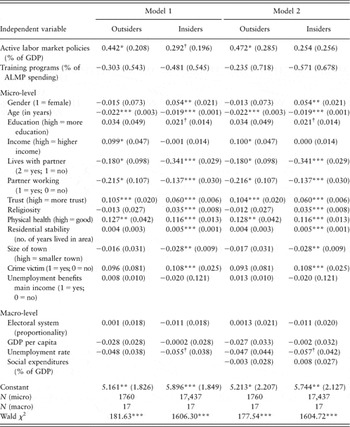
Effects of active labor market policies on the frequency of social interaction for labor market insiders and outsiders in Europe

GDP, gross domestic product; ALMP, active labor market policy.
***p < 0.001; **p < 0.01; *p < 0.05; †p < 0.1; standard errors in parentheses.
Note: Hausman–Taylor random effects estimations with random intercepts (respondents clustered by country).
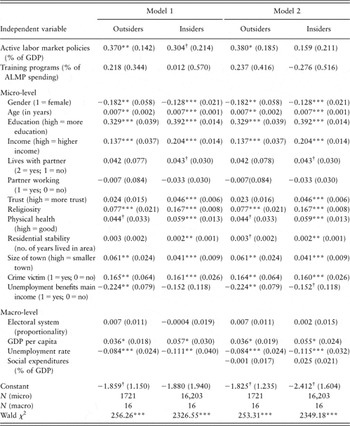
Effects of active labor market policies on membership in voluntary associations for labor market insiders and outsiders in Europe

GDP, gross domestic product; ALMP, active labor market policy.
***p < 0.001; **p < 0.01; *p < 0.05; †p < 0.1; standard errors in parentheses.
Note: Hausman–Taylor random effects estimations with random intercepts (respondents clustered by country).
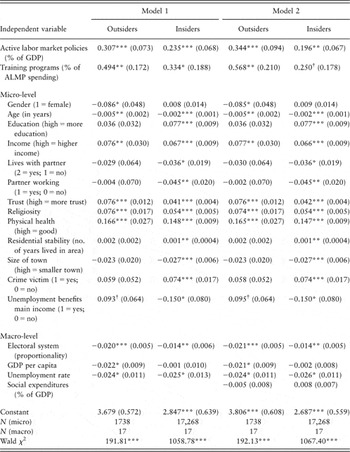
Effects of active labor market policies on feelings of social inclusion for labor market insiders and outsiders in Europe

GDP, gross domestic product; ALMP, active labor market policy.
***p < 0.001; **p < 0.01; *p < 0.05; †p < 0.1; standard errors in parentheses.
Note: Hausman–Taylor random effects estimations with random intercepts (respondents clustered by country).
Results
Below, I report the results of estimations of the effects of ALMPs on the different measures of social connectedness separately for insiders and outsiders. In addition, they show results from models with and without overall social expenditures as control variables. I expect ALMPs to have a positive effect on social ties. Moreover, if ALMPs affect social interactions across the board, irrespective of an individual’s labor market status, then the macro-level measures of labor market policies should matter equally for these two populations. In contrast, if labor market status moderates the impact of ALMPs, then we should see stronger effects of labor market policies on the social lives of outsiders.Footnote 27
Effects of ALMPs on social ties
Tables 1–3 show estimates of the effects of spending on ALMPs on the frequency of social interactions, membership in voluntary associations, and feelings of social inclusion (exclusion) for insiders and outsiders. The results show that ALMPs systematically shape people’s social ties: individuals in countries that spend more on such policies report more frequent social interactions and membership in voluntary organizations, and a reduced sense of social isolation. Moreover, these conclusions are not affected by the inclusion of total social expenditures in the model, as the coefficients for labor market policies are very similar across the models that control for social expenditures and those that do not. This similarity across models increases our confidence that these effects reflect the actual impact of labor market policies on social ties.
The results also reveal that ALMPs generally boost actual and perceived social ties among both insiders and outsiders. The effects of both measures of ALMPs are most consistent with regard to perceptions of social inclusion, followed by the frequency of social interaction and membership in voluntary association. Moreover, though quantity and quality of ALMPs both affect people’s sense of social exclusion, only the quantity of spending shapes the frequency of social interaction and associational membership.
Also, consistent with expectations, ALMPs boost social ties more powerfully among outsiders. Taking each of the dependent variables in turn, we find that the coefficient for the effect of ALMPs on the frequency of social interaction is 0.25 (ns) for insiders and 0.47 (p < 0.05) for outsiders; the coefficient for the effect of ALMPs on membership in voluntary organizations is 0.16 (ns) for insiders and 0.38 (p < 0.05) for outsiders; and the coefficient for the effect of ALMPs on people’s sense of social inclusion is 0.196 (p < 0.01) for insiders and 0.34 (p < 0.001) for outsiders (Model 2).
Moreover, the results show that insiders and outsiders in countries with labor market policies geared toward training report a significantly higher sense of social inclusion. Specifically, the coefficient for the effect of training programs on people’s sense of social inclusion is a sizable, 0.57 (p < 0.01) for outsiders and 0.25 (p < 0.1) for insiders. Thus, here too, the effects are stronger for outsiders than for insiders, suggesting that outsiders’ sense of inclusion is enhanced to a greater degree by the skill orientation of ALMPs than that of insiders.
The control variables exert some noteworthy effects as well. For example, high levels of trust, religiosity, good health, and residential stability, enhance subjective and objective social ties. In addition, individuals with higher levels of education and income report more extensive social ties, whereas those living with a partner and who have partners who work full-time have fewer social ties. Gender has mixed effects. Although women report more frequent social interactions, they also report lower levels of membership in voluntary associations and a greater sense of social exclusion. And victims of crime are more socially connected, perhaps reflecting a need to be socially involved in the aftermath of victimization. At the macro-level, the most consistent effects are those of labor market conditions, with individuals living in countries with higher levels of unemployment reporting lower levels of social ties.
Substantive effects
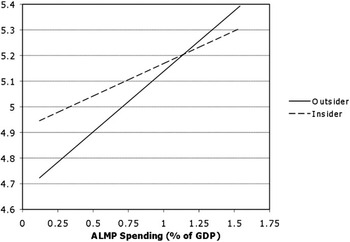
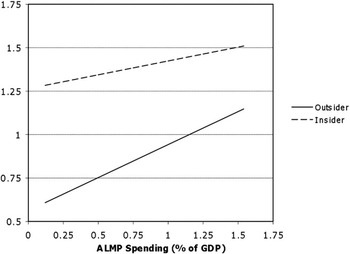
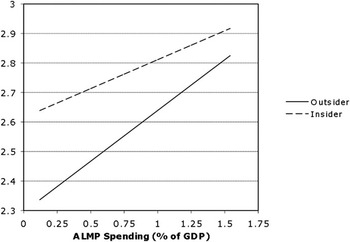
But how sensitive (or insensitive as it may be) are insiders’ and outsiders’ social lives to spending in these domains – that is, how consequential are these differences and how different are they really for insiders and outsiders? To better understand the estimated substantive impact of policy on the dependent variables, I illustrate how typical respondents’ social ties vary with different levels and types of active labor market spending using the coefficients from Model 2 reported in Tables 1–3. Overall, the results show that insiders have more extensive social ties than outsiders, and that both insiders and outsiders benefit from spending on ALMPs. At the same time, they show that the impact of ALMPs is more pronounced among outsiders. These results are shown in Figures 2–5.
Active labor market policies and frequency of social interaction.

Active labor market policies and associational membership.

Active labor market policies and perceived social inclusion.

Training programs and perceived social inclusion.

As the upward lines in Figures 2–4 reveal, both insiders and outsiders have more frequent social interactions and a greater sense of social inclusion if they live in countries that spend more on ALMPs. At the same time, the gap in real and perceived social ties between insiders and outsiders is larger in countries that spend less, and much smaller to non-existent in countries that spend more on ALMPs. For example, though there is a significant gap in the frequency of social interaction between typical outsiders and insiders in a country with the lowest level of active labor market spending, this gap disappears in the most generous countries (Figure 2). Similarly, a labor market outsider in a country with the lowest commitment to ALMPs is significantly less likely to be a member of a voluntary organization than an insider in the same country. This contrasts with a much smaller gap in membership levels for outsiders and insiders in the countries most generous in terms of ALMP spending (Figure 3).
The results also indicate that both ALMP spending and a focus on training greatly enhance people’s sense of social inclusion. Although typical insiders and outsiders in a country with the highest level of active labor market spending feel similarly (and positively) about their social ties, outsiders have a much lower score than insiders on the social inclusion scale if they live in the least generous country (Figure 4). In addition, the gap in perceived inclusion between outsiders and insiders is largest in countries that spend less of their ALMP budgets on training programs, and smallest in countries that devote most of their ALMP budgets to developing skills (Figure 5).
Though the results suggest that active labor market public policies and labor market status have the expected effects on the quality of people’s social lives, it is helpful to consider how they stack up against other significant determinants of reports and perceptions of social ties. Calculations show that the effects of ALMPs are comparable to some of the most important determinants of social ties, including trust, health, and living with a partner or spouse. For example, for typical respondents, moving from the lowest trust score (0) to the highest level of social trust (10) moves the frequency of social interaction, membership in voluntary associations, and feelings of social inclusion to an extent similar to spending on ALMPs.Footnote 28 Similarly, people who say that they are in very good health are more likely to report and feel that they are socially integrated than those who say they are in very bad health at rates comparable to people living in the most and least generous countries in ALMP spending. Finally, to take another example, living with a partner decreases people’s frequency of social interaction in ways comparable to moving from the most generous to the most miserly country in terms of ALMP spending.
Overall, the substantive effects of ALMPs thus compare favorably to those of other significant predictors of social connectedness. And though these results clearly indicate that labor market policies have a positive effect on the social lives of citizens, the results displayed in Figures 2–5 also reveal that their impact is one of degree: despite the fact that the overall impact of ALMPs on people’s private lives is positive, outsiders are more sensitive to ALMPs and more positively affected by them. These differential effects are marked and consistent, and they reveal that ALMPs are especially effective at enhancing the frequency of social interaction and feelings of social inclusion.
Discussion
When designing public policies, policymakers certainly assume that policies make a difference, but it is often difficult to tell how exactly how they matter. Political economists usually answer the question of whether labor market policies work with an eye toward individual and macro-level economic outcomes related to employment and earnings but are hesitant to go much beyond the economic consequences of such policies. And even though labor market policies are political in origin and design, political scientists have not usually investigated whether or how such policies affect people’s private and public (or political) behavior.
I have argued that labor market policies work, but in ways that are not purely economic in nature. Specifically, I hypothesized that, in addition to shaping their labor market behavior, public policies can have systematic effects on people’s private lives. Adopting a broadened conception of the effect of labor market policies, I examined the impact of ALMPs on people’s social networks and their perceptions of social exclusion in 17 European countries. The results show that ALMPs boost people’s social connectedness and reduce their sense of social exclusion. Individuals in countries that spend more on such policies report more frequent social interactions with friends, family members, and co-workers, and they are more active in voluntary organizations. In addition, they are more likely to say that that they participate in social activities compared to other people their age. This sense of social inclusion is boosted both by the overall investment in ALMPs as well as the programs’ orientation to enhance people’s skills.
The results furthermore suggest that the beneficial effects of ALMPs are more pronounced among individuals who occupy a more precarious position in the labor market – individuals labeled here as labor market outsiders. Thus, ALMPs affect the social lives of those individuals who are also typically the economic target of such policies. But insiders and outsiders both benefit because they do not have exclusive social ties; when outsiders interact socially, insiders are often parties to the interaction.
At the level of individuals, these findings confirm Amartya Sen’s argument that the negative effects of unemployment and employment inequalities act ‘to undermine and subvert personal and social life. The need to distinguish between the different ways in which joblessness causes problems is important not only for a better understanding of the nature and effects of unemployment, but also for devising an appropriate policy response’ (Sen, Reference Sen1997: 160). ALMPs target the long-term unemployed and the most disadvantaged in the labor market, and assessments of the impact of ALMPs should take social and not purely economic effects into account.
Viewed in this light, the findings reported here are encouraging, but they also raise the critical question of what it means for ALMPs to ‘work’. One way to answer the question would be through an investigation of such policies’ effects on people’s labor market behavior, including their ability and willingness to acquire new skills, engage in successful job searches, or overall labor market outcomes in terms of employment and unemployment patterns. This is the path economists have followed, but the results reported here show that the success of such policies can also be measured by how they affect a broader set of outcomes, including the social consequences of adverse labor market outcomes. Obviously, the results show that such policies do have the potential to affect this broader set of outcomes, and it is important to recall that ALMPs constitute only a small portion of public expenditures in capitalist democracies, and a much smaller share of the public purse than expenditures on general welfare benefits or education. As a consequence, it is difficult to see these in a negative light unless ALMPs clearly fail to deliver on first-order economic effects (with regard to the labor market) and second order effects cannot be achieved through cheaper policies that use less of society’s resources.
By investigating the effects of public policy on private lives, this paper consciously connects to the growing literature on policy feedback. For one, it pays heed to Mettler and Soss’s (Reference Mettler and Soss2004) call to reclaim policy analysis from economics. In particular, the results raise the intriguing question of how best to account for the success or failure of such policies, especially if they have limited effects in, say, changing the skills profile of target populations, but have the kinds of positive social effects documented here. Naturally, we need to know more, empirically speaking, about what exactly these effects are on target and non-target populations alike, and whether they extend beyond the European context or to other outcomes. But for the time being, the results indicate that ALMPs can provide social stability and strong social relations.
Also, it would be important to know, for example, if increased social connectedness and enhanced perceptions of social inclusion have positive knock-on effects for other domains of behavior. But the findings presented here raise the prospect of re-formulating the question of where we should be looking to gauge the effects of public policies on people’s lives. At a minimum, they suggest that there are layers to the effects of welfare states that go beyond current benefit recipients or eligible (targeted) populations. Thus, this study also extends our understanding of policy feedback effects in specific ways: first, it highlights the broader consequences of public policies by drawing attention to the connection between public policies and important consequences that are not obviously political in nature; and second, it adds a comparative and cross-national dimension to this literature, which is mostly focused on the USA.Footnote 29
Furthermore, the findings presented here suggest that it is important to look beyond the macro-politics so common in the contemporary study of comparative political economy, where the unit of analysis is usually the nation state, and the outcome of interest is most often a national level measure of political or economic performance. If nothing else, the study shows that a comprehensive understanding of the consequences of public policies should involve a systematic accounting of both the obvious and not so obvious consequences of government programs, as well as their significance for how real people lead their public as well as private lives.
Acknowledgements
I am grateful to Sarah Soule, David Rueda, Stefan Svallfors, Per Adman, and Staffan Kumlin for helpful suggestions. Special thanks also to Lena Hipp for detailed comments on an earlier draft, and to Rob Eisinga for helpful hints regarding the data analysis.
Appendix
Frequency of social interaction. ‘Using this card, how often do you meet socially with friends, relatives or work colleagues?’ Never (1); less than once a month (2); once a month (3); several times a month (4); once a week (5); several times a week (6); every day (7).
Membership in voluntary organizations. ‘For each of the voluntary organizations I will now mention, please use this card to tell me whether any of these things apply to you now or in the last 12 months, and, if so, which… member.’ Organizations included: sports club or club for outdoor activities; and organization for cultural or hobby activities; a business, professional, or farmer’s organization; a consumer or automobile organization; an organization for humanitarian aid, human rights, minorities, or immigrants; an organization for environmental protection, peace, or animal rights; a religious or church organization; an organization for science, education, or teachers and parents; a social club, club for the young, club for the retired/elderly, women, or friendly societies; any other voluntary organization such as the ones just mentioned. The variable is an additive index of memberships in these organizations.
Perception of social inclusion. ‘Compared to other people of your age, how often would you say you take part in social activities? Please use this card.’ Much less than most (1); less than most (2); about the same (3); more than most (4); much more than most (5).
Labor market status(outsiders/insiders). Based on responses to several questions about current and past labor market activity. Respondent coded as labor market outsider if she answered ‘unemployed and actively looking for a job’ or ‘unemployed, wanting a job but not actively looking for a job’ to the following question: ‘Using this card, which of these descriptions applies to what you have been doing for the last 7 days?’ In paid work (or away temporarily) (employee, self-employed, working for your family business); in education, even if on vacation (not paid for by employer); unemployed and actively looking for a job; unemployed, wanting a job but not actively looking for a job; permanently sick or disabled; retired; in community or military service; doing housework, looking after children or other persons; don’t know. In addition, respondents were coded as labor market outsiders if they answered ‘yes’ to both of the following two questions: ‘Have you ever been unemployed and seeking work for a period of more than 3 months?’; ‘Have any of these periods been within the past 5 years?’
Education. ‘What is the highest level of education you have achieved?’ Recoded from seven categories into three. Less than secondary education (1); completed secondary education (2); post-secondary education (3).
Age. ‘In what year were you born?’ Recoded to measure theactual age of respondent (in years).
Sex. Male (1); female (2).
Income. ‘Using this card, if you add up the income from all sources, which letter describes your household’s total net income? If you don’t know the exact figure, please give an estimate. Use the part of the card that you know best: weekly, monthly or annual income.’ Twelve income categories were recoded into: below median income in country (1); median income category (2); above median income (3).
Partner. Respondent coded as living with partner if answered ‘yes’ to one of the following questions: ‘Are you currently living with your husband/wife?’; ‘Are you currently living with another partner?’; or ‘Are you currently living with a partner?’. Coded (2) if individual currently lives with a partner, and (1) if the individual does not.
Partner working. Employment status of partner (coded 0, 1, where 1 = employed) based on: ‘Which of the descriptions on this card applies to what he/she has been doing for the last 7 days?’ Coded as ‘employed’ if respondent answered ‘in paid work’.
Social trust. ‘Using this card, generally speaking, would you say that most people can be trusted, or that you can’t be too careful in dealing with people? Please tell me on a score of 0 to 10, where 0 means you can’t be too careful and 10 means that most people can be trusted.’
Recipient of unemployment benefits. Unemployment benefits main source of income for household (coded 0, 1, where 1 = main source of income), based on: ‘Please consider the income of all household members and any income which may be received by the household as a whole. What is the main source of income in your household? Unemployment/redundancy benefit; any other social benefits or grants.’
Crime victim. Based on survey question: ‘Have you or a member of your household been the victim of a burglary or assault in the last 5 years?’ Yes (1); no (0).
Urban. Based on respondent’s description: farm or home in countryside (0); country village (1); town or small city (2); suburbs or outskirts of big city (3); a big city (4).
Residential stability. Number of years the respondent has lived in the area.
Physical health. ‘How is your health in general? Would you say it is … very good (5), good, (4), fair (3), bad (2), or very bad (1)?’
Religiosity. ‘Apart from special occasions such as weddings and funerals, about how often do you attend religious services nowadays?’ Every day (7); more than once a week (6); once a week (5); at least once a month (4); only on special holy days (3); less often (2); never (1).
GDP per capita. ‘World Development Indicators’. CD-ROM. Washington DC. (PPP US$), 1999. Source: World Bank, 2001.
Unemployment rate. % unemployed. Source: Eurostat (except Switzerland, OECD).
Proportionality of electoral system. Gallagher least index of electoral system proportionality. Source: Lijphart (Reference Lijphart1999).
ALMPs. Active labor market programs as a percentage of GDP in 2002. Source: OECD (2003). Includes all social expenditure (other than education) aimed at the improvement of the beneficiaries’ prospect of finding gainful employment or to otherwise increase their earnings capacity. This includes spending on public employment services and administration, labor market training, special programs for youth when in transition from school to work, labor market programs to provide or promote employment for unemployed and other persons (excluding young and disabled persons), and special programs for the disabled.
Training programs/ALMP. Spending on training programs as a percentage of total spending on ALMPs in 2002. Includes all expenditure on institutional training, workplace training, alternate training, and special support for apprenticeship training. Source: OECD (2003).
Social expenditures. Total social expenditures as a percentage of GDP in 2002. Source: OECD (2003).