Introduction
Over the past two decades, the construct of a clinical high-risk state for psychosis (HR), also known as the ‘at-risk-mental-state’, ‘prodromal’ and ‘ultra-high-risk’ (Schultze-Lutter et al. Reference Schultze-Lutter, Schimmelmann and Ruhrmann2011; Yung et al. Reference Yung, Woods, Ruhrmann, Addington, Schultze-Lutter, Cornblatt, Amminger, Bechdolf, Birchwood, Borgwardt, Cannon, de Haan, French, Fusar-Poli, Keshavan, Klosterkotter, Kwon, McGorry, McGuire, Mizuno, Morrison, Riecher-Rossler, Salokangas, Seidman, Suzuki, Valmaggia, van der Gaag, Wood and McGlashan2012), has allowed the identification of subjects with a 30% risk of developing schizophrenia spectrum psychoses (Fusar-Poli et al. Reference Fusar-Poli, Bechdolf, Taylor, Bonoldi, Carpenter, Yung and McGuire2013a ) within 2 years’ time (Fusar-Poli et al. Reference Fusar-Poli, Bonoldi, Yung, Borgwardt, Kempton, Valmaggia, Barale, Caverzasi and McGuire2012). Consequently, a number of focused interventions have been tested. A recent meta-analysis (Stafford et al. Reference Stafford, Jackson, Mayo-Wilson, Morrison and Kendall2013) considered 11 randomized controlled trials (RCTs) including 1246 subjects. Four RCTs compared cognitive behavioural therapy (CBT) with supportive counselling and monitoring (Morrison et al. Reference Morrison, French, Walford, Lewis, Kilcommons, Green, Parker and Bentall2004, Reference Morrison, Stewart, French, Bentall, Birchwood, Byrne, Davies, Fowler, Gumley, Jones, Lewis, Murray, Patterson and Dunn2011; Addington et al. Reference Addington, Epstein, Liu, French, Boydell and Zipursky2011b ; van der Gaag et al. Reference van der Gaag, Nieman, Rietdijk, Dragt, Ising, Klaassen, Koeter, Cuijpers, Wunderink and Linszen2012). Two RCTs compared risperidone and CBT over supportive counselling (McGorry et al. Reference McGorry, Yung, Phillips, Yuen, Francey, Cosgrave, Germano, Bravin, McDonald, Blair, Adlard and Jackson2002; Phillips et al. Reference Phillips, Nelson, Yuen, Francey, Simmons, Stanford, Ross, Kelly, Baker, Conus, Amminger, Trumpler, Yun, Lim, McNab, Yung and McGorry2009). Other RCTs compared risperidone and CBT v. placebo and CBT (Phillips et al. Reference Phillips, Nelson, Yuen, Francey, Simmons, Stanford, Ross, Kelly, Baker, Conus, Amminger, Trumpler, Yun, Lim, McNab, Yung and McGorry2009), olanzapine v. placebo (McGlashan et al. Reference McGlashan, Zipursky, Perkins, Addington, Miller, Woods, Hawkins, Hoffman, Lindborg, Tohen and Breier2003), integrated therapies over supportive counselling (Bechdolf et al. Reference Bechdolf, Wagner, Ruhrmann, Harrigan, Putzfeld, Pukrop, Brockhaus-Dumke, Berning, Janssen, Decker, Bottlender, Maurer, Moller, Gaebel, Hafner, Maier and Klosterkotter2012), integrated therapies over standard treatment (Nordentoft et al. Reference Nordentoft, Petersen, Jeppesen, Thorup, Abel, Ohlenschlaeger, Christensen, Krarup and Jorgensen2006), omega-3 fatty acids v. placebo (Amminger et al. Reference Amminger, Schafer, Papageorgiou, Klier, Cotton, Harrigan, Mackinnon, McGorry and Berger2010), and amisulpride plus a needs-based intervention v. the needs-based intervention alone (Ruhrmann et al. Reference Ruhrmann, Bechdolf, Kuhn, Wagner, Schultze-Lutter, Janssen, Maurer, Hafner, Gaebel, Moller, Maier and Klosterkotter2007). Overall, five out of 11 RCTs showed a moderate effect of CBT on preventing transition to psychosis (relative risk at 12 months = 0.54) (Stafford et al. Reference Stafford, Jackson, Mayo-Wilson, Morrison and Kendall2013), and this finding has been validated by a second independent meta-analysis focused on CBT (relative risk at 12 months = 0.45) (Hutton & Taylor, Reference Hutton and Taylor2014). Conversely, no consistent meta-analytical evidence was found to support the use of antipsychotic (AP) drugs in delaying or preventing transition to psychosis (Stafford et al. Reference Stafford, Jackson, Mayo-Wilson, Morrison and Kendall2013). Overall, focused interventions in HR subjects show a number needed to treat of six at 12 months (Fusar-Poli et al. Reference Fusar-Poli, Borgwardt, Bechdolf, Addington, Riecher-Rossler, Schultze-Lutter, Keshavan, Wood, Ruhrmann, Seidman, Valmaggia, Cannon, Velthorst, De Haan, Cornblatt, Bonoldi, Birchwood, McGlashan, Carpenter, McGorry, Klosterkotter, McGuire and Yung2013b ). These promising results indicate a positive efficacy of focused interventions under ideal circumstances, such as in RCTs. However, their effectiveness, or the extent to which they may achieve the intended effect ‘in the usual clinical setting’ is unknown (Kraemer, Reference Kraemer2000). Treating HR subjects in the real world of prodromal clinics [i.e. the Outreach and Support in South London (OASIS) clinic (Fusar-Poli et al. Reference Fusar-Poli, Byrne, Badger, Valmaggia and McGuire2013c )] is hindered by several practical issues. These may include the use of broader inclusion criteria and heterogeneous recruitment strategies, the maintenance of engagement with the service, concurrent psychophysical issues affecting the course of treatments, the use of ‘off-label’ APs, the lack of Diagnostic and Statistical Manual of Mental Disorders (DSM)/International Classification of Diseases HR diagnosis affecting NHS policies and the ongoing training of the staff (Yung et al. Reference Yung, Philips and McGorry2004). Since prodromal clinics are specialized mental health services, which require experienced input at clinical, administrative and research levels, there are several non-specific ‘real-world’ factors potentially making an impact on the effect of focused interventions in HR subjects. For example, the CBT engagement rates in prodromal clinics are unknown; indeed these data would be useful to evaluate the practical feasibility of CBT as a focused intervention. Similarly, naturalistic studies have suggested a different effect of AP treatments as compared with available RCTs (Kim et al. Reference Kim, Jang, Park, Shim, Hwang, Kim and Kwon2012). Even less is known about exposure to AP treatments before referral to prodromal services and their impact on baseline symptoms and longitudinal outcomes is underinvestigated (Nieman et al. Reference Nieman, Rike, Becker, Dingemans, van Amelsvoort, de Haan, van der Gaag, Denys and Linszen2009). We present here a large and long-term naturalistic study addressing these issues in the OASIS HR sample. The OASIS clinic was established in 2001 (Fusar-Poli et al. Reference Fusar-Poli, Byrne, Badger, Valmaggia and McGuire2013c ) and it is one of the largest prodromal clinics worldwide. Our first aim was to describe the type of focused interventions offered in a prodromal clinic and to test their association with baseline sociodemographic and clinical data. Our second objective was to assess their longitudinal associations with clinical and functional outcomes.
Method
Sample
All referrals to the OASIS clinic for assessment meeting diagnostic criteria according to the Comprehensive Assessments of the At Risk Mental State (CAARMS; Yung et al. Reference Yung, Yuen, McGorry, Phillips, Kelly, Dell'Olio, Francey, Cosgrave, Killackey, Stanford, Godfrey and Buckby2005) for a HR state for psychosis (Fusar-Poli et al. Reference Fusar-Poli, Borgwardt, Bechdolf, Addington, Riecher-Rossler, Schultze-Lutter, Keshavan, Wood, Ruhrmann, Seidman, Valmaggia, Cannon, Velthorst, De Haan, Cornblatt, Bonoldi, Birchwood, McGlashan, Carpenter, McGorry, Klosterkotter, McGuire and Yung2013b ) in the period 2001–2012 were included. HR subjects who disengaged from the service shortly after their intake without being actively treated for a minimum of 1 month were not included.
Setting
The OASIS team is specialized in detecting and treating subjects at HR for psychosis. Currently it covers a catchment area of about 1.18 million citizens in South London (Fusar-Poli et al. Reference Fusar-Poli, Byrne, Badger, Valmaggia and McGuire2013c ), which has one of the highest rates of psychosis in the world (Kirkbride et al. Reference Kirkbride, Fearon, Morgan, Dazzan, Morgan, Tarrant, Lloyd, Holloway, Hutchinson, Leff, Mallett, Harrison, Murray and Jones2006).
Study design
The study was of an open-label naturalistic prospective design, with a follow-up period of 6 years on average.
Clinical measures
At the OASIS clinic the referrals are managed in a three-step model and assessed with specific psychometric instruments. First, the individual is contacted by telephone to check the suitability of the referral (pre-screening). Second, an initial screening assessment is conducted over a session of 2 h, and involves a psychiatrist and/or a clinical psychologist administering the psychotic symptoms module of the CAARMS (Yung et al. Reference Yung, Yuen, McGorry, Phillips, Kelly, Dell'Olio, Francey, Cosgrave, Killackey, Stanford, Godfrey and Buckby2005). Third, after inclusion to the service a comprehensive CAARMS baseline assessment is performed, along with a life events assessment and a neuropsychological assessment (Fusar-Poli et al. Reference Fusar-Poli, Byrne, Badger, Valmaggia and McGuire2013c ). The inclusion criteria are based on the CAARMS and described elsewhere (Fusar-Poli et al. Reference Fusar-Poli, Byrne, Badger, Valmaggia and McGuire2013c ). The service is open to 14- to 35-year-old help-seeking patients only. The CAARMS (Yung et al. Reference Yung, Yuen, McGorry, Phillips, Kelly, Dell'Olio, Francey, Cosgrave, Killackey, Stanford, Godfrey and Buckby2005) is a semi-structured interview designed to assess putative prodromal psychotic symptoms in help-seeking individuals. Level of functioning is evaluated with the Global Assessment of Functioning (GAF) scale (Hall, Reference Hall1995). The DSM diagnoses of current co-morbid Axis I and Axis II disorders are assessed with the Structured Clinical Interview for DSM-IV (SCID) (First et al. Reference First, Spitzer, Gibbon and Williams2002).
Follow-up
Patients were followed up for an average period of 6 years and repeated measures were collected. Transition to psychosis was defined according to the CAARMS criteria (Fusar-Poli & Van Os, Reference Fusar-Poli and Van Os2013).
Focused interventions
The details of the clinical management of HR clients at the OASIS clinic have been fully described elsewhere (Fusar-Poli et al. Reference Fusar-Poli, Byrne, Badger, Valmaggia and McGuire2013c ) and are only briefly detailed here. All patients are offered a specific course of psychological interventions as first-line therapy, which consists of up to 24 sessions of CBT administered by experienced clinical psychologists. After this the patients were offered either boosting CBT sessions or a monitoring phase. Low-dosage APs can be added to CBT in a second phase, if HR patients complain of persistent attenuated psychotic symptoms making an impact on their overall functioning and quality of life (CBT + AP). Since co-morbid anxiety and depression are common in this group (Fusar-Poli et al. Reference Fusar-Poli, Byrne, Badger, Valmaggia and McGuire2013c ), antidepressant (AD) medications can be added to CBT (CBT + AD). Other combinations of different types of interventions (Combo) may include the use of an AD or AP alone or treatment as usual (psycho-educational interventions, case management, psychosocial support and clinical monitoring only). Any decision on treatment choice was based on clinical judgment and patients’ preference. Active interventions are usually offered for 2 years, and then the patients are regularly followed up with periodic monitoring (Fusar-Poli et al. Reference Fusar-Poli, Byrne, Badger, Valmaggia and McGuire2013c ).
Study measures
Predictor
As mentioned above, focused interventions included: (i) CBT only; (ii) CBT + AP; (iii) CBT + AD; and (iv) Combo. These categories were selected as representative of real-world prototypical clinical choices in a prodromal setting. The categories were also selected on the basis of the minimum sample size requested to detect any potential relationship with transition rates. In G*Power we have estimated a minimum of 30 subjects per group for a power of 0.9 and α = 0.05, to identify a transition risk of 29% at 2 years [on the basis of a recent meta-analysis (Fusar-Poli et al. Reference Fusar-Poli, Bonoldi, Yung, Borgwardt, Kempton, Valmaggia, Barale, Caverzasi and McGuire2012)] as opposed to the 1% risk to develop schizophrenia in the general population.
Primary outcome measures
The primary outcome measure of the present study was the clinical status (transition/non-transition) of HR at longitudinal follow-up.
Secondary outcome measures
The secondary outcome measures were the functional (GAF) characteristics of HR subjects longitudinally.
Additional measures
A number of additional measures were also collected. With respect to CBT we additionally recorded the number of sessions attended/not attended/cancelled, and the number of drop-outs. With respect to the pharmacological therapies we additionally recorded the type of molecule employed and its dose. Chlorpromazine (CPZ) equivalents were computed for reporting purposes, when applicable (Ho et al. Reference Ho, Andreasen, Ziebell, Pierson and Magnotta2011). We also recorded the exposure to medications (ADs, APs, none) of HR clients prior to their referral to the OASIS clinic. All the above variables were carefully collected, both checking the case notes on the clinical records and searching the electronic archive (ePJs) of clinical records used by the South London and Maudsley NHS Foundation Trust (SLaM). Interventions offered after transition to psychosis were not considered in this study.
Statistical analysis
Cross-sectional
Descriptive analysis included mean and standard deviation for continuous variables and absolute and relative frequencies for categorical variables. The cross-sectional associations between the predictor (type of focused interventions) and demographic and clinical characteristics of the sample were assessed with analysis of variance, correcting for multiple comparisons with the Bonferroni post-hoc test. For categorical variables, the χ2 test and Fisher's exact test were employed.
Longitudinal
Cox regression analyses tested longitudinally the association between focused interventions and primary (transition to psychosis) or secondary [good or poor GAF, with good functional status defined according to the literature as GAF ⩾ 61 (Schennach-Wolff et al. Reference Schennach-Wolff, Jager, Seemuller, Obermeier, Messer, Laux, Pfeiffer, Naber, Schmidt, Gaebel, Huff, Heuser, Maier, Lemke, Ruther, Buchkremer, Gastpar, Moller and Riedel2009)] outcomes. The regression model was then corrected for baseline between-group differences in sociodemographic or clinical variables corrected for multiple comparisons. In supplementary analyses we also tested the potential modulating effect of several variables that we regarded as possible confounders between treatment effect and outcome. Variables that showed differences between the four groups (based on a liberal significance value of p < 0.1) and had enough data to be included in our model were considered. Additional variables were selected on the basis of clinical relevance (independent from baseline differences). We explored the use of modern causal modelling analysis as advocated by Rubin and colleagues (Angrist et al. Reference Angrist, Imbens and Rubin1996) using an instrumental variable approach. However, it was not feasible, as among our available variables we do not have any variable that could be used as an instrument. Finally, the possibility of treatment × time interaction was explored for the HR symptoms (CAARMS items). All the analyses were computed using IBM SPSS 20 (USA).
Results
Descriptive results
Sample and clinical characteristics at baseline
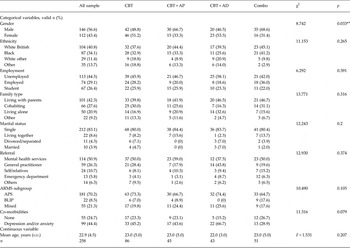
Our sample included a total of 258 HR subjects, of which 70% met the attenuated psychotic symptoms inclusion criteria, 9% the brief, limited intermittent psychotic symptoms (BLIP) criteria and 21% met more than one inclusion criteria. The mean age of the sample was 22.9 (s.d. = 4.5) years, most of which were males (57%) and white British (41%). At the time of referral 44.5% of them were unemployed, 42% were living with parents and the majority of them were single (83%). The most common co-morbid disorders in addition to the HR diagnosis were depression or anxiety (44.5%) (see Table 1, first column).
Cross-sectional association of focused intervention with sociodemographic and clinical characteristics of the OASIS sample at baseline

OASIS, Outreach and Support in South London; CBT, cognitive behavioural therapy; AP, antipsychotic medication; AD, antidepressant medication; Combo, combination of different types of interventions; ARMS, at-risk mental state; APS, attenuated psychotic symptoms; BLIP, brief, limited intermittent psychotic symptoms; s.d., standard deviation.
a Post-hoc comparisons showed more males in the Combo group (p < 0.05).
* Significant differences at p < 0.05 corrected for multiple comparisons.
Exposure to medication prior to OASIS referral
A total of 36 HR patients (14%) were prescribed an AD before being taken on by the OASIS, with half of them being prescribed citalopram (mean dose = 24.7, s.d. = 13.7 mg). In all, 10 (4%) HR patients were prescribed AP medications prior to their referral to the OASIS clinic, with an overall mean CPZ equivalent dose of 121.1 (s.d. = 104.5) mg/day. Overall, the AP mostly used before referral to the OASIS team was olanzapine (mean CPZ equivalents = 105.3, s.d. = 74.4 mg/day) (see online Supplementary Table S1). HR patients who were prescribed with APs before their referral to the clinic were older than patients treated with ADs (p = 0.033) and medication-naive subjects (p = 0.009) and were more likely to belong to the BLIP group (p = 0.001) (see online Supplementary Table S2). HR patients who were prescribed ADs before their referral to the OASIS also had higher levels of depressive co-morbidities (p = 0.001) (see online Supplementary Table S2).
Focused interventions at the OASIS clinic
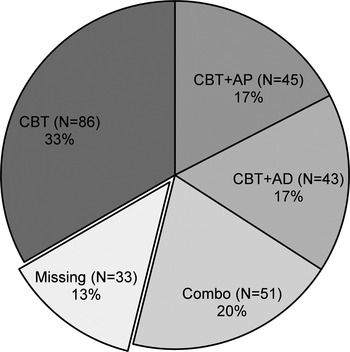
While under the 2-year period of care of the OASIS clinic, 17% of the HR sample received CBT plus APs (CBT + AP, n = 45) and 17% CBT plus ADs (CBT + AD, n = 43). Of the patients, 33% received only CBT sessions (CBT only, n = 86) (see Fig. 1). In the sample, 20% (n = 51) of patients received Combo treatment which included: CBT plus both APs and ADs (n = 16); medications only (n = 9): APs (n = 6), ADs (n = 1) or APs and ADs (n = 2); treatment as usual (psychoeducation, case management, psychosocial support and clinical monitoring) (n = 26).
Descriptive analysis of focused interventions offered to subjects at high clinical risk for psychosis during their clinical management at the Outreach and Support in South London (OASIS) clinic. CBT, Cognitive behavioural therapy; AP, antipsychotic medication; AD, antidepressant medication; Combo, combination of different types of interventions.

Across the HR patients who received some AP medications (n = 69), the overall CPZ equivalent dose was of 110.6 (s.d. = 85) mg/day, and the molecule mostly often prescribed (% of all APs used) was quetiapine (CPZ equivalents = 109.4, s.d. = 79.9 mg/day). Across the HR patients who were prescribed ADs (n = 62), citalopram (27.1, s.d. = 13.1 mg/day) was the most frequent (% of all ADs used). No patients were treated with stimulant medications while under the care of the OASIS and only one patient was treated with mood stabilizers. Across the HR patients who had CBT (n = 190), the mean number of CBT sessions attended was 12 (s.d. = 7.7; three subjects were excluded from the mean calculation as they were outliers and received more sessions than the usual course of 24 sessions) (see online Supplementary Table S1). Overall compliance to the CBT sessions was good: on average, HR patients attended 70% of the sessions offered. In terms of drop-outs, 38% of HR subjects receiving CBT dropped out from the therapy, with 62% of them completing the whole course (n = 24) or ending it for other clinical reasons (i.e. they were referred to another service, moved out of the catchment area). However, no established measure of CBT adherence has been validated in this sample.
Cross-sectional analysis
Association of focused interventions and baseline clinical/demographic characteristics
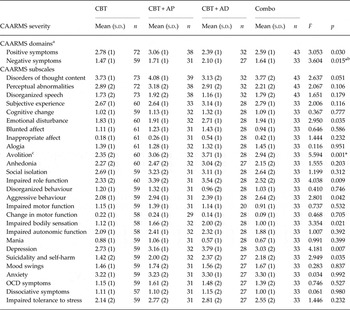
There were baseline between-group differences in gender and in the negative symptoms CAARMS domain, which survived corrections for multiple comparisons (see Tables 1 and 2). Post-hoc analyses showed more males in the Combo group and higher scores on the CAARMS negative symptoms domain in the CBT + AD group v. CBT group. Within the single CAARMS subscales, only the avolition subscale showed significant baseline between-group differences surviving corrections for multiple comparisons. Post-hoc tests showed that the CBT + AD group had more severe avolition (p = 0.001) relative to the CBT group.
Cross-sectional association of focused intervention with psychopathological features (CAARMS severity scores) of the OASIS sample at baseline

CAARMS, Comprehensive Assessment of the At Risk Mental State; OASIS, Outreach and Support in South London; AP, antipsychotic medication; AD, antidepressant medication; Combo, combination of different types of interventions; s.d., standard deviation; OCD, obsessive – compulsive disorder.
a CAARMS domains: positive symptoms = disorders of thought content + perceptual abnormalities + disorganized speech subscales scores; negative symptoms = emotional disturbance + blunted affect + inappropriate affect + alogia + avolition + anhedonia subscales scores.
b Post-hoc tests showed higher scores on the CAARMS negative symptoms domain in the CBT + AD group v. CBT group (p = 0.008).
c Post-hoc tests showed higher scores on the CAARMS avolition subscale in the CBT + AD group as compared with the CBT group (p = 0.001).
* Significant differences at p < 0.05 after multiple comparison correction.
Gender, negative symptoms CAARMS domain and avolition were therefore entered as covariates of interest between the predictor and the primary/secondary outcome variables in the Cox model (see below). Results at a more liberal threshold uncorrected for multiple comparisons are reported in the online Supplementary Results S1).
Longitudinal analysis
Sample characteristics at follow-up
The average time of follow-up was 6 (s.d. = 2.5) years. Of HR patients at baseline, 18% (n = 47) made a transition to psychosis: six developed a bipolar psychotic disorder; 29 a schizophrenia spectrum disorder; and 12 patients developed a psychotic disorder not otherwise specified. At follow-up the majority (63%) of the patients were medication-free (see online Supplementary Table S3), and 60% of patients (n = 57) had a good functional status. Interaction between focused interventions and time on HR symptoms are shown in the online Supplementary material (see Supplementary Results S2).
Association between focused interventions and transition to psychosis and functional outcomes
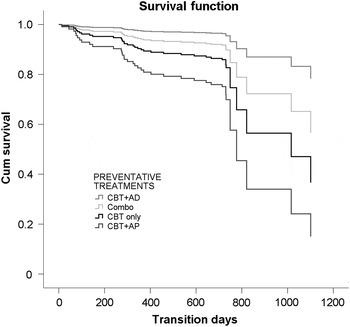
There was a significant correlation between focused interventions and psychosis transition [regression model: minus 2 log likelihood (−2LL) = 365.472, χ2 3 = 13.08, p = 0.004, see Fig. 2]. Cox regression showed the highest transition risk in the CBT + AP group, while the CBT + AD group showed the lowest transition risk.
Cox regression analysis showing the association of each group of focused interventions with the primary outcome (psychosis transition). Cognitive behavioural therapy plus antidepressant (CBT + AD) interventions are associated with a reduced risk of developing psychosis while the CBT plus antipsychotic (CBT + AP) interventions are associated with an increased risk of developing psychosis over time. Cum Survival, Cumulative survival; Combo, combination of different types of interventions.

Post-hoc analyses showed that the CBT + AD intervention was associated with a reduced risk of transition to psychosis, as compared with the CBT + AP intervention [hazards ratio = 0.129, 95% confidence interval (CI) 0.030–0.565, p = 0.007]. There were no significant differences in the CBT-only intervention as compared with the CBT + AP (hazards ratio = 1.886, 95% CI 0.935–3.805, p = 0.076) or CBT + AD (hazards ratio = 0.244, 95% CI 0.056–1.060, p = 0.060) interventions. The model survived when significant baseline between-group differences (corrected for multiple comparison) in symptoms or sociodemographic features (severity of negative symptoms CAARMS domain, avolition and gender) were entered as covariate of interest. The model was not improved by adding covariates deriving from between-group differences at baseline (at the liberal threshold of p < 0.1 uncorrected for multiple comparison) and from clinical judgement (see online Supplementary Results S3). There was no significant correlation between focused interventions and functional outcomes (Cox regression model for good functional status, −2LL = 386.64, χ2 3 = 3.271, p = 0.352).
Additional Cox-regression analyses are presented in the online Supplementary Results S4.
Discussion
The present study aimed at describing the type of focused interventions offered in a real-world setting of a prodromal clinic and at assessing their longitudinal association with transition to psychosis and functional status. We recruited a large sample of 258 HR subjects in a naturalistic design, and we followed them up for an average of 6 years. The core finding of the study is that HR subjects who were prescribed CBT and ADs were less likely to make a transition to psychosis, while those who were prescribed CBT and APs were more likely to go on to develop psychosis. These effects were corrected for baseline between-group differences in sociodemographic variables and symptom severity. There was no effect of focused interventions on longitudinal functional outcomes.
Our preliminary descriptive analysis is clinically informative in that little is known about prescriptions of interventions in the real-world settings of prodromal services worldwide. First, we found that only a small proportion of our HR patients were exposed to ADs (14%, mostly citalopram) or APs (4%, mostly olanzapine) prior to their referral to the OASIS clinic. Conversely, a recent North American survey indicated that up to 25% of HR subjects were prescribed AP medication in the community before their presentation to the prodromal clinics (Woods et al. Reference Woods, Addington, Bearden, Cadenhead, Cannon, Cornblatt, Mathalon, Perkins, Seidman, Tsuang, Walker and McGlashan2013). These differences are likely to reflect differential recruitment strategies and mental health services organization. For example, the North American sample was derived from several sites across the country, while the OASIS sample was derived from the SLaM, which has a longstanding tradition of offering psychological interventions (National Collaborating Centre For Mental Health, 2013). The presence of an established early intervention network within the SLaM and the training offered to general practitioners may have prompted potential AP prescribers to be more aware of recent published treatment guidelines discouraging AP use in HR subjects (Woods et al. Reference Woods, Carlson and McGlashan2010). These factors have been shown to make an impact on AP prescriptions in HR subjects (Woods et al. Reference Woods, Carlson and McGlashan2010). In line with these speculations, higher exposure to AP treatments was found in the oldest HR cohorts, at the time when the prodromal services were not well developed in the community (Woods et al. Reference Woods, Addington, Bearden, Cadenhead, Cannon, Cornblatt, Mathalon, Perkins, Seidman, Tsuang, Walker and McGlashan2013). In the North American study, the mean CPZ-equivalent dose of 121 mg/day was surprisingly the same as observed in our sample (121.1 mg/day). This finding may reflect the converging consensus towards the use of low-dosage APs in HR individuals (Fusar-Poli et al. Reference Fusar-Poli, Borgwardt, Bechdolf, Addington, Riecher-Rossler, Schultze-Lutter, Keshavan, Wood, Ruhrmann, Seidman, Valmaggia, Cannon, Velthorst, De Haan, Cornblatt, Bonoldi, Birchwood, McGlashan, Carpenter, McGorry, Klosterkotter, McGuire and Yung2013b ). We also found that patients prescribed with APs before their referral to the OASIS were older than patients treated with ADs. This presumably reflects the additional concerns of prescribers in treating adolescent HR subjects with APs. Interestingly, the patients prescribed with ADs prior to their referral to the OASIS clinic had higher rates of depressive Axis I co-morbidities. This may be associated with the fact that in primary care services depression may often represent the presenting complaint before or along with the concomitant attenuated psychotic symptoms. The North American study also found that patients with co-morbid depression were prescribed more ADs in the community (Woods et al. Reference Woods, Addington, Bearden, Cadenhead, Cannon, Cornblatt, Mathalon, Perkins, Seidman, Tsuang, Walker and McGlashan2013). We did not find any ethnic difference in medication prescription before referral to the OASIS.
Our cross-sectional analysis suggested that CBT is feasible in the context of prodromal services. This is the first-line therapy in the OASIS clinic, and the vast majority of OASIS patients (74%) had received it alone or with conjoint medications. We also showed that the mean number of CBT sessions attended by HR patients was 12, and that the majority of them (62%) did not drop out. These findings are in line with meta-analytical evidence indicating that an average of 11 sessions with good compliance (Stafford et al. Reference Stafford, Jackson, Mayo-Wilson, Morrison and Kendall2013) is required in RCTs of CBT interventions in HR samples. Only for a minority of OASIS patients did clinicians additionally prescribe an AP (17%) or AD (17%). An adjunctive AP was preferred for patients with higher levels of positive symptoms (unusual thought content). It is important to note that the use of APs in our sample does not reflect current treatment guidelines discouraging their use in HR subjects, as our sample was recruited in the years before these recommendations had been implemented. ADs were preferred for patients with prominent negative symptoms including avolition. To our knowledge, this is the first study to comprehensively address the relationship between baseline HR symptoms and treatment choices in a real-world setting. These findings can be used to develop and protocolize intervention algorithms, insist adherence to these and carefully measure the effectiveness of interventions provided across prodromal services (McGorry et al. Reference McGorry, Yung, Bechdolf and Amminger2008).
Our longitudinal analysis was testing our core hypothesis of an association between focused interventions and psychosis transition or functional outcome. We observed no association between focused interventions and functional outcome. To date, all RCTs in HR subjects have been developed to target psychosis transition with little or no focus on amelioration of functional status. However, functional status is becoming a mainstream outcome in HR research given evidence of persistent disability and functional impairments in subjects who do not convert to psychosis (Addington et al. Reference Addington, Cornblatt, Cadenhead, Cannon, McGlashan, Perkins, Seidman, Tsuang, Walker, Woods and Heinssen2011a ). Conversely, we found a differential association between focused interventions and psychosis transition. Addition of ADs to CBT was associated with a lower risk of psychosis onset (hazards ratio = 0.22), while the addition of an AP was associated with an increased risk of transiting towards the first episode of psychosis (hazards ratio = 2.69). These effects survived when correcting for baseline between-group differences in severity of symptoms and demographic characteristics. However, we were unable to control these results for other potential confounding factors such as patients’ attitudes towards medical/psychosocial interventions, treatment adherence, programme engagement, family involvement, motivation levels, dosage, side effects/tolerability of medications, as well as provider-related factors. These factors, along with the lack of randomization, prevent a causal relationship between focused intervention and psychosis transition to be established. Furthermore, our supplementary analysis testing time effects indicated a general improvement in all groups over time, which is consistent with other naturalistic studies suggesting that HR subjects improve longitudinally and independently from any intervention received (Cannon et al. Reference Cannon, Cadenhead, Cornblatt, Woods, Addington, Walker, Seidman, Perkins, Tsuang, McGlashan and Heinssen2008). To better clarify the confounding time effect we assessed the specific association of each focused intervention on HR symptoms over time. Focused interventions had a moderate effect for thought disorders and inappropriate affect and a large effect for anhedonia and depression domains. Specifically, CBT + AP were associated with a reduction in inappropriate affect symptomatology at follow-up, while CBT + AD were associated with improved anhedonia and depressive symptoms. The observed reduction in depressive symptoms in the CBT + AD group as compared with CBT alone is consistent with the general depression treatment literature (Middleton et al. Reference Middleton, Shaw, Hull and Feder2005). The reduced anhedonia in the CBT + AD group compared with the CBT + AP group can be secondary to the side effects/lack of efficacy of APs on this domain. However it is important to note that we were unable to test with regular and periodic assessments the dynamic course of symptoms during the follow-up time.
The association between AP treatment and risk of transition to psychosis has been investigated with conflicting results. In the North American Prodrome Longitudinal Sample (NAPLs), an increased transition risk was observed after AP prescription as compared with no AP (Cannon et al. Reference Cannon, Cadenhead, Cornblatt, Woods, Addington, Walker, Seidman, Perkins, Tsuang, McGlashan and Heinssen2008). However, the risk of transition was secondary to baseline differences in symptom severity in the AP group. Another naturalistic study also found an increased risk of transition in HR subjects treated with an AP (Kim et al. Reference Kim, Jang, Park, Shim, Hwang, Kim and Kwon2012) as compared with no AP. It was speculated that the off-label nature of this prescription led to the use of lower doses compared with what should be needed to reach a hypothetical preventive action (Kim et al. Reference Kim, Jang, Park, Shim, Hwang, Kim and Kwon2012). Similarly, a previous study in HR subjects indicated no significant effects of APs in preventing psychosis transition (Nieman et al. Reference Nieman, Rike, Becker, Dingemans, van Amelsvoort, de Haan, van der Gaag, Denys and Linszen2009). The available RCTs suggesting that APs may reduce the risk of conversion to psychosis (McGlashan et al. Reference McGlashan, Zipursky, Perkins, Addington, Miller, Woods, Hawkins, Hoffman, Preda, Epstein, Addington, Lindborg, Trzaskoma, Tohen and Breier2006; Ruhrmann et al. Reference Ruhrmann, Bechdolf, Kuhn, Wagner, Schultze-Lutter, Janssen, Maurer, Hafner, Gaebel, Moller, Maier and Klosterkotter2007) show inconsistent results, with an increased rate of conversion and exacerbation of prodromal symptoms after discontinuation of APs. These data suggest that the AP treatment may be palliative and just delay the onset of psychotic disorders as the pathophysiology underlying the prodromal psychosis worsens. Our results are in line with recent guidelines discouraging the use of APs in ultra-high-risk individuals and with neurobiological evidence suggesting that APs may negatively affect brain structure (Fusar-Poli et al. Reference Fusar-Poli, Smieskova, Kempton, Ho, Andreasen and Borgwardt2013d ).
However, all of the above studies missed a comparison group of AD treatments. A previous naturalistic study (Cornblatt et al. Reference Cornblatt, Lencz, Smith, Olsen, Auther, Nakayama, Lesser, Tai, Shah, Foley, Kane and Correll2007) found opposite effects for APs and ADs, with no transition in the AD group and 25% transition in the AP group over a mean follow-up time of 30.5 months; a similar finding was also confirmed by an audit in an early OASIS sample (Fusar-Poli et al. Reference Fusar-Poli, Valmaggia and McGuire2007). Conversely, a naturalistic NAPLs study (Walker et al. Reference Walker, Cornblatt, Addington, Cadenhead, Cannon, McGlashan, Perkins, Seidman, Tsuang, Woods and Heinssen2009) found no effect for ADs on symptoms over time but some effects for APs, which were, however, secondary to baseline differences in psychopathology.
In the present study, the AP v. AD differential association with psychosis transition was not secondary to differential baseline symptom severity. Further indirect evidence supporting a potential beneficial effect of ADs in preventing psychosis comes from a recent long-term follow-up study that found a decrement of transition rate during the 13-year period of 1993 to 2006 (Nelson et al. Reference Nelson, Yuen, Wood, Lin, Spiliotacopoulos, Bruxner, Broussard, Simmons, Foley, Brewer, Francey, Amminger, Thompson, McGorry and Yung2013). This finding has been confirmed at meta-analytical level as well (Fusar-Poli et al. Reference Fusar-Poli, Bonoldi, Yung, Borgwardt, Kempton, Valmaggia, Barale, Caverzasi and McGuire2012). The authors explained the decline in transition rates with the increased rates of AD medication prescription in the community and prodromal services. Despite these promising beneficial effects, we cannot exclude the alternative hypothesis, that the differential associations of ADs and APs with psychosis transition may be secondary to core underlying features of the HR state. Such a hypothesis is supported by the finding that psychopathological improvements in our subjects were associated with a strong effect for time with only a small to moderate effect for type of interventions. Additionally, there were no BLIPs in the AD group. Although such a difference was not statistically significant, presumably in the light of the small statistical power, the BLIP endophenotype is associated with a higher risk of developing psychosis than any other HR subgroup (Fusar-Poli et al. Reference Fusar-Poli, Byrne, Badger, Valmaggia and McGuire2013c ), triggering the use of APs. AP medications could have been initiated at a point where CBT was found to inadequately control worsening symptoms, correlating with higher transition risks. An alternative explanation may relate to the presence of different HR endophenotypes, each with a different natural history. The baseline HR diagnosis may include different subgroups with differential trajectories: a ‘true prodromal’ endophenotype later transiting to psychosis together with a ‘clinical noise’ HR endophenotype (Fusar-Poli et al. Reference Fusar-Poli, Carpenter, Woods and McGlashan2014a ). The latter HR subgroup may be characterized by specific neurobiological alterations (Modinos et al. Reference Modinos, Allen, Frascarelli, Tognin, Valmaggia, Xenaki, Keedwell, Broome, Valli, Woolley, Stone, Mechelli, Phillips, McGuire and Fusar-Poli2014) and be at risk for ongoing common mental disorders, mostly depression and anxiety disorders. In line with these speculations, we did observe a trend (not surviving correction for multiple comparison) towards higher rates of depressive and anxiety co-morbidities in HR subjects receiving adjunctive AD treatments. The presence of affective symptoms within the HR spectrum has been shown not to be associated with psychosis transition (Fusar-Poli et al. Reference Fusar-Poli, Nelson, Valmaggia, Yung and McGuire2014 b), so this may explain our results. Clinicians in the community as well as in prodromal clinics may simply build their prescription choices on the bases of the differential symptomatic presentation of their clients. Under this scenario, the AP v. AD effects may not reflect a better preventative efficacy but simply a lower level of psychosis risk in the HR subgroup with anxiety or depressive symptoms. Surprisingly, there are no available RCTs of ADs in HR subjects to definitively ascertain these issues in a controlled experimental design. Future studies in this area are urgently needed.
The major limitation of our study is that of causal inference in a non-RCT. We have clearly specified throughout the paper that association is not causation and that our findings should be interpreted cautiously. Furthermore, we have assessed the effects of several confounders and none of them changed the model. However, we cannot rule out bias by some hidden (unmeasured) confounders. Such bias can go either way: giving spurious moderation, or masking a true moderation on the observed model. Another problem is that of time-varying confounders, which could occur, e.g. if a patient starts treatment at different time points. In this case, treatment initiation depends on the evolving risk factors or time-varying confounders that are affected by prior treatment. Again, we are not able to control for time-varying confounders because we measured potential confounders only at baseline.
Conclusions
Our naturalistic 6-year study indicates opposite outcomes in HR subjects exposed to APs v. ADs as add-on interventions to standard CBT. These relationships were not secondary to baseline differences in symptom severity or sociodemographic features. Given the limitation of our naturalistic approach, these finding should be interpreted cautiously. However, it seems now imperative to advocate future RCTs to elucidate the potential beneficial effects of ADs in preventing psychosis transition.
Supplementary material
For supplementary material accompanying this paper visit http://dx.doi.org/10.1017/S003329171400244X
Acknowledgements
The study was financially funded by Guy's and St Thomas’ Charitable Foundations, the National Institute of Health Research (NIHR) Biomedical Research Centre for Mental Health at the SLaM and Institute of Psychiatry, King's College London. Our special thanks go to the staff and service users of the OASIS.
Declaration of Interest
None.