INTRODUCTION
The main focus in dairy cattle breeding has been on production traits. As the correlated response in energy intake is not large enough to cover the production potential (Van Arendonk et al. Reference Van Arendonk, Nieuwhof, Vos and Korver1991), selection has led to an increased negative energy balance in early lactation. This often leads to poorer reproductive performance, more mastitis and increased incidence of other diseases (Markusfeld et al. Reference Markusfeld, Galon and Ezra1997; Broster & Broster Reference Broster and Broster1998). Therefore, cost for the farmer and discomfort for the cow increases with increased negative energy balance. Diseases mainly affect dairy cow productivity in three ways: (1) by reducing reproductive efficiency, (2) by shortening the expected length of productive life (i.e. by increasing culling risk) and (3) by lowering milk yield.
Estimation of variance components (VCs) has long been important in animal breeding. Genetic parameters are based upon (co-)VCs, which must be accurately estimated. Therefore, improved methodologies for estimation of these components are constantly evolving. The Gibbs Sampling (GS) algorithm (Magnabosco et al. Reference Magnabosco, Lôbo and Famula2000) enables the estimation of random samples of parameter estimates based on a given dataset, by generating posterior distributions of parameter values that are proportional to the product of the parameter probabilities and the observation probabilities.
One main emphasis in dairy cattle improvement could be to increase profit by breeding high-yielding healthy cows with sound feet and legs. Locomotive traits have been shown to affect longevity and hence profit (Esslemont Reference Esslemont and Murray1990; Booth et al. Reference Booth, Warnick, Gröhn, Maizon, Guard and Janssen2004), and most countries include traits associated with feet and legs in their national selection index (Miglior et al. Reference Miglior, Muir and van Doormaal2005). Foot and leg diseases (FLD) in cattle are among the most common diseases in dairy cattle. A study on the cause of mortality in Danish dairy cows showed that locomotive disorders were the most frequently stated cause (0·25) of death, unassisted or by euthanasia. Huang & Shanks (Reference Huang and Shanks1995) estimated heritabilities for different claw and foot disorders in linear and threshold models (0·03–0·14); the results of both models were similar. Much of the variability in foot and leg health is associated with environmental effects, with much of that due to differences in management and housing (Esslemont Reference Esslemont and Murray1990). However, Distl et al. (Reference Distl, Koorn, McDaniel, Peterse, Politiek and Reurink1990) revealed genetic sources of variation in diseases of the foot and leg. For selection to be effective, reliable estimates of genetic parameters of claw and foot disorders are needed to determine the amount of genetic variation available. Uribe et al. (Reference Uribe, Kennedy, Martin and Kelton1995) defined culling as a result of leg problems as a binomial trait, assuming an underlying threshold model that included fixed and random effects.
Cystic ovarian disease (COD) is one of the most frequently diagnosed gynaecological findings in dairy cattle. Clinically, COD is most frequently (0·62–0·85) characterized by anoestrus because of the production of progesterone by more or less luteinized cysts. However, increased oestrus activity and irregular cycles are also common (Kasari et al. Reference Kasari, Fuller, Wideman, Jaques, Slay and Lee1996). COD causes temporary infertility and is likely to affect reproduction as well as production parameters in cows. It is mostly associated with a higher 305-day milk yield, increased number of days open, increased number of inseminations per conception and increased culling (Gröhn et al. Reference Gröhn, Erb, McCulloch and Saloniemi1990). The genetic background of COD has been investigated in a number of studies and heritability estimates range from 0·00 to 0·13 (Dohoo et al. Reference Dohoo, Martin, McMillan and Kennedy1984; Solbu Reference Solbu1984; Uribe et al. Reference Uribe, Kennedy, Martin and Kelton1995).
Displaced abomasum (DA) occurs in Holstein dairy cattle more frequently than in other cattle breeds. Epidemiological studies on diseases in different Bavarian cattle breeds revealed that DA was not prevalent in breeds other than Holsteins (Distl Reference Distl1992). Milk losses attributable to DA, diseases associated with DA, or both have been estimated at about 300–600 kg milk, 12 kg fat and 10 kg milk protein per lactation (Detilleux et al. Reference Detilleux, Gröhn, Eicker and Quaas1997; Geishauser et al. Reference Geishauser, Shoukri, Kelton and Leslie1998). High milk yield is one of the reported predisposing risk factors for DA in dairy cows. Milk losses caused by DA were greatest among the highest yielding cows (Detilleux et al. Reference Detilleux, Gröhn, Eicker and Quaas1997). Uribe et al. (Reference Uribe, Kennedy, Martin and Kelton1995) argued that long-term selection responses for increased fat yield may lead to higher prevalence of DA in dairy cows.
There were no estimates of genetic parameters for FLD, COD or DA in Iranian Holsteins. Also, there were no published reports of genetic correlations between these disease traits. Therefore, the objectives of the present study were to estimate the heritabilities of FLD, COD and DA in the first three lactations of Holstein dairy cows of Iran and to estimate the genetic relationships among these disease traits using Bayesian methodology.
MATERIALS AND METHODS
Dataset
All cases of veterinary-treated COD, FLD and DA in the first three lactations from 57 301 lactation records of dairy cows on 20 large dairy herds in Iran between January 2005 and June 2009 were included in the dataset. Although information on lactation number was given, a general restriction of age at calving was constructed to exclude cows with the wrong lactation number. Ages at calving were required to be 18–40, 28–49 and 40–68 months in lactations one, two and three, respectively. Within each of the three lactations, the presence or absence of each of the three diseases was scored as 0 or 1, respectively, based on whether or not the cow had at least one veterinary treatment recorded. A cow was diagnosed as COD positive if follicular structures with a diameter >25 mm were found present on one or both ovaries without a palpable corpus luteum. DA was diagnosed by the veterinarian and most cases were confirmed by surgery. FLD was assessed by veterinarians as absence of disorder (yes=1, no=0) and consisted of the following disorders: heel erosion, interdigital dermatitis, claw trimming by veterinarian, interdigital necrobacillosis, interdigital skin hyperplasia, laminitis, arthritis, sole ulcer, pressure injuries, tenosynovitis of hoofs and other leg injuries.
The herds used in the present study consist of purebred Holsteins which are under official performance and pedigree recording. Cows are milked three times a day. The main components of the dairy ration consisted of corn silage, alfalfa, cotton seed, soybean meal, cotton seed meal, barley grain, canola meal, wheat bran, fat powder, beet pulp and feed additives. Cows were fed by total mixed ration. Artificial insemination is used for almost entire herds and 0·60–0·80 of semen is usually from US and Canadian proven sires (Ghavi Hossein-Zadeh et al. Reference Ghavi Hossein-Zadeh, Nejati-Javaremi, Miraei-Ashtiani and Kohram2008). The pedigree information used in the present study was extracted from the database used for the national genetic evaluation of dairy traits in Iran, which was provided by the Animal Breeding Center of Iran and reported by Ghavi Hossein-Zadeh et al. (Reference Ghavi Hossein-Zadeh, Nejati-Javaremi, Miraei-Ashtiani and Kohram2009). Records were eliminated if no registration number was present for a given cow, as no pedigree information was available for the genetic analysis.
Analysis
The fixed effects included in the Bayesian model were determined from a preliminary analysis where the effects were statistically significant with a linear fixed effects model analysed with the GLM procedure of SAS (SAS 2002). Level of significance for the inclusion of effects into the model of analysis was P<0·05. The final model included the fixed class effects of herd-year, season of calving, the linear covariate effect of age at calving and additive direct genetic effect of animal. The final univariate animal model fitted for the underlying liability of disease traits was as follows:

where y is a N×1 vector of underlying liabilities, b denotes the fixed effects in the model with association matrix X, a is the vector of direct genetic effects with the incidence matrix Z, and e denotes the vector of residual effects. From a Bayesian perspective, it was assumed that prior distributions for additive direct effects followed a multivariate normal distribution with mean 0 and variance Aσa2, where A is the additive numerator relationship matrix and σa2 is additive direct variance. Residual effects were assumed to be multivariate normally distributed with mean 0 and variance Inσe2, respectively, where In is the identity matrix with orders equal to the number of individual records and σe2 is residual variance.
Resistance was assumed to follow a threshold liability model. The threshold liability model postulates that there is an unobserved underlying liability for the ith cow,  , where
 (healthy) if I Dis⩽t, and
 (sick) if t<I Dis. The response of diseases was modelled with the following distribution:
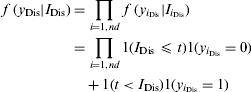
where t is the threshold that defines the two categories of response and nd is the total number of data points. Three-trait analyses were carried out for all of the studied traits. The models applied in three-trait analyses were univariate models fitted for each of the underlying traits. The identifiability of the model is ensured by fixing the values for the thresholds and the residual variances to values of 0 and 1, respectively. Each of the disease traits was considered as a threshold trait with one threshold and two categories.
The prior distributions for the genetic and residual covariances were assumed to be inverted Wishart distributions. A proper prior distribution using an inverse Wishart distribution with minimum shape parameter was adopted in order to ensure posterior propriety. Due to lack of prior knowledge about the vector of fixed effects an improper flat uniform prior distribution was assigned to b: P (b)∼constant.
Marginal posterior distributions of parameters and VCs of the traits were estimated using Multiple Trait Gibbs Sampling for Animal Models (MTGSAM) program (Van Tassell & Van Vleck Reference Van Tassell and Van Vleck1995). The Gibbsit program of Raftery & Lewis (Reference Raftery, Lewis, Gilks, Richardson and Spiegelhalter1996) was used to evaluate the length of the burn-in period and thinning interval needed to obtain stationary chains of independent samples and to estimate the total number of Gibbs samples required. The Gibbs sampler was run for 215 000 rounds. The first 45 000 rounds were discarded as a burn-in period. A thinning interval of 100 rounds was used to retain sampled values that reduced lag correlation. The posterior means of VCs were calculated and those of expected values for heritabilities and correlations.
RESULTS
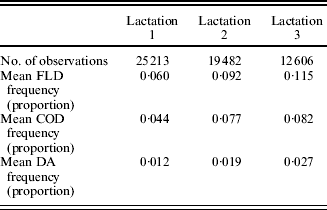
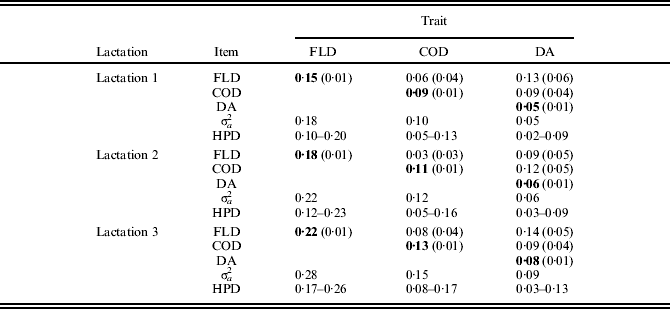
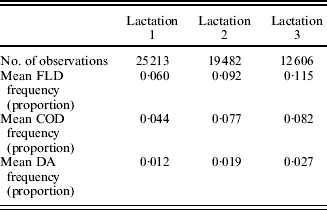
Mean disease frequencies for each lactation are given in Table 1. For all three diseases, frequency was highest in second and third lactations. The posterior mean of heritabilities and genetic correlations for disease traits in the first, second and third parities are presented in Table 2. Posterior estimates of heritability for disease traits were low to moderate and ranged from 0·15 to 0·22 for FLD, from 0·09 to 0·13 for COD and from 0·05 to 0·08 for DA across the first three lactations. The highest posterior density (HPD) regions (P⩽0·05) for the heritability estimates of diseases are shown in Table 2. The HPD of the heritability estimates is located in the region greater than 0.
Mean frequency of FLD, COD and DA by lactation
The posterior mean of heritabilities (in bold on diagonal), genetic correlations (above the diagonal) and HPD (P⩽0·05) for the estimates of heritabilities for disease traits in the first three lactations of Holstein dairy cows (standard deviations (PSD) of marginal posterior distribution of estimates are in brackets)
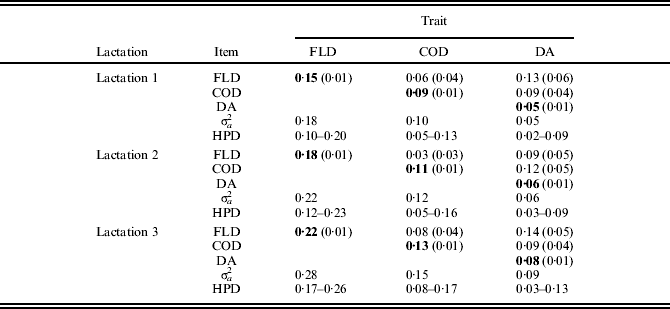
FLD=foot and leg disease; COD=cystic ovarian disease; DA=displaced abomasum; σa2=additive genetic variance.
Genetic correlations between different diseases were low within lactations; the highest values were between DA and FLD, and the lowest estimates were between COD and FLD. The posterior means of the genetic correlations were between 0·03 and 0·08 for COD and FLD, between 0·09 and 0·14 for FLD and DA, between 0·08 and 0·12 for COD and DA (Table 2).
DISCUSSION
The heritability and genetic relationship between traits are needed for planning an efficient breeding system and the development of effective genetic evaluation. The results of the present study can be used as a preliminary step for considering the health traits and including them into the national selection index of Holstein dairy cows. Lactational incidences of DA ranging from c. 0·005 to 0·055 have been reported for Holstein dairy cows in the literature (Lyons et al. Reference Lyons, Freeman and Kuck1991; Uribe et al. Reference Uribe, Kennedy, Martin and Kelton1995; Detilleux et al. Reference Detilleux, Gröhn, Eicker and Quaas1997; Van Dorp et al. Reference Van Dorp, Dekkers, Martin and Noordhuizen1998), which are in accordance with the values found in the present study. The prevalence of lameness associated with FLD found in US studies (0·08–0·15; Warnick et al. Reference Warnick, Janssen, Guard and Gröhn2001) is also similar to the results of the present study; however, results from Britain (average of 0·206; Clarkson et al. Reference Clarkson, Downham, Faull, Hughes, Manson, Merrit, Murray, Russell, Sutherst and Ward1996) are not consistent with the results of current study. Also, generally consistent with the present results, Hooijer et al. (Reference Hooijer, Lubbers, Ducro, Van Arendonk, Kaal-Lansbergen and Van der Lende2001) reported the incidence of COD varied from 0·019 to 0·113.
There were no previously published estimates of genetic correlations between these three diseases. In general, low to medium estimates of heritabilities for disease traits, along with the positive genetic correlations between diseases, should make it much easier to improve resistance genetically to these diseases.
The present heritability estimate for COD was generally in the range reported by other researchers. Similar to the present results, Hooijer et al. (Reference Hooijer, Lubbers, Ducro, Van Arendonk, Kaal-Lansbergen and Van der Lende2001) reported the estimated heritabilities on the underlying and observable scales for COD were 0·102 and 0·087, respectively, in Dutch Black and White dairy cattle. Ashmawy et al. (Reference Ashmawy, Vogt, Youngquist and Garverick1990), Chen et al. (Reference Chen, Yang and Li1990) and Uribe et al. (Reference Uribe, Kennedy, Martin and Kelton1995) also estimated genetic parameters for COD by using a non-linear threshold model. Ashmawy et al. (Reference Ashmawy, Vogt, Youngquist and Garverick1990) used a sire model and found a heritability (±s.e.) of 0·15 (±0·440) for heifers and 0·11 (±0·650) for second lactation cows. The heritability estimate for COD in second lactation cows in the present study was similar to that of Ashmawy et al. (Reference Ashmawy, Vogt, Youngquist and Garverick1990), but lower for first lactation cows. The present heritability estimate for COD was also lower than the report of Chen et al. (Reference Chen, Yang and Li1990), who found a heritability of 0·54. Heritability estimates for COD that are generally consistent with those found in the present study have been reported by Uribe et al. (Reference Uribe, Kennedy, Martin and Kelton1995; 0·13 for first lactation cows and 0·08 over all lactations) and Lin et al. (Reference Lin, Oltenacu, Van Vleck, Erb and Smith1989; 0·12). The present results were greater than the estimates of 0·07, −0·04 to 0·08, and 0 reported by Uribe et al. (Reference Uribe, Kennedy, Martin and Kelton1995), Solbu (Reference Solbu1984) and Dohoo et al. (Reference Dohoo, Martin, McMillan and Kennedy1984), respectively. The wide range in heritability estimates may reflect differences between populations and is caused by the generally small datasets used in the analyses. Furthermore, data collection protocols might vary between studies. In most studies, however, the data sets and progeny group sizes were relatively small, which prevented accurate estimation of the heritability. In addition, it is important to note that disease events are more accurately recorded if the herds are involved in a particular study with regular visits by veterinarians rather than in a continuous national health recording programme (Mäntysaari et al. Reference Mäntysaari, Gröhn and Quaas1993).
The heritability estimates found in the present study indicated additive genetic variability for FLD, COD and DA in Iranian Holstein dairy cows. The heritability estimates for the lactational incidences of DA in the current study were in the range as reported by Hamann et al. (Reference Hamann, Wolf, Scholz and Distl2004), Van Dorp et al. (Reference Van Dorp, Dekkers, Martin and Noordhuizen1998) and Lyons et al. (Reference Lyons, Freeman and Kuck1991), whereas Geishauser et al. (Reference Geishauser, Diederichs and Beuing1996) and Uribe et al. (Reference Uribe, Kennedy, Martin and Kelton1995) found higher values. Geishauser et al. (Reference Geishauser, Diederichs and Beuing1996) used material from a veterinary clinic in combination with field data and a linear daughter-dam regression; therefore, this analysis may not be comparable with the current analysis using field data with randomly chosen herds. The differences of the current results to the study of Uribe et al. (Reference Uribe, Kennedy, Martin and Kelton1995) may be partly explained by the applied statistical methods, because these authors used a sire model, but without a relationship matrix. All known additive genetic relationships among animals were included in the current analysis and therefore, the information of the available pedigree data should be used most efficiently.
Uribe et al. (Reference Uribe, Kennedy, Martin and Kelton1995) reported the heritability of 0·14 for leg problems, which were generally lower than estimates in the present study. Koenig et al. (Reference Koenig, Sharifi, Wentrot, Landmann, Eise and Simianer2005) also reported lower estimates of heritabilities than found in the current study for foot problems (0·07–0·11). However, in general, the current results are consistent with those reported previously: Boettcher et al. (Reference Boettcher, Dekkers, Warnick and Wells1998) reported estimates of heritability for clinical lameness of 0·10 and 0·22 from the linear and threshold models, respectively. Paget et al. (Reference Paget, Swanson and Mrode2004) reported heritabilities of 0·17 for locomotion and feet and leg traits in Guernsey and 0·22 in Jersey breeds. Heritability estimation for clinical lameness conducted by Van Dorp et al. (Reference Van Dorp, Dekkers, Martin and Noordhuizen1998) in a total of 4368 first lactation records of Holstein cows was 0·16. Lyons et al. (Reference Lyons, Freeman and Kuck1991) reported the estimates of heritabilities for individual locomotion traits were 0·14, 0·09, 0·20 and 0·09 for trimmed feet, leg problems, foot problems and crampy, respectively.
CONCLUSIONS
Point estimates of heritability for disease traits were in the range reported by other researchers and were 0·15–0·22 for FLD, 0·09–0·13 for COD and 0·05–0·08 for DA across the first three lactations. Genetic correlations between diseases were low (0·03–0·14), highest between FLD and DA and lowest between FLD and COD. All genetic correlations that could be considered to be different from zero were positive. Health traits have not been included in the selection index used for Holstein dairy cows in Iran until now. The results of the current study can be used as a preliminary step for considering the importance of health traits and including them in the national selection index of Holstein dairy cows. However, the feasibility of including diseases in indexes for dairy selection depends on the economic importance of a specific disease.
The authors wish to thank two anonymous reviewers for their constructive comments on the earlier versions of this manuscript.