INTRODUCTION
In the last 30 years, the success of pediatric cancer treatment rates has been on the rise; however, there remains a minority of parents who must still face the tragic loss of their child to cancer (Smith & Gloeker Ries, Reference Smith, Gloekler Ries, Pizzo and Poplack2002). For this unfortunate minority, their experience has been described as the “ultimate loss” (Wilson, Reference Wilson1988), one that is more difficult to cope with than the loss of other family members (Cleiren, Reference Cleiren1993; Shaefer & Moos, 2001). Although parental reactions to the loss of a child are not yet well understood by researchers, several studies have begun to reveal key factors influencing parental bereavement.
Some authors have reported several negative consequences of losing a child. For example, there are reported findings of elevated incidents of physical (Li et al., Reference Li, Laursen and Precht2005) and psychosocial (Rando, Reference Rando1983; Vance et al., Reference Vance, Boyle and Najman1995) difficulties related to the loss, including increased levels of anxiety and depression (Clarke & Williams, Reference Clarke and Williams1979; Osterweis et al., Reference Osterweis, Soloman and Green1984; Vance et al., Reference Vance, Foster and Najman1991; Malkinson & Bar-Tur, Reference Malkinson and Bar-Tur1999; Rubin & Malkinson, Reference Rubin, Malkinson, Stroebe, Hansson and Stroebe2001; Kreicbergs et al., Reference Kreicbergs, Valdimarsdottir and Onelov2004). Vital aspects of parents' lives have been found to also be negatively impacted, including their relationships and worldviews (Meert et al., Reference Meert, Thurston and Briller2005) and their personal identity and self-concept (Talbot, Reference Talbot2002; Uren & Wastell, Reference Uren and Wastell2002). Others have suggested that the profound grief of losing a child can potentially last for as long as 4 years postloss (Hazzard et al., Reference Hazzard, Weston and Gutterres1992), and there are reports of continued depressive symptoms in bereaved parents even 7 to 9 years postdeath (Kreicbergs et al., Reference Kreicbergs, Valdimarsdottir and Onelov2004). Parents who encounter difficulties adjusting to the loss may present symptoms associated with traumatic grief (Prigerson et al., Reference Prigerson, Shear and Jacobs1999), which include preoccupation with thoughts of the deceased and denial of and feeling stunned by the death. At the extreme, severe levels of traumatic grief can, in turn, be associated with extensive clinical problems, such as severe major depression and post-traumatic stress disorder (Murphy et al., Reference Murphy, Braun and Tillery1999, Reference Murphy, Johnson and Chung2003; Piper et al., Reference Piper, Ogrodniczuk and Azim2001; Prigerson & Jacobs, Reference Prigerson, Jacobs, Stroebe, Hansson and Stroebe2001). Some bereaved parents may occasionally experience several physical grief responses, including higher instances of cancer, myocardial infraction, multiple sclerosis, and an increased mortality from both natural and unnatural causes (Li et al., Reference Li, Hansen and Mortensen2002a, Reference Li, Johansen and Hansen2002b, Reference Li, Precht and Mortensen2003, Reference Li, Johansen and Bronnum-Hansen2004). In some extreme cases, parents are unable to express their grief by practicing avoidance whereas others are overwhelmed by their experiences (Barrera et al., Reference Barrera, Mammone D'Agostino, Schneiderman, Tallett, Spencer and Jovcevska2007).
Fortunately, however, these extreme grief symptoms are neither inevitable nor the norm. In fact, some studies have suggested that most parents are able to work through the difficult loss and to integrate their grief into their daily lives (Barrera & Jovcevska, Reference Barrera and Jovcevska2006; Barrera et al., Reference Barrera, D'Agostino and Spencer2006, Reference Barrera, Mammone D'Agostino, Schneiderman, Tallett, Spencer and Jovcevska2007) and report positive changes in their relationships (Miles & Crandall, Reference Miles and Crandall1983). Debilitating grief for bereaved parents is an ongoing process for some, but a large majority of parents report feeling both stronger and more courageous as a result of their difficult experiences (Arnold et al., Reference Arnold, Buschman Gemma and Cushman2005; Barrera et al., Reference Barrera, Mammone D'Agostino, Schneiderman, Tallett, Spencer and Jovcevska2007). Regardless of where a bereaved parent falls on this wide spectrum of bereavement, programs to help bereaved parents deal with their loss have been deemed necessary by many investigators (Goodenough et al., Reference Goodenough, Drew and Higgins2003).
There are many community bereavement programs already in existence; most of them are in the form of self-support groups such as The Compassionate Friends (Klass, Reference Klass1993, Reference Klass1999) and Bereaved Families of Ontario (Klich, Reference Klich1994). These groups are usually run by bereaved parents for parents that are bereaved from a variety of sources and have a flexible and open format that allows parents to join in at any time for as long and as frequently as they wish. Qualitative reports of these support groups suggest beneficial effects (Klass, Reference Klass1993, Reference Klass1999), although systematic evaluation of these programs remains limited (Schneiderman et al., Reference Schneiderman, Winders and Tallet1994). For the few bereavement intervention programs for which efficacy studies do exist, the results are both disappointing and, at times, negative (Schut et al., Reference Schut, Stroebe, Van den Bout, Stroebe, Hansson, Stroebe and Schut2001). Interventions open to all bereaved persons, organized to combine specific types of loss such as that of widows and widowers, offer the least amount of empirical support primarily because they suffer from vast methodological issues. Schut et al. (Reference Schut, Stroebe, Van den Bout, Stroebe, Hansson, Stroebe and Schut2001) not only report that the positive effects of such groups are at best temporary, but the sometimes negative results are particularly worrisome.
However, intervention programs aimed specifically at individuals who are considered at a higher risk (included here are bereaved parents) do show more promising results. At 6 months postloss, bereaved mothers receiving practical and emotional support from hospital professionals do show a decrease in their psychiatric symptoms compared to mothers in a control group (Forrest et al., Reference Forrest, Standish and Baum1982). A similar decline of negative symptoms at 6 months postloss was reported for mothers with higher grief and mental distress at baseline (Murphy et al., Reference Murphy, Johnson and Cain1998). In general, it appears that the more complicated the grief a bereaved person experiences, the better their chance of benefiting from a bereavement intervention program (Schut et al., Reference Schut, Stroebe, Van den Bout, Stroebe, Hansson, Stroebe and Schut2001).
Previous findings are not yet specific enough to address the immediate needs of parents who have lost a young child to cancer after a long illness, which involves establishing new relationships with other parents and staff from the treating center. Although the consequences of their loss are becoming more and more evident in the literature, it remains unclear what these bereaved parents' needs are and what services from the treating hospital they could benefit from shortly after the child dies as compared to services offered by programs that already exist in the community.
Parents of children who died of cancer after a long treatment period essentially develop a close relationship with some members of the treating team and experience additional grief at the loss of that relationship when the treating centers do not have a formal bereavement service. There are some reports indicating that parents perceived that health professionals do not provide the best possible and follow-up care to meet their needs (Widger & Wilkins, Reference Widger and Wilkins2004). The evolving philosophy of pediatric treating hospitals is integrating palliative and bereavement care as part of their services for children with life threatening illnesses and their families. It is unclear what bereaved parents' needs are that can be addressed by the treating hospital shortly after the child dies from cancer. To better understand the needs of this group of bereaved parents, our team took, as a first step, to explore these parents' perceptions of their needs.
Specifically, the research questions of this study are these: What are the views of bereaved parents of cancer patients regarding existing bereavement services? What they find helpful in dealing with their loss. What additional services they would like to see offered to bereaved parents by the treating center? To answer these questions, we used a brief survey and a focus group. The survey provided initial information about families interested in participating in a focus group. Focus groups are considered a useful methodology to attain preliminary information for program development (Heary & Hennessy, Reference Heary and Hennessy2002). The focus group was developed based on Freeman et al.'s (2001) description of this methodology.
METHODS
Recruitment and Participants
Using the Haemotology/Oncology Deceased Patient Database of a large pediatric hospital and after consulting with primary health professionals regarding the appropriateness of approaching potential families, a convenience sample of 20 bereaved families was identified in a 6-month period as potential participants. A letter describing the study and a brief survey were mailed. Ten parents (five mothers and five fathers who had collectively lost six daughters and four sons) responded to the survey. Eight parents agreed to participate in the focus group, seven (five mothers and two fathers) of which actually attended the session. One mother encountered car problems on her way to the group and was unable to join in. In only one family did both parents attend the focus group as a couple. As a group, they lost three daughters and three sons.
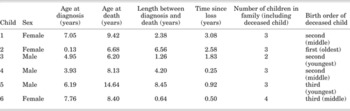
The demographic information about the deceased children is presented in Table 1. Briefly, children's age at diagnosis ranged from 0.13 to 7.76 years (M = 5.00, SD = 2.76) and their age at death ranged from 6.20 to 14.64 years (M = 8.91, SD = 3.04) with the length of time between diagnosis and death ranging from 0.64 to 8.45 years (M = 3.92, SD = 3.09). The time since the loss varied from 0.25 to 3.08 years (M = 1.53, SD = 1.15) at the time the group met. Most children were diagnosed with acute lymphoblastic leukemia, but two were diagnosed with neuroblastoma and one with acute myelogenous leukemia. All families had at least one surviving child.
Demographic data on deceased children and their families

Data Collection
Survey
A short, seven-item survey was mailed to families. Using open-ended questions, the survey inquired about parents' perception of past and current psychosocial difficulties, if any, related to the death of their child; previous experiences, if any, with bereavement services offered in the community; experience with bereavement services, if any, being offered at the hospital; and willingness to participate in a focus group to discuss their ideas about bereavement services at the treating center.
Focus Group
Those families who returned the survey and indicated a willingness to participate in the focus group discussion were subsequently contacted by phone. To accommodate some of the parents' reluctance to meet in the treating hospital, the 2-h focus group was held in a comfortable meeting area in a nontreating institution. Careful consideration was also taken to schedule a meeting time convenient for all participants. Verbal consent was obtained from each of the participants for audiotaping the discussion. The discussion was led by two moderators, a social worker and a psychologist, who alternated note taking and leading the group discussion. A carefully worded script and timetable were followed, consisting of the core topics and prompts to stimulate the discussion. Lastly, the moderators maintained a neutral tone throughout the session.
After the purpose of the focus group, participants' role, and the rules of the focus group process were explained to the participants, participants were asked to share information about themselves with the group. This was followed by the questions prepared for the focus group. Specifically, moderators asked parents what their easiest and the hardest bereavement experience was, what bereavement services they were provided by the hospital, what additional services they would have liked to have received, what community bereavement services, if any, they had attended, and what hospital and/or community service they found most useful. Prompts were utilized when necessary throughout the discussion. Finally, parents were debriefed about the experience of participating in the focus group and thanked for their participation.
Data Analyses
Descriptive statistics (frequencies and percentages) were calculated to describe the survey results. The focus group discussion was transcribed verbatim followed by content analysis to determine similar themes emerging from the discussion as recommended by Kitzinger (Reference Kitzinger1995). The transcript was initially coded by one of the researchers using an open coding process in an attempt to extrapolate meaningful theme categories using NVivo software. Subsequently, two members of the multidisciplinary research team independently undertook an iterative process of content analysis, based on the constant comparative method of grounded theory (Strauss & Corbin, Reference Strauss and Corbin1990), of the transcribed focus group audiotape to identify emerging themes of parents' experience and recommendations. This continuous interaction with data by each of the researchers was followed by joint sessions to discuss the themes. If disagreements between the two researchers occurred, they were resolved by further review, analysis, and discussion of the specific section in the transcript that resulted in disagreement. Moreover, credibility of the results was evaluated by comparing emerging themes to the field notes collected by the moderators during the focus group session and to the responses in the survey provided by parents. Frequencies of emerging themes were determined by mapping content analysis results to the focus group transcript. These frequencies are reported as gross (under) estimates capturing only the verbal statements made by participants, given the nature of focus group discussions where participants often talk over each other or simply gesture agreement or disagreement with particular topics. Finally, positive parental response to these results of the study added credibility to the findings (D'Agostino et al., Reference D'Agostino, Berlin and Barrera2004).
RESULTS
The survey results revealed that 6 out of 10 (60%) parents had used bereavement services offered in their communities and 4 out of those 6 (67%) found these services helpful. All 10 parents indicated that they liked the idea of having a hospital bereavement service. Parents provided little information about their psychosocial difficulties in the survey but expressed their willingness to discuss these issues in a group.
In answering the major questions of the study (What are the views of bereaved parents of cancer patients regarding specific existing bereavement services? What did they find helpful in dealing with their loss? What additional services would they like to see offered to bereaved parents by the treating center?), the qualitative analysis yielded themes that are grouped into three areas: Why offer bereavement services at the treating hospital? When would the service be helpful? What helped in dealing with the loss?
Why Offer Bereavement Services at the Treating Hospital?
During the focus group discussion approximately 60% of parents voiced the need to have bereavement services available from their deceased child's treating hospital shortly after the loss. Reasons given for their desire for this are outlined in the themes below.
The Treating Hospital as “Their Community”
A great deal of the discussion was focused on the sense of community parents had, and some still have, for their child's treating center. Parents perceived the treating hospital as “their community” because this was the place where they and their deceased child spent a great deal of their time throughout the illness and in particular during the last weeks before death. They often thought of it as their second home where they developed new friendships with other families and staff during this difficult period in their lives. As one parent expressed, “I just think that the community is there (treating center) and maybe you've been a part of it for years and years, and all of a sudden you are not part of it anymore … which seems wrong.” Yet another proclaimed, “Their children went through what my child went through. The bereavement support groups in the community, they are alike for all ages; parents who just lost their 50-year-old child, you know? It is different. And this is better (referring to the focus group). That's what I'd like to see.”
Minimize Secondary Losses and Feelings of Abandonment
Parents identified what they called “losing their second home” if there is no continuity of service by the treating center. Lack of follow-up treatment may result in additional losses for the family and perceptions of being abandoned by staff after the child dies. As one parent put it: “One of the difficult parts of losing [child] was losing [the treating hospital], because it was our second home … . So I think it is really important that we have a community for parents, especially at the initial transition, because I had a lot of trouble the first year coping, and a majority was the loss of my community.” Another parent said: “You walked down the corridor out of [the ward] and into the elevators knowing there's no way you're coming back for treatment, and it is, it's a big door that swings shut metaphorically … . It is almost as if ‘Well there's no medical problem now—finished!’”. A different parent reflected: “I was lost when I got home from this place. I wanted to be at the hospital. Eight days later, I came back.”
Flexible and Consistent Professional Services
Four parents voiced the need for flexibility of services. They felt strongly that any bereavement program developed by the treating center must be highly flexible in terms of the services provided, given that family needs will vary greatly, depending on their journey before and after the child dies. For some families, frequent contact with a professional may be necessary whereas for other families regular phone call follow-ups may be sufficiently beneficial. A second issue of flexibility was the idea of private, one-on-one services versus group interventions. Although some parents felt their grief was very private and wanted to keep it that way, for other parents it was important to share their grief with others experiencing similar situations as themselves. A parent put it best: “In your developing of this program, you may have to keep a huge flexibility in the program.” Another parent also said “It is part of building a community so you've got the community when the bereavement comes.” A different parent mentioned, “It was nice to have been offered [professional psychological services for the family] … to see that [my children] were doing fine. All those things.”
Facilitate Parental Networking with Each Other
For some families, the continuing support other parents provide is invaluable, therefore encouraging parents to network with each other in a variety of ways, including over the internet: “making a community board or website where people can post their desire to meet another family in their situation.” This would be useful because, as one parent put it, “I find it really hard to keep track of families we have known for so long; that means a lot to us. And that was also part of the transition.”
Having Information Packages Available
Parents find it useful to have written materials to help them navigate the complex health system or what is involved in dealing with their own journey from diagnosis to palliation and bereavement. As one parent commented, “So there is an entrance package, maybe we need an exit package.” Thus they suggested having different information packages available, perhaps before death, shortly after death, and 6 to 12 months after death. These packages could contain information about programs that are offered either by the treating center or in the community.
When Would the Service Be Helpful?
Preparation for the Death
As parents who had “been there,” they expressed “bereavement begins before the child dies,” or as it is known in the literature, anticipatory bereavement. Yet not all parents are able to grieve while the child is still alive. One parent stated, “But we can't just start after death and talk about this stuff, because everything we want to do, there has some root or something that helped pre-death.” As another parent said, “It almost has to have a connection before they die.”
Immediate Bereavement Services from the Treating Center
Parents suggested that bereavement services from the treating center immediately after the child dies need to be offered on an individual basis and can vary on intensity depending on the family needs. This will prevent feelings of abandonment for families who needed the continuity of care. As one parent specifically reflected, “It was the immediate after when I felt I was falling without a parachute … and that is where I felt I would have enjoyed help from the hospital.” Another declared, “I don't know if I could have handled the group before now, because I wanted one on one for a while.” Yet another parent said these immediate individual services may be useful “for the family [who] just lost their child; probably they would need it more frequently.” This individual bereavement counseling could help parents make the transition to their local community for support: “Now I don't want it … but at that time I needed that connection. And then there's a point where you think, yeah, you don't want to be reminded of that rawness that I felt when [staff] called last time.”
Follow-up in Group Format
Group support, however, was seen as helpful and desirable after the first few months postloss. Thus, parents expressed that the existence of group support services could be beneficial as follow-up and transition services before they can benefit from group community services. As one parent expressed, “Now that it is almost two years, a group once a month is a really okay time for us.”
What Helped in Dealing with the Loss?
Having People Who Understand the Experience of Losing a Child to Cancer
The majority of parents commented on the positive outcomes of communicating and networking between parents as well as others, such as health care workers, who understood their experiences. Importantly, the two parents in the group who made the least number of comments during the focus group discussion echoed, several times, the importance of this theme. They expressed the desire to feel as if they were not alone in experiencing the loss of a child; as one parent stated “I'm not the only one.”
Parents spoke of building a community of parents who are able to share in release of their grief. For example, one parent proclaimed, “We knew a couple of other parents from [treating hospital] who lost children around the same time, and we met them at different places. And that was great, it was a really wonderful way to talk about things and finally make it make sense.” One parent said, “I like talking to other parents that are going through like I did with [daughter]. Like, their children went through what my child went through. Whereas, the bereavement support groups out in the community-they're like, for all ages.” Other parents reflected on the healing aspects of helping each other; “You want to support, and you need as much to give as you've got—it's very benefiting.”
This network not only included other parents who had similar experiences, but also staff who had treated the child and developed a caring relationship with the family: “She (staff) was sharing a story about her interaction with our son, this little kid, 4 years prior, and you need to hear that.” A different parent mentioned, “It was nice to have been offered [professional services].”
Preparing for the Child's Death
A very common theme, voiced by a great majority of parents, was the need to prepare parents for the child's death. As difficult as it could be for parents at the time the child is going through the end stage of life, upon reflection, bereaved parents believed that talking and preparing for the child's death can be beneficial.
For some parents, their child's loss was evident to them and they were ready to let go. As one parent said, “For us, it was very obvious that we had lost the battle, and it was time to let him go.” Another parent reflected on wanting the child to die because “he was so ill and in so much pain.” Despite reaching these conclusions, parents were adamant that they did not lose hope for their children. One parent said, “We were actively preparing for death, while pursing the latest experimental treatment, really hoping—right up to the last 22 days actually.” Hope, for many families, was “so important, even in the face of a devastating prognosis.” For those families who had come to terms with their child's death, they noted some benefits of coming to such terms. One parent spoke about the ability to plan for the death, “because we started talking about these things about 6 months before he died.” One mother felt relief because she and her husband had talked to their son about his death 3 months before he died. These parents were also glad that they did not have to pretend in front of their dying child as well: “Kid doesn't have to pretend, we don't have to pretend.”
Other parents in the group expressed having had a more difficult time coming to terms with their child's imminent death. One parent said, “I didn't even want to be there, because I didn't want to be anywhere near anything that sounded like death.” Another said, “We always denied it, till even the last minute I still did not want him to die.” Regardless of their pre-death experiences, the need for pre-death support services was clearly communicated by the parents of this focus group. One parent reflected, “A pre-death bereavement session could be preparing and talking about … . You don't have to give up your hope—but you can still make plans, so that it doesn't creep up on you.” Another parent said, “That's a really hard place to get to, and I think there's a huge need for the kind of support that enables you to get to that place.” Helping parents express their feelings and thoughts during this palliative phase must be done with great sensitivity based on their individual needs. Some parents expressed their need for support during this phase but were adamant that they were not ready to “be involved with the parents who lost their kids,” nor were they, at that point, ready to go into “a support group for parents whose child had already died.”
Physical Activity and Humor
Parents also identified specific activities they found helpful after the child died, such as engaging in exercise (“The one thing that seemed really potent at the time [shortly after loss] was exercise.”) and using humor among their circle of supporting family members, friends, and staff. As one parent put it: “But no one can appreciate that humor, and you really have to suppress it … . You really have to be in the community of oncology to understand.”
DISCUSSION
We ascertained parental views about services with the goal of designing a program that would address parental bereavement needs using a brief survey and focus group. Seven of the 10 bereaved parents who returned the survey participated in the focus group to discuss developing parental bereavement services by the treating center. The focus group proved very informative in examining parental views regarding the necessity of having formal bereavement services offered by their deceased child's treatment center shortly after the loss and the nature and reasons for these services. Parents also expressed a strong need for, benefit from, and value in staying connected to their child's various health care professionals after the child dies to prevent secondary loss and feelings of abandonment, which is consistent with previous reports (Neidig & Dalgas-Pelish, Reference Neidig and Dalgas-Pelish1991; James & Johnson, Reference James and Johnson1997; Beardsmore & Fitzmaurice, Reference Beardsmore and Fitzmaurice2002; Contro et al., Reference Contro, Larson and Scofield2002; Bradshaw et al., Reference Bradshaw, Hinds and Lensing2005; Macdonald et al., Reference Macdonald, Liben and Carnevale2005). In fact, insufficient contact with their deceased child's health care team was the second most common stressful event for parents following the loss of their child (Kreicbergs et al., Reference Kreicbergs, Valdimarsdottir and Onelov2004). As well, good communication between parents and the treating team has been identified as critical for reducing parental distress before and after the loss (Contro et al., Reference Contro, Larson and Scofield2002) and for improving parental satisfaction of treatment (Wolfe et al., Reference Wolfe, Grier and Klar2000). Providing bereavement care to families from the treating team may be considered a natural progression of care (Sirkia et al., Reference Sirkia, Saarinen-Pihkala and Hovi2000; Russo & Wong, Reference Russo and Wong2005). Thus, both our participants' responses and the literature on this topic suggest that a bereavement program that includes contact with some members of the treating center team shortly after the loss is critical for parents. The mechanism behind this need to be connected seems to be the perception of a double loss when the child dies, including the loss of their “hospital community,” as parents in this study called it.
Immediate bereavement services following the loss could be especially beneficial during the early stages of bereavement, when parents' profound sense of loss may make them more vulnerable for poor mental health (Li et al., Reference Li, Laursen and Precht2005) and they may not have the energy to form new relationships with service providers in the community. Bereavement services by the hospital can provide continuity and can then serve as a bridge in the transition to community services. Supporting bereaved parents during the early bereavement process will allow them time to reestablish links and rebuild relationships in their residential communities. After the early months of grieving, which may vary from parent to parent, parents may feel ready for local community bereavement resources.
Flexibility of bereavement services was another important theme. For example, telephone follow-up, group, and one-on-one sessions were thought to meet the needs of different bereaved parents. One-on-one individual bereavement counseling sessions can give other grieving parents the privacy and individual attention needed to move forward through their grieving process. Group sessions will allow some parents the opportunity to network with others who understand their experiences, thus further building necessary social support. These bereaved parents consistently specified their need to share their experiences with others whose situations are akin to their own, which is also consistent with previous research (Klass, Reference Klass1993, Reference Klass1999; Widger & Wilkins, Reference Widger and Wilkins2004).
Parents also described other ways in which the treating center can act as a conduit for bringing families together who wish to learn from others' experiences and those who wish to share their own experiences such as providing a community board. Because lack of social support is a key stressor for bereaved parents (Kreicbergs et al., Reference Kreicbergs, Valdimarsdottir and Onelov2004), it is consequently imperative that future bereavement programs be designed to promote social support for parents. This would ensure that parents learn to draw from their own social networks instead of having to rely solely on the intervention program, which is a criticism of bereavement intervention programs (De Keijser, 1997 as cited in Schut et al., Reference Schut, Stroebe, Van den Bout, Stroebe, Hansson, Stroebe and Schut2001).
Parents also identified the need for palliative care support and anticipatory grief services during the period before the child dies, even though they admitted that, at the time, it would have been very difficult to agree to discuss the imminent death of their child for fear of equating it with giving up; those who were able to address the reality of the child's condition and prepare for the death stated it was very helpful. Parents also indicated that specific information packages were something that parents should be provided to allow review at their own pace and as an opener for initiating discussion regarding preparation for loss. Parents want to be provided with information before the death in order to gain a sense of control over their unfortunate situation (Widger & Wilkins, Reference Widger and Wilkins2004). This preparation for death could also work to help ensure that those vivid memories parents have of their child's death are positive and not tainted with regret (Kreicbergs et al., Reference Kreicbergs, Valdimarsdottir and Onelov2004).
Although the study was successful in achieving its primary goal, identifying bereaved parents' perspective regarding bereavement services in treating centers, there are some limitations to keep in mind. Self-selection bias is an intrusive problem in most studies. For example, as Freeman et al. (Reference Freeman, O'Dell and Meola2001) suggest, those families who did not attend the focus group may be significantly different from those families who did attend, and therefore the participants may not be representative of most bereaved parents whose child died of cancer. The probability of self-selection bias was reduced by involving families who varied in demographic characteristics, in time since the loss, and in experience with disease, treatment, and progression. The consistency of themes within the focus group among the participants and with the literature, however, made the findings of this study credible. Moreover, several steps were employed to further ensure credibility of the results. First, an “ideal” number of parents, seven (Heary & Hennessy, Reference Heary and Hennessy2002), participated in the focus group. Second, the focus group moderators (social worker and psychologist) and senior psychologist formed a multidisciplinary team, allowing for an accurate and wider perspective on the results. Third, results presented at a provincial conference, where bereaved parents were present, were received with confirmatory comments (D'Agostino et al., Reference D'Agostino, Berlin and Barrera2004).
In conclusion, this study explored bereaved parents' views regarding parental bereavement services that could be provided by the treating center shortly after the loss and what factors they perceived as helpful during their bereavement process. Their insightful comments provided useful information in the process of developing the desired program to serve bereaved families after childhood cancer. Two key components of an optimal program include transitional bereavement services from treating center that start during the end stage of the child's life and continue shortly after the death and services that are flexible in order to tailor them to individual parental needs. Contact with staff who knew their child and understood their journey and with other parents who have had similar experiences and preparation for the child's imminent death were identified as important. Although a majority of parents are able to integrate their grief into their daily lives (Barrera et al., Reference Barrera, Mammone D'Agostino, Schneiderman, Tallett, Spencer and Jovcevska2007), the continuation of palliative and bereavement services would facilitate parents' grief and improve their quality of life.