INTRODUCTION
Thalassinidean mud shrimps are a dominant burrowing group in marine and estuarine sediments. Bioturbation by the shrimps during burrow construction as well as their feeding patterns have significant effects on the physical, chemical and microbiological characteristics of the sediment (Posey et al., Reference Posey, Dumbauld and Armstrong1991; Ziebis et al., Reference Ziebis, Forster, Huettel and Jørgensen1996; Nates & Felder, Reference Nates and Felder1998; Bird et al., Reference Bird, Boon and Nichols2000; Kinoshita et al., Reference Kinoshita, Wada, Kogure and Furota2003a, Reference Kinoshita, Wada, Kogure and Furota2008; Papaspyrou et al., Reference Papaspyrou, Gregersen, Cox, Thessalou-Legaki and Kristensen2005). The structures of burrows of several thalassinidean shrimps have been previously described (see Griffis & Suchanek, Reference Griffis and Suchanek1991; Nickell & Atkinson, Reference Nickell and Atkinson1995 for reviews). Generally, upogebiid shrimp burrows are distinctly U-shaped or Y-shaped and are divided into an upper section, which is U-shaped, and a lower more vertical shaft (Dworschak, Reference Dworschak1983; Hall-Spencer & Atkinson, Reference Hall-Spencer and Atkinson1999; Coelho et al., Reference Coelho, Cooper and Rodrigues2000; Candisani et al., Reference Candisani, Sumida and Pires-Vanin2001; Kinoshita, Reference Kinoshita2002; Kinoshita & Itani, Reference Kinoshita and Itani2005; Li et al., Reference Li, Lin, Chan and Chan2008). The burrows of these shrimps often serve as habitats for other animals, such as copepods, phoronid worms, bivalves, crabs and gobies (MacGinitie Reference MacGinitie1930; Kato & Itani, Reference Kato and Itani1995; Astall et al., Reference Astall, Taylor and Atkinson1996; Itani et al., Reference Itani, Davie and Takeda2002; Itani, Reference Itani2002; Itoh & Nishida, Reference Itoh and Nishida2002; Kinoshita, Reference Kinoshita2002; Santagata, Reference Santagata2004; Nara et al., Reference Nara, Akiyama and Itani2008). Thus, these shrimps play a major role in structuring the local benthic community.
Upogebia yokoyai Makarov is a common member of the family Upogebiidae on tidal flats in Japan (Itani, Reference Itani2004). The ecology of this species has been studied with respect to its life history in a local population in western Japan (Itani, Reference Itani2001) and in relation to its trophic level (Kanaya et al., Reference Kanaya, Takagi, Nobata and Kikuchi2007). Upogebia yokoyai was often confused with U. major. For example, some reports on the respiration characteristics (Mukai & Koike, Reference Mukai and Koike1984) and gill-cleaning mechanism (Batang & Suzuki, Reference Batang and Suzuki2003) of U. major are in fact references to U. yokoyai (see Sakai & Mukai, Reference Sakai and Mukai1991; Itani, Reference Itani2004). Therefore, some aspects of the physiology and ecology of U. yokoyai are still poorly understood.
In this study, the burrow structure of U. yokoyai was investigated using in situ resin casting. The characteristics of the shrimp burrow are compared with those of other upogebiid species. Additionally, we report on associated animals found attached to the shrimp and in their burrows.
MATERIALS AND METHODS
The study site chosen was a tidal flat in Nanakita River mouth (38°15′N 141°00′E), Miyagi prefecture, in north-eastern Japan. The sediment was mainly sand (1.4% gravel, 97.4% sand and 1.2% silt–clay). The horizontal distance between the lowest spring tide line and the lower edge of the reed marsh was approximately 20 m. The mean number of burrow openings was 592 m−2, reaching a maximum of 720 m−2 in some areas (Kinoshita, personal observation). Burrow casts were made in April 2000, using polyester resin (Eporak® G-226P, Nippon Shokubai Co. Ltd, Japan), as recommended by Hamano (Reference Hamano1990). Liquid resin was poured into frames that encompassed several burrows and the hardened casts were carefully removed from the sediment after 4 days. All shrimps appearing on the surface following removal of the casts were collected by hand. In the laboratory, casts were examined, photographed, and measured as recommended by Kinoshita & Itani (Reference Kinoshita and Itani2005). Burrow depth was measured as the straight-line vertical distance from the top of the cast to the bottom. The length of each major section—the upper U-shaped and the lower shaft—was measured to the nearest 0.1 cm using a measuring tape. The distance between the burrow openings was alo measured (overall width of U-shaped section). Cast diameters were measured to the nearest 0.01 cm using a hand caliper, thereby enabling individual burrow surface area and burrow volume to be calculated from total length and mean burrow diameter. The number of turning chambers and branches per cast were also recorded.
Shrimps trapped in the cast were carefully removed and fixed with 10% neutralized seawater–formalin. Carapace length (CL) was measured from the tip of the rostrum to the rear edge of the carapace (nearest 0.01 cm) using hand calipers. Large shrimp (CL > 0.77 cm) were sexed by inspecting for the presence or absence of the first pleopods (present in females) while smaller shrimps were considered juveniles and were not sexed. All other animals caught during casting were identified.
RESULTS
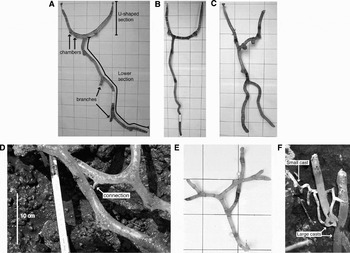
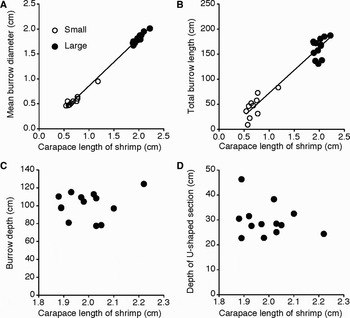
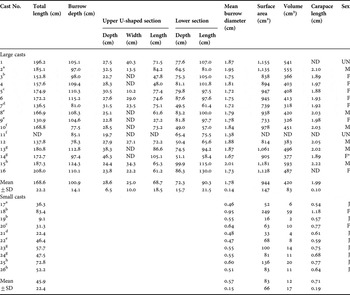
A total of 26 burrow casts were recovered. Casts were separated into two size-classes (large and small) for the purpose of comparison; 16 large casts and 10 smaller casts were obtained (Table 1). The large burrows consisted of an upper U-shaped section and a lower shaft section, with or without turning chambers and branches (Figure 1A–C). The total burrow length ranged from 130.9 to 208.0 cm and the burrow depth ranged from 77.5 to 124.3 cm. Further, the depth of the U-shaped section ranged from 19.7 to 46.3 cm, and the length from 27.2 to 105.1 cm. Depth of the lower shaft ranged from 49.0 to 99.9 cm, and the length from 57.0 to 130.0 cm. The burrow surface area ranged from 733 to 1181 cm2, and burrow volume ranged from 318 to 593 cm3. Three pairs of large casts were connected through a narrow horizontal connection (Figure 1D). The small burrows were more complex in structure (Figure 1E) and were connected to the large burrows (Figure 1F). The total length of the small burrows ranged from 9.1 to 83.4 cm, the surface area ranged from 7.8 to 124.7 cm2, and the burrow volume ranged from 2 to 59 cm3. Each cast contained only a single shrimp. Carapace length measurements of the large shrimp ranged from 1.88 to 2.22 cm, and those of the small shrimp ranged from 0.54 to 1.18 cm. Mean burrow diameter of the large casts ranged from 1.38 to 2.01 cm, and from 0.47 to 0.95 cm for the small casts. Relationships between the CL of the shrimp and mean burrow diameter, total burrow length, burrow depth and depth of the U-shaped section are shown in Figure 2. Mean burrow diameter and total burrow length were related to CL (r2 = 0.996 and 0.933), but no significant relationships were found with other burrow measurements (r2 < 0.5). Total burrow length was not related to CL (r2 = 0.128) for large casts. The number of chambers in the large casts ranged from 2 to 9, while that in the small casts ranged from 0 to 9. The number of branches in the large casts ranged from 0 to 3, while that in the small casts ranged from 1 to 6.
Typical burrow casts (A–C, E) and close-up showing connection between casts (D, F). (A) Cast number 1; (B) cast number 6; (C) cast number 10; (D) cast number 13 (left) and 14 (right); (E) cast number 18; (F) cast number 22 (small cast, left), 9 (large cast, center) and 8 (large cast, right). Background squares (A–C, E) 10 cm × 10 cm.

Relationship between carapace length of shrimp and burrow measurement. (A) mean burrow diameter (y = 0.95x − 0.10, r2 = 0.996, N = 23); (B) burrow total length (y = 91.23x – 18.61, r2 = 0.933, N = 23); (C) burrow depth (y = 28.50x + 44.26, r2 = 0.035, N = 13); D, depth of U-shaped section (y = – 17.10x + 63.82, r2 = 0.064, N = 13).

Burrow dimensions of Upogebia yokoyai from resin casts. Connected casts are indicated with the same letters.

ND, no data; M, males; F, females; J, juveniles; UN, sex unknown; *, parasitized specimens.
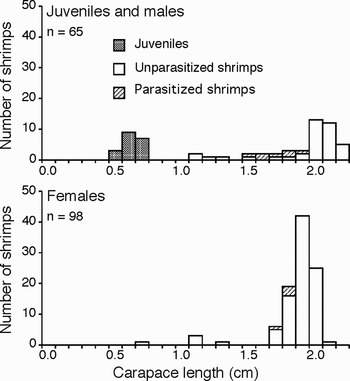
Three size-classes of shrimp could be identified in a total of 163 individuals of U. yokoyai collected (less than 0.8 cm CL, 1.1–1.3 cm CL, and over 1.5 cm CL; Figure 3). The sex-ratio of the shrimp with CL over 0.77 cm was 3:7 (male:female). Some shrimps (6.7%; 7 males and 4 females) showed branchial chambers occupied by the bopyrid isopod Gyge ovalis. Sizes of the affected shrimps were 1.53–1.90 cm CL (Figure 3). Four gobies (one Chaneogobius macrognathos and Chaneogobius mororanus; one each and two Eutaeniichthys gilli) were collected from the large burrow.
Length–frequency histogram of juvenile and male Upogebia yokoyai sampled on Nanakita River tidal-flat (top) and female shrimp (bottom). Parasitization by the bopyrid isopod Gyge ovalis is also indicated.

DISCUSSION
The burrow structure of Upogebia yokoyai is generally Y-shaped. This is the most common pattern observed among the family Upogebiidae (Nickell & Atkinson, Reference Nickell and Atkinson1995). However, these detailed features are different in each species. Kinoshita & Itani (Reference Kinoshita and Itani2005) compared the burrow structure of Austinogebia narutensis and Upogebia issaeffi that lived in the same tidal flat. The burrow of A. narutensis tended to have a wider and shallower U-shaped section than those of U. issaeffi though the difference of each shrimp size was considered. The differences in the burrow structure of the two shrimps were due to potentially non-adaptive phylogenetic interspecific differences. The data show that mean burrow diameter and total burrow length of the burrow of U. yokoyai were related to shrimp size, but no significant relationships were found with other burrow measurements. Upogebiid shrimps tend to extend their burrow vertically, with linear or exponential increases in the upper U-shaped section and the lower section in association with the shrimp size (Dworschak, Reference Dworschak1983; Coelho et al., Reference Coelho, Cooper and Rodrigues2000; Kinoshita, Reference Kinoshita2002). Li et al. (Reference Li, Lin, Chan and Chan2008) compared the burrow structures of Austinogebia edulis that lived on muddy shore and sandy shore, and suggested that the different sediment property affected the relationship between burrow parameters (burrow depth and width of U-shaped section) and shrimp size. Therefore, the burrow structure in the present study might be influenced by not only this species characteristic but also the sediment property. An investigation of burrows in different environments should be made to better understand the burrow morphology of U. yokoyai. Burrows of small U. yokoyai were complex and always connected to large burrows. Juveniles of other thalassinidean shrimps have also been shown to use conspecific burrows as recruitment sites (Forbes, Reference Forbes1973; Frey & Howard, Reference Frey and Howard1975; Tamaki et al., Reference Tamaki, Ikebe, Muramatsu and Ingole1992; Felder & Griffis, 1994; Candisani et al., Reference Candisani, Sumida and Pires-Vanin2001). Juveniles of N. harmandi [= Callianassa japonica] use the adult burrows until they are able to construct their own, avoiding heavy bioturbation by adults (Tamaki et al., Reference Tamaki, Ikebe, Muramatsu and Ingole1992). In contrast, juveniles of U. major and U. omissa occupied their own independent simple U- or Y-shaped burrows (Coelho et al., 2000; Kinoshita, Reference Kinoshita2002). At our study site, the physical disturbance caused by the water and tidal current is likely to be always present, but small U. yokoyai that use large conspecific adult burrows may have an advantage in terms of survival.
Our data show that U. yokoyai creates a quite deep burrow. Although the upper U-shaped section is generally less than 47 cm from the sediment surface, the lower shaft extends much deeper (maximum depth of 124 cm in this study). In most Upogebiid shrimps, burrow depth is less than 100 cm (Li et al., Reference Li, Lin, Chan and Chan2008). Thus, U. yokoyai is one of the deep burrowers in this family along with U. major whose burrows reach the exceptional depth of 208 cm (Kinoshita, Reference Kinoshita2002). Upogebiid shrimps use the U-shaped section for filter feeding and irrigation activities (Dworschak, Reference Dworschak1983; Allanson et al., Reference Allanson, Skinner and Imberger1992), yet the function of the lower section is unclear (Astall et al., Reference Astall, Taylor and Atkinson1997). Several authors suggest that the lower section may act as an anti-predator device (Astall et al., Reference Astall, Taylor and Atkinson1997; Candisani et al., Reference Candisani, Sumida and Pires-Vanin2001; Li et al., Reference Li, Lin, Chan and Chan2008) and Kinoshita et al. (Reference Kinoshita, Nakayama and Furota2003b) report that the vertical expansion of the lower section of the burrow of U. major provides refuge from predators and physical stress, allowing the shrimps to survive for a long time. We hypothesize that the lower section may also be used as a shelter when the U-shaped section breaks because of a physical disturbance caused by wave and tidal action. Even if the U-shaped section breaks, the shrimp can repair it using the lower section without emerging from the burrow. Further behavioural studies on these mud shrimp would be necessary to clarify this hypothesis.
We observed connections from three large burrows to other large burrows. These burrows appear to be purposely connected. Four casts with connections were inhabited by male–female pairs suggesting possible mating behaviour of the shrimp. Other upogebiid shrimps have also been found in inter-connected burrows (Coelho et al., Reference Coelho, Cooper and Rodrigues2000; Candisani et al., Reference Candisani, Sumida and Pires-Vanin2001; Li et al., Reference Li, Lin, Chan and Chan2008) and Candisani et al. (Reference Candisani, Sumida and Pires-Vanin2001) reported that burrows of Upogebia noronhensis with additional branches resulted from male searches for females during breeding.
Gobies are frequently found in thalassinid shrimp burrows (Kinoshita, Reference Kinoshita2002; Kneer et al., Reference Kneer, Asmus and Vonk2008). Three species of gobies were collected when casting the burrow of U. yokoyai. These species are commonly found outside of the shrimp burrows (Kanou et al., Reference Kanou, Koike and Kohno2000) and the shrimp burrows may be used only temporarily when the mudflat is exposed. The relationship merits further investigation. The bopyrid isopod G. ovalis was found at a prevalence of 6.7% in shrimps less than 2 cm CL. Itani (Reference Itani2001) reported that bopyrid isopods were present in the branchial chamber of 10.1% of U. yokoyai on a tidal flat in Tonda River mouth in western Japan. While it is well known that the isopods exert a negative influence on the reproduction and metabolism of their hosts (Tucker, Reference Tucker1930; Hughes, Reference Hughes1940; Smith et al., Reference Smith, Chapman and Dumbauld2008), further investigation would be necessary to demonstrate such a negative effect on growth of U. yokoyai.
In conclusion, burrows of U. yokoyai are relatively simple and Y-shaped, but depths exceed 1.2 m. Burrow diameter and total burrow length were related to shrimp size, but no significant relationships were found with other burrow measurements on the Nanakita River tidal-flat. Small U. yokoyai create their own burrows which are connected to the burrows of large conspecifics. This strategy may help the small shrimps avoid physical or other stresses, but experimental work is required to test this. Some large casts were connected to other large casts through a narrow connection suggesting subterranean mating behaviour of the shrimp. One species of bopyrid isopod and three species of gobies that appear to be endoeketes were found to be associated with the shrimp. Thus both the shrimp body and its burrow provide a habitat for other animals in the tidal flat community.
ACKNOWLEDGEMENTS
We thank the following contributors for their superb cooperation, without which this paper could never have been completed. T. Sunobe graciously identified the gobies. T. Toya and S. Takagi assisted in the field observations. R. S. Lavin assisted in editing the English version of the manuscript. Thanks are also due to the Executive Editor and referees for providing valuable comments and suggestions.