Bat-pollinated (chiropterophilous) flowers are characterized by a wide-throated corolla, foetid odour, production of a copious amount of pollen and nectar, and most importantly nocturnal blooming (Faegri & van der Pijl Reference FAEGRI and VAN DER PIJL1979). In India, out of the 28 chiropterophilous plants reported (Subramanya & Radhamani Reference SUBRAMANYA and RADHAMANI1993) only Ceiba pentandra (Bombacaceae) has been investigated in some detail (Nathan et al. Reference NATHAN, RAGHURAM, ELANGOVAN, KARUPPUDURAI and MARIMUTHU2005).
Oroxylum indicum (L.) Kurz is a bat-pollinated tree species native to the Indo-Malayan region and occurs in many parts of India. The tree propagates naturally by seeds, but fruit-set is extremely poor (~0.45%). In Malaysia (Gould Reference GOULD1978) and Thailand (Srithongchuay et al. Reference SRITHONGCHUAY, BUMRUNGSRI and SRIPAO-RAYA2008), O. indicum is legitimately pollinated by a generalist bat, Eonycteris spelaea. Two key features have emerged from these studies: (1) low fruit-set due to poor pollination efficiency, (2) declining populations of this bat species may adversely affect the survival of O. indicum.
In India two bat species, Rousettus leschenaulti (Desmarest) and Cynopterus sphinx Vahl have been suggested as the possible pollinators of O. indicum (Marshall Reference MARSHALL1985, McCann Reference MCCANN1939). However, on the basis of essentiality of morphological fit between the flower and pollinator, Gould (Reference GOULD1978) suggested C. sphinx as the more likely pollinator. Until the present study Gould's surmise had not been tested by careful observations. We report here various aspects of reproductive biology of O. indicum studied in the foothills of Western Himalaya and clearly demonstrate a legitimate relation between C. sphinx and O. indicum.
Data were collected for 3 y (2005–2007) from the naturally occurring trees of Oroxylum indicum in a broad-leaved, semi-deciduous forest located in Rishikesh district, (30°03′16″–30°09′10″N, 78°17′10″–78o 20′27″E), Uttarakhand, India. We marked 30 trees in the region to record the reproductive events and randomly used individual trees for detailed observations. Flower production per inflorescence and the flower longevity (time interval between anthesis and abscission of the corolla) were determined from randomly tagged inflorescences and flowers, respectively. Floral dimensions were measured using a vernier calliper. The average pollen production was determined with a haemocytometer (Kearns & Inouye Reference KEARNS and INOUYE1993) and pollen viability with fluorochromatic reaction (FCR) test (Heslop-Harrison & Heslop-Harrison Reference HESLOP-HARRISON and HESLOP-HARRISON1970). The onset of stigma receptivity was ascertained by the peroxidase method (Kearns & Inouye Reference KEARNS and INOUYE1993), and in vivo pollen germination. The index of ovular receptivity was expressed as per cent of ovules with micropylar exudate (MEx); the latter was localized by staining the ovules (n = 20) with toluidine blue O' (pH = 4.4). To establish whether or not the presence of MEx was a function of ovular maturity, the ovules at different stages of flower (24, 48 and 72 h before and after anthesis) were analysed (n = 10 pistils at each stage; total ~6000 ovules).
After ascertaining that bats were the only floral visitors, attention was focused on the types of bat and their visitations (n = 20 occasions) employing a battery-operated torch light. The frequency of bat visits was recorded; the flower-handling time was measured with the help of a digital stop-watch. After establishing the average number of visits made by the bats, the amount of pollen removed after each of the successive visits was counted. The average pollen load on the open-pollinated stigma (30 pistils) and the naturally abscised pistils (n = 50) was determined. Quantification of nectar (30 flowers, 7 trees) was made with a calibrated microsyringe (1 ml). For determining the temporal details, nectar was drawn from each flower every 30 min (between 21h00 and 02h30). Five flowers were bagged and kept undisturbed (control) to estimate the total nectar production. The sugar concentration of nectar was determined with a portable refractometer (Sigma, 0–80%).
For establishing the breeding system, four types of controlled pollinations were done: (1) Emasculated flowers were hand self-pollinated (n = 234) with pollen from the same tree and bagged; (2) Emasculated flowers were hand cross-pollinated (n = 250) using pollen from different trees and bagged; (3) Emasculated flower buds (n = 150) were bagged without pollination to ascertain the incidence of apomixis, if any; and (4) spontaneous autogamy by bagging flowers (n = 282) without emasculation. Fruit-set (%) through open-pollination (n = 868 flowers) was computed from three randomly tagged racemes in each season. For recording the comparative growth rate of self- and cross-pollen tubes in a pistil, the pollinated pistils (n = 50 each) were analysed at different times after pollination (up to 50 h) by aniline blue fluorescence method (Linskens & Esser Reference LINSKENS and ESSER1957). Data obtained as percentage were arcsine transformed to achieve homoscedasticity (Sokal & Rohlf Reference SOKAL and ROHLF1995). The data were pooled if there was no significant difference between the results recorded each year. All ANOVA were carried out using SPSS 15 at 0.05 probability level. Post hoc test (Tukey's test) was applied in cases where there were more than two sets of data to be compared for significance of differences.
All the marked trees showed synchronized flowering in the first/second week of April attaining a peak during July–August. On average, a tree bore 12.3 ± 3.2 racemes (n = 10 trees) and each raceme produced 112 ± 16 flowers (n = 35 racemes); the average flower production per tree being 1434 ± 162 (n = 20). The average number of flowers that opened each night in a raceme (n = 20 trees) and in a tree (n = 5) was 2.7 ± 0.8 and 39 ± 12, respectively.
The corolla tube measures 45.3 ± 2.7 mm × 39 ± 3.2 mm. Flowers are protandrous and anthesize between 19h15 and 20h00. The corolla tube is retained in a flower for ~10h (until 05h00). The average pollen production per flower was 3.31×10⁶ (n = 50 flowers). The viability of fresh pollen grains (n = 30 flowers) was 39.2% ± 4.2% and it was completely lost within 15h00 after anther dehiscence. The stigma is bilobed, wet-papillate and only its inner surface is receptive. An ovary contains 649 ± 68 ovules (n = 30 pistils); the average pollen:ovule ratio was ~4909 (n = 40). In the younger stages the ovules did not secrete MEx. However, at anthesis ~64% (417 ± 28) of them exuded it. In the post-anthesis stages, there was no significant increment in the number of receptive ovules (ANOVA, F = 0.20, P = 0.817). The unpollinated pistils (n = 10) did not show an increase in the number of receptive ovules during 24–72 h after anthesis. The distribution of receptive ovules was random (n = 30 pistils) and their number correlated (r = 0.54) positively with the average number (319 ± 12) of normal seeds.
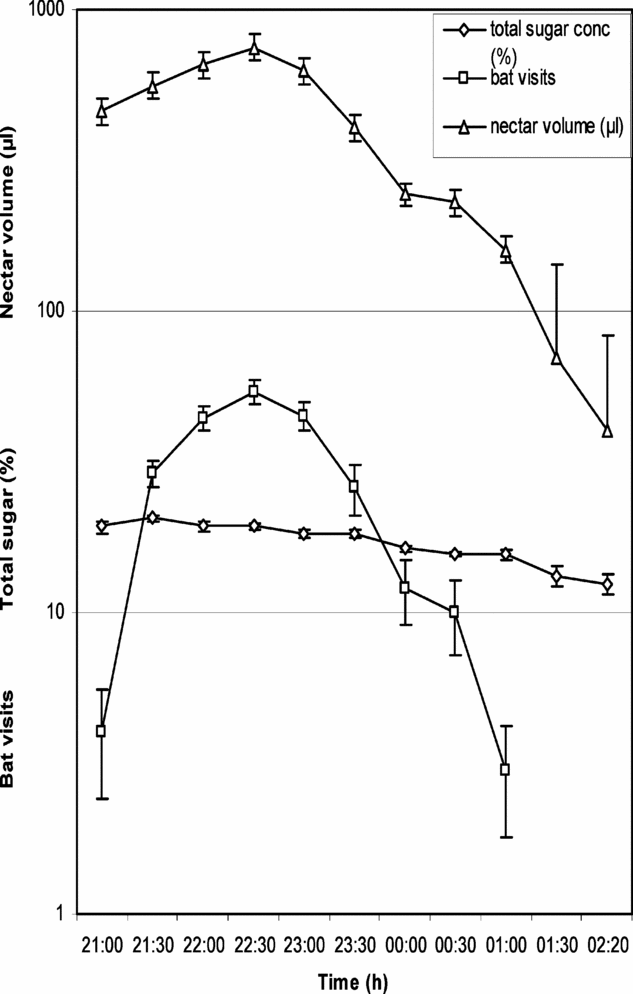
Nectar production commenced 30–45 min before anthesis and continued until 01h00. The total amount of nectar after periodic removal was 3.7 ± 0.2 ml; this amount was significantly higher (ANOVA, F = 6.8, P = 0.0001) than that in the control (2.1 ± 0.2 ml). The nectar contained 20.6% ± 0.4% sugars during the peak time of nectar production (22h00–23h00), and it declined to 12.5% ± 0.4% by 02h30 (Figure 1).
Logarithmic graph showing temporal details of nectar volume (μl), its total sugar concentration (%) from the flowers of Oroxylum indicum and total number of visits by Cynopterus sphinx.
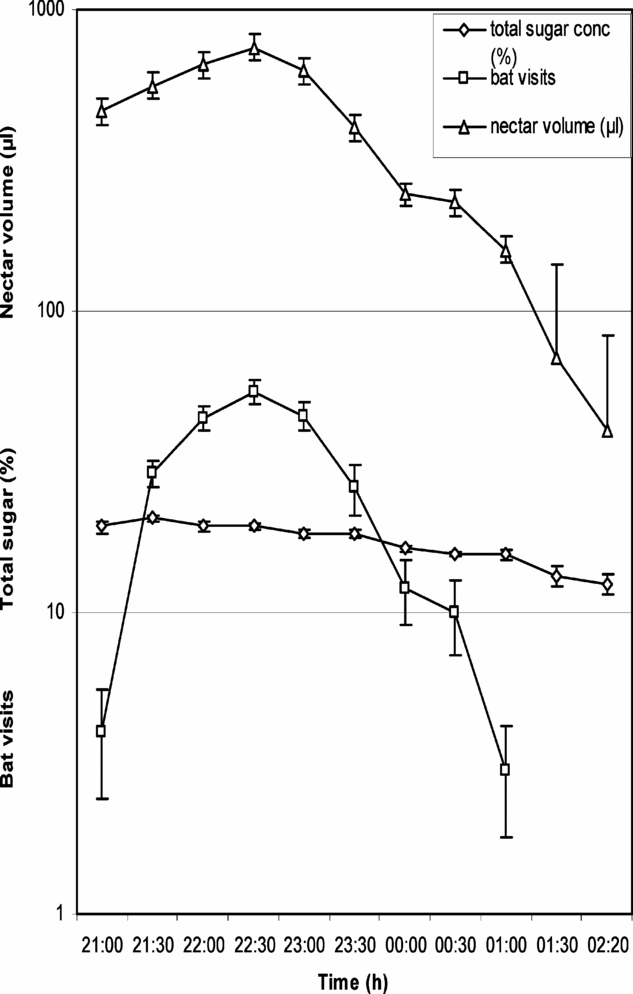
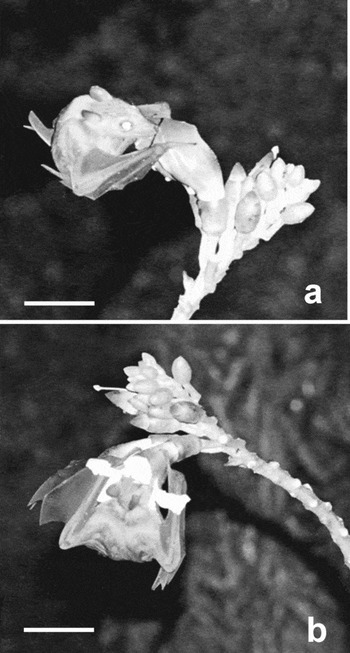
At the study sites only two species of bat, Cynopterus sphinx and Pteropus giganteus, were recorded. Between these only C. sphinx frequently visited O. indicum flowers. The visits of C. sphinx began ~30 min before anthesis and they facilitated anthesis by touching or biting the tip of the buds (Figure 2a). While foraging, the bat perched on the flowers and completely inserted its snout (Figure 2b) into the corolla tube to draw nectar. On an average a bat spent 1.2 ± 0.4 s (n = 50 visits) on a flower and a single flower was visited ~10 times. The peak of foraging activity resided between 22h00 and 23h30 and it stopped completely ~01h00. On an average, 80% ± 12% of pollen was removed after five visits to a flower (n = 25 flowers). The foraged flowers also showed pollen scattered on the inner surface of corolla and in the nectar.
Pollination of Oroxylum indicum by Cynopterus sphinx. The pollinator bat facilitating anthesis by biting the buds (a) and consuming nectar by completely inserting the snout (b). Bar = 5 cm.

The unfolding of stigma lobes 20 ± 10 min (n = 20 pistils) after anthesis marked the onset of stigma receptivity (between 21h30 and 22h30). Once touched by the head of the bat, the lobes closed down within 10 s and invariably failed to open completely again. Gentle touch with a finger or a wooden stick had a similar effect on the sensitivity of the stigma (n = 10 flowers). The open-pollinated stigmas (n = 30 pistils) had 456 ± 373 pollen grains (range = 55–1456) by the end of the foraging period. Of these pistils, only 3% had more pollen (~871 per stigma) than the average number of ovules (~650) in an ovary. The pollen load on the naturally abscised pistils was significantly lower (60 ± 12, n = 50) than the open-pollinated flowers that were retained on the tree (ANOVA, F = 60, P = 0.0001).
Flowers bagged to ascertain apomixis and spontaneous autogamy failed to set fruits. Fruit-set from open-pollination (0.4–0.6%) could be significantly increased to 24% by hand cross-pollination (ANOVA, F = 231, P = 0.0001). Fruit-set from manual pollinations in the 3 y was nearly the same (ANOVA, F = 1.0, P = 0.422). Both self- and cross-pollen germinated within 50 ± 10 min after pollination and the pollen tubes had reached the base of the style at the rate of 3 ± 1 mm h−1 within 14–16 h. The onset of penetration of pollen tubes into the ovules occurred in 36 h after cross-pollination; in self-pollination this occurred after ~50 h. A mature fruit (n = 40) contained ~310 (52%) seeds, each surrounded by a large membranous wing.
The present work on the reproductive biology of O. indicum has established many parallel findings with that from Malaysia (Gould Reference GOULD1978). The most striking similarities are the specialized relation of the tree with a suitable bat species and the foraging behaviour of pollinator bats. The thigmosensitive nature of the stigma and self-incompatibility are the common findings by Srithongchuay et al. (Reference SRITHONGCHUAY, BUMRUNGSRI and SRIPAO-RAYA2008) and us. The present study has established that at the study site short-nosed bat C. sphinx is the only legitimate pollinator. The specialized relation of Oroxylum–Cynopterus under Indian conditions conforms to the prediction made by Gould (Reference GOULD1978). Successful pollination of O. indicum by C. sphinx follows the ‘lock and key’ mechanism described for Oroxylum–Eonycteris (Gould Reference GOULD1978), according to which only the appropriately sized bats would be the effective foragers. This morphological prerequisite is considered to be crucial for a specialized relation in bat-pollinated plant species (Muchhala Reference MUCHHALA2007). As observed in E. spelaea (Gould Reference GOULD1978), C. sphinx manipulates the opening of mature flower buds. This behaviour could be attributed to seeking an assured reward in the form of copious nectar during the extended phase of flowering. It is unclear whether this phenomenon has been noticed by Srithongchuay et al. (Reference SRITHONGCHUAY, BUMRUNGSRI and SRIPAO-RAYA2008).
The stimulated nectar production in O. indicum may have implications for the frequency of foraging bouts. Considering the short foraging period (4–5 h), poor pollen viability, and low pollen load on the open-pollinated stigma, frequent foraging bouts may be essential in O. indicum to deposit a sufficient amount of pollen. In Thailand, it has been shown that E. spelaea makes ~65 visits to a single flower (Srithongchuay et al. Reference SRITHONGCHUAY, BUMRUNGSRI and SRIPAO-RAYA2008) whereas in India only ten visits of C. sphinx were recorded. Out of these 10 visits, ~80% pollen grains were dislodged in five visits. However, the observed low pollen deposition in the majority (~97%) of the pistils (present work) could be due to low pollination efficiency caused by the thigmosensitive stigma, which can receive the pollen only once irrespective of whether the pollinator carries the pollen or not. This is in contrast to Catalpa speciosa (Stephenson Reference STEPHENSON1979) and Tecoma stans (Singh & Chauhan Reference SINGH and CHAUHAN1996), which show periodic opening of stigma lobes.
In O. indicum, fruit-set could be significantly enhanced by hand cross-pollinations to 24% (present work). The high pollen:ovule ratio also suggests a xenogamous breeding system (Cruden Reference CRUDEN1977). Also, the naturally abscised pistils showed poor stigmatic pollen load. Thus, it is likely that the poor natural fruit-set in O. indicum is caused by pollen limitation and insufficient xenogamous pollination. It has been shown that ~900 pollen grains are to be deposited to ensure fruit-set (Srithongchuay et al. Reference SRITHONGCHUAY, BUMRUNGSRI and SRIPAO-RAYA2008). Whereas we have not examined this aspect, we have recorded 55–1456 pollen grains in the open-pollinated stigmas at the end of the foraging period.
Hand self-pollinated flowers invariably abscised; the epi-fluorescence studies of cleared pistils of such flowers showed pollen tube entry in the ovules. The selfed-ovules showed delayed pollen tube penetration suggesting that possibly the inhibition is manifested before ovule penetration. Such delayed rejection of self-pollen tubes is termed late-acting self-incompatibility (LSI) observed in many other bignoniaceous trees (Bittencourt & Semir Reference BITTENCOURT and SEMIR2005). It is likely that micropylar exudate (MEx) may be involved in screening the pollen tubes for compatibility because the growth rate of self-tubes is considerably reduced near the micropyle. This is in agreement with some unrelated LSI systems such as Asclepias (Sage & Williams Reference SAGE and WILLIAMS1995) and Gasteria (Franssen-Verheijen & Willemse Reference FRANSSEN-VERHEIJEN and WILLEMSE1993). MEx also appears to play a crucial role in the proportion of seed-set in O. indicum, as the proportion of seed-set in nature is significantly correlated (r = 0.54) with the extent of receptive ovules.
It is believed that a specialized plant-pollinator relationship should ideally enhance pollination efficiency (Stebbins Reference STEBBINS1970). However, in self-incompatible O. indicum xenogamous pollen deposition on the stigma is limited just to one visit by the bat. As the flowers are protandrous, the closed stigma lobes might have been a contrivance for preventing selfing and sensitivity to touch could have evolved as a further measure in this direction. Although C. sphinx is not an endangered bat species in India, our study and that of Srithongchuay et al. (Reference SRITHONGCHUAY, BUMRUNGSRI and SRIPAO-RAYA2008), both indicate that dependence on the single bat pollinator in different regions is probably detrimental to Oroxylum indicum in different parts of the tropics causing decreased fecundity and decline in population size.
ACKNOWLEDGEMENTS
Vikas acknowledges the award of a Junior Research Fellowship by the University Grants Commission. HYM thanks the Indian National Science Academy for granting him the position of Honorary Scientist. We are grateful to Professor G. Marimuthu, Madurai Kamaraj University, for identifying the pollinator bat species.