INTRODUCTION
The present line of research—exploring cancer treatment experiences among survivors of childhood sexual abuse—began with a breast cancer patient who had been sexually abused by her father. Although she believed that she had addressed and processed the abuse successfully in psychotherapy several years before, she reported the following reaction to her breast biopsy:
I was completely unprepared. I did not realize the vulnerability I would feel when I had to lie down on a table, put my breast through a hole and remain completely still. I was told not to move—and knew I couldn't scream. That replicates my sexual trauma: I was a terrified girl in my bed, unable to move or scream. (Schnur & Goldsmith, Reference Schnur and Goldsmith2011, p. 4054)
The literature demonstrates that this patient is not alone—her trauma history and her frightened reactions to healthcare are disturbingly common. In the United States, 25% of women and 8% of men have experienced unwanted or abusive sexual experiences before the age of 18 (Pereda et al., Reference Pereda, Guilera and Forns2009), and more than 1.6 million individuals will be diagnosed with new invasive cancers in 2016 (Siegel et al., Reference Siegel, Miller and Jemal2016). These rates, together with the increased incidence of cancer among survivors of childhood sexual abuse (Brown et al., Reference Brown, Thacker and Cohen2013), indicate that the cooccurrence of a history of childhood sexual abuse (CSA) and cancer is relatively common.
Across healthcare settings, CSA survivors can struggle with, and in fact can be retraumatized by, medical procedures due to perceived similarities with the original abuse (Dallam, Reference Dallam2010). For example, both CSA and medical procedures can involve feeling submissive to authority figures, undressing, and pain. Many CSA survivors report feeling powerless or threatened in healthcare settings and report experiencing posttraumatic stress (PTS). PTS experiences in healthcare settings can include: intrusive thoughts; emotions (e.g., shame, embarrassment, fear); avoidance (e.g., avoiding screening or other medical appointments because they trigger CSA-related distress [Alcala et al., Reference Alcala, Mitchell and Keim-Malpass2016]); and memories associated with the original abuse. In combination, this set of reactions is referred to as “healthcare retraumatization.” Healthcare retraumatization has been documented in qualitative studies in non-cancer settings (e.g., OB/GYN care, physical therapy, dentistry [Roberts et al., Reference Roberts, Reardon and Rosenfield1999; Schachter et al., Reference Schachter, Stalker and Teram1999; Reference Schachter, Radomsky and Stalker2004]), as well as in quantitative studies (Willumsen, Reference Willumsen2004; Leeners et al., Reference Leeners, Stiller and Block2007; McGregor et al., Reference McGregor, Julich and Glover2010) and literature reviews (Schachter et al., Reference Schachter, Stalker and Teram1999; Monahan & Forgash, Reference Monahan and Forgash2000; Havig, Reference Havig2008). However, most qualitative research on healthcare retraumatization among CSA survivors has focused on routine medical care (e.g., OB/GYN, primary care, screening procedures, dentistry). Few studies have specifically explored how patients with a history of CSA experience cancer treatment, despite the frequency, duration, and intimacy of such cancer care.
The few case reports and case series that have examined CSA survivors' emotional responses to cancer treatment document a range of difficulties. Among 18 individuals with cancer and histories of CSA, Gallo-Silver and Weiner (Reference Gallo-Silver and Weiner2006) identified such issues as intense emotional distress, nonadherence to treatment, disturbances in relationships with members of their healthcare team, and dissociation that prevented the ability to integrate medical information. The researchers noted that all 18 patients in their sample reported having upsetting memories of their abuse arise during cancer treatment. Wygant and colleagues (Reference Wygant, Hui and Bruera2011) focused on the experiences of one CSA survivor with advanced cancer. The patient struggled with insomnia, trust in the medical team, avoidance of male physicians, and claustrophobia that diminished the patient's capacity to tolerate such procedures as magnetic resonance imaging. Schnur and Goldsmith (Reference Schnur and Goldsmith2011) described the experiences of two cancer patients with histories of CSA. The patients indicated that aspects of biopsy, surgery, and radiotherapy each triggered memories of the abuse. Although these case reports provide clinical insights into the experiences of CSA survivors with cancer, they all have small sample sizes (n = 1 to n = 18), and all are anecdotal. To date, there has been no formal qualitative analysis to understand the cancer treatment experiences of a large sample of men and women with a history of both CSA and cancer.
Therefore, the objective of the present study was to explore the cancer treatment experiences of CSA survivors, with a particular focus on the most difficult and triggering aspects of treatment. To understand and address CSA survivors' difficult experiences in cancer settings, we must first listen carefully to the survivors themselves.
METHODS
Reporting Standards
This manuscript follows the COREQ (COnsolidated criteria for REporting Qualitative research) reporting standards (Tong et al., Reference Tong, Sainsbury and Craig2007). For details, please see the COREQ Checklist (Supplementary Table 1; see Supplementary Materials).
Study Design
This project was part of a larger anonymous online survey study that was designed to increase understanding of CSA survivors' experiences of cancer treatment. Our study was approved by the Program for the Protection of Human Subjects at our institution.
Setting
For our study, we took an anonymous online survey approach because: (1) the anonymity permitted by the internet has the potential to reduce participant self-censorship, shame, embarrassment, and fear of judgment/stigmatization (Griffin et al., Reference Griffin, Resick and Waldrop2003; Caplan & Turner, Reference Caplan and Turner2007); and (2) trauma survivors may feel less inhibited in responding to surveys using computer-based questionnaires (East et al., Reference East, Jackson and O'Brien2008). In particular, we chose to recruit a convenience sample of participants anonymously from Amazon Mechanical Turk (MTurk). MTurk in particular was chosen as a recruitment site because it is an active crowdsourcing site for conducting online psychological research, including populations impacted by cancer and trauma (Shapiro et al., Reference Shapiro, Chandler and Mueller2013; Arch & Carr, Reference Arch and Carr2016). The benefits of MTurk include the ability to reach large and geographically diverse samples, including individuals living in remote areas, and the potential to include individuals who might not be able or willing to meet with investigators in person. Past research has demonstrated that the quality of MTurk data is comparable to non-internet-based samples across various tasks (Paolacci et al., Reference Paolacci, Chandler and Ipeirotis2010; Buhrmester et al., Reference Buhrmester, Kwang and Gosling2011; Sprouse, Reference Sprouse2011), and that MTurk members tend to be honest about self-reported information (Rand, Reference Rand2011).
We recruited participants by posting a Human Intelligence Task (HIT) on the MTurk website. Individuals browsing the HITs initially saw the survey title “Survey of childhood sexual abuse history & reactions to cancer care (men and women over 21).” Individuals interested in participating could click on this title to view a short description of the study and its eligibility criteria.
If participants chose to proceed, they clicked to view a more detailed information page that included: the name, professional title, and departmental and institutional affiliations of the principal investigator (PI); a statement that the research group was interested in understanding the cancer care experiences of individuals who experienced childhood sexual abuse and who were diagnosed with cancer as an adult; and that our goal was to improve the sensitivity of cancer care. Participants were also informed that the PI's interest in the topic was to “directly inform the cancer care community about this important issue” and to “guide the development of sensitive practice guidelines for physicians and other healthcare providers working with individuals who have experienced childhood sexual abuse.”
Sampling and Recruitment
The eligibility criteria for the larger parent study included: age ≥ 21; reporting CSA before age 13 (based on the Centers for Disease Control definition [Breiding et al., Reference Breiding, Basile and Smith2014]); being diagnosed with cancer after age 21; being an MTurk member; having completed at least 100 prior MTurk assignments (HITs); having at least 95% of those HITs approved as satisfactory; and living in the United States. This residency inclusion criterion was chosen to reduce the variability associated with medical practices/procedures in different parts of the world.
To be included in the present qualitative study, individuals had to meet the above criteria and also report having been diagnosed with and treated for breast, skin, gynecological, or colorectal cancer; report no cancer other than these; and respond to at least one of two open-ended questions that were part of the larger survey:
1. As an individual who experienced childhood sexual abuse, what was the most difficult part of cancer treatment and why?
2. During cancer treatment, were there specific triggers of childhood sexual abuse memories? If so, what?
Some 420 participants met these eligibility criteria. We then coded their responses to indicate the presence or absence of CSA-related difficulties or triggering. Responses were coded as “present” if they described difficulties or triggers that were explicitly related to CSA or that have been associated with CSA in the literature (e.g., “feeling unsafe with the male doctors and nurses due to my past sexual abuse,” “being touched in one of my most private areas”). Responses were coded as “absent” if participants indicated that they did not experience any CSA-related triggers or difficulties by responding “no” or “nothing”; that they saw no relationship between their CSA history and their experience of cancer; or by describing only cancer-related difficulties (e.g., nausea, fatigue, concerns about mortality). Of the 420 eligible participants, 118 (28.1%) indicated an absence of CSA-related difficulties or triggers, and 302 (71.9%) indicated the presence of CSA-related difficulties or triggers. These 302 participants were included in the study's analyses. Given that the open-ended questions were optional, no data were collected on participants' reasons for a nonresponse.
Data Collection
The survey was hosted on PsychData.com and was completed by participants entirely online. There was no relationship between the investigators and participants prior to study commencement. Participants were paid $3.00 US for survey completion. All data were collected during three periods of data collection (3/24/15–3/31/15, 12/23/15–12/25/15, and 1/11/16-1/12/16), after which investigators reviewed the data. After the third period, investigators agreed that thematic saturation had been reached and ended recruitment. There were no follow-up or repeat surveys.
The open-ended questions described above, and analyzed in the present paper, were developed by the first author, a female Ph.D.-level clinical psychologist and faculty member in a cancer prevention and control program, in conjunction with the other investigators. The first author has previous training in qualitative research, and three of the four coinvestigators are clinical psychologists with experience working with individuals with cancer and trauma histories. These questions had been pilot-tested in previous online research.
All the collected qualitative data were typed by participants as responses to the two open-ended questions analyzed in this study; there were no audio or visual recordings. Given that responses were typed directly by participants, no transcripts were sent for comment and/or correction. No prompts or guides on how to respond to the questions were provided by the investigators. Data are not available on how long it took participants to respond to the two open-ended questions since they were embedded in a longer survey. No fieldnotes were collected, as the investigators did not receive the participants' responses in real time—only after they were submitted through PsychData.com. The anonymous online survey format means that we do not know specifically where patients completed the questions (e.g., home, workplace) or whether anyone else was present at the time of survey completion.
Participants also responded to a demographics and medical history survey asking about their age, cancer type, gender, race, ethnicity, and educational status.
Data Analysis
Survey responses were downloaded from PsychData.com and imported into NVivo (v. 10 for Windows; QSR International, Chicago, IL) for data management. For this project, we employed thematic analysis, following the approach described by Braun and Clarke (Reference Braun and Clarke2006). We conducted an inductive thematic analysis, meaning that our analysis was data-driven, rather than driven by a preexisting framework. Themes were not identified in advance; they were derived from the data. Analytic procedures were as follows: Phase 1—all of the investigators familiarized themselves with the data by reading the set of open-ended responses; Phase 2—two of the investigators generated initial codes individually, and then met together to discuss their initial codes. By the end of Phase 2, these two coders had generated 46 initial codes; Phase 3—the two coders worked together to sort these codes into four broader themes, and sought input from the other investigators to resolve discrepancies; Phase 4—the set of investigators reviewed and refined the themes, checked to ensure that the data within themes were internally consistent, and worked to ensure that themes were clearly distinguishable from one another. At this point, the set of investigators sorted the original 46 codes into two primary themes, the first of which had three key subthemes (see Supplementary Table 2 [Supplementary Materials] for our coding tree); and Phase 5—the set of investigators jointly defined and named the two themes and selected illustrative quotes for each. Given that this was an anonymous study, and that participants only consented to initial survey completion, they were not recontacted to provide feedback on the findings.
RESULTS
Participants
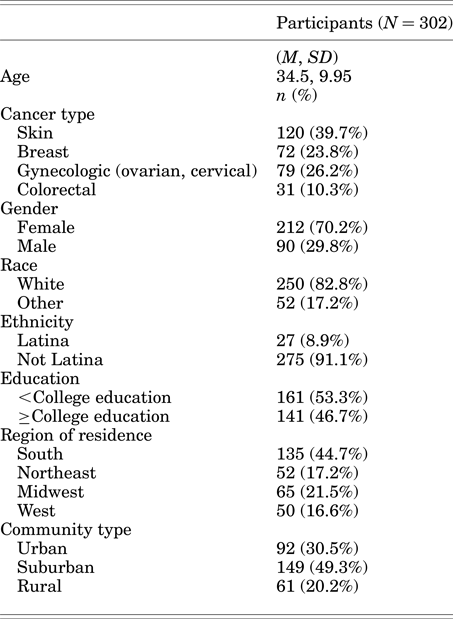
See Table 1 for a summary of participants' demographic characteristics and types of cancer.
Sample characteristics

Primary Themes
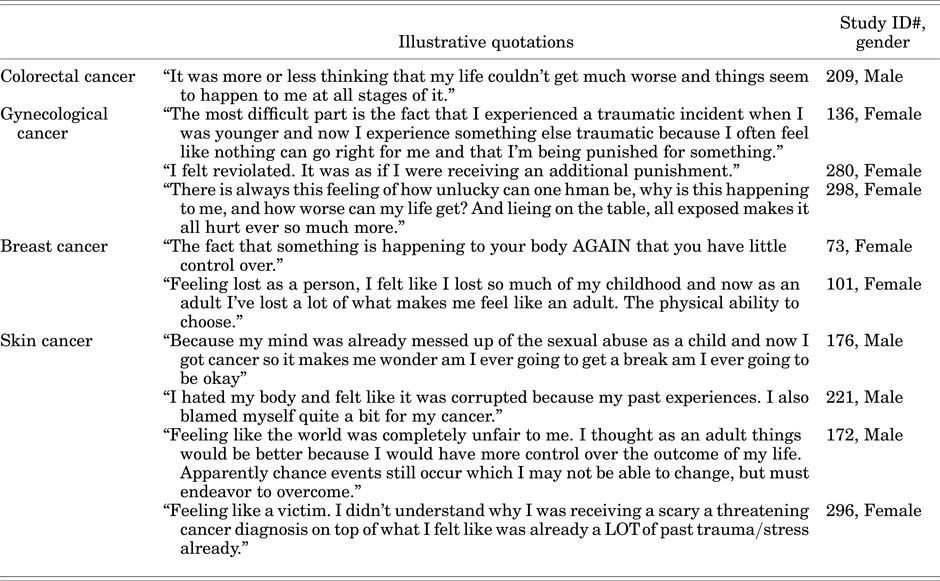
We developed two primary themes describing the difficulties and triggering experienced by CSA survivors undergoing cancer treatment: (1) treatment-related triggers (key subthemes: procedure-related, provider-related, and emotional triggers); and (2) questioning the experience of cumulative trauma (“Why me again?”). Each theme is presented below, along with illustrative quotations in Tables 2–5.
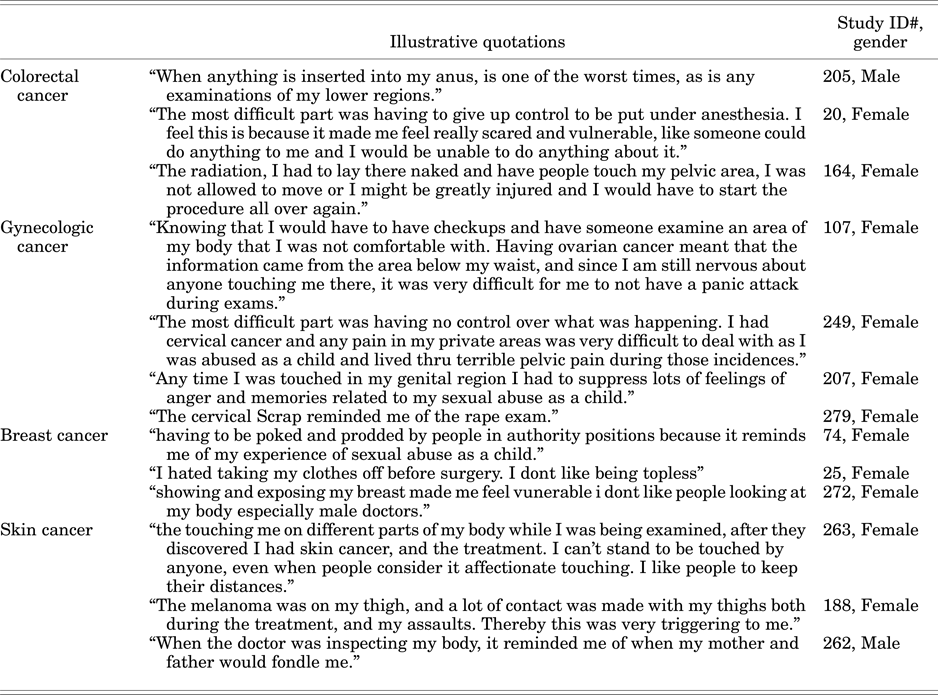
Key theme 1A: Procedure-related difficulties by cancer type

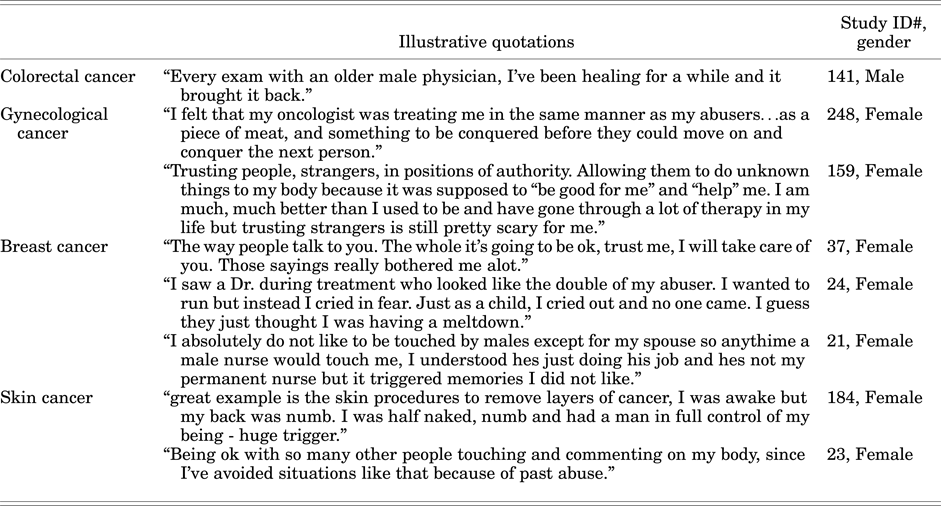
Key theme 1B: Provider-related difficulties by cancer type

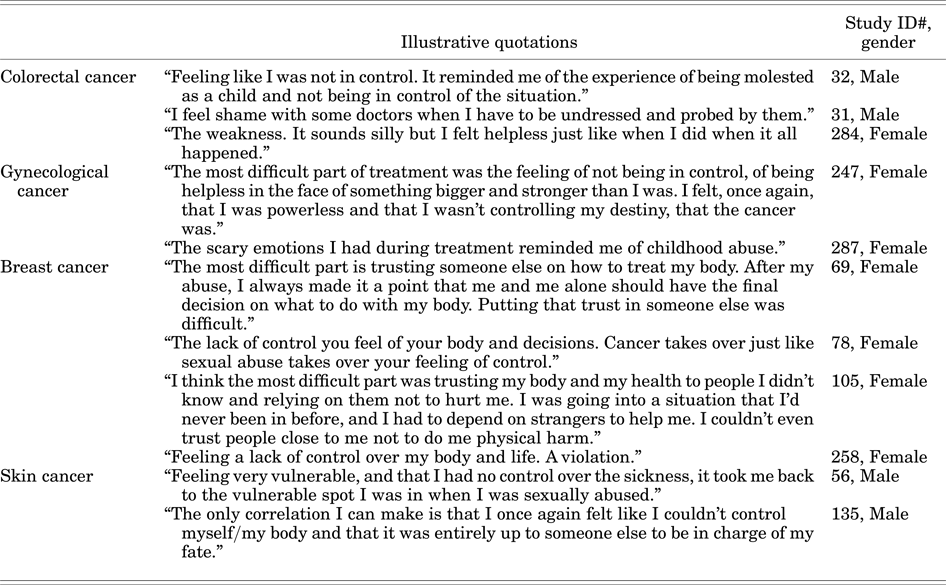
Key theme 1C: Emotional triggers by cancer type

Key theme 2: Questioning the experience of cumulative trauma by cancer type

Theme 1: Treatment-Related Triggers
This theme focused on the ways in which undergoing cancer treatment triggered participants' CSA-related memories and emotions. Parallels were noted between cancer care experiences in the here and now, and distressing memories of there and then. Specifically, participants revealed the parallels they perceived between: how they felt physically during treatment and how they felt physically during the CSA; what they were required to do during treatment and what they were forced to do during the CSA; how they felt emotionally during cancer and its treatment and how they felt emotionally during the CSA; and how the feelings they had about their abusers were projected onto their cancer treatment providers. These parallels are described in more detail in the three key subthemes below (procedure-related, provider-related, and emotional triggers).
Theme 1A: Procedure-Related Triggers
The list of procedures that participants found difficult or triggering was extensive (see Supplementary Table 2 [Supplementary Materials]), but across participants, the most commonly mentioned difficult procedures were: (1) anesthesia—participants were distressed by being touched, viewed, examined, and operated upon when they were unconscious, vulnerable, and unable to defend themselves; (2) physical examinations—participants mentioned being distressed by having their bodies inspected, penetrated, and commented on; (3) undressing—associated with feeling exposed, anxious, uncomfortable, and ashamed; and (4) being touched, particularly being touched in intimate areas of the body, such as the upper thigh, buttocks, face, lower back, and genital/pelvic/“below-the-waist” areas. Treatments that combined multiple difficult procedures were seen as particularly distressing. For example, radiotherapy was mentioned as a procedure that involves undressing, being touched in “private areas,” and having to lie perfectly still throughout or risk injury. Illustrative quotes are given in Table 2.
Theme 1B: Provider-Related Triggers
Participants also shared how providers, in terms of their particular characteristics, were triggering. The two most commonly mentioned provider characteristics were: (1) provider gender—male providers, particularly older male providers, were seen as threatening when the abuser had been male. This was true regardless of the male provider's profession. Participants mentioned feeling anxious and uncomfortable with male nurses, male radiation therapists, and male physicians; and (2) unfamiliarity with the provider—providers who were new and who were seen as “strangers” were particularly anxiety-provoking. Illustrative quotes are presented in Table 3.
Theme 1C: Emotional Triggers
The previous themes related to external stimuli or physical sensations that served as triggers. Theme 1C focused instead on how patients' intrapsychic emotional experience during cancer treatment served to trigger memories of the emotions experienced during CSA. The range of emotions described as triggers were extensive, but three were the most common. First, participants expressed feelings of powerlessness, vulnerability, and a lack of control, which was far and away the most commonly reported emotional trigger. Participants discussed feeling that their bodies were subject to forces outside of their control (i.e., cancer), feelings of diminished agency, a lack of options or choices, and a sense that they were vulnerable to and powerless before providers. These feelings of being vulnerable and defenseless strongly reminded participants of how powerless and vulnerable they felt during CSA. Second, participants reported elevated stress levels and described cancer as the most difficult stressor since the CSA, and that the stress itself evoked memories of the CSA. Third, participants described struggling with uncertainty and fears of the unknown, not knowing what to expect, and dreading what was to come, which also reminded them of their experience of abuse. Illustrative quotes can be viewed in Table 4.
Theme 2: Questioning the Experience of Cumulative Trauma (Why Me Again?)
Theme 2 reflects participants' plaintive questioning of why, after being subject to CSA, they were subject to a second bodily assault—cancer. They felt it was unfair for them to get cancer, as childhood abuse was understandably perceived as enough trauma for one lifetime. They wondered if they were unlucky or doomed or cursed, and whether they would be subject to a life of one trauma after another. They both dreaded and expected that they would continue suffering and wondered if they were “bad” in some way to deserve this additional suffering. Illustrative quotes can be seen in Table 5.
Diverse Cases and Minor Themes
As one might expect, given that each participant's experience of CSA was unique, many participants reported idiosyncratic triggers. Examples of idiosyncratic sensory triggers included: “When people would talk to me in low voices it would take me back for some reason” (ID #36); “Laying on my back trying to stay still” (ID #254); “for some reason the center where I went for the actual treatment (not my dermatologist who I know well) made me very uneasy. The spaces seemed more closed in, which has always been bad for me (small spaces are a big trigger)” (ID #64); and, “Once, my doctor touched my ear and his hand was cold. I was extremely uncomfortable because my abuser used to lick my ears” (ID #245).
DISCUSSION
Summary of Main Findings
For many CSA survivors, the experience of cancer and its treatment is shadowed by their prior history of abuse. This shadow means that procedures that some might consider minor or innocuous are viewed as invasive and humiliating; that cancer care providers may be perceived as predatory, suspect, and threatening, and that cancer, a biological aberrance, can be viewed as proof of being cursed or doomed.
Comparison with Previous Literature
To our knowledge, this is the first study to apply formal qualitative analytic methodology to understanding the cancer treatment experiences of a large sample of male and female CSA survivors. The themes identified here are consistent with past research on healthcare retraumatization in CSA survivors in noncancer settings and move the field forward by adding specifics unique to cancer.
Our finding of sensory and relational triggers in Theme 1 is consistent with past research on CSA survivors' healthcare retraumatization (Havig, Reference Havig2008; Cadman et al., Reference Cadman, Waller, Ashdown-Barr and Szarewski2012). As in past research, we too found that participants were triggered by specific aspects of healthcare such as intimate procedures, undressing, or touch (Gallo-Silver & Weiner, Reference Gallo-Silver and Weiner2006; Cadman et al., Reference Cadman, Waller, Ashdown-Barr and Szarewski2012). Also consistent with past research, our study found that participants mistrusted and felt vulnerable with medical providers (Roberts et al., Reference Roberts, Reardon and Rosenfield1999), who they felt had power over their health and even survival. Participants' reactions to providers are also consistent with the larger trauma literature demonstrating that CSA survivors commonly retain relationship patterns shaped by prior abuse (e.g., submitting to authority, expecting mistreatment and betrayal). These patterns influence their relationships in adulthood, including their relationships with healthcare providers (Brière & Hodges, Reference Brière, Hodges and Lanius2010). Participants' responses also demonstrate how intrapsychic, emotional experiences—in addition to sensory or relational experiences—can trigger memories and feelings associated with past abuse. Although the triggering effects of emotions have been demonstrated in other chronic illness contexts (e.g., HIV [Sikkema et al., Reference Sikkema, Hansen and Kochman2007]), to our knowledge, we are the first to demonstrate this phenomenon in the context of cancer treatment.
Theme 2 reflects participants' struggling to process what they viewed as being punished by cancer when they had already been punished by abuse. A sense of being doubly powerless—that is, assaulted by both CSA and by disease status—has been observed among HIV-infected adults with histories of CSA (Sikkema et al., Reference Sikkema, Hansen and Kochman2007). However, to our knowledge, patients' interpretations of the “double trauma” of cancer and CSA have been only minimally addressed in the cancer-treatment literature.
CSA survivors commonly hold schemas of the world as unsafe, of other people as untrustworthy, and of themselves as scarred. The traumatic stress literature often refers to a model of shattered assumptions (Janoff-Bulman, Reference Janoff-Bulman1992) to depict how trauma can destroy individuals' pre-trauma perceptions of others and the world as generally benevolent and safe. For survivors of CSA, a cancer diagnosis and subsequent treatment might fit a model of confirmed assumptions, in which additive trauma corroborates prior schemas of life as unsafe and unfair; of suffering as inescapable; of others as dangerous; and of the self as shameful, powerless, defective, or doomed. Responses from our study mirror findings showing that childhood abuse and/or negative trauma appraisals impact the way that individuals respond to additional trauma as adults (Babcock & DePrince, Reference Babcock and DePrince2012).
Implications for Practice and Policymakers
We hope that the present results spur further research to: (1) determine the prevalence of triggering and treatment-related retraumatization among CSA survivors with cancer; (2) explore the implications of triggering on adherence to cancer screening and treatment; and (3) develop and test interventions to improve CSA survivors' cancer treatment experiences.
In general, cancer care providers may find it useful to adopt guidelines on sensitive and trauma-informed practice when working with CSA survivors. Prior research suggests that trauma-informed sensitive care can mitigate CSA-related triggers and trauma appraisals in healthcare screening and treatment settings (Cadman et al., Reference Cadman, Waller, Ashdown-Barr and Szarewski2012; Gesink & Nattel, Reference Gesink and Nattel2015). For a thorough discussion of how to deliver trauma-informed sensitive care to CSA survivors, interested readers are encouraged to review the Handbook on Sensitive Practice for Health Care Practitioners: Lessons from Adult Survivors of Childhood Sexual Abuse (Schachter et al., Reference Schachter, Stalker and Teram2009).
STRENGTHS AND LIMITATIONS OF THE STUDY
Like any study, ours has its limitations. First, the sample is entirely composed of MTurk members living in the United States with one of four cancers, and the participants were predominately white, non-Latino, and living in urban/suburban areas. Future research should explore the generalizability of the results to other groups (e.g., community samples, individuals with other cancers). Second, this paper is exclusively focused on individuals who have experienced CSA. The literature on cancer patients with childhood abuse histories demonstrates that other forms of abuse (e.g., physical and emotional) can also impact the cancer treatment experience (Salmon et al., Reference Salmon, Holcombe and Clark2007; Clark et al., Reference Clark, Beesley and Holcombe2011). Therefore, future research should explore the influence of a wider variety of adverse childhood events, as well as adult traumatic events, on cancer treatment experiences. Third, the open-ended questions analyzed here focused specifically on upsetting experiences (difficulties and triggers) during cancer treatment. We did not collect information on helpful moments during treatment, factors that made patients feel safe, or moments of empowerment. Future research should seek CSA survivors' input on what helped them to feel safe and empowered during treatment. Fourth, in any qualitative research, reflexivity is an important concern (Malterud, Reference Malterud2001). Reflexivity has been described as an “attitude of attending systematically to the context of knowledge construction, especially to the effect of the researcher, at every step of the research process” (Malterud, Reference Malterud2001, p. 484). We recognize that our professional backgrounds likely shaped our research process and interpretation.
The study also has two primary strengths. Most notably, it is the first to use formal qualitative analysis to explore the cancer treatment-related experiences of CSA survivors in depth. The present findings add to the small but extant literature about CSA survivors with cancer. Another strength of the study is its use of MTurk as a recruitment site. The sample size attained, the large numbers of men and women who participated, the geographic reach, and the rich data collected while preserving participant anonymity demonstrated the potential of MTurk as a recruitment tool for future qualitative research with cancer patients and CSA survivors.
CONCLUSIONS
Our results revealed that many CSA survivors are challenged by cancer and its treatment in ways that are related to their childhood abuse experiences. For CSA survivors, the very cancer-related procedures and provider relationships that are required to save their lives can trigger distressing memories and emotions associated with their past abuse. We hope that the present study raises awareness about how patients experience cancer treatment when past CSA intersects with current cancer care, and that such increased awareness can help providers empathize with the CSA survivors whom they treat. In particular, we hope that the results help providers become more emotionally attuned to their patients, and in doing so, recognize the courage it takes for many survivors to pursue cancer treatment despite enduring treatment-related triggering and emotional distress. We believe that such recognition and attunement will help improve the CSA survivor experience of cancer care and help survivors feel supported and understood as they navigate their cancer journey.
ACKNOWLEDGMENTS
Research reported in this publication was supported by the National Cancer Institute of the National Institutes of Health (award nos. R21CA173163 and R25CA166042). The content is solely the responsibility of the authors and does not necessarily represent the official views of the National Institutes of Health. The funder had no role in study design, data collection, data analysis, manuscript preparation, or publication decisions. We are very grateful to the participants for sharing their experiences.
SUPPLEMENTARY MATERIALS
To view supplementary materials for this article, please visit https://doi.org/10.1017/S147895151700075X.