Introduction
Environmental contamination associated with legacy waste from human activities remains unresolved in many locations in Antarctica, despite the widespread perception that it is a pristine wilderness (Snape and others 2001a; Poland and others 2003). Legacy waste in Antarctica includes all forms of historical waste associated with human activities remaining on-site, and is typically concentrated around abandoned research stations. Many of the remaining abandoned stations in Antarctica were in operation prior to the ratification of the Protocol on Environmental Protection to the Antarctic Treaty (Madrid Protocol 1991). Prior to the ratification of the Madrid Protocol, waste generated on station was typically stored in on-site landfills or was disposed onto sea ice (Kennicutt and others 1995; Stark J.S and others 2006; Haward and Griffiths Reference Haward and Griffiths2011; Fryirs and others 2013). In several instances, remnant waste associated with abandoned stations presents a significant threat to the Antarctic environment (Kennicutt and others 1995; Snape and others 2001a; Stark J.S and others 2006; Fryirs and others 2013).
The Madrid Protocol provides clear guidelines for the protection of the Antarctic environment. Annex III (Waste disposal and waste management) establishes the requirement for all past and present work sites to be cleaned up by the generators and users of sites unless the site is considered to be a monument of historical value, or unless disturbance would result in greater adverse environmental impacts (Snape and others 2001a; Poland and others 2003; Evans Reference Evans2007). Annex V (Management of protected areas) provides guidance for the designation and protection of historic sites and monuments (HSMs) approved for listing by the Antarctic Treaty Consultative Meeting (ATCM). This listing prohibits damage to HSMs and provides strict conditions for their preservation. Annex V also requires treaty parties to identify HSMs in a systematic framework and include them in the series of Antarctic Specially Protected Areas (ASPAs). However, no timeframes for this requirement are specified (Evans Reference Evans2007). Australia has not yet completed this requirement, nor has it sought HSM listing for any potential heritage sites by the ATCM. Currently there are 80 listed HSMs in Antarctica (Roura Reference Roura2011). Additional guidance on the handling of pre–1958 historic remains with unknown locations is provided in resolution 5 (2001) of the Antarctic Treaty (ATCM 2001).
The Madrid Protocol's requirements for managing past and present work sites are seemingly clear. However, managing legacy waste remains an arduous task in many parts of Antarctica. Extreme weather, restrictions to access and financial constraints can form major obstacles to clean-up operations (Snape and others 2001a; Blanchette and others 2002; Poland and others 2003). Further obstacles may arise at sites such as Wilkes Station (hereafter Wilkes), where the need for clean-up co-exists with the desire to preserve items with potential historical or cultural heritage value remaining on-site (Evans Reference Evans2007, Reference Evans2011).
For the purpose of this paper, we consider an item with historical heritage value to be items that provide visual, symbolic or functional historical evidence of the past (Scazzosi Reference Scazzosi2004). Items with cultural heritage values are those which have the ability to interact with a memory or are considered to hold a recognised tangible or intangible value of cultural identity or diversity (Vecco Reference Vecco2010). Items with ‘potential heritage value’ are those which may hold a cultural or historical heritage value which is not yet recognised under existing relevant legislative frameworks
Wilkes and other abandoned research sites raise significant questions about the management and clean-up of legacy waste, the heritage value of abandoned Antarctic research sites, and the protocols relevant to their protection. Accurate environmental impact assessments, classifications of the amount and distribution of on-site waste, and cultural heritage surveys can provide information vital for development of strategic approaches to clean-up and preservation programmes. However, the ambiguity of what constitutes a historical item, particularly when distinguishing relic from rubbish can make such assessments contentious (Blanchette and others 2004; Evans Reference Evans2007, Reference Evans2011)
Due to the paucity of studies describing a multi-disciplinary approach to clean-up operations in Antarctica, this paper discusses some of the complexities associated with the management of legacy waste at sites with informal heritage value. The legislative frameworks governing the clean-up of legacy waste and protection of heritage items in Antarctica are reviewed and we investigate any potential legislative and environmental considerations surrounding clean-up operations at Wilkes. Finally, we argue the importance of a holistic approach to remediation which facilitates the clean-up of legacy waste and preservation of potential heritage value at Wilkes.
The case study of Wilkes is used in this paper to place in context the complexities associated with clean-up operations in Antarctica and to provide a platform for a discussion of the potential for co-managing legacy waste and heritage values. The issues raised in this paper extend beyond Wilkes, and the complexities discussed at Wilkes extend to other sites in Antarctica.
Co-managing legacy waste and heritage in Antarctica
Environmental management practices in Antarctica typically involve on-site assessments of the ecological, engineering, historical, cultural and aesthetic aspects of a site (Lazer Reference Lazer2006; Evans Reference Evans2011; Fryirs and others 2013). These aspects frequently collide and assessments seldom involve an integration of research from both scientific and heritage-based disciplinary approaches. This can generate complications which can delay clean-up operations, the formal heritage listing of a site, or protection of items with potential heritage value (Evans Reference Evans2007).
Recommendations relating to the management of heritage items have been a part of the Antarctic Treaty system since the first ATCM meeting in 1961 (Evans Reference Evans2007, Reference Evans2011). Items with formal heritage or potential heritage value in Antarctica exist in the form of artefacts, relics, monuments and other vestiges of human behaviour including former sites of human activities (Blanchette and others 2004; Evans Reference Evans2007, Reference Evans2011). At some sites with informal heritage value, the desire to preserve items with potential heritage value conflicts with the Madrid Protocol requirement to clean-up all past and present work sites. While items with informal heritage value remaining at contaminated sites may provide a wealth of historical and cultural information worthy of preservation, contaminants such as asbestos, lead and hydrocarbons present serious environmental health concerns and necessitate remedial action (Blanchette and others 2004).
Concerns surrounding the increased risk of damage to items with potential heritage value associated with clean-up operations have been discussed in several recent publications specific to Antarctic sites (Blanchette and others 2002, 2004; Evans Reference Evans2007, Reference Evans2011; Roura Reference Roura2011). These publications provide evidence of the competing priorities surrounding the management of legacy waste in Antarctica at sites with formal or informal heritage value and suggest that there is a need for a transition towards multi-disciplinary approaches to clean-up operations in Antarctica.
Environmental setting
Location and historical overview
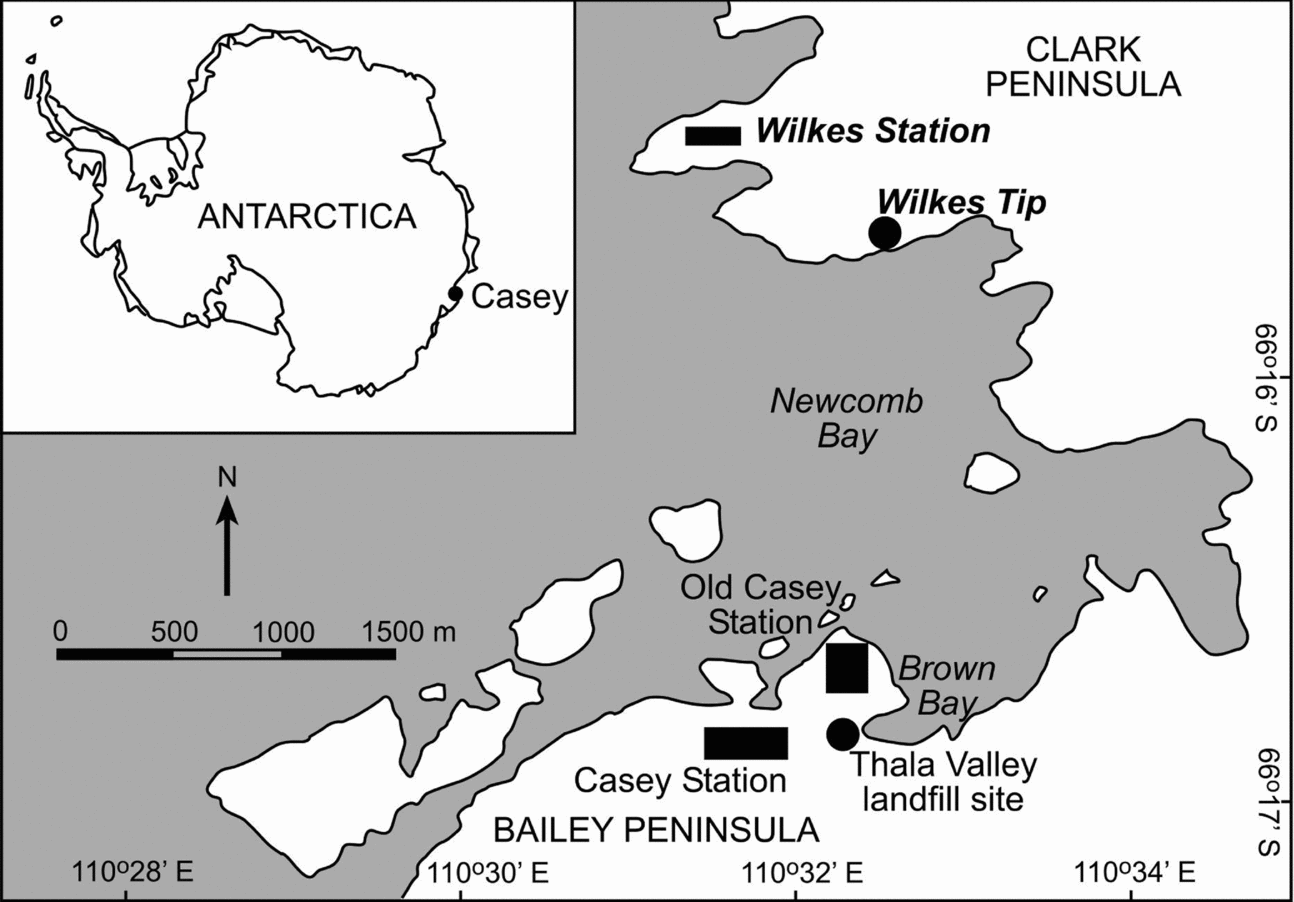
Wilkes is located on Clark Peninsula, East Antarctica (Fig. 1) and was established by the United States of America (USA) as part of Operation Deep Freeze 2 during the International Geophysical Year (IGY) (1957–1958). The IGY culminated in a formal hand-over ceremony in which administrative and operational control of Wilkes was transferred to Australia. In 1961, Wilkes came under the exclusive control of the Australian National Antarctic Research Expedition (ANARE) (AAD 2002). Australia occupied Wilkes until 1969 when it was abandoned due to frequent burial by snow (Deprez and others 1999).
Regional map of Wilkes Station showing the location of the landfill adjacent to Newcomb Bay (from Fryirs and others 2013).

Logistical constraints prevented the complete removal of buildings and equipment at Wilkes and the majority of buildings, equipment and waste material remains on-site (Fryirs and others 2013). Prior to the Madrid Protocol (1991), the acceptable standards for waste management were considerably less strict than current standards, and the abandonment of research stations was not uncommon (Haward and Griffiths Reference Haward and Griffiths2011; Roura Reference Roura2011).
Vegetation and wildlife
The Windmill Islands (including the Clark Peninsula) support some of the most extensive and well-developed vegetation in Antarctica (Smith 1998; Wasley and others 2012). Vegetation includes at least 27 macrolichens and 4 bryophytes (consisting of 3 moss species and 1 liverwort) (Wasley and others 2012). Adjacent to Wilkes is ASPA 136 which was established for the protection and study of mosses and lichens and contains an Adélie penguin Pygoscelis adeliae colony (Fryirs and others 2013). Wilson's storm petrels Oceanities oceanicus and snow petrels Pagodroma nivea are also well established within the area. The coastal waters surrounding Wilkes host a large diversity of marine flora and fauna (Orton Reference Orton1963; Melick and Seppelt Reference Melick and Seppelt1997).
Environmental contamination at Wilkes
Localised metal and petroleum hydrocarbon contamination at Wilkes from legacy waste has been well documented (Snape and others 1998; Snape and Riddle Reference Snape and Riddle1998; Babicka Reference Babicka2000; Stark J.S and others 2003, 2006; Fryirs and others 2013).
A recent site assessment by Fryirs and others (2013) used waste categories listed in Annex III, Article 2 of the Madrid Protocol (1991) to identify and classify on-site legacy waste items. Batteries, food remains, scrap metal, gas cylinders, copper wire, piping, hazardous substances, mechanical components and approximately 1000 fuel drums were reported in the assessment (Fryirs and others 2013). The majority of this legacy waste is concentrated in a landfill with an estimated volume of 20,000 m3, located east-southeast of the station precinct (Fig. 1) (Snape and others 1998; Fryirs and others 2013).
Several studies report on metal-contaminated groundwater associated with the landfill discharging into Newcomb Bay and elevated metal concentrations have been reported in sediments collected from sites adjacent to the landfill (Snape and Riddle Reference Snape and Riddle1998; Stark J.S and others 2003, 2006; Townsend and Snape Reference Townsend and Snape2008; Townsend and others 2009; Fryirs and others 2013). The threat to the local marine environment posed by hydrocarbon contamination is evidenced by large fuel slicks sighted across Newcomb Bay during a large melt episode in 1992 (Fryirs and others 2013).
There has been no systematic large-scale clean-up of legacy waste at Wilkes; however, small-scale clean-up operations have been undertaken during the 1980s and 1990s (Fryirs and others 2013). These operations involved the removal of hazardous materials, decanting fuel drums and venting gas cylinders (Fryirs and others 2013). As the generators and users of the site, both Australia and the USA hold responsibility for the management of legacy waste at Wilkes. Australia is the current custodian of Wilkes, has occupied the station for the longest period and has generated the majority of legacy waste at Wilkes and consequently must have the greatest responsibility for the management of legacy waste at Wilkes
Heritage status of Wilkes
Wilkes is one of the most well preserved research stations constructed during the IGY (Evans Reference Evans2007). Remnant infrastructure consists of barrack buildings, semi-cylindrical store buildings, work stations and scientific laboratories (Clark and Wishart Reference Clark and Wishart1989; 1999). Forty of the forty-five buildings at Wilkes remain. However, almost all are deteriorating, contain asbestos or are buried under snow and ice (Thearle Reference Thearle1990; Fryirs and others 2013). Several graves of former Wilkes expedition members also remain within the station precinct. The Australian Government has not sought HSM listing for Wilkes under the ATCM, despite the completion of an on-site cultural heritage assessment which reports several buildings and items with potential heritage value at Wilkes (Clark and Wishart Reference Clark and Wishart1989). The Australian Government has not publicly justified why HSM listing has not been sought for Wilkes.
Historical sites or monuments are defined in the Antarctic Treaty as follows:
1. A particular event of importance in the history of science or exploration of Antarctica occurred at the place.
2. A particular association with a person who played an important role in the history of science or exploration in Antarctica.
3. A particular association with a notable feat of endurance or achievement.
4. The site is representative of, or forms part of, some wide-ranging activity that has been important in the development and knowledge of Antarctica.
5. Particular technical, historical, cultural or architectural value in its materials, design or method of construction.
6. The potential, through study, to reveal information or has the potential to educate people about significant human activities in Antarctica.
7. Has symbolic or commemorative value for people of many nations (Madrid Protocol 1991).
Wilkes is representative of human activities in Antarctica during the IGY and was the launch site for the famous 3,000 km Vostok traverse in 1962 (Haward and Griffiths Reference Haward and Griffiths2011). Therefore, if the above criteria are applied to Wilkes, HSM listing may be justifiable on the basis that it is representative of activities that took place during the IGY, has potential to provide knowledge about Antarctica and educate people about the significance of human activities in Antarctica. Wilkes also holds symbolic value to the Australians and Americans who resided at Wilkes. Establishing HSM listing of Wilkes by the ATCM would require a detailed assessment as to how Wilkes satisfies these criteria and establishes why the potential heritage values at Wilkes should be preserved. This is beyond the scope of this commentary and would require a detailed on-site cultural and historical heritage assessment
Wilkes is listed as an indicative place on the Register of National Estate of the Australian Heritage Commission but is not registered as a national or world heritage site under the Environment Protection and Biodiversity Conservation Act (EPBC 1999) (Fryirs and others 2013). Therefore, Wilkes has no formal heritage value and is afforded limited protection under the Antarctic Treaty system or the relevant domestic legislative frameworks (Evans Reference Evans2007).
Discussion
The complexities surrounding clean-up operations at Wilkes provide a platform for a discussion of the potential for co-managing legacy waste and heritage values at contaminated sites in Antarctica. Here we discuss the legislative frameworks and environmental considerations governing the clean-up of legacy waste and protection of potential heritage items in Antarctica. We argue for the importance of a holistic approach to operations at Wilkes which facilitate the clean-up of legacy waste and preservation of the potential heritage values. Finally, we discuss the relevance of the issues described at Wilkes to other contaminated sites in Antarctica
Legislative frameworks and environmental considerations surrounding clean-up operations at Wilkes
All human activities in Antarctica are governed by international agreement between nations under the Antarctic Treaty system; however, the domestic legislation of Treaty members addressed through ATCM meetings can be applied to Antarctica (Snape and others 2001a; Bastmeijer Reference Bastmeijer2003). There are several legislative aspects to consider in respect to Wilkes
Australian domestic legislation can be applied to Antarctic sites under Australia's administrative control. Thus, Australian legislation can be applied to the management of Australian heritage in Antarctica. The EPBC Act (1999) provides a legal framework for the protection of sites and items of heritage significance and could be applied to the preservation of heritage at Wilkes. The Act prohibits actions likely to have an impact on national or world heritage values at declared national or world heritage places without approval from the Constitutional Corporation, Commonwealth Agency or Federal Minister. However, Wilkes is not recognised as a national or world heritage place under the EPBC Act and is therefore provided no protection under this legislative framework.
The Antarctic Treaty provides protection for items or sites with heritage value if listed as a HSM on the ATCM list. Wilkes is not so listed; therefore, the items with potential heritage value remaining on-site are not protected. However, resolution 5 (ATCM 2001) provides guidelines for the handling of pre-1958 historic remains whose locations are unknown. It stipulates that artefacts should not be removed from Antarctica and if artefacts are discovered during construction activities all activities must be discontinued until the artefacts have been appropriately recorded and evaluated. If any uncertainty surrounds the age of an artefact it is to be managed as a pre-1958 artefact. An artefact is considered to be any item which meets the following criteria:
1. Has a particular association with a person who played an importance role in the history of science of exploration of Antarctica.
2. Has a particular association with a notable feat of endurance achievement.
3. Are representative of some wide ranging activity that has been important in the development of knowledge of Antarctica.
4. Has particular technical or architectural value in its materials, design or construction.
5. Has the potential through study to reveal information or educate people about significant human activities in Antarctica.
6. Items which have symbolic or commemorative value for people of many nations.
While guidance on the handling of pre-1958 artefacts is provided in resolution 5 (ATCM 2001), no clear legislative consequences of non-compliance with its requirements are stipulated
A further legislative consideration surrounds Australia's clean-up obligations as a signed Antarctic Treaty party member. The Madrid Protocol requires comprehensive protection of the environment by all nations operating in Antarctica. As a signatory to the Antarctic Treaty, custodian of Wilkes and a producer of legacy waste at Wilkes, Australia is responsible for its waste management. While the treaty has effect under international law, it does not make the Australian Government liable for penalties or prosecution (Harris and Meadows Reference Harris and Meadows1992). Therefore, despite Australia having responsibility for waste management at Wilkes, it is unclear whether a contravention in Australia's obligations for clean-up will have enforceable legal consequences under existing domestic or international legal frameworks (Harris and Meadows Reference Harris and Meadows1992).
A further unlikely, but potential consequence of not undertaking clean-up operations at Wilkes may be disputes with other treaty nations as a result of Australia's inactivity to complete the requirements of the Madrid Protocol. In this unlikely instance, and in the absence of a peaceful agreement between nations, an outcome would be determined by the International Court of Justice, as per article XI of the Antarctic Treaty (The Antarctic Treaty 1959; Antarctic Treaty Environment Protection Act 1980). As Wilkes is not HSM listed under the treaty, nor is it recognised as a national or world heritage place under the EPBC Act; the potential heritage values at Wilkes are not protected heritage items under the relevant legislative frameworks (Evans Reference Evans2007).
The environmental considerations relevant to legacy waste and clean-up operations at Wilkes surround concerns of the risk of contaminant migration, impacts to biodiversity and the risk of instigating further adverse environmental impacts during clean-up operations (Snape and others 2001a; Stark J.S and others 2003).
Wilkes is situated adjacent to ASPA No. 136; therefore, contaminant migration from Wilkes may present a threat to cryptogamic species and penguin colonies (Fryirs and others 2013). Clark and Wishart (Reference Clark and Wishart1999) sighted Adélie penguins in the landfill during their cultural heritage survey of Wilkes in 1988–1989. The threat to biodiversity posed by legacy waste and contaminant migration at Wilkes represents an important environmental consideration and warrants effective waste management.
The Wilkes landfill or tip site presents similar environmental hazards to those reported at Thala Valley landfill nearby (Fig. 1) (Snape and Riddle Reference Snape and Riddle1998). The effectiveness of clean-up operations at Thala Valley demonstrates that prompt and effective remediation at Wilkes is achievable. Prior to the completion of successful clean-up operations, the concentration of metal contaminants in runoff obtained from the Thala Valley was shown to increase when melt-streams travelled across the landfill into Brown Bay (Deprez and others 1999; Snape and others 2001a). Since the geographical setting of Wilkes landfill is similar to that of Thala Valley, clean-up operations at Wilkes should aim to prevent the migration of metal-contaminated runoff into Newcomb Bay.
Reducing the potential for the mobilisation and migration of contaminants during excavation and clean-up operations is an important engineering concern which must be managed to prevent further adverse environmental impacts associated with clean-up operations. Snape and Riddle (Reference Snape and Riddle1998) report strategies applicable to Wilkes which could be used to reduce the environmental impacts associated with excavation and clean-up operations.
Co-managing clean-up operations at Wilkes and preservation of heritage
The complexities surrounding the management of legacy waste and the informal heritage values at Wilkes provide a platform to discuss the potential for multi-disciplinary approaches to waste management in Antarctica.
A principal objective of clean-up operations at Wilkes would be to reduce the environmental impacts of legacy waste in accordance with the framework provided in the Madrid Protocol. Preventing further adverse environmental impacts associated with clean-up operations is a vital component of this objective. Despite its non recognition as a protected site resolution 5 (ATCM 2001) of the Antarctic Treaty requires the protection of pre-1958 artefacts remaining on-site. Therefore, there is a need to co-manage the requirements to clean-up legacy waste at Wilkes, while preserving pre–1958 artefacts and on-site items with potential heritage value. This can only be achieved by a multi-disciplinary approach to the management of the environment and heritage.
The development of a multi-disciplinary approach to managing legacy waste and heritage at Wilkes first requires an integrated environmental, engineering and heritage assessment. An appropriate assessment would review the relevant legislative frameworks and site-specific priorities such as contaminant types, distribution, mobility and their potential for environmental harm as well as describe the heritage values on site and the importance of their preservation. Similar to the cultural heritage survey by Clark and Wishart (Reference Clark and Wishart1999) and site assessment by Fryirs and others (2013), a current characterisation, documentation and location of legacy waste and heritage value at Wilkes would aid in the development of a holistic approach to environmental management. Such an assessment should describe the location and heritage value of individual items, distinguish relic from rubbish and identify potential environmental impacts of legacy items. The relationship of individual items to the site and the value associated with their preservation on-site should also be assessed (Roura Reference Roura2011). A similar framework to resolution 5 (ATCM 2001) could be used to distinguish the differences between rubbish, cultural remains or heritage items (Roura Reference Roura2011). In the absence of supporting legislation for sites with informal heritage value, this assessment could provide a framework for the protection of potential heritage items in Antarctica and could be pivotal to the development of a holistic approach to clean-up operations.
Evans (Reference Evans2011) argues that complete removal of rubbish can sanitise and falsify the historical picture. Similarly, other conservation approaches raise concern about the potential for lost cultural and historical information as a result of removal of legacy items remaining on-site (Evans Reference Evans2007). Pearson (Reference Pearson, Barr and Chaplin2004) recognises that not all legacy material surrounding historical sites contributes to our understanding of history but argues that excavation and uncontrolled clean-up operations threaten the potential for the preservation of evidence. For instance, the removal of ice by picks and shovels from Scott's Hut, Cape Evans during 1960–1961 was found to damage artefacts (Pearson Reference Pearson, Barr and Chaplin2004). In order to prevent damage to items with potential heritage value, an awareness and respect for history must be incorporated into clean-up strategies.
Reducing the environmental risks associated with legacy waste at Wilkes is likely to require a large scale clean-up operation with excavation. Wilkes is a large, complicated contaminated site; however, contamination at Wilkes is not homogenously distributed (I. Snape, personal communication, 21 April 2013). Therefore, it is possible for a staged approach to clean-up operations to be undertaken. A staged approach should identify priority areas which present the greatest threat to the environment and initial clean-up operations should be concentrated in these high risk areas. This approach would reduce the risk of damage to potential heritage items substantially.
Site assessments by Snape and others (1998), Snape and Riddle (Reference Snape and Riddle1998) and Fryirs and others (2013) demonstrate the environmental hazards associated with the Wilkes landfill. Therefore, initial clean-up operations could be concentrated at this site following a detailed multi-disciplinary site assessment. Fryirs and others (2013) estimate that 13% of the landfill material holds heritage value; thus caution must be applied during excavation of the landfill to prevent damage to potential heritage items and pre-1958 artefacts. A strategy which priorities clean-up at the landfill will also allow the preservation of remnant buildings in the station precinct.
Excavation at the landfill site will require the removal of hazardous items such as zinc-coated iron drums, unidentifiable chemicals, food supplies and contaminated landfill material adjacent to Newcomb Bay (Snape and others 2001a). During this process it is likely that items with potential heritage value may need to be removed temporarily or permanently. Any items which must be removed to facilitate clean-up operations should be appropriately documented and managed according to the relevant legislative requirements (for example resolution 5 (ATCM 2001)).
Locating heritage items in the landfill often concealed by ice is difficult. Hence any excavation or clean-up operations at Wilkes should be undertaken by a multi-disciplinary team of remediation professionals and cultural and historical heritage experts (Evans Reference Evans2007, Reference Evans2011). Where waste materials with heritage value are identified as a threat to the environment (items such as chemically treated building materials), they should be properly assessed, removed and preserved ex situ (Splettstoesser and Rossnes Reference Splettstoesser, Rossnes, Valencia and Downie2002). In such circumstances other avenues for the preservation of culture and history (for example museums) could be considered. This approach was adopted during clean-up operations at Cape Hallett Station when waste materials with heritage value were removed and displayed at the Canterbury Museum in Christchurch, New Zealand (Roura Reference Roura2011)
Various remediation techniques applicable to metal and hydrocarbon-contaminated sites in cold environments exist; however, in situ techniques are preferable as they prevent unnecessary excavation, disruption to the environment and contaminant migration (Martin and Ruby Reference Martin and Ruby2004). In situ techniques not requiring excavation are also less likely to damage relics and artefacts remaining on-site (Martin and Ruby Reference Martin and Ruby2004).
Managing legacy waste and metal and hydrocarbon contamination at Wilkes will require the remediation of both contaminated groundwater and soil material. Groundwater contaminated by landfill material could be managed using pump and treat systems or permeable reactive barriers (PRBs) (Martin and Ruby Reference Martin and Ruby2004). Pump and treat systems use extraction wells, often with submersible pumps to extract contaminated groundwater and control the movement of contaminated groundwater, reduce contaminant migration and reduce the dissolved concentrations of contaminants. Once groundwater is extracted it is purified by filtration, precipitation and ion exchange media which remove the contaminants (Higgins and Olsen 2009). PRBs are subsurface barrier systems that consist of reactive materials and are installed in situ, down gradient of a contaminated groundwater plume (Gore Reference Gore and Margesin2009). When contaminated groundwater flows through a PRB, the barrier materials react with contaminants to immobilise them. Barriers can be customised according to site-specific requirements and a wide range of effective barrier designs has been described (for example Snape and others 2001b; Henderson and Demond Reference Henderson and Demond2007; Fu and Wang Reference Fu and Wang2011; Gibson and others 2011). These techniques can provide a long term, logistically feasible and low-maintenance management solution for contaminated groundwater without disturbing heritage items. PRBs installed at Wilkes should be designed to treat metal and hydrocarbon contaminants (Snape and others 2001a) which could be achieved using absorptive media coupled with natural biodegradation of the hydrocarbons (Mumford and others in press). These strategies might need to be in place for decades in order to treat long-lived hydrocarbons (Gore and others 1999).
Managing metal-contaminated soil could be also achieved by chemical fixation, encapsulation, electrokinetic remediation, bioremediation or vitrification technologies (see Martin and Ruby Reference Martin and Ruby2004; US EPA 2006; White and others 2012). Hydrocarbon contaminated soil at Wilkes could be managed using natural attenuation by microbial activity; this has been successfully on trial at sub-Antarctic Macquarie Island (Rayner and others 2007)
These technologies could all be adapted for in situ usage at Wilkes to achieve controlled clean-up of legacy waste and reduce the need for large-scale excavation, thereby limiting the associated risk to heritage items as described by Blanchette and others (2002, 2004). In situ clean-up following a comprehensive site assessment and development of multi-disciplinary approach to clean-up, could facilitate a holistic approach to the co-management of legacy waste and heritage at Wilkes.
Relevance of Wilkes to other Antarctic sites with formal or informal heritage value
Legacy waste and contamination exist at various Antarctic sites with formal or informal heritage (Poland and others 2003; Tin and others 2009). Remnant huts, buildings and artefacts from early expeditions offer an abundance of information which warrants preservation; however, at many of these sites, similarly to Wilkes, contaminants remaining on-site (for example asbestos, metals and hydrocarbons) present an environmental health risk (Blanchette and others 2004).
Blanchette and others (2004) reported elevated mean concentrations of soil-lead at Cape Royds Hut (1621 mg/kg) and Discovery Hut (1222 mg/kg). High concentrations of zinc, cadmium and lead have prompted clean-up operations at Atlas Cove Station on Heard Island (Stark S.C and others 2003). Similarly, metal contamination has been reported in the region surrounding the French Port-Martin Base (Management Plan (MP) ASPA No. 166 2006). Port-Martin Base is situated within ASPA No. 166 and is required to be listed as a HSM as per the requirements of annex V, of the Antarctic Treaty (ATCM 2006). This complicates clean-up operations at this site significantly. The abandoned Port Lockroy Base on Goudier Island (UK; designated in 1995), East Base on Stonington Island (USA; designated in 1987) and Aguirre Cerda Base on Deception Island (Chile; designated in 2001) have also attracted significant environmental concern (Roura Reference Roura2011). Evidently, the issues discussed in this paper are not exclusive to Wilkes
Blanchette and others (2004) discuss other complexities associated with managing contamination at early huts. Sites reflective of the ‘heroic era’ of Antarctic exploration such as Robert Scott's Discovery Hut, Douglas Mawson's Hut and Ernest Shackleton's Hut are attractive to tourists and hold recognised heritage value (Hughes Reference Hughes1992; Blanchette and others 2004). Visitation at these sites generates additional complications for the preservation of heritage items in the presence of contamination. The risk of structural damage to wooden heritage buildings or compromised integrity of historic items from visitors or clean-up operations is a serious concern at these sites and is difficult to monitor (Blanchette and others 2002).
Logistical constraints present a challenge for both clean-up operations and the conservation of historical sites in Antarctica. Poland and others (2003) report on the challenges that isolation and climate impose on transport requirements, safety and equipment transfer surrounding remediation operations. Conservators of heritage sites must overcome similar logistical challenges associated with the delivery of required materials to remote locations. In instances where both site-remediation activities and heritage works are required, collaborations which facilitate consultation surrounding the coexisting needs of remediation and maintenance of historical integrity are favourable. Such collaborations also have the potential to reduce the risks to the environment or potentially valuable heritage items.
The complexity of managing legacy waste and contamination in the presence of heritage remains an arduous task at many sites. However, these sites represent a great opportunity for collaboration between scientists, engineers and cultural and historical experts. Collaboration between these disciplines can aid in the development of holistic solutions to environmental and heritage management. In this paper we argued for the need for a holistic approach to land management at Wilkes; however, the existence of similar problems at sites such as Port-Martin Base indicates that any solutions developed and implemented at Wilkes will have wider relevance to similar sites. The solutions developed at Wilkes and other contaminated sites in Antarctica may also be relevant to the Arctic where disputes between human expansion, mineral exploration and protection of heritage persist (Roura Reference Roura2011).
Conclusions
The Madrid Protocol requires that all past and present work sites in Antarctica are cleaned up by the generators and users of waste at such sites. The presence of items with formal or informal heritage value at sites such as Wilkes warrants a transition towards a multi-disciplinary approach to the clean-up of legacy waste and management of heritage. While clean-up of legacy waste and the preservation of heritage value may occasionally represent conflicting interests, they should not be seen as mutually exclusive. In this commentary we have argued that effective clean-up can be achieved without compromising the integrity of heritage items if a multi-disciplinary approach to assessment and clean-up operations is adopted.
Wilkes does not formally hold a heritage value under the relevant domestic and international legislative frameworks and Australia has not taken formal action to ensure the protection of items with potential heritage value at Wilkes. However, caution and respect for historical items should be executed if clean-up operations are undertaken, as per the requirements of resolution 5 (ATCM 2001). We argue that in situ remediation facilitated by a multi-disciplinary team of scientific and heritage experts may represent the best means of satisfying clean-up requirements at Wilkes without instigating unnecessary damage to items with potential heritage value. We also argue the importance of a holistic assessment of legacy waste and cultural heritage at Wilkes to distinguish relic from rubbish and characterise the potential for environmental harm posed by legacy waste, prior to the commencement of clean-up operations.
Finally, we acknowledge that the issues presented in this paper are not exclusive to Wilkes or to Antarctica, and anticipate that the issues presented here are of wider relevance in a global discussion of the need for co-management of legacy waste and heritage.
Acknowledgements
We thank Eric Portenga and the anonymous reviewer for their helpful feedback on the original manuscript. This work was supported by Australian Antarctic Science (grant number 4029).