Tomato is one of the most important and nutritious vegetable crops in the United States. It is consumed in many different ways, such as in the form of juice, sauce/paste, and tomato-based ketchup, in addition to its use as whole and fresh-sliced fruit (Frusciante et al. Reference Frusciante, Carli, Maria, Ercolano, Pernice, Matteo, Fogliano and Pellegrini2007). Tomato is especially valued as a source of minerals and antioxidants such as carotenoids, lycopene, vitamins C and E, and phenolic compounds, which have a key role in human nutrition and disease prevention (Adalid et al. Reference Adalid, Roselló and Nuez2004). The crop ranks first in terms of economic value as a fresh-market vegetable crop and for processed production. Ohio is a major processing tomato producer, with more than 2,100 ha planted in 2013 producing approximately 140,000 tons of tomato with a value of over US$17.7 million (NASS 2014).
Weed management is one of the costliest practices required to produce tomato and often accounts for a significant portion of the total operating cost (Devkota et al. Reference Devkota, Norwsorthy and Rainey2013). Weed management in bare ground production consists of a combination of herbicides and inter-row cultivation (Robinson et al. Reference Robinson, Soltani, Hamill and Sikkema2006). Fresh-market tomato farmers are likely to also rely on polyethylene plastic mulch to manage weeds and maximize yield (Lament Reference Lament1993; Sanders et al. Reference Sanders, Cook and Cranberry1996). Holes are punched in the mulch to provide space for each tomato plant. It is in these plant holes, and the row middles, that uncontrolled weeds can compete with the crop (Norsworthy et al. Reference Norsworthy, Oliver, Jha, Malik, Buckelew, Jennings and Monks2008). Many growers rely on pretransplant and POST herbicide applications, along with hand-removal of weeds, which can be costly (Garvey et al. Reference Garvey, Meyers and Monks2013).
Although mechanical cultivation, cover crops, and mulches (Campiglia et al. Reference Campiglia, Radicetti and Maneinelli2012) have been shown to reduce weed incidence in both conventional and organic vegetable production, herbicides remain the main weed management strategy used in conventional vegetable production. S-metolachlor (Dual Magnum®, Syngenta Crop Protection, Greensboro, NC), imazosulfuron (League®, Valent U.S.A. Corporation, PO Box 8025, Walnut Creek, CA), trifloxysulfuron (Monument®, Syngenta Crop Protection, Greensboro, NC), metribuzin (Metribuzin 75®, Loveland Products, 14520 County Road 64, Greeley, CO), and halosulfuron(Halosulfuron Pro®, Nufarm Americas Inc., 150 Harvester Drive, Burr Ridge, IL) have all been used to control various weeds in tomato (Devkota et al. Reference Devkota, Norwsorthy and Rainey2013). Weeds resistant to herbicides that are registered for use in tomato (i.e., triazine herbicides), such as common lambsquarters (Chenopodium album L.) biotypes, are particularly difficult to control (Trader et al. Reference Trader, Wilson, Hagood and Hines2009). The identification of effective alternative herbicides that can be implemented without substantially increasing weed management costs is important to control these and other resistant weeds.
Identification of new herbicides that are safe for tomato yet effectively control a range of weeds is one important key to sustaining successful tomato production in north central United States. Fomesafen (Reflex®, Syngenta Crop Protection, Greensboro, NC), which has been utilized PRE and POST to control weeds in several crops including cotton (Gossypium hirsutum L.) and soybeans [Glycine max (L.) Merr.], has recently received attention for use in vegetable crops including tomato (Boyd Reference Boyd2015; et al. 2016; Shrefler et al. Reference Shrefler, Brandenberger and Webber2013). There are a limited number of herbicides labeled for tomato production, making it challenging to effectively control weeds (Kemble et al. Reference Kemble, Tyson and Curtis2004). The objectives of this research were to characterize tomato response to fomesafen and to gather data needed to support registration of the herbicide.
Materials and Methods
Experiments were conducted at the Ohio Agricultural Research and Development Center, North Central Agricultural Research Station, Fremont, Ohio (41.31°N, 83.17°W; elevation 199 m), during the 2009 and 2010 growing seasons. The soil was a silty clay loam with pH of 6.6 and organic matter content of 4.4%. ‘Peto 696’ tomato (Seminis Inc., 2700 Camino Del Sol, Oxnard, CA) was the variety used. Tomato was direct-seeded in flats and grown in a greenhouse for approximately 7 wk. Tomato seedlings were machine transplanted using a one-row water wheel transplanter on June 5, 2009 and May 28, 2010. For this experiment, individual plots consisted of three rows that were each 7.5 m long. Row spacing was 1.5 m. A randomized complete block experimental design was used with four replications. Prior to transplanting, glyphosate (Touchdown® potassium salt of glyphosate, Syngenta Crop Protection, Greensboro, NC) was applied at 580 g ae ha−1 to kill weeds that had emerged in the field.
Pretransplant (PRETP) applications of fomesafen were made one day before transplanting, on June 4, 2009 and May 27, 2010. Treatments were fomesafen at 280, 350, 420, 560, and 840 g ha−1. Applications were made using a CO2 pressurized sprayer calibrated to deliver 234 L ha−1 at 276 kPa via 8002VS flat-fan spray nozzles (TeeJet Technologies, 200 W. North Ave., Glendale Heights, IL). Weed-free control plots were hoed and weeded by hand every 2 wk until 6 wk after transplanting. At that time all plots were cultivated and hand-weeded. Nontreated weedy and weed-free controls were included for comparison. Air temperature at the time of application was 16 C and 28 C in 2009 and 2010, respectively, with wind speed below 10 km h−1 both years.
Crop injury symptoms and weed control were assessed visually using a 0 to 100 linear scale in which 0% indicated no crop injury or weed control, and 100% indicated death of the crop or total weed control. Plots were evaluated at 7, 14, 28, and 42 d after treatment (DAT). The crop was harvested by hand from the middle row of each plot on September 16, 2009 and September 30, 2010, at which time more than 90% of the fruit was ripe. Evaluations for PRETP treatments were done 14, 28, and 42 DAT in both years. The predominant weeds in 2009 included giant foxtail (Setaria faberi Herrm.), green foxtail [Setaria viridis (L.) Beauv.], common purslane (Portulaca oleracea L.), common lambsquarters (Chenopodium album L.), and redroot pigweed (Amaranthus retroflexus L.). In 2010, the primary species were common purslane and annual grasses (giant and green foxtails).
Years and replications were considered random effects, and all other variables were considered fixed effects (Carmer et al. Reference Carmer, Nyquist and Walker1989). The random effect of year and its interaction with herbicide treatments was significant for visual injury, yield, and weed control. As a result, data for these parameters are reported by year. Analyses were conducted using PROC Mixed in SAS 9.2 (SAS Institute, Inc., SAS Campus Dr., Cary, NC). Data were subjected to ANOVA, and means that were significantly different were separated using Fisher’s Protected LSD test at the 5% level of probability. Weed-free and weedy control data were included in the ANOVA for yield but not for crop injury and weed control.
Results and Discussion
Crop Injury
Fomesafen caused slight injury to tomato, characterized by plant stunting and chlorosis, ranging from 0% to 14% in 2009 and 2010. The maximum rate of fomesafen, 840 g ha−1, caused 13% and 14% injury 7 DAT in 2009 and 2010, respectively. Injury with this application rate declined to 4% and 8% 14 DAT in the same years. In 2009, 6% injury was recorded with 420 and 560 g ha−1 7 DAT. Injury was not observed in plots treated with fomesafen at 280 and 350 g ha−1, and injury was never observed 42 DAT, regardless of treatment (Table 1).
Response of tomato crop injury (%) and yield to PRETPFootnote a fomesafen and weed pressure at the North Central Agricultural Research Station in Fremont, OH in 2009 and 2010.

a Abbreviations: PRETP, pre crop transplant; DAT, days after treatment; NS, nonsignificant (P=0.05).
b Means separated using Fisher’s Protected LSD test (α=0.05).
c Weed-free and weedy control data were not included in the ANOVA for crop injury.
In 2009, yield did not differ amongst the herbicide-treated and weed-free control plots. In contrast, yield in the weedy control was reduced by 54% compared to that of the weed-free plots, agreeing with previous work by McGiffen et al. (Reference McGiffen, Masiunas and Hesketh1992) and Weaver et al. (Reference Weaver, Smits and Tan1987). In 2010, plots that received herbicide treatments had the same yield as did the weed-free plots; however, yields were 1.3- to 1.6-fold greater than yield of the weedy control (Table 1).
Weed Control
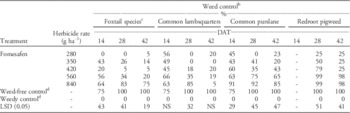
In 2009, fomesafen at all of the applied rates provided better control of redroot pigweed and common purslane than it did of foxtail species and common lambsquarters (Table 2). Fourteen days after treatment, fomesafen at the lowest rate (280 kg ha−1) provided no control of foxtail species; control for the other rates ranged from 20% to 64% at this rating interval. Incomplete common lambsquarters control was observed 14 DAT; however, the rate effect was not significant. Common purslane was best controlled with fomesafen at 840 g ha−1, while control with the lower rates ranged between 43% and 63%. Acceptable foxtail species and common lambsquarters control 28 DAT was only achieved with fomesafen at 840 g ha−1. Lower rates provided 0% to 34% control of foxtail species and 0% to 35% control of common lambsquarters. At this rating interval, fomesafen at 560 and 840 g ha−1 provided 75% and 92% common purslane control, respectively. Redroot pigweed had not emerged 14 DAT, but acceptable redroot pigweed control, ranging from 79% to 99%, was observed 28 DAT in plots treated with fomesafen at the three highest rates. Fomesafen provided acceptable foxtail species and common purslane control only with the highest rate at 42 DAT, while common lambsquarters was not controlled by any of the fomesafen rates tested during this evaluation. Acceptable redroot pigweed control (98%) was achieved by the two highest rates of fomesafen at this rating interval (Table 2).
Effect of PRETPFootnote a fomesafen rates on broadleaf and grass weed control in tomato at the North Central Agricultural Research Station in Fremont, OH in 2009.

a Abbreviations: PRETP, pre crop transplant; DAT, days after transplanting crop; NS, nonsignificant (P=0.05).
b Means separated using Fisher’s Protected LSD test (α=0.05).
c Giant and green foxtail.
d Weed-free and weedy control data were not included in the ANOVA for crop injury.
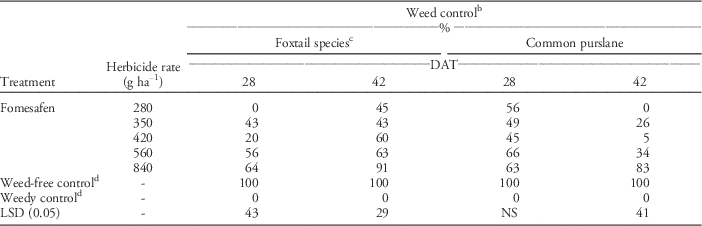
Visual observations in the field indicated that weed densities in 2010 were lower than they were in 2009; therefore, weed control ratings in 2010 were done only for foxtail species and common purslane at 28 and 42 DAT. Inferior foxtail species and common purslane control compared to the weed-free control plots was observed at 28 DAT (Table 3). Foxtail species control was unacceptable with any of the fomesafen rates, although 64% suppression was achieved with the highest rate at 28 DAT. At 42 DAT, acceptable control of foxtail species (91%) and common purslane (83%) was only observed with the highest rate of fomesafen (Table 3).
Effect of PRETPFootnote a fomesafen rates on broadleaf and grass weed control in tomato at the North Central Agricultural Research Station in Fremont, OH in 2010.

a Abbreviations: PRETP, pre crop transplant; DAT, days after transplanting crop; NS, nonsignificant (P=0.05).
b Means separated using Fisher’s Protected LSD test (α=0.05).
c Giant and green foxtail.
d Weed-free and weedy control data were not included in the ANOVA for crop injury.
Previous studies have reported that processing tomato (Sant Reference Sant2014) and other vegetable crops such as cucumber, snap beans (Johnson and Talbert Reference Johnson and Talbert1993), and watermelon (Shrefler et al. Reference Shrefler, Brandenberger and Webber2013) have not been injured by fomesafen. Our results are in agreement with previously published studies in which the application of fomesafen caused minimal injury and no effects on crop yield. Minimal tomato injury observed early in the experiments may have been due to the herbicide treatments, although the crop completely recovered and no injury symptoms were observed at 42 DAT both years. Higher yield in plots treated with fomesafen in both years indicates a positive crop response to weed control. Differences in yield among years were likely due to weather conditions. Average minimum and maximum daily temperature, as well the total precipitation, were higher between June and September 2010 compared to the same period of time in 2009 (Anonymous 2014).
These results indicate that the PRETP rates of fomesafen can provide commercially acceptable and persistent control of common purslane and redroot pigweed. Control of giant and green foxtails was inconsistent, and PRETP rates of fomesafen did not provide adequate control of common lambsquarters. To manage these difficult species, additional weed control measures should be considered, especially during the critical period for weed interference, which ranges from 24 to 36 days after transplanting (Friesen Reference Friesen1979; Weaver et al.Reference Weaver, Smits and Tan1987), when there is high infestation of these weeds.
Considering the lack of research on fomesafen efficacy on redroot pigweed and common purslane control in tomato, results from this study should lead to more research. Season-long weed management is of pivotal importance for successful tomato production; therefore, use of an integrated weed management system can improve control of weed species and increase tomato yield and crop value. Further research is needed to evaluate the combination of fomesafen and other herbicides to provide a broader spectrum of weed control in processing tomato production. Overall, our results indicate that fomesafen tolerance in tomato is sufficient to allow safe use of the herbicide at the proposed rates. The data collected in this study, particularly the evidence of redroot pigweed control, support the registration of fomesafen on tomato. Registration of fomesafen at the tested rates would provide processing tomato growers with a more effective means of controlling emerged weeds than currently available options.
Acknowledgments
The authors thank IR-4 Program for helping to fund this project. The authors also thank former research associate Tim Koch and North Central Agricultural Research branch manager Matt Hofelich for their assistance with the project.