Introduction
Psychotic disorders affect over 120 000 people in Ireland, with approximately 1500 people experiencing their first psychotic episode each year (Health Service Executive (HSE) 2011b). Eighty per cent of first episodes of psychosis occur between the ages of 16 and 30, often impairing psychosocial development (Lester et al. Reference Lester, Birchwood, Bryan, England, Rogers and Sirvastava2009). It has been hypothesised that treatment should be accessed within 6 months of onset of the first symptoms of psychosis if there is to be a response (Robinson et al. Reference Robinson, Woerner, Alvir, Geisler, Koreen, Sheitman, Chakos, Mayerhoff, Bilder and Goldman1999; Malla et al. Reference Malla, Norman, Manchanda, Ahmed, Scholten, Harricharan, Cortese and Takhar2002; Perkins et al. Reference Perkins, Gu, Boteva and Lieberman2005). In Ireland early intervention (EI) has been identified as a National Clinical Programme of the Mental Health Directorate. Currently less than 10% of the population has access to an early intervention service (EIS) (HSE 2011a).
A pilot EIS for first-episode psychosis (FEP) was set up within the South Lee Mental Health Service (SLMHS) in Cork in 2016. The EIS pilot was developed within two community mental health team (CMHT) sectors – servicing a population of 55 000.
The pilot EIS involves both interventions in early detection and treatment. A clinical nurse specialist was allocated to act as an assertive key worker for all FEP patients in the catchment for 1 year. This key worker was allocated to an existing consultant led home-based treatment team (HBTT) in these sectors. Clinical care of FEP patients was transferred from the CMHTs within the catchment area to the consultant lead of the EIS for 1 year, and after reverted back to the CMHTs. Each patient works with the key worker who assertively develops collaborative therapeutic relationships with an emphasis on engagement of patients and their carers. Patients are offered medications in line with National Institute for Health and Care Excellence guidelines (NICE 2014). All patients are referred for cognitive behavioural therapy (CBT) and occupational therapy. FEP cases are prioritised by multidisciplinary team members. Families are offered a meeting within the first two weeks of contact with the service and behavioural family therapy (BFT) thereafter.
Components of early detection included conducting an educational campaign with general practitioners (GPs) through meetings. A guide on identifying psychosis and on how to refer to the EIS was developed for GPs and distributed to all practices in the catchment area.
The aims of the EIS pilot are to reduce delays in accessing care by educating GPs and CMHTS on EI and by providing rapid access (within 72 hours) to a comprehensive and standardised assessment for all possible psychosis in this urban catchment; to provide treatment for psychosis in the least restrictive environment; to reduce risk of relapse by providing assertive follow up to all FEP cases for the duration of 1 year, and to facilitate access to evidence based interventions for FEP. Access to CBT and BFT has proven to be challenging due to inadequate resources. A recent audit of the service indicates that about 25% of patients have access to psychology and 40% have access to BFT. There is no access to individual placement and support at present.
Aims
The current study has undertaken a review of patients presenting with FEP to the SLMHS – both to the EIS and CMHTs – exploring their demographic and clinical profiles, and pathways to care. It also examined short-term service outcomes in terms of hospital admissions.
Objectives
To evaluate if having an EIS, which is embedded within an HBTT, is associated with (1) shorter duration of untreated psychosis (DUP), (2) fewer emergency admissions at first presentation, (3) fewer admissions within 6 months of presentation to the service and (4) a reduced number of bed days overall.
Methods
Design
The SLMHS is a community-based service divided into five general adult services by catchment area. An acute adult mental health unit (AMHU), old age psychiatry service, child and adolescent service and four acute day-hospitals service the area. An HBTT services two inner-city sectors. A GP or any member of the health service can make referrals to this service. The pilot EIS was set up in 2016, servicing this same area. All patients diagnosed as having an FEP within these sectors are referred to the EIS. GPs or any member of the health service could make referrals to the EIS also.
For this study, the files of all those who presented with an FEP from January 2016 to February 2017 (inclusive) were identified retrospectively by each of the five general adult sectors. Those presenting for the first time with affective and non-affective psychosis were considered. Diagnostic decision was made by a consultant psychiatrist after clinical review and reconfirmed by the consultant or clinical nurse manager at the time of data extraction. Demographic and clinical profiles, pathways to care and hospital admissions were compared for those admitted to EIS and CMHTs.
Participants
Patients who presented with FEP from January 2016 to February 2017 were included. Patients presenting to old age services, child and adolescent services and those under the care of learning disability services were not included.
Procedure
The general adult services were asked to identify patients who were assessed as having FEP within the given 14-month time frame. Consultants and lead nurses were contacted on a number of occasions in an effort to ensure that patients were not missed.
Demographic and clinical information were gathered using an auditing tool developed for the study. Clinical information included the diagnosis given within the first 6 months of referral to the service according to the International Classification of Disease, 10th revision criteria (WHO 1992). DUP was recorded based on review of clinical notes, and discussion with the team. DUP was defined as the time from manifestation of the first psychotic symptom to the initiation of adequate treatment (Behan et al. Reference Behan, Kennelly and O’Callaghan2008). Levels of smoking, alcohol and illicit drug use, as reported by patients at the time of first presentation, were recorded.
Information on hospital admissions was obtained from the HSE patient information management system database. The number and length of emergency admissions at first presentation were recorded along with number of hospital admissions within the first 6 months of presentation (i.e. an admission after discharge from any first admissions but within 6 months of initial assessment). A 6-month follow-up period was achieved for all.
Data analysis
The Mann–Whitney U test was used to examine age at presentation; age at onset of psychosis; DUP; number of days between referral and assessment; number of days stay following emergency assessment at AMHU/Emergency Department (ED); and total number of bed days (for both admissions at and within first 6 months of presentation).
The Chi-Squared test was used to examine referral source; number of admissions following emergency assessment at AMHU/ED; number of admissions within the first 6 months of presentation; gender; education; vocational and relationship status; living arrangements; diagnosis; and illicit drug and alcohol use.
All data were analysed using IBM SPSS version 23.
Results
Demographic and clinical characteristics
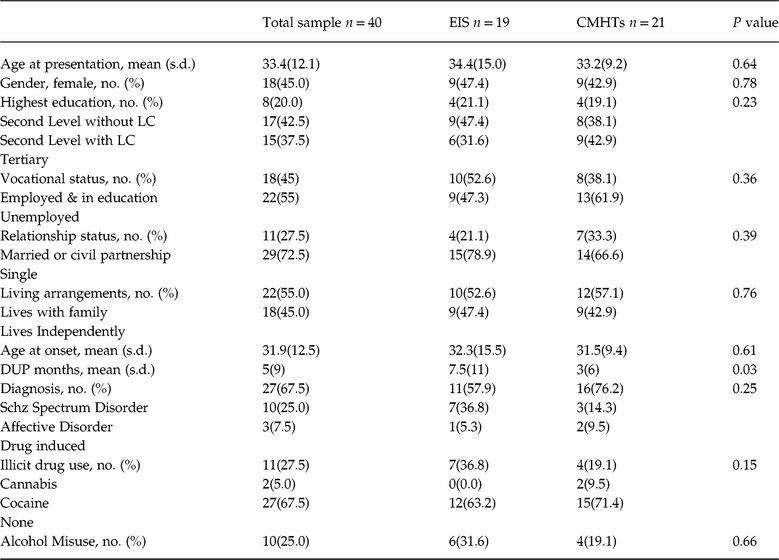
The mean age at onset of psychosis was 31.9 years (s.d. = 12.5, median 29). The mean DUP was 5 months (median 1 month) with those presenting to the EIS having a longer DUP (U = 121, p = 0.03); mean DUP for EIS was 7.5 months (median 3) while mean DUP for CMHTs was 3 months (median 0.5) – see Table 1.
Demographic and clinical characteristics

LC, Leaving certificate; Schz, Schizophreniform
Referral pathways and hospital admissions
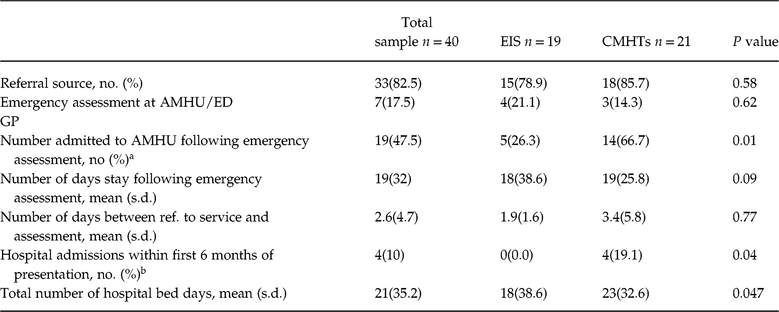
The majority of referrals came from emergency assessments at the AMHU or ED – 82.5% (n = 33). Nineteen were admitted to the AMHU at the time of emergency assessment: 5 were referred to the EIS during this admission and 14 were referred to CMHTs.
Four CMHT patients had an admission within the first 6 months of presentation (i.e. an admission after discharge from any first admissions but within 6 months of initial assessment); no EIS patient had an admission within the first 6 months of presentation (χ2 (1) = 5.56 p = 0.04) – see Table 2.
Referral pathways and hospital admissions

EIS, Early intervention service; CMHT, Community mental health team; AMHU, Adult mental health unit; ED, Emergency Department.
a Patients were referred to the EIS or CMHTs during hospital admission.
b Defined as an admission after discharge from any first admissions but within 6 months of initial assessment.
While the effect size for emergency admissions (ES = 0.4) and admissions within 6 months (ES = 0.3) is considered to be medium by Cohen ’s criteria, it is considered to be small for DUP (ES = 0.1) and for the number of bed days overall (ES = 0.1).
Discussion
Principal findings and comparison with previous research
Forty individuals were identified as having presented to the SLMHS with an FEP during the 14-month time frame – lower than rates found in previous studies (Kirkbride et al. Reference Kirkbride, Errazuriz, Croudace, Morgan, Jackson, Boydell, Murray and Jones2012). Fewer cases were identified by the CMHTs. This may be due to socio-economic differences between the populations linked with the services; the EIS is linked with an urban, lower socio-economic population. It may also be due to an under identification of cases.
The majority of those who presented with FEP were male, single and living with parents or siblings. This is in keeping with the findings of previous studies (Kingston et al. Reference Kingston, Owoeye, Kinsella, Russell, O’Callaghan and Waddington2011; Clarke et al. Reference Clarke, McLaughlin, Staunton, Kerins, Power, Kearney, McGuinness and Whitty2017). The mean age of onset of psychosis (32 years, median 29) is on the upper limit of the range suggested by Lester et al. in Reference Lester, Birchwood, Bryan, England, Rogers and Sirvastava2009. By including only adults here the mean age has been raised. The mean DUP recorded here is 5 months. It has been found to range from 13 to 17 months in other studies (Singh et al. Reference Singh, Croudace, Amin, Kwiecinski, Medley, Jones and Harrison2000; Clarke et al. Reference Clarke, McLaughlin, Staunton, Kerins, Power, Kearney, McGuinness and Whitty2017). The DUP was longer for EIS than for CMHTs, which was a surprising finding. However, DUP was recorded systematically in clinical notes by the EIS key worker. In CMHTs it was estimated from notes and required discussion with clinicians. This may have resulted in an underestimation of DUP in the CMHTs. The time between referral and assessment was on average 2 days for the EIS and 3 days for the CMHTs.
For those who presented to the EIS as compared to CMHTs, there were less emergency admissions at the time of presentation and less hospital admissions within the first 6 months of presentation. This reflects the findings of previous studies at 18 months (Craig et al. 2014).
Limitations
The study is retrospective by nature and so identification of cases was dependent upon the consideration of past presentations. This may have led to an under-identification of cases. While every effort was made to identify all FEP cases a prospective study would be superior. The power of the study to detect significant differences between the groups is low and the follow-up period of 6 months is limited. A post-hoc power analysis was performed which suggested that the sample size for the study to be adequately powered was 50, which limits our interpretations of the study findings. A paper looking at hospital admissions at 1 and 2 years would be beneficial. The retrospective recording of DUP and extrapolation from case notes for CMHTs is not ideal. The definition applied here has been done so retrospectively and DUP was recorded at different stages of treatment by CMHTs. For reliability, an agreed definition, assessment tool, and time of recording would need to be applied.
There are a number of confounding variables to consider: the EIS is embedded within an HBTT, making it difficult to assess the effect of EI alone. There are variants in the services available between the different sectors, which may have had an effect on the group outcomes as a whole. Geographical and socio-economic differences exist between the groups – the EIS is linked to an urban, lower socio-economic population, while the CMHTs are linked to a mixture of urban and rural, higher socio-economic population. As such, we would expect a higher incidence of FEP in the EIS group (Kirkbride et al. Reference Kirkbride, Jackson, Perez, Fowler, Winton, Coid, Murray and Jones2013).
Conclusion
The study provides a baseline clinical and demographic profile of patients with FEP in an Irish mental health service. The demographic and clinical information gathered here are in line with previous studies on similar populations. EIS embedded within an HBTT was associated with fewer hospital admissions and less bed usage within the first 6 months of patient care. It is unclear whether these findings may have occurred due to the EIS or due to the benefits provided by an HBTT. A paper looking the longer-term effect of the service on patient outcome would be beneficial.
Financial support
The research received no specific grant from any funding agency, commercial or not-for-profit sectors.
Conflict of interests
Nuala Murray had no conflicts of interest to disclose. Karen O’Connor had no conflicts of interest to disclose.
Ethical standards
The authors assert that all procedures contributing to this work comply with the ethical standards of the relevant national and institutional committee on human experimentation with the Helsinki Declaration of 1975, as revised in 2008. The study protocol was approved by the Clinical Research Ethics Committee, University College Cork.