Well before the dust of the 2008 Democratic Party nomination process settled, Senator Hillary Clinton had garnered a hard fought and decisive victory in the California primary. In some respects, the contours of the California vote were unsurprising. As in other state primaries and caucuses, African Americans were beginning to support Senator Barack Obama over Clinton in overwhelming numbers. What surprised many observers, however, was the similarly overwhelming support for Clinton over Obama among Asian Americans. This lopsided margin in the Asian American vote was also evident in exit polls from other Super Tuesday states such as New York and New Jersey. This led many media observers to ask, in the words of Time magazine's Lisa Takeuchi Cullen, “Does Obama Have an Asian Problem?” (Cullen Reference Cullen2008), with feature stories and anecdotal evidence suggesting that he did.
Such pronouncements were problematic, however, because they were drawn from a limited set of data. The California exit poll interviews were conducted only in English or Spanish, the ones in New York and New Jersey were conducted in a handful of cities, and none of the surveys weighted for the differential residential patterns of Asian Americans versus other primary voters. In addition to the limitations of the exit poll sampling and interview methods, the subsequent analysis of marginal vote totals failed to show the relative importance of racial attitudes versus other factors such as partisanship and political interest. The use of qualitative data via “person in the street” interviews did nothing to shed light on the generality of the problem or its magnitude.
In this article, we bring evidence from the 2008 National Asian American Survey (NAAS) to bear on the question of whether, and to what extent, race-related attitudes shaped the Asian American vote. The NAAS is the most comprehensive survey to date of Asian Americans' civic and political life in the United States, with 5159 interviews conducted over two months in 2008, in eight languages (English, Cantonese, Mandarin, Korean, Vietnamese, Tagalog, Japanese, and Hindi), and with large numbers of respondents from the six largest Asian national-origin groups (Asian Indians, Chinese, Filipinos, Japanese, Koreans, and Vietnamese). We focus on the vote choice of Asian Americans to examine the extent to which race-related attitudes account for variations in Asian American support for Obama over Clinton in the 2008 primary. We examine the relationship between vote choice and attitudes toward Blacks after controlling for a host of standard factors that have been shown to be predictive of vote choice. Finally, we try to uncover the extent to which these race-related considerations account for the relatively high level of “undecideds” among Asian American voters in the summer and fall of 2008.
CONVENTIONAL WISDOM ABOUT ASIAN AMERICANS IN THE 2008 ELECTION
The Democratic primaries in 2008 attracted a high level of attention from news media and voters alike. Not only did the contest feature a compelling story of an insurgent candidate taking on a formidable political dynasty, it was also deemed historic because of the likely nomination of either the first female or the first African American on a major-party presidential ballot. Given the competitiveness of the race even after Super Tuesday, all eyes focused on the contest for delegates, especially in some of the remaining large states such as Texas, Ohio, Virginia, and Washington. Some mainstream news outlets saw that, perhaps for the first time, Asian Americans held the potential to shape the momentum of a presidential primary, especially if they had a large turnout in states such as Washington and Virginia, which held their nominating contests less than a week after Super Tuesday.
In trying to assess each candidate's chance at winning these states, reporters and news analysts turned to exit poll data on Asian American voters in states such as California and New York. The sources may have been disparate (the National Election Pool sample of about 150 Asian Americans in California and a sample of 700 voters interviewed by the Asian American Legal Defense and Education Fund in New York City and three cities in New Jersey), but the picture that emerged was the same: Asian Americans supported Clinton over Obama in the primaries by the strongest margin recorded for any racial or ethnic group (Cullen Reference Cullen2008). Underlying many media treatments of Asian American primary-voting patterns were questions about whether Clinton's popularity with Asian Americans reflected antipathy toward, or at least a discomfort with, Black Americans.
The first prominent story suggesting racial attitudes as a significant factor in the Asian American vote was a segment by reporter Gary Tuchman on the popular CNN show Andersen Cooper 360° on the eve of the Washington state caucuses. The reporter started the segment in a Chinatown grocery store, where an informal canvass revealed no support for Obama. The story followed with a comment from a fourth-generation Japanese American that many Asian Americans would vote for a Caucasian because “they don't like change,” and concluded with a few words from a shopper at the Chinese store:
Tuchman: This woman actually refers to Hillary Clinton's skin color.
Unidentified Female: The white lady.
Tuchman [on camera]: So do you like Hillary Clinton?
Unidentified Female: Yes. I like her.
Tuchman: Do you like Obama?
Unidentified Female: Not really.
Tuchman [voice-over]: Obama had a large number of Asian-Americans at this huge Seattle rally but didn't appear to be near the percentage of the rally for the senator from New York. Advantage, Clinton (Tuchman Reference Tuchman2008).
Academic observers also speculated that racial attitudes were at play. In a Time magazine article, entitled “Does Obama Have an Asian Problem?” Oliver Wang, a sociology professor at California State University, commented that “on a gut level my reaction is that at least some Asian Americans are uncomfortable voting for a Black candidate.” His explanation rested squarely on assumptions about foreign-born Asian Americans, hypothesizing that new immigrants may have little direct experience with African Americans and that lack of contact may lead to racial bias (Cullen Reference Cullen2008).
Asian American advocacy organizations and the ethnic media disputed this perspective, citing Clinton's strong name recognition and better, more targeted outreach to Asian American communities as key explanations for the Asian American vote. In addition, scholars and community leaders suggested that Clinton benefited from immigrants' nostalgia for her husband's administration. Matt Barreto, a political scientist at the University of Washington, argued:
They remember the good times in the 1990s. There was [sic] a lot of benefits; not only the economy, but other policies that benefited immigrants and, in particular, Asian Americans that would cause them to remember the Clintons in fondness (Tuchman Reference Tuchman2008).
Others noted that many Asian American voters were naturalized during Bill Clinton's administration and thus came of political age under “the Clintons” (Kim Reference Kim2008). In addition, commentators speculated that Asian Americans, particularly recent immigrants, might be wary of change and more comfortable voting for a known entity (Tuchman Reference Tuchman2008).Footnote 1
If Obama indeed had an Asian American problem in the Democratic primary, he seemed to have overcome it by the general election. The NAAS showed that, as early as August 2008, Obama enjoyed a nearly two-to-one advantage over John McCain among Asian American likely voters. Still, nearly one-third of Asian American likely voters remained undecided, higher than for any other racial or ethnic group. Exit polls in November suggested that most of these undecided voters broke in favor of Obama, with the National Exit Poll survey showing that Asian American voters favored Obama over McCain by 62% to 35% (New York Times 2008), while an Election Day exit poll of over 16,000 voters in eleven states by the Asian American Legal Defense and Education Fund (AALDEF 2009) suggested an even greater margin of 76% to 22%.
Still, many questions about the role of race in the vote choice of Asian Americans remain unanswered. For instance, while Asian Americans largely supported Obama in the general election, racial attitudes may still have played a significant role in their support for Clinton over Obama in the primaries. Furthermore, racial attitudes may have continued to play a significant role in the general election campaign, perhaps accounting for the relatively high proportion of Asian American voters declaring themselves to be “undecided” even as late as October 2008. Using the 2008 NAAS, we focus on the following questions:
1. Did racial attitudes play a role in Asian American primary and caucus voters' choice of Clinton over Obama, and how did racial attitudes compare with the effects of other factors such as issue preferences and party identification?
2. To what extent did racial attitudes play a role in boosting the proportion of Asian American voters who said they were undecided between McCain and Obama?
3. To what extent did racial attitudes account for variations in individual-level shifts, from supporting Clinton in the primary to Obama in the general election?
Race and Asian Americans
Because race relations in the United States have long been framed in terms of the “black-white paradigm” (Blackwell et al., Reference Blackwell, Kwoh and Pastor2002, p. 37), it is not surprising that commentators confronted with exit poll data on Asian American primary voters began to speculate about the group's racial loyalties. With which group would Asian Americans find common political ground? Mia Tuan (Reference Tuan1999) posed the question more provocatively in her book Forever Foreigners or Honorary Whites? Like White Americans, on average, Asian Americans enjoy high levels of economic and educational achievement in the United States. Asian Americans are also the most residentially integrated minority group in the United States. Such trends might suggest that Asian Americans would link their political fortunes with similarly situated White Americans and perhaps a White candidate. Dana Takagi (Reference Takagi1993) provided a compelling account of how some Asian American students coalesced with conservative Whites in the battle over affirmative action, for example.
Yet Asian Americans share much in common with Black Americans as well. Like many African Americans, Asian Americans compose a phenotypically distinct population sometimes subject to racial stereotyping, discrimination, or even violence rooted in perceived racial difference. Janine Young Kim's (Reference Kim1999) article “Are Asians Black?” presented a nuanced argument for considering seriously shared histories and experiences of racialization between Black Americans and Asian Americans. Although scholars of Asian American studies have made forceful arguments for moving “beyond the black-white paradigm” (Chang Reference Chang1999; Wu Reference Wu2001; Ancheta Reference Ancheta1998), Kim argued that “Blackness,” as defined by the paradigm properly understood, serves to explain the racial positioning of both Blacks and Asian Americans. In fact, like Claire Jean Kim, who accounted for the “racial triangulation” of Asian Americans (Reference Kim1999), Janine Kim suggested an intimate relationship between the racial position of Black Americans and that of Asian Americans. Furthermore, Janine Kim argued that “situating Asian Americans as a buffer between Black and White does not position Asian Americans outside the Black-White paradigm, but rather in a dominant place where they can be manipulated to serve the interests of the dominant group” (Kim Reference Kim1999, p. 2409).
Although Asian Americans have joined in coalition with other groups of racial minorities to fight for worker rights, push for greater civil rights protections, and elect candidates of color, examples of intergroup conflict between Asian Americans and other groups more often make headlines. Media coverage over the past two decades emphasizes tensions between Asian Americans and other minority groups. News stories following the Green Grocers boycott in Brooklyn in 1990 and the urban unrest in Los Angeles in 1992, for instance, were especially keen to highlight “Black-Korean conflict.” These media accounts, more often than not, distort and overplay the extent of this conflict, ignore the agency and voice of Asian Americans themselves, and portray such events in terms of “episodic frames” that point to individual-level prejudices rather than “thematic frames” that underscore structural factors that precipitate intergroup competition (Cho Reference Cho and Gooding-Williams1993; Abelmann and Lie, Reference Abelmann and Lie1995; Yoon Reference Yoon1997; Kim Reference Kim2000; Lee Reference Lee2002; see Iyengar Reference Iyengar1994 on media framing).
In fact, just a handful of scholars have investigated Asian Americans' racial attitudes systematically (Johnson et al., Reference Johnson, Farrell and Guinn1997; Lee Reference Lee and Ong2000; see also Bobo and Johnson, Reference Bobo, Johnson, Bobo, Oliver, Johnson and Valenzuela2000; Bobo and Suh, Reference Bobo, Suh, Bobo, Oliver, Johnson and Valenzuela2000). Using data from the 1992–1994 Los Angeles Survey of Urban Inequality, James Johnson and his colleagues (Reference Johnson, Farrell and Guinn1997) found that a majority of Asian Americans in their sample viewed Blacks and Latinos as “less intelligent” and “more welfare dependent” than their own group (p. 1064). Using data from the 1992 Los Angeles County Social Survey, Taeku Lee (Reference Lee and Ong2000) found that Asian Americans exhibited distinct attitudinal preferences for intermarriage and residential integration with Whites over Blacks (pp. 109, 114). Beyond this limited scholarship, however, we know little about Asian Americans' racial attitudes, and we know even less about how they influence political behavior. New data from the NAAS allow us to investigate these relationships. In particular, we examine the relationship between various race-related considerations among Asian Americans and their presidential vote choice.
Presidential Vote Choice among Asian Americans
The literature on presidential vote choice is vast (e.g., Lazarsfeld et al., Reference Lazarsfeld, Berelson and Gaudet1944; Berelson et al., Reference Berelson, Lazarsfeld and McPhee1954; Campbell et al., Reference Campbell, Converse, Miller and Stokes1960; Nie et al., Reference Nie, Verba and Petrocik1976; Wolfinger and Rosenstone, Reference Wolfinger and Rosenstone1980; Fiorina Reference Fiorina1981; Lewis-Beck et al., Reference Lewis-Beck, Jacoby, Norpoth and Weisberg2007). Much of the research in this area over the past fifty years has concentrated on the ways individual-level attributes and political attitudes predict voting turnout. Among the most important predictors of the act of voting is affiliation with a political party (e.g., Campbell et al., Reference Campbell, Converse, Miller and Stokes1960; Bartels Reference Bartels2000) and socioeconomic status (Converse Reference Converse, Campbell, Converse, Miller and Stokes1966; Wolfinger and Rosenstone, Reference Wolfinger and Rosenstone1980; Markus Reference Markus1988), including education (Axelrod Reference Axelrod1986; Erikson Reference Erikson1989), religious identity and religiosity (Layman Reference Layman2001; Pew Forum on Religion and Public Life 2008), and group identity (Wolfinger Reference Wolfinger1965; Mutz and Mondak, Reference Mutz and Mondak1997; for a related study, see Barreto and Pedraza, Reference Barreto and Pedraza2008). Age and life cycle effects have also been identified as important predictors of voting behavior (e.g., Erikson Reference Erikson1989; Jennings and Niemi, Reference Jennings and Niemi1981; Highton and Wolfinger, Reference Highton and Wolfinger2001). Beyond individual-level demographic factors, scholars have also highlighted the significance of issue positions (Page and Brody, Reference Page and Brody1972; Nie et al., Reference Nie, Verba and Petrocik1976; Carmines and Stimson, Reference Carmines and Stimson1989; Abramowitz Reference Abramowitz1994), ideology (Hinich and Munger, Reference Hinich and Munger1994), political mobilization (Rosenstone and Hansen, Reference Rosenstone and Hansen1993; Gerber and Green, Reference Gerber and Green2000), and economic conditions (Markus Reference Markus1988).
The past decade has also seen some periodic attempts to examine the presidential vote choice of Asian Americans. Past research using a multicity study of Asian Americans, the 2000–2001 Pilot National Asian American Political Survey (PNAAPS), suggested that the strongest predictor of Asian Americans' vote for Democratic candidate Al Gore in 2000 was party identification. Democrats were much more likely to vote for Gore, and Republicans were much less likely to vote for Gore than those who did not identify with a major U.S. party (Lien et al., Reference Lien, Conway and Wong2004). In addition, Pei-te Lien and her colleagues (Reference Lien, Conway and Wong2004) found that geography and national origin mattered for Asian American vote choice in 2000. Controlling for other factors, those residing in Honolulu were less likely to support Gore than those from Los Angeles, San Francisco, New York, and Chicago. Those of Korean and South Asian national origin were more likely to favor Bush over Gore than those of Chinese national origin.Footnote 2 Finally, factors such as socioeconomic status, having a sense of linked fate with other Asian Americans, and experience with racial discrimination were not associated strongly with vote choice among Asian Americans. These past studies help focus our attention on key variables likely to affect Asian American voting behavior in the 2008 presidential election.
Finally, very little is known about Asian American support for candidates of different racial backgrounds. A long history of research suggests that racial prejudice among White voters hurts Black candidates, especially in statewide races or in majority White districts (Terkildsen Reference Terkildsen1993). Data from experiments consistently show that when Whites are presented with a White and a Black candidate, they will evaluate the former more favorably than the latter (Sigelman et al., Reference Sigelman, Sigelman, Walkosz and Nitz1995; Terkildsen Reference Terkildsen1993). Nayda Terkildsen found that when presented with candidates that were identical except for their racial backgrounds, White subjects preferred the White candidate (Terkildsen Reference Terkildsen1993, p. 1041). Carol Sigelman et al.'s (Reference Sigelman, Sigelman, Walkosz and Nitz1995) experimental results suggested that White respondents judge Black candidates and Latino candidates to be less competent than White candidates with otherwise identical characteristics. However, studies from actual elections point to mixed findings about racial voting, with some suggesting that voter stereotypes and discrimination decline after an electorate has experience with a Black incumbent (Hajnal Reference Hajnal2001), others indicating that White voters no longer discriminate against Black candidates (Highton Reference Highton2004), and still others suggesting that White voters choose to express an enthusiasm for a Black candidate that is not reflected in the privacy of the voting booth (Bullock Reference Bullock1984; Finkel et al., Reference Finkel, Guterbock and Borg1991).Footnote 3 Studies have also diverged over whether an unusually high proportion of undecided voters in elections featuring a White candidate and a non-White candidate is evidence for racial voting (Citrin et al., Reference Citrin, Green and Sears1990; Reeves Reference Reeves1997). One notable limitation to the literature on racial voting is that it has concentrated primarily on the vote choice of Whites and, to a lesser extent, Blacks. Although some scholars have studied Latino support for Black candidates (Kaufmann Reference Kaufmann2003), very little is known about Asian American voters' support for Black or non-Asian candidates.
DATA AND VARIABLE CONSTRUCTION
The National Asian American Survey (NAAS) is the most comprehensive survey to date of the civic and political life of Asians in the United States. Based on 5159 interviews conducted from August 18, 2008 to October 29, 2008, the NAAS included adults in the United States who identified any family background from countries in Asia.Footnote 4 Survey interviews were conducted in eight languages (English, Cantonese, Mandarin, Korean, Vietnamese, Tagalog, Japanese, and Hindi) and yielded sample sizes of at least 500 adult residents for Asian Americans in the six largest national-origin groups. The registered voters in our sample included 784 of Indian origin, 748 Chinese, 521 Vietnamese, 406 Filipinos, 388 Koreans, and 340 of Japanese origin.Footnote 5 We weighted our sample, using a raking procedure and population characteristics from the American Community Survey, to reflect the balance of gender, nativity, citizenship status, and educational attainment of the six largest Asian national-origin groups in the United States, as well as the proportion of these national-origin groups within each state.
For this article, we focused on two dependent variables: Asian American vote choice between Clinton and Obama during the Democratic primaries and caucuses (hereafter “primaries”), and the intended vote choice between McCain and Obama in the general election. Our survey did not include any self-reported measures of racial prejudice. We excluded such measures because of the difficulty in using telephone surveys to obtain reliable measures of intergroup prejudice, including problems associated with misreporting attitudes and testing effects from asking the same measure of prejudice with more than one reference group, the extensive number of items required in the most commonly used measure—the racial resentment scale—as well as the controversy about its general external validity (see, e.g., Kinder and Sanders, Reference Kinder and Sanders1996; Fazio et al., Reference Fazio, Jackson, Dunton and Williams1995; Dovidio et al., Reference Dovidio, Brigham, Johnson, Gaertner, Macrae, Stangor and Hewstone1996; Blank et al., Reference Blank, Dabady and Citro2004).Footnote 6 In its stead, our survey asked respondents: “Thinking about government services, political power and representation, would you say Asian Americans have a lot in common, some, little in common, or nothing at all in common with [African Americans or Blacks]/[Latinos or Hispanics]/[Whites] (rotated)?” We used respondent rankings on these three reference groups to come up with two measures: (1) a measure of general group distance, where the variable took on a value of 1 if the respondent stated that Asian Americans had little or nothing in common politically with any other racial or ethnic group, and (2) a measure of Latino-Black proximity that captured the extent to which respondents saw more political commonality with Latinos than with African Americans. This measure is theoretically interesting because it allows us to identify those respondents who saw the potential for political coalitions with Latinos but not with Blacks.Footnote 7 It does not allow us to test specifically for the influence of anti-Black prejudice, per se, on Asian American vote choice, but it does allow us to assess the effect of racial considerations on this choice.
In our attempt to ascertain the role of race-based political considerations for Asian American voters in the primary and general elections, we also included several other factors that have traditionally been significant predictors of presidential vote choice. These included party identification, issue positions on important policy questions such as government provision of health care and restrictions on abortion, the frequency of religious attendance, and other demographic factors such as age, gender, and educational attainment.Footnote 8 In addition to these standard sets of factors, we added two other factors that were potentially important in explaining the vote choice of Asian Americans: national origin and past experience with discrimination.
FINDINGS
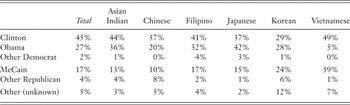
How did Asian Americans vote in the 2008 presidential primaries? In Table 1, we present the self-reported vote preferences of Asian American registered voters. Since several states had open primaries or modified open primaries where “decline-to-state” voters could still choose a primary candidate, we present the results for all registered voters, regardless of their party registration. As Table 1 indicates, Asian Americans did favor Clinton over Obama by a substantial margin (45% to 27% overall, or 61% to 36% among Democratic primary voters). However, these margins in our national survey appear to be smaller than those reported in exit polls from California (71% to 25% among Democratic primary voters) and New York (86% to 14% among Democratic primary voters).Footnote 9
Asian American Vote Choice in the 2008 Primaries, among Registered Voters

Source: National Asian American Survey (2008)
Vote choice varied dramatically by national origin. Chinese Americans were the group most likely to vote for Clinton in the primaries (57%), and they had the lowest proportion of primary voters for Obama (20%). By contrast, Korean American primary voters were equally likely to support the two major Democratic candidates, and Japanese Americans were more likely to support Obama over Clinton. Vietnamese Americans, traditionally the most Republican-leaning Asian American group, actually showed stronger support for Clinton (49%) than McCain (39%), and very weak support for Obama (5%).Footnote 10
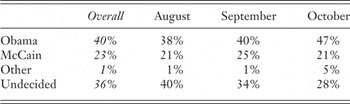
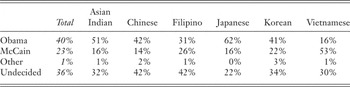
Despite the tepid support for Obama in the primaries, Asian Americans appeared to be leaning strongly toward Obama in the weeks leading up to the general election. When asked for whom they planned to vote in the general election, 40% of registered Asian Americans said Obama, 23% said McCain, and 36% said they were undecided about their vote choice. As Table 2 indicates, Asian Americans heavily favored Obama over McCain throughout the last months of the campaign. The most striking trend observed over that time period, however, is the large proportion of Asian Americans who claimed to be undecided between the candidates. In September 2008, over one-third of registered voters described themselves as “undecided,” and even in October, more than one in four did so. By contrast, most polls showed that about 8% of registered voters nationally were undecided over the same period (Cost Reference Cost2008). National-origin differences persisted in the general election. When asked for whom they planned to vote in the presidential contest, Indian, Chinese, Japanese, and Korean Americans expressed strong support for Obama over McCain. Filipino Americans expressed weaker levels of support for Obama, while Vietnamese Americans were the only group likely to favor McCain over Obama. It is striking to note, however, that substantial proportions of each of these groups (22% to 42%) remained undecided even as the election drew to a close. (National origin differences in intended vote choice are shown in Appendix Table A.1.)
Asian American Vote Choice in the 2008 General Election, among Registered Voters by Month of Interview

Source: National Asian American Survey (2008)
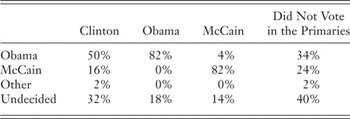
Did Asian American support for Clinton in the primaries have anything to do with the subsequent high level of undecided voters in the general election campaign? Table 3 shows the relationship between vote choices in the primary and general election among Asian Americans. We found that the proportion of undecided voters in the general election was indeed higher for those who voted for Clinton than for those who had voted for anyone else during the primaries. Nearly one-third (32%) of Clinton primary voters remained undecided about the presidential vote, while only 19% of Obama primary voters and 13% of McCain primary voters were undecided.Footnote 11 Still, it is important to note that a majority of Clinton voters intended to vote for Obama, and only 16% of them declared a preference for McCain. Furthermore, the proportion of undecided voters was even higher among those who had not voted in the primaries (40%) than among those who had voted for Clinton (32%). Thus, continued attachment to Clinton provides only a partial explanation for Asian American indecision during the general election. Furthermore, as we shall see in the multivariate analysis that follows, prior support for Clinton played only a marginal role in explaining vote indecision among Asian Americans in the general election.
Asian American Vote Choice in the 2008 General Election, among Registered Voters by Primary Vote Choice

Source: National Asian American Survey (2008)
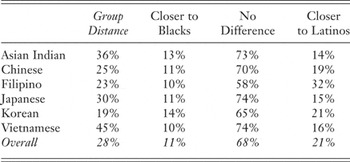
So far, we have focused on the descriptive findings that related to our dependent variables. Before proceeding with the multivariate analysis, however, it is important to examine the distribution of Asian American voters on our measures of general group distance and Latino-Black proximity. As the first column in Table 4 shows, about one in four Asian Americans indicated that on matters of political power and representation, Asian Americans had little or nothing in common with any other racial group. There were some significant national-origin differences, with Vietnamese American voters expressing the greatest levels of general group distance (45%), and Korean Americans expressing the least (19%). Finally, when comparing the degree of political commonality with Latinos and African Americans, we found that two-thirds of the Asian American electorate saw no difference between the two groups. Among the remainder, however, about twice as many Asian Americans felt more political commonality with Latinos than with Blacks.
Group Distance and the Black-Latino Divide Among Asian American Registered Voters

Note: Group distance = 0 if “little” or “nothing” in common with Blacks, Latinos, and Whites on matters of government services, political power, and representation; 1 otherwise.
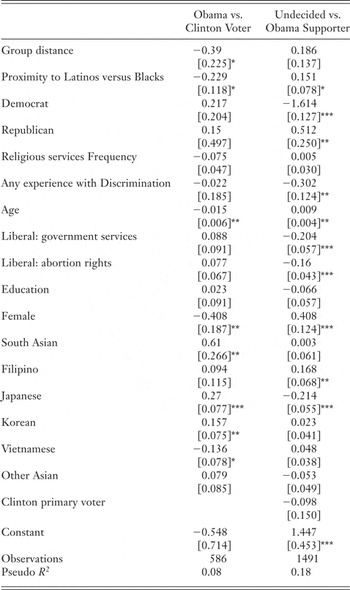
To what extent were these race-related considerations associated with the Asian American vote for Clinton over Obama, and how did they compare with other competing explanations? We addressed these questions with a logit model that regressed a dummy variable measuring support for Obama over Clinton in the primary on party identification, important issue positions, frequency of religious attendance, past experience with discrimination, and various demographic factors including age, gender, education, and national origin (Appendix Table A.2). In Figure 1, we present the standardized effects of these various factors with respect to the Obama/Clinton vote. We found that proximity to Latinos over Blacks does indeed predict a vote for Clinton over Obama, and that this relationship is statistically significant at the 0.10 level. In other words, we found Asian American primary voters who felt more political commonality with Latinos than with Blacks were more likely to vote for Clinton over Obama, even after controlling for generalized levels of group distance and a host of other factors.
Explaining the Asian American Vote for Obama over Clinton
Note: Standardized effects of mean ±0.5 standard deviation
Darker bars are statistically significant at the p < 0.10 level or greater (two-tailed).

At the same time, it is important to note that other factors such as age and gender bore an even stronger relationship to the primary vote choice of Asian Americans. Just as the rest of the electorate, older voters and women were more likely to favor Clinton over Obama in the primary. Other factors, such as party identification and issue preferences, played a relatively marginal role in the choice between Clinton and Obama. Finally, there were sizable national-origin differences in the primary vote choice, and these remained even after we controlled for factors such as age, gender, and issue preferences. Thus, while race-based considerations played a significant role in the vote choice of Asian Americans in the Democratic primary, other factors such as age and gender delivered more explanatory power.
We turned next to consider the relationship between race-based considerations and the general election choice between McCain and Obama. As we have seen, more than one in three Asian American registered voters in our sample were undecided between McCain and Obama, and nearly one in four remained undecided even in the last month of the presidential campaign. Were these “undecided” Asian American registered voters hiding their true feelings about the race of the candidates by claiming to be undecided rather than admitting that they were not voting for Obama? To what extent did feelings about African Americans underlie the “undecided” vote among Asian Americans? To answer these questions, we relied on the same set of explanatory factors as in the analysis of the Democratic primary vote, with one important addition: We added a variable for whether or not the respondent voted for Clinton in the primary, to control for the possibility that a residual attachment to Clinton prompted greater feelings of ambivalence among Asian American voters, regardless of other factors such as issue preferences and race-based considerations.
There were different ways to model intended vote choice: as a logit regression between undecided voters and Obama supporters, as an ordered logit regression going from McCain supporters to undecideds to Obama supporters, and as a multinomial logit that did not presume any ordering in the vote choice between Obama, McCain, and undecideds. For ease of interpretation, we present standardized effects based on the logit regression (Figure 2), and discuss instances where alternative modeling techniques lead to different outcomes for our variables of interest. The results from our regressions indicated that Asian Americans who felt closer politically to Latinos than to Blacks were more likely to claim they were undecided about their presidential pick, a finding that was statistically significant at the 10% level. We also found that those who had personally experienced racial or ethnic discrimination were less likely to be undecided.
Explaining Asian American Indecision over Obama in the General Election
Note: Standardized effects of mean ±0.5 standard deviation
Darker bars are statistically significant at the p < 0.10 level or greater (two-tailed).

However, the effects of these race-based attitudes and experiences paled in comparison to other factors, most notably party identification, issue preferences, and gender. While partisanship and issue preferences played a small role in the primary season, it is not surprising that they played a much larger role in the general election. Party identification played the biggest role, by far. Even though a third of Asian American registered voters identified as “pure independents,” meaning they did not claim to lean toward either party, 45% identified with the Democratic Party, with 21% strongly doing so. Nearly a quarter of Asian American voters identified with the Republican Party (22%), with 10% strongly doing so.
Given the differentiation of Asian American voters along this important dimension of vote choice, it is not surprising, then, that it played the strongest role in whether a respondent was undecided or had made up his or her mind.Footnote 12 Issue preferences also played a strong role. McCain and Obama staked out sharply contrasting positions on issues such as abortion rights and the government provision of health care, and our analysis indicated that such issue differentiation played a significant role in the vote choice of Asian Americans. Gender also played a significant role, with female voters more likely to be undecided than male voters. By contrast, other factors such as religious attendance, educational attainment, and prior support for Clinton in the primary bore no significant relationship to whether or not Asian American voters declared themselves as undecided.
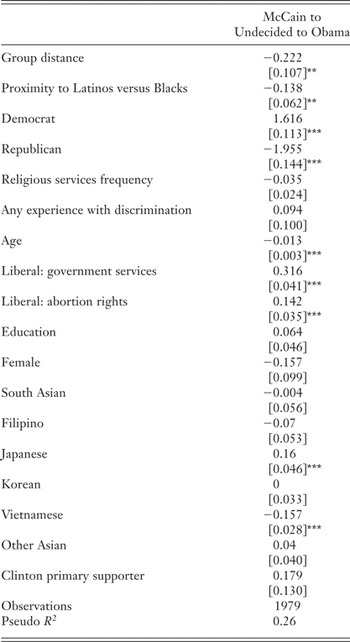
In order to ensure that our findings about the modest effects of race-based considerations were not subject to variations in our modeling choice, we tested for various interaction effects and for alternative ways of modeling the presidential vote choice. Two important findings turned up when we tested for interactive effects, with respect to gender and partisanship. The role of Latino-Black proximity was stronger among women than among men; indeed, among men the relationship was close to nil. Furthermore, we found that race-based considerations played a varying role according to party identification, with certain components mattering for some groups but not others. Among Democrats, the relative proximity to Blacks played an important role, while for Republicans, general group distance played a significant role, and among Independents, group distance and past experiences with discrimination played an important role. We found no interactive effects between prior support for Clinton and race-based considerations in terms of Asian American voter intention in the general election. Finally, in terms of alternative ways of modeling the intended vote for president, we found that proximity to Latinos over Blacks remains statistically significant at the 0.10 level using an ordered logit model (going from McCain to undecided to Obama), but the variable is not significant in a multinomial logit model (Table A.3).Footnote 13
IMPLICATIONS AND CONCLUSIONS
Was race an important factor in the Asian American vote in 2008? Media accounts of the presidential primaries, based on a limited set of exit poll survey data and a few interviews with experts and “persons on the street,” suggested that race-based attitudes played an important role in the lopsided support among Asian Americans for Clinton over Obama. Our findings, based on the NAAS, partially support these hypotheses, but situate them within a more comprehensive account of Asian American vote choice in 2008. We find, first of all, that Asian American support for Clinton over Obama was not as large as previously thought: instead of margins approximating 85%-15% in the Democratic primary, as suggested in exit polls, we find margins closer to 60%-30%. Furthermore, when we assess the relative importance of race-based considerations and other factors, we find that national origin, age, and gender played a markedly greater role in shaping the primary vote choice of Asian Americans than factors such as prior experiences with racial discrimination and feelings of political commonality with African Americans.
We also find that the role of race-based considerations grew much weaker in the general election than in the primaries. Party identification and issue preferences played such a strong role in shaping the vote choice of Asian Americans that the effects of race-based considerations were comparatively very weak. This points to the importance of context in shaping whether or not race-based considerations were relevant to vote choice. In the primary election, Clinton and Obama did not vary substantially on issue positions such as health care and abortion rights. Furthermore, low-information voters could not rely on differences in the party affiliation of candidates to guide their vote choices in the primary (Rahn Reference Rahn1993; Popkin Reference Popkin1991). In the general election, however, voters could rely both on partisan cues and on substantive issue differences between McCain and Obama, relegating factors such as age, gender, and race-based attitudes to a more subordinate role.
While the varying importance of race-based considerations between the primary and general election is relatively easy to explain, other findings require further exploration. In particular, we need to understand why the effects of race-based considerations seem to have been stronger among Asian American women than men, and why they had a varying effect across party identification. It is possible that the interaction effect we find by gender is a “Hillary Clinton effect,” one that is particular to the dynamics of a historic presidential primary that featured a prominent and competitive female candidate. We need data from other points in time, and possibly other types of races, to see if these gendered effects are more generally true.
As for party identification, one may be tempted to argue that our finding about the significance of race-based considerations among Democrats is in line with Paul Sniderman and colleagues' (Reference Sniderman, Crosby, Howell, Sears, Sidanius and Bobo2000) work on White public opinion toward affirmative action programs, with race-related factors playing a stronger role independent of ideology among Democratic identifiers than Republicans. A similar logic could apply in this case, where race-based considerations operated in a direction opposite to the role of party identification among Democrats, but in the same direction for Republicans. What we find, however, is a more complicated story: a different set of race-based considerations seems to have mattered for Republicans and Independents, with general group distance mattering more for non-Democrats, and proximity to Blacks in particular making more of a difference for Democrats.
It is possible that these puzzles are an artifact of the way we measure race-based considerations. For instance, the NAAS does not have any direct measures of racial prejudice or stereotyping with respect to African Americans and other groups. Nor does it contain measures about social networks, residential contexts, and work contexts to know more about the interactions of Asian Americans with ingroup and outgroup members. Thus, we cannot rule out the possibility that our measures of race-based considerations are standing in for other factors such as racial prejudice or social distance. Finally, it is important to note that the distribution of our race-related factors is highly uneven: only 26% see Asian Americans as having little or nothing in common with other groups, and only 19% see Asian Americans as having more political commonality with Latinos than with Blacks. Thus, the distribution on our independent variables cannot be interpreted as evidence of hostile feelings toward African Americans or other racial and ethnic groups.
Still, our findings shed some much-needed light on the question of whether race was the primary factor in the vote choice of Asian Americans in the primary and general elections of 2008. Our analysis finds that race-based considerations do help to explain why Asian Americans supported Clinton over Obama and why individuals claimed to be “undecided” about their candidate choice in the general election. However, these factors played a relatively limited role when compared with other factors such as party identification, issue preferences, age, and gender. This was especially true in the general election, where our preelection survey as well as exit polls both suggest that Asian Americans heavily favored Obama over McCain, even though their support for Obama was more tepid during the primary season. It remains an open question whether our findings from the presidential election in 2008 will apply to other electoral contests. Given the growing share of Asian American voters in many states, cities, and congressional districts, and given the increasing number of minority candidates for elected office, it is clear that questions about the role of race in vote choice will increasingly require research that breaks the traditional Black-White paradigm, to include the opinions and voting behavior of Asian Americans and Latinos.
APPENDIX
Asian American Vote Choice in the 2008 General Election, among Registered Voters, by Ethnicity

Source: National Asian American Survey (2008)
Logit Regressions of Vote Choice in the 2008 Primary and General Election

Note: Standard errors in brackets
* p < 0.10;
** p < 0.05;
*** p < 0.01
Ordered Logit Regression of Intended Vote Choice in the 2008 General Election

Note:
Standard errors in brackets
* p < 0.10;
** p < 0.05;
*** p < 0.01