Introduction
Symptoms of childhood-onset attention-deficit/hyperactivity disorder (ADHD) often decline with age, particularly hyperactivity symptoms (Faraone et al., Reference Faraone, Biederman and Mick2006; Gau et al., Reference Gau, Lin, Cheng, Chiu, Tsai and Soong2010a). However, 30–80% of children with ADHD continue to suffer from the ADHD-related impairments as they enter late adolescence and adulthood (van Lieshout et al., Reference van Lieshout, Luman, Twisk, van Ewijk, Groenman, Thissen, Faraone, Heslenfeld, Hartman, Hoekstra, Franke, Buitelaar, Rommelse and Oosterlaan2016). The age-dependent development of ADHD symptoms is not a universal process; instead, it is highly variable between individuals (Lahey et al., Reference Lahey, Lee, Sibley, Applegate, Molina and Pelham2016). Differential developmental courses of ADHD symptoms bring different impacts on several life domains (Sasser et al., Reference Sasser, Kalvin and Bierman2016).
Many efforts have been made to investigate the influence of genetic risk, brain structure and activities, neurocognitive functioning, behavioral and environmental factors on the developmental course of ADHD (van Lieshout et al., Reference van Lieshout, Luman, Buitelaar, Rommelse and Oosterlaan2013). For behavioral and environmental factors, higher childhood symptoms of ADHD, greater functional impairment, a higher level of aggressiveness or more oppositional/conduct problems during preschooler age (Lahey et al., Reference Lahey, Lee, Sibley, Applegate, Molina and Pelham2016), lower socioeconomic status (Cheung et al., Reference Cheung, Rijdijk, McLoughlin, Faraone, Asherson and Kuntsi2015; Lahey et al., Reference Lahey, Lee, Sibley, Applegate, Molina and Pelham2016), more psychiatric comorbidity and maternal psychopathology (Biederman et al., Reference Biederman, Petty, Clarke, Lomedico and Faraone2011) were found to predict the persistence of ADHD diagnosis or symptoms at follow-up. To date, the link between these behavioral/environmental predictors and the developmental course of ADHD remains unclear (van Lieshout et al., Reference van Lieshout, Luman, Buitelaar, Rommelse and Oosterlaan2013).
Longitudinal structural neuroimaging studies suggested that ADHD might be a problem of maturational lag (Shaw et al., Reference Shaw, Eckstrand, Sharp, Blumenthal, Lerch, Greenstein, Clasen, Evans, Giedd and Rapoport2007) with a delay for 3–5 years for different brain regions, and the developmental trajectories of brain volumes between individuals with ADHD and controls were roughly parallel (Castellanos and Tannock, Reference Castellanos and Tannock2002). It was suggested that the ‘normalization’ of some brain regions, e.g. the right parietal cortex (Shaw et al., Reference Shaw, Lerch, Greenstein, Sharp, Clasen, Evans, Giedd, Castellanos and Rapoport2006), or ‘compensatory maturation’ of some brain regions, e.g. prefrontal, cerebellar, and thalamic circuitry (Proal et al., Reference Proal, Reiss, Klein, Mannuzza, Gotimer, Ramos-Olazagasti, Lerch, He, Zijdenbos, Kelly, Milham and Castellanos2011), might compensate for neurocognitive deficits in individuals with ADHD who showed more behavioral improvements and had better outcomes. The role of neuropsychological functioning in the association between brain functions and ADHD symptoms is still inconclusive (Coghill et al., Reference Coghill, Hayward, Rhodes, Grimmer and Matthews2014a).
Some neuropsychological functions are consistently found to be impaired in individuals with ADHD across the lifespan (Seidman, Reference Seidman2006) and their unaffected relatives (Gau and Huang, Reference Gau and Huang2014; Lin et al., Reference Lin, Hwang-Gu and Gau2015). Neuropsychological functioning is therefore suggested as an endophenotype and a useful proxy to understand ADHD (Castellanos and Tannock, Reference Castellanos and Tannock2002). For example, Sahakian and coworkers have suggested that deficits in sustained attention are a core cognitive feature and an endophenotype in ADHD (del Campo et al., Reference del Campo, Fryer, Hong, Smith, Brichard, Acosta-Cabronero, Chamberlain, Tait, Izquierdo, Regenthal, Dowson, Suckling, Baron, Aigbirhio, Robbins, Sahakian and Muller2013; Pironti et al., Reference Pironti, Lai, Muller, Dodds, Suckling, Bullmore and Sahakian2014). Based on the observation that the development of the prefrontal cortex roughly paralleled the decline of ADHD symptoms, Halperin and Schulz (Reference Halperin and Schulz2006) hypothesized that with age, executive functions subserved by the prefrontal cortex and the interconnected brain regions might compensate for the core non-executive deficits of ADHD and result in improvements of ADHD symptoms. In support, Halperin et al. (Reference Halperin, Trampush, Miller, Marks and Newcorn2008) reported that adults with persistent ADHD had both executive and non-executive deficits, while adults with remitted ADHD had only non-executive deficits in a cross-sectional study. Against the hypothesis of Halperin et al. (Reference Halperin, Trampush, Miller, Marks and Newcorn2008), Cheung et al. (Reference Cheung, Rijsdijk, McLoughlin, Brandeis, Banaschewski, Asherson and Kuntsi2016) suggested that preparation-vigilance but not working memory was the marker of remission. However, these two studies lacked the developmental longitudinal study design; hence, it is possible that the ADHD non-persisters may have better neuropsychological functioning than persisters at the baseline. Longitudinal data of neuropsychological functions and ADHD symptoms are needed to elucidate the role of neuropsychological functions in the developmental change of ADHD symptoms.
Only a few studies have examined the relationships between developmental changes in ADHD symptoms and the neuropsychological functioning. Two studies showed no linear associations between changes in ADHD symptoms and some specific executive functions, including sustained attention (Vaughn et al., Reference Vaughn, Epstein, Rausch, Altaye, Langberg, Newcorn, Hinshaw, Hechtman, Arnold, Swanson and Wigal2011), spatial planning, spatial working memory (SWM), and set shifting (Coghill et al., Reference Coghill, Hayward, Rhodes, Grimmer and Matthews2014a). Another two studies demonstrated a linear association between changes in ADHD symptoms and changes in overall neuropsychological functioning in children during early childhood (Rajendran et al., Reference Rajendran, Trampush, Rindskopf, Marks, O'Neill and Halperin2013) and in girls from childhood to young adulthood (Miller et al., Reference Miller, Loya and Hinshaw2013). The mixed results call for more data covering broader domains of various neuropsychological functions in a longitudinal design.
There is no consistent evidence that any specific neuropsychological domain might predict the developmental trajectories of ADHD symptoms (van Lieshout et al., Reference van Lieshout, Luman, Buitelaar, Rommelse and Oosterlaan2013). Some follow-up studies from childhood to adolescence or young adulthood found that better baseline set-shifting (Coghill et al., Reference Coghill, Hayward, Rhodes, Grimmer and Matthews2014a) and global executive functions (Miller and Hinshaw, Reference Miller and Hinshaw2010) predicted a greater reduction of clinical ADHD symptoms; others reported reaction time variability (Sjowall et al., Reference Sjowall, Bohlin, Rydell and Thorell2017) and SWM (van Lieshout et al., Reference van Lieshout, Luman, Twisk, Faraone, Heslenfeld, Hartman, Hoekstra, Franke, Buitelaar, Rommelse and Oosterlaan2017) predicted later ADHD symptom severity after adjusting for baseline ADHD symptoms. Few studies examined the predicting effects of neuropsychological functioning and other demographic factors on the ADHD outcome within the same study. Cheung et al. (Reference Cheung, Rijdijk, McLoughlin, Faraone, Asherson and Kuntsi2015) found that baseline ADHD symptoms, socioeconomic status, and IQ were the predictors of ADHD symptoms in late adolescence. In their study, cognitive functions did not play a significant role in predicting ADHD outcome. Another study reported that neither baseline socioeconomic status nor baseline neuropsychological functions anticipated the change of ADHD symptoms (Rajendran et al., Reference Rajendran, Trampush, Rindskopf, Marks, O'Neill and Halperin2013), despite their high correlation with baseline ADHD symptoms.
Due to the limited and inconsistent results about the developmental changes of neuropsychological functions and their relationship with ADHD symptom changes, the current study had three specific aims. First, this study investigated whether the development of neuropsychological functioning of adolescents with ADHD was different from those without ADHD and to explore whether neuropsychological functions showed the pattern of persistent impairment, maturational lag, deterioration, or catch-up in adolescents with ADHD. Second, we investigated the associations between the changes in ADHD symptoms and the changes in various neuropsychological functions with high- and low-executive demands from early adolescence to young adulthood. Third, we explored the neuropsychological functions and demographic characteristics at baseline (early adolescence) predicting the ADHD symptoms at follow-up (late adolescence/early adulthood) independent of baseline ADHD symptoms in the ADHD group. We expected that baseline neuropsychological functions and parental education and/or occupation would predict the severity of ADHD symptoms at follow-up.
Methods
Participants and procedure
We reassessed the neuropsychological functioning of part of participants of our previous study (Gau et al., Reference Gau, Chiu, Shang, Cheng and Soong2009), which conducted around 5–10 years (mean ± standard deviation 85.17 ± 22.97 months) (time 1) before the current study (time 2). At time 1, 95 participants with ADHD, 107 controls, and their parents agreed to attend the future re-assessment and signed the informed consent. Among them, we successfully recruited 56 subjects with ADHD and 50 controls for the re-assessment within the research time frame at time 2. The reasons that participants with ADHD and controls did not complete the second assessments were because they were either out of Taipei or they had busy school or work schedules in 2014–2015 during the study period. Three participants with ADHD who did not complete all measurements were excluded. Finally, a total of 53 (55.8%) participants with a clinical diagnosis of ADHD according to the DSM-IV (Diagnostic and Statistical Manual of Mental Disorders, Fourth Edition) diagnostic criteria and 50 typically developing controls (42.7%) without a lifetime diagnosis of ADHD entered and completed the current follow-up study.
At time 1, adolescents with ADHD, aged 10–16 years, were recruited from an outpatient clinic in the National Taiwan University Hospital, Taipei, Taiwan. The typically developing community controls of the same age range were recruited from the schools at the similar school districts as the ADHD group with the help of school principals and teachers. All the participants first received a formal psychiatric diagnostic interview by the corresponding author. Thereafter, they and their parents received interviews of the Chinese version of Kiddie–Schedule Affective Disorders and Schizophrenia – Epidemiological Version (K-SADS-E) (Gau et al., Reference Gau, Chong, Chen and Cheng2005; Gau et al., Reference Gau, Ni, Shang, Soong, Wu, Lin and Chiu2010b) by trained interviewers to confirm their ADHD status and other psychiatric disorders based on the DSM-IV symptom and impairment criteria at time 1 and time 2. The symptoms of ADHD were collected from the comprehensive assessment of the participant's interviews at the two time points by ADHD supplement of the K-SADS-E. Participants who took medication were asked to report the symptoms when the effect of medication had worn off. The interviewers at time 2 were blind to the diagnosis of the participants at time 1. The details of the interviewer training are described in the supplementary material and elsewhere (Gau et al., Reference Gau, Lin, Cheng, Chiu, Tsai and Soong2010a; Lin et al., Reference Lin, Yang and Gau2016).
The participants received intelligence assessment by using the Wechsler Intelligence Scales for Children-Third Edition (WISC-III) at time 1 and neuropsychological tests by the Cambridge Neuropsychological Testing Automated Battery (CANTAB) (www.cambridgecognition.com) (Sahakian and Owen, Reference Sahakian and Owen1992) at both time 1 and time 2. Participants were asked to hold medication for ADHD at least 48 h before the CANTAB assessment. Participants were excluded if they had any systemic medical illness such as cardiovascular disease, learning disability, autism spectrum disorder, or full-scale intelligence quotient (FIQ) <80 at time 1. The Research Ethics Committee of the National Taiwan University Hospital, Taiwan (IRB ID, 2010003087R; ClinicalTrials.gov number, NCT01247610) approved this study before its implementation.
Comparison of study variables of participants followed and not followed
There was no significant difference between participants who were successfully followed and not followed in sex, age, ADHD symptoms, IQ, medication history, psychopathology, neuropsychological functions, parental age, and education at time 1 in either the ADHD group or the control group with the following exceptions. Participants with ADHD followed in this study were less likely to use medication and more likely to have any psychiatric comorbidity than those not followed (online Supplementary Table S1). Compared to controls not followed, controls followed in this study had worse performance in spatial planning [Stocking of Cambridge (SOC)] (online Supplementary Table S2). Therefore, the difference of the neuropsychological functioning between individuals with ADHD and controls at time 1 in this study might not be as significant as the original sample.
Neuropsychological assessment
CANTAB. Six tasks of the CANTAB were selected and described in Table 1.
Neuropsychological tasks and the corresponding functions

EF = executive function.
Statistical analysis
We used SAS 9.3 to conduct the data analyses (SAS Institute Inc., Cary, NC, USA). The cross-sectional comparison of basic data and neuropsychological functions of the ADHD and control groups at time 1 and time 2 were performed by analysis of variance for continuous variables and χ2/Fisher's exact test for categorical variables. The effect sizes (the standard difference between two means) were computed using Cohen's d (Cohen, Reference Cohen1988).
For longitudinal data, we performed paired t test to compare symptom changes between time 1 and time 2 at each group and repeated-measures linear mixed model to evaluate the group × time interactions (time as a within-subject factor and group as a between-subject factor). We tested whether time 1 neuropsychological functions could predict time 2 ADHD symptoms in the correlation matrix controlling the effects of age, sex, time 1 ADHD symptoms, and duration of follow-up. Besides, we tested whether changes in neuropsychological functions could predict changes in ADHD symptoms in the linear regression model adjusting for age, sex, and duration of follow-up. The influences of FIQ and the presence of any psychiatric condition on the models were tested by adding these two covariates separately in the majority of statistical models.
We further identified predictors for time 2 neuropsychological functions using the following procedures. Time 1 neuropsychological functions which showed significant or marginal associations (raw p values <0.05) with time 2 ADHD symptoms, as well as time 1 symptoms, FIQ, any current psychiatric comorbid condition, pariticipant's and parental educational level (i.e. junior high school or below, senior high school, college or above), parental occupation (professional, technical, others), time 2 age, sex, duration of ADHD medication treatment, and duration of follow-up (in months) between two time points were included into the stepwise linear regression model to identify the variables significantly predicting time 2 ADHD symptoms. Duration of follow-up and time 2 age were included in the statistical models because we assumed that they might influence time 2 ADHD symptom severity (van Lieshout et al., Reference van Lieshout, Luman, Twisk, Faraone, Heslenfeld, Hartman, Hoekstra, Franke, Buitelaar, Rommelse and Oosterlaan2017). FIQ, parental educational level, and occupation were controlled in the model because these variables were related to later ADHD outcome (Cheung et al., Reference Cheung, Rijdijk, McLoughlin, Faraone, Asherson and Kuntsi2015; Lahey et al., Reference Lahey, Lee, Sibley, Applegate, Molina and Pelham2016). We used the significance level of 0.05 as a criterion for variables to enter the model and used adjusted R 2 as the model selection criterion.
We addressed the multiple comparison problems by using the Benjamini–Hochberg procedure (Benjamini and Hochberg, Reference Benjamini and Hochberg1995), which was performed by using the SAS software. We presented the adjusted p value adjusting for the false discovery rate (maximum false discovery = 0.05) and set the significance level of adjusted p value as 0.05. For the models with results of extremely small p value, i.e. p < 0.0001, in almost all the tests, we did not present the adjusted p value because the probability of true null hypotheses among these rejected results is very low (Glickman et al., Reference Glickman, Rao and Schultz2014).
Results
Basic data
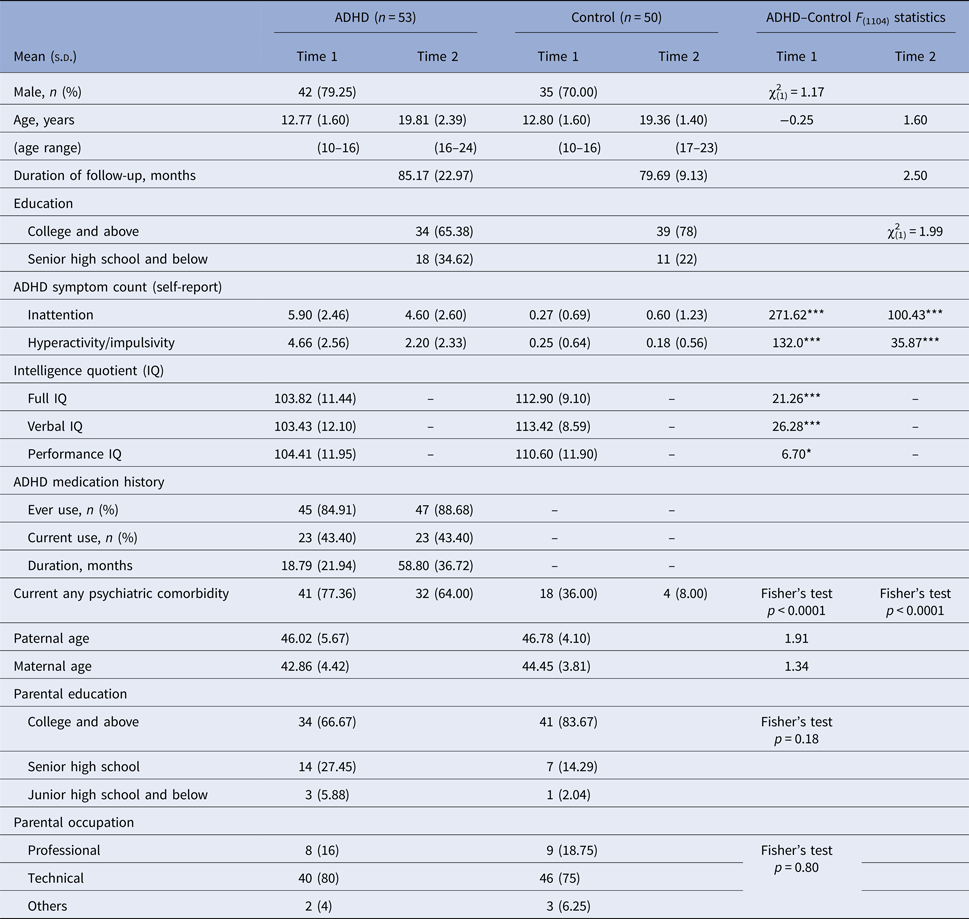
The clinical data of the participants are presented in Table 2. There was no significant group difference in sex, age, duration of follow-up, and educational levels. The symptoms of inattention and hyperactivity/impulsivity and psychiatric comorbidities were significantly higher, and IQ was significantly lower in the ADHD group than the control group at baseline. Of 53 participants with ADHD, 47 (88.68%) were ever treated with methylphenidate, and 21 and two currently used methylphenidate and atomoxetine at time 2, respectively. There was no group difference in parental ages, educational levels, and occupations.
Demographic and clinical data

s.d., standard deviation; ADHD, attention deficit/hyperactivity disorder.
*p < 0.05; **p < 0.01; ***p < 0.001.
Changes in ADHD symptoms
There was a significant decrease in inattention and hyperactivity/impulsivity symptoms in the ADHD group with a larger effect size in the decrease of hyperactivity/impulsivity symptoms (paired t = −5.49, p < 0.001, d = −1.01) than that of inattention symptoms (paired t = −3.33, p = 0.002, d = −0.47). On the other hand, we found a significant increase in inattention symptoms in the control group (paired t = 2.33, p = 0.023, d = 0.33).
Comparison and changes of neuropsychological functions
Cognitive alertness (reaction time)
Longer reaction time in the simple task (Fig. 1a) and five-choice task (Fig. 1b) in ADHD participants than controls was noted only at time 2 but not at time 1. Both groups showed no significant change overtime in the simple task (Fig. 1a). For the five-choice task, there was a significant decrease in reaction time in the control group but not the ADHD group (Table 3). The repeated-measures linear mixed model showed no group difference in the magnitude of the slope of reaction time changes (group × time interaction) (Fig. 1a, b, more details of statistics in online Supplementary Table S3).
Developmental changes of neuropsychological functions of ADHD and controls from early adolescence to late adolescence/young adulthood. Note: RVP, rapid visual information processing; SWM, spatial working memory; IED, intra-dimension/extra-dimension shift; SOC, Stocking of Cambridge; β, slope of the change of the neuropsychological function; CI, confidence interval. Group difference: d = Cohen's d; *p < 0.05, **p < 0.01, ***p < 0.001.

Changes of neuropsychological functions from adolescence to young adulthood for the ADHD and control groups

#Paired t test. Adjusted p value is the value adjusted for the false discovery rate (maximum = 0.05) from the raw p value.
Sustained attention (rapid visual information processing)
Participants with ADHD had a lower probability of hit and A’ (signal detectability) at both two time points than controls (Fig. 1c, d). Both the ADHD and control groups had significant improvements in these two indices from time 1 to time 2 (Table 3). The repeated-measures linear mixed model showed a significant main effect of time and group (only in A’, p < 0.05) without significant group difference in the slope of changes in the two rapid visual information processing indices (Fig. 1c, d, online Supplementary Table S3).
Short-term spatial memory (spatial span)
Participants with ADHD had a significantly shorter spatial span length at both time points than controls (Fig. 1e). Both the ADHD and control groups showed a significant increase of spatial span lengths from time 1 to time 2. There was no group difference in the slope of changes of spatial span length (Fig. 1e, online Supplementary Table S3).
Spatial working memory
Compared to the control group, the ADHD group had significantly more SWM between errors at time 1 and time 2 and used more strategies to complete the tasks at time 1 (Fig. 1f, g). Both groups showed a significant improvement in strategy utilization and between errors from time 1 to time 2 (Table 3) with significant greater magnitude of reduction slopes in both indices in ADHD than controls (Fig. 1f, g, online Supplementary Table S3).
Set-shifting (intra-dimension/extra-dimension shift)
There was no significant group difference in the number of completed stages at time 1 and time 2, and extra-dimensional shift errors at time 1. Participants with ADHD showed significantly more extra-dimensional shift errors at time 2 than controls. Both indices had significant improvements from time 1 to time 2 in both groups. There was no significant group difference in the slope of changes in both indices (Fig. 1h, i, online Supplementary Table S3).
Spatial planning (SOC)
Compared to the controls, participants with ADHD needed more moves to solve the five-move problems at time 1 and time 2 (Fig. 1j), and they solved fewer problems in minimal moves at time 1 without group difference at time 2 (Fig. 1k). These two indices showed significant improvements from time 1 to time 2 for both groups (Table 3). There was no significant group difference in the slope of changes in both indices (Fig. 1j, k, online Supplementary Table S3).
The correlation matrix of FIQ at time 1, ADHD symptoms, and all neuropsychological functions at the two time points is presented in online Supplementary Table S4. After further controlling for any psychiatric comorbidity, the significance of group differences (ADHD–control) of neuropsychological functions vanished only in the tasks with high-executive demands, i.e. SWM, intra-dimension/extra-dimension shift (IED), and SOC, at time 2. After controlling for any psychiatric comorbidity and FIQ as well, the significance of group differences decreased almost in all the neuropsychological tasks at time 1 and time 2 (online Supplementary Table S5).
Association between time 1 neuropsychological functions and the changes of neuropsychological functions
Poorer time 1 performance predicted more improvements between time 1 and time 2 in all neuropsychological tasks in the whole sample (online Supplementary Table S6 and S6-1) as well as in the ADHD group (online Supplementary Table S7 and S7-1) after adjusting for time 1 age, sex, duration of follow-up, and FIQ (all p < 0.001), suggesting that there may be a catch-up in individuals with poorer performance at baseline, probably due to brain maturation.
Association between neuropsychological functions and ADHD symptoms in the ADHD group
There was no significant association between changes of neuropsychological functions and changes of inattention or hyperactivity/impulsivity symptoms after adjusting for time 1 age, sex, and/or FIQ as well as the presence of psychiatric comorbidity in the whole sample (online Supplementary Table S8 and S8-1) and the ADHD group (online Supplementary Table S9 and S9-1) (all p > 0.05 if adjusting for multiple comparison).
Predictors of time 2 ADHD symptoms in the ADHD group
Time 1 SWM, IED, and SOC had significant associations with time 2 overall ADHD symptoms [SWM: β (s.e.) = 0.10 (0.04), F = 6.16, p = 0.01, adjusted p = 0.06; IED completed stages: β (s.e.) = −2.35 (0.71), F = 11.08, p = 0.003, adjusted p = 0.02; IED extra-dimensional shift errors: β (s.e.) = 0.15 (0.06), F = 2.17, p = 0.02, adjusted p = 0.06] and hyperactive/impulsive symptoms [SWM: β (s.e.) = 0.05 (0.02), F = 5.10, p = 0.02, adjusted p = 0.09; IED completed stages: β (s.e.) = −1.29 (0.39), F = 11.23, p = 0.004, adjusted p = 0.02; IED extra-dimensional shift errors: β (s.e.) = 0.09 (0.03), F = 8.65, p = 0.01, adjusted p = 0.03; SOC strategy utilization: β (s.e.) = −0.29 (0.14), F = 4.38, p = 0.05, adjusted p = 0.09; SOC mean move of five-move task: β (s.e.) = 0.48 (0.21), F = 4.98, p = 0.02, adjusted p = 0.09] after controlling for time 1 age, sex, duration of follow-up, and same dimension of ADHD symptoms at time 1 (online Supplementary Table S10). While adding the psychiatric comorbidity or FIQ into the predictive models, the significance of the results remained similar (online Supplementary Table S10).
In the ADHD sample (Table 4), time 1 IED completed stages, and parental occupation accounted for 38% of the variance in time 2 overall ADHD symptoms. Time 1 inattentive symptoms, IED completed stages, and SWM between errors explained 33% of the variance of time 2 inattentive symptoms (Table 4). Time 1 IED, SOC mean moves of the five-move task, and parental occupation accounted for 49% of variance in time 2 hyperactive/impulsive symptoms (Table 4).
Predictors of time 2 ADHD symptoms in the ADHD group

ADHD symptoms, SWM between errors, IED completed stage and extra-dimensional shift errors, SOC mean moves of the five-move task, FIQ, ADHD symptoms, parental occupation, parental educational level and any psychiatric disorder at time 1, time 2 age, sex, duration of ADHD medication treatment, and duration of follow-up between two evaluations (months) were put into the stepwise linear regression. SWM, spatial working memory; IED, intra-dimension/extra-dimension shift; SOC, Stocking of Cambridge; parental occupation, a highest parental job level, the ‘professional’ group as the reference group.
Discussion
As one of few longitudinal follow-up studies examining the developmental changes of neuropsychological functions assessed by the CANTAB in individuals with and without ADHD, this study had the following important findings. First, both ADHD symptoms and neuropsychological functions improved with age, but young adults with ADHD continued to perform poorer than controls not only at time 1 but also at time 2. Second, the developmental changes of neuropsychological functions of ADHD and controls were parallel, except SWM, in which individuals with ADHD showed a larger magnitude of improvement than controls. Third, there was no significant linear correlation between changes of ADHD symptoms and changes of neuropsychological functions. Fourth, for individuals with ADHD, time 1 set-shifting (IED), SWM, and spatial planning (SOC) predicted time 2 ADHD symptoms severity independent of baseline ADHD symptoms, sex, age, and duration of follow-up. Lastly, better baseline set-shifting, SWM, and spatial planning and parental occupation as professional predicted fewer ADHD symptoms at follow-up based on the model selection.
Similar to other longitudinal studies (Faraone et al., Reference Faraone, Biederman and Mick2006), we found that with age, there was a significant decline of ADHD symptoms, especially hyperactive/impulsive symptoms (Gau et al., Reference Gau, Lin, Cheng, Chiu, Tsai and Soong2010a). Consistent with the hypothesis of maturational lag, our data showed that neuropsychological functions, except cognitive alertness (reaction time), demonstrated parallel improvements with age for both the ADHD and control groups with persistently poorer performance in young adults with ADHD than controls. Converging data suggest that ADHD is characterized by a delay but not a deviance in brain development based on the observation that the behavioral presentations of children with ADHD often like their younger typically developing counterparts, including activity level, behavioral regulation ability, neurocognitive performance, speech development and quantitative electroencephalographic presentation [see review, El-Sayed et al. (Reference El-Sayed, Larsson, Persson, Santosh and Rydelius2003)]. Neuroimaging studies showed that children with ADHD had a similar ordered sequence of brain maturation as typically developing children, i.e. primary sensorimotor cortex prior to high-order association areas, but had a lag of years in attaining the peak of cortical thickness (Shaw et al., Reference Shaw, Eckstrand, Sharp, Blumenthal, Lerch, Greenstein, Clasen, Evans, Giedd and Rapoport2007). Also, there was a fixed and non-progressive rate of cortical thinning (Shaw et al., Reference Shaw, Malek, Watson, Greenstein, de Rossi and Sharp2013) and persistent smaller brain volume (Castellanos et al., Reference Castellanos, Lee, Sharp, Jeffries, Greenstein, Clasen, Blumenthal, James, Ebens, Walter, Zijdenbos, Evans, Giedd and Rapoport2002) in individuals with ADHD, especially those with persistent diagnosis (Shaw et al., Reference Shaw, Malek, Watson, Greenstein, de Rossi and Sharp2013). In other words, the gap of neuropsychological functions between individuals with ADHD and controls did not enlarge from early adolescence to late adolescence/early adulthood.
Although roughly parallel with the typically developing youth, the brain development of individuals with ADHD was found to have a differential delay in maturation over different brain regions (Shaw et al., Reference Shaw, Eckstrand, Sharp, Blumenthal, Lerch, Greenstein, Clasen, Evans, Giedd and Rapoport2007; Shaw et al., Reference Shaw, Malek, Watson, Sharp, Evans and Greenstein2012). We found a tendency of the development of SWM of individuals with ADHD to converge toward controls from early adolescence to young adulthood. The significant convergence might imply a delayed but rapid catch-up of this ability through the developmental stage of adolescence in ADHD, coincident with the delayed, vigorous development of the frontal area during this period (Halperin and Schulz, Reference Halperin and Schulz2006). The anterior frontal gyri, especially the right side, subserving visuospatial working memory (Chase et al., Reference Chase, Clark, Sahakian, Bullmore and Robbins2008), were demonstrated to be the brain region with the most marked delay in ADHD (Shaw et al., Reference Shaw, Malek, Watson, Sharp, Evans and Greenstein2012). Because there was no such a catch-up in spatial short-term memory, it was more likely that the central executive component, rather than spatial sketchpad component, accounted for the rapid improvement of ADHD in SWM during early to late adolescence. Nevertheless, young adults with ADHD consistently showed a significant deficit in SWM. This ability might catch up but be still impaired. On the other hand, the most simple task, the simple reaction time task, showed almost no improvement in both ADHD and controls, implying that this ability reaches a plateau before adolescence (Luciana and Nelson, Reference Luciana and Nelson1998).
Our finding that FIQ shared a significant part of variance contributing to the group differences in neuropsychological functions might be explained by the high correlations among ADHD, FIQ, and neuropsychological functions. Putting IQ into analysis would diminish the associations between ADHD and neuropsychological deficits (Miller et al., Reference Miller, Loya and Hinshaw2013) because IQ tests and neuropsychological tasks might share some common indirect measures of brain functions which were related to ADHD. Therefore, our discussions still focused on the neuropsychological deficits of ADHD without controlling for FIQ. Some influences of the psychiatric comorbidity on group differences in CANTAB performance might be explained by the small sample size and the high proportion of the psychiatric comorbidity in ADHD. Although IQ and the psychiatric comorbidity were reported to influence the outcome of ADHD (Uchida et al., Reference Uchida, Spencer, Faraone and Biederman2018), neither IQ nor the psychiatric comorbidity had a significant influence on the association between changes of ADHD symptoms and changes of neuropsychological functioning, or prediction of neuropsychological functions to time 2 ADHD symptoms in the ADHD group.
Consistent with previous studies (Cheung et al., Reference Cheung, Rijdijk, McLoughlin, Faraone, Asherson and Kuntsi2015; Lahey et al., Reference Lahey, Lee, Sibley, Applegate, Molina and Pelham2016), we found that parental occupation and baseline set-shifting ability (Coghill et al., Reference Coghill, Hayward, Rhodes, Grimmer and Matthews2014a) predicted time 2 ADHD symptoms, especially hyperactive/impulsive symptoms. Parents having a professional occupation, compared with non-profession/non-technical occupation, implying a higher socioeconomic status, was a protective factor for adolescents with ADHD (Cheung et al., Reference Cheung, Rijdijk, McLoughlin, Faraone, Asherson and Kuntsi2015). This result again highlights the importance of environmental factors, especially the family influence, in the outcome of ADHD in addition to the inherent executive abilities. In contrast to the finding of Cheung et al., we found the parental occupation explained more variance than IQ, possibly because we included neuropsychological functions in the model selection which shared the variance of the association between ADHD and IQ.
Although there was no significant linear relationship between the changes of ADHD symptoms and changes of neuropsychological functioning, we could not rule out the possibility that there was a ‘threshold effect’ of neuropsychological functioning in ADHD symptoms, i.e. when individuals’ neuropsychological functioning reaching the normal developing level or maturation, the ADHD symptoms would remit. Because this study focused on the dimensional approach and the sample size was small, we did not divide the ADHD group into subgroups of normal or impaired neuropsychological functioning nor subgroups of persistent ADHD or non-persistent ADHD at time 2. Further longitudinal studies with large samples would be helpful in elucidating the existence of a non-linear relationship between ADHD symptoms and neuropsychological functions.
There are some conflicts with regards to the definition of ‘core neuropsychological deficits’ and ‘epiphenomenon’ of ADHD. Miller et al. (Reference Miller, Loya and Hinshaw2013) suggested that the neuropsychological deficits with developmental trajectories unrelated to ADHD symptom changes were the core deficits, otherwise were the epiphenomenal deficits (Carr et al., Reference Carr, Nigg and Henderson2006). In contrast, Coghill et al. (Reference Coghill, Hayward, Rhodes, Grimmer and Matthews2014a) suggested that because of the lack of linear relationship between developmental changes in neuropsychological functions and ADHD symptoms, neuropsychological deficits were phenotypes co-occurring with ADHD symptoms at the same level of analysis in the causal model, the concept closer to epiphenomena. By the definition of Walters and Owen (Reference Walters and Owen2007), the only difference between the endophenotype (core deficits) and the epiphenomenon is that the former lies in the middle of the pathway from genes to the target phenotypes, which is state-independent, and the later shares the same genes with the target phenotypes but is not within the pathway. The confusion comes from the developmental nature of ADHD symptomatology and neuropsychological functioning. The definitions of trait vs. state-dependent factors suitable for the mental illness with significant wax and wane might not be ideal for a developmental disorder with a gradual change of symptoms and without substantial short-term fluctuations like ADHD. Artificially, methylphenidate causes acute and transient phenotypical changes, and also improves several high- and low-executive neuropsychological functions (Coghill et al., Reference Coghill, Seth, Pedroso, Usala, Currie and Gagliano2014b), but the changes might not be linear or prominent (Coghill et al., Reference Coghill, Rhodes and Matthews2007). On the other hand, there might be different sets of genetic and environmental factors contributing to the baseline condition and the developmental course of ADHD (Pingault et al., Reference Pingault, Viding, Galera, Greven, Zheng, Plomin and Rijsdijk2015). In other words, there might be different mechanisms underpinning the cause and recovery of ADHD (Halperin and Schulz, Reference Halperin and Schulz2006). While investigating the causal model of ADHD, factors associated with pathogenesis and developmental course might have to be addressed separately (Kuntsi et al., Reference Kuntsi, Wood, Rijsdijk, Johnson, Andreou, Albrecht, Arias-Vasquez, Buitelaar, McLoughlin, Rommelse, Sergeant, Sonuga-Barke, Uebel, van der Meere, Banaschewski, Gill, Manor, Miranda, Mulas, Oades, Roeyers, Rothenberger, Steinhausen, Faraone and Asherson2010). The longitudinal familial genetic studies would be more informative to identify endophenotypes in the pathway from genes to ADHD phenotypes (Gau and Shang, Reference Gau and Shang2010; Kuntsi et al., Reference Kuntsi, Pinto, Price, van der Meere, Frazier-Wood and Asherson2014).
There are some limitations in this study. First, we used the clinical sample, and thus our results cannot be generalized to the community population. Second, the sample sizes for both groups may be too small to detect the differences and changes. Third, more than half of the participants were currently or ever medicated for ADHD, so we could not rule out the effect of long-term ADHD medication use (mostly methylphenidate) on the changes of ADHD symptoms and neuropsychological functioning. Neveretheless, Saville et al. (Reference Saville, Feige, Kluckert, Bender, Biscaldi, Berger, Fleischhaker, Henighausen and Klein2015) ever reported no influences of medication use on the development of ADHD symptoms. Fourth, although we asked the participants who currently took medication for ADHD to hold medication for at least 24 h, we cannot rule out the possible withdrawal effect of methylphenidate and the therapeutic effect of atomoxetine (only two participants currently used). Fifth, we intended to do dimensional-based analysis and the sample size was small, so we did not divide individuals with ADHD into persisters/remitters or groups of normal/impaired neuropsychological functioning. Use of the dimensional approach to evaluating the development of ADHD would be informative given that ADHD symptoms exist in a continuum in the population (Kuntsi et al., Reference Kuntsi, Wood, Rijsdijk, Johnson, Andreou, Albrecht, Arias-Vasquez, Buitelaar, McLoughlin, Rommelse, Sergeant, Sonuga-Barke, Uebel, van der Meere, Banaschewski, Gill, Manor, Miranda, Mulas, Oades, Roeyers, Rothenberger, Steinhausen, Faraone and Asherson2010; Cheung et al., Reference Cheung, Rijsdijk, McLoughlin, Brandeis, Banaschewski, Asherson and Kuntsi2016). For categorical analysis, a larger size of the sample to accord with the strict definition of persisters and remitters in combination with functional impairment would be necessary. Finally, we discuss group differrencs in neuropsychological functions mainly focusing on the results without controlling for the influence of FIQ.
In conclusion, there were parallel improvements of several neuropsychological functions with high- and low-executive demands in individuals with and without ADHD from early to late adolescence/young adulthood. Young adults with ADHD showed a fixed delay in arousal, signal detectability, spatial span, set-shifting, and spatial planning but had a ‘catch-up’ in SWM, especially the central executive component. Till late adolescence/early adulthood, ADHD showed deficits in almost all these neuropsychological functions. There might be different determinants of the cause and the developmental change of ADHD (Halperin and Schulz, Reference Halperin and Schulz2006; Pingault et al., Reference Pingault, Viding, Galera, Greven, Zheng, Plomin and Rijsdijk2015). Executive functions at baseline and parental occupation might influence the persistence of ADHD symptoms, especially hyperactive/impulsive symptoms, during adolescence. The predicters for persisting ADHD symptoms can be used for designing the specific strategies to offset the adverse outcome of ADHD at adulthood. To elucidate the causal relationship of neuropsychological functioning, ADHD symptoms and the mutual relationship of their developmental changes requires large-scale longitudinal familial genetic studies.
Supplementary material
The supplementary material for this article can be found at https://doi.org/10.1017/S0033291718001599
Acknowledgements
This work was supported by the National Health Research Institute (NHRI-EX100-10008PI, NHRI-EX101-10008PI, NHRI-EX102-10008PI; NHRI-EX103-10008PI), Taiwan. The authors thank Ms. Yu-Lun Lin for data management and psychiatric interviews.
Conflict of interest
None.