Introduction
In May 2007, devolved government returned to Northern Ireland after a period of suspension which had lasted five years. This meant the restoration of legislative and executive powers over most major aspects of social policy to a new Northern Ireland Executive and Assembly. Suspension in 2002 had been the outcome of political difficulties in the operation of the power-sharing coalition. Established in 1999, this coalition government had been led by the Ulster Unionist party and the Social Democratic and Labour party, with the Democratic Unionist party and Sinn Fein as smaller coalition partners. Eithne McLaughlin (Reference McLaughlin, Powell, Bauld and Clarke2005) identified the most significant social policy developments during the first period of devolution and its immediate aftermath. This had a focus on describing the degree of policy divergence, drawing in part on work by Keating (Reference Keating2002). The analysis undertaken by McLaughlin emphasised the significance of the ‘imperative’ of cross-party agreement in policy-making by the coalition government. Consequently, she found that the need to find a consensus led to the ‘unambiguously deserving poor’, including children and older people, becoming the groups that benefited most from divergence and devolved concerns. McLaughlin (Reference McLaughlin, Powell, Bauld and Clarke2005: 116) reached a view of the danger under devolved coalition governance of a ‘lowest common denominator’ of conservative social values and social policies and identified that this would be a concern for the future. It is now possible to examine the second period of social policy development under devolution between 2007 and 2011. Government was still composed of a four party coalition, but the two leading parties occupying most of the Executive ministerial posts were now the Democratic Unionist party and Sinn Fein. The powers of the devolved institutions remained similar to the 1999–2002 period of devolution. The only major change occurred in 2010 when agreement was reached on the transfer of policing and justice to the devolved administration. This involved the transfer of functions such as probation, youth justice and the rehabilitation of offenders. The devolution of these powers also meant the four party coalition became a five party coalition, with the appointment of an Alliance Party MLA as the new Justice Minister. In this context, the article analyses the most significant developments in social policy since 2007, using McLaughlin's lowest common denominator thesis. It also provides a further analysis which suggests a more complex scenario of social policy formulation and implementation. This is based on identifying five different categories of social policy-making by the devolved government:
• a lack of agreement on social policies;
• lowest common denominator decisions;
• areas of agreement on social policy;
• individualised decision-making by ministers;
• external determinants of social policy.
This form of differentiation makes it possible to assess the impact of this mix of social policy-making on actual provision and also to consider some of the factors that explain the complexities of social policy development in Northern Ireland between 2007 and 2011.
A lack of agreement on social policies
One notable feature of devolution in Northern Ireland has been the failure of the Coalition Executive to reach agreement on a number of major social policy issues, producing almost a policy impasse. The Executive is not bound by the principle of collective responsibility, and pre-coalition party negotiations were not policy specific. Failures to reach consensus have occurred even after much discussion and debate and despite the existence of commitments drawn up as part of the St Andrews AgreementFootnote 1 on conditions for the restoration of devolution. This Agreement had proposed a new anti-poverty strategy to tackle deprivation and social exclusion which was to be taken forward by the incoming Executive (Gay, Reference Gay2006). The original strategy, ‘Lifetime Opportunities’, published during the period of Direct Rule in 2006 was not endorsed by the Northern Ireland Executive until December 2008. Since then progress in implementing the actions and objectives contained in the strategy and revising the strategy has been slow. The wider UK debates on welfare reform and child poverty, initiatives in the other devolved administrations and the publication of research reports on disadvantage in Northern Ireland did not provide the incentive for any agreed strategy development and implementation. There has also been a failure to reach consensus on some high profile policies, particularly replacing the system for academic selection for secondary schools which had been based on the 11+ test. The 11+ had been abolished by a previous Sinn Fein Minister of Education, but the political parties have been unable to agree on a new transfer process. There has also been a lack of agreement on the shape of education administration, local government reform, a detailed victim's strategy and new single equality legislation. Most recently, the Executive has delayed making decisions about the impact of the Comprehensive Spending Review (CSR), despite the fact that the outcome of the CSR in terms of the recurrent budget was better than anticipated.
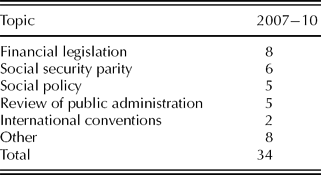
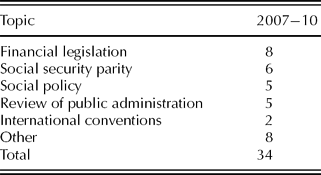
The relatively small amount of new legislation in areas of devolved powers is again indicative of the difficulties in obtaining agreement on social policies. Legislation may have to obtain cross-community support in the Assembly and divisive or radical measures may be opposed or never presented and debated. Out of 34 acts passed since 2007 only five relate to social policy subjects which are at the discretion of the Executive and Assembly. A further five relate to the review of public administration (see Table 1).
Northern Ireland Assembly legislation
The inability to reach agreement has resulted in Northern Ireland falling behind in some areas of social policy provision. Existing equality and fair employment legislation had imposed duties in a radical and innovative way not seen before in the UK (McLaughlin, Reference McLaughlin2007). However, new single equality legislation which was to have been taken forward by the Executive would have enhanced equality provision and updated existing legislation, but the lack of consensus means that Northern Ireland now lags behind Britain as a result of measures introduced by the 2010 Equality Act there (Great Britain, 2010a). For instance, additional protections regarding age discrimination and equal pay will not apply to Northern Ireland and, in the view of the Equality Commission for Northern Ireland, ‘vulnerable and marginalised individuals in Northern Ireland have less protection against unlawful discrimination, harassment and victimisation than those in GB’ (ECNI, 2011: 5).
Within Northern Ireland political discourse on the equality debate has ended up as ‘part of sectarian political antagonism’ (Wilson, Reference Wilson2007). A similar impasse has existed over the Executive and Assembly position on a new Human Rights Bill. This is a matter reserved to the Westminster Government but there is no consensus in the Executive and Assembly on advice to be given to the Secretary of State, largely on the question of including social and economic rights, as recommended by the Northern Ireland Human Rights Commission. The Good Friday Agreement, ten years earlier, had contained a recognition of a case for additional protections for the rights of people in Northern Ireland which reflect its particular circumstances. A decade has also passed since a process was initiated on reform of local government, and following political disputes over structures, functions and local government boundaries a further postponement of the long-awaited modernisation was announced in June 2010.
Lowest common denominator decisions
Agreement on a number of social policy matters was achieved after a negotiation and bargaining process which has revolved around what can be described as the lowest common denominator approach. This has applied to decisions made at a very general level, as was the case with the whole Programme for Government in 2008, which was brief, general and has been described as not having a single definitive policy in its relatively few pages (Wilford and Wilson, Reference Wilford, Wilson and Trench2008). Despite cross party agreement and a Programme for Government commitment to bring forward a Programme of Cohesion and Integration for a Shared Future, the formulation of a major community relations strategy has been a difficult policy area for agreement. It was only in 2010 that some consensus was reached on a strategy document but the content could be interpreted as reflecting a lowest common denominator approach, with no radical policy innovations or special action plans (OFMDFM, 2010). Finding agreement on the extension of devolved powers to include policing and justice and related policies developed into a long drawn out process despite the direct intervention of the UK Prime Minister and the offer of financial incentives. The agreement to proceed with the devolution of policing and justice was again reached on the basis of postponing the final policy details on some key decisions which will impact on social policy related issues, such as youth justice and probation services.
The lowest common denominator approach can also be identified as still operating in ways identified by McLaughlin (Reference McLaughlin, Powell, Bauld and Clarke2005), that is, as embracing a cautious and conservative approach to social policy development. This applies to the limited developments in provision in early years and childcare provision, new support for long-term care, the lack of modernisation of adult social care, the failure to realise the potential of the integrated structure of health and social care and limited provision for public and user participation in health and social care and housing. Bargaining over budget allocations to 11 departments and 11 ministers led to a consensus on equalising increases or cuts across all departments rather than a determination of priority areas. This has had a major impact on levels of expenditure on health and education, resulting, for example, in concerns about the ability of the DHSSPS to implement long-awaited policies to improve mental health and disability services and the postponement of a final decision on university tuition fees. The dominance of departmental protectionism has been an obstacle to ringfencing expenditure on health in the face of pressure on Northern Ireland's block grant.
Areas of agreement on social policy
It is possible to identify a number of social policy decisions made since 2007 which do demonstrate a degree of consensus. These tend to cover pragmatic measures which may have electoral value as reflected in the all-party support for a rates (council tax) freeze and the decision to postpone the introduction of water charges. There are perhaps a few examples of policies which could be described as more solidaristic, such as the abolition of prescription charges, free travel on trains and buses for the over sixties and the passing of the Financial Assistance Act (2009). The latter enabled the Executive to provide financial assistance to tackle poverty and deprivation when existing funding arrangements are considered ineffective or unsatisfactory (Northern Ireland, 2009). Under these powers, a £150 fuel payment was made to 150,000 very low-income households (Department for Social Development, 2009).
There has also been a consensus on a number of policies which reflect a process of policy copying or policy transfer from Scotland and Wales. The Northern Ireland Executive and Assembly have agreed on a number of policies introduced first in Scotland and Wales, for example the Office of Children's Commissioner introduced originally in Wales. Northern Ireland is now proceeding with legislation to introduce a Commissioner for Older People, again copied from Wales. The decision to introduce free prescriptions was justified by reference to the same rationales used by ministers in Scotland and Wales.
Another facilitative factor has been policy learning through formal inter-governmental networks, particularly the British–Irish Council, established in 1999. This consists of representatives of all four governments in the UK, the Irish government and the governments of the Channel Islands and the Isle of Man. The work streams of the British–Irish Council have led to the exchange of information and sometimes implementation of detailed good practice on subjects such as credit unions, drug misuse in prisons, affordable housing, disability and access to employment and the contribution of the third sector (British–Irish Council, 2010). Work on child poverty by the British–Irish Council contributed to an agreed strategy for implementation across the UK.
Individualised decision-making by ministers
Whilst we have noted the difficulties faced by the Executive and Assembly in reaching decisions, individual ministers have been able to take and implement departmental decisions without requiring the approval and agreement of the Executive. This arises in the case of non-legislative decisions in the realm of regulations, guidelines, action plans and the allocation of finance. The most striking example has been the decision by the Minister of Education to end the 11+ examination, a non-legislative decision. However, with no agreement on legislation to establish a new transfer system, grammar schools ignored the Department of Education guidance on transfer and set up their own entry tests. A further example was a decision by the Minister of Social Development to end grants to a loyalist community group on the basis of paramilitary connections. In this case, the courts overturned the Minister's decision. This ‘ministerial individualism’ has been a product of the absence of the principle of collective responsibility, governing both ministerial and Executive decision-making. This has encouraged the operation of government departments as ‘silos’ or ministerial ‘fiefdoms’ with limited cross-departmental cooperation and working.
External determinants of social policies
The difficulty in finding agreement in devolved areas of decision-making has also to be placed in the context of the existence of policy areas which are actually determined mainly by decisions and major influences outside Northern Ireland's devolved system. Although the main areas of social policy are devolved, certain areas are not. Thus income tax and national insurance are the responsibility of the UK government. The area of social security and benefits is more complex in that formally and constitutionally this is a devolved matter, but in practice, and through historic agreements and statutes, social security is almost totally kept in parity with Great Britain (Birrell, Reference Birrell2009a). The 1998, Northern Ireland Act, setting up devolved government, requires arrangements to provide a single system of social security, child support and pensions for the United Kingdom. The scope for divergence from parity in social security matters is also constrained financially, as additional spending would inevitably have to be met from the block grant. In practice, the Assembly normally copies Westminster Bills in separate Northern Ireland statutes. This procedure has effectively ruled out significant discussion or divergence in social security policy.
Some policy areas involve both devolved and non-devolved matters with an overlap in responsibilities between the UK and the devolved administrations. Tackling child poverty is such an area, and Northern Ireland has accepted the UK target of eliminating child poverty by 2020. The UK Child Poverty Act 2010 (Great Britain, 2010b) requires the Northern Ireland department to prepare child poverty strategies through to 2020 (Kennedy and Townsend, Reference Kennedy and Townsend2009). The Child Poverty Commission will provide advice that the Northern Ireland department must have regard to preparing their child poverty strategy. The Northern Ireland Executive and Assembly, like the Scottish Government and Parliament, accepted a legislative consent motion to permit the legislation to apply to Northern Ireland.
Even when areas are clearly devolved, the influence of UK policy developments may be such that Northern Ireland has little choice or may be unwilling to depart from GB practices. This applied to welfare reform proposals where the Northern Ireland Executive and Assembly introduced legislation with almost the same content as in Britain, even though there were questions about the suitability of the proposals for Northern Ireland (Gray and Horgan, Reference Gray and Horgan2010). The Department for Social Development Assembly Committee attempted to ensure some discussion of the proposed legislation by resisting the Minister for Social Development's initial intention to seek accelerated passage for the Welfare to Work legislation on the grounds of parity. However, subsequent Assembly debates and committee questions on the policy were mostly limited to timing and implementation issues rather than a critical discussion of the policy.
Institutions external to the Northern Ireland government are beyond the influence of local politicians and can determine some policies. The clearest examples are EU directives which have to be transposed into national law. It is for the devolved administration, in consultation with the UK government, to decide if new directives should be implemented in separate Northern Ireland legislation. At another level EU funding, including a special peace initiative for Northern Ireland, the EU Programme for Peace and Reconciliation, has shaped and supported provision in aspects of community development, youth work, job creation, social inclusion and community relations.
International conventions and agreements to which the UK is a signatory can impose uniform obligations on the devolved administrations. The Convention on the Rights of the Child and the Convention on the Elimination of Discrimination against Women (CEDAW) extend to Northern Ireland, although it is the government at Westminster which is accountable to the UN bodies. There is some evidence of the UN conventions influencing policy documents. Policies and strategies relating to children and young people refer to the principles set out in the Convention on the Rights of the Child, particularly the ten year strategy for Children and Young People (OFMDFM, 2006a), which is seen by government as the main vehicle for implementing the Convention in Northern Ireland. The Gender Equality Strategy for Northern Ireland (OFMDFM, 2006b) refers extensively to the principles of the strategy being informed by the CEDAW obligations and the Beijing Platform for Action. There has, however, been criticism of the lack of progress in terms of actual implementation of these policies and strategies. Devolution has also posed some challenges for the UK government in terms of meeting the obligations of the UN Conventions; the CEDAW Committee in its examination of the UK government in 2008 criticised the uneven application of the Convention across the UK and cited several examples relating to lack of progress and poorer outcomes in Northern Ireland than elsewhere in the UK (UN OHCHR, Reference High2008).
Another major source of potential external influence comes from the Irish government, although in practice the influence on social policies is somewhat limited. Six cross-border implementation bodies set up as part of the Good Friday Peace Agreement have limited functions and operate mainly in areas of physical infrastructure. The formal North−South Ministerial Council oversees these bodies as well as six specified areas of cooperation, which include education, health and rural development. There is cooperation and contact between government departments and public bodies and a range of cross-border projects involving public and voluntary sectors. The outcomes mainly relate to detailed and localised aspects of delivery, for example projects based on cooperation in aspects of health and social care in border areas, and collaboration on child protection and suicide prevention. The overall influence on social policies in Northern Ireland is fairly marginal.
Influences on social policy development
The development and formulation of social policy in Northern Ireland has been affected not only by difficulties caused by the coalition government struggling to agree policies, but also by a more general, low key and conservative approach to social policy. A number of factors contribute to this social policy environment and can be listed as:
• the role of social policy;
• the public sector's policy-making capacity;
• the lack of critical policy discussion;
• the lack of joined-up government;
• the dominance of communal interests;
• the lack of public and user involvement;
• public attitudes to the devolved Assembly.
The Northern Ireland Executive and Assembly have not given priority to social policy, with few debates on the nature, scope and consequences of welfare provision. This is despite the dominance of social policies and services in terms of public expenditure and devolved policy-making powers. Such an approach stands in contrast to Scotland and Wales, where commitment to the welfare state has been to the fore in discourses in the Scottish and Welsh parliaments in a way rarely articulated in Northern Ireland. Williams and Mooney (Reference Williams and Mooney2008) point to policy departures in Scotland and Wales, which indicate policies being made on the basis of ideology or philosophy which is distinctly ‘Scottish’ or ‘Welsh’ and markedly different from Westminster. In Northern Ireland however, there has been a continuance of a neo-liberal policy agenda, which Horgan (Reference Horgan2006) argues was dominant during the period of Direct Rule when the Assembly was suspended. Northern Ireland Executive and Assembly narratives make little reference to social justice, social democratic collectivism or welfare state values (Birrell, Reference Birrell2009a) in stark comparison to the ‘race to the top’ in terms of the objectives of social policies which Keating (Reference Keating2003) identified in Scotland and Wales. In contrast, the ideological stances in Northern Ireland contribute to a drift towards the bottom and the lowest common denominator.
The lack of policy capacity in the Northern Ireland Civil Service has received comment (Greer, Reference Greer2004; Birrell, Reference Birrell2009b), and within the Northern Ireland Civil Service there has been recognition of the need to improve the policy capability of senior civil servants. The Fit for Purpose reform document, published in (Department of Finance and Personnel, 2004), had as one of its key themes the importance of building policy capacity. Action was later taken to appoint a Head of Profession for policy delivery and a policy champions network (Permanent Secretaries Group) plus a Policy Innovation Unit (since abolished).
Policy capability has also been affected by the limited opportunity for critical policy discussion. Northern Ireland has a small policy community and relatively under-developed policy networks. It does not have a tradition of think tanks and the only example, Democratic Dialogue, ceased to exist just as devolution proper was getting underway. The opportunity to thrash out ideas and interrogate evidence has been limited. The lack of deliberative and evidence-based policy-making can be found in departmental political leadership and in the work of Assembly committees. Committees have initiated only a small number of inquiries into social policy issues, and committee reports, rather than presenting a critical discussion, are often little more than accounts of oral and written evidence. Wilford (Reference Wilford2010) discusses the ‘disconnect’ between politics, democracy and the public in Northern Ireland and argues that, unlike Scotland and Wales, in Northern Ireland discussions about setting up and reviving devolved policy-making have been top down and have not been based on forms of participatory democracy most likely to mobilise and inform public decision-making.
The failure to achieve joined-up government between departments can have major impacts. These are illustrated by welfare to work policy and also by lengthy delays in the implementation of many policies once they have been agreed. In Britain, greater conditionality imposed through welfare to work has been introduced in a context of enhanced support, particularly in relation to childcare. A national strategy on childcare was introduced in 2004 and the Childcare Act 2006 imposed a statutory duty on local authorities to ensure sufficient childcare provision in their areas. In Northern Ireland, childcare has not been a priority issue for the Executive and there is no childcare strategy. Responsibility for childcare is divided among four government departments, with no one department keen to lead on it; this lack of leadership inevitably impedes policy progress (Gray and Horgan, Reference Gray and Horgan2010). A new consultative document on early years provision for 0–6 year olds (Department of Education, 2010), focuses predominantly on preschool and early school education for 3–6 year olds with no opportunity taken to integrate childcare and early years education. Instead the Department of Education commits only to playing its part ‘in working with OFMDFM in considering the future of childcare policy’. Meanwhile, the ‘solution’ to the problem of implementing the welfare to work measures in the absence of adequate childcare provision has been to suggest that discretion will be exercised by Personal Advisers when making decisions about sanctions (Ritchie, Reference Ritchie2009). While, as acknowledged by Wiggan (Reference Wiggan2009), the nature of delivery of social security and employment has not been altered significantly by devolution, there have been some examples of operational differences. Under the New Deal Programme in Northern Ireland subsidies were available to employers for up to six months and participants in the New Deal for Lone Parents were able to claim the cost of informal childcare (Gray and Carragher, Reference Gray and Carragher2007). More recently, the SDLP Social Development Minister has argued that aspects of welfare reform measures proposed by the Westminster Government are not appropriate for Northern Ireland (Attwood, Reference Attwood2011). However, while this may represent some break or attempt to break with parity, it is at implementation rather than policy level.
Even when consensus has been achieved the lack of joined-up government impacts on policy implementation as in the case of a number of important strategies, including the Gender Equality Strategy, the Race Equality Strategy, the Child Poverty Strategy and the Anti-poverty and Social Exclusion Strategy, all of which require inter-departmental action. Another constraint on integrated policy-making and implementation arises from the significant number of personal advisers to ministers; the Office of the First and Deputy First Minister alone has eight. Although the advisers significantly influence policy and delivery, they often have limited policy expertise and make joined-up policy-making in the coalition style government even more difficult.
Disputes between ministers also often reflect communal interests rather than any socio-economic interests; thus welfare delivery and social policy innovations are often analysed in terms of which community is likely to benefit most or be disadvantaged. This continues despite the Equality Duty in Northern Ireland to check policy for meeting equality of opportunity standards. This community referencing further distracts from the encouragement of debates on the wider social impact of policies on the whole community. Cross community support on local issues can occur, for example on proposed hospital closures, but the social service delivery structure based on larger centralised quangos rules out locally based responsiveness. Although consideration was given to enhancing the role of local authorities with regard for social services – youth work is one example − there has been a reluctance to implement this. This may be due to fears about the capacity and ability of local government given the historical issue of sectarian discrimination or the entrenched interests of quangos and the civil service (Knox, Reference Knox2010).
Increasing capacity for public and user involvement in Northern Ireland has not been a major focus of policy. Greer's (Reference Greer2004) analysis of health policy-making in Northern Ireland identified a dominant managerialism, which, he argued, was distinct in the UK in having little commitment to localism or local accountability. The most recent restructuring of health and social care resulted in the creation of one single Patient and Client Council for the whole region limiting potential for public involvement. Non-governmental organisation (NGO) and user group ‘involvement’ through consultation is widespread as a result of the duty to engage in consultation under Section 75 of the Northern Ireland Act 1998. However, the positive impact of this on policy-making is questionable. An effectiveness review of Section 75 carried out the Equality Commission for Northern Ireland (ECNI, 2007) showed that the perception of policy makers and NGOs differs in terms of what they think their contribution to the policy-making process should be.
Delays and minimal development in social policy have had a major impact on delivery and provision. In high profile areas such as education and health and social care, this has led to public criticism as has the failure of ministers to work collectively as an Executive. In 2005, McLaughlin concluded that despite the difficulties popular support for a return to devolved government remained strong. While there is still support for devolution, the public appear to be less happy with what has been achieved and less hopeful than they did then. Data provided by the Northern Ireland Life and Times Survey (Reference McLaughlin2007, 2009) show that in 2007 8 per cent of people said the Assembly had achieved nothing at all; this had increased to 17 per cent by 2009. In 2007, 26 per cent of the public reported being fairly or very dissatisfied with the way MLAs were doing their job; this had increased to 53 per cent in 2009. A majority of respondents (57 per cent) in 2009 thought that having a Northern Ireland Assembly was making no difference to ordinary people. These survey findings also show that the public feel the Assembly should be much more concerned with ‘bread and butter’ issues and perhaps they may be more likely to judge politicians on outcomes in these areas in the future.
Conclusions
The development of social policy in Northern Ireland in the period 2007–2011 has to be considered in the context of a horizontal segmentation of the policy process. While the paper has found the original McLaughlin thesis to be still relevant, it has found a more expanded framework to be useful in explaining all the post 2007 developments. Thus, as well as McLaughlin's thesis emphasising lack of agreement and lowest common denominator approach, attention has to be paid to areas of some agreement, the ability of ministers to take individualised decisions and to external influences. Where a policy process is subject to strong external factors or imperatives, there is more convergence to the general trends in social policy in Great Britain. In the non-devolved areas of social policy, in overlapping and collaborative areas, in areas subject to EU and international influences, there is less evidence of the lowest common denominator influence in operation. In the major devolved areas of social policy, there is still evidence to support McLaughlin's common denominator thesis but also evidence of difficulty agreeing even on a lowest common denominator. This has led to a failure in policy development and a falling behind standards in England, Scotland and Wales. There have been a few exceptions in terms of some policy copying from Scotland and Wales and a consensus on some items to improve welfare and well-being. The structural reasons which sustain a policy context and process pushing towards the lowest common denominator approach may change with time, but this is likely to be gradual. Meanwhile, new pressures in the form of austerity and expenditure cuts are likely to further sustain the lowest common denominator approach as evidenced by the failure to debate social welfare principles, to prioritise social policies and a lack of determination or agreement about which budgets or areas of provision should be ringfenced.