INTRODUCTION
The giant Mediterranean limpet, Patella ferruginea Gmelin, 1791 (Gastropoda: Patellidae) is regarded as the most endangered marine macroinvertebrate on the western Mediterranean rocky shores by the European Council Directive 92/43/EEC on the Conservation of Natural Habitat of Wild Fauna and Flora (1992). The intense human exploitation for feeding, fishing and collecting purposes (Aversano, Reference Aversano1986; Laborel-Deguen & Laborel, Reference Laborel-Deguen, Laborel, Boudouresque, Avon and Gravez1991a; Cristo et al., Reference Cristo, Caronni and Floris2007; Espinosa et al., Reference Espinosa, Rivera Ingraham and García Gomez2009) has progressively reduced its range, formerly widespread across the western and central Mediterranean, to very few areas—namely the Sardinian–Corsican region, the Tuscan Archipelago, islands off Western Sicily (Egadi, Pantelleria) and a small number of areas along the Iberian Peninsula and North African shores and islands (Biagi & Poli, Reference Biagi and Poli1986; Laborel-Deguen & Laborel, Reference Laborel-Deguen, Laborel, Boudouresque, Avon and Gravez1991a; Ramos, Reference Ramos1998; Cristo & Caronni, Reference Cristo and Caronni2008; Espinosa et al., Reference Espinosa, Rivera Ingraham and García Gomez2009)—placing its populations under serious risk of extinction.
Patella ferruginea is a protandrous species (see, e.g. Espinosa et al., Reference Espinosa, Rivera Ingraham and García Gomez2008a), and human exploitation impacts disproportionately on the largest, female individuals, unbalancing the local sex-ratio, and reducing therefore the reproductive success and the recovery of the species (Espinosa et al., Reference Espinosa, Rivera Ingraham and García Gomez2009). Furthermore, indirect genetic evidence supports the hypothesis of reduced rate of gene flow in P. ferruginea, often restricted at very small geographical scale (Casu et al., Reference Casu, Casu, Lai, Cossu and Curini-Galletti2006).
However, at present, the knowledge about the real extent of reproductive rate, the duration of the dispersal phase, and the specific patterns of juvenile recruitment is fragmentary and often controversial (see, e.g. Frenkiel, Reference Frenkiel1975; Laborel-Deguen & Laborel, Reference Laborel-Deguen, Laborel, Boudouresque, Avon and Gravez1991a; Espinosa et al., Reference Espinosa, Guerra García, Fa and García Gomez2006).
In this context, Laborel-Deguen & Laborel (Reference Laborel-Deguen, Laborel, Boudouresque, Avon and Gravez1991b) observed young individuals up to 10 mm in length clinging to the shell of adults of P. ferruginea, and hypothesized that a phenomenon of juvenile phoresis may be present in the species. These authors also argued that selective fixation could take place by means of an interaction between adults and juveniles or larval stages (i.e. larval philopatry), similarly to those evidenced in other marine invertebrates (e.g. Klautau et al., Reference Klautau, Russo, Lazoski, Boury-Esnault, Thorpe and Solé-Cava1999; Mariani, Reference Mariani2003; Duran et al., Reference Duran, Pascual and Turon2004). However, these findings may be biased by the difficulty of correctly classifying very young individuals (often less than 5 mm) of the genus Patella on a morphological basis only, as species' diagnostic features may not be apparent. Our recent observations support the unfeasibility of a confident identification, even sacrificing the specimen, a practice not to be encouraged when dealing with a species threatened with extinction.
Molecular techniques can potentially overcome this problem, and DNA barcoding (Hebert et al., Reference Hebert, Ratnasingham and deWaard2003)—even if it is not to be seen as a mere substitute for ‘traditional taxonomy’ (see, e.g. Ebach & Holdrege, Reference Ebach and Holdrege2005; Vogler & Monaghan, Reference Vogler and Monaghan2007)—has been suggested as a promising tool to assess, or help in, the identification of a species, when morphology proves inadequate. In particular, a ~640 bp long nucleotide region of mitochondrial DNA (mtDNA) coding for the cytochrome oxidase subunit I (COI) gene, known as the ‘Folmer region’ (Folmer et al., Reference Folmer, Black, Hoeh, Lutz and Vrijenhoek1994), has been extensively used as the ‘identification code’ to facilitate the correct taxonomic identification of specimens and the discovery of new species within marine invertebrates (Moritz & Cicero, Reference Moritz and Cicero2004).
In this perspective, following results previously obtained (Mauro et al., Reference Mauro, Arculeo and Parrinello2003; Sá-Pinto et al., Reference Sá-Pinto, Branco, Harris and Alexandrino2005), this research was aimed at further exploring the potential usefulness of the Folmer region as DNA barcoding in P. ferruginea and in three additional species belonging to this genus (Patella caerulea Linnaeus, 1758, Patella rustica Linnaeus, 1758 and Patella ulyssiponensis Gmelin, 1791), which has long been recognized as taxonomically challenging (Fisher-Piette, Reference Fisher-Piette1938). The sequencing of COI on species belonging to the genus Patella appears recommendable, since the absence of nuclear mitochondrial pseudogenes (Numts) in Mollusca (Bensasson et al., Reference Bensasson, Zhang, Hartl and Hewitt2001) avoids the mutual amplification of nuclear pseudogenes and their mitochondrial counterpart.
Consequential focuses, with a conservationist perspective, were: (i) to provide further information on the historical explanation of the rarity of P. ferruginea (see Espinosa & Ozawa, Reference Espinosa and Ozawa2006); and (ii) to shed some light on the possibility that young individuals of Patella settled on the shell of the adults of P. ferruginea belong to the same species or alternatively to different species of the genus Patella. The former instance may corroborate the hypothesis of an intraspecific larval philopatry, followed by juvenile phoresis in the species. The possibility to achieve this survey has been provided by the discovery in north-eastern Sardinia of a large individual of P. ferruginea carrying on its shell two young individuals of Patella spp. The two specimens were about 2.5 mm in length, and not clearly identifiable on morphological parameters. Their classification on a molecular basis is presented and discussed here.
MATERIALS AND METHODS
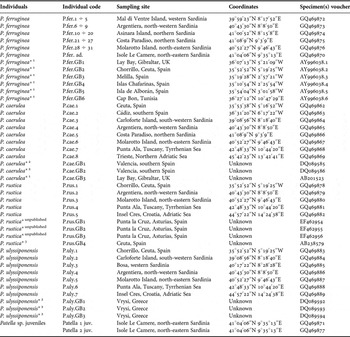
Samples of 32 adult individuals of P. ferruginea, eight of P. caerulea, five of P. rustica, seven of P. ulyssiponensis, plus the two juveniles of Patella spp., were collected from different sites of the western Mediterranean using a not lethal tissue sampling protocol as reported in Casu et al. (Reference Casu, Casu, Lai, Cossu and Curini-Galletti2006) (for sampling details, see Table 1).
Details on the individuals of Patella spp. analysed. Asterisks (*) and numbers identify individuals whose sequences were taken from the GenBank database, and sampling sites from (1) Espinosa & Ozawa (Reference Espinosa and Ozawa2006), (2) Sá-Pinto et al. (Reference Sá-Pinto, Branco, Harris and Alexandrino2005) and (3) Nakano & Ozawa (Reference Nakano and Ozawa2007), respectively.

The polymerase chain reaction (PCR), carried out in a total volume of 25 µl, contained about 10 ng/μl of total genomic DNA on average, 2.5 U of Taq DNA Polymerase (Eurotaq provided by Euroclone®), 1× reaction buffer, 1.25 mM of MgCl2, 0.4 µM of both LCO1490 and HCO2198 universal primers (Folmer et al., Reference Folmer, Black, Hoeh, Lutz and Vrijenhoek1994), and 200 µM of dNTPs mix. PCR amplification was carried out in a MJ PTC-100 Thermal Cycler (MJ research) programmed as follows: a pre-heating of 3 minutes at 94°C, 35 cycles of 40 seconds at 94°C, 45 seconds at 54°C (annealing temperature), and 1 minute and 40 seconds at 72°C. At the end, a post-treatment for 5 minutes at 72°C and a final cooling at 4°C were carried out. Both positive and negative controls were used to test the effectiveness of the PCR reagents. Electrophoresis was carried out on 2% agarose gels (0.5× TBE buffer) at 4 V/cm for 20 minutes and stained with ethidium bromide (10 mg/ml). PCR products, purified by ExoSAP-IT (USB Corporation®) were sequenced using an external sequencing core service.
Six COI sequences of P. ferruginea, three of P. caerulea, four of P. rustica, and three of P. ulyssiponensis (Table 1), were also added from the GenBank database to the dataset obtained. Thus, a total of 44 sequences were aligned using the software Clustal W Multiple alignment (Thompson et al., Reference Thompson, Higgins and Gibson1994), implemented in BioEdit 7.0.5.2 (Hall, Reference Hall1999). To characterize genetic variation within and among the four species analysed, the number of polymorphic sites (S) and haplotypes (H), and the estimates of haplotype diversity (Hd) and nucleotide diversity (Pi) were obtained using the software package DnaSP 4.10 (Rozas & Rozas, Reference Rozas and Rozas1999).
The best probabilistic model of sequence evolution was determined after evaluation by Modeltest 3.7 (Posada & Crandall, Reference Posada and Crandall1998), using the corrected Akaike information criterion (AIC). Maximum-likelihood (ML) cluster analysis, which involved the dataset including the two juveniles and the outgroup Patella candei d'Orbigny, 1839 (GenBank Accession No. EU073888), was conducted by means of PAUP*4.0b10 (Swofford, Reference Swofford1998), using a full-heuristic search and a tree bisection–reconnection (TBR) branch swapping and a random sequences addition (10 replicates). Bootstrap percentages were calculated after 100 replicates. The tree topology (with no-collapsed branches) was plotted by the software MEGA 4 (Tamura et al., Reference Tamura, Dudley, Nei and Kumar2007).
Furthermore, the partitioning of genetic variation was estimated by the software BAPS 5.2 (Corander et al., Reference Corander, Waldmann, Marttinen and Sillanpää2004), applying the Bayesian method which allows the authors to identify clusters of genetically related individuals without prior knowledge of their origin.
RESULTS AND DISCUSSION
Fifty-four sequences of 574 bp—which represent about 90% of the Folmer region length—were obtained and aligned with 16 sequences found in GenBank (Table 1). No dual peaks of similar height, which could be interpreted as evidence of nuclear pseudogenes (see Sorenson & Quinn, Reference Sorenson and Quinn1998) were found in the electropherograms.
A number of haplotypes of H = 7, H = 6, H = 4, and H = 1, leading to values of haplotype diversity of Hd = 0.873, Hd = 0.867, Hd = 0.694, and Hd = 0, was found in P. caerulea, P. ulyssiponensis, P. rustica, and P. ferruginea, respectively.
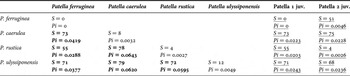
As a first result, COI is confirmed as a powerful DNA barcoding at least for the species belonging to the genus Patella studied here. Indeed, the sequences analysed of adult individuals of Patella spp. showed a very low rate of polymorphic sites and nucleotide diversity at intraspecific level, ranging from values of S = 0 and Pi = 0 in P. ferruginea to S = 12 and Pi = 0.0049 in P. ulyssiponensis, whereas the nucleotide diversity at interspecific level grew of an order of magnitude, ranging from values of Pi = 0.0288 between P. rustica and P. ferruginea to values of Pi = 0.0643 between P. rustica and P. caerulea (Table 2).
Number of polymorphic sites (S) and values of nucleotide diversity (Pi). Estimates obtained by pairwise comparisons of the species are in bold, whereas those obtained from comparisons between juveniles and species are underlined.

Secondly, it is important to underline the worrisome absence of genetic variability evidenced in P. ferruginea, whose individuals are genetically identical. Such data are consistent with those provided by Espinosa & Ozawa (Reference Espinosa and Ozawa2006), who found 44 out 49 individuals analysed from north African coasts and south Spain sharing a unique haplotype, and the rest differentiated by one position only. The occurrence in 32 Sardinian individuals of the same common haplotype further corroborates the hypothesis suggested by Espinosa & Ozawa (Reference Espinosa and Ozawa2006) of a strong genetic bottleneck which took place in the Pleistocene and drastically reduced the genetic variability of this species.
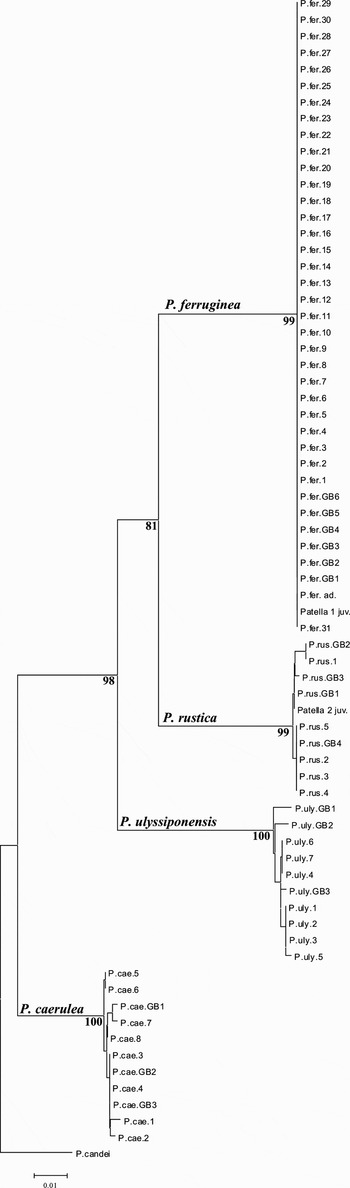
The evolutionary model that better fits the COI whole dataset was the TrN + I (Rodríguez et al., Reference Rodríguez, Oliver, Marín and Medina1990), with a proportion of invariable sites of 0.75, whereas the TVM + I model (Rodríguez et al., Reference Rodríguez, Oliver, Marín and Medina1990), with a proportion of invariable sites of 0.70, has been obtained when the outgroup P. candei was excluded. The ML analysis recovered a single tree, shown in Figure 1, which graphically evidenced the sharp separation among the four species, corroborated by the high bootstrap values (>80%) present at each corresponding node.
Maximum likelihood consensus dendrogram. Bootstrap values >80% are reported at each node.

Such results fit with the main constraints of a ‘well-suited’ DNA barcoding, i.e.: (i) a variability at the Folmer region among populations/individuals of different species exceeding the variability among populations/individuals of the same species; and (ii) a constant rate of variability of the Folmer region throughout the distribution range of a species (Moritz & Cicero, Reference Moritz and Cicero2004). These findings have great relevance within the growing debate on the presumptive usefulness of COI sequences as ‘universal’ DNA barcoding for the taxonomic identification of marine invertebrates (see, e.g. Dunn, Reference Dunn2003; Ebach & Holdrege, Reference Ebach and Holdrege2005). Indeed, it is worth noting that the Folmer region failed as a ‘barcoding molecule’ in numerous instances, e.g.: (i) in Cypraeidae (Mollusca), Meyer & Paulay (Reference Meyer and Paulay2005) were unable to detect cryptic speciation by means of COI sequencing; (ii) in two different genera (Lubomirskia and Baikalospongia) of freshwater sponges (Porifera) from Lake Baikal, COI bore identical sequences (Schröder et al., Reference Schröder, Efremova, Itskovich, Belikov, Masuda, Krasko, Müller and Müller2003); (iii) in Astrosclera willeriana (Cnidaria), COI analysis did not allow the resolution of a species complex (Erpenbeck et al., Reference Erpenbeck, Hooper and Worheide2006); and (iv) in Anthozoa (Cnidaria), Shearer et al. (Reference Shearer, van Oppen, Romano and Worheide2002) evidenced a very slow rate of mitochondrial DNA sequence evolution. An additional hindrance to the extensive employment of the Folmer region is that, in some cases, the high variability of the sequences adjacent to the priming region makes the ‘universal’ primers unusable (Vogler & Monaghan, Reference Vogler and Monaghan2007; Sanna et al., Reference Sanna, Lai, Francalacci, Curini-Galletti and Casu2009). Furthermore, it has been proven that, in some groups, other regions (e.g. cytochrome b, 18S-rDNA, 28S-rDNA and ITSs) may provide better results as DNA barcoding than COI (see, e.g. Tautz et al., Reference Tautz, Arctander, Minelli, Thomas and Vogler2003; Markmann & Tautz, Reference Markmann and Tautz2005; Monaghan et al., Reference Monaghan, Balke, Gregory and Vogler2005; Erpenbeck et al., Reference Erpenbeck, Hooper and Worheide2006; Casu et al., Reference Casu, Lai, Sanna, Cossu and Curini-Galletti2009).
In this context, it is important to underline that the resolution of the species boundaries can be completely resolved only by using an integrative taxonomic approach, which includes—together with the analysis of single sequences of DNA—complementary analyses on morphology, karyology and reproductive biology. This practice has been recently advocated as the best way to overcome potential caveats of species' delimitation methods (Padial et al., Reference Padial, Castroviejo-Fisher, Köhler, Vilà, Chaparro and De la Riva2009; Casu et al., 2009).
The validation of the appropriate use of the COI as DNA barcoding in species of Patella can offer some attractive applications. In particular, DNA barcoding should be performed as a regular procedure when the traditional approaches do not allow the discrimination among species. This is a not uncommon occurrence for P. caerulea and P. ulyssiponensis, whose morphological features partially overlap, leading ecologists to consider them as globally ‘Patella spp.’ (see, e.g. Maggi et al., Reference Maggi, Bertocci, Vaselli and Benedetti-Cecchi2009). In such a context, it is interesting to note that present study confirms the findings obtained by Mauro et al. (Reference Mauro, Arculeo and Parrinello2003) and Sá-Pinto et al. (Reference Sá-Pinto, Branco, Harris and Alexandrino2005), who characterized morphologically problematic individuals of P. caerulea and P. ulyssiponensis by means of COI sequences. However, Mauro et al. (Reference Mauro, Arculeo and Parrinello2003) used a short strand of COI (418 bp, about 65% of the Folmer region), and the sampling plan was done on a local geographical scale only.
The difficulty of a correct specific attribution of Patella individuals is further exacerbated when either young individuals, with a shell length smaller than 5 mm across, or larger individuals with the shell partially or totally hidden by epibionts are to be taken into account in ecological surveys, based on in situ appreciation of biodiversity. In this context, the comparison of COI sequences allowed us to unequivocally identify the two juveniles fixed on the shell of a P. ferruginea. In fact, the ML dendrogram (Figure 1) places one of them (‘Patella 1 juv.’) within the P. ferruginea cluster, whereas the second (‘Patella 2 juv.’) groups within the P. rustica cluster. According to the ML cluster analysis, the assignment test performed by a Bayesian approach (four groups in optimal partition, each grouping individuals of each species analysed, with a P = 100%) confirms that ‘Patella 1 juv.’ belong to the species P. ferruginea, and ‘Patella 2 juv.’ to P. rustica. In this framework, the fewest values of polymorphic sites and nucleotide diversity found between ‘Patella 1 juv.’ and P. ferruginea (S = 0; Pi = 0.000), and ‘Patella 2 juv.’ and P. rustica (S = 3; Pi = 0.002), are congruous with the results of the cluster analysis and the assignment test. However, it is not possible to attribute the P. ferruginea juvenile (‘Patella 1 juv.’) and the conspecific adult (‘P.fer. ad.’) to a single population, or at least to a specific gene pool, since the extremely reduced genetic variability of COI in the species (present study; Espinosa & Ozawa, Reference Espinosa and Ozawa2006) prevents us from obtaining insights on their phylogeographical relationships. In addition, these results shed a new light on the possible pattern of recruitment of P. ferruginea and make questionable the hypothesis of the existence of larval philopatry in the species.
In fact, the occurrence of a young individual of P. rustica on P. ferruginea suggests either that attraction of larvae to adult specimens of P. ferruginea is not species-specific, or that juveniles of Patella spp. may settle on adults just by chance. If validated by additional evidence, these findings would have great impacts on the conservation strategies for P. ferruginea, which presently consider the presence of adults as a prerequisite for the settlement of juveniles, thus prompting experiments of reintroduction of adults to areas no longer inhabited by the species (Laborel-Deguen & Laborel, Reference Laborel-Deguen, Laborel, Boudouresque, Avon and Gravez1991c; Espinosa et al., Reference Espinosa, González, Maestre, Fa, Guerra-García and García Gomez2008b).
ACKNOWLEDGEMENTS
We gratefully acknowledge Gina Rivera who kindly provided limpets from Ceuta and Cádiz, and the data on the sampling sites of Patella ferruginea from Ceuta, Melilla, Islas Chafarinas, Isla de Alborán and Cap Bon. We also acknowledge the three anonymous referees for their useful comments and suggestions, which greatly contributed to improving an early draft of the paper. This research was supported by the ‘Centro di eccellenza’ of the University of Sassari, Italy.