Introduction
Elevated rates of psychotic illness among ethnic minority populations have been consistently demonstrated but never fully explained (Cantor-Graae & Selten, Reference Cantor-Graae and Selten2005; Fearon et al. Reference Fearon, Kirkbride, Morgan, Dazzan, Morgan, Lloyd, Hutchinson, Tarrant, Lun, Fung, Holloway, Mallett, Harrison, Leff, Jones and Murray2006). In recent years a growing body of evidence suggests this cannot be dismissed as merely an artefact of misdiagnosis and a series of international comparison studies have ruled out simple genetic explanations (Fearon et al. Reference Fearon, Kirkbride, Morgan, Dazzan, Morgan, Lloyd, Hutchinson, Tarrant, Lun, Fung, Holloway, Mallett, Harrison, Leff, Jones and Murray2006; Morgan & Hutchinson, Reference Morgan and Hutchinson2010; Selten & Cantor-Graae, Reference Selten and Cantor-Graae2010). Attention has therefore focused on environmental factors, such as the social stress and social isolation associated with an ethnic minority status (March et al. Reference March, Hatch, Morgan, Kirkbride, Bresnahan, Fearon and Susser2008). An ethnic density effect has been proposed whereby the proportion of an ethnic group living in an area is inversely related to the risk of psychosis for members of that group.
This relationship between ethnic density and psychosis was first identified over 70 years ago (Faris & Dunham, Reference Faris and Dunham1939) and has since been replicated in other settings for a range of migrant groups (Pickett & Wilkinson, Reference Pickett and Wilkinson2008). However, as a recent review concludes, UK studies present a more mixed picture (Fung et al. Reference Fung, Bhugra and Jones2009). The first to address this question looked at the association between hospital admission rates, for schizophrenia, and ethnic density, for a number of migrant groups, at a national and regional health authority level and found no evidence for an effect (Cochrane & Bal, Reference Cochrane and Bal1988). Boydell and colleagues then looked at ethnic density at ward level using a simple binary definition of ethnicity and found incidence rates for non-whites were significantly higher in areas with a lower non-white population (Boydell et al. Reference Boydell, van Os, McKenzie, Allardyce, Goel, McCreadie and Murray2001). The Aetiology and Ethnicity of Schizophrenia and Other Psychoses study also addressed the question of ethnic density and found some effect using a similar definition of ethnicity to Boydell et al. (Kirkbride et al. Reference Kirkbride, Morgan, Fearon, Dazzan, Murray and Jones2007b). This study had a larger sample, including 163 black and minority ethnic (BME) participants newly diagnosed with non-affective psychoses, compared with 126 non-white incident cases of schizophrenia in Boydell's study. However, the ethnic density effect failed to reach statistical significance and disappeared completely when a more detailed ethnicity definition was used. A recent study using national survey data also looked at the effect of ethnic density on psychotic symptomatology and found a negative association with overall ethnic density; although, again, this failed to reach statistical significance (Becares et al. Reference Becares, Nazroo and Stafford2009).
These studies examined area effects at census area statistics (CAS) ward level or higher. With a mean population of just under 6000 per CAS ward (Groenewegen et al. Reference Groenewegen, van den Berg, de Vries and Verheij2006) these can provide only a relatively broad definition of neighbourhood. Furthermore, they ultimately derive from electoral wards, which are largely based on political convenience. In recent years a number of accounts have therefore called for further research on ethnic density to be conducted using more theoretically justified area definitions (Kirkbride et al. Reference Kirkbride, Morgan, Fearon, Dazzan, Murray and Jones2007b; March et al. Reference March, Hatch, Morgan, Kirkbride, Bresnahan, Fearon and Susser2008; Stafford et al. Reference Stafford, Becares and Nazroo2009). Using a large primary care database we were able to examine neighbourhood effects at the more detailed lower super output area (LSOA) level, comprising a mean of around 1500 people. As well as providing greater detail, it is argued, LSOAs are theoretically more justified with a greater historical continuity in the face of changing administrative boundaries and a more socio-economically homogenous population within each unit (Thunhurst, Reference Thunhurst2009). We set out to test the ethnic density effect on psychosis at this area level in an area with a large ethnic minority population.
Method
Study design
We analysed general practitioner (GP) records, over a 10-year period, from a large sample of practices in Lambeth, South East London.
Setting
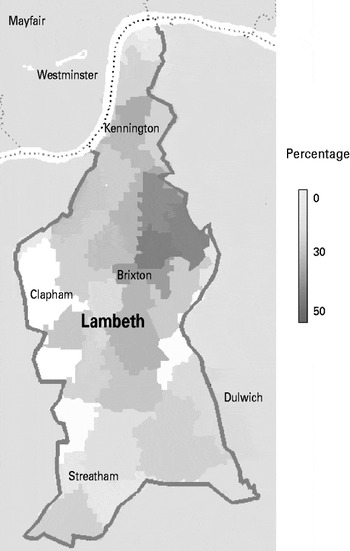
Lambeth has the second highest proportion of black residents in the UK and there is wide variation in ethnic density across the borough (see Fig. 1). For example, census estimates (Office for National Statistics, 2002) show approximately 60% black residents in some Brixton wards compared with around 7% in Dulwich.
Distribution of black population in Lambeth.

Data source
The data comprised a large sample of electronic GP patient records (the Lambeth DataNet). To facilitate data extraction, this was restricted to only those practices using the EMIS-LV computer system, comprising just over half (29/54) the GP practices in Lambeth. The database was originally set up to facilitate ethnic monitoring of health inequalities (Kumarapeli et al. Reference Kumarapeli, Stepaniuk, de Lusignan, Williams and Rowlands2006). Several strategies were used to improve both the level and quality of self-ascribed ethnicity coding (Pinto et al. Reference Pinto, Ashworth, Seed, Rowlands, Schofield and Jones2010).
The Lambeth DataNet comprises records for a total of 206 000 patients. We looked at records covering a 10-year period from January 1996 to November 2006, extracted at the end of 2006 using miquest software. The dataset was validated by manually checking a sample of 6% of dataset records against the original patient records (Kumarapeli et al. Reference Kumarapeli, Stepaniuk, de Lusignan, Williams and Rowlands2006).
We obtained ethical approval for the study from the Bexley and Greenwich Local Research Ethics Committee (reference: 05/Q0707/41).
Case ascertainment
We looked at patients with a first diagnosis of a psychotic illness, defined as any non-organic psychosis and excluding drug-induced disorders. Diagnosis was determined from Read codes entered in the GP records together with the earliest date of diagnosis [see Supplementary Appendix (available online), for a list of Read codes used for case ascertainment]. Cases were restricted to those registered with the practice for at least 6 months in order to discount the possibility that they had recently moved into the practice area. We included patients if they were aged ⩾16 and ⩽74 years at the time of first diagnosis, this being the age range of patients referred to local adult psychiatric services.
Predictors
Patient ethnicity codes were mapped on to UK census ethnic categories (Office for National Statistics, 2002). Our analysis concentrated on those coded under the ‘black or black British’ 2001 census category as this is the largest ethnic minority group in Lambeth. This group were compared with the white population, defined as all those coded under the ‘white’ 2001 census category.
Ethnic density, defined as the proportion of black people in a given neighbourhood, was determined by matching patient postcodes to LSOA and the ethnic profile of each LSOA was determined using 2001 census data. We were interested in how our results might change at different geographic levels of analysis; therefore, we also modelled area effects at the CAS ward level. We categorized neighbourhoods according to their ethnic density in two ways. First, neighbourhoods were categorized as high or low ethnic density areas according to whether they had a higher or lower than average proportion of black residents compared with the sample as a whole. Second, we divided up areas into equal-sized quintiles based on their relative ethnic density.
Neighbourhood social deprivation, as well as being associated with ethnic density, may add to the risk of psychosis among black and ethnic minority groups (Harrison et al. Reference Harrison, Gunnell, Glazebrook, Page and Kwiecinski2001). We therefore adjusted for neighbourhood social deprivation, using the Index of Multiple Deprivation (IMD 2007) score at the LSOA level (Department for Communities and Local Government, 2008). We also adjusted for patients' age and gender.
Statistical analysis
Psychosis rates over the 10-year period were analysed using multi-level Poisson regression with the xt-poisson function in Stata version 10 for Windows (Stata Corporation, USA). Using a multi-level model we were able to simultaneously model neighbourhood effects and patient level effects together with cross level interactions. We began by modelling psychosis rates in terms of the interaction between individual ethnicity and area ethnic density and then looked in more detail at the effect of ethnic density for the black ethnic group alone. In each model, the effect of the predictor variables on psychosis rates was assessed using the Wald statistic to determine statistical significance.
Results
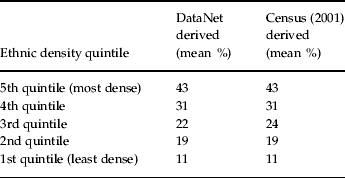
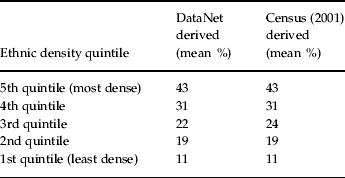
Prior to the main analysis, we compared sample practice characteristics with practices in the borough that were not included in our sample. Using publicly available census data and data collected from the Health and Social Care Information Centre, we found no statistically significant differences in the proportion of black residents, mean deprivation (IMD 07) scores and prevalence of severe mental illness, when measured at a practice level. We also looked at the within neighbourhood percentage of black patients in our sample, comparing these with census estimates for the same areas (Table 1), and found very little difference. Our practice sample therefore appeared broadly representative of the borough as a whole for our study purposes.
Neighbourhood ethnic density estimates (percentage of black people in each local super output area)
The eligible study sample covered records for a total of 185 827 patients. Ethnicity was coded for 51% of the sample with 37 278 (61%) coded white and 23 693 (25%) coded black. Restricting our sample to those coded black or white left a total of 60 971 patients. This comprised 46% males and the overall median age was 35 years.
In total, we identified 508 first onset cases of psychosis meeting our study criteria, during 1 039 253 person-years of follow-up. Of these, 277 (55%) had their ethnicity coded including 109 black patients and 87 white British patients with a psychotic illness. Of these 196 cases, 56% were male and the median age of onset was 42 years for women and 37 years for men.
We found an unadjusted incidence rate of 47 per 100 000 for those in the white category and 88 per 100 000 for those in the black category. Adjusting for age and gender gave an overall psychosis incidence rate ratio (IRR) of 2.14 [95% confidence interval (CI) 1.61–2.85) when comparing black and white participants.
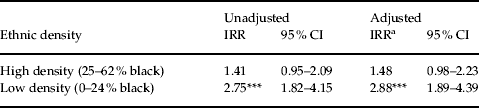
Adding neighbourhood effects to our model, we found a significant interaction between neighbourhood ethnic density and individual ethnicity (see Table 2). The average neighbourhood composition for our study sample was 25% black. We found that black people in areas with this or a higher ethnic density showed no significant difference in psychosis rates compared with the white population. Conversely, black people in lower than average ethnic density areas were nearly three times more likely [odds ratio (OR) 2.88, 95% CI 1.89–4.39] to develop a psychotic illness compared with their white counterparts in the same area.
Psychosis incidence for black versus white in high and low ethnic density neighbourhoods
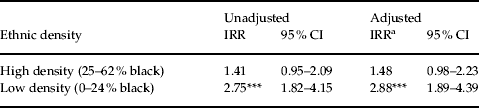
IRR, Incidence rate ratio; CI, confidence interval.
a Analysis adjusted for age, gender and area deprivation score.
*** p<0.001.
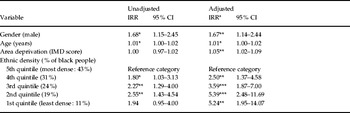
Looking at the model for black patients only (Table 3), psychosis rates can be seen to progressively increase as neighbourhood ethnic density decreases, with rates in the least dense quintile over five times greater than in the most dense quintile (OR 5.24, 95% CI 1.95–14.07). The corresponding model for white patients showed no significant difference in psychosis rates between these same ethnic density areas. It is important to note that when we re-analysed the data at the less detailed ward level, much of this ethnic density effect disappeared and what remained was no longer statistically significant. For example, there was relatively little difference in rates when comparing the least dense and most dense quintiles at ward level (OR 1.47, 95% CI 0.35–6.18) and this was no longer statistically significant (p=0.6).
Factors associated with psychosis incidence – black population only
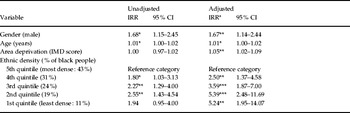
IRR, incidence rate ratio; CI, confidence interval; IMD, Index of Multiple Deprivation.
a Analysis adjusted for age, gender and area deprivation (IMD 2007) score.
* p<0.05, ** p<0.01, *** p<0.001.
While the effect of area deprivation is not significant in the unadjusted model, it is revealed as a contributory factor after adjusting for the effect of neighbourhood ethnic density. This suggests that the negative effects of social deprivation are therefore smaller than, and work in the opposite direction to, the ethnic density effect and are therefore cancelled out in the unadjusted model.
Discussion
Main findings
Our study has shown that neighbourhood ethnic density is inversely related to the risk of psychosis for black people in the urban area that we examined. For white people, the risk of psychosis was the same across areas of differing ethnic density. In areas with a greater than average black population, their risk of psychosis was no greater than the majority white population. However, as the concentration of black people decreased, their risk of psychosis steadily increased. An equally clear dose–response effect was also observed in Boydell and colleagues' study based on secondary care data collected over 10 years earlier (Boydell et al. Reference Boydell, van Os, McKenzie, Allardyce, Goel, McCreadie and Murray2001). That our study shows the same effect suggests that this is a consistent pattern. Our finding that the increased risk disappears for black people in high density areas also mirrors the results of Veling and colleagues' study in The Hague, where living in a high ethnic density area appeared to cancel out the otherwise increased risk of psychosis for migrants from Turkey and North Africa (Veling et al. Reference Veling, Susser, van Os, Mackenbach, Selten and Hoek2008). Our results also confirm that the ethnic density effect works in the opposite direction to the deleterious effects of neighbourhood social deprivation on the mental health of BME populations (Kirkbride et al. Reference Kirkbride, Barker, Cowden, Stamps, Yang, Jones and Coid2008; Veling et al. Reference Veling, Susser, van Os, Mackenbach, Selten and Hoek2008).
What our study adds is an understanding that the effect of ethnic density occurs at a detailed local neighbourhood level and that much of this effect may disappear when analysed at the broader ward level. A particular strength of the dataset used was that it included a large number of patient records, together with their postcodes, which meant that we could examine area effects at a fine level of detail. A further consideration is that LSOAs, the unit of analysis that we used, are more justified theoretically and therefore allow us to better tap into area effects. LSOAs were established after the 2001 census to improve the reporting of small area statistics (Office for National Statistics, 2007). They are designed to be comparable, with each unit more similar in size than electoral wards and are intended to be stable over time, whereas electoral wards are subject to, often frequent, boundary changes. Furthermore, they are ultimately derived from output area units, which, in turn, are derived from collections of postcodes that are intended to be as socially homogeneous as possible (Martin, Reference Martin2002). Therefore, it is likely that our analysis benefited from both a greater level of detail as well as a more theoretically defined unit of analysis. This suggests, further, that the lived experience of a local community is more likely to be tied to the smaller and more homogeneous LSOAs rather than larger and more politically defined ward levels. The study was based on GP records, which are a largely under-used resource in mental health research despite evidence for a high level of accuracy in recorded diagnosis of severe mental illness (Jick et al. Reference Jick, Jick and Derby1991; Nazareth et al. Reference Nazareth, King, Haines, Rangel and Myers1993).
Study limitations
However, using primary care data in this way entails some study limitations. While care was taken to ensure comprehensive ethnicity coding, there was still a large number of participants with ethnicity unassigned. To account for any bias resulting from this, we compared the proportion of patients with missing data by ethnic density quintile and found significantly more missing data in the higher density areas. However, when we confined our missing data analysis to the psychosis group alone, we found that ethnicity data was more likely to be included and there was minimal variation across different ethnic density areas. As a result of this difference, when calculating psychosis rates for black people, the numerator, people with psychosis, is less likely to be affected by missing data while the denominator, the overall black population, is likely to be underestimated. Therefore, our results may have underestimated the overall proportion of black people with psychosis in higher density areas, leading to an underestimate of the ethnic density effect.
A further limitation of our study was that we relied on subjects being already registered with a GP practice and, in the analysis, our sample was restricted to only those patients registered for at least 6 months. This meant excluding a large proportion (63%) of cases occurring before or soon after registration. As a result, our sample has an older age at onset than is usual, which may be because older patients are more likely to have already been registered prior to being diagnosed. We explored how this might have influenced our results in two ways. First, we looked at the number excluded by ethnic density quintile and found no significant difference. Second, we re-ran the analysis, removing the above exclusion criteria and retaining all new onset cases that were diagnosed during the study period, whether already registered or not. When we did this, we found no major differences in the overall results although there was some reduction in the strength of the ethnic density effect. This may be due to ‘social drift’ working in the opposite direction, where people with a psychotic illness may have recently moved into a socio-economically deprived, and more ethnically dense, area just prior to diagnosis. That psychosis rates for the black population are still relatively low in these areas serves to demonstrate the strength of the ethnic density effect, as previous studies addressing the same methodological problem have also argued (Halpern & Nazroo, Reference Halpern and Nazroo2000; Veling et al. Reference Veling, Susser, van Os, Mackenbach, Selten and Hoek2008).
Another limitation of the data was that we were unable to account for patients moving out of the practice area during the study period. It is difficult to say in which direction this may have influenced our results but it could be argued that mobility would be higher in more deprived, and therefore more ethnically dense, areas. Again, mobility for those with a psychotic illness is likely to be downward, with ‘social drift’ resulting in an underestimate of the ethnic density effect. However, this is still speculative and the effect of attrition cannot be completely discounted.
A further consideration is that black people may be less likely to have registered with a GP practice, as past studies have shown (Koffman et al. Reference Koffman, Fulop, Pashley and Coleman1997; McCracken et al. Reference McCracken, Boneham, Copeland, Williams, Wilson, Scott, McKibbin and Cleave1997). To examine the representativeness of our primary care sample, we compared the percentage coded as black, within each sample ethnic density quintile, with the census-defined proportion of black people in each area. We found very little difference, which suggests that, in our sample, black people were no more or less likely to register with a GP practice than other ethnic groups.
Given that the study was based on electronic health records only, we had to rely on recorded diagnoses, which are potentially less accurate than those arrived at using standardized diagnostic tools. For this reason, we did not attempt to differentiate between those with a diagnosis of schizophrenia and other psychotic disorders. A recent study failed to find any neighbourhood variation in rates of affective psychosis (Kirkbride et al. Reference Kirkbride, Fearon, Morgan, Dazzan, Morgan, Murray and Jones2007a); therefore, it could be argued that merging all psychoses, as we did, may have, at worst, led to ethnic density being underestimated.
Arguments against the ethnic density effect have in the past centred around the question of diagnosis; that black people, it is argued, are more likely to be diagnosed with psychosis in areas where they are less well represented because they are more likely to stand out, known as the ‘fit’ hypothesis (Wechsler & Pugh, Reference Wechsler and Pugh1967). One way to address this is to look for evidence of case ascertainment bias, i.e. whether black people are being diagnosed earlier, and therefore more readily, in some areas more than others. To do this, we compared mean age at diagnosis for black people in each ethnic density quintile and found no significant difference, which suggests that neighbourhood ethnic density is not a major determinant of early diagnosis.
As discussed earlier, we went to some trouble to account for the effect of social drift in our analysis; however, it is also possible that the location of institutional and semi-institutional settings in the area may have influenced our results. We therefore re-conducted the analysis excluding anyone with a psychotic illness sharing the same postcode and found this did not make a significant difference to our overall findings.
Study implications and summary
The aetiological implications of the ethnic density effect have been discussed comprehensively and at length in recent years (Kirkbride et al. Reference Kirkbride, Morgan, Fearon, Dazzan, Murray and Jones2007b; March et al. Reference March, Hatch, Morgan, Kirkbride, Bresnahan, Fearon and Susser2008; Pickett & Wilkinson, Reference Pickett and Wilkinson2008; Becares et al. Reference Becares, Nazroo and Stafford2009). One wide-ranging review argues that determining the size of the community within which the ethnic density effect is most salient is one of the major methodological questions to be addressed in order for research in this field to advance (Pickett & Wilkinson, Reference Pickett and Wilkinson2008). Our findings go some way to achieving this, having demonstrated that the ethnic density effect operates more powerfully at the LSOA neighbourhood level. We postulate that this protective effect is likely to be dependent on the social milieu within just a handful of streets and that a sense of shared ethnicity is therefore felt more in social interactions with, for example, immediate neighbours and who one meets on the way to the corner shop rather than with the broad ethnic composition of larger urban areas. However, further work is now needed to look in more detail at the mechanism behind this and also to examine the ethnic density effect at this neighbourhood level for different populations and different outcomes.
To summarize, using primary care data we found a clear association between neighbourhood ethnic density and risk of psychosis for a BME population and we were able to demonstrate how this applies at a detailed neighbourhood level.
Note
Supplementary material accompanies this paper on the Journal's website (http://journals.cambridge.org/psm).
Acknowledgements
The study was supported by a grant from the Guy's and St Thomas' Charity. We would also like to acknowledge the contribution of the Lambeth patients and practices who allowed us access to their data.
Declaration of Interest
None.