In the present study, we examined how Korean mothers mediate children's writing of words in terms of literate aspects and socioemotional aspects and how maternal mediation relates to children's Hangul reading acquisition. The process of Korean Hangul acquisition in young children is particularly intriguing because of the unique features of Hangul. Korean Hangul is first taught as an alphasyllabary to the youngest Korean learners. That is, children first learn “blocks” of syllables of Korean and then gradually learn to decompose these into letters with development and formal teaching in school. This approach appears to minimize the importance of individual letter name knowledge for earliest literacy acquisition in Korean but also makes initial learning of consonant–vowel (CV) syllable patterns of Korean essential for reading development (e.g., Cho, Reference Cho2009). Korean is a particularly interesting orthography to examine because of the unique focus of its learners on the word's CV (consonant + vowel) body and coda (the final consonant of a syllable) rather than on onset-rime phonological units (Kim, Reference Kim2007; Yi, Reference Yi1998; Yoon, Bolger, Kwon, & Perfetti, Reference Yoon, Bolger, Kwan, Perfetti, Verhoeven, Elbro and Reitsma2002). Coda phoneme awareness is developed as early as syllable awareness and strongly contributes to both regular and irregular word recognition among Korean kindergartners (Cho, McBride-Chang, & Park, Reference Cho, McBride-Chang and Park2008). Coda sensitivity may, thus, be a critical element of early reading acquisition in Korean (e.g., Cho & McBride-Chang, Reference Cho and McBride-Chang2005; Cho et al., Reference Cho, McBride-Chang and Park2008).
Korean students tend to rank among the top achievers in reading comprehension in cross-country comparisons, an accomplishment that might be related to parents’ high expectations for their children's educational attainment from a young age (e.g., Chiu & McBride-Chang, Reference Chiu and McBride-Chang2006; Lee, Park, & Kim, Reference Lee, Park and Kim2000). Much of Korean children's early literacy learning initially takes place at home with parents, especially mothers. For example, about 80% of parents teach Korean reading and writing to their 4-year-old children (Korean Association of Child Studies & Hansol Education Research Center, 2002). In addition, parents’ reports of reading and teaching to their young children were positively associated with these children's literacy skills (Cho, Bae, Park, & Park, Reference Cho, Bae, Park and Park2012; Kim, Reference Kim2009). Despite the reported strong parental support for early Hangul acquisition, to our knowledge, this study is one of the first to focus on Korean mothers’ specific literate mediation instructions to facilitate Hangul acquisition, which might be different from either those of alphabetic or abjad (e.g., English, Hebrew, Arabic, and Urdu) languages or logographic Chinese due to the characteristics of Korean language and culture (e.g., Aram, Korat, & Hassunah-Arafat, Reference Aram, Korat and Hassunah-Arafat2013; Aram & Levin, Reference Aram and Levin2001, Reference Aram and Levin2004; Lin et al., Reference Lin, McBride-Chang, Aram, Levin, Cheung and Chow2009; Newmann & Newmann, Reference Newmann and Newmann2010; Skibbe, Bindman, Hindman, Aram, & Morrison, Reference Skibbe, Bindman, Hindman, Aram and Morrison2013).
KOREAN HANGUL AND LITERACY DEVELOPMENT
Hangul is an alphabetic script consisting of 21 vowel and 19 consonant letters (e.g., Taylor & Taylor, Reference Taylor and Taylor2014). Each letter makes a sound, representing transparent letter–sound correspondences, with the exception of sound changes that are often predictable from sound context. Hangul letters are written in a square block or Gulja to depict each Korean syllable, which includes letters systematically from top to bottom and from left to right. The Korean Gulja structure is simple, having mostly CV (e.g., 나 /na/ “I,” 코 /ko/ “nose”) and consonant–vowel–consonant (CVC; e.g., 낮 /nat / “day,” 콩 /koŋ/ “bean”) structures. Examples of words are 땅콩 /t'aŋ.koŋ/ “peanut” or, literally, “soil bean” and 낮잠 /nat.ʤam/ “nap” meaning literally “day sleep.” Gulja is considered as a basic unit of Korean written word recognition (Simpson & Kang, Reference Simpson and Kang2004).
It is interesting that Korean people tend to divide syllables into CV body and coda rather than onset-rime phonological units (Yi, Reference Yi1998; Yoon et al., Reference Yoon, Bolger, Kwan, Perfetti, Verhoeven, Elbro and Reitsma2002). The salience of the CV and coda subsyllabic units is partly related to CV syllables being relatively prominent phonotactically in oral Korean (Kim, Reference Kim2007). Korean children develop coda awareness earlier than rime and onset awareness (Cho et al., Reference Cho, McBride-Chang and Park2008; Kim, Reference Kim2007). Coda sensitivity might be related to the fact that coda variation affects meaning. For example, in the words 남 /nam/ “other person,” 낙 /nak/ “joy,” 날 /nal/ “day,” and 난 /nan/ “orchid,” only the end of the coda differs across the four, but such differences strongly affect meaning. Furthermore, different coda consonant letters make the same sound such that the syllable of /nat/ can be written in different Gulja such as 낫 “sickle,” 낮 “day,” 낯 “face,” or 낱 “piece.” In addition, this may be related to the phonological irregularity in the coda position caused by resyllabification and sound assimilation phenomena of the Korean language. For these reasons, Korean children have to be sensitive to the final, as compared to the initial, position in a syllable in order to understand Korean language and to learn to read (e.g., Cho et al., Reference Cho, McBride-Chang and Park2008) and spell (e.g, Kim, Reference Kim2010) Hangul correctly.
Most Korean children learn to read and write Hangul at home at the age of 4 or earlier. Korean children typically learn to read beginning with the CV Gulja in their names and high-frequency words. Only later do children learn to divide these Gulja into component letters (Cho, Reference Cho2009). Although most parents actively give extra literacy training at home by themselves (Cho et al., Reference Cho, Bae, Park and Park2012; Kim, Reference Kim2009), there has, nevertheless, been little research on which are the most efficient maternal teaching instructions for children's Hangul acquisition. Our main focus in the present study was to capture and test the associations of different naturally occurring strategies among mothers to children's early literacy achievement. In particular, finding efficient instructions for Hangul acquisition can help teach Hangul to those young Korean children in underprivileged environments that do not adequately provide extra literacy training via parents or adequate formal literacy education from school.
THEORETICAL FRAMEWORK FOR CHARACTERIZING MATERNAL MEDIATION OF WORD WRITING
We are conceptualizing maternal mediation in two ways: via literacy and via socioemotional paradigms. Maternal literate mediation refers to mothers’ instructions about specific encoding and decoding strategies for assisting children's word writing. Maternal literate mediation is the general term we have for any teaching tips or structuring that mothers use to help their children in the process of learning to write. Socioemotional mediation refers to positive and negative feedback as well as general and specific comments used by mothers to facilitate children's writing (e.g., Kamins & Dweck, Reference Kamins and Dweck1999; Lin et al., Reference Lin, McBride-Chang, Aram, Shu, Levin and Cho2012). The maternal mediation task in mother–child joint writing we used from Lin et al. (Reference Lin, McBride-Chang, Aram, Levin, Cheung and Chow2009, Reference Lin, McBride-Chang, Aram, Shu, Levin and Cho2012) and from structured mother–child joint writing of words by Aram and Levin (Reference Aram and Levin2001) is perhaps relatively ecologically valid because it allows mothers to structure their children's learning in the way that is most comfortable for them.
Assisted or mediated learning by mothers in mother–child joint writing should enhance children's literacy acquisition as suggested by Vygotsky's (Reference Vygotsky1978) notion of the zone of proximal development. According to Vygotsky (Reference Vygotsky1978), parents support their child in difficult tasks and problems until the child acquires the skills to manage the task independently (e.g., Neitzel & Stright, Reference Neitzel and Stright2003). In the process of scaffolding, parents adjust their level of support to fit the child's zone of proximal development. Parental mediation, complete with parent–child interactions, ultimately extends the child's knowledge, reduces task complexity, and enhances cognitive and academic skills (Bruner, Reference Bruner1986; Neitzel & Stright, Reference Neitzel and Stright2003). An understanding of maternal mediation in Korean mother–child joint writing might theoretically and practically complement earlier work on both parental involvement (e.g., Kim, Reference Kim2009) and individual children's cognitive skills in relation to Hangul acquisition (e.g., Cho & McBride-Chang, Reference Cho and McBride-Chang2005; Cho et al., Reference Cho, McBride-Chang and Park2008; Kim, Reference Kim2007) to demonstrate how parent–child interactions might approach the literacy acquisition process.
MATERNAL LITERATE MEDIATION IN MOTHER–CHILD JOINT WRITING
In a study of Hebrew to examine parent–child interactions during shared writing of words and names, Aram and Levin (Reference Aram and Levin2001) analyzed the quality of mother–child joint writing among kindergartners living in a household with a low socioeconomic status (SES) in terms of maternal literate mediation along with other dimensions. Maternal literate mediation was measured based on how mothers talked about alphabetic and orthographic rules of Hebrew when mediating writing. Higher levels of maternal mediation were linked to phonological units such as the syllable, subsyllable, or phoneme with letter names; these contributed to children's phonological awareness, word writing, and reading concurrently (Aram & Levin, Reference Aram and Levin2001), and writing and reading comprehension longitudinally (Aram & Levin, Reference Aram and Levin2004), suggesting that optimal maternal mediation for Hebrew implies a grapheme–phoneme encoding process in letter-by-letter fashion. Similarly, American and Chinese maternal instructions have focused on sounds of letters in an alphabetic-like system such as English and even the phonetic symbol system of Pinyin, respectively, as most strongly associated with children's independent literacy skills, including word reading and word writing (McBride-Chang et al., Reference McBride-Chang, Lin, Liu, Aram, Levin and Cho2012; Skibbe et al., Reference Skibbe, Bindman, Hindman, Aram and Morrison2013).
However, effective maternal strategies in Chinese mother–child joint writing of Chinese characters have differed dramatically from a strong letter–sound focus of alphabetic writing systems by focusing on visual patterns of strokes, characters, character structures, and phonetic and semantic radicals and morphology of a character (e.g., Lin et al., Reference Lin, McBride-Chang, Aram, Levin, Cheung and Chow2009, Reference Lin, McBride-Chang, Aram, Shu, Levin and Cho2012). Chinese mothers show developmental differences in their use of instructions such that mothers of younger children make use of strategies of copying strokes and visual similarity whereas mothers of older children tend to use more analytic strategies focused on semantic radicals of a character (Lin et al., Reference Lin, McBride-Chang, Aram, Levin, Cheung and Chow2009). In particular, maternal strategies focusing on morphology of characters was strongly associated with children's Chinese word reading (Lin et al., Reference Lin, McBride-Chang, Aram, Levin, Cheung and Chow2009, Reference Lin, McBride-Chang, Aram, Shu, Levin and Cho2012) in those studies, suggesting that maternal mediation involving connecting of symbols, syllables, and morphological information at a character level is key for Chinese word reading.
The main focus of the present study was on identifying prominent literate strategies for literacy acquisition used by Korean mothers. We initially hypothesized that these strategies might be different from those of other orthographies such as Chinese (Lin et al., Reference Lin, McBride-Chang, Aram, Levin, Cheung and Chow2009, Reference Lin, McBride-Chang, Aram, Shu, Levin and Cho2012), English (Skibbe et al., Reference Skibbe, Bindman, Hindman, Aram and Morrison2013), and Hebrew (Aram & Levin, Reference Aram and Levin2001, Reference Aram and Levin2004) due to the characteristics of the alphasyllabary Hangul script and the salience of the CV body and coda subsyllabic division in the Korean language and script (Kim, Reference Kim2007; Yi, Reference Yi1998; Yoon et al., Reference Yoon, Bolger, Kwan, Perfetti, Verhoeven, Elbro and Reitsma2002). They might include recognition of letters of the alphabet, whole Gulja analysis, CV, and coda subsyllabic unit identification. We sought to document these strategies and also to examine their independent associations with Hangul reading of CV Gulja and words in 4- and 5-year-old children.
SALIENT GRAIN SIZES IN DIFFERENT ORTHOGRAPHIES
According to the psycholinguistic grain size theory, salient phonological units differ depending on different orthographies (Ziegler & Goswami, Reference Ziegler and Goswami2005). Salient grain sizes in a language are related to major reading instruction in early literacy by teachers as well as parents. In alphabetic orthographies, children are often taught letter–phoneme correspondences mostly by a phoneme-based strategy, whereas in some nonalphabetic orthographies, Chinese in particular, children are often taught syllables and corresponding characters mostly by rote memory (e.g., McBride-Chang, Reference McBride-Chang2004). Given these major approaches, we then wondered what phonological grain size is most important for teaching Hangul, an orthography that is called an alphasyllabary and is transparent. Relatively little focus has been given to subsyllabic units such as body (onset-vowel) and coda as major grain sizes related to reading instruction in previous research, although the rhyme analogy strategy has been recognized to be efficient for teaching irregular English words with certain rime spellings (e.g., light, tight; Ziegler & Goswami, Reference Ziegler and Goswami2005). The present study examined salient grain sizes that are made use of most often in mother–child joint writing; this has important implications for reading instruction in Hangul.
MATERNAL SOCIOEMOTIONAL MEDIATION IN MOTHER–CHILD JOINT WRITING
Previous research on maternal mediation via socioemotional paradigms has tested one aspect perhaps best conceptualized as a positive/negative dimension (e.g., Aram, Reference Aram2007; Lin et al., Reference Lin, McBride-Chang, Aram, Shu, Levin and Cho2012; Ng, Pomerantz, & Lam, Reference Ng, Pomerantz and Lam2007). Parenting style questionnaire research has consistently demonstrated that perceived parental warmth is typically associated with better achievement in children across cultures (e.g., Chao, Reference Chao1994). However, parent–child interaction types were adjusted as a function of children's age and communicative status. That is, American parents tended to be less demanding and give more verbal and nonverbal emotional support to younger, communicatively less-competent children during parent–child joint book reading (Pellegrim, Brody, & Sigel, Reference Pellegrini, Brody and Sigel1985). Asian parenting has often been described as “controlling” or “restrictive” (Chao, Reference Chao1994). In Asian studies, for example, the authoritarian parenting style, which tends to be described as relatively directing and demanding in nature, was positively related to adolescents’ school performance (Ang & Goh, Reference Ang and Goh2006; Chao, Reference Chao1994), suggesting that certain aspects of parental control may actually facilitate cognitive learning in Asian children. In this regard, in an approach directly and naturally recording mothers’ behavior, we examined whether critical comments, including the tendency to call attention to errors and flaws and to demand a correction of mistakes, in addition to comments related to warmth and positivity (e.g., Aram, Reference Aram2007), might be associated with age and literacy acquisition among Korean kindergartners.
A second dimension related to parental style, which was included in the present study, was the extent to which mothers’ feedback was oriented toward the process, outcome, or person during the cooperative writing process between children and their mothers (Lin et al., Reference Lin, McBride-Chang, Aram, Shu, Levin and Cho2012). In earlier work using role-play tasks, Kamins and Dweck (Reference Kamins and Dweck1999) manipulated teachers’ feedback to kindergarteners to be one of three types, namely, process-, outcome-, and person-related criticism in Experiment 1. They further examined the same three types, but of praise, in Experiment 2. They found that person-related criticism or praise produced more helpless responses (e.g., self-blame or no persistence) of children compared with process-related feedback. Process-related comments are those adults’ responses that are directed to children's strategies and effort. Outcome-related comments focus on broad overall performance, whereas person-related comments are responses that focus directly on personal traits, abilities, or intelligence of the child. Lin et al. (Reference Lin, McBride-Chang, Aram, Shu, Levin and Cho2012) examined the two separate dimensions of positive–negative and process–outcome–person feedback. They found that in both Hong Kong and Beijing mothers, the process feedback was uniquely associated with children's independent reading skill, even with children's other cognitive skills statistically controlled. In the present study, capturing socioemotional comments directly from mother–child interactions, we tested whether the association of socioemotional comments, particularly this process variable, would be associated with children's independent literacy achievement, in a Korean culture highly valuing academic performance. This association was examined in a stringent paradigm by additionally controlling for SES (i.e., mother's education) and children's general vocabulary skill. Note that few previous studies have controlled for SES to examine maternal socioemotional support.
RESEARCH QUESTIONS OF THIS STUDY
To summarize, we explored four research questions. First, what are Korean mothers’ literate instructions and socioemotional supports, as they help their kindergartners to write words that are not familiar to them in print? We expected that literate instructions might be related to the recognition of alphabet letters and whole Gulja, and CV and coda subsyllabic unit identification. Socioemotional supports could be coded into positive/negative and process/output/person feedback. Second, through an exploration of the various literate mediation strategies and socioemotional comments, are there developmental differences across every strategy and comment across the 2 years of kindergarten typical in South Korea? We expected that Korean mothers of older children would use more analytic strategies characterizing Korean language and Hangul script such as focusing on the alphabet or division of CV and coda. Mothers of younger children were expected to use more positive comments. Third, how are these maternal literate mediation strategies associated with independent Hangul word recognition and CV Gulja recognition in children? After controlling for the possibility that mothers’ instructions might vary as a function of children's cognitive skill of writing, we expected that more analytic levels of maternal instructions focusing on the CV and coda would be related to children's reading of Hangul CV Gulja and words. Fourth, how are mothers’ socioemotional comments associated with independent Hangul word recognition and CV Gulja recognition in children? In particular, we expected that process-related comments focusing on specific writing processes and critical comments, including the tendency to call attention to errors and their corrections, might be associated with literacy acquisition among Korean kindergartners.
METHOD
Participants
The participants in this study were 48 4-year-old children in first-year kindergarten (29 girls, 19 boys; mean age = 4.94 years, SD = 0.30), who were from four separate schools, and 36 5-year-old children of second-year kindergarten (14 girls, 22 boys; mean age = 5.83 years, SD = 0.26) from three of these schools and their mothers. Although 51 4-year-old and 50 5-year-old children were originally tested with their mothers, 17 pairs whose children had excellent writing skill (i.e., >80% correct in the maternal mediation writing task) were excluded from this study because those mothers tended not to make use of diverse strategies but only one or two strategies. In addition, these children's data were too limited to include overall given such ceiling effects. Those mothers’ responses would not be truly reflective of the natural and informal instructions that mothers typically used to scaffold young children at an initial phase of word spelling. All participating children and mothers were native Korean speakers. None were bilinguals. Families were generally from middle SES backgrounds in Korea. The four kindergartens were located in a medium-sized city in a southern part of South Korea. The kindergartens followed the same Korean governmental curriculum for literacy education (Ministry of Education, Science & Technology, 2007). Kindergartens used whole-word methods to encourage children's learning motivation for literacy but did not explicitly teach alphabet and decoding skills. Popular activities for literacy education used in kindergartens included using flash cards, rote-copying words, utilizing syllables in name tags, and listening to stories and sharing experiences in circle times (Lee et al., Reference Lee, Park and Kim2000; Kim, Reference Kim2007).
Mothers’ education
Mothers’ education level was measured on a 7-point scale with 1 = primary–6th grade, 2 = middle school, 3 = high school, 4 = junior college, 5 = university, 6 = master's degree level, and 7 = education beyond the master's level. The mean education level was 4.06 (SD = 0.76, range = 3–5) and 4.08 (SD = 1.08, range = 2–7) for the mothers of the first-year kindergarten students and the second-year kindergarten students, respectively. These means were close to the Korean national average for young women's education levels in the sense that 58% of 25- to 34-year-old Korean women had attained tertiary and advanced education (Organisation for Economic Co-operation and Development, 2009).
Stimulus materials
Vocabulary knowledge
In order to gauge general verbal knowledge, general vocabulary skills were measured with the Korean Wechsler Preschool and Primary Scale of the Intelligence vocabulary subtest (Park, Kwak, & Park, Reference Park, Kwak and Park1995). For this test, children were asked to define three pictures of objects at the beginning and explain 22 concepts presented in order of difficulty level from easiest to most difficult. The administration and scoring were based on the test manual. Naming pictures were scored as either 0 or 1 point, whereas descriptions of concepts were 0, 1, or 2 points depending on the children's answers. Two points were given when children mentioned correct uses, synonyms, classification, or critical features of a concept (e.g., a knife is used to cut); 1 point was given when children answered insufficiently (e.g., a knife is what mother uses); 0 points were given for an incorrect or no answer. The ceiling for this task was 0 marks for 5 consecutive items. The test consisted of 25 items, and the maximum possible score on this measure was 47. Its internal consistency reliability was 0.64 in this study.Footnote 1
Literacy measures
CV GULJA READING
Children were given 19 CV Gulja from a typical CV Gulja chart. Pronunciation of CV Gulja was always regular following letter to sound correspondences in Korean. Each of the 19 consonant letters was combined with 1 of 10 basic vowel letters, each of which was used once or twice, to use all 19 CV Gulja in this testing. One point was given for each Gulja correctly read aloud. The maximum score was 19. The internal consistency reliability of this measure was 0.95 in this study.
HANGUL WORD READING
A list of 90 words arranged from easier to more difficult items was given to the children, and they were asked to read each word aloud. The first 30 items were phonologically regular words consisting of two syllables and the last 60 words were irregular words consisting of two and three syllables. Words included CVC Gulja and CV Gulja. Regular words could be read correctly by applying Korean grapheme–phoneme correspondence rules, whereas irregular words were subject to phonological changes due to the application of resyllabification, consonantal assimilation, and other Korean phonological alteration phenomena. The task stopped if the child failed to read 5 consecutive items. One point was given for reading a word correctly. The maximum possible score was 90. The internal consistency reliability for this measure as obtained in this study was 0.98.
Maternal mediation task in mother–child joint writing
We designed our writing task with the intention of maximizing opportunities for writing facilitation by selecting 22 two-syllable words that could be depicted using a picture card. All were presented to the mother–child dyads. Mothers were asked to help their children to write each Gulja of each word on a separate page of a notebook. The mother was told that she could hold the child's hand to write, write a Gulja or its part for the child to copy, or say whatever might be helpful for the child to complete the word-writing task. Words were presented on picture cards, rather than in print, to encourage mothers to use different strategies for teaching of the words, rather than merely asking children to copy from given cards. The whole mother–child interaction was videotaped and served as the basis for measuring all aspects of maternal mediation that were coded. All videotapes were coded by a trained student coder. Each Gulja written on each page was the unit of coding analyses in this study.
CODING AND SCORING OF MATERNAL LITERATE MEDIATION
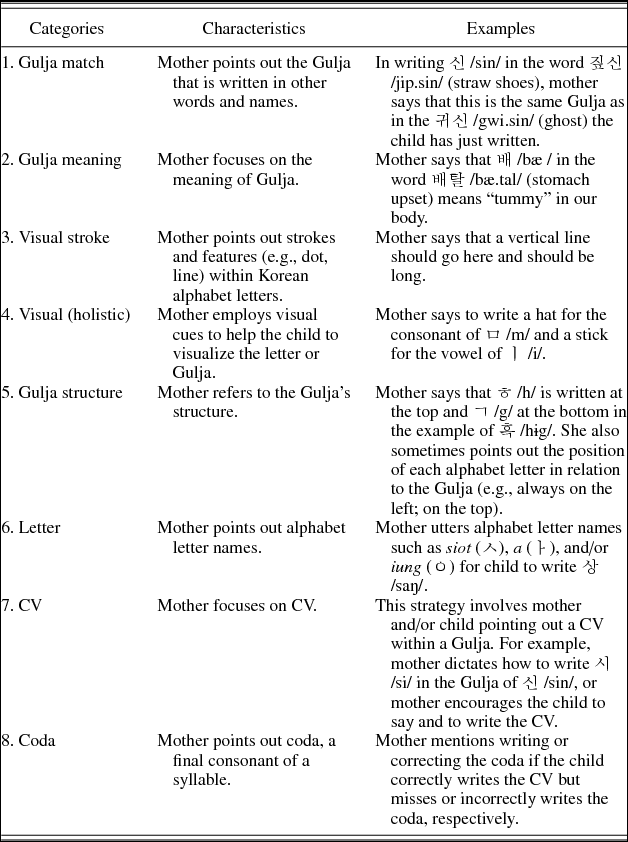
Content analysis with inductive coding was employed to code the videotaped data (Houldin & Aprn, Reference Houlin and Aprn2007; Strause & Corbin, Reference Strauss and Corbin1990). Original categories for the maternal mediation were proposed based on the categories from Hebrew (Aram & Levin, Reference Aram and Levin2001) and Chinese (Lin et al., Reference Lin, McBride-Chang, Aram, Levin, Cheung and Chow2009, Reference Lin, McBride-Chang, Aram, Shu, Levin and Cho2012) studies, as well as from unique features observed in relation to Korean teaching. They included “segmenting Gulja into sounds (onset, vowel, CV, and coda),” “mentioning letter names,” “connecting letter names and sounds,” “mentioning visual patterns such as strokes, holistic pattern, and visual structure,” “pointing out meanings such as homophones of Gulja and words,” “referring to other words and Gulja visually similar,” and others. After the first coding, similar categories were grouped together according to a common element. For example, some categories such as “mentioning letter name of consonant onset” and “mentioning vowel name” were repetitive, thus they were combined in a “letter” category. Some categories such as “mentioning visually similar Gulja” were deleted because of no or only a small number of cases. We coded maternal instructions several times by the procedure of deleting, adding, and dividing categories to maximize the unique and nonoverlapping qualities of each category. Ultimately, we came up with eight categories for coding based on the instructions given by Korean mothers. These categories included a whole “Gulja” level focus on words by mothers, a focus on visual patterns, alphabet letters, and Gulja structure focuses, and a CV and a coda analysis of the Gulja within words. These categories were, respectively, focusing on Gulja-match (GULJA-MATCH), Gulja meaning (GULJA-MEANING), visual strokes (VIS-STROKE), visualization of a Gulja or alphabet (VIS-WHOLE), Gulja structure (GULJA-STRUCTURE), and alphabet letter (LETTER), CV, and coda, as described in Table 1.
Eight categories of maternal literate mediation instructions

Note: Gulja refers to a written Korean syllable. CV, Consonant–vowel.
The same coding criteria were consistently applied to individual Korean Gulja (two per word). Given this unit of analysis, prior to the computation of maternal literate mediation scores, the frequency of valid mediated Gulja of each child was recorded as the general raw score. Because of variations in literacy competence, some children needed their mothers’ help in writing certain Gulja, whereas others wrote independently without getting any help at the Gulja level. Thus, because our focus in the present study was on mothers’ scaffolding of word writing, we excluded all Gulja that the child could write without any help, because, by definition, in these cases, maternal mediation was not involved. In total, an average of 25.8% and 44.9% of the 44 Gulja were excluded from analyses for mothers of 4- and 5-year-old children, respectively. Specifically, the excluded items were from 45% and 69% of CV Gulja (e.g., 이 /i/, 마 /ma/) and from 17% and 35% of CVC Gulja (e.g., 신 /sin/, 상 /saŋ/) for 4- and 5-year-old children, respectively. In addition, we had 23 (1.1%) and 37 (2.3%) instances in which mothers themselves incorrectly taught the syllables for 4- and 5-year-old children, respectively. These instances were also excluded from our analyses because we wanted to focus on writing of standard words, and these mistakes indicated that mothers were writing these words in nonstandard ways.
Thus, in computing mothers’ scores in literate mediation, we calculated the proportion of each strategy that the mother used as follows:
 $$\begin{equation*}
\frac{{{\hbox{Number of valid mediated Gulja under a particular strategy }}}}{{{\hbox{Total number of valid mediated Gulja (General raw score)}}}}
\end{equation*}$$
Using these filtering mechanisms and the above-identified categories, all videotapes were coded by a trained student helper who was unaware of the study hypotheses. Another rater coded 20 cases (23.8%) with the number of 1 or 0 according to whether or not a mother mentioned each particular strategy to her child in each valid mediated Gulja. The interrater reliabilities were obtained by a Cohen κ statistic with the coded data (κ = 0.89, 0.88, 0.82, 0.92, 0.96, 0.87, 0.83, and 0.82 for GULJA-MATCH, GULJA-MEANING, VIS-STROKE, VIS-WHOLE, GULJA-STRUCTURE, LETTER, CV, and CODA strategies, respectively).
CODING AND SCORING OF SOCIOEMOTIONAL COMMENTARY MEDIATION
In coding socioemotional comments, we followed three steps. First, we recorded the frequencies of a mother's comments on two dimensions of the positive-critical dimension and process–outcome–person dimension that could be double coded (e.g., Lin et al., Reference Lin, McBride-Chang, Aram, Shu, Levin and Cho2012). In the first positive-critical dimension, positive comments indicated warmth and approval by mothers (e.g., “Good”), and critical comments indicated the use of negative responses or pointing out and correcting the mistake (e.g., “no” “not correct” “this is wrong” “write again!”). The second dimension was related to the extent to which mothers’ feedback was oriented toward the process (e.g., “this line should be longer”), outcome (e.g., “this line is beautiful”), or person (e.g., “you are smart”). For example, a mother responded to her child, “Good, this syllable is very well written.” This was counted in both the positive category in the positive-critical dimension and the outcome category in the process–outcome–person dimension. Second, we counted the total number of Gulja for which the mother at least commented via one type of response category. Those Gulja on which mothers failed to comment were not counted in this step, because by definition in these Gulja mothers’ comments were not involved. In total, an average of 32.2% and 47.1% of 44 Gulja were excluded from analyses for mothers of 4- and 5-year-old children, respectively. Third, we obtained commentary mediation scores for each category as follows:
 $$\begin{equation*}
\frac{{{\hbox{Frequency of a particular type of response}}}}{{{\hbox{ Total number of Gulja on which mothers responded with at least a comment}}}}
\end{equation*}$$
Approximately 23.8% of these cases (20 cases) were double coded to check proportions of agreement between two raters with Pearson's correlations. Two raters coded how many times (frequency) a mother responded with each socioemotional comment to each Gulja. For commentary mediation, the obtained interrater reliabilities were r = .91, .85, .85, .88, and .90 for positive, critical, process-, outcome-, and person-related comments, respectively.
Procedure
Measures of maternal mediation of word writing and vocabulary were tested at children's homes by trained psychology student interviewers. The shared word writing exercise was done with a mother and child together, but parents were not present for the administration of the task of vocabulary knowledge. Demographic information from parents was also collected at this time. The remaining testing of Hangul word reading and CV Gulja reading, among other tasks not described here, was conducted at individual kindergartens. Maternal mediation was assessed from April to May in 2009 at home, and individual testing of children was done in June 2009 at school. During the home session, the maternal mediation task was first administered and typically lasted about 30 min. There was no time limit for the maternal mediation task. The mean videotaping time was 18.05 min (SD = 9.54, range = 2–51 min).
RESULTS
Descriptive statistics, mean comparisons in literate mediation strategies, and socioemotional comments
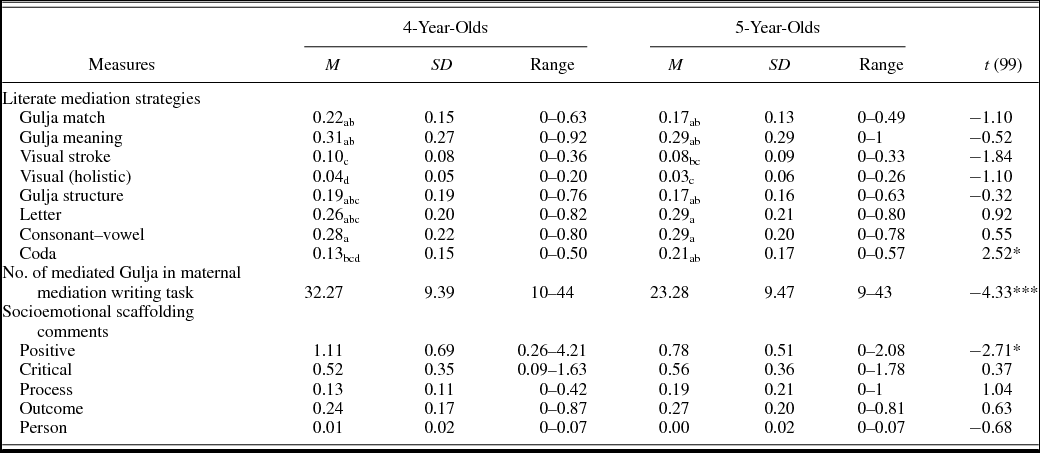
Table 2 shows the data on mean proportions, standard deviations, and ranges of maternal literate mediation, commentary categories, and the number of mediated Gulja in the maternal mediation writing task across 4- and 5-year-old children. Because of the large standard deviations of maternal literate strategies and socioemotional comments, further analyses were conducted on the square-root transformed proportions of maternal literate strategies and socioemotional comments.
Proportions of maternal literate mediation strategies and socioemotional mediation comments to support children's word writing across 4- and 5-year-old children and t values representing age differences

Note: Means in the same column that have different subscripts significantly differed in the Bonferroni post hoc comparisons.
*p < .05. ***p < .001.
In order to examine which maternal mediation strategies were significantly more common, a one-way repeated-measures analysis of variance was conducted on the transformed proportions with maternal literate mediation strategies as the within-participants factor in each for the 4- and 5-year-old children. There was a significant effect of strategy in 4-year-olds, F (7, 329) = 15.28, p < .001, and 5-year-olds, F (7, 245) = 11.03, p < .001. Bonferroni post hoc comparisons are presented in Table 2, where means in the same column that do not share subscripts are significantly different in each age group. The maternal strategies of CV, Gulja matching and meaning, and Gulja structure and letter were mentioned more often to 4-year-old children than visual and coda strategies, whereas CV, letter, coda, and Gulja matching and meaning strategies were mentioned more often to 5-year-old children than visual strategies. Visual strategies (STROKE and WHOLE) were mentioned less often in both age groups. The results showed that Korean mothers similarly often mentioned three different strategies of Gulja matching, CV, and letter, each of which represented respective orthographic unit of whole-syllable, subsyllable, and phoneme.
Developmental differences in literate mediation strategies and socioemotional comments
Table 2 also provides mean comparisons between the two age groups across all of the categories; mothers used more of the coda (CODA) strategy to teach Gulja to the 5-year-olds as compared to the 4-year-olds, t (82) = 2.52, p < .05. However, other literate mediation strategies were not different between two age groups. Table 2 shows that 4-year-old children had more mediated Gulja in the maternal mediation task than did 5-year-old children, t (82) = –4.33, p < .001. For commentary mediation, in the positive-critical dimension, mothers of 4-year-old children gave more positive responses than critical responses. Mothers of 5-year-old children made fewer positive responses as compared to the mothers of 4-year-old children, t (82) = –2.71, p < .05. In the process–outcome–person dimension mothers of 5-year-olds responded similarly to those of 4-year-olds.
Relations of maternal literate mediation strategies to children's reading skills
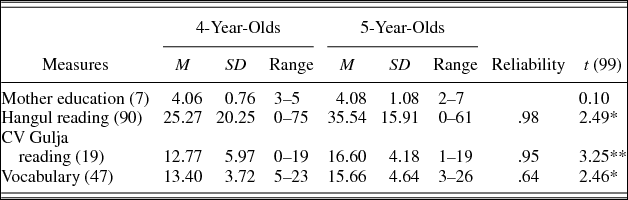
Means, standard deviations, ranges, and reliabilities for reading and other measures in the two age groups are reported in Table 3. Overall, the measures were normally distributed with good variability and internal consistency reliabilities. The maternal education levels indicated that our participants were generally from families with middle SES. Skills on literacy and vocabulary measures presented as raw scores improved across age levels. In particular, CV Gulja reading was 67% and 87% correct in 4- and 5-year-old children, respectively, showing high performance, whereas their respective corresponding performances for word reading were 28% and 39%.
Reliabilities of reading and vocabulary measures across 4- and 5-year-old children and t values representing age differences

Note. All reliabilities were the internal consistency reliabilities. CV, Consonant–vowel.
*p < .05. **p < .01.
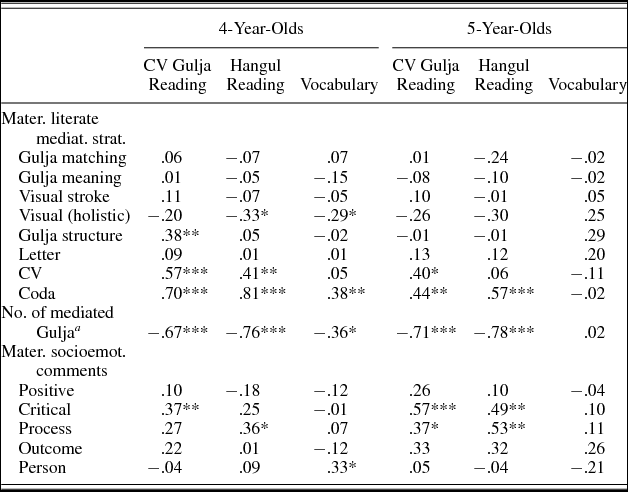
Table 4 shows Pearson product-moment correlation coefficients with each of the square-root transformed proportions of the maternal literate strategies and socioemotional comments with children's literacy and vocabulary performances. The correlation coefficients of the maternal CODA strategy were strongly associated with word reading and with CV Gulja reading (rs > .70, ps < .001) for 4-year-olds and moderately for 5-year-olds (rs > .44, ps < .05). The maternal CV strategy was positively correlated with CV Gulja reading and word reading in 4-year-old children (rs > .41, ps < .01) and with CV Gulja reading in 5-year-olds (r = .40, p < .05). Other strategies were not significantly associated with any reading measures. It is interesting that mothers’ use of the Gulja meaning strategy was not significantly associated with children's vocabulary knowledge in either grade group. In this study, the number of mediated Gulja in the maternal mediation of word writing was strongly negatively correlated with CV Gulja reading and Hangul reading (rs < –.67, ps < .001) in both age groups but weakly with vocabulary in 4-year-olds only (r = –.36, p < .05).
Correlations of maternal literate mediation strategies, number of mediated Gulja, and socioemotional comments with children's reading and vocabulary measures in both age groups

Note: CV, Consonant–vowel.
a The number of mediated Gulja in the maternal mediation writing task.
*p < .05. **p < .01. ***p < .001.
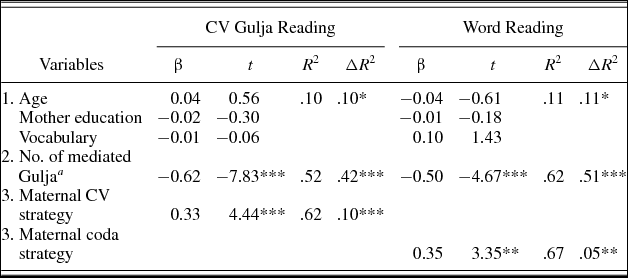
It is important that mothers’ frequent use of the coda strategy was strongly and uniformly linked to better performance of word reading and CV Gulja reading in both age groups. Mothers’ frequent use of the CV strategy was significantly associated with CV Gulja reading in both age groups. The two strategies were then subjected to a further test of strength in hierarchical regression analyses. First of all, to examine the extent to which mothers’ CV strategy contributed uniquely to children's independent Korean CV Gulja reading, we conducted a hierarchical regression analysis as shown in Table 5. We used the combined sample for the regression analysis because patterns of correlations were similar in the 4- and 5-year-old children separately.
Hierarchical regression explaining CV Gulja reading from the maternal CV strategy and word reading from the maternal coda strategy for the combined sample of 4- and 5-year-old children

Note: CV, Consonant–vowel.
a The number of mediated Gulja in the maternal mediation writing task.
*p < .05. **p < .01. ***p < .001.
The first step of the hierarchical regression equation included children's age, mother's education, and vocabulary knowledge. In the second step, we added the total number of mediated Gulja in the maternal mediation of word writing to control for children's cognitive skill of writing. The maternal CV strategy was included in the final step of these analyses. After controlling for the independent demographic information, vocabulary, and writing skill in the first two steps, the maternal CV strategy explained 10% of the unique variance in CV Gulja reading.
The other hierarchical regression analysis was conducted with maternal coda strategy used to explain children's word reading as shown in Table 5. The regression equation included the same variables in the first two steps as in the previous analysis. The maternal coda strategy was included in the final step of these analyses. After controlling for the measures in the first two steps, the maternal coda strategy explained 5% of the unique variance in children's word reading. Note that the effect of maternal coda strategy on children's CV Gulja reading was not examined because coda does not exist in CV Gulja.
Relations of maternal socioemotional comments to children's reading skills
For commentary scaffolding, among the five categories, the process and critical responses were significantly associated with CV Gulja and word reading in 5-year-olds (rs > .37, ps < .05) as shown in Table 4. It is slightly different that, in 4-year-olds, process comments were significantly related with word reading (r = .36, p < .05) and critical comments with CV Gulja reading (r = .37, p < .05). However, positive comments were not significantly associated with any of the children's literacy and vocabulary measures. The critical comment variable was significantly correlated with both process and outcome responses in both age groups (rs > .53, ps < .01), although these correlations are not presented in Table 4.
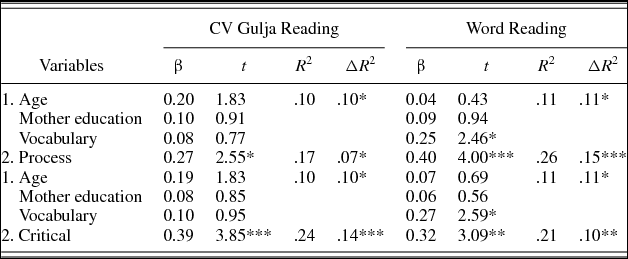
We next carried out hierarchical regression analyses in the combined samples to examine to what extent the process response variable would explain reading skills with demographic information and vocabulary controlled. As shown in Table 6, after controlling for mother's education and children's age and vocabulary in Step 1, process responses explained 7% of the unique variance of CV Gulja reading and 15% of this variance in word reading. In hierarchical analyses paralleling those incorporating process-related comments as described above, critical responses explained 14% of the unique variance of CV reading and 10% in word reading after controlling for mother education and children's age and vocabulary in Step 1, as shown in Table 6.
Hierarchical regression explaining word reading and CV Gulja reading from process and critical comments for the combined sample of 4- and 5-year-old children

Note: CV, Consonant–vowel.
*p < .05. **p < .01. ***p < .001.
DISCUSSION
The present study has revealed four aspects of early Korean reading development that may be both theoretically and practically important for teaching young Korean children to read and write. First, we identified eight different categories of literate mediation used by Korean mothers to facilitate their children's word writing. They were focusing on Gulja matching and meaning, visualization, Gulja structure, alphabet letters, CV, and coda. Second, there were developmental differences in coda strategy, which was mentioned more often by the mothers of 5-year-old children. Third, we identified the maternal CV and coda strategies in particular as being highly associated with CV Gulja reading and word reading achievement in children, respectively; we further demonstrated the unique contribution of maternal CV strategy to children's independent CV Gulja reading and the unique contribution of maternal coda strategy to children's word reading after controlling for children's writing skill, vocabulary, and background information. Fourth, we examined mothers’ social–emotional approaches to writing with their children and demonstrated that mothers’ emphasis on the process of writing as well as critical comments, but not the positive comment variable, were uniquely associated with both CV Gulja and word reading acquisition in these samples. Each of these ideas is elaborated in turn below.
Salient maternal literate mediation strategies: CV Gulja and coda
One of the eight categories identified as prevalent in these Korean mothers showed a clear developmental difference in mothers with children in different levels of kindergarten. The coda strategy was used significantly more often by mothers of 5-year-olds and was uniformly positively associated with reading of Hangul words and CV Gulja across both age groups. The maternal coda strategy was also strongly associated with the number of mediated Gulja in the maternal mediation writing task. That is, the coda strategy was often adopted when children were at a more advanced phase of writing. This result supports earlier findings that parents adjust their cognitive teaching strategies to children's level of cognitive skill (Pellegrini et al., Reference Pellegrini, Brody and Sigel1985). Moreover, the maternal coda strategy was included as a statistical predictor of word reading to explain reading after controlling for children's vocabulary and writing skill, a second unique aspect of the present study. This “primacy” of the coda may also explain why, in previous work (e.g., Cho, Reference Cho2009; Cho et al., Reference Cho, McBride-Chang and Park2008), Korean children showed better performance in coda deletion than in onset deletion, and coda awareness was a unique independent predictor of reading Hangul words among Korean kindergartners.
The maternal CV strategy was strongly correlated with CV Gulja reading in 4-year-olds and moderately in 5-year-old children, and it was found to be an independent predictor of children's CV Gulja reading over and above background information, vocabulary, and writing skill. This suggests that a maternal focus on the CV subsyllabic unit that has been recognized as a salient grain size in Korean language (Ziegler & Goswami, Reference Ziegler and Goswami2005) is directly linked to children's reading of CV syllables at an initial phase of Hangul acquisition. Our findings support earlier work on a maternal mediation task done in Chinese (Lin et al., Reference Lin, McBride-Chang, Aram, Levin, Cheung and Chow2009, Reference Lin, McBride-Chang, Aram, Shu, Levin and Cho2012) and Hebrew (Aram & Levin, Reference Aram and Levin2001) that maternal instructions of teaching word writing were strongly related to children's literacy skill development concurrently or longitudinally. It is noteworthy that this study replicated earlier works even after adopting a more stringent methodology, which was statistically controlling for cognitive writing skills of children. However, specific maternal mediation strategies and their focuses on psycholinguistic grain size appear to be different across languages. Although efficient strategies are related to letter–phoneme correspondences in alphabetic languages (Aram & Levin, Reference Aram and Levin2001; Skibbe et al., Reference Skibbe, Bindman, Hindman, Aram and Morrison2013) and syllable and morphological knowledge at the character level in Chinese (Lin et al., Reference Lin, McBride-Chang, Aram, Levin, Cheung and Chow2009, Reference Lin, McBride-Chang, Aram, Shu, Levin and Cho2012), efficient strategies of Korean mothers were to focus on orthographic units corresponding to subsyllabic units of the CV (body) and coda. Ours is among the first studies to demonstrate that maternal teaching of the subsyllabic units of CV and coda is an efficient reading scaffolding strategy, supporting CV and coda as salient grain sizes of the Korean language (Ziegler & Goswami, Reference Ziegler and Goswami2005).
Hangul acquisition tends to progress gradually from CV Gulja to a coda segment. In the spoken language, similarly, Korean children develop body awareness earlier than awareness of coda subsyllabic unit (Kim & Cho, Reference Kim and Cho2001). For example, Kim and Cho (Reference Kim and Cho2001) found that Korean kindergartners performed 88% correct in a body detection task but only 60% correct in a corresponding coda task. Using a different task, Kim (Reference Kim2007) found that Korean kindergartners performed only 22% correct in a blending and segmenting task of body and coda but 95% correct in a corresponding syllable blending and segmenting task. Awareness of phonemes and subsyllabic units develops via reading education and training (for a review, see, e.g., McBride-Chang, Reference McBride-Chang2004). It would be interesting to further examine whether maternal literate mediation focusing on CV and coda would enhance children's phonological awareness.
In the present study, there were many instances of mothers focusing on Gulja match and Gulja meaning, but the strategies were not positively associated with tasks of Hangul reading, CV Gulja reading, or vocabulary knowledge. Note that learning of the whole Gulja is favored and often used in Korean kindergartens as a practice of whole language literacy teaching. Focusing on the whole Gulja might not be effective in the initial stage of Hangul acquisition; by themselves, they are not enough to master the alphasyllabary of Hangul. The lack of association between a maternal focus on Gulja meaning and children's vocabulary skill in this study was disappointing, although Skibbe et al. (Reference Skibbe, Bindman, Hindman, Aram and Morrison2013) showed similar results. Further studies may need to examine mothers’ scaffolding of children's vocabulary knowledge in diverse age groups of children and in more natural settings.
In the present study, mothers’ focus on Korean alphabet letters was not significantly associated with Hangul word reading, although there were many instances in which mothers made use of the letter strategy. This is different from the results of Hebrew (Aram & Levin, Reference Aram and Levin2001, Reference Aram and Levin2004) and Chinese Pinyin, a phonological system used to teach Chinese (McBride-Chang et al., Reference McBride-Chang, Lin, Liu, Aram, Levin and Cho2012), for which a maternal focus on letter name and sound knowledge was strongly associated with literacy skills. Our results might be related to the fact that Korean children learn letter names later than they master CV Gulja reading and have not yet mastered letter names by age 5 (Cho, Reference Cho2009). The modest letter knowledge of Korean children may be partly due to complicated Korean consonant names, each with two or three syllables such as /gi.yek/ (ㄱ) and /ssang.si.ot/ (ㅆ) and partly due to the salience of Gulja in Korean word recognition (Simpson & Kang, Reference Simpson and Kang2004). Related to this, letter naming was not strongly associated with letter–sound knowledge among Korean kindergartners concurrently (Kim & Petscher, Reference Kim and Petscher2013) or longitudinally (Cho, Reference Cho2009), whereas CV knowledge predicted letter–sound knowledge longitudinally (Cho, Reference Cho2009).
Several of the documented eight maternal mediation strategies reflected the uniqueness of Korean Hangul writing. Korean mothers make use of visual information such as strokes and whole shapes of letters and Gulja to help their children in writing, but not as much as Chinese mothers do, given a relatively stronger visual emphasis found in Chinese in previous work (e.g., Lin et al., Reference Lin, McBride-Chang, Aram, Levin, Cheung and Chow2009). In the present study, Korean mothers’ instructions heavily relied on phonological information such as letters of the alphabet, subsyllabic units of CV and coda, and syllables in teaching their children in writing, as mothers did in some other alphabetic (abjad) scripts, such as Hebrew (e.g., Aram & Levin, Reference Aram and Levin2001, Reference Aram and Levin2004), but the prominence of the phonological information at the CV and coda levels is especially noteworthy here, when comparing across cultures.
Maternal socioemotional supports: Process and critical comments
Another aspect of parental scaffolding in relation to Korean reading development that is noteworthy from these data is the fact that the process-related comments variable was also uniquely associated with both Hangul word reading and CV Gulja reading after controlling for mothers’ education, and children's grade, age, and vocabulary skill. These findings echo those of another study on Chinese children's literacy development (Lin et al., Reference Lin, McBride-Chang, Aram, Shu, Levin and Cho2012) as well as those on older children focused on a cognitive reasoning task (Ng et al., Reference Ng, Pomerantz and Lam2007). This process variable emerged across all of these studies as the strongest correlate of literacy learning from among the socioemotional variables capturing mother–child interactions. This replication of findings across studies underscores the importance of parents working together with their children on specific aspects of the literacy process for literacy improvement. Feedback on the process of word writing during scaffolding by mothers of their children's writing may not only teach children how to write specific words but also foster more of a mastery-oriented sense that includes high expectations, positive affect, and increased persistence; feedback might also increase children's overall self-confidence and self-efficiency (e.g., Kamins & Dweck, Reference Kamins and Dweck1999), thus boosting children's further independent reading and writing development (Lin et al., Reference Lin, McBride-Chang, Aram, Shu, Levin and Cho2012). However, in contrast to some previous findings (e.g., Lin et al., Reference Lin, McBride-Chang, Aram, Shu, Levin and Cho2012), critical comments from parents were also positively associated with reading acquisition across both kindergarten grade levels in the present study. Perhaps this critical focus, a tendency to call attention to flaws and errors, to demand the correction of mistakes, and to demand precision (e.g., Skibbe et al., Reference Skibbe, Bindman, Hindman, Aram and Morrison2013) has something to do with Korean parents’ training focus with children vis-à-vis learning (e.g., Chao, Reference Chao1994). For example, Stright, Herr, and Neitzel (Reference Stright, Herr and Neitzel2009) found that for Hmong (Southeast Asians) families living in the United States, maternal directive instructions focusing on a child's action about what to do in problem-solving tasks positively predicted children's conscientious behaviors in kindergarten such as following the rules, being organized, and completing work in a timely fashion. The use of more formal and directive methods to teach reading and mathematics to young children is also evidenced in Chinese American immigrant parents (Huntsinger, Jose, & Larson, Reference Huntsinger, Jose and Larson1998). The training focus may explain Chinese school success (e.g., Chao, Reference Chao1994). However, as suggested by previous studies, parental emotional support may cultivate motivational dispositions for children's academic competence and control (e.g., Neitzel & Stright, Reference Neitzel and Stright2003; Zimmerman, Reference Zimmerman1995). Thus, it might be possible that maternal critical comments may be negatively related to motivation and enjoyment of reading among Korean children. The age at which such comments are given may also matter for this issue. Future studies should examine this issue in greater detail.
Parent–child bidirectional interactions
The positive relations of maternal coda emphasis and children's performance in reading are likely bidirectional. For example, parents in this study have adjusted their literate mediation instructions to children's level of writing skills of Hangul words, replicating results from other parent–child interaction studies (e.g., Neitzel & Stright, Reference Neitzel and Stright2003; Pellegrini et al., Reference Pellegrini, Brody and Sigel1985). That is, parents tended to focus on the coda in the present study more often with older children who could read and write CV Gulja, which could ultimately help children to master Hangul word reading and writing. Similarly, a previous Korean study reported possible bidirectional relations that Korean parents tended to teach more frequently to their 4- or 5-year-old child who was slow in literacy acquisition (Kim, Reference Kim2009). Similarly, American parents have adjusted their interaction types in terms of cognitive demand and directiveness to children's level of communicative competence during parent–child joint book reading (Pellegrim et al., Reference Pellegrini, Brody and Sigel1985). That is, American parents tended to be less directive and more demanding to older and communicatively competent children. In a similar vein, Korean parents in this study tended to be more positive to younger children.
Limitations of this study
Perhaps the strongest critique of this study has to do with its small sample size. The 84 mother–child dyads were difficult to recruit and videotape. This type of work is painstaking and requires an extensive focus on coding. Therefore, having obtained samples of 84 mother–child dyads for children at ages 4 and 5 was already a substantial achievement. Another critique of this work lies in its potentially weak ecological validity given that mothers were provided with particular words during mother–child joint writing, which might have limited possible scaffolding activities and instructions to use for the children. The last critique would be that mothers’ education level was relatively high compared to other studies conducted in other countries, although their mean educational level in this study was close to the Korean national average. Future studies may need to test maternal mediation from families of low SES or multicultural backgrounds to look at how these others support their children's Hangul acquisition.
Theoretical and practical implications for Hangul teaching
Despite those limitations, therefore, the present study has extended work on mother–child writing in different cultures (e.g., Aram & Levin, Reference Aram and Levin2001, Reference Aram and Levin2004; Lin et al., Reference Lin, McBride-Chang, Aram, Levin, Cheung and Chow2009, Reference Lin, McBride-Chang, Aram, Shu, Levin and Cho2012; McBride-Chang et al., Reference McBride-Chang, Lin, Liu, Aram, Levin and Cho2012) to Korean Hangul writing in a rather innovative way. Our documentation of unique strategies used by mothers to facilitate children's writing has been helpful in understanding what mothers actually do when working with their children on literacy-related skills. Our results expand on Kim's (Reference Kim2009) study on associations of parents’ questionnaire reports related to early reading and writing with Korean children and underscore the importance of parental scaffolding for early Korean literacy development. This study may provide evidence on how the use of the alphasyllabary Korean Hangul writing system in a Korean culture context might influence maternal strategies of teaching word writing and subsequently children's literacy skill development. In particular, more frequent use of the coda strategy by mothers of older children and positive-related comments by mothers of younger children in this study support the theory that parents adjust their level of cognitive as well as socioemotional support to fit the child's zone of proximal development (Neitzel & Stright, Reference Neitzel and Stright2003; Pellegrini et al., Reference Pellegrini, Brody and Sigel1985; Vygotsky, Reference Vygotsky1978).
That the maternal CV focus was uniquely associated with children's CV Gulja reading and maternal coda focus with children's word reading in young Korean children underscores their potential utility as teaching strategies for both parents and teachers of preschoolers. Specifically, it would be ideal to teach Korean CV Gulja within a CV chart and then coda information to read and write Hangul words. A CV Gulja chart contains 14 basic consonant letters in columns and 10 basic vowel letters in rows to form 140 CV Gulja. CV charts could be particularly useful to teach Hangul to young children with poor emergent literacy skills and in poorer environments. In addition, Korean mothers’ critical comments was associated with positive reading outcomes in children as well, which supports several previous studies dealing with parenting styles of Asian mothers. Criticism that focuses on errors and demands that mistakes immediately be corrected during writing mediation may be related to training-focused practice in Korea. Perhaps partly related to this, Korean young children were found to have more advanced inhibitory control and self-regulation that could be most important factors for early school success in previous research (Oh & Lewis, Reference Oh and Lewis2008). Moreover, Korean students were among the highest achievers in literacy in the latest cross-country comparisons of 65 countries and regions (Chiu & McBride-Chang, Reference Chiu and McBride-Chang2006; Organisation for Economic Co-operation and Development, 2010). Our results suggest that early critiques by parents may play some sort of facilitating role in promoting early literacy skills in Korean children, though this finding, which is relatively novel, should be replicated in future research.
To conclude, we have found that two strategies never before documented as prevalent in maternal mediation of writing in previous work are not only prominent but also strongly positively related to early literacy outcomes in Korean children. The CV strategy at an initial phase and the coda strategy at a later phase are apparently especially important for Hangul acquisition in young children. In addition, mothers’ emphases on the process of writing, as well as, to a lesser extent, critical comments, are all associated with positive literacy outcomes in children as well. Future work might explore such associations longitudinally and even experiment with CV and coda strategy-related interventions in fostering early Korean children's writing.
ACKNOWLEDGMENTS
This research was supported by RGC Grant 448608 from the Hong Kong government to Catherine McBride and partially supported by the NRF Grant NRF-2013S1A3A2054928 from the Korean government.