Introduction
In the temperate zone, photoperiod is considered the most predominant stimulus in the determination of diapause in many insects, because it is the most reliable signal for long-term predictor of environmental change (Tauber et al., Reference Tauber, Tauber and Masaki1986; Saunders, Reference Saunders2002; Bradshaw & Holzapfel, Reference Bradshaw and Holzapfel2010). Other physical factors such as temperature generally fluctuate more vastly than photoperiod and, thus, tend to be used in the stimulation or inhibition of insect growth on a short-term basis (Roff, Reference Roff, Brown and Hodek1983). Even so, insects are responsive to temperature in the process of diapause determination in several different ways (Tauber et al., Reference Tauber, Tauber and Masaki1986; Danks, Reference Danks1987; Xue et al., Reference Xue, Spieth, Li and Hua2002).
The cabbage butterfly, Pieris melete Ménétriés, is a serious pest of crucifers in the mountainous areas in China, displays both summer and winter diapause in the pupal stage. Besides its agricultural significance, this insect can also serve as an excellent experimental animal for diapause study because it has a multi-voltine life cycle with both summer and winter diapause in the pupal stage, which were mainly induced by relatively long and short day lengths, respectively. Furthermore, the cabbage butterflies can be easily mass-reared within an outdoor nested insectary (Xue et al., Reference Xue, Zhu and Wei1996, Reference Xue, Kallenborn and Wei1997). The effects of temperature and photoperiod on diapause induction and termination have been evaluated in detail in this butterfly under laboratory conditions (Xue et al., Reference Xue, Kallenborn and Wei1997; Xiao et al., Reference Xiao, Yang and Xue2006, Reference Xiao, Wei, Li and Xue2008a,Reference Xiao, He, Li and Xueb, Reference Xiao, Wu, Wang, Zhu and Xue2009). These studies revealed that high temperatures strongly weakened the diapause-inducing effects of long day-length and significantly reduced the incidence of summer diapause; whereas winter diapause can be induced under short day-length at relatively high temperatures, and a diapause-inducing short day-length has a stronger diapause-inducing effect than a long day-length at higher temperatures (Xue et al., Reference Xue, Kallenborn and Wei1997; Xiao et al., Reference Xiao, Wei, Li and Xue2008a,Reference Xiao, He, Li and Xueb, Reference Xiao, Wu, Wang, Zhu and Xue2009). Thus, we suggest a hypothesis that temperature may exhibit a much greater effect in the determination of summer diapause induction than photoperiod, whereas photoperiod may play a more important role in the initiation of winter diapause than temperature under field conditions. However, it was not verified in the aforementioned studies. In the present study, we conducted an analysis based on the field investigation for five successive years to clarify the role of naturally changing day-length and temperature in the determination of summer and winter diapause in the cabbage butterfly.
Material and methods
The cabbage butterfly, P. melete, used in the experiments originated from a wild population in the suburbs of Nanchang (28°46′N, 115°50′E; at an altitude of 120–200 m above sea level), Jiangxi Province, P.R. China. Full-grown larvae prior to pupation were collected from crucifers in late November in 2002, 2003, 2004, 2005 and 2006 and were transferred to wooden cages (30×30×35 cm) for pupation and overwintering under natural conditions. To examine the effect of seasonal variation on summer and winter diapause, adults from the overwintering pupae were released to an outdoor web-screened insectary equipped with potted Chinese cabbage, Brassica chinensis, for mating and oviposition. Under natural conditions, almost all individuals in the first spring generation entered summer diapause. Therefore, some larvae were kept under natural conditions to observe the diapause incidence, whereas some of the rest larvae of the first generation were reared under an intermediate artificial photoperiod of LD 12.5:11.5 under otherwise natural conditions to obtain more non-diapausing individuals for further mass-rearing. Adults emerging from non-diapauing pupae were released into an outdoor web-screened insectary to mate and produce the second generation. Full-grown larvae were collected every few days from the insectary and were transferred to wooden cages for pupation under natural photoperiods and temperatures. When adults emerged, they were released into an outdoor screened insectary to start another generation. The same rearing process was repeated in the following generations until the last generation of the year in which all pupae entered winter diapause in late November. In each generation, the dates of hatching, pupation and the incidence of diapause were recorded in detail.
Diapause in P. melete was recognized in the pupal stage. Non-diapause pupae generally emerged within 7–10 days in spring-summer generations and 12–14 days at the end of autumn. The longest period for pupal development in non-diapausing individuals did not exceed 30 days. Thus, pupae that did not emerge within 30 days were considered to be in diapause (Xue et al., Reference Xue, Kallenborn and Wei1997).
During the entire experimental period, temperatures were recorded by an auto thermograph. The daily mean temperature was calculated by averaging the temperatures recorded at 2 am, 8 am, 2 pm and 8 pm. The day-length from larvae hatching to pupation (including twilight) was calculated according to the civil twilight table (Danilevski, Reference Danilevski1965).
Statistical analyses were conducted using the STATA package Version 9.0. The percentage of diapause (arcsin-square root transformed) was modeled as a function of photoperiod and temperature associated interaction terms. Stepwise regression was used to analyze the correlation between the incidence of diapause and environmental factors. Path coefficient analysis was useful in that it revealed the true nature of cause-and-effect relationships of photoperiod and temperature with the incidence of diapause (Bhatt, Reference Bhatt1973). Therefore, regression analysis and path coefficient analysis were used together to determine whether the variance in the incidence of diapause in different spring-summer and autumn generations were mainly caused by day-length or temperature.
Results
Incidence of summer diapause in successive spring-summer generations
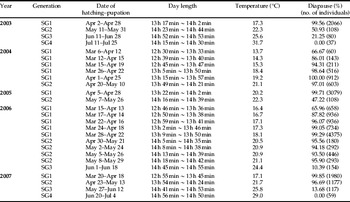
The incidences of summer diapause in successive spring-summer generations were observed under the natural conditions for five successive years. As seen in table 1, the incidence of summer diapause in different spring-summer generations (SG) was strongly affected by natural environment stimuli. In the first generation (SG1), almost all individuals were induced to enter diapause (>96%) when larvae growing from late March to early May experienced relatively low mean daily temperatures (<20.2°C) and gradually increasing day-length from 13 h 0 min to 14 h 5 min. However, in 2004 and 2006, 33.33% and 34.04% individuals in the first generation developed without diapause when the larval period was from March 6 to April 12 and from March 15 to April 13, respectively. The mean daily temperature experienced by these caterpillars was 13.7 and 16.4°C, respectively, combined with an intermediate to relatively long day-length (12 h 30 min∼13 h 36 min).
Incidence of summer diapause for successive generations in P. melete reared under natural spring and summer conditions.

SG, spring-summer generation.
The incidence of summer diapause in the second generation (SG2) during spring-summer differed in different years, depending on the mean daily temperatures. More than 94% pupae were induced to enter diapause in 2004, 2006 and 2007, when the larvae experienced a mean daily temperature below 22°C and a gradually increasing day-length from 13 h 49 min to14 h 42 min. The incidence of diapause dropped to 50.93% and 47.22% when larvae experienced the mean daily temperature of 22.3°C and long day-length from 14 h 16 min to 14 h 44 min in 2003 and 2005, respectively. The diapause incidence in SG3 was 21.25% in 2003, 10.39% in 2006 and 13.68% in 2007. Summer diapause disappeared in SG4 in July in both 2003 and 2007.
Role of day-length and temperature in the determination of summer diapause
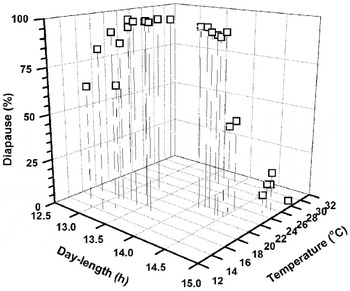
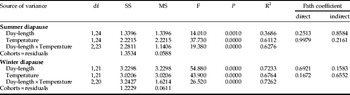
Regression analysis was carried out based on the data from table 1 (fig. 1). It was clear that relatively low mean daily temperatures (<22°C) combined with long day-length from 13 h 0 min to 14 h 30 min induced almost all individuals to enter diapauses, whereas high temperatures (>22°C) combined with long day-length (>14.5 h) caused most individuals to develop without diapause. Regression analysis indicated that the incidence of summer diapause correlated negatively with the increasing day-length and temperature. Both day-length and temperature had significant impacts on the incidence of summer diapause in different spring-summer generations (table 3). However, path coefficient analysis showed that temperature played a more significant role in regulating summer diapause, while increasing day-length had minor influence. The direct path coefficient of temperature in the determination of summer diapause was 0.9979, and indirect effect path coefficient (i.e. influence via day-length) was 0.2161. For the increasing day-length, however, the direct path coefficient in the determination of summer diapause was 0.2513, and the indirect effect path coefficient was 0.8584 (table 3).
Influence of day-length and temperature on the incidence of summer diapause in P. melete.

Incidence of winter diapause in successive autumn generations
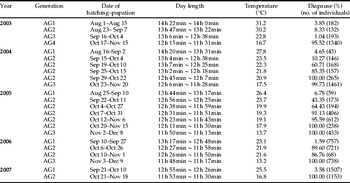
The incidences of winter diapause for successive generations in P. melete were observed under natural autumn and winter conditions for five successive years (table 2). The incidence of winter diapause was very low (<10.27%), when the gradually shortening day-length combined with the high mean daily temperatures (>23.1°C) in the first and second autumn generations (AG1 and AG2). With the gradually shortening day-length during mid-September and early October, the incidence of winter diapause increased from 60% to 90% in AG2. The day-length shorter than 12 h induced nearly all individuals to enter winter diapause in AG2, AG3 and AG4.
Incidence of winter diapause for successive generations in P. melete reared under natural autumn and winter conditions.

AG, autumn generation.
Role of day-length and temperature on the determination of winter diapause
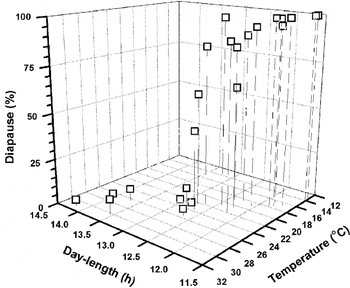
Regression analysis was used to interpret the data from table 2 (fig. 2). Obviously, the influence of day-length and temperature on the incidence of diapause showed a negative correlation (table 3). Path coefficient analysis indicated that temperature and day-length showed an opposite role to that in the induction of summer diapause. The direct path coefficient of day-length in the induction of winter diapause was 0.6921, and indirect effect path coefficient (i.e. influence via temperature) was 0.1583. For the decreasing temperature, however, the direct and indirect path coefficient in determination of winter diapause was 0.1672 and 0.6552, respectively (table 3).
Influence of day-length and temperature on the incidence of winter diapause in P. melete.

Statistics table for the effects of day-length and temperature on the incidence of summer and winter diapause (arcsin-square root transformed) in P. melete.

Discussion
In many organisms, photoperiod and temperature are thought to be the most significant cues for seasonally timed events, including diapause in the life history of arthropods. Temperature is known to influence the photoperiodic control of summer as well as winter diapause. In many aestivating insects, it is generally accepted that long photoperiod and high temperature tend to induce or maintain summer diapause, and low temperatures tends to prohibit it (Masaki, Reference Masaki1980; Tauber et al., Reference Tauber, Tauber and Masaki1986; Danks, Reference Danks1987). This is shown, for example, by Masaki & Sakai (Reference Masaki and Sakai1965) in the cabbage moth, Mamestra brassicae; Sullivan & Wallace (Reference Sullivan and Wallace1967) in the European pine sawfly, Neodiprion sertifer; Khoo (Reference Khoo1968) in the stonefly, Capnia bifrons; Sáringer & Deseö (Reference Sáringer and Deseö1966) in the alfalfa weevil, Hypera variablis; Paarmann (Reference Paarmann1976) in the carabid, Orthomus barbarus atlanticus; Butler et al. (Reference Butler, Wilson and Henneberry1985) in the tobacco budworm, Heliothis virescens; Finch & Collier (Reference Finch and Collier1985) in the cabbage root fly, Delia radicum; and Xue et al. (Reference Xue, Zhu and Shao2001) in the leaf-mining fly, Pegomyia bicolor. In contrast to the above species, high temperatures strongly weakened the diapause-inducing effects of long day-length and significantly reduced the incidence of summer diapause in P. melete under laboratory conditions; whereas relatively low temperatures combined with long day-length induced nearly all individuals to enter summer diapause (Xue et al., Reference Xue, Kallenborn and Wei1997; Xiao et al., Reference Xiao, Wei, Li and Xue2008a, Reference Xiao, Wu, Wang, Zhu and Xue2009). The present study for five successive years of field observations further confirmed that summer diapause was induced by relatively low temperatures rather than high temperatures, as suggested by the fact that almost all individuals were induced to enter diapause (>95%) when larvae growing from late March to early May experienced relatively low mean daily temperatures (<22°C) (table 1). Undoubtedly, the gradually increasing day-length during spring also played an important role in the induction of summer diapause. However, path coefficient analysis showed that the effect of temperature was much greater than photoperiod in the determination of summer diapause in the cabbage butterfly (table 3). Similar results were also found in the cabbage beetle, Colaphellus bowringi, in which high temperatures obviously inhibited the incidence of summer diapause (Xue et al., Reference Xue, Spieth, Li and Hua2002).
According to our field observations for nine years (1988, 1989, 1994, 1995, 2003, 2004, 2005, 2006 and 2007), if the overwintered pupae eclosed into adults between mid-March and early April (1988, 1989, 1994, 1995, 2003, 2005 and 2007), almost all their progenies would enter summer diapause because larvae of the first generation experienced relatively low temperatures (<20°C) and relatively long day-length (>13 h). However, if adults emerged between late February and late March, some progenies produced by the early emerged adults would develop without diapauses; as shown in 2004 and 2006, 33.33% and 34.04% individuals developed without diapauses because they experienced the intermediate to relatively long day-length (12 h 30 min∼13 h 31 min) (table 1). These individuals emerged as adults in late April and produced the second generation. These results suggest that the butterfly has the potential ability to reproduce in summer, although this is usually not expressed under local climatic conditions.
In winter diapause with long-day photoperiodic response, the effect of temperature on diapause induction can also be expressed as that diapause incidence varies with temperature when the combined photoperiod is inductive at certain temperatures only. Photoperiodic cues may be effective in diapause induction only when the temperature is above or below particular thresholds, i.e. diapause cannot be induced at any photoperiod when the temperature is above a particular level in some insects. For example, in the swallowtail Sericinus montelus, although diapause induction in the pupa was regulated by photoperiod, high temperature could reverse the effect of short day-length on diapause induction (Wang et al., Reference Wang, Yang, Zhou, Xu and Lei2009). However, in the grape berry moth, Lobesia botrana, under the photoperiod of L:D 12:12 combined with various temperatures (from 12 to 30°C), almost 100% of individuals were induced to enter winter diapause, indicating that in the range of field temperatures occurring in Crete in August, the temperature probably had no effect on diapause induction (Roditakis & Karandinos, Reference Roditakis and Karandinos2001). In the bean blister beetle Epicauta gorhami, lower temperatures (20 and 22.5°C) induced all larvae to enter pseudopupae diapause. By contrast, at higher temperatures (27.5 and 30°C), almost all larvae pupated without diapause, regardless of the photoperiod (Shintani et al., Reference Shintani, Hirose and Terao2011). In natural lines of Drosophila melanogaster from both Florida and Maine, temperature was the primary determinant of dormancy; however, photoperiod had no significant effect either between populations or among lines within populations (Emerson et al., Reference Emerson, Uyemura, McDaniel, Schmidt, Bradshaw and Holzapfel2009).
In autumn, adults of P. melete from the aestivating pupae emerge over a long period, usually from the end of August to early November. The aestivating individuals which emerge at the end of August and develop without diapause, produce three generations; those emerging before mid-October and then developing without diapause, produce two generation; and, finally, those emerging after mid-October produce only one generation (Xue et al., Reference Xue, Zhu and Wei1996, Reference Xue, Kallenborn and Wei1997). The present study also showed that there are three generations under autumnal conditions (table 2). However, there are always some individuals entering winter diapause regardless of temperature, as suggested by the fact that 3.85% in 2003, 4.65% in 2004 and 6.78% of individuals in 2005 that hatched in August entered winter diapause even under high temperatures from 26.4 to 31.2°C (table 2). This result suggests that gradually shortening summer-fall day-length may play an important role in inducing these individuals to enter diapause. With shortening day-length and decreasing mean daily temperature, the incidence of winter diapause increased (fig. 2). Path coefficient analysis indicated that the decreasing day-length has more importance in the determination of winter diapause than temperature.
All these results revealed that in P. melete, the roles of photoperiod and temperature in the determination of summer and winter diapause were quite different. This photoperiod-temperature response mechanism in the induction of summer and winter diapause in P. melete was important in ecological adaptations. Temperature had a stronger effect in the induction of summer diapause. In nature, such a thermal mechanism for diapause induction ensures that almost all larvae that grow in spring enter pupal diapause, thus avoiding reproduction during adverse summer conditions, e.g. drought and food shortage. In the field, all cruciferous vegetables are harvested in May, and are generally not cultivated until autumn. Winter diapause induction mainly depended on the daily shortening day-length. Such a response pattern allows individuals pupating in late autumn under warm conditions to enter diapause in time, thus ensuring the population to overwinter in a safe stage, and avoiding adult emergence in winter when the conditions are unfavorable for continuous reproduction and growth.
Acknowledgements
This research was sponsored by National Natural Science Foundation of China (Project no. 30760034, 30900946) and the Research Fund for the Doctoral Program of Higher Education of China (Project no. 20093603120002) and the research initiation fund for the doctoral of JAU (Project no. 2678).