“But they wouldn't clod rivets at the stage, would they?” …
“You never know what a man will do when he has drink and religion in him.”Footnote 1
Jessie: Johnny Patterson the Irish Singing Clown, met his death last week in the circus ring in a most untimely accident. He was a devout patriot of his native Ireland, who nevertheless had come to believe that the one hope for that troubled isle lay in a commingling of the Orange and Green, an accommodation between the Nationalist and Unionist factions. …
Boucicault: You have to be a real clown to believe in that.
Jessie: To this end he wrote a song, “Do Your Best For One Another” … which he performed … holding in one hand a flag showing the harp and in his other, one showing the crown …
Boucicault: Permit me to speculate—abuse hurled from both sides, faction fights ensuing, Patterson set upon by both camps simultaneously.
Jessie: It just says there was a riot, he was trying to save the circus equipment from the mob, and was struck on the head with an iron bar.Footnote 2
Until relatively recently,Footnote 3 melodrama has been an unfairly maligned genre of theatre history; its pejorative associations based on the prejudiced assumptions that its aesthetics of excess (in terms of its extravagant emotion, sensationalism and popularity amongst predominantly working class audiences) meant, therefore, that it was for simpletons. What Walter Benjamin excoriated as the “ancient lament that the masses seek distraction whereas art demands concentration from the spectator”Footnote 4 fuelled bourgeois disdain for this theatrical form and the derision of the Theatrical Inquisitor’s dismissal of melodrama as “aris[ing] from an inertness in the minds of the spectators, and a wish to be amused without the slightest exertion on their own parts, or any exercise whatever of their intellectual powers”Footnote 5 remained the dominant critical response throughout the nineteenth century. Indeed, such views continued well into the twentieth century and certainly characterized the modernist reactions of the founding figures of the Irish national theatre in this period. Frank Fay, cofounder of the National Dramatic Society, denounced both the aesthetics of Dublin's Queen's Theatre as the “home of the shoddiest kind of melodrama,” and the intelligence of its audiences who, “wouldn't, at present, understand anything else.”Footnote 6
Such scathing assessments of the supposed simplicity of both melodrama and its audiences were in themselves crassly simplistic, with the irony of Fay's vicious indictment of melodrama vividly apparent when one considers the complexity of so-called Irish Nights.Footnote 7 These were performances of popular, political melodramas in Belfast that precipitated rowdy paratheatrical responses from local audiences—one was described as a “melodrama within a melodrama”Footnote 8—and were unique to the city, as it was a crucible of sectarian conflict throughout the Irish Revival.Footnote 9 In this period, the recrudescence of nationalist feeling had generated a popular new genre of Irish patriotic melodrama that was staged throughout the country; however, what distinguished performances of these political melodramas in Belfast was the ritualized rowdiness it prompted from working-class audiences who flocked to the theatre in their droves. The lack of “real” rioting outside Belfast's theatres on Irish Nights, however, suggests that the offstage performance of these in-house ructions—in a city all too often wracked by very real rioting—were mock ones: ritualized and recreational; part of the night out.
To contextualize the phenomenon of Irish Nights, I first examine how the advent of modern Irish drama was built on an abjection of a popular theatre practice pejoratively dismissed as simplistic and sentimental. Although this foundational myth has been debunked by scholars over the past two decades, much of this scholarship is confined to (and by) theatre in the capital. This essay, in contrast, examines how Belfast's history of sectarian conflict shaped the theatrical conditions for the reception of popular performance in such a way that the city acquired a notorious reputation as a tough audience for touring theatre.
In this essay I also investigate Irish Nights in relation to the riotous rural performances of historical melodramas that (literally) staged the sectarian historical conflicts of the Battle of Aughrim and the Siege of Derry, which were wildly popular throughout Ulster in the mid to late nineteenth century. These amateur folk melodramas were the precursory cousins of later melodramas presented before Belfast's recently urbanized working class, though in a professional and institutional context. Drawing on Peter Brooks's seminal work, I argue that both these melodramatic practices, through their dramatic polarizations, acted as modes “of conception and expression … [a] fictional system for making sense of experience”Footnote 10 that helped (re)produce the violent, public, political performances of communal identity enacted outside of the auditorium, in the increasing ghettoized and politically volatile Belfast of the period.
This essay concludes with the argument that beyond their comically chaotic appearance, Irish Nights—and their rural counterparts—are extraordinarily complex, paratheatrical performances of power and resistance that raise provocative questions as to the political agency of audiences: an issue largely ignored in Irish theatre historiography and criticism. This essay finishes with a final methodological observation as to how (Irish) theatre history continues to privilege a metropolitan narrative that should be extended ‘beyond the pale’ to explore theatrical practice beyond the capital. Critical consideration of theatre and performance in contested cities like Belfast, will not only enhance our understanding of the complexity of melodrama (both on and off the stage), but will raise profound challenges to, and rich possibilities for, the future directions of Irish theatre historiography and criticism.
Irish Theatre and the Revival: Melodramatic Slatterns versus the Modernist Muse
Frank Fay's contempt for melodrama and its “intensely uncritical and ignorant type”Footnote 11 of audience was shared by many of his Revivalist compatriots. Author George Moore, cofounder of the Irish Literary Theatre, excoriated the “illiterate puerilities” of playwrights who pandered to the base appetites of their audiences for a “trough full of guineas,” abandoning high art for the “the unclean straw of melodrama and farce,” their genius “submerged beneath the waves of popular taste.”Footnote 12 Yeats, too, abjured “melodrama and its easy victory over our susceptibilities”Footnote 13 and in those formative years before the founding of the Irish Literary Theatre, had praised John Todhunter's poetic drama for appealing to “that circle of cultivated people who remain faithful to the rightful Muses, and have not bowed the knee to those two slatterns, farce and melodrama.”Footnote 14 This axis of allegiance between Muses and slatterns, poetic drama and melodrama, tells us much about Yeats's sensibilities, although in this instance his invocation of the Muses refers to a different kind of intervention from the gods than that practiced nightly in the Queen's TheatreFootnote 15 where rough divinities sat in both gallery and pit: the unwashed watching the ungodly. Indeed, the founding manifesto of modern Irish drama drawn up by the Irish Literary Theatre disavows the trope and tradition of the Stage Irishman and its bastardized Boucicaultian progeny in favor of “a Celtic and Irish school of dramatic literature” that will show that “Ireland is not the home of buffoonery and of easy sentiment, as it has been represented.”Footnote 16 Over the decades this modernist privileging of high art over popular culture was reproduced by successive generations of Irish practitioners and historians, as epitomized in Hugh Hunt's history of the Abbey Theatre in which he declares that that the plays and playwrights of this Victorian period are “best forgotten.”Footnote 17
A less high-minded attitude, however, was adopted by the entrepreneurial English manager of the Queen's Theatre, James W. Whitbread, who recognized the commercial potential of Irish historical melodrama in the context of surging nationalist sentiment in the 1890s. He subsequently produced, before packed houses, a series of his own patriotic melodramas: The Nationalist (1891); The Irishman (1892); Lord Edward; or, ‘98 (1894); Wolfe Tone (1898); Rory O'More (1900); The Ulster Hero (1902), The Insurgent Chief (1902), Sarsfield (1905). These plays, along with Dion Boucicault's The Colleen Bawn (1860), Arrah-na-Pogue (1864), The Shaughraun (1874), Robert Emmet (1884) became phenomenally popular amongst Irish audiences, both North and South, courtesy of the prodigious labors of the Kennedy Miller Combination: a company that toured these works throughout Britain and Ireland for forty weeks of the year.Footnote 18 Unlike the embryonic Irish national theatre, this “very capable company of Irish players” never produced anything “as pretentious as a public manifesto for circulation to the press”;Footnote 19 an omission, which, combined with their association with exclusively melodramatic fare, contributed to their canonical disappearance as historians and critics like Hunt elevated literary drama over popular performance.
Such critical views and canonical narratives were not unique to Ireland. Indeed, various theatre historians have analyzed how the advent of modern drama was predicated on the abjection of popular theatre in both Britain and America.Footnote 20 In Ireland, in the past two decades, a dam-burst of revisionist scholarship has interrogated all aspects of the Irish Revival and has helped to dismantle the central grand narrative of Irish theatre historiography which consecrated the Abbey as Ireland's national theatre at the expense of any consideration of popular theatre. Stephen Watt, Nicholas Grene, Cheryl Herr, and Mary Trotter's work has examined the radical as well as the reactionary nature of melodrama, the relations between its aesthetic form and ideological function, and its complex cultural legacy in contributing to the development of modern Irish drama as a whole.Footnote 21 Their work has also recuperated the sub-genre of Irish political melodrama and (re)positioned it as a vital precursory body of nationalist drama that preceded the more esteemed work of the Abbey Theatre; arguing that the latter was often less effective in politically galvanizing its audiences. Certainly such claims support those made several decades earlier in an editorial of the Freeman's Journal:
The Irish Literary Theatre … appealed to a limited audience, because it was literary. At the other side of the Irish theatrical world we have had for many years an Irish drama that was not literary in either the modern or the Elizabethan acceptation of the term, but which—as we know it in the Queen's Theatre—appealed very powerfully to the mind of the average man in Dublin, and especially the average workingman. Superior people sneer at what they consider the crude and melodramatic pictures of ’98 and other periods in Irish history which from time to time are presented in the oldest and most historic theatre in Dublin. For the most part they are critics who have never witnessed the wonderful influence which even a very plainly-told story of Irish patriotism has on the minds of the honest working-men and working-women of Dublin.Footnote 22
Most recently, Christopher Fitz-Simon argued that Irish political melodramas are distinct from their English and American counterparts by virtue of their nationalistic voltage, whereby Irish heroines are less hapless victims than aisling Footnote 23 embodiments of the nation; villains are invariably treacherous agents, absentee landlords, informers or bailiffs who have betrayed their birthright; and silver-tongued servants outmaneuver their masters and mortal enemies with a linguistic wit as subversive as it is sophisticated.Footnote 24
Such scholarship has exposed the aesthetic and ideological processes of canon formation to open up new directions in Irish theatre historiography, however, almost all of it has concentrated on melodramatic performances in Dublin. The extraordinary scenes enacted, onstage and off, at Belfast's theatres on Irish Nights when these plays were taken on tour offers further fascinating evidence as to “the complexity rather than the simplicity of this popular culture.”Footnote 25 As Irish Nights involved performances of political melodramas in Belfast's altogether more volatile playhouses, they invariably precipitated ritualized violence from the city's warring working-class audiences.
Irish Nights in Belfast
Irish Nights were unique to Belfast, largely because the city was a crucible of sectarian conflict throughout the latter half of the nineteenth century (more were killed in local rioting than in all of the nationalist rebellions of the nineteenth century). Although Dublin remained the administrative and commercial center of Ireland, Belfast was its industrial base; with a smaller middle class and a significantly larger working class than the capital. It was, therefore, a city unique in the island: heavily industrialized, predominantly Protestant, prosperous and proud of its world famous shipyards and linen industry. Through trade and technology, Belfast was more integrated with Scotland and northern England than with any of its urban counterparts in the South, and “in its size, economic activities and social problems, had more in common with Glasgow or Liverpool, than with any town elsewhere in Ireland.”Footnote 26 Massive financial investment by British magnates and entrepreneurs further welded trade and political connections to Britain and the Empire and enhanced a (Protestant) colonial pride in their place in the Empire and “the enviable rank she is hastening to attain among the commercial entrepots of the British Empire.”Footnote 27 The corollary of this was unionist contempt for the mainly agricultural economy of Southern Ireland. As J. W. Good laconically observed, since North-East industrialists had imported their raw materials (flax and iron) and exported their final products (ships and linen) they had consequently come to regard themselves “as in Ireland rather than of it.”Footnote 28
Northern industrialists and magnates, consequently, were amongst the most active opponents of Home Rule, although, unlike many of their proletarian Protestant employees, they regarded it as a threat to their economic hegemony rather than their religion. Ongoing sectarian conflict greatly benefited these wealthy ruling elites, especially against repeated efforts to organize the labor force—many of whom worked in some of the worst working conditions in the British Isles—into effective industrial action.
By the end of the nineteenth century, Belfast was the fastest growing city in the British Isles and the largest in Ireland. With this accelerated urbanization, Belfast's Catholic population dramatically increased from 10 percent in 1800 to 34 percent in 1861; seismically shifting the sectarian balance of what had always been a securely Protestant city. These profound demographic changes are concomitantly reflected in the increase of sectarian rioting which was rare before 1830, but soon after became characteristically commonplace. The increase in the Catholic population created competition for jobs and housing, and the often wretched condition of many Catholic migrants, especially during the Famine, fuelled the contempt of Protestant citizens, who regarded their destitution as yet further evidence of the baleful effects of their creed on prosperity and progress. This increase of religious and political tensions exacerbated already embittered community relations and erupted in sectarian conflict on a regular basis and subsequently, the two communities who were already separated in schools, churches, workplaces, increasingly became segregated residentially.
The intensity of this segregation, with its attendant sense of threat, given the contiguity of both communities, created intense loyalties to particular localities, such as the Protestant Sandy Row or Catholic Pound Loney and similarly the Shankill/Falls districts. Interfaces between these areas became ritualized flash points; sites of conflict that mutually reinforced each other's territory and identity. Indeed, the boundaries of these “seismic zones”Footnote 29 continue to be bitterly contested (and enforced) today, where they still act as a violent source and site of sectarian conflict, reflecting how Belfast remains a deeply divided city.
If You Could Survive Belfast and Glasgow, You Could Survive Anywhere
Popular entertainment for Belfast's new urban population was much the same as other industrial cities in mainland Britain and its theatres were dominated by touring English companies, however, local audiences were notorious for their rowdiness; prompting performers to remark: “if you could survive Belfast and Glasgow, you could survive anywhere.”Footnote 30 Local author Denis Ireland described Belfast as (in)famously “forbidding for the stranger or the theatrical in third-rate lodgings,”Footnote 31 and declared that the “sardonic humour of my native city” was most vividly evident in its theatres, where it was the traditional refrain of audiences who felt
moved at the most impressive moment of Hamlet, when the ghost walks upon the darkened platform at Elsinore, to shout from the gallery: “Hi Hamlick! There's yer da.”Footnote 32
Such verbal heckles were harmless compared to those more violent interjections recorded by theatre historian, W. J. Lawrence, such as an incident in 1819, when a stone, rather than a thunderbolt, hurled by a local divinity in the gods seriously injured an actress. Later that century even the gilded splendor of Frank Matcham's sumptuous Grand Opera House could not protect performers from the gods, so that the fourth wall had to be literally materialized in the form of a giant net, installed to catch “Belfast confetti” (steel rivets from the shipyards) and (empty) porter bottles hurled from the gallery. Belfastman Samuel Elliot recalls the rough and rowdy atmosphere of Belfast's playhouses, fondly reminiscing:
It was quite a common thing to throw an unfortunate offender or unpopular personage from the gallery to the pit and there kick and buffet him ‘til almost dead, nothing apparently but the dread of the law causing them to desist. … [S]eats were torn up and thrown about through the house and on to the stage, causing the speedy exit of the actor.Footnote 33
One of the worst disturbances took place in 1906 in the Grand Opera House, now rechristened the Palace Theatre of Varieties, and was provoked by the seemingly innocuous act of Ahrens-Meyer, a “cowboy hypnotist,” during which the fireproof screen had to be lowered speedily to facilitate his escape, leaving behind a scene worthy of any Wild West saloon brawl:
[T]he crowd smashed the musicians’ instruments, demolished the decorations and electrical fittings … the cinematograph apparatus was broken up and chairs flung into the stalls. … The scene was one of wild disorder and the row only quelled when 50 police were marched in.Footnote 34
Whereas such violent fracas frequently occurred in theatres throughout the British Isles, the unique in-house ructions associated with Irish Nights can be distinguished from other theatre disturbances as they were precipitated by performances of Irish political melodramas in Belfast's playhouses in a period of increasing political tension. Though such plays were wildly popular throughout the North, where they were performed by professional troupes, traveling fit-up companies, and local communities, they were especially popular in Belfast, as one local critic wearily conceded:
As for amateur representations of Arrah-na-Pogue and The Shaughraun and other Irish dramas—well, I confess in Belfast within the last half score years one and another society have produced them as often as I have fingers and toes.Footnote 35
The phenomenal popularity of these plays prompted another satiric critic to claim in mock-brogue, “These dramas constichoot the foinest Iorish stage licheratoor we hev’ got at the prisint moment.”Footnote 36 Irish Nights appealed to, and were attended by, working-class audiences from both sides of Belfast's sectarian divide, with both factions well fuelled with the “liquid fire and distilled damnation”Footnote 37 that the temperance campaigner, Reverend William O'Hanlon, despaired was all too prodigiously consumed by the city's lower orders. Both camps also attended the theatre equipped with instruments, flags, oranges, and pockets stocked with Belfast confetti: little wonder then if Irish Nights were seen as plays within plays, if not melodramas within melodramas, with multiple roles being performed both on and off the stage by Catholic and Protestant audiences. Perhaps the best account of an Irish Night is related in the memoirs of Ulster actor Whitford Kane, as he recalls performing in Boucicault's The Shaughraun:
The play was generally turned into a battle between religious factions. Naturally it was a nervous play for the actors, especially those cast for the rôles of the priest and the young Fenian hero. The players of these characters knew that the pit would be friendly to them, but they often looked with anxious eyes at the gallery, knowing that the climax at the end of the first act would cause a hullabaloo. This occurred when the young Irish rebel was in hiding. The gallery patrons would point out to the English captain where he was concealed for they believed this was their duty as true British subjects, and, when the priest refused to disclose it, they hurled rivets and bottles at the actor. Luckily this scene happened just before the intermission and the asbestos curtain served as a timely shield for the players … and the gallery policeman would conveniently turn his back and see nothing if an odd rivet should find its way there. Cracking the skull of a fellow citizen during a performance of The Shaughraun was hardly a misdemeanour.Footnote 38
His colorful account reveals the sense of ritualized theatre both on and off the stage and the symbolic, strategic and sectarian segregation of the audience with the added symbolism of the asbestos curtain, which in protecting the stage, reflected the poisoned fabric of Belfast society before it.
The popularity of Irish history and politics with Boucicault, Whitbread, and others stemmed partially from the fact that it provided them with ideal melodramatic material: battlefields and the spectacular backdrop of the “Wild West” of Ireland provided sensational settings;Footnote 39 informers and traitors facilitated complicated plots riddled with villainous double crosses, deceptions and dastardly asides; and the Irish pantheon of patriots provided familiar cast lists of dramatis personae that needed little introduction to local audiences who were equally familiar with the revolutionary rhetoric of the eponymous heroes of Wolfe Tone, Robert Emmet, Sarsfield, Lord Edward, Father Murphy which automatically lent itself to the rarefied speech of melodrama. Interestingly, this recourse to history for both subject and setting by Irish melodramatists was in marked contrast to the market in England, according to Bram Stoker, the Irish author and manager of the century's most successful actor, Henry Irving. Stoker reasoned that the rarity of successful historical plays in England was best explained by his compatriot playwright, Boucicault, who declared in “the beautiful Irish brogue which was partly natural and partly cultivated: ‘The rayson why historical plays so seldom succeed is because a normal audience doesn't go into the thayatre with its politics in its breeches pockets.’”Footnote 40 Evidently, both Boucicault and Stoker were ignorant of how the former's plays were received by the “abnormal” audiences of Belfast, whose pockets positively bulged with politics (and projectiles of various kinds).
In contradistinction to Dublin, where the nationalist heroes of Wolfe Tone, Robert Emmet, and others arrived onstage to deafening cheers of “patriotic sentiment”Footnote 41 and villains, (informers, soldiers, and police), were catcalled and hissed, these roles and receptions were reversed to riotous effect in Belfast. The city had none of the capital's (relative) political homogeneity, a fact that became forcefully apparent when these nationalistic melodramas toured to the North where local sectarian divisions effectively undermined the central dramaturgical dialectic (good vs. evil; virtue vs. vice; nationalism vs. unionism; England vs. Ireland) which animated these plays and established their hero–villain hierarchy. For example, when the Kennedy Miller Company toured from Dublin to Belfast to stage Lord Edward, loyalists and nationalists lauded their own representatives and lambasted those of their “Other” simultaneously. One audience member describes these different reactions to the hero Lord Edward Fitzgerald, and the villain Magan:
The Shankill hurled oranges at Tyrone Power [who played Lord Edward], and the Falls shared its hatred of Frank Breen's informer by fierce hisses and catcalls … Now and then a scuffle would break out at the points of junction between the Shankill and the Falls.Footnote 42
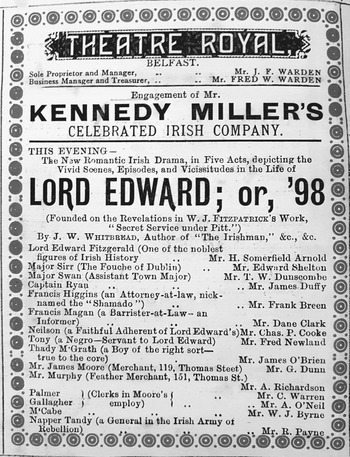
Lord Edward (Fig. 1) dealt with the life of Lord Edward Fitzgerald, a nationalist hero of the 1798 rebellion. However, it attracted audiences equally from the Catholic Falls and the Protestant Shankill, who were seated to the left and right respectively, equipped with their flags, instruments and emblems and, more ominously, rivets purloined from the shipyards. It was a setting deemed unsuitable for the young dramatist, St. John Ervine, whose aunt who refused to take her curious nephew to an Irish Night for:
she was fearful lest there might be a row in the gallery between the Papist and the Orange corner-boys who congregated there on “Irish” nights to make a demonstration of their religious beliefs: one side cheering the British authorities, while the other side pelted them with orange-peel and objurgations.Footnote 43
Again, the drama of these occasions was well underway before the curtain had even been raised with partisan cries of “Up the Celts!” and “Go on the Blues!”Footnote 44 (local Catholic and Protestant football teams) providing a sectarian prelude to the play's opening tune: “The Wearing of the Green”—a nationalist ballad commemorating the 1798 Rising—that prompted the collected Catholic choirs of the Falls and the Markets to demonstrate their political solidarity, if not their musicality, as they roared along:
In response, a similarly enthused Shankill replied with a loyalist broadside of the “The Protestant Boys.” After this roisterous patriotic prelude, McCartan records how the opening of the play proceeded peaceably, as its early scenes of love and tenderness “appealed to Orange and Green alike.”Footnote 46 However, this temporary lull was disturbed when Lord Edward entered center stage to reveal his plans to liberate Ireland from English tyranny, prompting St. Peter's Brass Band, from the heart of Falls, to subsequently “marched[ ] round the boards playing ‘The Boys of Wexford’” in carnivalesque support of their patriot hero's revolutionary speech.
From the program for Lord Edward at the Theatre Royal, Belfast, on 20 August 1894. Courtesy of the Linen Hall.

This nationalist performance subsequently prompted the Protestant gallery to “stage [ ] a melodrama of their own”:Footnote 47 a synchronous, symbolic, and ritualized interaction among text, performance, actors, and audience(s) that was an anticipated and integral part of the theatrical event. This unique and rather intimidating atmosphere prompted one audience member to wonder what the company made of their rowdy reception:
What the Kennedy-Mill[e]r company—straight from the applause of the Old Queen's Theatre in Dublin—thought of this noisy prelude I could only guess; probably they were prepared for it, possibly they enjoyed it.Footnote 48
Local audiences certainly enjoyed these occasions, with Hugh McCartan recalling how the West (of Belfast) would awake as the “thrilling news spread like wildfire through the Falls, the Pound Loney, the Markets … ‘Lord Edward is coming to the Royal.’”Footnote 49
Obviously, the tumultuous conditions and tendentious positions that accompanied these rowdy paratheatrical performances radically affected the reception of the play, given its divided interpretative communities. The febrile atmosphere of the occasion conditioned the theatrical experience in ways that coerced individuals within both factions to decode the onstage action and its depiction of real historical events through partisan lenses. In these heated sectarian settings, such overdetermined readings remained impervious to the actors’ efforts to influence their reading of the play, as each faction supported separate characters as surrogates for their own community's political beliefs. And so, on Irish Nights, different sections of the audience cheered at different occasions; they chanted different slogans and sang different songs in a rowdy environment that resembled that of a local football match. The physical segregation of this polarized and highly partisan audience not only minimized points of contact and conflict between the two communities, but also helped reinforce how each side “read” the historical events being staged before them. This territorial segregation of communities inside the theatre had a profound structural effect in regulating and reinforcing how each community interpreted the performance of divisive events and actions from Irish history. In portraying political struggle, these melodramas spoke directly to the situation of working-class playgoers in Belfast, whose experiences of sectarian division and conflict informed their clamorous reception of Irish Nights and inspired their paratheatrical performances of political affiliations within the auditorium. All of which suggests that these melodramatic plays present a far less stable and coherent narrative than has often been assumed.
For instance, consider the above in relation to the compelling closing scene of Lord Edward. Commended by critics for its powerful emotional charge, the play's denouement is an anomalous exemplar of melodrama's dramaturgy. On one hand, the melodramatic trope whereby heroes are “unjustly sentenced to die (but never executed)”Footnote 50 is violated, as such a scenario (even for the most sensationalist melodramatist) was impossible, given the hard historical facts of Fitzgerald's fate, which precluded any prospects of a last-minute reprieve or rescue. At the same time, Whitbread squeezes as much sensation and sentimentality as he can from the scene as Lord Edward expires, en tableau, in the embrace of his weeping wife and children, regretting the death of the officer he had killed during his arrest yet remaining true to the cause: “I would rather be here wounded as I am, dying of neglect in this miserable dungeon, than be Pitt at the head of the British Empire.”Footnote 51
The villain, Higgins, taunts the hero over his personal and political failure, “Every stick and pin yer have will go to the King, forfeited to the State. … It's death ye're feeling … it's comin’ nigh on ye now an’ whin it grips ye hard and fast in its icy grasp, the Rebellion will die wid you, will die wid you.”Footnote 52 Fitzgerald magnanimously forgives his foe, “I do not—cannot blame you” and mournfully reflects on the failure of the rebellion, “Oh, to know that the green flag of liberty waved above our shores,”Footnote 53 before nobly parting with this paternal peroration:
Do not weep for me. To live in the hearts of those we love is not to die. Farewell, beloved wife, partner of my life's aims, joys and sorrows. Farewell brother, Aunt and trusted friend. Farewell all. Farewell. (Dies) Tableau.Footnote 54
It was a scene that moved one Dublin critic to opine, “no-one who has witnessed [H. Somerfield Arnold's] powerful acting in the last act … will fail to remember it as one of the most emotional and artistic representations ever staged.”Footnote 55 Even in Belfast, “wet eyes were not confined to the Falls and Pound Loney”Footnote 56 (the Catholic quarters), as the sectarian divide was fleetingly bridged by dint of sheer sentiment. Thus both sides left the theatre satisfied, albeit for entirely different reasons, given their divergent readings of this final scene. Loyalists were reassured by the rebellion's defeat, the dispatch of its leaders, and the restoration of the ruling order; a victory that, in the context of the Home Rule crises,Footnote 57 reassured a community that felt threatened by the growth of the Catholic population and its increasing confidence in challenging Protestant supremacy.Footnote 58 For nationalist audiences, however, Fitzgerald's heroic spirit transcended the bitter reality of the rebellion's military defeat: his sacrifice was sanctified by a republican mythology that romanticized its long litany of crushing military failures that were “changed utterly” into moral victories. Fitzgerald's dying declaration, “I have devoted myself wholly to her emancipation. Sacrificed wife, children, fortune, even life itself in her cause,”Footnote 59 and his heroic expiration en tableau in the arms of his family had not only an enormous emotional charge but a powerful political resonance, given the surge of renascent nationalism in the North, particularly in the run-up to the extensive centenary celebrations of the 1798 Rebellion: an uprising led by the United Irishman, a separatist movement founded in Belfast. And so Lord Edward simultaneously valorized nationalist resistance to British rule and validated loyalist views of how historical victories had secured their present-day dominance. These contradictory responses leave the play curiously ambiguous and open-ended: a feature all the more striking in that a distinguishing feature of melodrama (for which it is frequently pilloried) is its simplistic resolution of conflict. Good triumphs over evil; virtue prevails over vice; the hero vanquishes the villain. For Irish Nights, this series of binaries is blurred by conflicting audience allegiances, which complicate these oppositions and confound any prospect of neat resolutions; thus the restoration of a moral order, which melodrama traditionally confirms, here belongs to two mutually exclusive spheres.
Audience Agency in Urban and Rural Settings
Melodrama's dependence on stock characters and stereotypes particularly appealed to the divided audiences of Belfast, who, as the lives of Wolfe Tone, Robert Emmet, Lord Edward, and Major Sirr played out in performance, cast themselves as the heroes and their antagonists, both within the auditorium and onstage, as the villains. The fact that melodrama banished all complexity and ambiguity from the dramaturgic struggle of the hero–villain conflict resembled the sectarian, territorial imperatives of identity formation for working-class unionist and nationalist communities in Belfast.
Melodramatic heroes were traditionally virtuous, gallant, brave, just, and ultimately victorious, whereas villains incarnated the darkness and violence of the play, were attired in black, delivered dastardly asides, and were incorrigibly devious, feigning friendship while plotting feverishly in secret. In the light of this summary of the archetypal melodramatic villain, consider writer Lynn Doyle‘s youthful perception of the Catholic community: “[T]he name of a Home Ruler had necessarily a sinister sound. Home Rulers to my childish mind were a dark, subtle, and dangerous race, outwardly genial and friendly, but inwardly meditating fearful things.”Footnote 60 In his ground-breaking study of popular theatre in Dublin, Stephen Watt argues that for the average theatregoer “history was melodrama,”Footnote 61 and this was even more powerfully the case for those theatregoers among the “Montagues and Capulets of inflammable Linenopolis.”Footnote 62 Melodrama's valorization and vilification of its protagonists created a monochrome moral world that mirrored the polarized reality of Belfast. Both breathed in a world of absolutes, where character and identity were defined in rigid terms and diametrically opposed to each other. In many ways the dramaturgic structure of melodrama and “the Manichean polarities of melodrama's moral world”Footnote 63 also shaped the quotidian mise-en-scène of life in nineteenth-century Belfast in the construction and performance of power, politics, and identity.
One further aspect of these extraordinary theatrical events needs to be considered. Although voluminous scholarship from various disciplines examines the socioeconomic, cultural, and demographic development of Belfast, as well as the complex forces that drove the processes of polarization that shaped the sectarian geography and identity of the city, the theatre has been completely neglected in all historical, political, and cultural studies of the city in this period, even though it remained virtually the singular, secular meeting place in the whole of Belfast.Footnote 64 Catholics and Protestants, separated residentially, religiously, socially, and spatially, attended the theatre together in droves and mixed freely together—with the notable exception of Irish Nights, when audiences self-consciously replicated within the theatre the religious and political segregation extant outside it. While the audience's political and physical polarity reflected (and reproduced) the partisan politics of the play, the separation of audiences into Catholic and Protestant sections also contributed to the overall entertainment of the occasion, for there is a palpable sense of the collective enjoyment of the whole spectacle, particularly in the audiences’ shared anticipation, along with the hapless actors, of the fateful lines that prompted their fusillades. Indeed, in spite of the perfervid political atmosphere of these occasions, I have been unable to find any records of serious disturbance either in or outside theatres in Belfast on Irish Nights, suggesting that these in-house ructions were an accepted part of the theatrical experience. That the audience corralled themselves in different areas and brought “ammunition” with them also suggests a local familiarity with, and popular anticipation of, the likelihood of offstage dramatics. Such a supposition is supported by Whitford Kane's acknowledgment that Irish political melodrama was “always a draw in Belfast, not so much for its dramatic value, but because the audience knew it would get a chance to participate in the performance.”Footnote 65
It is this issue of audience agency that is crucial, all the more so in light of the historical dismissal of popular theatre and the pernicious tendency to regard its audiences as passive plebs. The subtle and complex agency of popular audiences is vividly apparent from the following incident recorded in W. J. Lawrence's unpublished Annals of the Old Belfast Stage when, in 1823, the celebrated actor Edmund Kean visited Belfast, where he performed as Macbeth:
[A]s he commenced one of his grandest speeches a tremendous “boo” came like a report of a cannon from the top gallery, and for a moment disconcerted even the great actor himself. With that eagle glance which distinguished him, he detected the author of the interruption, who happened to be a burly sweep from Smithfield. The piece proceeded and when it was over, Kean hurried to the gallery in semistage costume and met his adversary just as he was descending the stairs. Kean collared him saying, “Why did you hiss me you ruffian?” “Because,” coolly replied the sweep, “you put the wrong foot foremost.”
Kean subsequently released his heckler, reflected on his charge, conceded the point, “and putting his hand into his pocket, he gave his dusky critic a guinea.”Footnote 66 It is a superb example illustrating the sophistication of audiences and their specialized knowledge of performance technique, custom, and practice; they were aficionados of the material stage, not passive ignoramuses. There are myriad accounts and anecdotes of similar such incidents, all of which collectively testify to the limitations of scholarship that examines theatrical performance as something created and presented in front of a passive audience. Irish Nights testify to theorist Tony Bennett's view that “all texts … may be ‘productively activated’ during what is traditionally and inadequately thought of as the process of their consumption or reception.”Footnote 67
This was certainly the case with performances of political melodrama in Belfast before audiences who were malevolently partisan rather than meekly passive. Although Bennett was writing of the role and agency of a literary readership, his theoretical paradigm of “reading formations” can be appositely applied to the performative context of audience participation. This is somewhat comically proven by the performance of yet another Boucicault play, Arrah-na-Pogue, which was productively deactivated by a Belfast audience, as the shipyard worker, poet, dramatist, and staunch Orangeman Thomas Carnduff recalls:
We weren't so sweet on this type of dramatic art, and generally collected a party of enthusiasts to patronise the performance, not so much to welcome the artists, rather to bring the play to an early conclusion. … [W]e filled our pockets with suitable missiles, such as bolts, rivets, half-bricks and such things. … [W]e allowed the play to proceed until one of the actors broke forth into song. He managed to get through two lines of “The Wearing of the Green.”Footnote 68
This intervention resulted in the forcible physical expulsion of Carnduff and comrades by his fellow theatregoers. Such vivid, violent interaction between audience and performance and the intra-action between other audience members powerfully demonstrates the political agency of spectators who participated fully in the spectacle before them rather than being pacified by it.
It was exactly this kind of audience agency and participation that left Bram Stoker ill at ease with plays that explicitly addressed political or historical issues; hence, his evident relief that his client, Henry Irving, was never able to fulfill his ambition of portraying Irish patriot Robert Emmet, whom Irving resembled. Stoker wholeheartedly agreed with the Lord Chamberlain's intervention when it made a “request” that Irving not proceed with a production he had previously announced. The Lord Chamberlain's Office (whose legal remit ironically did not extend to Ireland) evidently suspected that a romantic melodrama, portraying the life story of a romantic Irish revolutionary and performed by the stage's greatest star, could provoke political unrest—a feeling shared by Irving's Irish manager:
[T]he Irish question was acute. Fenianism or certain of its sequelae became recrudescent. The government of the day considered that so marked and romantic a character as Robert Emmett, and with such political views portrayed so forcefully … might have a dangerous effect on a people seething in revolt.Footnote 69
Stoker's reluctance to stage plays addressing contentious political or historical issues stemmed not from his political conservatism, nor any concern for his compatriots, but from his anxiety of the unpredictability of audience reaction to such a charged production, which could potentially usurp the starring role of his client: an inversion that was anathema to him. Although Robert Emmett was written as a star vehicle for Irving, Stoker realized that his status could be potentially threatened by the political agency of his audience:
A great political situation may like any other great existing force form a milieu for dramatic action. … But where the political situation is supposed to be lasting or eternally analogous, it is apt to create in the minds of an audience varying conditions of thought and sympathy. And where these all-powerful forces of an audience are opposed they become mutually destructive, being only united into that one form which makes for the destruction of the play.Footnote 70
Stoker's description of audiences as “all-powerful forces”—able to digest, deconstruct, even ultimately destroy texts if they disagree with their politics—incisively identifies a greater sophistication of nineteenth-century audiences than they are generally accredited, as well as illustrating their critical and creative contribution to activating the theatrical text in order to produce their own meaning.”
In relation to the agency and activity of audiences, I would like to briefly consider two other extraordinary melodramas that were predominantly staged in rural areas throughout Ulster and that are not examined in Watt's, Herr's, Fitz-Simon's, or Trotter's studies: The Siege of Londonderry by John Michelborne and The Battle of Aughrim by Robert Ashton. In spite of their phenomenal popularity, especially in Ulster,Footnote 71 neither has been examined in any great detail—a neglect narcotically noted by the historian G. C. Duggan: “The poppy of oblivion appears to have fallen on them.”Footnote 72 As may be surmised by the titles, both plays deal with the momentous seventeenth-century battles that marked the defeat of Catholic armies by Williamite forces, and the fact that these iconic historical events are enacted in each makes their historiographical banishment to the wings of Irish theatre history all the more ironic.
William Carleton records that both plays further fomented sectarian strife in rural Ulster, albeit it in a radical new form as, in Carleton's words, “political rancour became dramatic.” He records that both plays “were acted in barns and waste houses night after night, and were attended by multitudes, both Catholic and Protestant.”Footnote 73 Both were widely taught in hedge schools, learned by heart, and regularly recited and performed throughout the North. The Battle of Aughrim, in particular, was popular with the Orange Order, who enacted it in order to “show to the whole world how the field of Aughrim was so gloriously won”;Footnote 74 but the extent to which their world extended beyond their Catholic neighbors is doubtful.Footnote 75 Attracted to the play's strongly pro-Williamite sentiments, the author being “a great enemy of popery and wooden shoes,”Footnote 76 they originally performed their play within their own community, and these productions are very much performative precursors to the pageants and parades that are so much part of present-day Orange culture.
However, unlike performances of the modern-day mock Battle of Scarva,Footnote 77 members of the Catholic community also took part in these early productions of The Battle of Aughrim.Footnote 78 What is altogether more surprising is that these were not perforce performances, as Carleton records local Catholics actually approached the Orange Order to request if they could “be allowed the favour of representing the Catholic warriors of the disastrous field.”Footnote 79 Subsequently, casting of the dramatis personae of Jacobite and Williamite forces proceeded along traditional tribal lines and inevitably resulted in a sanguinary, sectarian showdown of erstwhile neighbors, roared on by their kith and kin in the audience, so that:
[W]hen they came to the conflict with which the play is made to close [the Battle of Aughrim], armed as they were on both sides with real swords, political and religious resentment could not be restrained, and they would have hacked each others’ souls out had not the audience interfered and prevented them. As it was, some of them were severely if not dangerously wounded.Footnote 80
A more literal manifestation of Conor Cruise O'Brien's maxim that Irishness “is the condition of being involved in the Irish situation, and usually of being mauled by it,”Footnote 81 would be difficult to find. Subsequently, “swords were interdicted and staves substituted”: an emergency health and safety measure that met with only limited success, for the consequence, “as might have been expected, was that heads were broken on both sides, and a general fight between Protestant and Catholic portions of the actors and the audience ensued.” In spite of these minor setbacks, a “new system was adopted” with innovative introduction of cross-casting, whereby Williamite characters were played “by staunch Catholics, all probably Ribbonmen,” and Jacobite characters were to be played by the “most violent Orangemen in the parish.”Footnote 82 This new system initially worked, with the only act of violence involving the ejection of “an unfortunate flunkey, who had seen a play in Dublin, and shouted ‘up with the rag,’ for which, as it was supposed that he meant to turn the whole thing into ridicule, he was kicked out by the Ghost, who … was one of the stoutest fellows among them.”Footnote 83 The play proceeded peaceably until half the stage floor of the local barn collapsed—the Catholic half, leading to talk of a “Protestant plot”—and enmities among the audience members resumed. Moving the performance outside and “fighting out the battle on the green,” the actors’ “orange and green ribbons were soon flung off as false emblems of the principles which they had adopted only for the sake of ending the play in a peaceable manner.”Footnote 84
Carleton's two versions of these performances (even his comically exaggerated and embellished version published in Humours) are remarkable descriptions of how traditional theatrical codes and conventions of illusion and reality, past and present, audience and actors, collapse in the heat of the moment in “acting out” The Battle of Aughrim, as atavistic animosities overwhelm the performers. It seems that the Catholics protagonists, bitterly resentful of both the triumphalist historical narrative the written text (re)imposed on them and the subordinate social position it reinforced, were determined to resist these roles by reversing their historical defeat to exact revenge on their contemporary enemy in the live, performative present: “‘Well they bate us at Aughrim,’ said the Catholics, ‘but … we'll turn the tebles [sic] and lick them now’”—a retributive reversal that resonated with the millenarian politics of the Ribbonmen and other nationalist secret societies. Conversely, Protestant actors sought to (re)produce the play to protect and perpetuate the social order it helped shore up, which had secured their superiority ever since the historic battle they were now literally reenacting: “‘We licked them before,’ said the Orangemen, ‘an’ by japers, we'll lick them again.’”Footnote 85
Carleton's description of a divided community, ritually reenacting the past to reinforce it on one side and rewrite it on the other, is remarkable. This is all the more so when considered in relation to one of the central questions raised by Freddie Rokem in Performing History: “As we know, it is usually the victors, not the victims, who write history. The question is to what extent this is true of those who ‘perform’ it on the stage as well.”Footnote 86 These forgotten performances of The Battle of Aughrim are extraordinary examples of the victors’ (written) history being contested (in performance) by those “victims” they have written out of history. In these palimpsestic performances, both communities ritually (re)enacted history either to reinforce or resist the social hierarchy and political hegemony of the present. As such, these rural performances of military melodramas mirrored the violent, paratheatrical performances of identity enacted by their urban counterparts in the increasingly urbanized and ghettoized Belfast of the nineteenth century.
Melodramatic Formations: Playhouse and the Polis
Melodrama's reductive absolutism and its central dramaturgical axis of virtue versus vice, good versus evil also reflected (and reproduced) the polarized sectarian processes that shaped Belfast's geography and politics in the latter nineteenth century, as the political teleologies of unionism and nationalism were constructed on similarly absolutist terms. The populist appeal of melodrama, its reliance on sensation and spectacle, as well as its emotionally charged speech resembled the demagogic rhetoric deployed by Belfast's street preachers and political leaders as they sought to mobilize the masses throughout the mid to late 1800s. Accordingly, it seems astonishing that such strident, sectarian demonstrations of political allegiance and religious animosity, made in such close proximity to one another on Irish Nights, did not generate far greater violence.
One explanation is that, as a venue, the official auditorium provided a different spatial and temporal context from the streets outside: one that helped to contain, both literally and figuratively, its audience. Such a “safety valve” thesis is supported by historian Douglas Reid, who suggests that “apart from the hustings, the theatre was perhaps the last location where an ‘eighteenth-century’ commotion could still occur,”Footnote 87 given that it was a public forum that facilitated expressions of distress from downtrodden sections of society. Certainly, the lack of any serious disturbances on Irish Nights in theatres in Belfast—a city blighted by sectarian violence—supports this notion, and that the fact that only a few cracked heads were incurred suggests these re(staged) battles between religious factions were theatricalized interactions and part of the night out.
Indeed, there is a long history of political disturbances at the theatres in Ireland, most notably the infamous case of the Orangemen who rioted in Dublin's Theatre Royal in December 1822, hurling wood and oranges at Viceroy Wellesley to demonstrate their displeasure at his administration's movement toward agreeing to introduce Catholic Emancipation. Mary Condon describes how the theatre was packed with Orangemen, all of whom met beforehand in Ship Street Orange Lodge, where they were “given whiskey and bludgeons.”Footnote 88 Political placards were also brought to the theatre, and the riot commenced when the band began to perform “God Save the King” at the end of the play.
The deliberate selection of the theatre as the venue to target the viceroy dramatically illustrates how the theatre also operated as a public stage for the expression of political discontent, and indeed there have also been many cases in Belfast of the theatre being used for similar paratheatrical political performances.Footnote 89 As Christopher Morash highlights in his vivid survey of the Irish stage, the theatre had long enjoyed a “legal status … as a place of public protest,”Footnote 90 and the prolific number of protests and disturbances that transpired in nineteenth-century playhouses were events that were tolerated by civil and legal authorities. Official recognition of this role was actually enshrined in law, as was reflected by the fact that the legal defense for these Orangemen “based its case on the theory that a disturbance at the theatre was not a breach of the peace”:Footnote 91 a legal argument confirming the unique sociopolitical position of theatre and illustrating rather remarkable levels of tolerance for such practices in an increasingly strict age.
In fact, as an institution, theatre was unique in that it straddled two vying, political cultures: that of the eighteenth century's riotous public protest and the nineteenth century's rigid social control. It was able to accommodate both given its particular position in society as a “‘closed’ or only semi-public arena where social disruption can occur without necessarily having implications for the whole social order.”Footnote 92
Staging the Nation?
And yet, for its aristocratic founders, one of the key attractions of the nascent national theatre was the “enticing prospect of social consensus” wherein nationalist and unionist spectators “were agreed … [and] would behave not like a crowd but like individual citizens.” For this “theatre of political citizenship”Footnote 93 to materialize, however, the rowdy conditions of the nineteenth-century playhouse needed to be modernized and its unruly spectators converted into passive citizen-subjects. Thus, the declaration in the Irish Literary Theatre's founding manifesto that Ireland was not the “home of buffoonery and of easy sentiment” signaled not only its repudiation of (Boucicaultian) melodrama, but its bourgeois rejection of the participatory culture of the popular stage. And so, in the project of the Irish national theatre, as Lionel Pilkington astutely argues, the disciplinary processes of theatrical modernism and political modernization dovetailed: an ideological congruence crystallized in Yeats's (inaccurate) invocation of Victor Hugo: “In the theatre, the mob becomes a people.”Footnote 94 If the tumultuous atmosphere of the playhouse and the politicized interactions of its moblike audiences were antithetical to the modernist mission of Yeats and his fellow Ascendancy proponents of the national theatre, then their agency would have to be curbed through the cultivation of an audience “trained to listen.”Footnote 95 This abjection of popular theatre with the advent of modern Irish drama was not unique to Ireland and reflected the embourgeoisement of theatre audiences in the twentieth century whereby spectators were silenced in darkened auditoria, physically as well as perceptually separated from the action onstage, staring at the light, supine and susceptible. Pacifying and positioning audiences in this way predisposed them to read the spectacle before them in certain ways while concomitantly restricting their modes of response, all of which eroded their political agency so as to render them passive spectators rather than rowdy participants. This particular aesthetic contract and its creation of spectator-citizens was one that reflected (and reproduced) the disciplinary processes of nation-building outside the theatre through the mass mobilization of individuals and geographically dispersed groupings into a coherent imagined community. This wider nationalist rehearsal of a public sphere in the pursuit of Ireland's political independence was one in which the “national” theatre played a critical role as an ideal apparatus for “dissipating political conflict, shaping social behaviour, and reinforcing traditional structures of authority.”Footnote 96 However, as I have argued in this essay, there was little prospect of it ever dissipating political conflict or disciplining the social behavior of spectators in the febrile atmosphere of Belfast's playhouses, where fissiparous working-class audiences provided a counter–public sphere from that produced in the capital. The working-class counterpublic attending Irish Nights could not be assimilated into nationalist narratives of nation and remained inimical to such conceptions of political identity.Footnote 97
In his preface to The Bending of the Bough (1900), George Moore declared that “[t]he same audience goes everywhere, and the same fare is consequently served everywhere at the same prices.”Footnote 98 However, audiences are never homogeneous, as is vividly apparent with Irish Nights, which demonstrate the wildly variant receptions of Irish political melodrama in Dublin and Belfast: two cities “very little more than a hundred miles apart, yet … Manchester and Bombay are not more separated in spirit.”Footnote 99 A critical consideration of how these disparities shaped the horizons of expectation of audiences in both cities reveals how the “enticing prospect of social consensus” entertained by the Ascendancy founders of the national theatre inevitably proved illusory. For decades, the dominant historiographical narrative of the Irish Revival dismissed the popular stage and elided earlier indigenous theatrical practices to elevate the role of the Abbey Theatre in the project of staging the nation. In light of the consequent canonical exclusion and critical relegation of melodrama, it seems profoundly ironic that this maligned form proves so prescient in revealing the future fault lines of this project (later manifest in the act of partition) that were created by cultural forces and identitarian feelings—unionist, Protestant, urban, proletarian—enacted on Irish Nights, which were violently recalcitrant to emergent models of national identity that later became hegemonic.
However, the role and agency of audiences, which were so prominent in the nineteenth-century playhouse, have been relegated in Irish theatre scholarship and have received relatively little scholarly attention. Perhaps the ultimate success of both bourgeois modernism and nationalism in removing the rowdy, participative character of the nineteenth-century stage and its concomitant pacification of audiences within a new contract of realism can be best measured by their continued “silence” in Irish theatre scholarship.Footnote 100 This neglect, however, has been to the detriment of the discipline as a whole, as the question of audiences’ political agency is crucial, not only for any investigation of the (re)production and reception of dramatic texts, but for the whole project of staging the nation. After all, the very fact that theatre was used as an ideological apparatus to represent, or rather, invent the Irish nation fundamentally calls into question the role of the people/spectators: Were they passive audiences or active agents in this process? As Loren Kruger inquires, “is the audience spectator or participant? incoherent crowd or mature nation?” and “does mature nationhood call for participation or simply assent?”Footnote 101
When such questions are considered in relation to audience dissent as enacted in Belfast's theatres, the complexities and contradictions over conflicting narratives of “nation” proliferate. In performance, political melodramas of nationalist history were denied any neat denouement, as the Manichean struggles they had dramaturgically resolved were reactivated once more by Belfast's restive audiences, among whom there was precious little political consensus. The partisan interactions of Belfast's fractious audiences undercut the formulaic emotionalism of melodrama, reinforced sectarian cleavages, and ensured no simple or stable resolution could be reached. And it is this lack of consensus and closure, as a divided audience renews and replays conflicts that neither the dramaturgical form of the play nor the institutional frame of the theatre can effectively contain, that seems precociously modern, in that it accurately captures the contemporary political deadlock and deepening sectarian division that endures in Belfast today
Tableau.