Introduction
In recent decades, there are many persistent organic pollutants and carcinogens in wastewater from textile, plastic, pigments, and pulp industries which can cause serious environmental problems [Reference Brindha and Sivakumar1, Reference Li, Xie, Jiang, Yu and Zhang2]. Although the current methods for wastewater treatment including chemical (chlorination and ozonation), physicochemical, electrochemical, and biological are effective, they can lead to many troubles, such as hazardous by-product generation, high cost of equipment, low effectiveness, and long operation time [Reference Garcia-Segura and Brillas3]. It is a big challenge to develop easy, superior, efficient, and environmentally friendly methods. Photoelectrocatalysis (PEC) is composed of photocatalytic and electrochemical oxidation process, which is considered as an effective technology to eliminate persistent organic pollutants in wastewater [Reference Liu, Ding, Wu and Teng4].
PEC efficiency is directly related to the properties of photocatalytic materials. Therefore, to obtain a highly efficient PEC material that can degrade refractory organic pollutants under solar, many researchers have devoted themselves to this field and achieved many application results. As photoelectrode materials for green applications, immobilized TiO2 films have deserved increasing attention, which can be ascribed to their utilization of solar energy, nontoxicity, long-term chemical stability, and less secondary pollution [Reference Wang, Zhu, Liu, Zhang, Crittenden, Zhang and Cong5, Reference Lyu, Liu, Wang and Tian6]. Compared with the nanoparticles, the TiO2 films can be easily separated from treated wastewater so that they can be recycled. However, there are several notable disadvantages of TiO2 films which influence the photocatalytic performance, including low utilization of sunlight due to its wide band gap (3.2 eV for anatase), low specific surface area, and low separation efficiency of photogenerated electron–hole pairs obviously [Reference Zhou, Zheng, Zhou and Zhou7, Reference Kmentová, Nandan, Kment, Naldoni, Gawande, Hubička and Zbořil8]. They decrease the TiO2 films’ photocatalytic activities and deeply impede the practical applications. Therefore, many efforts have been made to further improve the photocatalytic activity of TiO2 and utilize more solar energy to overcome these limitations.
The nonmetal (especially N and S) doping can efficiently narrow the band gap of TiO2 films, enhance optical absorption to the visible light region, and accelerate the separation of photogenerated electron–hole pairs [Reference Rahimi, Pax and Gray9, Reference Li, Zhao, Shindume Lomboleni, Huang and Peng10]. Nowadays, N/S doping is recognized as one of the most promising researches. Daghrir et al. [Reference Daghrir, Drogui, Delegan and El-Khakani11] prepared a mixture of anatase and rutile crystal phase N/TiO2 films, which exhibited a high photoelectrocatalytic performance under visible light owing to an obvious redshift in the optical absorption. Umebayashi et al. [Reference Umebayashi, Yamaki, Itoh and Asai12] also reported an excellent photoelectrocatalytic activity under visible light irradiation when TiO2 catalyst was doped into S. This is due to mixing of S 3p with the O 2p level and/or forming localized states in TiO2 lattice that can increase the width of valence band (VB) and result in band gap narrowing. In a study by Andoshe et al. [Reference Andoshe, Yim, Sohn, Kim, Kim, Kwon, Hong, Choi, Moon, Hong, Han and Jang13], the TiO2 film modified with N and S was fabricated, which display high absorption in the visible-light region for efficient photoelectrochemical solar water oxidation. N-doped TiO2 narrows the band gap through forming nitric oxides (NO) bond with the π character at interstitial lattice sites [Reference Chen and Burda14]. So far, almost all N/S TiO2 films have been prepared in NH3 or H2S atmosphere at a high temperature to ensure N- or S-dopants into the TiO2 film lattices [Reference Asahi and Morikawa15]. These methods not only cause energy waste, but also have harsh preparation conditions. The problems can be avoided by the electro-oxidation methods [Reference Momeni, Ghayeb and Ghonchegi16], while most of the chemical reagents with nitrogen and sulfur sources are complex and toxic (see Table SI). Meanwhile, it is also difficult to treat the reactants after preparation. Therefore, simple and eco-friendly reagents become the key to solve the problem.
Persulfate (PS, S2O82−), a strong oxidant, could be activated to produce stronger sulfate radical (SO4•−) by electron transfer [Reference Chen and Huang17] [Eq. (1)]. Sulfate radicals can obtain electrons from ammonia nitrogen (NH4+) in pH value of 3–8.3, which makes the nitrogen of ammonia into a higher valence state (N2 and NOx) [Eq. (2)] [Reference Deng and Ezyske18]. Meanwhile, PS generates practically inert sulfate anions as final product that not be considered as pollutants.
 $${{\rm{S}}_2}{{\rm{O}}_8}^{2 - } + {{\rm{e}}^ - } \to {\rm{S}}{{\rm{O}}_4}^ - + {\rm{S}}{{\rm{O}}_4}^{2 - }\quad ,$$
 $${\rm{S}}{{\rm{O}}_4}^ - + {\rm{N}}{{\rm{H}}_4}^ + \to {{\rm{N}}_2} \uparrow + {\rm{N}}{{\rm{O}}_x}\left( {{\rm{molecules}}} \right) + {\rm{S}}{{\rm{O}}_4}^{2 - }\quad .$$
In this study, ammonium persulfate ((NH4)2S2O8) was used as an electro-oxidation reagent to fabricate NOx/S6+–TiO2 films for promoting N and S codope into TiO2 lattices. The obtained film’s morphology, crystal structure, chemical composition, optical properties, and photoelectrochemical activities were investigated by various characterization techniques. Subsequently, the film was used for PEC degradation of methyl orange (MO) under solar irradiation. Under the same conditions, the degradation effects of other pollutants (methylene blue and nitrobenzene) were also determined. In addition, the possible degradation mechanism was proposed by radical quenching experiment.
Results and discussion
Elemental composition analysis
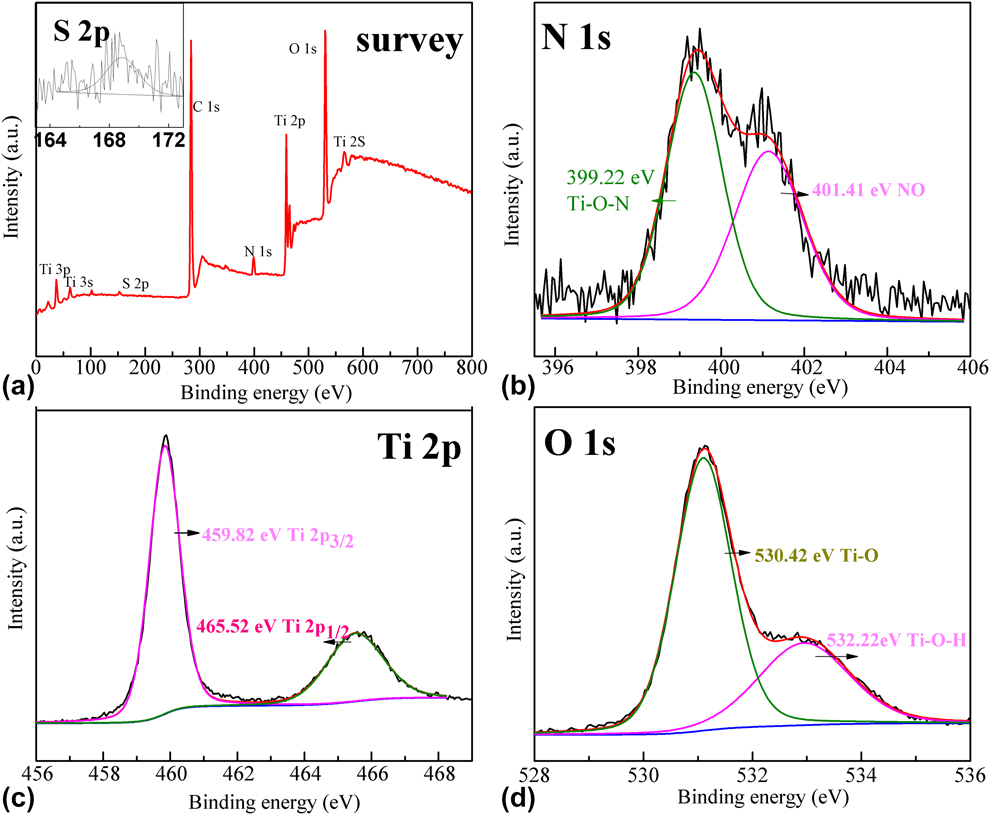
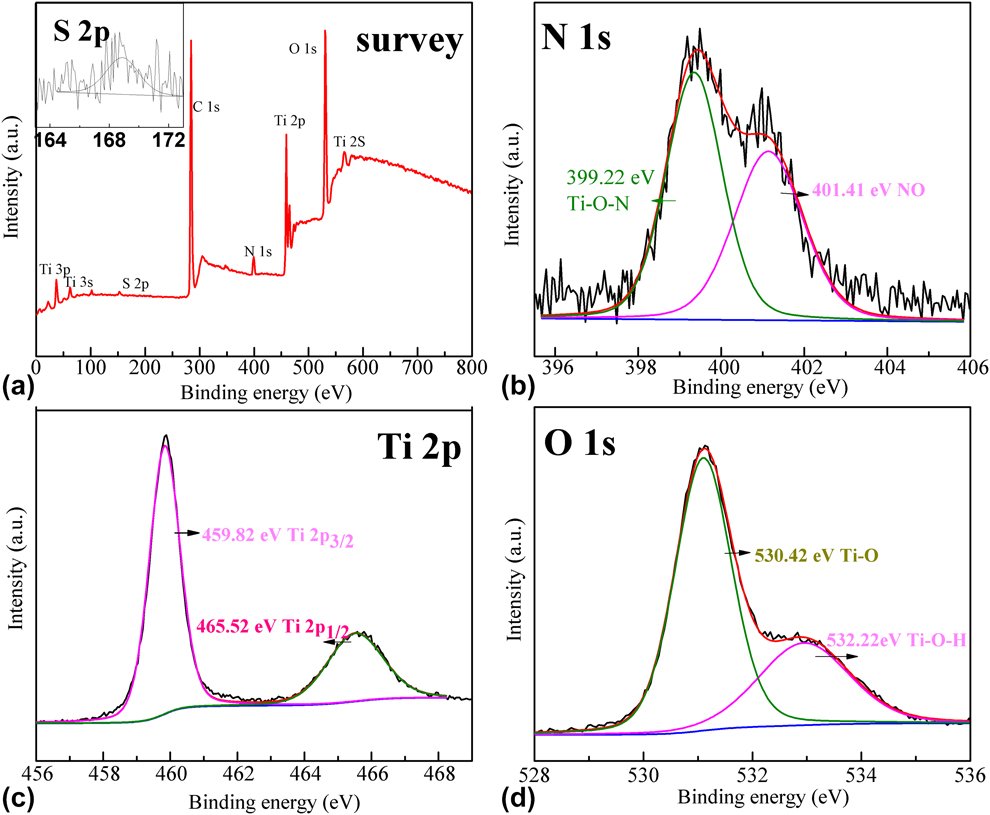
Chemical compositions were carried out in the wide scan X-ray photoelectron spectroscopy (XPS) spectra for the NOx/S6+–TiO2 film. Composition elements of Ti, N, O, S, and C were observed in Fig. 1(a). It can be clearly confirmed that N (3.34 at.%) and S (0.28 at.%) were successfully codoped into TiO2 lattice, and N doping concentration was much higher than that in most existing peer literatures [Reference Gomathi-Devi and Kavitha19]. Among them, the impurity C element was derived from adventitious carbon-based contaminant in XPS instrument during the testing process. In the insert of Fig. 1(a), there is only one weak peak of S 2p at 168.88 eV, which was ascribed to S6+ state. Due to the large size of S6+, it is impossible to dope in Ti–O gap or displace oxygen, but it can replace Ti4+ to form Ti–O–S bonds [Reference McManamon, O’Connell, Delaney, Rasappa, Holmes and Morris20]. The binding energies at 399.22 eV and 401.14 eV were assigned to Ti–O–N bonds and NO, respectively [Fig. 1(b)] [Reference Yang, Wang, Yang, Yan, Ding and Xiao21, Reference Wu and Yin22]. The NO molecules possibly derived from Eq. (2) or produced from oxidation reaction of residual NH4+ at a high temperature on the film surface were trapped in the microvoids [see in Fig. 2(d)] or incorporated within TiO2 lattice [Reference Sysoev, Okotrub, Gusel’nikov, Smirnov and Bulusheva23, Reference Bendova, Kolar, Marik, Lednicky and Mozalev24]. Ti4+–O bonds were inferred from two binding energies at 459.82 eV and 465.52 eV peaks, respectively indicating the presence of Ti 2p 3/2 and Ti 2p 1/2 [Fig. 1(c)]. Ti 2p 3/2 was shifted to higher binding energy in comparison with pure TiO2 (458.6 eV) [Reference Fan, Ma, Liu, Chen, Dong and Yin25]. The high binding energy of this double was beneficial to assign the peak to hydrated titanium-containing compounds. Figure 1(d) showed the high-resolution XPS spectrum of O 1s. There were two high binding energy peaks of rich hydroxyl species at 531.09 and 532.94 which could promote its hydrophilicity and were conducive to the PEC degradation of organic pollutants [Reference Cheng, Liu, Chen, Li and Wang26]. The atomic ratio of O to Ti was 2.41 (>2), meaning that there was titanium oxynitride (oxysulfide) in the NOx/S6+–TiO2 film. Binding energy of elements shifted to high energy, which indicated that the electrons were easier to flow to N and S dopants that combined with titanium oxide, thus reducing the recombination of electron–hole pairs [Reference Chen and Clemens27].
XPS spectra of NOx/S6+–TiO2 film: (a) Full survey spectrum and the inset was S 2p, (b) N 1s, (c) Ti 2p and (d) O 1s.
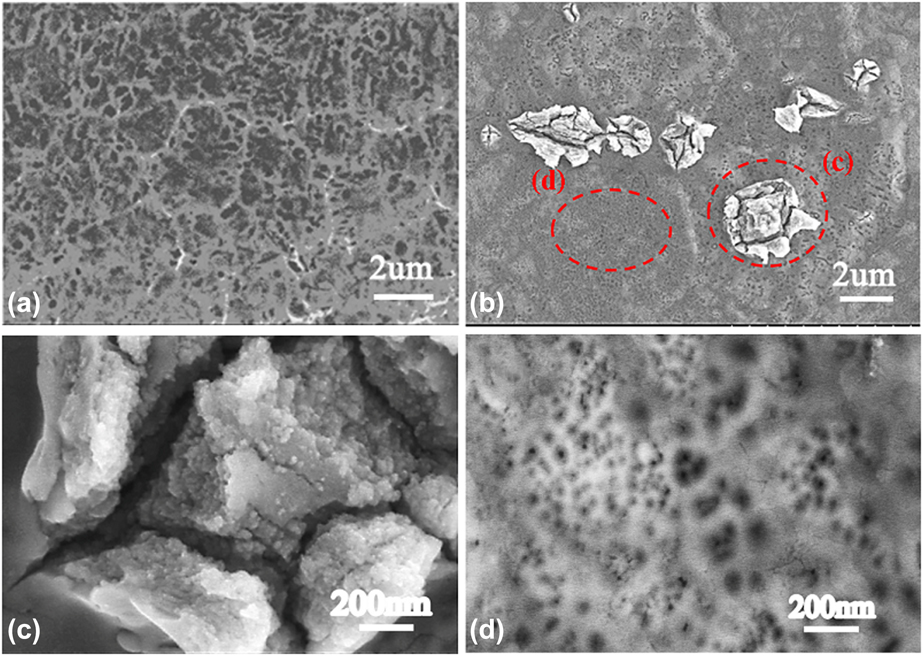
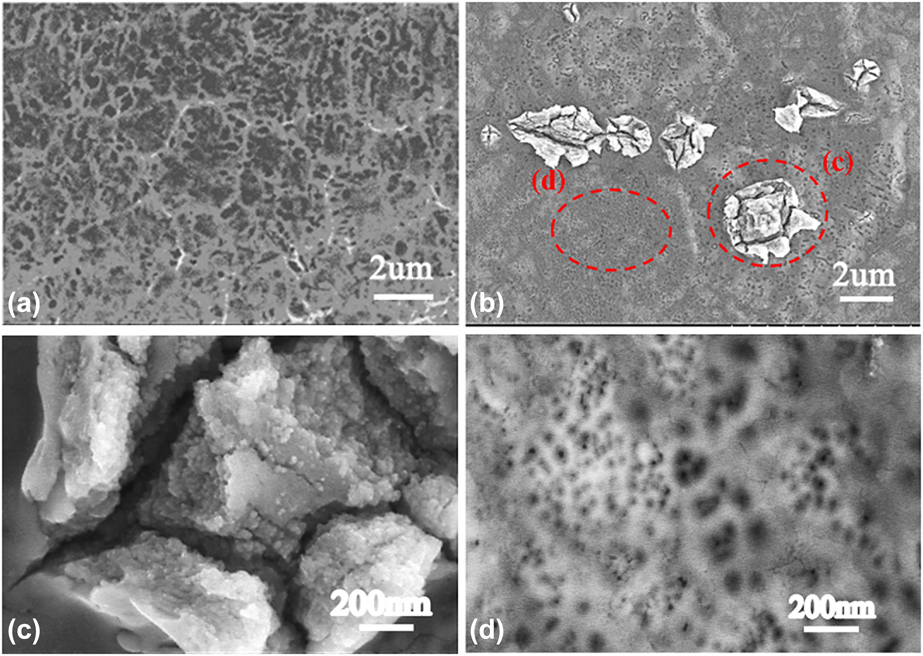
FE-SEM images of (a) Ti substrate, (b) NOx/S6+–TiO2 film, (c) and (d) local enlarged images in (b).
Morphology and crystal structure analysis
The prepared samples were first characterized by SEM to observe the possible morphology structures. As shown in Fig. 2(a), Ti substrate surface formed an oxide film with irregular pores after mechanical and chemical polishing. Some “flower-like” structures grew out on the surface via electric assistance, and a large number of microvoids were distributed around them [Fig. 2(b)]. The rough Ti substrate caused nonuniform electric field, especially at these irregular pores with high voltage [Reference Zhang and Wang28]. The pores acted as crystal nucleation sites and the nitric/thionic ions [from Eqs. (1) and (2)] focused preferentially on these sites. Therefore, the pores were easier etched and further facilitated crystallization [Reference Wei29, Reference Mazzarolo, Curioni, Vicenzo, Skeldon and Thompson30, Reference Chen, Glans, Qiu, Dayal, Jennings, Smith, Burda and Guo31], resulting in the formation of “flower-like” structures with the increase in time [Fig. 2(c)]. Meanwhile, many microvoids with different depth were also formed in the direction of different electric intensity [Fig. 2(d)] [Reference Zhang and Wang28]. For further study of microstructural characteristics of the NOx/S6+–TiO2 film, the internal structure was measured by transmission electron microscopy (TEM). At low magnifications, it clearly revealed that the film had a uniformly well-dispersed pore structure [Figs. S1(a) and S1(b)], which was consistent with the SEM observation results [Reference Manju and Joseph-Jawhar32]. The single crystal and internal mesoporous structure can be seen in high-resolution TEM [Fig. S1(c)], indicating that the film exhibited good crystallinity. The crystal surface spacing of lattice fringe was 0.35 nm, corresponding to anatase phase (101) [Reference Pan, Shen, Jin and Zhu33].
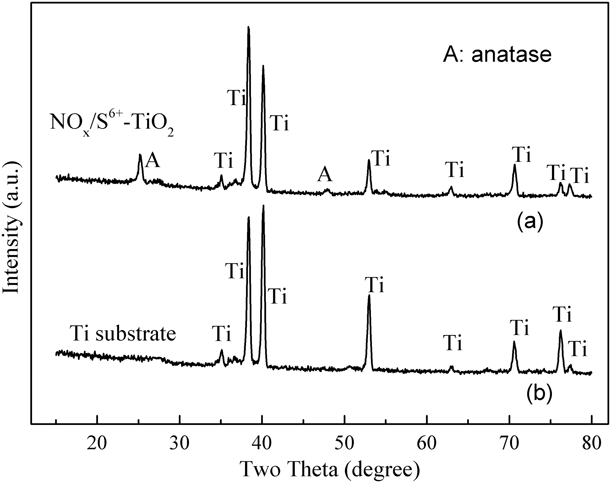
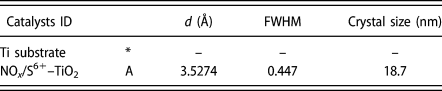
The Ti substrate displayed only titanium crystal peaks (PDF no. 44-1294) [Fig. 3(a)], while two diffraction peaks of anatase phase appeared in the NOx/S6+–TiO2 film at 25.26° (101) (PDF no. 21-1272) and 48.02° (200) [Fig. 3(b)] [Reference Li, Han, Wang, Zheng, Wan and Ni34, Reference Yan, Dong, Zhang, Wang, Gang, Fei, Deng, Zhang and Zhang35]. The width and intensity of the (101) peak were broad and strong, indicating the smaller crystallite size and higher crystallinity [Reference Behpour and Atouf36]. The crystallite size was calculated from the X-ray diffraction (XRD) patterns by Scherrer’s equation [as follows Eq. (3)] from the width at half maximum of the TiO2 phase (Table I). It can be seen that the anatase crystallite sizes were small, which suggested that N and S codoping could efficiently inhibit crystallite growth [Reference Bhirud, Sathaye, Waichal, Ambekar, Park and Kale37]. Furthermore, N and S codoping effectively promoted the formation of anatase TiO2, thereby increasing the film’s photoresponsive activity [Reference Li, Xu, Liu, Qin and Pan38].
 $$D = {{K\lambda } \over {B\cos \;\theta }}\quad ,$$
where D is the NOx/S6+–TiO2 film size, K is Schiller constant (0.89), λ is the wavelength of X-ray radiation (0.154056 nm), B is the full width half maximum of diffraction peak, and θ is the scattering angle.
XRD patterns of the samples. (a) Ti substrate and (b) NOx/S6+–TiO2 film.

The crystal size of NOx/S6+–TiO2 film.

“–”: No data, “*”: titanium crystal, “A”: Anatase.
Analysis of optical properties
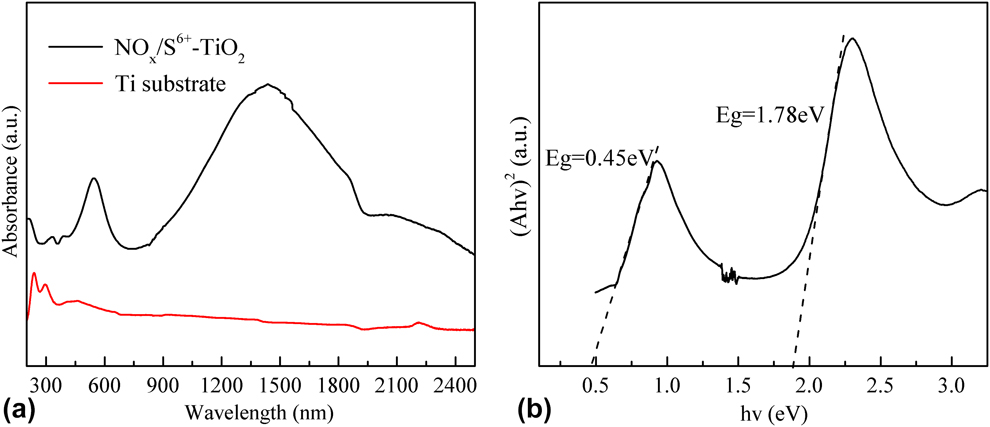
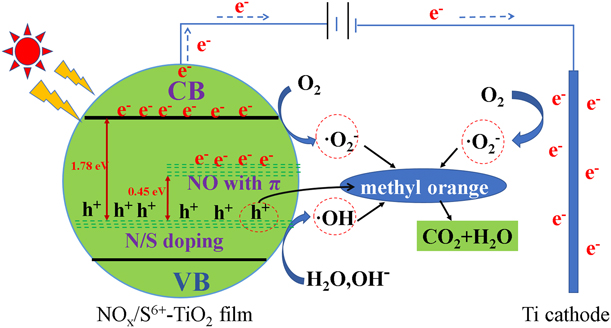
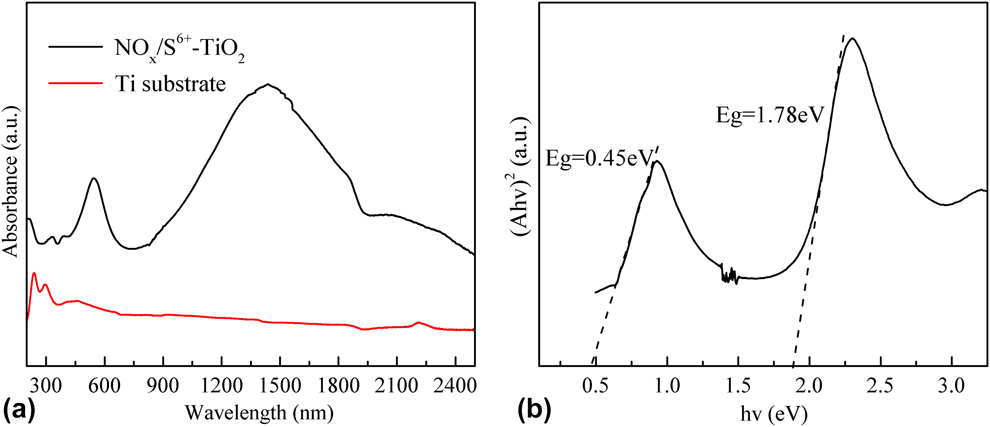
The UV-vis diffuse absorption spectra of the films were shown in Fig. 4(a), almost no absorption peak was found for Ti substrate. However, the major absorption peaks appeared in visible region (544 nm) and near-infrared region (around 1500 nm) for the NOx/S6+–TiO2 film. To determine the band gap energies, a plot of (Ahv)2 versus hv was shown in Fig. 4(b). The NOx/S6+–TiO2 film displayed lower band gap energy (1.78 and 0.45 eV). The band gap at 1.78 eV was ascribed to the formation of delocalized state above the VB because of interstitial N/S 2p and O 2p interaction [Reference Liu, Mu, Zhong, Chen, Zhang, Yang, Wang, Deng, Shen and Zhang39]. The band gap at 0.45 eV may be caused by the NO bond with π character generating new localized states between VB and conduction band (CB) [Reference Zhou, Song, Wang, Komarneni and Yan40]. In summary, the optical transitions among N/S dopants, dopant-induced levels, and Ti hole orbitals could explain the observed visible-light absorptions of N, S elements-doped TiO2 films. Photoluminescence (PL) spectroscopy can measure the separation rate of photogenerated electron–hole pairs [Reference Li, Han, Wang, Zheng, Wan and Ni34]. The emission signal of photo-induced spectroscopy was mainly derived from the recombination of photogenerated electron–hole pairs. Therefore, PL intensity could generally reflect the level of photocatalytic activity. The weaker PL intensity suggested that more electron–hole pairs were generated, which provided favorable conditions for photocatalytic degradation of organic compounds [Reference Zhang, Wang, Liu and Li41]. From the spectrum (Fig. S2), PL intensity of the film was very weak after N and S doping, displaying that charge transfer could rapidly occur between N/S dopants and TiO2, thus promoting the separation of electron–hole pairs.
(a) UV-vis absorption spectra of Ti substrate and NOx/S6+–TiO2 film, and (b) plots of transformed Kubelka–Munk for band gap energy in UV-vis absorption spectra.
Measurement of photoelectrochemical activity
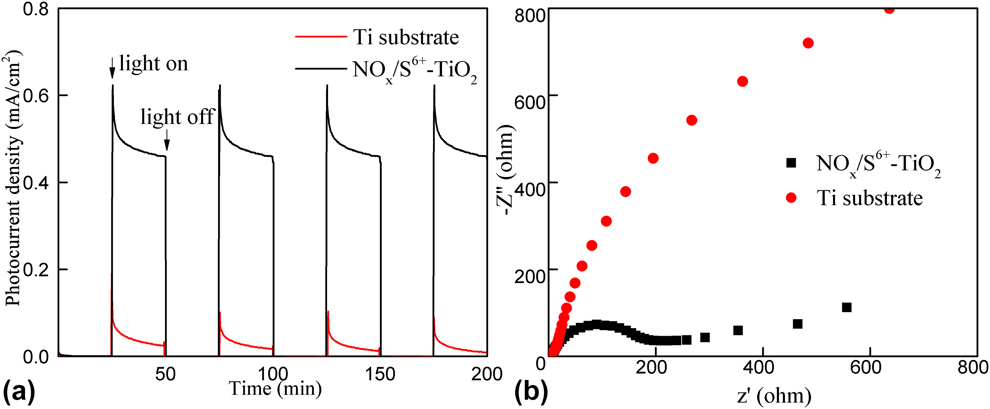
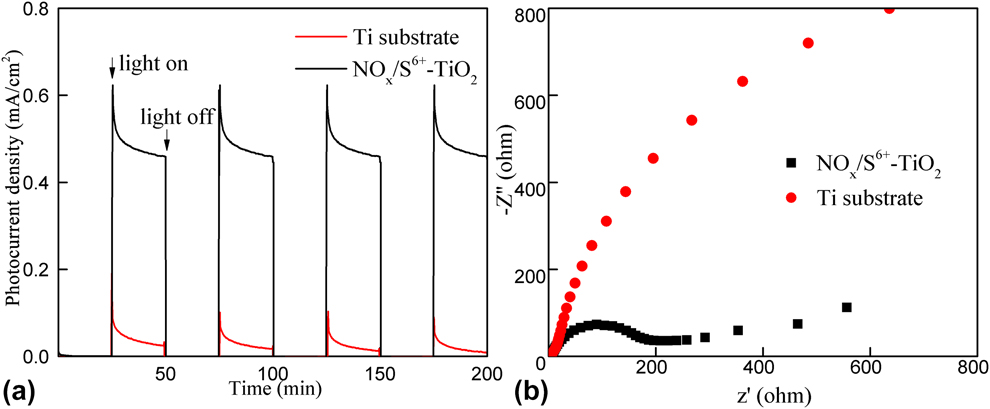
The photocurrent response of specimens was investigated to evaluate the photocatalytic performance under solar irradiation [Fig. 5(a)]. Ti substrate hardly generated photocurrent, while the NOx/S6+–TiO2 film showed a high photocurrent density of 0.46 mA/cm2. Both the long-time and cyclic photocurrent indicated good stability and reproducibility of the obtained film. In addition to photocurrent density analysis, the electrochemical impedance spectroscopy (EIS) Nyquist plots of Ti substrate and NOx/S6+–TiO2 film were also compared under solar conditions. From the plots in Fig. 5(b), it was observed that N/S codopants in TiO2 film greatly reduced the circular radius, and small circular radius typically indicated a low charge transfer resistance of the interface between electrode and electrolyte [Reference Wang, Zhu, Liu, Zhang, Crittenden, Zhang and Cong5]. These results suggested that electrons could rapidly transport to the electron donor/electron [Reference Brindha and Sivakumar1].
(a) Photocurrent response of NOx/S6+–TiO2 film with a potential bias of 0 V versus Ag/AgCl and (b) EIS Nyquist plots measured in 0.05 M NaCl aqueous solution with a frequency range of 100 kHz–0.05 Hz at amplitude of 10 mV.
Evaluation of photoelectrocatalytic activity
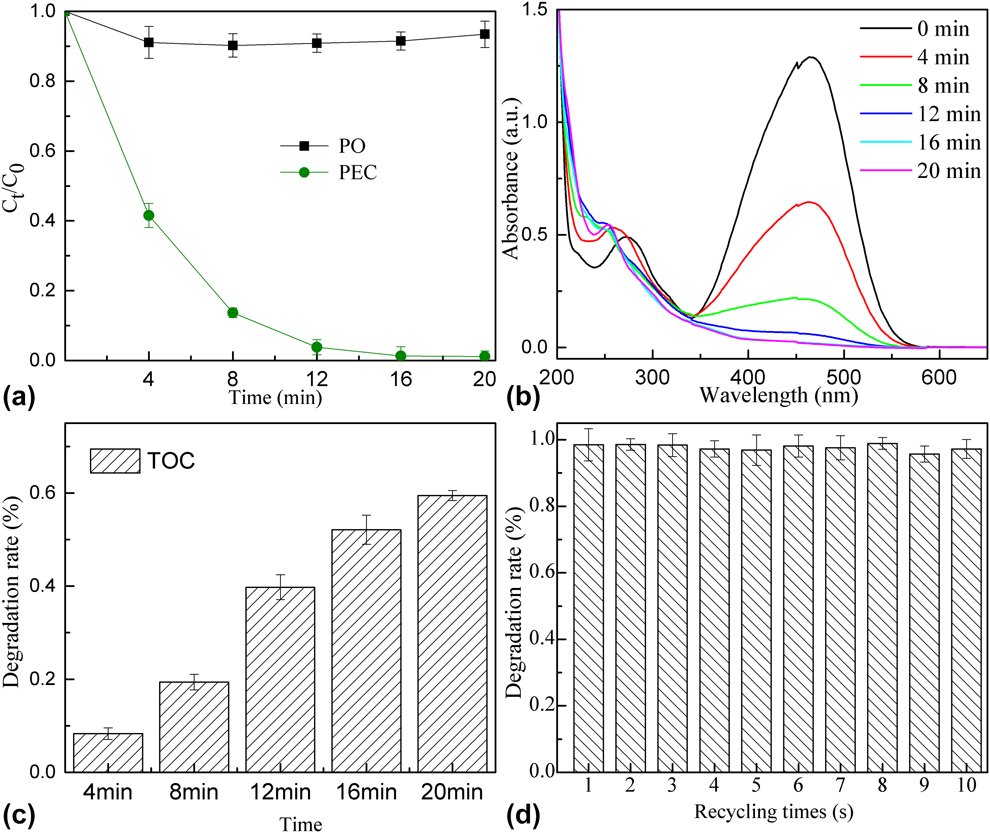
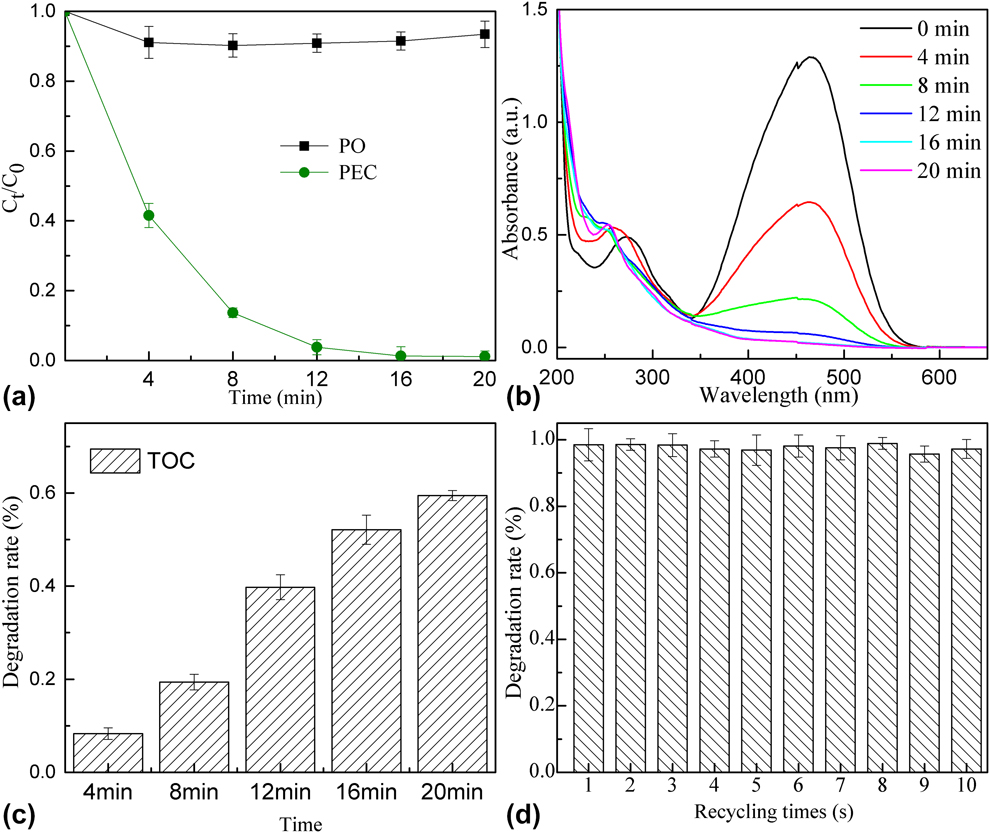
The direct photolysis (PO) efficiency of MO was only 6.56% under simulated solar irradiation, while the MO decoloration rate could reach 98.97% in 20 min in PEC process [Fig. 6(a)]. The estimated rate constant (k: 0.2194 min−1) of the NOx/S6+–TiO2 film (Fig. S3) was far superior to other similar experimental results [Reference Wu, Li, Liu and Zhang42, Reference Wen, Li, Liu, Fang, Xie and Xu43], while the degradation process of PO didn’t accord with first-order kinetics. Meanwhile, the absorption peak of MO at 466 nm diminished with increasing decoloration time [Fig. 6(b)]. It indicated that MO almost completely decomposed into small and simple molecules [Reference Islam and Basu44]. Nevertheless, the TOC removal reached 59.44% after 20 min [Fig. 6(c)]. It was showed that the cleavage of chromophores mainly occurred at the initial stage, but the mineralization of the generated organic intermediates required longer time. Moreover, the decoloration rate had no significant reduction after using repeatedly ten times [Fig. 6(d)]. This degradation efficiency was significantly better than previously reported. For better comparing and understanding other similar film materials, the reported experimental results have been shown in Table SI with the color removal rate of several representative dye wastewaters and preparation method.
(a) The MO decolorization rate under the conditions of PO (solar irradiation without photoelectrode and a 2.0 V bias) and PEC (photoelectrode under solar irradiation with 2.0 V bias), (b) UV-vis scanning spectrum of MO solution during PEC process of NOx/S6+–TiO2 film, (c) TOC removal under solar, and (d) recycling tests of PEC decoloration under solar (reaction conditions: 2.0 V, 0.05 M NaCl, pH = 6.5 ± 0.2, 20 mg/L MO, 50 mL solution).
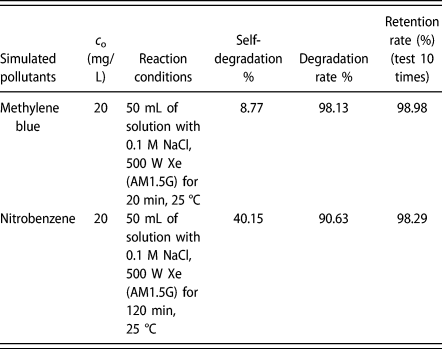
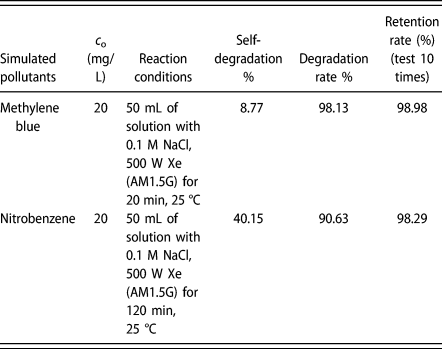
Using the same reaction conditions above, relevant data of degradation of other pollutants in this work were listed in Table II. For alkaline methylene blue dye and nitrobenzene wastewater, the NOx/S6+–TiO2 film both had a good degradation effect and retention rate on them under solar irradiation. Especially for methylene blue, the decoloration rate also reached 98.13% in a short time. These results encouraged further studying to find the optimum conditions for handling refractory organic in water and achieved the better degradation effect, to widely use in practical industries. The higher PEC activity of the NOx/S6+–TiO2 film can be due to three key aspects. First, the hybrid structures could increase the specific surface area and provide more active sites [Reference Li, Zhao, Shindume Lomboleni, Huang and Peng10]. Second, the introduction of NOx/S6+ narrowed the band gap significantly, heightening the quantum yield of solar. Third, suitable bias voltage accelerated the charge transfer, decreasing the recombination of electron–hole pairs.
Degradation of different simulated pollutants using NOx/S6+–TiO2 film with the same reaction conditions.
Degradation mechanism for PEC
The active species (such as •O2−, •OH, and h+) played important roles in PEC reaction, and the generation of active species in PEC process could be expressed by Eqs. (4)–(10) in PEC reaction [Reference Liu, Zhou, Wang, Tian, Li, Nie, Piao and Sun45].
 $${\rm{Ti}}{{\rm{O}}_2}\;{\rm{film}} + {\rm{sunlight}} \to {\rm{h}}_{{\rm{VB}}}^ + + {\rm{e}}_{{\rm{CB}}}^ - \quad ,$$
 $${\rm{h}}_{{\rm{VB}}}^ + + {{\rm{H}}_2}{\rm{O}} \to {{\rm{H}}^ + } + {\;^ \bullet }{\rm{OH}}\quad ,$$
 $${\rm{e}}_{{\rm{CB}}}^ - + {{\rm{O}}_2} \to {\;^ \bullet }{\rm{O}}_2^ - \quad ,$$
 $${\rm{e}}_{{\rm{CB}}}^ - + {{\rm{O}}_2} + {{\rm{H}}^ + } \to {{\rm{H}}_{\rm{2}}}{{\rm{O}}_{\rm{2}}}\quad ,$$
 $${\rm{e}}_{{\rm{CB}}}^ - + {{\rm{H}}_2}{{\rm{O}}_2} \to {\;^ \bullet }{\rm{OH}} + {\rm{O}}{{\rm{H}}^ - }\quad ,$$
 $${\;^ \bullet }{\rm{O}}_2^ - + {{\rm{H}}_{\rm{2}}}{{\rm{O}}_{\rm{2}}} \to {\;^ \bullet }{\rm{OH}} + {\rm{O}}{{\rm{H}}^ - }\quad ,$$
 $${\rm{h}}_{{\rm{VB}}}^ + + {\rm{O}}{{\rm{H}}^ - } \to {\;^ \bullet }{\rm{OH}}\quad .$$
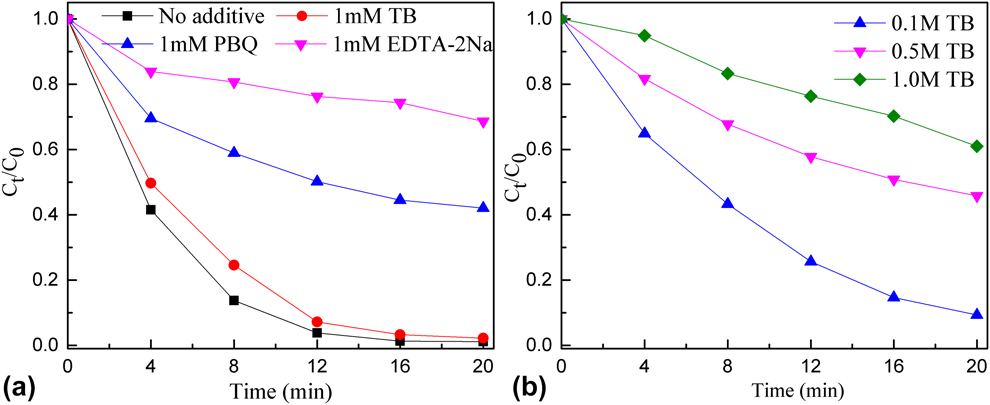
To explain the causes for the enhanced PEC behavior of the NOx/S6+–TiO2 film and infer the underlying reaction mechanism, quenching experiments of active species were carried out. As shown in Fig. 7(a), the effect of different radicals was verified by adding radical scavengers to the reaction system. The EDTA-2Na (h+ scavengers) and PBQ (•O2− scavengers) significantly inhibited the MO degradation while tertiary butanol (TB) (•OH scavengers) were hardly affected, and h+ and •O2− radicals played important roles in the reaction process. In addition, combined with above equations, we knew the •OH was generated by two approaches: (i) the oxidation of H2O/–OH by h+ [Eqs. (4), (5), and (10)] and (ii) transient formation of hydroperoxide radicals (HR) [Eqs. (7), (8), and (10)]. Therefore, to further determine the effect of hydroxyl radicals, we increased the concentration of TB and then found that MO degradation rate decreased obviously [Fig. 7(b)].
Quenching of active species: (a) adding various scavengers and (b) adding different concentration of TB (reaction conditions: 2.0 V, 0.05 M NaCl, pH = 6.5 ± 0.2, 20 mg/L MO, 50 mL solution).
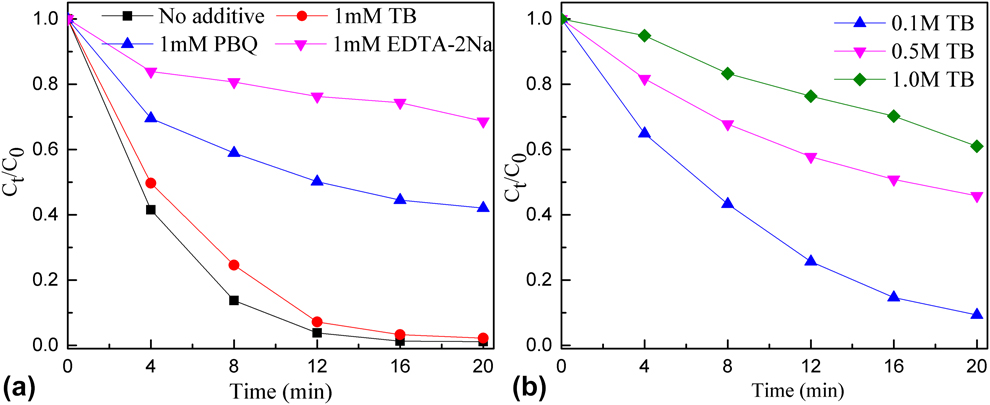
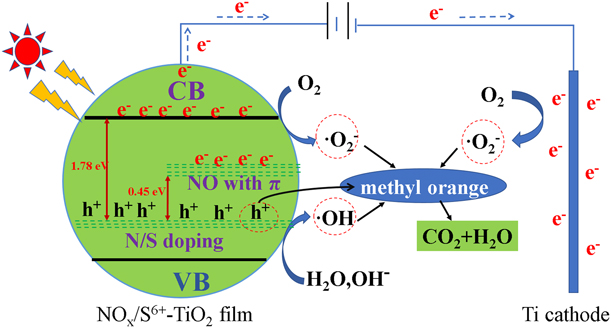
This suggested that large amounts of hydroxyl were also produced in the process. Based on the above experimental and analysis results, a possible mechanism was proposed in Fig. 8. Interstitial N 2p and S 2p mixed with O 2p composed the VB and interstitial NO with π character forming localized states between VB and CB. The electrons were excited and fast migrated from the VB to CB under sunlight irradiation. The active species including h+ [Eq. (4)], h+-created •OH [Eqs. (5), and (10)], HR-created •OH [Eqs. (7)–(9)] and •O2− [Eq. (6) and Ti cathode] were obtained and the adsorbed MO on the porous surface was oxidized [Reference Chen, Ma and Zhao46]. It was easier to transfer the electrons from the film surface to Ti cathode when a suitable voltage was applied to the poles, resulting in a higher separation efficiency of e−/h+ pairs. Hence, the degradation of MO was mainly attributed to the synergistic effect of h+, •O2−, and •OH in the PEC process.
A possible mechanism of PEC in the MO degradation by using NOx/S6+–TiO2 film.
Conclusions
In this study, we successfully fabricated N/S codoping TiO2 porous film using electro-assisted activation (NH4)2S2O8. The existence of anatase phase TiO2 film was confirmed. Meanwhile, the NOx/S6+–TiO2 film has strong light absorption (from 290 to 2500 nm) and narrow gap, which inhibit efficiently the recombination of electrons–holes. The film also exhibited high PEC activity and stability for the degradation of MO, methylene blue, and nitrobenzene organic pollutants under solar irradiation. On the whole, the film could be developed as a promising PEC material for practical application due to highly efficient solar energy utilization.
Experimental
Materials
All chemicals (AR grade) were purchased from the Sinopharm Chemical Reagent Co., Ltd., Chengdu, China. Ti foil (purity 99.6%) was purchased from Baoji Jinbu Titanium Equipment Corporation, Baoji, China. Ultrapure water (resistivity 18.2 MΩ cm) was used in all experiments.
Preparation of NOx/S6+–TiO2 film
Ti substrate (50 × 50 × 0.15 mm) was obtained by traditional mechanical (300 mesh sandpapers) and chemical polishing (in mixed solution of HF:HNO3:H2O = 1:4:5). Ti substrate and Pt sheet were used respectively as the anode and cathode, and then they were put into 0.01 M (NH4)2S2O8 aqueous solution (80 mL, pH 4.34). The whole preparation device was placed in ultrasonic bath (50 Hz) for 30 s to promote the oxidation cleaning of Ti substrate surface and hydrolysis of the solution. Subsequently, it was connected to the DC power supply to control the desired voltage (40 V) for 5 min, and SO42− and NOx originating from (NH4)2S2O8 electrolysis can be simultaneously etched and doped into the oxide layer (TiO2). The final film was obtained by calcining at 773 K for 1 h in muffle furnace and then was taken out and cooled to an ambient temperature.
Characterization of NOx/S6+–TiO2 film
The morphology was observed by field-emission scanning electron microscopy (FE-SEM, S-4800, Hitachi, Tokyo, Japan) and transmission electron microscopy (TEM; Tecnai G2 F20 S-TWIN, FEI, Oregon). XRD analysis was performed on X’Pert PRO diffractometer. X-ray photoelectron spectroscopy (XPS) measurements were conducted by Thermo Scientific Escalab 250 Xi XPS (PerkineElmer Corporation, Eden Prairie, Minnesota) system with Al K X-ray radiation. The UV-vis-NIR absorption spectra were obtained using UV-3600 spectrometer in the range of 200–2500 nm with BaSO4 reference. PL spectroscopy was tested via HORIBA Fluomax-4 instrument (HORIBA Scientific, New Jersey) with excitation wavelength at 380 nm. The photoelectrochemical measurements and electrochemical impedance spectroscopy (EIS) Nyquist plots were carried out in 0.05 M NaCl aqueous solution in three-electrode cell using electrochemical workstation (CHI 660E Instruments, Shanghai Chenhua Device Company, Shanghai, China). The NOx/S6+–TiO2 film and Pt foil were used as the working and counter electrode, respectively.
Procedure for photoelectrocatalytic degradation of pollutant
The PEC experiments were carried out in a quartz photoreactor containing 50 mL MO solution (20 mg/L) with 0.05 M NaCl used as supporting electrolyte. The NOx/S6+–TiO2 film acted as the photoanode and the same size Ti foil acted as the photocathode (electrode spacing 5 mm). A bias potential of 2.0 V was applied to the photoanode. The experiments were performed under 500 W Xenon lamp with an AM1.5G filter (GLORIA-X500A, Zolixin Instruments Corporation, Shenzhen, China). The irradiance was around 850 W/m2 at the distance of 200 mm. The average irradiation intensity was recorded by digital UV-C meter (ZDZ-1) and solar power meter (TES-1333). The absorbance of MO solution was measured at 466 nm using UV-vis spectrophotometer (UV 3000, Shanghai Mapada Device Company, Shanghai, China). The decolorization efficiency (D) was calculated as follows:
 $$D{\rm{\ }} = {{\left( {{C_0} - {C_t}} \right)} / {{C_0}}} \times 100\% \quad ,$$
where C 0 (mg/L) was the initial concentration of MO and C t (mg/L) was the instantaneous concentration at a time (t).
TOC was measured by TOC analyzer (TOC-V CPH, Shimadzu, Chengdu, China). And the TOC removal (TOCr) was calculated using the following equation:
 $${\rm{TO}}{{\rm{C}}_{\rm{r}}} = {{\left( {{\rm{TO}}{{\rm{C}}_0} - {\rm{TO}}{{\rm{C}}_{\rm{t}}}} \right)} / {{\rm{TO}}{{\rm{C}}_0}}} \times 100\% \quad ,$$
where TOC0 (mg/L) was the initial concentration of MO and TOCt (mg/L) was the remaining concentration after the reaction.
Quenching experiments of active species
EDTA-2Na, p-benzoquinone (PBQ), and TB were added to the MO solution as scavengers for holes (h+), superoxide radicals (•O2−), and hydroxyl radicals (•OH), respectively [Reference Zhang, Gu, Zhu and Wang47, Reference Ma, Wang, Zhang, Cheng, Xie and Cheng48]. The testing procedure was similar to the above photoelectrocatalytic experiments.
Supplementary material
To view supplementary material for this article, please visit https://doi.org/10.1557/jmr.2019.274.
Acknowledgments
This work was supported by the Science and Technology Department of Sichuan Province (2017JZ0021, 2017SZ0039) and the Education Department of Sichuan Province (17ZA0298).