One of the principal advances sociolinguistics has brought to the study of language change has been in trying to answer what Weinreich, Labov, and Herzog in their groundbreaking paper Empirical Foundations for a Theory of Language Change (Reference Weinreich, Labov, Herzog, Lehmann and Malkiel1968) termed the embedding problem, namely the route linguistic changes take both through the language as well as through the speech community that uses that language. They convincingly argued that “the problem of providing sound empirical foundations for the theory of change revolves about … this embedding” (Reference Weinreich, Labov, Herzog, Lehmann and Malkiel1968:185). Once changes are underway, some of the most sophisticated analyses have come from sociolinguistic undertakings, shedding light on changes so complex that traditional asocial models of change fail to account for them. The variationist paradigm has excelled not only at identifying these but also at detailing their considerable intricacies. One notable example is Labov's (Reference Labov, Fasold and Schiffrin1989, Reference Labov1994) analysis of the extremely complex structure of variation and ongoing change in short (a) in Philadelphia.
Less successful, however, has been our ability to socially and linguistically locate and investigate language changes that are in their infancy. Here the embedding problem overlaps with the actuation problem—why a particular change (and not some other change) takes place at a particular time (and not at some other time) in a particular place (and not in some other place) in a particular variety (and not some other variety). A good example is Trudgill's (Reference Trudgill1988) finding that labiodental [ʋ] as a variant of prevocalic (r), a vigorous change in contemporary Norwich English, and used by a considerable minority of young speakers in the 1980s, had been present in recordings made in the 1960s (Trudgill, Reference Trudgill1974), but had not been considered then as a change that would affect the linguistic system of the speech community as a whole. J. Milroy (Reference Milroy1992: 169–172) made the very important distinction between speaker-innovations—the “pool” of new linguistic forms in the speech community each of which may or may not spread—and linguistic change—an alteration in the linguistic system that results from a speaker-innovation successfully spreading through the language and the speech community. Labiodental /r/, then, had been treated as a speaker-innovation, rather than a linguistic change—only real-time analysis of the speech community at a later date was able to identify that it was indeed change in progress (see also Foulkes & Docherty, Reference Foulkes and Docherty2000; Meuter, Reference Meuter2002, for other studies of labiodental /r/ in England).
Weinreich et al. (Reference Weinreich, Labov, Herzog, Lehmann and Malkiel1968:176) also argued for “social realism” in the resolution of the embedding problem, a strong claim for a detailed and meticulous search for the social factors that are undoubtedly intertwined with linguistic variation and change. Sociolinguistics has made great advances in this direction too: consider the progress made, for example, in the deconstruction of gender (Eckert & McConnell-Ginet, Reference Eckert and McConnell-Ginet1992), style (Bell, Reference Bell1984), age (Eckert, Reference Eckert and Coulmas1997), and space (Britain, Reference Britain, Chambers, Trudgill and Schilling-Estes2002a) as social variables.
In the study of postcolonial varieties of English, such as those spoken in New Zealand and Australia, the need for social realism in dialectological analysis also applies to the very origins of those dialects. As I show both here and in Britain (Reference Britain2001a), differences between present-day New Zealand English (NZE) and British English have, in the past, sometimes been analyzed as if the New Zealand forms necessarily must be innovations. In Britain (Reference Britain2001a), for example, I showed how present-day NZE <-own> past participles, such as grown, blown, and flown, originating from Middle English (ME) ou, and realized today mostly as disyllabic forms, for example, [grʌuən], have often been analyzed as being the result of a split of a formerly merged and monosyllabic /ou/. Yet there is evidence not only that there was still considerable retention of the ME ou–ō distinction in mid-19th century Britain—the time that large-scale migrations to New Zealand began—but also that such disyllabic forms have been present in NZE from its early days (Gordon & Trudgill, Reference Gordon and Trudgill1999) and would have been an (admittedly minority) immigrant settler variant. What has often been analyzed as a split and an innovation away from a form whose phonology very much resembles that of standard accents is more probably the expansion of an imported disyllabic form swimming around in an extremely diverse pool of variants (see Britain, Reference Britain2002b, Reference Britain, Bell, Harlow and Starks2005a).
Here and in Britain (Reference Britain2001a, Reference Britain2002b, Reference Britain, Bell, Harlow and Starks2005a), a number of case studies on NZE, I therefore argue that we must pay much more attention to the social makeup of the settler speech community—as heterogeneous, with diverse geographical, social, and linguistic origins (e.g., Montgomery, Reference Montgomery1989; Mufwene, Reference Mufwene1996, Reference Mufwene1999, Reference Mufwene2001; Siegel, Reference Siegel1993; Trudgill, Reference Trudgill1986, Reference Trudgill2004)—to fully understand the nature and course of linguistic change.
As the example of disyllabic <-own> in NZE makes clear, an important factor in the embedding/actuation interface revolves around establishing where the innovation came from and what the original prechange form was. This appears to be so obvious that it does not deserve mention. This article, however, highlights a case where, I believe, too little attention has been given to where a particular change “came from.” I therefore propose a rather simple and obvious methodological principle that addresses the embedding problem: the “if there is a change from A to B, make sure A exists” principle. I think this principle is particularly relevant to the study of postcolonial varieties of English.
(au) IN NEW ZEALAND ENGLISH
The case to be investigated here is the NZE diphthong (au).Footnote 1 It has received a considerable amount of discussion in the literature on variation and change in NZE, especially early NZE (see, for example, Gordon, Reference Gordon1983, Reference Gordon1994, Reference Gordon1998; Gordon & Trudgill, Reference Gordon and Trudgill1999; Gordon et al., Reference Gordon, Campbell, Hay, Maclagan, Sudbury and Trudgill2004; Maclagan & Gordon, Reference Maclagan and Gordon1996; Maclagan et al., Reference Maclagan, Gordon and Lewis1999; Trudgill, Reference Trudgill2004, Trudgill et al., Reference Trudgill, Gordon, Lewis and Maclagan2000a, Reference Trudgill, Gordon, Lewis and Maclagan2000b; Woods, Reference Woods1997, Reference Woods, Bell and Kuiper1999, Reference Woods2000). The variation involved—the position of the onset of the diphthong between [a] and [ε]—has often been noted as highly salient, and the “nonstandard” variants almost always labeled as “strongly stigmatized” (see, for example, Gordon, Reference Gordon1983, Reference Gordon1994; Maclagan & Gordon, Reference Maclagan and Gordon1996:7). It is somewhat surprising then, given this apparent saliency, that there exists to date no published large-scale quantitative investigation of mouth based on contemporary conversational data. The analyses of mouth thus far (e.g., Bayard, Reference Bayard1987; Maclagan, Reference Maclagan1982; Maclagan & Gordon, Reference Maclagan and Gordon1996; Maclagan et al., Reference Maclagan, Gordon and Lewis1999) have all looked solely at the reading of words in experimental /h_d/ frames, in lists or in reading passages, with all the usual consequences for access to informal vernacular forms of the dialect. Smaller-scale studies of conversational data have been carried out by Woods (e.g., Reference Woods, Bell and Kuiper1999, Reference Woods2000) who compared four female speakers born in OtagoFootnote 2 in 1874, around 1920, 1935, and around 1960, respectively (Woods, Reference Woods, Bell and Kuiper1999), and speakers born in the 1860s and 1870s with their children (Woods, Reference Woods2000:118).
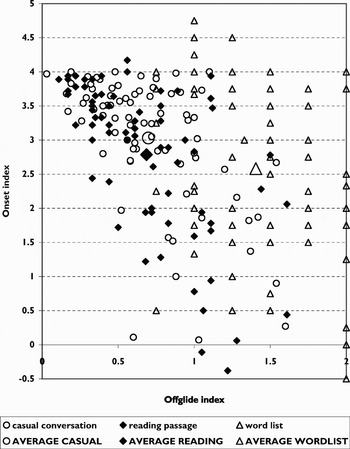
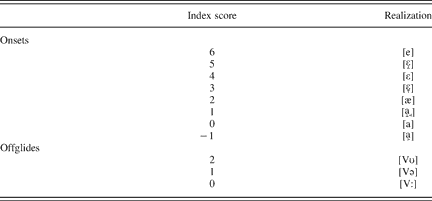
Figure 1A is a scatter plot of an analysis I conducted of mouth based on the 75 recordings of young and old, Maori and Pakeha, working and middle class, men and women from Porirua, a town in the south of New Zealand's North Island, for the Wellington Social Dialect Project, directed by Holmes, Bell and Boyce (Reference Holmes, Bell and Boyce1991) in the early 1990s.Footnote 3 Each small shape on the graph represents each speaker's average onset and offglide realizations based on 5251 tokens, an average of 70 per speaker, comparing conversational data (small circle) (3666 tokens), the reading of a passage (small diamond) (1290 tokens), and a word list (small triangle) (295 tokens). Average realizations for each style are represented by the larger symbols. The x axis shows the offglide and the y axis the onset, and the variable indices for both are presented in Table 1. For now, we can note a few important points.
(au) in Wellington New Zealand English: comparing casual, reading passage and word list styles across a 75-speaker corpus.

The index scores for onsets and offglides of (au) used in analysis of variation and change in contemporary vernacular NZE

First, there is a tight clustering of realizations in the top left of the scatter plot, in both casual and reading passage styles, representing realizations with mid-open onsets and dramatically reduced offglides—around  . Second, very few speakers indeed are in the supposedly standard location of (2, 0),Footnote 4 that is, [aʊ], and those that do reach this standard only do so consistently in word list style. Third, the average realizations for the sample, and the overall pattern of the scatter plot, show that the difference between casual conversation (3.03, 0.698) and reading passage styles (2.788, 0.686) is one of height of the onset, and both differ from word list style in terms of height and quality of offglide (2.581, 1.405). Conversational Wellington English, then, on average, uses
 .
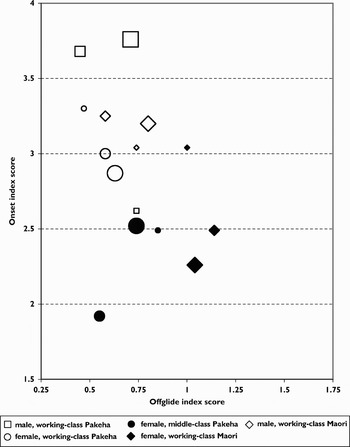
Figure 1B displays group-averaged variable index scores according to the age (old, middle, young), ethnicity (Maori, Pakeha [=European NZ]), social class (working, middleFootnote 5), and gender of the speakers. Each shaded or unshaded shape represents a different combination of ethnicity, gender, and class and the differing sizes of the shapes represent different age groups—the largest are old speakers, the smallest are young speakers. Variation across apparent time can be noted, therefore, by comparing the differences between the largest, medium, and smallest shape for each of the gender/ethnic/class groupings (see caption to Fig. 1B).
The realization of (au) according to age, ethnicity, and social class in the Wellington Social Dialect Project (conversational data only). Large symbols denote old speakers (70–79 years old), medium symbols middle-aged speakers (40 – 49 years), and small symbols young speakers (20–29 years).

Female working-class speakers of both ethnic groups (unfilled circles, Pakeha; filled diamonds, Maori) appear to be raising the onset across apparent time, whereas the Pakeha men appear to be lowering the onset, as do the Maori men, although less markedly. The middle-class Pakeha women display behavior typical of a stable variable that is sensitive to marché linguistique and progress through the life-course (e.g., Laberge & Sankoff, Reference Laberge, Sankoff and Sankoff1978; Trudgill, Reference Trudgill1988), with young and old showing remarkably similar behavior, and the middle-aged veering significantly toward the onset (but not offglide) values of the standard form.
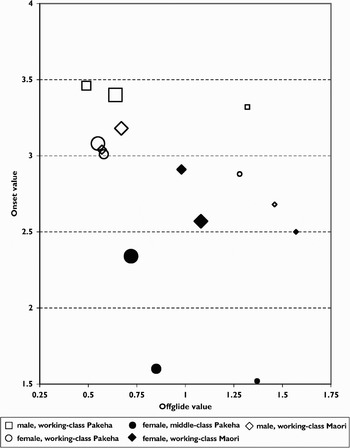
Figure 1C contrasts the different social groups across the three styles: (i) conversation, from which most of the tokens were derived, (ii) reading a passage, and (iii) reading a list of words. Here, each shaded or unshaded shape again represents the average realization for a different combination of ethnicity, gender, and class, but this time, the differing sizes of the shapes represent different styles, the largest being conversation, the smallest word list style, with reading passages represented by the mid-sized shapes (see caption to Fig. 1C). Here, variation from “most informal” to “most formal” can be noted by comparing the differences between the largest, medium, and smallest shapes for each of the gender/ethnic/class groupings. Most notably, word list data consistently behave quite differently from the other styles, showing in every case average realizations for the group that have a more open/back onset and a fuller offglide than the conversational data, demonstrating how careful we must be if we draw conclusions about vernacular behavior from word list data alone.
The realization of (au) in different styles (conversation, reading passage, and word list), according to gender, ethnicity, and class. Large symbols denote conversational style, medium symbols reading passage style, and small symbols word list style.

The question for this article, though, is not the realization of the variable, per se—a number of studies, whether based on informal observation or analyses of word-list data, have commented on the non-open onsets of mouth (see following discussion)—but where these non-open onsets came from. Footnote 6
THE TRADITIONAL VIEW [ɛʊ] ← [aʊ]
A brief word is needed at this point on the history of (au) in English to date. Almost all historical accounts of the history of English claim that following the Great Vowel Shift (GVS), ME ū diphthongized and the onset of the new diphthong fully opened to [aʊ]. Given that the present-day onset of mouth in many varieties of English spoken in the South of England, the Anglophone Southern Hemisphere, and parts of the southern United States is in a position that is more close and more front than [aʊ], dialectological accounts of the origins of these varieties have proposed a change that has raised and fronted the diphthong from [aʊ] to [εʊ ~ εə ~ ε:]. Wells (Reference Wells1982:310) introduced both what he calls “price-mouth crossover,” changes altering [aI] → [ɑI] and [ɑʊ] → [æʊ], and “diphthong shift” (Reference Wells1982:256), a coordinated set of vowel changes that affect not only mouth and price but also face (/ei/), goat (/ou/), fleece (/i:/), and goose (/u:/): “Cockney, and also the local accents of much of the south of England and the Midlands, together with those of Australia and New Zealand, exhibit a set of changes almost as fundamental as the Great Vowel Shift of half a millennium ago. This is the “Diphthong Shift” (Wells, Reference Wells1982:256, his emphasis). His diagrammatic representation of the shift follows (Reference Wells1982:256).
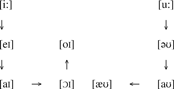
Lass (Reference Lass1987:298) supported this view, claiming that “Aus/NZ show innovatory qualities in … out … the following points are worth noting: (i) the ‘crossover’ of the first elements of the bite/out diphthongs… .” Labov includes vowel movements currently underway in NZ (and Australia and southern England) under his label “Southern Shift” (Reference Labov1994:202; Labov & Ash, Reference Labov, Ash, Bernstein, Nunnally and Sabino1997:512–514; see also, for example, Fridland, Reference Fridland1999). Labov and Ash claim that the “oldest and the most widespread aspect of the Southern Shift” is ‘Vw fronting’ (Reference Labov, Ash, Bernstein, Nunnally and Sabino1997:513)—that is, the fronting of the onsets of the goose, goat, and mouth lexical sets—and that the shift “is the organizing force in the vowel systems of South Africa, Australia, and New Zealand” (Reference Labov, Ash, Bernstein, Nunnally and Sabino1997:514).Footnote 7 The “advanced” nature of front mid-open variants is also argued for by Stockwell (Reference Stockwell, Goyvaerts and Pullum1975:347, 349; see also Stockwell & Minkova, Reference Stockwell, Minkova, Kastovsky and Bauer1988) who suggests a historical route of archaic [əw], standard [aw], advanced [æw~ew].
Given these accounts, it is perhaps not too surprising then that many researchers of NZE go along with this “route” proposed by Wells (Reference Wells1982) and others and claim that NZE, with its mid-open and front onset of mouth, has indeed undergone Diphthong Shift for this variable in order to arrive at this realization. Woods, a leading analyst of early NZE (see Reference Woods1997, Reference Woods, Bell and Kuiper1999, Reference Woods2000), for example, claimed that “the analysis of the vowel in the mouth lexical set reveals that, in line with internal principles (as detailed by Labov, Reference Labov1994), the nucleus of mouth has become fronted and closer over time” (1999:108) and “the use of a front and close nucleus of mouth … is the consequence of innovative raising” (1997:110; see also 2000:112). Maclagan et al. (Reference Maclagan, Gordon and Lewis1999:22) supported the view that raising was involved. They claimed that “the diphthong variants that are stigmatized are those associated with a relatively recent shift, which … was certainly not as widespread in early NZE as it is today … there are now very few … [aʊ] variants of /ɑʊ/ which earlier would have represented the most conservative, least stigmatized variants of the diphthong. Similarly, the first elements of the stigmatized variants have raised over time. For these reasons, the terms ‘innovative’ and ‘conservative’ are used … for … diphthong variants” (1999:22) and continued: “in New Zealand, the first target of /au/ is typically progressively fronted and raised by lower social-class speakers. Tokens with a relatively open first target ([aʊ]) were classified as conservative, those that started on [æ] were classified as neutral, and those with raised first targets ([ε]) were classified as innovative” (1999:29), strongly implying that these variants represent points on the trajectory of a change. Gordon and Sudbury (Reference Gordon, Sudbury, Watts and Trudgill2002:80) claimed that “mouth has fronted towards /æ/,” implying it was further back at some earlier stage. Watson, Harrington, and Evans (Reference Watson, Harrington and Evans1998:185) talked about “the raising and fronting of the first target of the how diphthong.”
Some researchers have explicitly linked the evolution of mouth with a set of changes also part of the Southern Shift and which are ongoing in current NZE—the movement of the front short vowels (see Labov, Reference Labov1994; Maclagan & Gordon, Reference Maclagan and Gordon1996; Maclagan et al., Reference Maclagan, Gordon and Lewis1999; Woods, Reference Woods1997, Reference Woods, Bell and Kuiper1999, Reference Woods2000). In other words, it is claimed that mouth is raising to [æʊ] and further to [εʊ] along the front peripheral track of vowel space, just as /æ/ is moving from [æ] to [ε], /ε/ from [ε] to [e˕], and /I/ from [I] to [ə] (but see Trudgill, Gordon, & Lewis, Reference Trudgill, Gordon and Lewis1998). For example, Woods (Reference Woods1997, Reference Woods, Bell and Kuiper1999, Reference Woods2000) treated mouth together with the front short vowels in her analysis of change in early NZE, and Maclagan et al. (Reference Maclagan, Gordon and Lewis1999) explicitly compared the two in their analysis of contemporary NZE, even comparing individual speakers who have apparently raised their front short vowels more than their vowel onset in mouth and vice versa.
In order to ascertain if this is truly the case, if mouth really did raise from “[aʊ] variants of /ɑʊ/ which earlier would have represented the most conservative, least stigmatized variants of the diphthong” (Maclagan et al., Reference Maclagan, Gordon and Lewis1999:22) to [æʊ] and beyond, we must first establish the existence of the supposed [aʊ] at some earlier period in the history of the variety. If [æʊ~εʊ] is the result of innovative raising, we should expect to find solid and consistent evidence somewhere of [aʊ] being used widely as a conversational variant in earlier stages of the history of these varieties. Such evidence is almost entirely lacking.
REVIEWING THE HISTORY OF STUDIES OF /au/ IN NEW ZEALAND ENGLISH
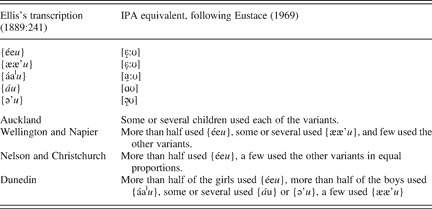
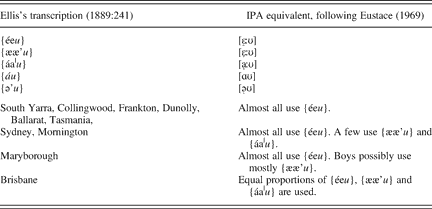
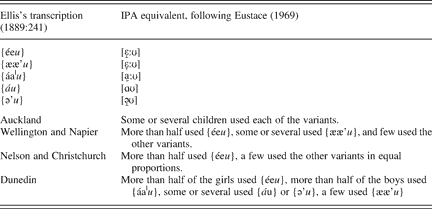
The earliest evidence we have of mouth in NZE comes from Samuel McBurney's observations, published in Ellis (Reference Ellis1889). Table 2 presents his findings from across New Zealand with respect to mouth, transcribed into Ellis's (Reference Ellis1889) paleograph, and “translated” into the International Phonetic Alphabet (IPA) according to Eustace's (Reference Eustace1969) conversion method.Footnote 8 Two conclusions can be drawn from this data, I believe. First, the early NZE he was describing was clearly quite mixed, with a number of variants being used across the country. Second, the dominant forms in that mixture are ones with front and mid-open onsets, Ellis's {éeu} and {ææ’u}, precisely the same types of variants as are dominantly used today in NZE over a century later.
The realization of /au/ in varieties of early NZE according to McBurney with IPA equivalents from Eustace
Source: McBurney cited in Ellis, Alexander. (Reference Ellis1889). On early English pronunciation: Part V. London: Truebner & Co. Eustace, S. (Reference Eustace1969). The meaning of the palaeotype in A. J. Ellis's “On early English pronunciation.” Transactions of the Philological Society 67:31–79.
Next, we have the analyses of the Mobile Unit recordings of old New Zealanders, born in the second half of the 19th century and recorded in the late 1940s. These have been analyzed for mouth both by Woods (Reference Woods1997, Reference Woods, Bell and Kuiper1999, Reference Woods2000) and Trudgill (Reference Trudgill2004; Trudgill et al., Reference Trudgill, Gordon, Lewis and Maclagan2000a, Reference Trudgill, Gordon, Lewis and Maclagan2000b), but from different approaches.
Woods (Reference Woods1997:105) analyzed 10 Otago residents from the Mobile Unit corpus and, subsequently in the 1990s, recorded their children. Using a variable index score method similar to that used in my analysis of contemporary Wellington English, she found that, where 0 = [äʊ~aʊ],  , and 200 = [æʊ~εʊ], men rose on average from 111 (in the Mobile Unit recordings) to 171 (among their sons) and women fell from 147 (Mobile Unit) to 116 (their daughters).Footnote 9 A close analysis of the 5 male and 5 female speakers from the Mobile Unit recordings and their 5 sons and daughters shows scores ranging from around 75 to 145 for first-generation (i.e., Mobile Unit data) men and 90 to 190 for first-generation women and from 150 to 185 for second-generation men and 60 to 195 for second-generation women. The first-generation men and especially the women have average scores well over 100, strongly suggesting front, non-fully open variants were predominant in their speech already. The averages for the second-generation women actually show lower scores overall than the Mobile Unit women, but the men's scores increased significantly. These overall averages led Woods, here and in later work (Reference Woods, Bell and Kuiper1999, Reference Woods2000), to suggest that “the nucleus of mouth has become slightly closer over time.” The data demonstrate that each of the Mobile Unit speakers has non-fully open forms as their majority variant, with 8 of the 10 first-generation Mobile Unit speakers averaging forms between
 and [æʊ~εʊ], that is, with scores over 100 (with 3 having the latter as the dominant form, with scores over 150) (see the data presented in Woods, Reference Woods2000:122). In both the Mobile Unit data and subsequently, both sexes remain consistently with realizations above the 100 mark, that is, they already have “raised” onsets.
Later, Woods (Reference Woods, Bell and Kuiper1999) analyzed mouth among four individual speakers: Mary, a first-generation New Zealander, born in 1874 of Scottish parents; two of her granddaughters, Florence and Louise; and one of her great-granddaughters, Sarah. Although her data show Mary with more open variants than Florence and Sarah, in particular (1999:95), she later commented in a footnote that perhaps Mary was not typical: “Mary reveals a rather more conservative use of mouth than other elderly female speakers recorded in 1948” (1999:110).
One of the very significant contributions of Trudgill's participation in research on the Mobile Unit data was a consideration that the NZE forms may have been imported from the British Isles. Trudgill et al. (Reference Trudgill, Gordon, Lewis and Maclagan2000a, Reference Trudgill, Gordon, Lewis and Maclagan2000b) found that mouth was already further to the front and closer than [aʊ]. In Trudgill et al. (Reference Trudgill, Gordon, Lewis and Maclagan2000a:313), all 10 speakers that had been acoustically analyzed showed “some diphthong shift of /au/.” Trudgill et al. (Reference Trudgill, Gordon, Lewis and Maclagan2000b:118) argued that, of all six vowels undergoing the change, diphthong shift was most advanced for /au/ and was present in an overwhelming majority of the very oldest speakers in their corpus, born between 1850 and 1869. Other elements of diphthong shift dragged behind /au/ and they conclude that “diphthong shifted vowels were indeed inherited by NZE from English English, but that it was really diphthong shift as an ongoing process which was inherited rather than the vowel qualities themselves.” Later in the paper, in an acoustic case study of two speakers, they argue “mouth and price have moved for both speakers, with Mrs. Dudley's mouth having almost reached the modern NZE position” (Reference Trudgill, Gordon, Lewis and Maclagan2000b:131). Indeed, the onset of mouth begins halfway between an already rather close trap vowelFootnote 10 and what Trudgill et al. (Reference Trudgill, Gordon, Lewis and Maclagan2000b:132) described as “a slightly raised dress vowel.” The mouth vowel of the other acoustically analyzed speaker, Mr. Dufty, has a more open onset, midway between [a] and [æ] (Reference Trudgill, Gordon, Lewis and Maclagan2000b:132).
Gordon's ongoing analyses (see, for example, Reference Gordon1983, Reference Gordon1994) of prescriptive commentary, particularly by school inspectors and head teachers, about NZE has revealed telling detail about the state of mouth in NZE from the turn of the century. One commentator, in 1908, highlighted “a failure to appreciate the value of the common vowel sounds—e.g., … teown” (Gordon, Reference Gordon1983:36); another, in 1912, said that many children in Wellington talk about “fleour” for flour (Reference Gordon1983:37); yet another, in 1912, that “If you take a class of thirty at the beginning of the year, I do not think you will find more than three or four who will say ‘house’ correctly…. the word is ‘house’ not ‘heouse’” (Reference Gordon1983:37); and finally another, in 1924, commented on “shout” as “sheout” (Reference Gordon1983:39) (see also Bauer, Reference Bauer and Burchfield1994:393, 394). In the 1994 article, Gordon adds more examples of the representation of mouth, such as nee-ow in 1912, bree-aoon in 1946, and heyow neyow breyown ceyow in 1948.
Woods, too, provides evidence of comment about mid-open onsets of mouth in the first part of the 20th century. Gray and Milne (cited in Woods, Reference Woods2000:132) suggested that to “insure the purity of vowel sounds” in NZE, words such as “house,” “pound,” “round,” and “bounce” should be practiced every day in schools. Martyn Renner in the Education Gazette said that “the pronunciation of such words as ‘shout’ and ‘now’ as sheout and neow was an ‘extraordinarily common defect in pronunciation’” (1924:130; quoted in Woods, Reference Woods2000:132).
Since then, informal observations and variationist analyses have shown front, non-fully open, or mid-open onsets to be dominant in vernacular NZE. Baker (Reference Baker1945:442), for example, noted [Iau] in mid-20th century New Zealand. Turner (Reference Turner1966:103) suggested [æʊ], and later commented (Reference Turner and Ramson1970:89) that “bout is kept distinct from boat by a raised first element to [æ] or even [ε]. These developments occur in New Zealand as well as Australia.” Orsman (Reference Orsman and McLintock1966:681) suggested that “diphthong ɑʊ of cow has a first element like the e of very, and a fronted second element eu. Some speakers turn it into a triphthong eiu by inserting a glide between the first and second elements (ɑbeut, ɑbeiut) rather than (ɑbɑut) for about.” Bennett (Reference Bennett and Ramson1970:70–71) noted a [æʊ~εə] pronunciation and suggests a parallel with American speech because he claims the form is used in New England and the southern states of the United States. Bartlett (Reference Bartlett1992) showed that mouth in Southland is realized as [εY]. Bauer (Reference Bauer1986:240) proposed [æε] and later (Bauer, Reference Bauer and Burchfield1994:389) suggested that  is the “more formal variant … or … associated with higher social class” and [εɨ] “less formal or lower class.” Watson et al. (Reference Watson, Harrington and Evans1998), in an experimental laboratory study of almost entirely university educated informants between the ages of 16 and 33, found “a fronted first target of how” (1998:197–198) and concluded that “we arrive at [ɛɔ] for NZE how” (1998:204). These results are very similar to those of my Wellington social dialect analysis, in which the word list style “average” realization was around
 (see Figs. 1A and 1C).
Bayard (Reference Bayard1987) conducted the first variationist analysis on what he described as a sample “fairly biased toward the upper end of the socioeconomic scale” (1987:6) in which “the tapes obviously reflect only upper-register usage (i.e., reading passage, word list, and minimal pair styles)” (1987:7). He found that where 1 = [æʊ],  , and 3 = [aʊ] speakers ranged from a mean score of approximately 1.2 for lower working-class speakers, up to approximately 2.5 for upper-middle-class speakers (1987:10). He also found this to be a stable variable (1987:14). Speakers are therefore using relatively non-fully open variants even in the formal styles that characterize Bayard's data.
Maclagan et al. (Reference Maclagan, Gordon and Lewis1999:22) presented a complex picture of the variable. They treat the variable as presently undergoing change in their analysis. Conservatism and innovation in the diphthongs /aʊ/ and /aI/—sociolinguistic markers of NZE and both often endowed with the label stigmatized—are explicitly contrasted with conservatism and innovation in the nonsalient (at least to New Zealanders) front short vowels, in word list style. They suggested, however, that in some respects the diphthongs show a picture of relative stability. “The situation observed in NZE today with regard to the diphthongs /ai/ and /au/ may well indicate relatively stable sociolinguistic variation rather than ongoing changes, so the terms ‘conservative variants’ and ‘innovative variants’ are therefore not necessarily strictly correct … while these diphthongs seem to have represented stable sociolinguistic variation for some time, as evidenced by the long history of complaints … the pattern nevertheless seems to have shifted over time … there are now very few … [au] variants of /au/ which earlier would have represented the most conservative, least stigmatised variants of the diphthong” (1999:22). In their analysis, 77.6% (788 out of 1016) of tokens were realized with onsets of [æ] or [ε] (based on data in Maclagan et al., Reference Maclagan, Gordon and Lewis1999:29). Their discussion here, then, is rather guarded about whether they believed a process of “raising” to be the origin of the present-day realizations, although in an earlier paper (Maclagan & Gordon, Reference Maclagan and Gordon1996:9), they did support such a hypothesis.
The overall picture gained from this review of the history of mouth in NZE is that:
• In the early days of NZE, non-open front onsets of mouth were very common and were the dominant vernacular forms in the early dialect mix, alongside other less widespread variants.
• These mid-open front onsets have been noted as characteristic ever since, by prescriptive observers, descriptive linguists, as well as sociolinguists.
• We have not found sufficient evidence of [aʊ] being used as a vernacular variant to warrant the raising hypothesis proposed by Woods (Reference Woods1997, Reference Woods, Bell and Kuiper1999, Reference Woods2000), Maclagan et al. (Reference Maclagan, Gordon and Lewis1999:22, 29), and others.
In order to find the thus far elusive vernacular [aʊ], we perhaps need to look further back to the settlement history of New Zealand, as suggested by Trudgill (e.g., Reference Trudgill2004; Trudgill et al., Reference Trudgill, Gordon, Lewis and Maclagan2000b).
[aʊ], [εʊ] AND THE SETTLERS
The discussion turns now therefore to the emigrants to New Zealand, and what forms of mouth they brought with them. Mufwene (Reference Mufwene1996, Reference Mufwene2001) argued, in his detailed outline of the Founder Principle, that such a direction of analysis is crucial if we are to understand the genesis of dialect patterns in postcolonial speech communities. Important, he claims, in such an analysis are “the characteristics of the vernaculars spoken by the populations that founded the colonies” (Reference Mufwene1996:84), “the ethnographic setting in which the … displaced population has come into contact with … other populations whose structural features enter into the competition with its own features” (Reference Mufwene1996:85), and “the demographic proportion of the newcomers relative to local populations” (Reference Mufwene1996:86) (see also, for example, Montgomery, Reference Montgomery1989; Mufwene, Reference Mufwene1999; Siegel, Reference Siegel1993; Trudgill, Reference Trudgill1986:126, 161). We look here then at where the settlers came from and in what proportions during the important founder period of NZE—the mid-19th century—and follow this with an analysis of the variants of mouth that they would have brought and, again, in what proportions.
Who were the settlers?
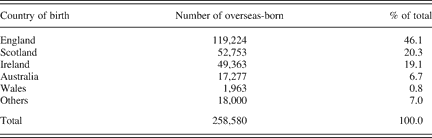
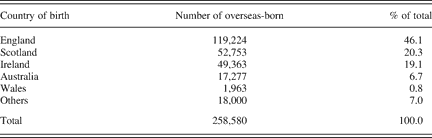
The historical and sociodemographic evidence we have suggests that two places will be influential in our discussions of Anglophone New Zealand settlement—the British Isles, because this is where the majority of migrants were born, and Australia, because many migrants passed through Australia for varying periods en route to New Zealand, and some migrants were Australia-born. Table 3 presents McKinnon, Bradley, and Kirkpatrick's (Reference McKinnon, Bradley and Kirkpatrick1997) statistics for the origins of the overseas-born migrants of 1881.
The origins of the overseas-born in New Zealand in 1881
Source: Based on McKinnon, Malcolm, with Bradley, Barry, & Kirkpatrick, Russell. (Reference McKinnon, Bradley and Kirkpatrick1997). New Zealand historical atlas/Ko papatuanuku e takoto nei. Auckland: David Bateman. Plate 49).
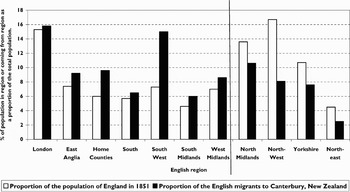
In order to gain an insight into the history of mouth, however, greater geographical precision is required. A number of sources provide us with some detail on the geographical origins of the New Zealand settlers of the 19th century. In an analysis of the birthplaces of settlers to Canterbury,Footnote 11 Pickens (Reference Pickens1977) shows that the southern counties of England, as opposed to the Midlands and the North, were more heavily represented in the early NZ population (sampled between 1851 and 1877) than we would expect given the population that these counties contributed to the country's total. Figure 2 provides a more detailed breakdown for England. In addition to settlers from England, many came to Canterbury from Scotland and Ireland. Pickens, for example, claims that although approximately 54% of mid-19th century migrants were from England, approximately 16% were from Ireland, and 15% from Scotland (Pickens, Reference Pickens1977:70).
Where did the immigrants come from? The populations of English-speaking regions compared with the numbers of New Zealand settlers to Canterbury (South Island) coming from the regions.

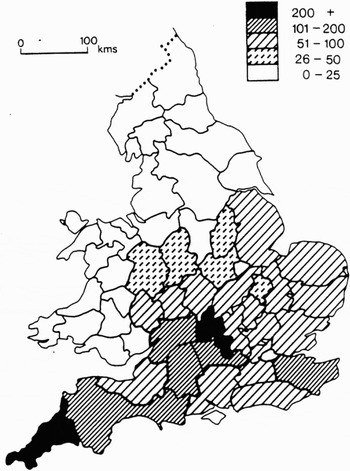
Following an analysis of migrants to New Zealand in 1871, Arnold (Reference Arnold1981), in his well-known work entitled The Farthest Promised Land, claimed that “clearly the great majority of the emigrants came from a wide stretch of southern England, with almost all counties south of a line from Herefordshire to the Wash feeling the pull fairly strongly. North of this line, only Lincolnshire was much affected, and the industrial North was little influenced. The most fruitful counties were all rural counties” (102). Later, he claimed, “New Zealand's founding stock was drawn predominantly from village life in the Old World, and the village outlook which they brought with them was sustained and reinforced by the colony's geography” (Arnold, Reference Arnold1994:118). Figure 3, based on Arnold's (Reference Arnold1981) research, shows the number of settlers coming from each county of England per 100,000 residents in 1871. It shows that the west and southwest were particularly well represented in the settler population, as were the southeast and East Anglia. The Midlands were less well represented and the numbers from the north were relatively low.
The origins of emigrants to New Zealand between 1873 and 1876. Figures represent the numbers of emigrants per 100,000 of the county population of 1871. Source: Arnold, Rollo. (Reference Arnold1981). The farthest promised land: English villagers, New Zealand immigrants of the 1870s. Wellington: Victoria University Press. 103. Used with permission.

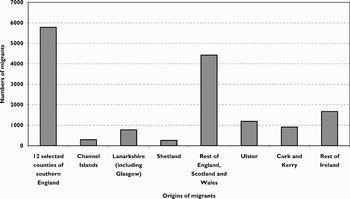
An analysis of New Zealand migrant origins in 1874 based on McKinnon et al.'s (Reference McKinnon, Bradley and Kirkpatrick1997) data is shown in Figure 4. The detail they gave is patchy—only giving precise details for some places—but the overall pattern is again the same: the dominant areas of settlement are the south of England, Scotland, Ireland, and Australia. Note that the largest bar in the graph—for 12 counties selected by McKinnon et al.—does not include all southern English counties. East Anglia, parts of the southern Midlands, and the south and southwest are included in the Rest of England/Scotland/Wales category.
Migrants to New Zealand from the British Isles in 1874. Source: Based on McKinnon, Malcolm, with Bradley, Barry, & Kirkpatrick, Russell. (Reference McKinnon, Bradley and Kirkpatrick1997). New Zealand historical atlas/Ko papatuanuku e takoto nei. Auckland: David Bateman.

All three of these historical sources admitted potential problems with the data they were drawing from. Pickens's data on birth places of migrants to Canterbury (and not the whole of New Zealand) only related to those migrants who died after 1875, registered a birth after 1875, or were married in New Zealand after 1881, though he claimed that these registration records, in comparison with information contained in shipping lists, contained “demographic data of a far more representative kind” (Reference Pickens1977:69). Arnold's data focused only on assisted male and unmarried female immigrant workers and not simply all migrants. However, what we can draw from these resources is the very strong agreement they all show, despite these different caveats, that migration to New Zealand was strongest from Southern England.
Australia was also an important source of settlement in early New Zealand. Although the figures for Australia-born migrants appear rather small—McKinnon et al. (Reference McKinnon, Bradley and Kirkpatrick1997:plate 49) suggested the figure is approximately 7% of the total number of overseas-born in 1881—many migrants spent time in Australia before moving on to New Zealand. Vaggioli (Reference Vaggioli and Crockett[1896] 2000:112), for example, showed that of the 12,447 Europeans in New Zealand in 1844, 3464 or 27.8% lived in Auckland, the Bay of Islands, or HokiangaFootnote 12 and stated that “colonists who settled the upper half of the North Island were mostly migrants from Australia” (Reference Vaggioli and Crockett[1896] 2000:112). In addition, McCaskill (Reference McCaskill1982:6–7) claimed that “in socio-economic terms, much of the European community in northern New Zealand in the 1830s was a ‘drop-out’ extension of Sydney society with escaped convicts, former convicts, debtors, traders and land speculators enjoying an early kind of ‘enterprise zone’ free of oversight and the law.” In a detailed paper on migration between New Zealand and Australia, Carmichael (Reference Carmichael1993:516) claimed that many of the estimated 2000 first settlers to New Zealand had come from Australia: “By 1854, the European population totalled 32,500 … 12,000 in Auckland, a garrison town with probably over half its European population … having come from Australia.” In addition, he quoted William Fox (a former premier of New Zealand) who described Auckland in the early 1850s as “a mere section of the town of Sydney transplanted” (Carmichael, Reference Carmichael1993:516; Sinclair, Reference Sinclair1959:98). In addition, Arnold (Reference Arnold1994:120) suggested that “many settlers had a period of Australian experience behind them, and an intricate network of interrelationships gave a significant Australasian dimension to colonial New Zealand.”
When looking at the dialect evidence from the 19th century, therefore, looking for which variants of mouth would have been well represented in early NZE, we need to look in particular at those areas that sent relatively high numbers of settlers—the south of England generally, Ireland, Scotland, and Australia. We have four sets of evidence that may shed some light on which forms were taken—these sources provide us with dialectological detail covering people born from the early 19th century, slightly before large-scale migration to New Zealand, through to those born in the final quarter of the 19th century, slightly after the first substantial New Zealand–born generation. The earliest and most important source we have at our disposal for the purposes here is Ellis (Reference Ellis1889). This is a dialect survey of the traditional type, based on information from over 1100 locations in Great Britain. Data in the form of spontaneous transcriptions of reading passages and word lists were sent to Ellis by a combination of trained dialect enthusiasts (such as Thomas Hallam) and interested locals. In some locations, Hallam was sent to check the validity of the local data collectors' work and investigate some features more thoroughly. Because these data were collected primarily from older people, it gives us a picture of the vernacular dialects of people born in the early part of the 19th century. Ellis's work was pioneering. Jones claimed that it is “an unsurpassed masterpiece of philological scholarship, a work equally indispensable for information on period data, the direction of phonological change, sociolinguistic and regional distribution and, perhaps above all, a work noted for its attention to real observed data analysed through highly pragmatic eyes” (2006:274). Unlike his predecessors, he expressed due caution for what we could learn from educated speech and was wary of word lists because their use removes the relevant item from its context and “alters the feeling of the speaker” (Ellis Reference Ellis1874, cited in Jones, Reference Jones2002:280). For the variable in question, Ellis gives consistent detail, reporting on the variants of mouth in each of his proposed dialect regions and usually at more local levels too. Next, we have the data presented in Wright's (1905:146–147) English Dialect Grammar, which presented a detailed account of the different variants of mouth used by older speakers at the turn of the 20th century. Additionally, we have the evidence, for southern England, from Kurath and Lowman (Reference Kurath and Lowman1970). Here, a traditional dialectological questionnaire-based data collection of 56 speakers was carried out in the mid-1930s. These data give us an insight into dialects of the mid- to late 19th century. Finally, we have the data from the Survey of English Dialects (SED). These data were collected mostly in the 1960s of older speakers and hence give us an indication of the vernacular speech toward the end of the 19th century.
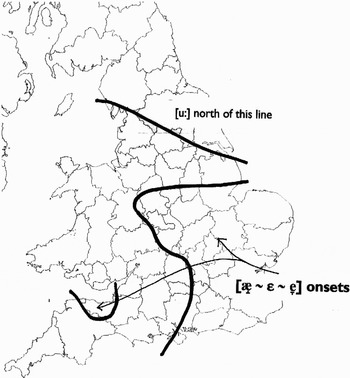
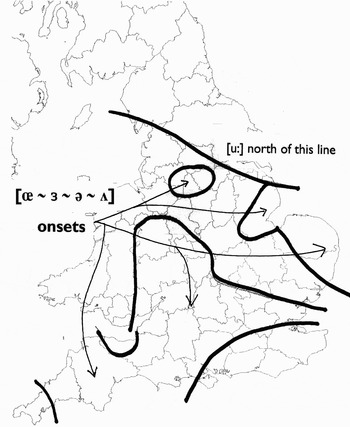
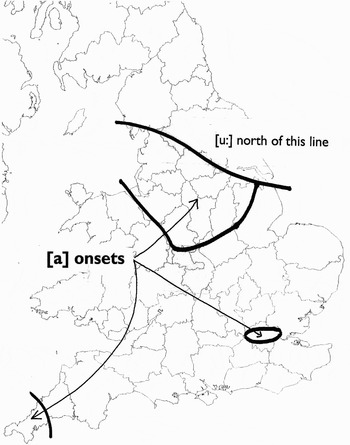
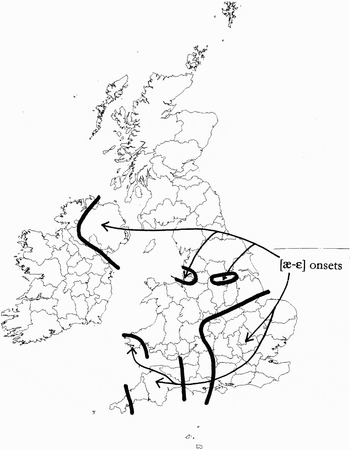
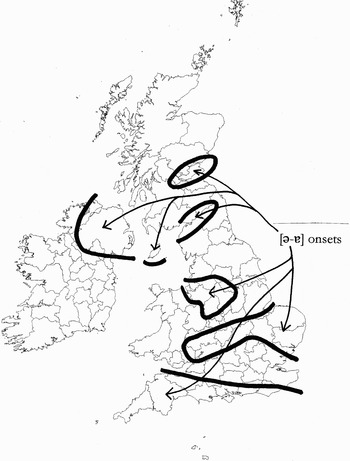
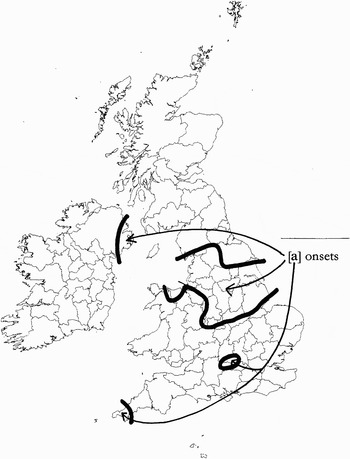
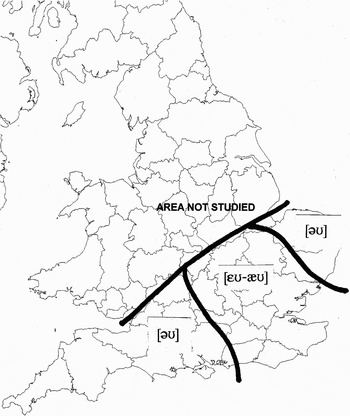
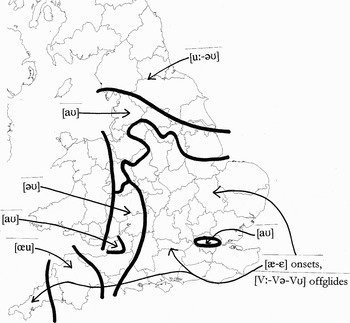
Figures 5A, 5B, and 5C show the results of my analysis of the data in Ellis (Reference Ellis1889), where I have presented the geographical distribution in England of the three dominant types of mouth variant (see also Britain Reference Britain2001b, Reference Britain2002b, Reference Britain, Bell, Harlow and Starks2005a). The “isogloss” in northern England represents the northern limit of the GVS for mouth. Areas to the north of this line—including Scotland—had, according to Ellis, yet to diphthongize the mouth vowel, that is, variants such as [u:] are dominant. The southeast, East Anglia, the Midlands, and large areas of the southwest (in other words, a majority of the population of England at the time) show front non-fully open [æ~ε~e] onsets of mouth as dominant, according to Ellis's data. Common also, however, in the south and west, northern parts of East Anglia, the Home Counties, the West Midlands, and small pockets in Lincolnshire, Derbyshire, and South Yorkshire are central onsets of mouth, around [ə–ɜ]. Together these front mid-open and central onsets of mouth dominate the south and Midlands of England, precisely those areas that sent large numbers of migrants to New Zealand. Realizations of mouth with open onsets—[aʊ]—have a much more restricted geographical distribution and are found in the northern Midlands and the northwest, as well as in the extreme west of Cornwall, and as one of three variants in London.Footnote 13
The geographical distribution in England of front mid-open onsets  of mouth. Source: Based on Ellis, Alexander. (Reference Ellis1889). On early English pronunciation: Part V. London: Truebner & Co.

The geographical distribution in England of central/rounded onsets [œ ~ ɜ ~ ə ~ Λ] of mouth. Source: Based on Ellis, Alexander. (Reference Ellis1889). On early English pronunciation: Part V. London: Truebner & Co.

The geographical distribution in England of fully open [a] onsets of mouth. Source: Based on Ellis, Alexander. (Reference Ellis1889). On early English pronunciation: Part V. London: Truebner & Co.

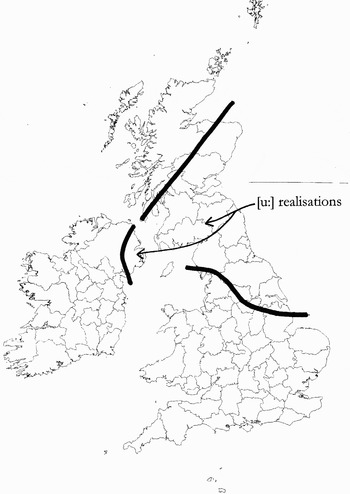
Figures 6A, 6B, 6C, and 6D below reproduce in map form the locales in Wright (Reference Wright1905) that use variants with [ε], [a], [ə~ɐ], and other variants ([ou], [u:]), respectively. Again, the pattern found in Ellis is reiterated: the South, East, and Southwest of England, as well as Ulster—areas of heavy migration to New Zealand—are characterized by [ε] and [ə~ɐ] onsets, with [aʊ] restricted almost entirely to the north. Of these [aʊ] realizations, Wright commented that they are “doubtless due in great measure to the influence of the literary language” (Reference Wright1905:146), which suggests they may be standard forms, rather than informal vernacular forms.
Front mid-open onsets of mouth in Wright. Source: Wright, Joseph. (Reference Wright1905). English dialect grammar. Oxford: Oxford University Press. Used with permission.

Central onsets of mouth in Wright. Source: Wright, Joseph. (Reference Wright1905). English dialect grammar. Oxford: Oxford University Press. Used with permission.

[a] onsets of mouth in Wright. Source: Wright, Joseph. (Reference Wright1905). English dialect grammar. Oxford: Oxford University Press. Used with permission.

[u:] realizations of mouth in Wright. Source: Wright, Joseph. (Reference Wright1905). English dialect grammar. Oxford: Oxford University Press. Used with permission.

Figure 7 compares the data for mouth in Kurath and Lowman (Reference Kurath and Lowman1970). Their comments on the geographical distribution of the different variants will suffice here: “in most of the eastern counties … the reflex of ME ū is a diphthong starting in mid-front or lowered mid-front position and gliding up toward [ʊ]. In the central counties this [εʊ - εu - æʊ] is universal. In Norfolk and … the western counties ME ū has yielded [əu] … it is noteworthy that the Standard British English type [ɑu] does not occur in the folk speech of the section of England dealt with here.”
Realizations of mouth in southern England. Source: Based on Kurath, Hans, & Lowman, Guy. (Reference Kurath and Lowman1970). The dialectal structure of southern England. Tuscaloosa: University of Alabama Press.

Finally, Figure 8 presents the geographical distribution of the dominant variants in the SED, based on Anderson (Reference Anderson1987). He suggested that “the commonest reflex of ME /u:/ [was] the [εω - æω - εY] type … the Standard English development (to [aω - ɑω]) is relatively uncommon in the dialects … it is rather surprising that Standard English has selected this type. Probably it indicates the conservative nature of the standard language and its relative isolation from the sound systems of neighbouring dialects” (1987:41). The “commonest reflex,” once more, is found in those areas that were heavy providers of NZ migrants. On the basis of an analysis of the SED in relation to NZE, Bauer agreed and claimed that “the distributions … show NZE to be based firmly on southern rather than northern varieties of British English” (Reference Bauer1999:298). What is again reassuring about these dialectological studies, all conducted at different times and with often different aims, is their broad agreement—that front mid-open onsets dominate the South of England and that [aʊ] is barely used as a vernacular variant there.
Realizations of mouth based on SED data presented in Anderson. Source: Anderson, Peter. (Reference Anderson1987). A structural atlas of the English dialects. London: Croom Helm. Used with permission.

Other early researchers who have conducted smaller scale locality studies have also noted mid-open onsets in various parts of the British Isles. Wyld (Reference Wyld1907:328) claimed, “various vulgarisms and provincial forms of this diphthong exist, such as (æu, εu)” and later (Reference Wyld1953) found raised onsets in Lancashire and, notably, in London, where he claimed, “in Middle Class London Cockney, the first element of the diphthong has been fronted, and a typical mark of the beast, as Lord Chesterfield would call it, in certain circles, is the pronunciation [hæus]” (Reference Wyld1953:230). Matthews (Reference Matthews1938:63), investigating Cockney, claimed that mountain was pronounced “meowntain.” Sivertsen claimed that “by far the most common” (Reference Sivertsen1960:67) realization in London was [εə~εʊ]. Collins (Reference Collins1964:42) found [εʊ] in South Warwickshire; Kökeritz (Reference Kökeritz1932:65) remarked that [εʊ] was a “very stable diphthong” in Suffolk, and noted (Reference Wyld1932:67) that Thomas Albrecht had claimed [æʊ]~[εʊ] for Essex in Reference Albrecht1916. Wakelin (Reference Wakelin1986:28) showed onsets that are either front mid-open or slightly centralized  for Cornwall, Devon, and Somerset.Footnote 14
In sum, all the dialectological survey evidence, from Ellis (Reference Ellis1889) right through to the most recent nationwide survey of the dialects of England, the SED, confirms that the dominant variants in those areas that sent the most migrants from England to New Zealand are those with front mid-open onsets, similar to those used in New Zealand today.
We have relatively little evidence of the pronunciation of mouth in Scotland and Ireland in the 19th century, beyond evidence presented by Ellis (Reference Ellis1889) that the GVS had not begun in the far north of England and Scotland (and hence had forms such as [u:] or possibly [ʊu]) and Wright's evidence for the British Isles as a whole. Descriptions of present-day Scottish and Irish English suggest that these 19th-century descriptions were largely accurate for mouth, because Lass, Wells, and others all show relatively conservative central onsets for many locations even today. Lass (Reference Lass1987:269) found Mid Ulster [əu], Southern Hibernian [Ʌʊ], and Standard Scots [Ʌu]. Bird (Reference Bird and Tristram1997:297) reported [εu] on the Hebridean island of Barra. Hickey has suggested that 19th-century Dublin had [εʊ] (personal communication; see also Hickey, Reference Hickey and Jahr1999:212).
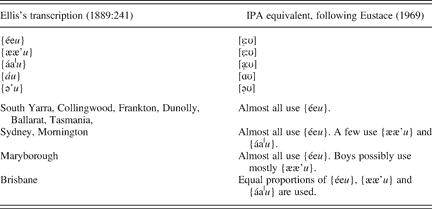
The earliest evidence we have of mouth variants in Australian English comes from McBurney, whose comments on NZE were examined earlier (Ellis, Reference Ellis1889). His findings for mouth are presented in Table 4. Perhaps even more so than in New Zealand, diphthongs with front mid-open onsets dominate. Ellis (Reference Ellis1889:237), commenting on McBurney's description, suggested that “on the whole … a visitor from England to Australasia finds great resemblance to the mode of speech he has left behind him.” He claims that a characteristic of Cockney is “alteration of the first factor of ow in cow, so that it is written kyow or caow {kjE’u, kæ’u} … [which] has nearly naturalised itself in Australia.” In a rarely cited article, Gunn (Reference Gunn1975:11), talking about the role of the early settlers in the formation of Australian English, stated that “/æu/, the form established in Australia, must have been very common in these general or advanced speakers.” Subsequently, writers have agreed, as in New Zealand, that the dominant vernacular form in Australian English has had onsets in the area of [æ] or [ε]. Baker, back in 1945, suggested that Australia has [æu~əɑu~εɑu~eiɑu], Mitchell and Delbridge (Reference Mitchell and Delbridge1965) proposed  , etc (see also Bernard, Reference Bernard, Collins and Blair1989; Clark, Reference Clark, Collins and Blair1989; Cochrane, Reference Cochrane, Collins and Blair1989; Lee, Reference Lee1989; Hammarström, Reference Hammarström1980:15; Harrington et al., Reference Harrington, Cox and Evans1997:179).
The realization of /au/ in varieties of early Australian English according to McBurney with IPA equivalents from Eustace
Source: McBurney cited in Ellis, Alexander. (Reference Ellis1889). On early English pronunciation: Part V. London: Truebner & Co. Eustace, S. (Reference Eustace1969). The meaning of the palaeotype in A. J. Ellis's “On early English pronunciation.” Transactions of the Philological Society 67:31–79.
The demographic and historical sociolinguistic analysis of the New Zealand migrant population highlights a number of points very clearly indeed:
• First, by far the most dominant variant of mouth among the settlers to New Zealand would have had an onset that was front and not fully open. This is shown by the fact that those very areas that saw heavy migration to New Zealand are those areas which, as agreed by several dialect surveys, predominantly used mid-open onsets. These include the south of England, parts of Ireland, and Australia.
• The [aʊ] realizations of mouth, necessary for us to support the hypothesis that /au/ completed the GVS before fronting and raising via Diphthong Shift, are found very sparsely indeed in areas that sent significant numbers of migrants and are more popular in areas that sent relatively few migrants—the North of England.
• Other variants would have also been present in the dialect mix: these include variants with central onsets [əʊ], found far more extensively across England than [aʊ], as well as in Scotland and Ireland, and noted as a minority form in New Zealand by McBurney (Ellis, Reference Ellis1889:241), and pre-GVS [u:]-type variants from Scotland and the far north of England.
It appears clear, I believe, from all this evidence, that [aʊ] would not have been found in sufficient quantity to have constituted the early dominant vernacular form, undermining proposed raising and fronting hypotheses.
CHALLENGES
Woods (Reference Woods1997, Reference Woods, Bell and Kuiper1999, Reference Woods2000) is the only linguist who seriously provided some challenge to the view that the present-day realizations of mouth can be accounted for by importation from the British Isles (2000:113).Footnote 15 She presented a considerable amount of evidence in favor of the presence of non-open onsets of /au/ from the early days of NZE. However, she ultimately rejected the idea of “preservation,” and so it is important in the context of the discussion of the origins of /au/ in NZE, therefore, to consider the reasoning behind her counterarguments. These include:
• The similarities between NZE and other postcolonial varieties. Woods claimed, for example, that “the direction of the shift in mouth … mirrors changes which have occurred in other colonial varieties of English” (Reference Woods2000:133), and “the fact that Australian English and South African English also display similar vowel structures, when the input dialects would have been of a different and divergent ‘mixture,’ may be taken as further evidence in favour of this hypothesis: these varieties show similarities not, or at least not solely, because they have retained elements from the original input dialects, but rather because they have undergone innovative parallel developments in their vowel structures which are governed by universal principles of change” (Reference Woods2000:142).
It is true that some postcolonial varieties of English have seen change in the mouth diphthong similar to that which Woods claimed for New Zealand. Labov (Reference Labov1994:71), for example, clearly demonstrated change in apparent time in Philadelphia. However, other more neighboring varieties with more similar sociodemographic backgrounds, such as Australian English, have similar histories of stable use of front mid-open onsets from the very beginnings of their English speech community.Footnote 16 As far as mouth is concerned, migrants to Australia would have imported a largely similar mix of variants, because the dominant areas of emigration were similar to those from which New Zealand drew migrants, namely southern England, Scotland, and Ireland (see Britain, Reference Britain2008).
• Labov's (Reference Labov1994) Principle 1 of language change—in chain shifts, tense nuclei tend to rise along a peripheral track. Woods saw the cross-varietal similarities not as evidence of a similar source but as evidence of parallel and independent developments. She claimed that “fronting and raising of mouth is predicted by Labov's internal principles of language change” (Reference Woods2000:133). She contrasted “conservative dialects of British and American English (e.g., northern New Jersey, Detroit, and Chicago) [which] are noted to have a low nucleus [æʊ], while more innovative dialects and more innovative speakers (e.g., Cockneys and young speakers in the southern states of the USA) are found to use a higher variant [e:ʉ]. This latter variant is, of course, extremely similar to the articulation of the mouth diphthong characteristic of NZE, and this may indicate, therefore, that NZE is located towards the innovative end of the archaic-progressive continuum” (Reference Woods2000:133). Similarly, she argued that “the fact that many similarities between Cockney and NZE can be explained by reference to patterns of the ‘Southern Shift’ suggests that, in general, the correspondences between these two varieties may best be explained by reference to parallel independent developments rather than to patterns of retention of particular phonological features” (Reference Woods2000:141); “thus … internal principles of change, and particularly those related to the Southern Shift, may account for the similarities between early NZE and Cockney … this seems a more feasible hypothesis than one of retention of features from a variety which was only used by a small percentage of the population” (Reference Woods2000:142).
Labov's (Reference Labov1994) principles of sound change are obviously an attractive source of explanation in variation studies. However, if they are to be used to support evidence of change it must be demonstrated in each case that the particular speech community in question actually underwent those changes and at the appropriate time for them to be relevant to the argument. As we have seen, there is very little empirical evidence indeed that NZE underwent this raising and fronting change in this way—were this change really to have taken place, we would have found more robust signs of [aʊ] being used as a vernacular variant in the early days of the English speech community in New Zealand. Similarly, Labov's principle may have applied to CockneyFootnote 17 but if that change took place in Southern England before the British settlement of New Zealand (as appears to be the case if we consider the evidence from Ellis [1889], see Fig. 5A), and given New Zealand was predominantly settled not just by Cockneys, but by people from right across the South of England bearing mid-open onsets of mouth, then we have to propose a rather contorted chain of events to posit that NZE underwent a Principle 1 change for that feature. If the majority front mid-open forms brought by thousands of migrants from the British Isles were not a driving force behind the evolution of mouth in New Zealand, where did they go? Showing a synchronic similarity in a number of different varieties does not necessarily mean they all underwent similar changes to get there. Some may have changed, but others may have imported the form from elsewhere.
Another challenge to the direct importation of variants dominated by mid-open variants is the proposal that diphthong shift was inherited as an ongoing process (e.g., Trudgill et al., Reference Trudgill, Gordon, Lewis and Maclagan2000b, Trudgill, Reference Trudgill2004). Certainly, for a number of the other elements that formed part of the diphthong shift, this seems to be a reasonable claim. Britain (Reference Britain2002b) considered, through an analysis of Ellis (Reference Ellis1889), the importation of British and Irish variants of face (/ei/) and showed that although many British dialects in the early to mid-19th century would have had lowering of the onset of face, suggesting diphthong shift was underway, those dialects did not dominate the dialectological landscape of southern England quite as much as front mid-open onsets of mouth (Reference Britain2002b:27). Furthermore, diphthong-shifted variants of fleece (/i:/) were much more restricted in 19th century-Britain (Reference Britain2002b:30). However, diphthong shifting of mouth, if such a thing occurred in the way Wells (Reference Wells1982) described, was in its latter stages of expansion in England by the time of Ellis (Reference Ellis1889). A comparison of mid-open front onsets of mouth in Ellis (Fig. 5A) with the SED data collected three-quarters of a century later, portrayed in Figure 8, shows a relatively small expansion in the geographical distribution of those forms. Recall also McBurney's finding (Table 4; Ellis, Reference Ellis1889) that, in the earlier-formed Australian English, mouth (drawn from slightly different, but similar migrant origins) was even more dominantly front and mid-open than in NZE. Consequently, what was imported from the British Isles was not a diphthong shift of mouth as a vigorously ongoing process, but as an almost completed one.
I turn, finally, to what I consider the most plausible explanation for the history and current position of the mouth diphthong in NZE, one that incorporates Woods's insistence that there was change, but which recognizes the role played by the dominant forms of mouth transported to New Zealand by mid-19th century migrants.
KOINEISATION AND FRONT MID-OPEN MOUTH
As a number of researchers have shown (Britain, Reference Britain1997a, Reference Britain, Boberg, Meyerhoff and Strassel1997b, Reference Britain, Ammon, Dittmar, Mattheier and Trudgill2004; Kerswill & Williams, Reference Kerswill and Williams2000; Siegel, Reference Siegel1985; and especially, Trudgill, Reference Trudgill1986, Reference Trudgill2004; Trudgill & Britain, forthcoming), one characteristic of speech communities such as New Zealand that have witnessed high levels of dialect contact between speakers of distinct but mutually intelligible varieties is koineisation. Koineisation can have a number of different outcomes, perhaps the most common of which is leveling, whereby marked or minority linguistic variants in a dialect mix are eradicated in favor of more common, less marked variants that have a wider social currency in the locale (see, for example, Britain, Reference Britain, Boberg, Meyerhoff and Strassel1997b; Sudbury, Reference Sudbury2001).
The demographic and linguistic evidence presented here for 19th-century New Zealand, I would claim, provides solid evidence of koineisation in progress. The early speech community, as highlighted by McBurney, is characterized by (i) dialect mixture—a range of variants of mouth in use in the early years of settlement,Footnote 18 but (ii), in this case, one overwhelmingly dominant variant of mouth—with a front mid-open onset. This mixed situation is a genuine reflection of the variety and proportions of forms imported by migrants from the British Isles and Australia. As the postcontact leveling process progressed, so the mid-open onsets of mouth gradually eradicated minority vernacular variants such as [əʊ] and [aʊ], with speakers accommodating to the local dominant variant, until a situation was reached when the dominance of front mid-open onsets in vernacular varieties of NZE reached its present strength. In doing so, it would not be surprising—in fact, we would expect it (Britain, Reference Britain, Boberg, Meyerhoff and Strassel1997b, Reference Britain2005b; Trudgill, Reference Trudgill1986, Reference Trudgill2004)—if interdialect forms such as variants between [aʊ] and [εʊ~εə] were found and this may account for some of the intermediate forms found in some studies—leveling in progress rather than fronting and raising in progress, given that fairly swiftly minority conversational vernacular variants would be replaced by the dominant ones.
So, importantly, I am not claiming that [aʊ]-type variants were not present in New Zealand, but that they were present in such insignificant proportions that they were leveled away as vernacular variants. They would have been retained somewhat among some speakers in some styles as “prestige” variants, demonstrating, I would like to claim, that the relationship between [aʊ] and [εʊ] in present-day NZE is not one of parent and child but one of standard and nonstandard. I am not claiming that there has been no change in mouth in NZE, but rather that the change is of a different nature to that usually proposed: externally driven leveling under circumstances of extreme dialect contact, where, for this particular variable (and not necessarily for others), there was an overwhelmingly dominant variant imported from the British Isles, rather than a gradual neogrammarian internally driven raising and fronting that somehow soldiered on despite the demographic turmoil in the community at large. The relevant process that led to the dominance of [æʊ–εʊ] therefore is one of dialect leveling rather than vowel raising.
In fact, a very similar argument has been put forward by Trudgill (Reference Trudgill2004; Trudgill et al., Reference Trudgill, Gordon and Lewis1998) to account for another characteristic of NZE—the raised front short vowels in trap and dress. He argues that in the dialect mix that arrived in New Zealand was a good proportion of variants that were already relatively close (see also, for example, both Gordon et al., Reference Gordon, Campbell, Hay, Maclagan, Sudbury and Trudgill2004, for discussions of trap and dress raising; and Woods, Reference Woods1997, for a very interesting account of the role speaker gender plays in focusing and new dialect formation) and that once in New Zealand, rather than this closeness becoming obsolescent (which is what has largely happened in Southern England), the vowels became more close over time to reach the present-day extremely distinctive qualities, leading consequently to NZE diverging rather than converging with British English. The same can be said for mouth—front mid-open variants were brought in abundance (perhaps in greater abundance than close variants of trap and dress), and though they have retreated somewhat in England (though retreated much less than close variants of dress and trap), they have flourished in NZE, and, following the course of the front short vowels, may well be becoming closer. Certainly in the Wellington data reported above, some of the younger female speakers (of both ethnicities) had variants of mouth with onsets closer than [e]. NZE, in this respect also, has diverged and continues to diverge from Southern Britain.
CONCLUSIONS
The history of mouth in NZE has previously been analyzed as if it has undergone a fronting and raising—some suggest this alteration is an imported change in progress, other work does not really lend much credence to the possibility that it is not New Zealand–born. I have argued here that NZE imported a fairly dominant front mid-open variant of mouth that leveled away other minor competitors on New Zealand soil. There is evidence to suggest the already close onset of the diphthong is perhaps becoming closer and given the (slow) retreat of front mid-open variants in England, it represents a(nother) case of NZE diverging from English English. In the case of mouth, the settler dialects showed patterns that were not only quite unlike standard varieties (indeed, note the comments of Anderson, Reference Anderson1987; and Kurath & Lowman, Reference Kurath and Lowman1970 ), but which showed a dominance of the variants that prevail in the country today. The leveling in the early colonial period left front mid-open onsets “victorious” at the vernacular level, but engaged in a much longer battle with more prestigious variants at the stylistically more formal level. Figures 1A and 1C appear to suggest that the fully open [aʊ] forms may be slowly losing this battle too.
At a more general level, this case study highlights the need to attend as carefully as possible to the initial stages of change as well as to the direction and outcome of change. Our ability to highlight leveling as a dominant koineisation process relies quite crucially on us having detailed and explicit knowledge both of the structures of the dialects in the input and of the demographics of their users. Kuo's (Reference Kuo2005) study of the development of Taiwanese Mandarin (TM) (which has formed over the half century since the flight of Chinese Nationalists from the mainland after the Chinese Civil War [1945–1949]) provided another reminder of the importance of understanding who brought which dialects to the mix. The previous literature on TM had suggested strongly that this new variety was different from Standard Beijing Mandarin because of the second-language acquisition failures of the non-Mandarin speaking population of Taiwan (mostly speakers of the majority Southern Min) who were forced to learn and speak Mandarin after the Nationalists arrived from the mainland. Earlier researchers pointed to the fact, for example, that although Standard Beijing Mandarin had four retroflex consonants in its inventory, Southern Min had none, and so, when learning Mandarin, the Southern Min speakers merged the retroflexes with corresponding nonretroflex sounds, and diffused these nonretroflex consonants to, among others, the children of original mainlanders. Through a very careful analysis of both the structure of Chinese dialects in the middle of the 20th century and census information on the regional origins of the migrant mainlander population, Kuo demonstrated that although retroflexes were common in central Beijing, they were rarely found elsewhere in China and were in a tiny minority of the mid-20th-century migrant population to Taiwan. She argued, therefore, that the lack of retroflexes in TM was a simple result of them not having been brought to Taiwan in sufficient numbers in the first place, and the few that were brought, being highly marked, were swiftly leveled away. This and the New Zealand case study reiterate the importance of looking behind us as well as in front when analyzing change, because we might find the journey already undertaken has been rather different than we had first imagined.
 ; {E} = [ε];
 ;
 (Jones, 2006:278). Ellis's paleograph symbols in the region of IPA [æ] are {ah}, {æh}, and {əh} (Jones, 2006:278), none of which are found in the transcriptions of McBurney's data.