1. Introduction
The Ediacaran Period spans a critical time interval during the Earth history, beginning with the termination of global Cryogenian glaciation and ending at the earliest occurrence of marine bilaterian animals on a global scale at the beginning of the Phanerozoic Eon (Knoll et al. Reference Knoll, Walter, Narbonne and Christie-Blick2004). The successions during this interval record the dramatic fluctuations in the compositions of the ocean and atmosphere, such as the large excursions of the carbon isotope in seawater (e.g. Jiang, Kennedy & Christie-Blick, Reference Jiang, Kennedy and Christie-Blick2003; Le Guerroué, Allen, & Cozzi, Reference Le Guerroué, Allen and Cozzi2006; Zhu, Zhang & Yang, Reference Zhu, Zhang and Yang2007) and increasing oxygen levels (e.g. Och & Shields-Zhou, Reference Och and Shields-Zhou2012; Lyons, Reinhard & Planavsky, Reference Lyons, Reinhard and Planavsky2014; Chen et al. Reference Chen, Ling, Vance, Shields-Zhou, Zhu, Poulton, Och, Jiang, Li, Cremonese and Archer2015). Broadly coincident is the rapid radiation of the complex, macroscopic multicellular organisms on the eve of the Cambrian explosion, including Ediacara-type soft-bodied fossils (e.g. Narbonne, Reference Narbonne2005; Droser & Gehling, Reference Droser and Gehling2015), megascopic multicellular algal fossils (e.g. Xiao et al. Reference Xiao, Yuan, Steiner and Knoll2002), trace fossils (e.g. Jensen et al. Reference Jensen, Saylor, Gehling and Germs2000; Chen et al. Reference Chen, Zhou, Meyer, Xiang, Schiffbauer, Yuan and Xiao2013) and weakly calcified metazoans (e.g. Hofmann & Mountjoy, Reference Hofmann and Mountjoy2001; Cai et al. Reference Cai, Xiao, Hua and Yuan2015). Stratigraphic successions spanning the Ediacaran–Cambrian transition are well developed and exposed in South China (Zhu, Zhang & Yang, Reference Zhu, Zhang and Yang2007). Previous studies on the litho-, chemo- and biostratigraphy of these successions have advanced significantly in understanding the evolution of life and environment during the Ediacaran Period (e.g. Jiang et al. Reference Jiang, Shi, Zhang, Wang and Xiao2011; Zhu et al. Reference Zhu, Lu, Zhang, Zhao, Li, Yang, Zhao and Zhao2013; Liu et al. Reference Liu, Xiao, Yin, Chen, Zhou and Li2014). However, the Ediacaran stratigraphy of South China is complicated because of facies variation, hampering development of a global integrated stratigraphic model for life evolution and environmental changes at this critical interval.
Absolute dating (i.e. radio-isotopic geochronology) is the fundamental method for the development and testing of models of intra-basinal and global stratigraphic inter-comparison, and is the only way to quantify the rates of the geological and biological processes. The zircon 207Pb–206Pb age 550.55 ± 0.75 Ma from the top of the Miaohe Member in the west Huangling Anticline (Condon et al. Reference Condon, Zhu, Bowring, Wang, Yang and Jin2005), which has been traditionally correlated to the Doushantuo Member IV in the Yangtze Gorges area, constrains the age of the Miaohe biota (Xiao et al. Reference Xiao, Yuan, Steiner and Knoll2002) and is regarded as the age for the top of the Doushantuo Formation, that is, the top of the DOUNCE (Doushantuo negative carbon isotope excursion; Zhu, Strauss & Shields, Reference Zhu, Strauss and Shields2007)/Shuram δ13C negative excursion and the base of the Dengying Formation (e.g. Ding et al. Reference Ding, Li, Hu, Xiao, Su and Huang1996; Wang et al. Reference Wang, Erdtmann, Chen and Mao1998; Condon et al. Reference Condon, Zhu, Bowring, Wang, Yang and Jin2005; Zhu, Zhang & Yang, Reference Zhu, Zhang and Yang2007; Lu et al. Reference Lu, Zhu, Zhang, Shields-Zhou, Li, Zhao, Zhao and Zhao2013). This stratigraphic correlation was recently challenged by An et al. (Reference An, Jiang, Tong, Tian, Ye, Song and Song2015), who suggested that Miaohe Member in the west Huangling Anticline is significantly younger than the Doushantuo Member IV in the Yangtze Gorges area, most likely time-equivalent with the lower Shibantan Member of the Dengying Formation which yields abundant Ediacara-type fossils (Chen et al. Reference Chen, Zhou, Xiao, Wang, Guan, Hua and Yuan2014). Improvement of the chronostratigraphic framework is therefore required for understanding of the DOUNCE/Shuram δ13C negative excursion and its causal relation with the Miaohe biota and other Ediacaran fossils recorded in upper Ediacaran successions. One of the key issues to test those two competing models is to obtain absolute ages from the Dengying Formation. However, no radiometric ages within the Dengying Formation or its equivalents have yet been reported. Meanwhile, the lack of the robust age constraints in the Dengying Formation hinders the biostratigraphic correlations between the Ediacara-type fossils discovered in South China and the three Ediacara-type fossil assemblages in other palaeocontinents: the Avalon Assemblage (c. 575–560 Ma); the White Sea Assemblage (c. 560–550 Ma); and the Nama Assemblage (c. 550–541 Ma) (Grotzinger et al. Reference Grotzinger, Bowring, Saylor and Kaufman1995; Martin et al. Reference Martin, Grazhdankin, Bowring, Evans, Fedonkin and Kirschvink2000; Waggoner, Reference Waggoner2003; Bowring et al. Reference Bowring, Grotzinger, Condon, Ramezani, Newall and Allen2007; Xiao & Laflamme, Reference Xiao and Laflamme2009; Noble et al. Reference Noble, Condon, Carney, Wilby, Pharaoh and Ford2015).
To achieve a better understanding of the geochronological framework of the Dengying Formation and the biostratigraphic correlations of the Ediacara-type fossils in South China, we scrutinize the SIMS zircon 238U–206Pb and 207Pb–206Pb data in order to derive robust age constraints. We present two new SIMS zircon U–Pb datasets with a weighting towards the 207Pb–206Pb dates due to issues of open-system behaviour (i.e. radiogenic Pb-loss) of the ash beds in the middle part of the Dengying Formation in eastern Yunnan Province, South China.
2. Geological background and sampling
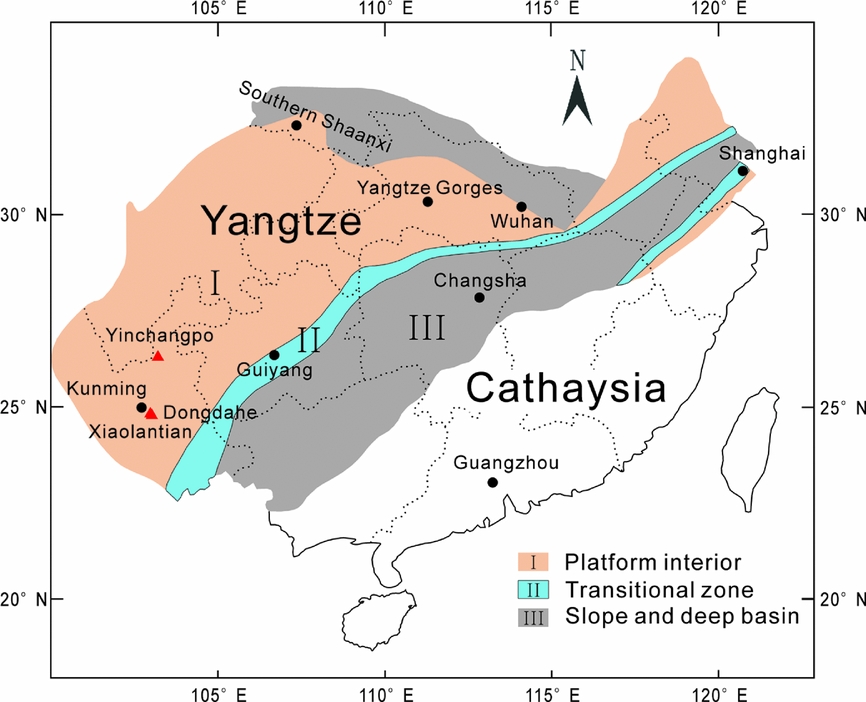
As a part of the Rodinia supercontinent, the South China Block was formed by amalgamation of Yangtze and Cathaysia blocks along the early Neoproterozoic Sibao Orogen (Fig. 1), although the timing of the amalgamation is still controversial (e.g. Li et al. Reference Li, Li, Zhou and Kinny2002, Reference Li, Li, Li, Lo, Wang, Ye and Yang2009a ; Zhou et al. Reference Zhou, Yan, Kennedy, Li and Ding2002). Mantle plume was formed beneath the Rodinia supercontinent about 50 million years after the completion of its assembly, leading to the development of the continental rifting and the break-up of the supercontinent (Li et al. Reference Li, Bogdanova, Collins, Davidson, Waele, Ernst, Fitzsimons, Fuck, Gladkochud, Jacobs, Karlstrom, Lu, Natapov, Pease, Pisarevsky, Thrane and Vernikovsky2008b ). Rift-related sedimentary successions and bimodal magmatic rocks dated at 0.85–0.72 Ga are widespread in South China, especially around the periphery of the Yangtze Block (e.g. Wang & Li, Reference Wang and Li2003; Li et al. Reference Li, Li, Li and Liu2008 a; Yang et al. Reference Yang, Li, Wang and Lan2015). Overlying the rift-related sequences are the glacial and interglacial deposits, recording the two Neoproterozoic worldwide glaciations in South China (Shields-Zhou, Porter & Halverson, Reference Shields-Zhou, Porter and Halverson2016). The early Ediacaran Doushantuo Formation is overlying the Nantuo (Marinoan-equivalent) glacial deposit, with the characteristic ‘cap carbonates’ at the base (Jiang, Kennedy & Christie-Blick, Reference Jiang, Kennedy and Christie-Blick2003; Zhu, Zhang & Yang, Reference Zhu, Zhang and Yang2007). The thin ash layer at the top of the cap carbonate was dated at 635.2 ± 0.6 Ma, constraining the terminal timing of the Nantuo glaciation in South China, which reflects the global Marinoan glaciation (Condon et al. Reference Condon, Zhu, Bowring, Wang, Yang and Jin2005). The Doushantuo Formation is composed mainly of carbonate rocks and black shale. Large acanthomorphic acritarchs, multicellular algae, animal embryos and few animal fossils are present in the Doushantuo Formation (e.g. Xiao, Zhang & Knoll, Reference Xiao, Zhang and Knoll1998; Chen et al. Reference Chen, Bottjer, Oliveri, Dornbos, Gao, Ruffins, Chi, Li and Davidson2004; Liu et al. Reference Liu, Yin, Chen, Tang and Gao2013; Yin et al. Reference Yin, Zhu, Davidson, Bottjer, Zhao and Tafforeau2015). As the uppermost part of the Ediacaran strata in South China, the Dengying Formation (and its equivalents) consists mainly of carbonate rocks in the shallow water basin and cherts in the slope and deepwater basin (Zhu et al. Reference Zhu, Zhang, Steiner, Yang, Li and Erdtmann2003, Reference Zhu, Strauss and Shields2007). The Dengying Formation is known to contain abundant fossils, such as Ediacara-type soft-bodied fossils, trace fossils, macroalgal fossils and some tubular fossils (e.g. Hua, Chen & Yuan, Reference Hua, Chen and Yuan2007; Chen et al. Reference Chen, Zhou, Meyer, Xiang, Schiffbauer, Yuan and Xiao2013, Reference Chen, Zhou, Xiao, Wang, Guan, Hua and Yuan2014; Cai et al. Reference Cai, Xiao, Hua and Yuan2015). These terminal Ediacaran fossils are central to our understanding of the animal evolution on the eve of the Cambrian explosion.
Simplified palaeogeographic map of the Yangtze Block during the Precambrian–Cambrian transition interval (modified after Zhu et al. Reference Zhu, Zhang, Steiner, Yang, Li and Erdtmann2003). The dots represent the cities or the areas, and the triangles represent the sections.

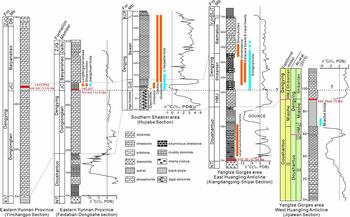
The Ediacaran–Cambrian transitional strata with shallow-marine facies are extensively developed and well exposed in eastern and northeastern Yunnan Province, South China (Zhu et al. Reference Zhu, Li, Zhang, Steiner, Qian and Jiang2001). We studied and sampled the middle part of the Dengying Formation in the Xiaolantian and Yinchangpo sections in the eastern Yunnan Province (Figs 1, 2). The Xiaolantian section is located to the NE of the Fuxian Lake, about 6 km to the east of the Chengjiang county town. This section is near the well-described Feidatian–Dongdahe section (Zhu, Zhang & Yang, Reference Zhu, Zhang and Yang2007) and the lithostratigraphy of the Dengying Formation at the two sections is similar, so the horizon of the dated ash bed from Xiaolantian section is marked on the column of Feidatian–Dongdahe section (Fig. 2). The Xiaolantian section consists of four formations spanning upper Ediacaran – lower Cambrian stratigraphy (from bottom to top): Dengying, Zhujiaqing, Shiyantou and Yu'anshan formations. The Dengying Formation is divided into three members including (from bottom to top) the Donglongtan, Jiucheng and Baiyanshao members. The Donglongtan and Baiyanshao members are dominated by dolostone. The Jiucheng Member mainly consists of sandstone and muddy siltstone interbedded with laminated silty dolomite at the basal part. Overlying the Dengying Formation is the Zhujiaqing Formation which is composed of dolostone, phosphorite and interbedded phosphatic limestone. Numerous small shelly fossils (SSFs) were discovered from this formation (Qian et al. Reference Qian, Zhu, He and Jiang1996). Unconformably overlying the Zhujiaqing Formation is the Shiyantou and Yu'anshan formations which are dominated by siltstone and shales. The famous Chengjiang biota occurs in the middle part of the Yu'anshan Formation (Zhang & Hou, Reference Zhang and Hou1985). The Yinchangpo section is located about 10 km to the NW of the Huize county town. This section consists of two formations including Dengying and Zhujiaqing formations (Fig. 2). The Donglongtan Member of the Dengying Formation is c. 460 m thick and is composed of thickly bedded to massive dolostone. The Jiucheng Member is c. 20 m thick and consists of muddy siltstone and silty dolostone. The Baiyanshao Member consists of c. 260 m of medium- to thickly bedded, laminated dolostone. Only the lower part of the Zhujiaqing Formation crops out in this section, composed of interbedded dolostone and chert (Fig. 2).
Stratigraphic column of the Yinchangpo section in the eastern Yunnan Province and its lithostratigrahic correlation to the Ediacaran–Cambrian transition successions in eastern Yunnan Province (Zhu, Zhang & Yang, Reference Zhu, Zhang and Yang2007; Li et al. Reference Li, Ling, Shields-Zhou, Chen, Cremonese, Och, Thirlwall and Manning2013 a), southern Shaanxi Province (Zhu, Zhang & Yang, Reference Zhu, Zhang and Yang2007) and Yangtze Gorges area (Condon et al. Reference Condon, Zhu, Bowring, Wang, Yang and Jin2005; Jiang et al. Reference Jiang, Kaufman, Christie-Blick, Zhang and Wu2007; Lu et al. Reference Lu, Zhu, Zhang, Shields-Zhou, Li, Zhao, Zhao and Zhao2013; Zhu et al. Reference Zhu, Lu, Zhang, Zhao, Li, Yang, Zhao and Zhao2013; An et al. Reference An, Jiang, Tong, Tian, Ye, Song and Song2015). The biostratigraphy is based on Tang et al. (Reference Tang, Song, Yin, Liu, Awramik, Wang and Gao2006), Hua, Chen & Yuan (Reference Hua, Chen and Yuan2007), Zhu (Reference Zhu2010), Chen et al. (Reference Chen, Zhou, Meyer, Xiang, Schiffbauer, Yuan and Xiao2013, Reference Chen, Zhou, Xiao, Wang, Guan, Hua and Yuan2014) and Zhang, Hua & Zhang (Reference Zhang, Hua and Zhang2015). The dotted lines represent the lithostratigraphic boundaries. KY – Kunyang Group; NT – Nantuo Formation; ZJQ – Zhujiaqing Formation; KCP – Kuanchuanpu Formation; YJH – Yanjiahe Formation; SJT – Shuijingtuo Formation; JC – Jiucheng Member; DB – Daibu Member; GJS – Gaojiashan Member; Fm – formation; Mb – member.

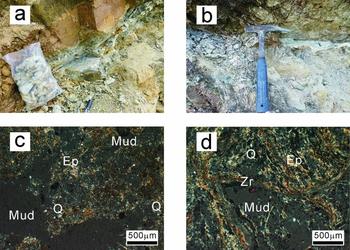
Two ash samples from the middle part of the Dengying Formation were collected for SIMS zircon U–Pb dating (Figs 2, 3). Sample 14CJ07 was collected c. 3.8 m above the phosphorite layer at the base of the Jiucheng Member, Dengying Formation in the Xiaolantian section, and sample 14YCP02 was collected from the middle part of the Jiucheng Member, 471 m above the base of the Dengying Formation in the Yinchangpo section.
Field photographs showing the sampling site of the ash beds (a) 14CJ07 and (b) 14YCP02. Photomicrographs of samples (c) sample 14CJ07 and (d)14YCP02, showing they are mainly composed of mud, epidote and quartz.

3. SIMS zircon U–Pb dating method
Zircon crystals were separated from c. 3 kg of each sample using conventional density and magnetic separation techniques. Together with zircon standards Plešovice, 91500, Penglai and Qinghu, zircon grains were mounted in an epoxy resin which was then polished to section the crystals in half for analysis. All zircon grains were documented with transmitted and reflected light photomicrographs and cathodoluminescence (CL) images to reveal their external and internal structures, and the mount was vacuum-coated with high-purity gold prior to secondary ion mass spectrometry (SIMS) analysis.
Measurements of U, Th and Pb isotopes were conducted using a Cameca 1280-HR SIMS at the Institute of Geology and Geophysics, Chinese Academy of Sciences in Beijing. The O2 − primary ion beam was accelerated at –13 kV with an intensity of 5–12 nA. The ellipsoidal spot is c. 20 μm × 30 μm in size. Positive secondary ions were extracted with a 10 kV potential. Oxygen flooding was used to increase the O2 pressure to c. 5 × 10⁻⁶ Torr in the sample chamber, enhancing the secondary Pb+ sensitivity to a value of 35 cps (nA ppm)−1 for zircon. In the secondary ion beam optics, a 60 eV energy window was used to reduce the energy dispersion. To achieve a higher precision of SIMS U–Pb zircon geochronology, a dynamic multi-collector U–Pb dating method was used to take advantages of both mono-collector mode (high-precision determination of the 238U–206Pb age) and multi-collector mode (high-precision determination of the 207Pb–206Pb age). This new analytical protocol is able to achieve a higher precision by a factor of two for the 207Pb–206Pb age than the conventional mono-collector mode within the same working time, allowing the 207Pb–206Pb and 238U–206Pb ages to be obtained simultaneously with comparable quality to effectively evaluate the concordance of the U–Pb system for Phanerozoic and late Precambrian samples (Liu et al. Reference Liu, Li, Tang, Li and Yin2015). Each measurement consists of seven cycles, and the total analytical time is c. 14 min. More details of this method are provided by Liu et al. (Reference Liu, Li, Tang, Li and Yin2015).
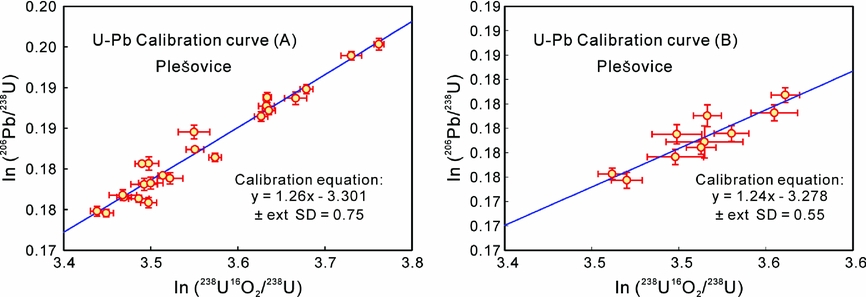
Analyses of the standard zircons were interspersed with those of unknown grains. Two successive sessions (sessions A and B) were conducted within a short time period and the errors of the U–Pb calibration curve fitted by the standard zircons, 0.75 % (1 SD, session A) and 0.55 % (1 SD, session B), were propagated to the unknowns of the respective session (Fig. 4). The U–Th–Pb ratios were determined relative to the Plešovice standard zircon (Sláma et al. Reference Sláma, Košler, Condon, Crowley, Gerdes, Hanchar, Horstwood, Morris, Nasdala, Norberg, Schaltegger, Schoene, Tubrett and Whitehouse2008), and the absolute abundances were calibrated to the standard zircon 91500 (Wiedenbeck et al. Reference Wiedenbeck, Alle, Corfu, Griffin, Meier, Oberli, Vonquadt, Roddick and Speigel1995). Measured Pb isotopic compositions were corrected for common Pb using the 204Pb method. Corrections are sufficiently small to be insensitive to the choice of common Pb composition, and an average of present-day crustal composition (Stacey & Kramers, Reference Stacey and Kramers1975) is used for the common Pb assuming that the common Pb is largely surface contamination introduced during sample preparation. To be consistent with the published dates, the 238U/235U ratio of 137.88 (Steiger & Jaeger, Reference Steiger and Jaeger1977) and 238U and 235U decay constants of Jaffey et al. (Reference Jaffey, Flynn, Glendenin, Bentley and Essling1971) are adopted in this study. Data reduction was carried out using the Isoplot/Exv. 4.15 program (Ludwig, Reference Ludwig2003). Details of the calibration method are provided by Li et al. (Reference Li, Liu, Li, Guo and Chamberlain2009b ). In order to monitor the external uncertainties of SIMS U–Pb measurements, analyses of zircon standard Qinghu were interspersed with unknowns. Twelve analyses yielded a weighted mean 238U–206Pb age of 159.8 ± 0.6 Ma (2 SE, MSWD = 1.2), identical within errors to the reported age of 159.5 ± 0.2 Ma (Li et al. Reference Li, Tang, Gong, Yang, Hou, Hu, Li, Liu and Li2013b ).
Logarithmic U–Pb calibration graphs. Curve (a) is applied to samples 14YCP02 and 14CJ07/01-20, and curve (b) is applied to 14CJ07/21-50.

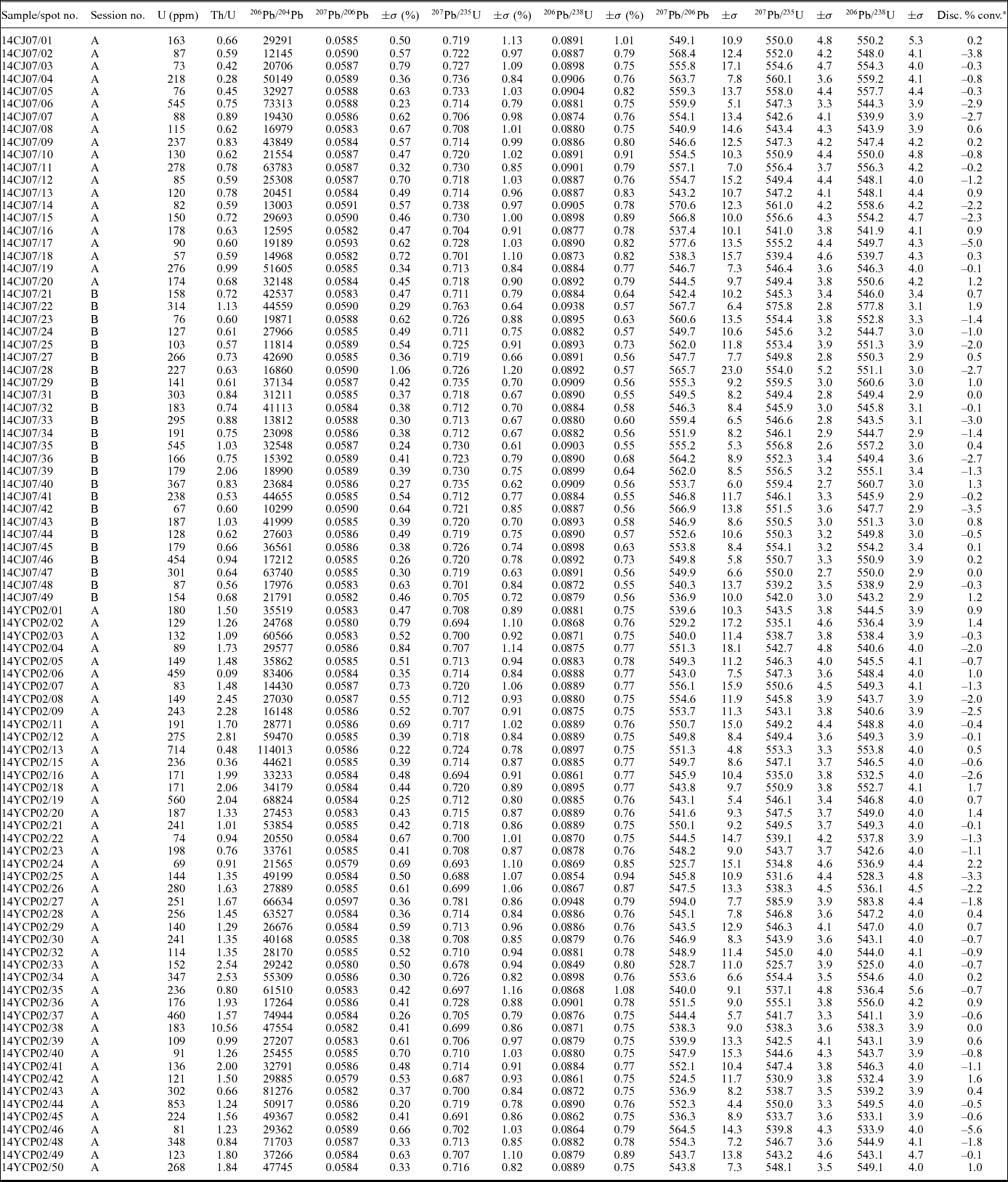
SIMS zircon U–Pb data are given in Table 1, and uncertainties on individual analysis are reported at a 1σ level. Noteworthy is that the precision of the weighted mean ages is the standard error (SE), which will decrease with an increasing quantity of zircon data included in the weighted mean age calculation. The external uncertainty of 1 % (2 SD) for SIMS zircon 238U–206Pb age (e.g. Ireland & Williams, Reference Ireland and Williams2003; Yang et al. Reference Yang, Li, Liu, Tang, Ling and Li2014) should be taken into consideration when comparing the SIMS zircon 238U–206Pb age with other published dates (e.g. the ID-TIMS date from Condon et al. Reference Condon, Zhu, Bowring, Wang, Yang and Jin2005). The multi-collector SIMS determination of the 207Pb–206Pb age for the latest Neoproterozoic zircon has a comparable precision as the 238U–206Pb age (Li et al. Reference Li, Liu, Li, Guo and Chamberlain2009b ), and the zircon 207Pb–206Pb age by SIMS measurement is independent of the matrix-matched U–Pb calibration. We assume that the external reproducibility for the multi-collector SIMS determination of latest Neoproterozoic zircon 207Pb–206Pb age is c. 0.5 % (2 SD) (Li et al. Reference Li, Liu, Li, Guo and Chamberlain2009b , Reference Li, Li, Liu, Wu, Yang and Mitchell2010; Liu et al. Reference Liu, Li, Tang, Li and Yin2015). The reported errors of the weighted mean ages in this study include two components, for example, Age ± X/(Y), where X represents the analytical error and (Y) represents the analytical + external reproducibility. The calculation of (Y) follows the uncertainty propagation workflow of Horstwood et al. (Reference Horstwood, Košler, Gehrels, Jackson, McLean, Paton, Pearson, Sircombe, Sylvester, Vermeesch, Bowring, Condon and Schoene2016). The MSWD (mean square of the weighted deviates) of the weighted mean age is calculated prior to the addition of the external uncertainties.
SIMS zircon U–Pb data of ash samples from Dengying Formation in eastern Yunnan Province

*Age discordance in conventional concordia space.
4. Results
4.a. Sample 14CJ07 at the base of the Jiucheng Member
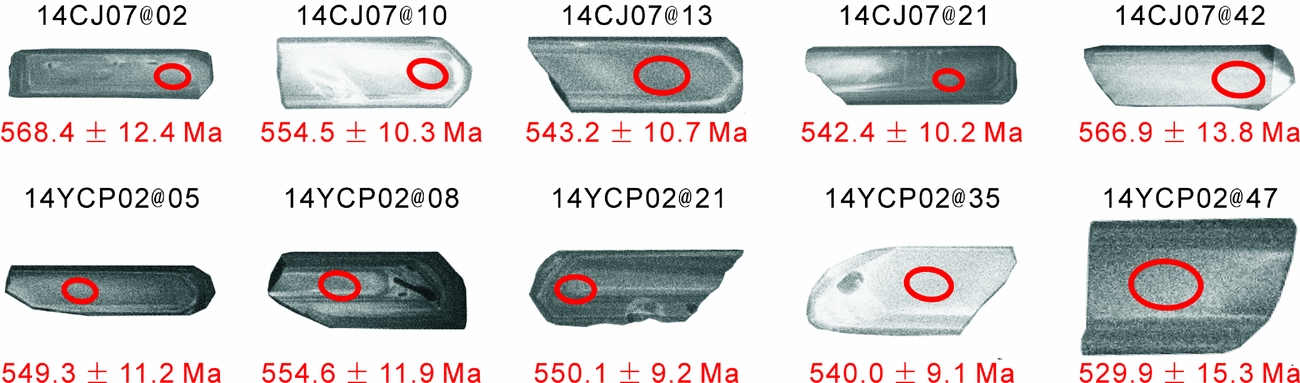
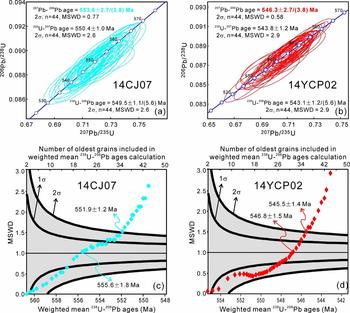
Most zircons from this sample are 100–200 μm in length and have aspect ratios of 3–5. They are euhedral and long-prismatic in morphology, with weakly oscillatory zoning under CL images (Fig. 5). A total of 50 analyses were conducted on 50 zircons. U and Th contents are within the range 57–545 ppm and 31–559 ppm, respectively, with Th/U ratios of 0.28–2.06 (mostly within 0.28–1.03), suggesting a magmatic origin. With the exception of five sets of data from zircons with high common lead, all the others are considered to be reliable. The main population includes 44 grains, and their 238U–206Pb ages range from 539 ± 3 Ma to 561 ± 3 Ma (Fig. 6), yielding a weighted mean 238U–206Pb age of 549.5 ± 1.1/(5.6) Ma (2σ, n = 44, MSWD = 2.6). Their weighted mean 235U–207Pb and 207Pb–206Pb ages are 550.4 ± 1.0 Ma (2σ, n = 44, MSWD = 2.6) and 553.6 ± 2.7/(3.8) Ma (2σ, n = 44, MSWD = 0.77), respectively. The spot no. 22 yielded a 238U–206Pb age of 578 ± 3 Ma and a 207Pb–206Pb age of 568 ± 6 Ma. Its 238U–206Pb age is outwith the main population and it is a little reverse discordant (discordance = 1.9 %). To be prudent, this grain was excluded from the weighted mean age calculation.
Photomicrographs of representative zircons analysed in this study. The ellipses indicate the SIMS U–Pb analytical spots, each 30 μm in length for scale. Zircon 207Pb–206Pb ages are quoted.

U–Pb concordia diagrams of samples (a) 14CJ07 and (b) 14YCP02. Weighted mean 238U–206Pb ages versus their MSWD versus the number of the oldest grains included in the weighted mean age calculation for samples (c) 14CJ07 and (d) 14YCP02. The grey area represents the range of the acceptable MSWD (Wendt & Carl, Reference Wendt and Carl1991).

4.b. Sample 14YCP02 at the middle part of the Jiucheng Member
Zircons from sample 14YCP02 are 100–200 μm in length and have aspect ratios of 2–4. They are euhedral and prismatic in morphology, showing oscillatory zoning under CL images (Fig. 5). A total of 50 analyses were conducted on 50 zircons, which are characterized by moderate U (47–853 ppm) and Th (42–1934 ppm) contents with Th/U ratios ranging over 0.09–10.56 (mostly within 0.36–2.81). The morphology and the Th/U ratios suggest that they are of magmatic origin. With the exception of five sets of data from zircons with high common lead, all the others are considered to be reliable. The major population consists of 44 analyses, with their 238U–206Pb ages ranging from 525 ± 4 Ma to 556 ± 4 Ma. They yield a weighted mean 238U–206Pb age of 543.1 ± 1.2/(5.6) Ma (2σ, n = 44, MSWD = 2.9, Fig. 6). Their weighted mean 235U–207Pb and 207Pb–206Pb ages are 543.8 ± 1.2 Ma (2σ, n = 44, MSWD = 2.9) and 546.3 ± 2.7/(3.8) Ma (2σ, n = 44, MSWD = 0.58), respectively. Spot no. 27 gives a clearly older 238U–206Pb age of 584 ± 4 Ma and older 207Pb–206Pb age of 594 ± 8 Ma than the major population, suggesting a xenocrystal origin.
5. Discussion
5.a. Ages of the ash beds from middle Dengying Formation
Zircon U–Pb geochronology is the most widely used radiometric dating tool for determining geological ages and establishing time scales of processes in the Earth history. However, the Pb-loss in zircons, a result of the crystal lattice being damaged by the emission of alpha particles and alpha recoil processes, has often been recognized in U–Pb systematics of zircon (e.g. Nasdala et al. Reference Nasdala, Hanchar, Kronz and Whitehouse2005). In micro-beam zircon U–Pb dating techniques, such as the LA-ICPMS and SIMS, it is possible to recognize the significant Pb-loss effect in the high-U zircons or zircons with old ages since their 238U–206Pb and 207Pb–206Pb dates can be resolved. However, Pb-loss can be cryptic and impossible to identify in the zircons with younger ages without reference to other techniques such as CA-ID-TIMS or 40Ar–39Ar dating (e.g. Kryza et al. Reference Kryza, Crowley, Larionov, Pin, Oberc-Dziedzic and Mochnacka2012; Crowley et al. Reference Crowley, Heron, Riggs, Kamber, Chew, McConnell and Benn2014; Watts et al. Reference Watts, Coble, Vazquez, Henry, Colgan and John2016). Thermal annealing and chemical abrasion (‘CA’) can minimize the effect of Pb-loss by removing the radiation-damaged parts of zircons, and have been widely used in thermal ionization mass spectrometry zircon U–Pb dating method (Mattinson, Reference Mattinson2005). The SIMS 238U–206Pb ages of the CA-treated zircons are generally older than the results obtained from the untreated zircons from the same magmatic rock, even though no discordance can be resolved from the latter analytical data set (Kryza et al. Reference Kryza, Crowley, Larionov, Pin, Oberc-Dziedzic and Mochnacka2012; Watts et al. Reference Watts, Coble, Vazquez, Henry, Colgan and John2016).
The dynamic multi-collector U–Pb dating method we adopted in this study has the ability to measure the high-precision 207Pb/206Pb ratio as in the static multi-collector mode without trade-off in the analytical precision of the 238U/206Pb ratio of the conventional peak-hopping mono-collector mode (Liu et al. Reference Liu, Li, Tang, Li and Yin2015). This new method has potential to simultaneously produce higher-precision 238U–206Pb and 207Pb–206Pb ages of zircon, providing reliable evaluation on the concordance of the zircon U–Pb system as young as 500 Ma (Liu et al. Reference Liu, Li, Tang, Li and Yin2015). For the two samples in this study, their weighted mean 238U–206Pb age < 235U–207Pb age < 207Pb–206Pb age, indicating that they are discordant and most likely resulted from subtle radiogenic Pb-loss. The MSWD of the two weighted mean 238U–206Pb ages (2.6 and 2.9) are large and fall outside of the acceptable range of the MSWD values for a given population included in weighted mean age calculation (44 grains for each sample in this study, Fig. 6), implying that they do not represent a single population and their weighted mean 238U–206Pb ages are meaningless (Wendt & Carl, Reference Wendt and Carl1991). If the assumption that the analysed zircons have suffered subtle radiogenic Pb-loss is correct, we can explore a MSWD-based model to exclude the outliers. The model is that using the largest population of the oldest grains that yield an acceptable MSWD value to calculate the weighted mean 238U–206Pb ages. The MSWD-based model weighted mean 238U–206Pb ages for the two samples are therefore 551.9 ± 1.2/(5.6) Ma (Fig. 6c) and 545.5 ± 1.4/(5.6) Ma (Fig. 6d). We note however that the calculation of a MSWD with a value that is acceptable for n does not confirm a single age population.
Present-day radiogenic Pb-loss of zircon will not affect the accuracy of the 207Pb–206Pb age. The zircon 207Pb–206Pb age by SIMS measurement is independent of the matrix-matched U/Pb calibration, and its uncertainty is derived predominantly from the uncertainty of the measured 207Pb/206Pb ratio and the common Pb correction. All the zircons included in the weighted mean age calculation have 206Pb/204Pb ratios > 10 000, indicating that the common Pb correction only makes a small contribution to the final 207Pb–206Pb age uncertainty (Li et al. Reference Li, Liu, Li, Guo and Chamberlain2009b ). As mentioned above, the new analytical protocol we adopted is able to achieve a higher precision by a factor of two for the 207Pb–206Pb age than the conventional mono-collector mode within the same working time (Liu et al. Reference Liu, Li, Tang, Li and Yin2015). We therefore suggest that the weighted mean 207Pb–206Pb ages of 553.6 ± 2.7/(3.8) Ma and 546.3 ± 2.7/(3.8) Ma are the best estimates of the crystallization ages for the two ash samples in the middle Dengying Formation in eastern Yunnan Province, South China. This suggestion is also supported by the fact that the weighted mean 207Pb–206Pb age is identical within errors to its corresponding MSWD-based model weighted mean 238U–206Pb age.
5.b. Geochronological constraints on the Dengying Formation
The Dengying Formation is divided into three parts in South China, although they have been called different names in different areas (Fig. 2). The three lithostratigraphic units of the Dengying Formation in eastern Yunnan Province (in upwards order: Donglongtan, Jiucheng and Baiyanshao members) are traditionally correlated to those in other areas of the Yangtze Platform (Zhu, Zhang & Yang, Reference Zhu, Zhang and Yang2007) such as the Yangtze Gorges area (Hamajing, Shibantan and Baimatuo members) and southern Shaanxi Province (Algal Dolostone, Gaojiashan and Beiwan members).
Although numerous studies have been carried out on the lithostratigraphy, chemostratigraphy and palaeontology within the Dengying Formation, less achievement on geochronology has been made. No zircon U–Pb data have been directly obtained from the Dengying Formation or its equivalents, hampering attempts to verify the chronostratigraphic framework. The Miaohe Member, which consists of black siliceous and carbonaceous shales and contains the famous Miaohe biota in west Huangling Anticline, Yangtze Gorges area, has long been considered as the uppermost part of the Doushantuo Formation (‘traditional correlation model’, e.g. Ding et al. Reference Ding, Li, Hu, Xiao, Su and Huang1996; Wang et al., Reference Wang, Erdtmann, Chen and Mao1998; Zhu, Zhang & Yang, Reference Zhu, Zhang and Yang2007). The zircon 207Pb–206Pb age of 550.55 ± 0.75 Ma for the ash bed at the top of the Miaohe Member from the Jijiawan section in the west Huangling Anticline has therefore been widely accepted as the maximum age for the base of the Dengying Formation (Condon et al. Reference Condon, Zhu, Bowring, Wang, Yang and Jin2005). However, some researchers recently argued that the Miaohe Member is most likely time-equivalent to the lower Shibantan Member (equivalent to the Jiucheng Member in eastern Yunnan, Fig. 2) of the Dengying Formation in the Yangtze Gorges area, suggesting that the base of the Dengying Formation, that is, top of the Doushantuo Formation and the top of the DOUNCE/Shuram carbon isotope excursion, should be much older than 550.55 ± 0.75 Ma (An et al. Reference An, Jiang, Tong, Tian, Ye, Song and Song2015).
In this study, the ash beds from the basal and middle parts of the Jiucheng Member of the Dengying Formation in the Xiaolantian and Yinchangpo sections are dated at 553.6 ± 2.7/(3.8) Ma and 546.3 ± 2.7/(3.8) Ma, respectively, indicating that the base of the Dengying Formation is older than 553.6 ± 2.7/(3.8) Ma in eastern Yunnan Province. It seems that the age for the base of the Dengying Formation there is older than the age for the top of the Miaohe Member in the Yangtze Gorges area (zircon 207Pb–206Pb age 550.55 ± 0.75 Ma; Condon et al. Reference Condon, Zhu, Bowring, Wang, Yang and Jin2005), contradicting the traditional correlation model but agreeing with that of An et al. (Reference An, Jiang, Tong, Tian, Ye, Song and Song2015). There are three possible interpretations for the controversial correlations. (1) Considering the sequence boundary at the base of the Jiucheng Member and the thick Donglongtan dolostone unit in the lower part of the Dengying Formation, it is possible that the base of Dengying Formation in eastern Yunnan Province is older than 550.55 ± 0.75 Ma. That is not unexpected as the lithostratigraphic boundaries in different sedimentary basins can be diachronous, and the base of the Dengying Formation in the Yangtze platform represents initiation of a highstand system tract. (2) The traditional correlation model is incorrect and implies a lateral facies changes of the Dengying Formation among the basins of the Yangtze Platform, therefore supporting the correlation model of An et al. (Reference An, Jiang, Tong, Tian, Ye, Song and Song2015) which states that, the base of the Dengying Formation is below the Miaohe Member in the west Huangling Anticline, and 550.55 ± 0.75 Ma for the top of the Miaohe Member in this area represents the age of the middle Dengying Formation (Fig. 2). This interpretation is least likely because this correlation model violates the field observations, the chemostratigraphy and sedimentary model of the Dengying Formation over the entire Yangtze Platform (Zhu, Zhang & Yang, Reference Zhu, Zhang and Yang2007; Lu et al. Reference Lu, Zhu, Zhang, Shields-Zhou, Li, Zhao, Zhao and Zhao2013; Zhu et al. Reference Zhu, Lu, Zhang, Zhao, Li, Yang, Zhao and Zhao2013), and the stratigraphic correlations between South China, Namibia and Oman (Grotzinger et al. Reference Grotzinger, Bowring, Saylor and Kaufman1995; Bowring et al. Reference Bowring, Grotzinger, Condon, Ramezani, Newall and Allen2007). (3) It is beyond the precision of these two SIMS zircon 207Pb–206Pb ages to exactly determine the age for the base of Dengying Formation in eastern Yunnan Province. Within errors, the age 553.6 ± 2.7/(3.8) Ma for the base of the Jiucheng Member is similar to the age 550.55 ± 0.75 Ma for the top of the Miaohe Member in west Huangling Anticline in Yangtze Gorges area. Further, because of the update of the U–Pb tracer calibration (Condon et al. Reference Condon, Schoene, McLean, Bowring and Parrish2015; McLean et al. Reference McLean, Condon, Schoene and Bowring2015), there may be a bias between the new 238U–206Pb date derived from new parameters and the legacy ID-TIMS data in the published literatures (e.g. Burgess, Bowring & Shen, Reference Burgess, Bowring and Shen2014). The analyses above demonstrate that the two SIMS zircon 207Pb–206Pb ages from the Jiucheng Member in eastern Yunnan Province do not allow a clear test of the two correlation models for the chronostratigraphic position of the Miaohe Member in the Yangtze Gorges area (uppermost Doushantuo Formation vs. middle Dengying Formation; Fig. 2). Higher-precision geochronology on the upper Doushanuo and Dengying formations, including recalibration of the published dates, is therefore needed to further test and refine the upper Ediacaran stratigraphic correlation in South China.
5.c. Geochronological constraints on the biostratigraphic correlation
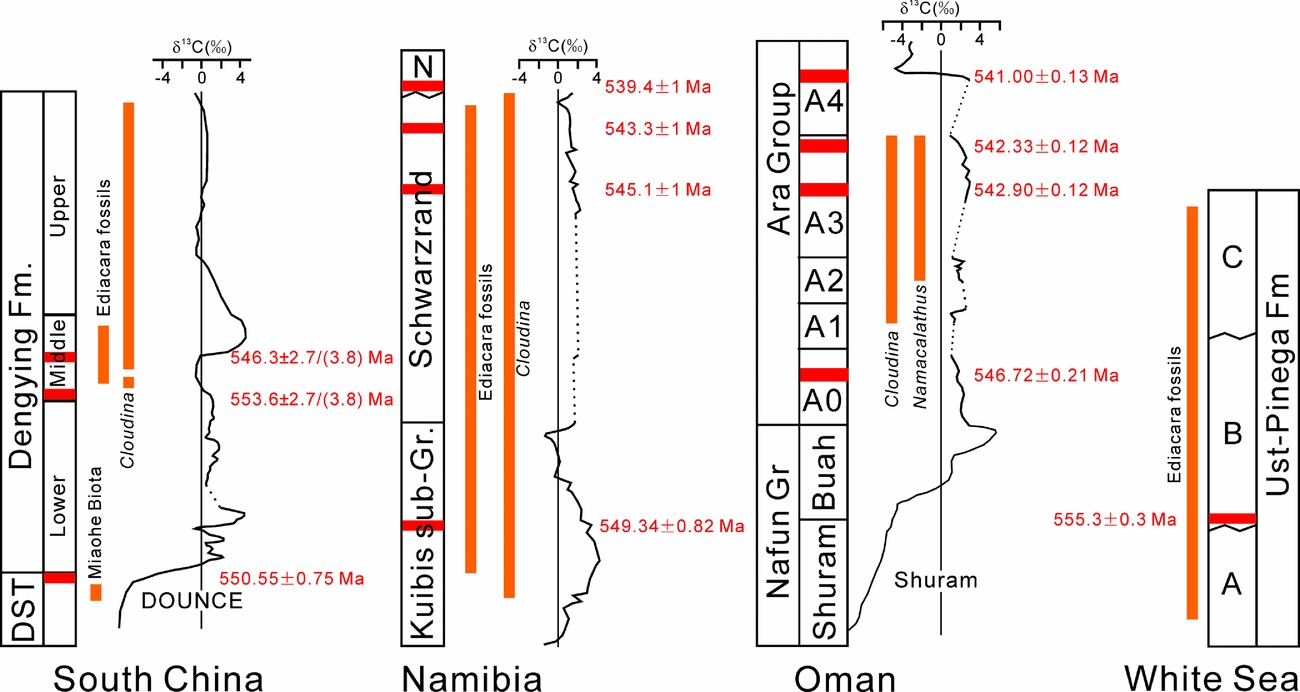
Abundant fossils have been discovered from the Ediacaran successions in South China, especially from the Dengying Formation and its equivalents (e.g. Hua, Chen & Yuan, Reference Hua, Chen and Yuan2007; Chen et al. Reference Chen, Zhou, Meyer, Xiang, Schiffbauer, Yuan and Xiao2013, Reference Chen, Zhou, Xiao, Wang, Guan, Hua and Yuan2014). Most of them, such as the Gaojiashan biota in the southern Shaanxi Province, the Xilingxia biota in the Yangtze Gorges area and the Jiangchuan biota in the Yunnan Province (Fig. 2), are preserved in the middle part of the Dengying Formation with some fossils extending to the upper part of the formation. They are mainly composed of macroscopic multicellular algae, Ediacara-type fossils, tubular fossils and trace fossils (Zhu, Reference Zhu2010). Our new zircon 207Pb–206Pb age of 553.6 ± 2.7/(3.8) Ma for the ash bed from the basal Jiucheng Member in eastern Yunnan Province provides constraints on the maximum age of the biotas in the middle part of the Dengying Formation. The zircon 207Pb–206Pb age of 555.3 ± 0.3 Ma for the ash bed from the lower part of sequence B of the Ust-Pinega Formation represents the minimum age for the oldest Ediacara-type fossils in the White Sea region (Fig. 7; Martin et al. Reference Martin, Grazhdankin, Bowring, Evans, Fedonkin and Kirschvink2000). The SIMS zircon 207Pb–206Pb age for the basal Jiucheng Member is slightly younger than (or within errors identical to) the age from the White Sea region, indicating that the Ediacara-type fossil assemblage preserved in the Dengying Formation is younger than the White Sea Assemblage.
Temporal distribution of the Ediacara-type fossils and the representative biomineralized animals in South China (Hua, Chen & Yuan, Reference Hua, Chen and Yuan2007; Chen et al. Reference Chen, Zhou, Meyer, Xiang, Schiffbauer, Yuan and Xiao2013, Reference Chen, Zhou, Xiao, Wang, Guan, Hua and Yuan2014), Namibia (Grotzinger et al. Reference Grotzinger, Bowring, Saylor and Kaufman1995; Bowring et al. Reference Bowring, Grotzinger, Condon, Ramezani, Newall and Allen2007), Oman (Amthor et al. Reference Amthor, Grotzinger, Schröder, Bowring, Ramezani, Martin and Matter2003; Bowring et al. Reference Bowring, Grotzinger, Condon, Ramezani, Newall and Allen2007) and White Sea (Martin et al. Reference Martin, Grazhdankin, Bowring, Evans, Fedonkin and Kirschvink2000). The thicknesses of the lithostratigraphic units are not to scale. DST – Doushantuo Formation; N – Nomtsas Formation; Fm – formation; Gr – group. Red bars represent the locations of the ash beds in the columns.

The zircon 207Pb–206Pb age of 546.3 ± 2.7/(3.8) Ma for the ash bed from the middle part of the Jiucheng Member constrains the ages of the Ediacara-type fossils, trace fossils and some tubular fossils in the middle part of the Dengying Formation (Fig. 7). This age is identical within errors to the zircon 207Pb–206Pb age of 549.34 ± 0.82 Ma for the ash bed from the middle part of the Kuibis subgroup of the Nama Group, which provides the minimum age for the Ediacara-type fossils and Cloudina in Namibia (Grotzinger et al. Reference Grotzinger, Bowring, Saylor and Kaufman1995; Bowring et al. Reference Bowring, Grotzinger, Condon, Ramezani, Newall and Allen2007). The δ13C negative excursion at the lowermost Cambrian strata starts at the top of the Dengying Formation in eastern Yunnan Province (Li et al. Reference Li, Tang, Gong, Yang, Hou, Hu, Li, Liu and Li2013b ), and the onset of this globally significant biogeochemical event was constrained at 541.00 ± 0.13 Ma in Oman (Amthor et al. Reference Amthor, Grotzinger, Schröder, Bowring, Ramezani, Martin and Matter2003; Bowring et al. Reference Bowring, Grotzinger, Condon, Ramezani, Newall and Allen2007). If this δ13C negative excursion can be correlated between South China and Oman, the age for the top of the Dengying Formation in eastern Yunnan Province would be c. 541 Ma, which is similar to the age for the top of the Spitskopf Member of the Nama Group (bracketed by zircon 207Pb–206Pb ages 543.3 ± 1 Ma and 539.4 ± 1 Ma; Grotzinger et al. Reference Grotzinger, Bowring, Saylor and Kaufman1995). Comparison between the newly obtained zircon 207Pb–206Pb ages and those from the Nama Group indicates that the Ediacara-type fossils in the middle Dengying Formation in South China can be temporally correlated to the Nama Assemblages in Namibia. This result is consistent with the affinity between the Dengying and Nama assemblages based on the same Ediacara genera such as the Pteridinium and Rangea, the presence of the Cloudina and Sinotubulites, and the abundance of trace fossils in the two assemblages (Chen et al. Reference Chen, Zhou, Xiao, Wang, Guan, Hua and Yuan2014). Pteridinium is one of the youngest Ediacara fossils, extending to the uppermost Ediacaran deposits (younger than 543.3 ± 1 Ma; Grotzinger et al. Reference Grotzinger, Bowring, Saylor and Kaufman1995). The Rangea are present in strata of age 558–549 Ma, and the Hiemalora and Charniodiscus are usually discovered in strata older than 550 Ma (Xiao & Laflamme, Reference Xiao and Laflamme2009; Noble et al. Reference Noble, Condon, Carney, Wilby, Pharaoh and Ford2015). The discovery of these fossils in the middle Dengying Formation (Chen et al. Reference Chen, Zhou, Xiao, Wang, Guan, Hua and Yuan2014) extends their stratigraphic ranges to as young as 546.3 ± 2.7/(3.8) Ma.
Assigning the Ediacara-type fossils in the Dengying Formation to the Nama Assemblage significantly extends their taphonomic ranges. The Ediacara-type fossils in Namibia were mostly preserved as casts and moulds in siliciclastic rocks, similar to the preservation in the Flinders Ranges area in Australia, where the fossils were restricted to the Ediacara Member of the Rawnsley Quartzite (e.g. Gehling & Droser, Reference Gehling and Droser2013). The Ediacara-type fossils with a limestone taphonomic window in the Dengying Formation in South China represent a distinct taphonomic pathway, extend their ecological range and prove that these Ediacara organisms were marine organisms rather than terrestrial lichens or microbial colonies (Xiao et al. Reference Xiao, Shen, Zhou, Xie and Yuan2005; Chen et al. Reference Chen, Zhou, Xiao, Wang, Guan, Hua and Yuan2014).
6. Conclusions
The following conclusions about the upper Ediacaran geochronology in South China can be made by SIMS zircon U–Pb dating of the ash beds from the Jiucheng Member, Dengying Formation in the eastern Yunnan Province, South China.
(1) Excess ‘scatter’ in U–Pb datasets is interpreted to reflect subtle radiogenic Pb-loss in the analysed zircons. The two weighted mean 207Pb–206Pb ages, 553.6 ± 2.7/(3.8) Ma and 546.3 ± 2.7/(3.8) Ma, are considered as the best estimates of the crystallization ages for the two ash samples from the basal and middle part of the Jiucheng Member, Dengying Formation in eastern Yunnan Province, South China.
(2) The age of the base of the Dengying Formation in eastern Yunnan Province is older than, or within errors identical to, that in the Yangtze Gorges area. The two SIMS zircon 207Pb–206Pb ages from the Jiucheng Member do not permit a clear test of the two correlation models for the chronostratigraphic position of the Miaohe Member (uppermost Doushantuo Formation vs. middle Dengying Formation).
(3) The Ediacara-type fossils preserved in the Dengying Formation in South China are temporally correlated to the Nama Assemblage. Their exceptional limestone taphonomic window in South China sheds new light on the diversity and palaeoecology of the macroscopic Ediacaran life forms.
Acknowledgements
We thank Qiu-Li Li, Yu Liu, Guo-Qiang Tang and Xiao-Xiao Ling for assistance with SIMS zircon U–Pb analysis, Zhongwu Lan and Zhi Chen for field assistance. This work was supported by the Chinese Ministry of Science and Technology (grant no. 2013CB835000) and the Strategic Priority Research Program (B) of the Chinese Academy of Sciences (grant no. XDB18030300).
Declaration of Interest
None