After five decades of systematic research, we now know quite a lot about how variations of pronunciation are distributed within urban speech communities of Europe and North America, and how this distribution realizes the historical unfolding of phonological change (Labov, Reference Labov2001). In Australian Aboriginal languages, however, there has been substantial research on historical sound change, but almost no investigation of how these changes are realized through socially structured variation. In recent years, the diversity of language types and social situations described in terms of sociolinguistic variation has increased; for example, in a study of dialect focusing in an Inuit community (Clarke, Reference Clarke, Stanford and Preston2009), or in a study of how village-indexed variants are acquired among exogamous Zhuang communities (Stanford & Pan, Reference Stanford and Pan2013). This article adds a further typological and sociological extension to variationist sociolinguistics by describing the distribution of a variable consonant lenition in Murrinh Patha, an Aboriginal language of northern Australia (Walsh, Reference Walsh1976). Murrinh Patha is a head-marking, polysynthetic language spoken by about 2500 people in the rather isolated town of Wadeye, some 400 km by unreliable road from Darwin, the nearest urban center on the northern Australian coast.
I begin by briefly reviewing existing research on change and variation in Australian languages, highlighting the fact that word-initial consonant reduction has been identified across the continent in both synchronic descriptions and historical reconstructions. I then use data from 24 young male Murrinh Patha speakers to explore the phonological conditioning of peripheral obstruent lenition in this language, showing that it is a sociophonetic manifestation of the areal pattern. A comparison with archival data shows that these young speakers lenite significantly more often than older speakers do, suggesting either age-grading of the variable or a phonological change in progress. Analysis of interspeaker variation also reveals an effect of language heritage, which may be rooted in recent intense contact with neighboring Marri languages that have phonologized a similar lenition phenomenon (Green, Reference Green1989:23–25).
The aims of this study are twofold: (i) to characterize Murrinh Patha consonant lenition phonologically, showing that it is distinct from lenition phenomena described in other parts of this world, but that these differences reiterate widespread Australian phonological patterns; and (ii) to characterize the lenition sociolinguistically, contextualizing it in terms of Wadeye language attitudes and showing that the frequency of its occurrence is influenced by speaker age and language heritage.
PHONOLOGICAL CHANGE AND VARIATION IN AUSTRALIAN LANGUAGES
This article investigates Murrinh Patha consonant lenition as a sociophonetic variable–that is to say, a feature of phonetic production that exhibits variation conditioned by social factors (Hay & Drager, Reference Hay and Drager2007). This represents the first quantitative study of sociophonetic variation in an Australian language, though the method employed here relies primarily on impressionistic categorization of stop versus continuant realizations and only refers briefly to acoustic data. The variable in question–in fact, a pair of closely related variables–is the realization of voiceless peripheral obstruents (/p/ and /k/), which are canonically realized as stops, but may also be lenited to fricatives, approximants, or deleted altogether.
Sound changes in Australian languages have been extensively reconstructed, and there are a few studies describing phonological differences between youth speech and older adults, but there are no published studies that use quantitative methods to investigate how variable pronunciation, which is the synchronic manifestation of diachronic change, correlates with social groups. Among the main findings of historical reconstruction in Australia is that reduction of initial consonants and syllables has occurred in many parts of the continent. Though all consonants can be affected, bilabial, laminal, and velar obstruents have been most widely reduced (Blevins, Reference Blevins, Simpson, Nash, Laughren and Alpher2001; Hale, Reference Hale and Sutton1976; Koch, Reference Koch, Bowern and Koch2004; Sutton, Reference Sutton and Sutton1976):
- Proto-Kartu
Nhanta
- *paca- ‘bite, sting’ >
aca
- *thuthu ‘dog (tame)’ >
uthu
- *kantharri ‘grandmother’ >
antharri (Blevins & Marmion, Reference Blevins and Marmion1994:195–200)
There are also studies describing youth varieties that have emerged recently after town settlement, in which initial consonant or syllable deletion is one of the features distinguishing the youth variety. For example, at Yirrkala, youth whose hereditary languages encompass a range of Yolngu dialects have converged in town on a single koine variety known as Dhuwaya (Amery, Reference Amery1985). One feature distinguishing Dhuwaya from the older clan dialects is the lenition and deletion of bilabial and lamino-palatal consonants (either nasal or obstruent), especially in word-initial position (Amery, Reference Amery1985:41–45). Similarly, at Areyonga in the Pitjantjatjara lands (Langlois, Reference Langlois2004, Reference Langlois2006), young people use a special “Short-Way” register as an in-group code among themselves. The main way that this code is distinguished, and to a degree encrypted, is the outright deletion of all initial syllables:
- Pitj.
nganarna anku-nytja-ku unytju-ringa-nyi ngura-kutu
- Short-Way
narna ku-nytja-ku tju-ringa-nyi ra-kutu
1pl.nom go.noml.purp like-inch-pres home-all
we (would) like to go home
(Langlois, Reference Langlois2004:166)
In summary, both the historical sound changes reconstructed and the distinguishing phonological features of recent youth varieties show a common pattern of word-initial reduction. We will see that this is echoed in the p/k-lenition variable found in Murrinh Patha.
P/K LENITION IN MURRINH PATHA
The variable described in this paper is the lenition of voiceless, peripheral obstruents, that is, bilabial voiceless /p/ and velar voiceless /k/. The lenition occurs in all syllable onsets (never in codas), but is most likely to occur in the onset of stressed syllables, which because of Murrinh Patha stress patterns tends to make it word-initial. Patterns of this type are largely unattested in the literature on the phonology of lenition (Bye & de Lacy, Reference Bye, de Lacy, Segeral, Scheer and Carvalho2008; Kirchner, Reference Kirchner1998, Reference Kirchner, Hayes, Kirchner and Steriade2004; Marotta, Reference Marotta, Segeral, Scheer and Carvalho2008; Segeral & Scheer, Reference Segeral, Scheer, Segeral, Scheer and Carvalho2008), though as we have seen, initial loss is historically reconstructed for various Australian languages.
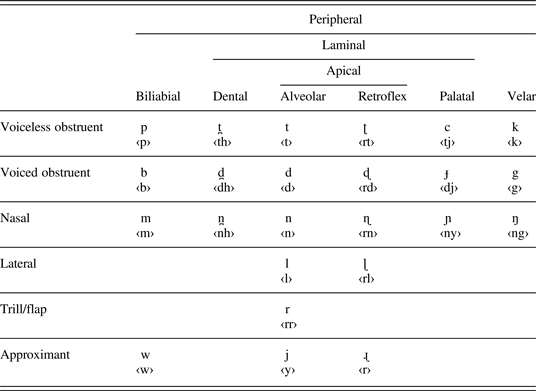
Like most Australian languages, Murrinh Patha has a rich set of contrasting places of articulation, but no contrasts for manner of articulation among the obstruent series (i.e., stop vs. fricative vs. affricate), though it does, unusually for an Australian language, have an obstruent voicing contrast (Butcher & Fletcher, Reference Butcher, Fletcher, Koch and Nordlinger2014; Evans, Reference Evans and Goldsmith1995). The full consonant inventory, excluding new segmental types associated only with recent English borrowings, is illustrated in Table 1.
Murrinh Patha consonant phonemes

Source: The consonant phonemes are from Street and Mollinjin (Reference Street and Mollinjin1981:184) and Walsh (Reference Walsh1976:24); organization of consonant positions based on Butcher (Reference Butcher2008).
The obstruent voicing contrast is realized by distinct voicing onset and offset timings, as well as stronger release bursts for voiceless obstruents (Butcher, Reference Butcher2004; Mansfield, Reference Mansfield2014:141–143). Voiced /b/ and /g/ do not exhibit the lenition pattern described here for /p/ and /k/, and the lenition of the latter pair is generally realized by reduced degrees of oral constriction, rather than changes to glottal timing that would collapse the phonemic voicing contrast.
The canonical careful-speech realization of the voiceless obstruents is as slightly aspirated plosives in syllable onsets and as unreleased stops in syllable codas (Street & Mollinjin, Reference Mollinjin and Street1981; Walsh, Reference Walsh1976). However in connected speech, there are also some continuant realizations (fricatives, approximants, or complete deletions), most noticeably for the peripheral obstruents /p/ and /k/, and as we will see, young men produce a substantial number of continuant realizations even in careful speech:
(1) purtek → [ˈɸuʈek]
dirt
(2) kardu → [ˈxaɖu]
person
The lenition of coronal obstruents in Murrinh Patha is far less noticeable than for /p/ and /k/, and I have not observed it at all in word-initial positions. Therefore, Murrinh Patha fits the Australian place-of-articulation pattern already described as far as bilabial and velar obstruents go, but does not fit the laminal pattern, as Murrinh Patha obstruents /t̪/ and /c/ do not exhibit word-initial weakening. Blevins hypothesizes bilabial, laminal, and velar obstruents to be especially susceptible to historical loss because if they lenite to fricatives, they result in nonstrident fricatives (e.g., /ɸ/, /θ/, /x/), with weak auditory cues that might easily lead to complete deletion (Blevins, Reference Blevins, Simpson, Nash, Laughren and Alpher2001:483). This hypothesis is not supported by Murrinh Patha lenition, where coronal obstruents are not spirantized word-initially in the first place, negating the possibility that strident versus nonstrident fricatives might influence which obstruents should undergo historical erosion.
Another hypothesis seeking to explain historical Australian initial deletion, especially in the Northern Paman subgroup (Hale, Reference Hale and Sutton1976), is that deletion was preceded by stress shift from the first to the second syllable. This is not the case in Murrinh Patha lenition, which occurs in the onset of syllables that still bear stress. On the other hand, it has been observed in some Australian languages that stress is signaled phonetically quite late in the syllable, often “drifting” well into the consonant onset of the next syllable (Round, Reference Round2009:318; Tabain, Fletcher, & Butcher, Reference Tabain, Fletcher and Butcher2014:54). This phenomenon has been observed in Murrinh Patha (Mansfield, Reference Mansfield2014:179–180), and indeed may be associated with the weakening of the onset in the stressed syllable. If this is the case, then it would suggest that the relationship between stress and initial consonant loss need not be a process with two distinct phases (stress shift then consonant loss), but instead could involve late-signaled stress covarying with onset consonant weakening, which may or may not at some point lead to phonologized deletion, either with or without phonologized stress shift. The data presented in this study show that young Murrinh Patha speakers lenite initial consonants more than their forebears do, but we do not yet have appropriate longitudinal data showing whether this should be interpreted as a change in progress.
While historic word-initial reductions have not been reconstructed for Murrinh Patha, lenition of root-initial consonants has been phonologized in polysynthetic verbs. Murrinh Patha incorporates verbal and nominal roots into the middle of a complex verbal word (Nordlinger, Reference Nordlinger2010; Walsh, Reference Walsh1976:202–210), and some of these roots have lexically specified lenition from obstruent to approximant in their initial consonant, whenever they bear lexical stress and the previous morpheme ends in a vowel:
(3) puma-patha-nu → pumaˈwathanu
3pl.hands.fut-fix-fut
they will fix it
(4) kardi-kaykay-dha → kardiˈwaykaydha
3sg.be.pst-call.out.rdp-pst
he was calling out
(5) pu-ngi-tje-bat=nukun → puniˈyebatnukun
3sg.strike-me-ear-hit=lest
he might hit me on the ear
Example (5) shows that this phonologized lenition has affected coronal obstruents, which is not the case for the variable, sociophonetic lenition described in this study. This should make us cautious in identifying the two phenomena too closely, though as we will see, the stress and segmental conditions of the phonologized alternation closely echo the sociophonetic variable.
Data collection and analysis
The primary data for this study is careful speech collected by picture elicitation. I showed participants a series of 108 images and asked them to name each object or action. This task was completed by 24 young male Murrinh Patha speakers, ages 18 to 44, with a hundred or so tokens of syllable onset /p/ and /k/ from each speaker producing a total dataset of 2883 tokens. The use of picture-stimulated elicitation means that the set of words recorded for each speaker is similar, but not identical, with 256 different lexical types with /p/ or /k/ syllable onsets appearing in the data.
Tokens were initially transcribed using four categories: stop, fricative, approximant, and deleted. Categories were assigned based on the author's auditory impressions, though in cases of doubt Praat spectrograms (Boersma & Weenink, Reference Boersma and Weenink2012) were checked to review acoustic evidence as follows:
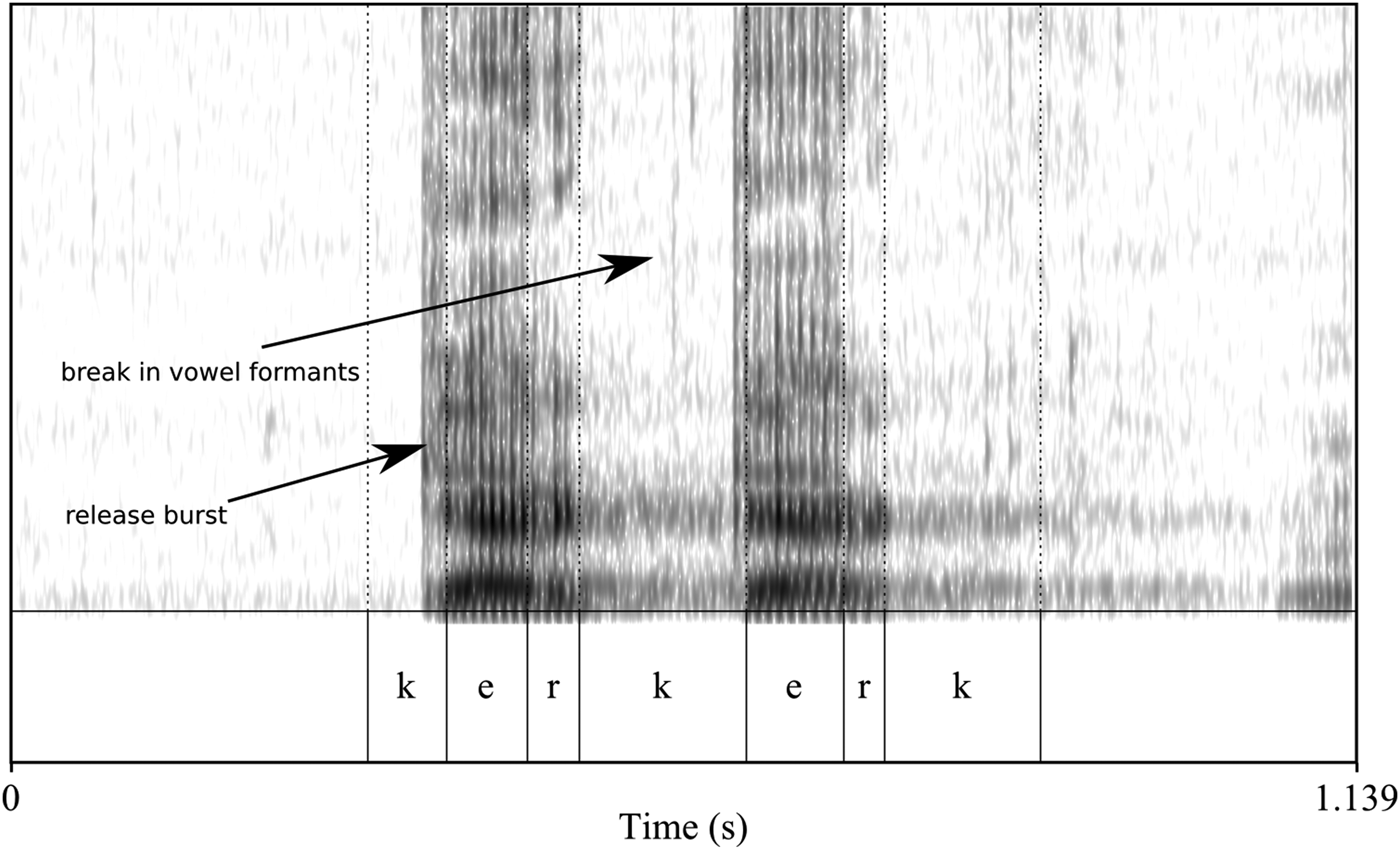
Stop: significant break in vowel formants, without turbulent noise, and with some sign of a release burst in the onset of the following vowel (Figure 1);
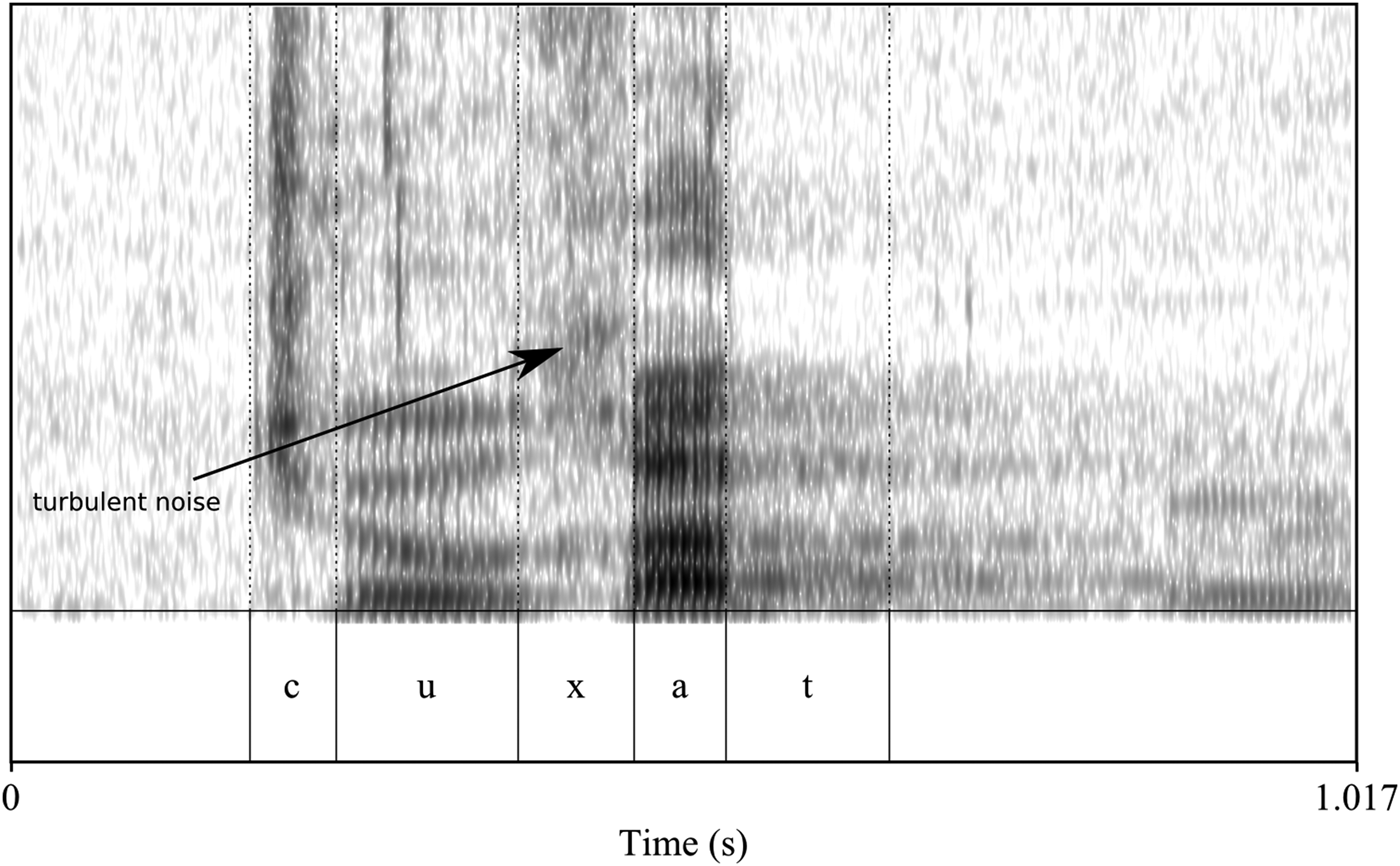
Fricative: turbulent noise (Figure 2);
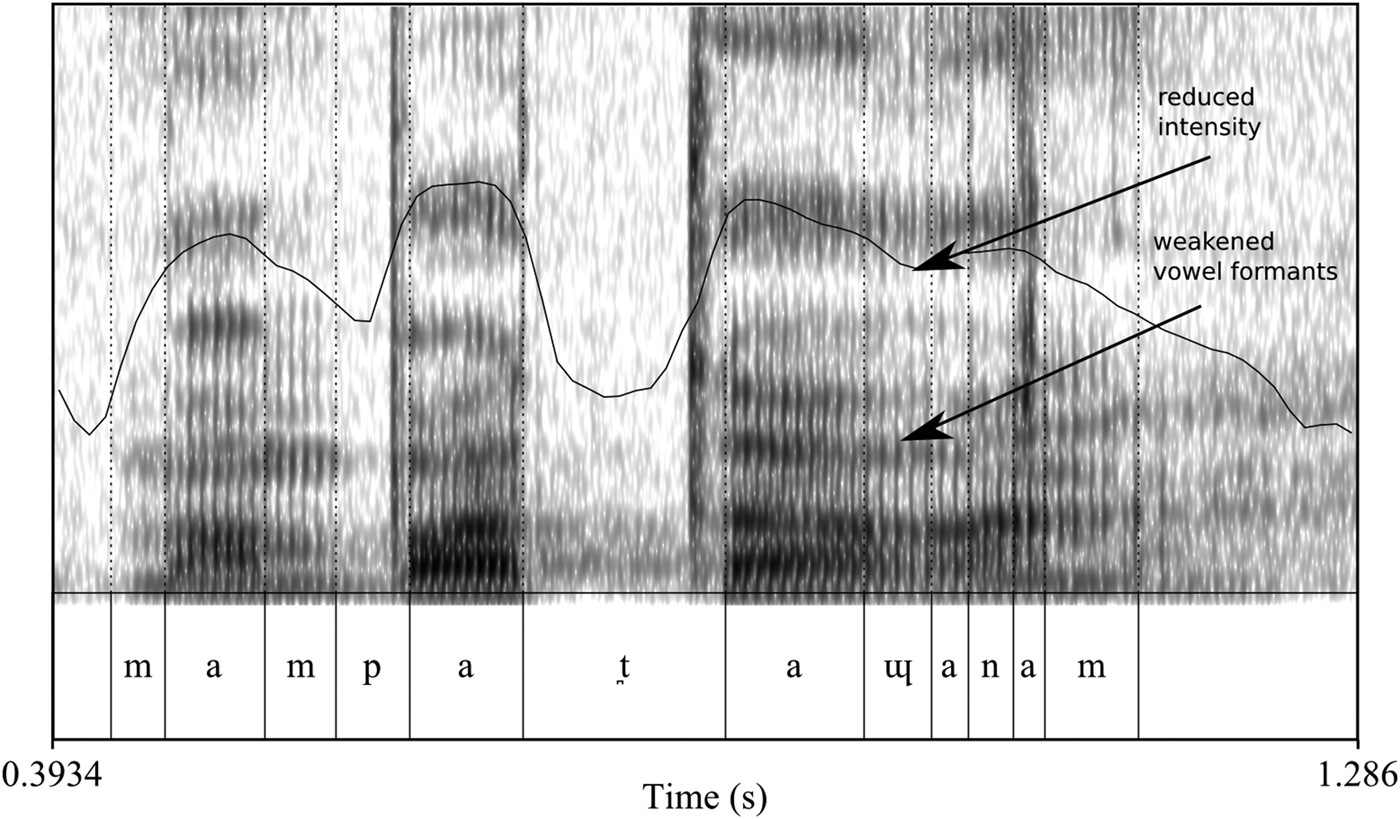
Approximant: a period in which vowel formants are evident, but are weaker than and lack the higher formant resonances of a full vowel (Figure 3);
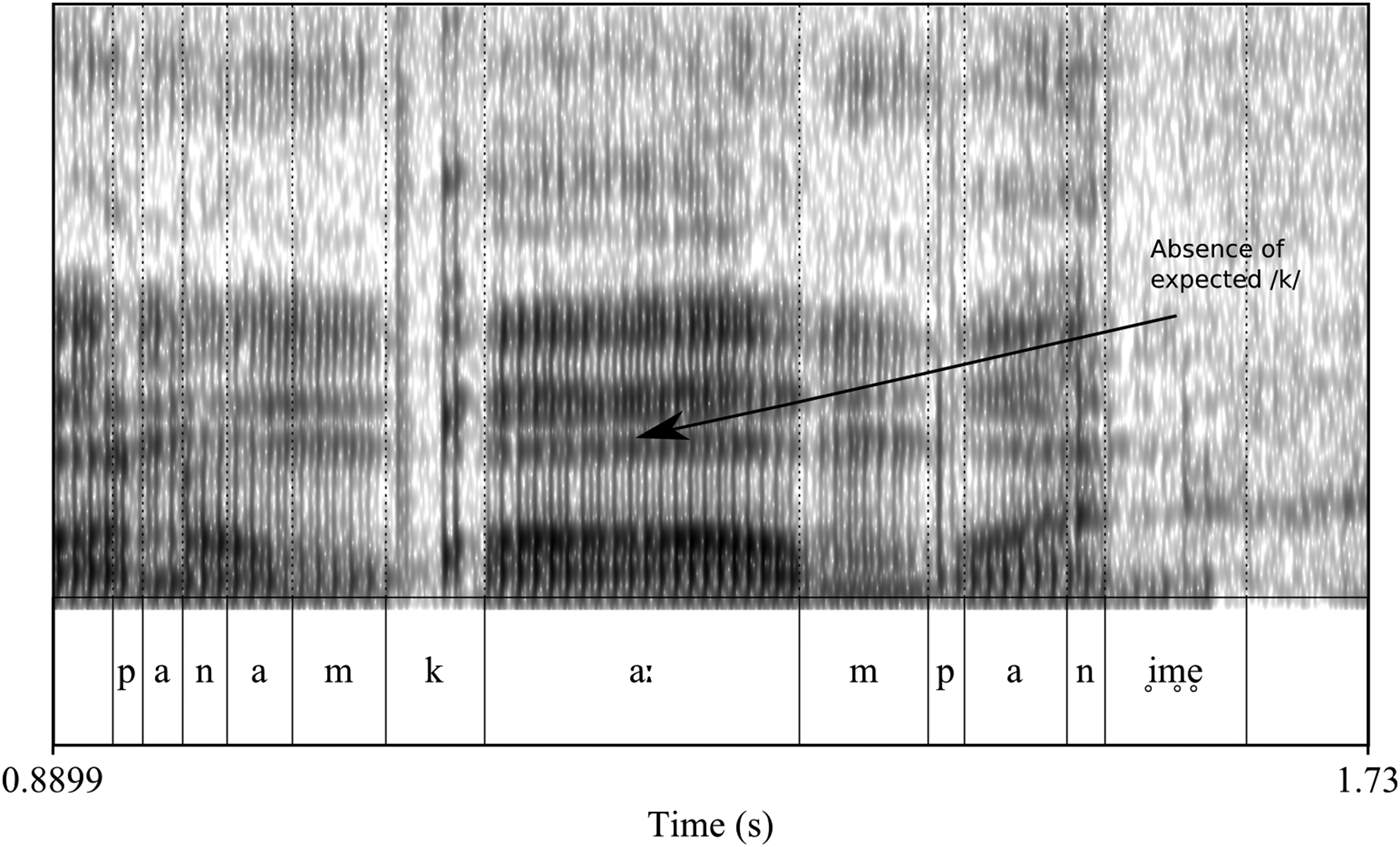
Deleted: absence of any acoustic events that can be attributed to the expected obstruent segment (Figure 4).
Two stop realizations in spectrogram for kerrkerrk “sharp” (2013-01_AdB).
Fricative realization in spectrogram for tju kat “playing cards” (2013-01_OB).
Approximant realization in spectrogram for mampatha-kanam (2013-01_PP).
Deleted realization in spectrogram for panamkakampanime (2013-01_AsL).
After all tokens were coded, a formal test of coding accuracy was performed by recoding a random subset of 144 tokens (every 20th token from every speaker) based purely on inspection of acoustic signals. Comparison of the recoding with my original impressionistic transcription showed that the coding of stops versus continuant realizations was well founded in acoustic data, though the finer distinctions between different continuant types (fricative, approximant, deleted) made the data less accurate. In terms of stop/continuant categorization, 93% of the coding was accurate; but with continuant types treated separately, accuracy fell to 85%, due to misperceptions of fricative versus approximant and approximant versus deleted. This contributed to the decision to use a binomial stop/continuant distinction for analysis. The smaller error rate of stop/continuant coding was almost entirely caused by fricatives or approximants misperceived as stops, meaning that the results reported here slightly underestimate of the overall frequency of lenition. However, there was no particular context or speaker in which these mismatched tokens were concentrated, so the analysis of conditioning factors reported here is likely to stand as well for acoustic data as it does for aural impressions of lenition.
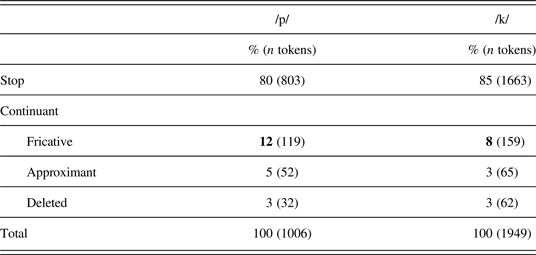
The distribution of the more fine-grained original coding, illustrated in Table 2, shows that fricatives account for the majority of lenited variants.
Quantitative breakdown of finer lenition categories
Factor analyses were tested on these specific continuant categories. Analysis of the fricative realization produced the same rankings of linguistic and social factors as for a generalized continuant category, while analyses focusing on approximant and deleted realizations were broadly similar, but had too few tokens to be meaningfully interpreted. On this basis, it seems likely that the different degrees of lenition are manifestations of a single sociolinguistic phenomenon, though further analysis of how the different lenited realizations are conditioned would require more data tokens and perhaps more accurate coding of continuant types. Together these considerations led me to base the following analyses on binomial output coding of the variant as either stop or continuant, treating all continuant realizations together as the “lenited” variant.
It would also be possible to reanalyze the entire dataset using directly quantified acoustic data, rather than realization categories. Recent acoustic studies (Bouavichith & Davidson, Reference Bouavichith and Davidson2013; Dalcher, Reference Dalcher2008) suggest that relative consonant duration and acoustic intensity could be used to quantify lenition in Murrinh Patha. Based on these previous results, we would expect that shorter duration and greater intensity of the consonant segment, relative to flanking segments, would correlate to the lenition phenomenon reported in this paper. However, a detailed acoustic analysis is beyond the scope of this study, which investigates the linguistic and social factors influencing the categorically coded stop/continuant variable.
Linguistic factors influencing lenition
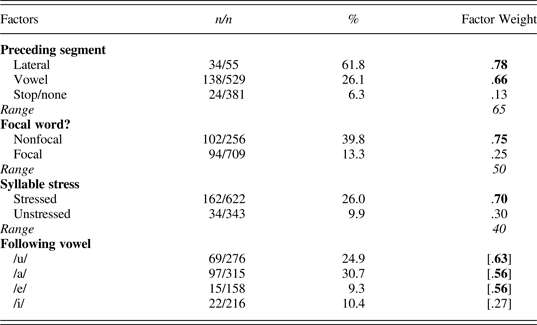
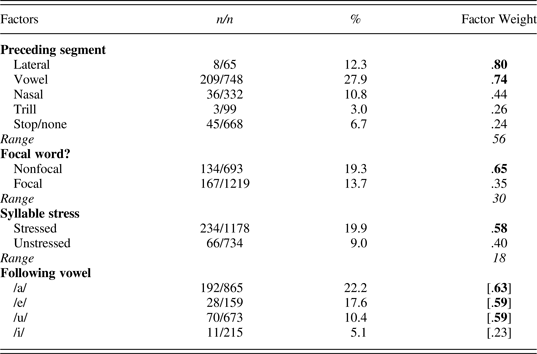
I describe here the linguistic factors influencing p/k-lenition, while social factors are discussed in the next section. Multivariate analysis shows that the two obstruents have very similar, but not quite identical conditioning. Three linguistic factors favor lenition with statistical significance (p < .01), while a fourth factor gives a subsignificant result (as indicated by square brackets) that I nonetheless report as a point of interest:
1. Preceding lateral or vowel;
2. Occurring in the onset of a stressed syllable;
3. Occurring in a “nonfocal” word, as opposed to a “focal” word;
4. Following vowel being /a/, /u/, or /e/.
The specific lexical item in which the obstruent occurred was also included in the analysis as a “random effect” (Gorman & Johnson, Reference Gorman, Johnson, Bayley, Cameron and Lucas2013). This reduced the significance of following vowel below robust levels, which essentially tells us that the current vowel findings depend upon fairly small sets of lexical items and would need to be tested against a larger set to reach statistical significance under the mixed-effects model. The position of the obstruent in the word and utterance was also tested, though not included in the model for reasons described below.
Tables 3 and 4 illustrate the results of Rbrul mixed-effects analysis (Johnson, Reference Johnson2009), which selects the three significant factor groups as the best model under both step-up and step-down procedures, while finding that “following vowel” does not make a significant improvement to the model. For each factor, three results are reported: (i) the total number of tokens with this factor, and the number of tokens lenited; (ii) the percentage of tokens lenited for this factor; and (iii) the (centered) factor weight, which is on a scale of 0 to 1: at .5, the factor is neutral; closer to 1, the more strongly it predicts lenition; and closer to 0, the more strongly it predicts nonlenition. Bold factor weights are those that positively predict lenition, and those factor groups that fall below statistical significance are in square brackets.Footnote 1
Multivariate analysis of linguistic factors for /p/-lenition in Murrinh Patha
Input = .13
Deviance = 655.8
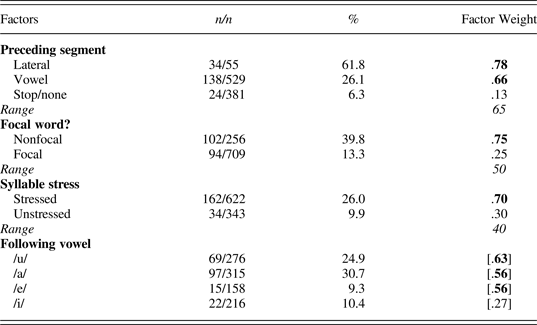
Note: Lexical item is included in the model as a random effect. Following vowel is not significant (p < .10), though it does show statistical significance (p < .01) if the random effect is not included.
Multivariate analysis of linguistic factors for /k/-lenition in Murrinh Patha
Input = .09
Deviance = 1405.9
Note: Lexical item is included in the model as a random effect. Following vowel is not significant (p < .10), though it does show statistical significance (p < .01) if the random effect is not included.
The /p/-lenition model excludes preceding nasals because this factor almost categorically produces a following stop (Tagliamonte, Reference Tagliamonte2006:217)Footnote 2 and excludes preceding trills due to paucity of tokens (n = 8). The preceding segment factor group includes a “none” category for absence of preceding segment (i.e., utterance-initial) that has been merged with the “stop” category, based on the observation that these produce almost identical proportions of continuant realizations. Incidentally, this seems to contradict a previous hypothesis that for Australian languages utterance-initial position is more susceptible to consonant erosion than other word onsets due to its lack of preceding articulatory cues (Blevins, Reference Blevins, Simpson, Nash, Laughren and Alpher2001:486; Blevins & Marmion, Reference Blevins and Marmion1994:198).
The influence of preceding segment type is much as expected from the literature, with preceding laterals and vowels showing a positive influence on lenition (Kirchner, Reference Kirchner, Hayes, Kirchner and Steriade2004; Lass, Reference Lass1984:182). Kirchner (Reference Kirchner, Hayes, Kirchner and Steriade2004:317) coined the term “quasi-intervocalic” to describe any flanking combination of vowels, glides or liquids, which he identified as the cross-linguistically favorable environment for consonant lenition. The positive effect of preceding laterals in Murrinh Patha obstruent lenition supports this, but for a preceding trill /r/, we find a negative influence on /k/-lenition, suggesting that for Murrinh Patha lenition preceding liquids do not behave as a natural class. Note that the preceding lateral effect for /k/-lenition is calculated to be strongly positive (.798 Cfw), even though the rate of lenition among these tokens (12.3%) is somewhat below the overall mean of 15.7%. This is explained by the fact that the 65 /lk/ tokens in this data just happen to be dominated by a preponderance of unstressed syllables in focal words, which factors together strongly disfavor lenition. Preceding lateral nonetheless has a strongly positive factor weight, because among those /lk/ tokens that occur in stressed syllables and/or nonfocal words, there is a very high lenition rate of 57%.
The influence of the following vowel character is not statistically significant in this analysis, though its influence would be calculated as significant if lexical types were not included as a random effect. If we take just the strongest vowel factor weights as tentative findings, they do appear to be explicable in terms of articulatory effort. Kirchner (Reference Kirchner, Hayes, Kirchner and Steriade2004:314–324) argued that lowness of vowels favors consonant lenition, due to the greater tongue displacement required to make an oral closure, and in Murrinh Patha, the low vowel /a/ is indeed the most favorable factor for /k/-lenition. However for /p/-lenition it is instead /u/ that is most favorable, perhaps because its lip-rounding gesture leads to effort cost savings if the bilabial obstruent closure is incomplete. As mentioned, the present data are based on a rather narrow range of lexical types, which especially effects the following vowel factors /e/ and /i/. Therefore, more nuanced analysis of vowel influence will depend on the availability of more lexically diffuse data.
The onset of stressed syllables favors lenition for both /p/ and /k/. Because most Murrinh Patha words have a primary stress on their first syllable, this leniting environment tends to coincide with word-initial position. However, when we review words in the data that do not have first-syllable stress, we find more frequent lenition on the stressed syllable than on the initial syllable:
(6) ngaˈpapa → [ŋaˈβapa] (lenited in 38% tokens, n = 26)
sugar-glider
(7) perrˈkenku → [perˈkenku] (lenited in 17% tokens, n = 12)
two
Furthermore, the intervocalic stressed position that attracts frequent lenition in (6) contrasts with very infrequent lenition for intervocalic obstruents in the onset of unstressed syllables:
(8) ˈthapak → [ˈthapak] (lenited in 0% of tokens, n = 25)
fog
The use of stress as a factor group in the multivariate analysis (see Tables 3 and 4) produces a stronger estimate of influence than the use of word position as a factor group, though the difference is minor, so this topic should be kept open for further research. In other Australian languages where historical consonant lenition and deletion has been studied, all words have initial stress (or had it before stress shift), so there is no way of distinguishing stress and initial position as contexts. Studies of this phenomenon have framed it in terms of word position, but the Murrinh Patha data presented in this study suggest that the influence of stress should also be investigated.
The favoring of a word-initial, stressed syllable onset for consonant lenition runs counter to the better studied lenition variables such as American English tapping, Spanish /s/ spirantization, or Florentine consonant lenition. Lenited variants in these languages are favored respectively by word-medial position (Warner & Tucker, Reference Warner and Tucker2011), word-final position (Erker, Reference Erker2010), and by no particular word/stress position (Marotta, Reference Marotta, Segeral, Scheer and Carvalho2008:242–243). The variable /p/ and /k/ pronunciation reported here for Murrinh Patha therefore appears to be quite a different type of variable in phonological terms, and one that belongs to a distinctly Australian areal pattern, though like other lenition variants, it is harnessed to produce sociolinguistic differentiation.
The final linguistic factor included in the analysis is whether the segment occurs in a word that is informationally focal or nonfocal–a distinction that is very close to “content” versus “function” words. A word was coded as focal if it was of lexical character, denoting the entity or action represented in the picture stimulus. This category thus includes nominal and verb roots, as well as pronouns. This leaves to the nonfocal category serial verbs, particles and affixes, demonstratives, noun classifiers and verb classifiers–in other words, all closed classes that add grammatical information. Note that the focal/ nonfocal split could almost be reinterpreted as a closed-class/open-class split, except that pronouns would be realigned under the latter distinction, whereas examination of the data showed that they pattern more like the open-class items in terms of lenition.
Focal words were lenited less than nonfocal words were, as expected given previous findings that function words are especially prone to phonological reduction (Round, Reference Round2011). In this case, I hypothesize that focal words were somewhat protected from lenition because their status as the target of elicitation word led speakers to use more effort in their articulation. Note however that focal words are by no means categorically protected from lenition, as they still have continuant realizations in around 14% of tokens.
SOCIAL FACTORS INFLUENCING LENITION
I began studying p/k-lenition based on my observation that it seemed to be part of a youth-oriented or even slang style of Murrinh Patha. In this section, I show that this variable is indeed a socially indexed variant, with reduced forms produced more often by young men who fit into an emic age grade labeled kardu kigay (approximately, ‘young men’) and whose patrilineal language is one of the neighboring Marri languages rather than Murrinh Patha. I reach these conclusions primarily through multivariate analysis of kigay's careful speech combined with archival recordings of older speakers, though I have also coded a small sample of narrative speech in support of the age correlation. After identifying social factors demonstrably linked to p/k-lenition, I suggest that the more frequent lenition exhibited by speakers of Marri heritage may derive from a language contact effect.
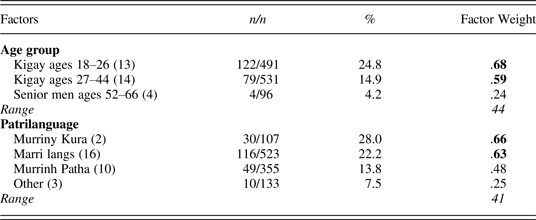
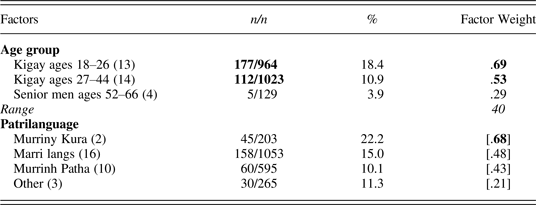
The results of multivariate analysis using age group and paternal language heritage are illustrated in Tables 5 and 6 (with all linguistic factor groups also included in the regression, but not shown). Individual speaker identity was also included as a random effect (Gorman & Johnson, Reference Gorman, Johnson, Bayley, Cameron and Lucas2013). For each factor, the number of speakers is given in parentheses, while other figures are as for the linguistic factor analyses previously discussed. This model was selected by both step-up and step-down procedures in Rbrul, while other factor groups, described in the following discussions, were rejected.
Social factors influencing /p/-lenition
Input = .09
Deviance = 713.8
Note: Individual speaker identity is included as a random effect.
Social factors influencing /k/-lenition
Input = .05
Deviance = 1342.0
Note: The effect of patrilanguage on /k/-lenition is not statistically significant (p = .10). Individual speaker identity is included as a random effect.
Kigay, language attitudes and careful speech
The Murrinh Patha speech data I recorded for this study is all from kigay (young men) ages 18 to 44 years. Kigay do not have ceremonial authority and neither do they participate much in emergent high-status activities such as formal work or education. They have instead developed a distinctive local subculture that has gained some notoriety due to violent clashes between gangs who name themselves after international heavy metal bands such as Pantera, Slayer, and Judas Priest (Brooks & West, Reference Brooks and West2009; Mansfield, Reference Mansfield2013, Reference Mansfield and Harris2015).
To test for age or date-of-birth effects, I combined my material with archival recordings of Murrinh Patha spoken by six men who were born a few decades earlier (1938–1958), and who were generally older (32–66) at the time of recording, as well as one older speaker who I recorded as part of the picture-elicited sessions. The older data is made up of word lists and English-based elicitation (Blythe, Reference Blythe2004; Butcher, Reference Butcher1990; Walsh, Reference Walsh1986), adding 358 tokens of syllable onset /p/ and /k/.
In Labov's view, careful, self-conscious speech is seen as less “natural” and less systematic than spontaneous speech, which is therefore the proper object of sociophonetic study (Labov, Reference Labov1972:208). Later sociolinguists with a focus on style shifting and “performativity” critique the idea of any speech type being natural (Coupland, Reference Coupland2007:181–184), but no matter what view one may take of speech types and phonological ontology, it is of interest to know whether differences between groups in elicited speech are specific to that speech type, or whether they are representative of more general differences. The elicited speech differences reported in this study might reflect different attitudes to the elicitation situation. Given that older men have more perceived legitimacy in speaking Murrinh Patha than young men do, it is plausible that in the context of self-monitored speech, “representing” the Murrinh Patha language, the former group would make more effort to enunciate carefully than the latter group would. For this reason, small samples of spontaneous narrative speech were also checked.
Spontaneous speech could not be used as the primary data in this study due to sparsity of material. It is difficult to make high-quality recordings of spontaneous speech with kardu kigay because they are generally very shy and reticent about the recording process. Kigay implicitly reject attempts at a typical “sociolinguistic interview,” with questions about their childhood, their school experiences, or attitudes to local community met with silence or one-word answers (cf. Tagliamonte, Reference Tagliamonte2006). Aboriginal people do not speak “on demand,” but only when they decide that they have something worth saying, and that you are the appropriate person to say it to (Von Sturmer, Reference Von Sturmer1981; Walsh, Reference Walsh1997). Therefore, spontaneous speech samples could not be systematically collected from a large number of speakers, even after some 15 months' fieldwork–though I am gradually developing such a collection. Among the available archival recordings, there are only a few items that contain long enough passages of spontaneous speech with high enough audio quality to judge tokens as being continuant or stopped with any degree of confidence; the two best samples are those used here (Kolumboort & Crocombe, Reference Kolumboort and Crocombe1997; Mollinjin & Street, Reference Mollinjin and Street1981).
This study has been limited to male speech because cultural protocols in Wadeye prevent me from spending time with young women. It therefore remains to be seen whether the patterns of p/k-lenition reported here are gender-specific.
Age-grading and change-in-progress
It is fairly clear even from casual inspection of the lenition percentages in Tables 5 and 6 that younger men lenite more than older men do. Kigay in their late teens and early 20 s lenite around 20% to 25% of careful speech tokens, while men in their 50 s and 60 s recorded in the archival data lenite less than 5% of tokens. The multivariate analysis including linguistic factors identified in the previous section, as well as the language heritage factor to be discussed, confirms that age group is a statistically significant effect (p < .01).
A similar age result is obtained either when speaker age is deployed as a continuous numerical variable or when speakers are divided into age groups. The “senior men” age group was naturally distinguished by a substantial age gap, while the 26-/27-year-old break-point for the younger/older kigay groups was established by plotting a graph of the individuals' lenition rates and making an impressionistic observation that the most frequent lenition was produced by kigay 26 years or younger, as illustrated in Figure 5.
Plot of individual speakers' /p/ and /k/ lenition rates against speaker age. Ellipses highlight the grouping of speakers older or younger than 27.
The 18 to 26 age group could be considered prototypical of the kigay age grade, while the 27 to 44 age group would also be considered kigay, but pushing toward the upper limit of the age grade (Ivory, Reference Ivory2009:100). The 52 to 66 age group is emically labeled kardu ngalantharr and is the group who holds the most authority in Wadeye, though the town has suffered a considerable breakdown in social consensus in recent decades (Mansfield, Reference Mansfield and Harris2015). The 26/27 age cutoff provides an interesting comparison with Wagner's (Reference Wagner2012) study of age-grading in a Philadelphia English youth variable, where speakers begin to reduce their use of the innovative variant around the ages of 17 to 19, coinciding with the completion of high school and the assumption of more adult-like independence. The later decrease in Murrinh Patha lenition may reflect a later expectation of social responsibility or “maturity” among Murrinh Patha youth, which would fit with other reports of Australian Aboriginal socialization processes (e.g., Brady, Reference Brady1992).
We have seen that word-initial consonant reduction is a common pattern in Australian sound changes, but further evidence would be required to show whether Murrinh Patha lenition is a phonological change in progress or a stable, age-graded variant, more like the stylistic marker reported for Areyonga Pitjantjatjara (Langlois, Reference Langlois2004). To effectively separate out the influence of age-grading versus change-in-progress, we would need either recordings of kigay speakers made at an earlier date or recordings of contemporary kigay made at a future point when they are much older. Neither of these sources is currently available. It is also worth keeping in mind that age-grading and historical change are not exclusive alternatives, but rather a spectrum from complete stability of age-graded distribution at one end, to a rapidly expanding distribution at the other (Labov, Reference Labov2001:26–32).
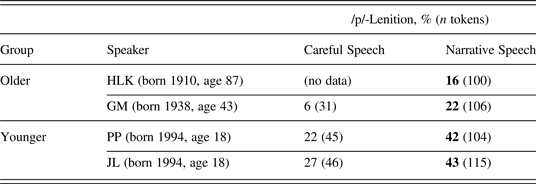
Narrative speech samples
As already outlined, the main data used for this study are elicited speech, though I also performed a small test to check whether speaker age differences in /p/-lenition would also be found in spontaneous narrative recordings.
At least 100 tokens of syllable-onset /p/ were coded impressionistically in the narrative speech of two younger and two older speakers. The two younger speakers were selected because good narrative recordings were available for both, and both appeared in the “younger kigay” careful-speech cohort with a mid-range level of lenition. For older speakers, the two recordings used were the only suitable narrative recordings available, and only one speaker appeared in the careful-speech data, where his lenition rate was again mid-range for his age group. As illustrated in Table 7, all speakers lenite more in their narrative speech, and the difference between speaker ages is maintained across both speech types. In narrative speech, the two younger speakers lenite /p/ at almost exactly the same frequency–in both cases about 42% of tokens–while the older speakers lenite 16% and 22% of tokens, respectively.
Narrative /p/ lenition in older and younger speakers
Note: It is estimated that speaker HLK was born in 1910.
These sample sizes are too small for detailed analysis of spontaneous speech realizations, but they do suggest that the age difference found for lenition levels occurs not just in elicited speech, but also in spontaneous speech.
Language heritage
The contemporary Murrinh Patha speech community was formed by the settlement of a Catholic mission at Port Keats in 1939, which in 1975 became a secular town, renamed Wadeye, with mixed governance negotiated between local Aboriginal elders and Australian government agencies. The mission was settled by seven different language groups (i.e., “tribes”) from the area, of which the Murrinh Patha were just one, and formed only a minority of the mission population (Falkes, Docherty, & Gsell, Reference Falkes, Docherty and Gsell1939; Pye, Reference Pye1972, n.d.). A series of related language groups–the Marri Ngarr, Magati Ke, Marri Tjevin, and Marri Amu–together were much more numerous than the Murrinh Patha, and spoke very similar languages, which I collectively label the “Marri languages” (Ford, Reference Ford2010a, Reference Ford2010b). For Aboriginal people, languages are intimately connected with geographic places (Rumsey, Reference Rumsey, Walsh and Yallop1993), and because the mission was built within Murrinh Patha territory, this was seen as the proper language of the mission. This soon led to all the other languages becoming obsolescent, with the Murrinh Patha speech community rapidly absorbing speakers from other groups. In contemporary Wadeye, all young people grow up speaking only Murrinh Patha (and some English or Kriol), but most still identify their obsolescent patrilineal language as being “their language.” Some of the complexity of the situation is captured in the following statement, made for a video recording by two kigay whose patrilineal language is Marri Ngarr, though like all kigay, both only speak Murrinh Patha:
Kardu kanyi thumemluluruy-thanam kardu da wan len thanamnime. Kardu wan Murrinh Patha thanamngerrennime da purtek karrim kanyi. Neki-gathu-ka rispek pumarrabatj pi. Purtkit kanyi-yu, da komuniti ngalla kanyi-yu. … Neki-ka da manangka da-wa kanyi-yu. Da ngathayida tjirrampunmawu Murrinh Patha-mup-nu.
The people here are always in conflict, (but) we're of the same country. We all speak the same language in this country. This is the Murrin Patha peoples' place, the two of us respect them. All of us have respect here in Port Keats, the whole community. … This country isn't the country of us two. We're just outsiders living here with the Murrinh Patha people.
(Author's fieldwork recording, 2013-06-22_02)Testing of language heritage factors among Wadeye kigay is not straightforward, since a tradition of clan exogamy (Falkenberg, Reference Falkenberg1962) means that all kigay have some degree of mixed heritage.Footnote 3 A person's language is considered to be inherited from their father (irrespective of whether the person actually speaks that language), though people also have a secondary right to the language of their mother. On the other hand, though bush life was patrilocal, since settlement, more kigay grow up in the household of their mother than their father (Mansfield, Reference Mansfield2013).
In developing the multivariate analysis reported in Tables 5 and 6, I tested both patrilanguage and matrilanguage variables, as well as testing a combined “heritage” variable in which having Murrinh Patha as either patrilanguage or matrilanguage was coded as “Murrinh Patha heritage.” All Marri languages were grouped together as a single factor, based on their grammatical and phonological similarity. Murriny Kura, an extinct dialect that was said to be very similar to Murrinh Patha (Walsh, Reference Walsh1976:4–5), was a heritage factor for three speakers (two with Murriny Kura patrilanguage, one with Murriny Kura matrilanguage) and was coded as such, though its influence remains unclear. Diverse other heritage languages (Jaminjung, Mendhe, Ngan'gikurungurr) were coded as a residue group. All the heritage variables tested gave similar rankings for the languages, with Marri and Murriny Kura associated with more frequent p/k-lenition, and Murrinh Patha and residue groups associated with less lenition. However, the only statistically significant effect was patrilanguage, and only with respect to /p/-lenition, for which Murriny Kura and Marri patrilanguage were positive predictors. For /k/-lenition, the same effect was only suggestive (p = .10).
Marri language contact effect?
The more frequent lenition exhibited by kigay with Marri patrilanguage may be explicable in terms of Marri language phonology, which shows more leniting tendencies both in terms of synchronic allophony and historical consonant loss resulting in vowel-initial words. Similar questions could be asked of Murriny Kura heritage, though the small number of speakers with this heritage, and the lack of documentation of Murriny Kura, make this impossible to investigate further.
In Marri languages, the word-initialFootnote 4 voiceless bilabial is usually pronounced as a fricative [ɸ~β], though it can also be an aspirated [pʰ] (Green, Reference Green1989:23–25). In a sense, this is the same allophony that is found in Murrinh Patha /p/-lenition, though in Marri languages the continuant realization is the typical careful speech variant, while in Murrinh Patha, it is the stop. Both languages lack any stop/fricative contrast in this position. Given that Marri languages prefer the continuant variant, we might expect that Marri language L1 speakers might transfer this pattern to some extent when they learn Murrinh Patha as L2.
I have been able to make a good recording of Murrinh Patha as spoken by one of the Marri-language L1 generation who settled the mission in the 1940s. The speaker, Claver Dumoo, was born in 1945 and spoke Marri Tjevin as his first language. It is not appropriate for Claver to represent Murrinh Patha on record; however, he is happy to provide Murrinh Patha translations to help clarify Marri Tjevin expressions in elicitation sessions. In Claver's careful Murrinh Patha speech, we find precisely the type of phonological transfer hypothesized: /p/ in word-initial, stress-onset positions is produced as a continuant with much higher frequency (43%, n = 32) than for other Murrinh Patha speakers.
(9) parnu → [ˈɸɐɳʊ]
grass
(10) pemarr pangkuy → [ˈpɸεmɐr ˈɸɐŋgʊj]
hair long
long hair
The Marri heritage kigay, who produce more /p/-lenition than do Murrinh Patha heritage kigay, do not themselves speak Marri languages. But the phonological influence from Marri languages may have been transferred to them via child acquisition in which speakers such as Claver provide a major input. To further investigate this possible language contact effect would require more data from the mission-generation Marri language speakers and from their direct and indirect descendants. Obtaining such data will be a challenge, and an urgent one, as there are only a handful of Marri language speakers still living, and all linguistic research at Wadeye requires careful development of relationships with the people whose speech one wishes to investigate. The language-contact hypothesis also raises a question regarding /k/-lenition, which was shown in Tables 5 and 6 to have a subsignificant positive influence from Marri patrilanguage. It is not clear why this should be the case, given that Marri languages are not attested as having velar word-initial fricatives, though perhaps the increased /k/-lenition among Marri-heritage kigay might be explained as an analogical effect derived from their increased /p/-lenition.
CONCLUSION
I have shown in this article that p/k-lenition in Murrinh Patha has a distinctive phonological pattern to more familiar consonant lenition phenomena, in that it effects the onsets of stressed syllables, which are usually word-initial. This fits well with the reconstruction of historical word-initial reduction in Australian languages, though my analysis suggests that stress, rather than word position, may be the crucial factor. Analysis of speaker factors shows that the lenited variants are produced more by younger speakers, and more by those who have Marri, as opposed to Murrinh Patha, linguistic heritage. The contemporary pattern of lenition used by young men of the postmissionary generation may be in part the result of intensive language contact, with high-frequency /p/-lenition in Marri languages provoking an increased frequency of Murrinh Patha lenited variants.
This study is presented as a first foray into Australian Aboriginal sociophonetic variation and leaves many questions demanding further research. Among these are: How are the lenition variables distributed among speakers in spontaneous, as opposed to elicited speech? How are the variables distributed among female speakers? Does the difference between older and younger speakers represent age-graded stylistic variation, change-in-progress, or some combination of the two? Sociolinguistic research in Murrinh Patha places special demands on the linguist, because the act of providing a recorded sample of language has special significance for Aboriginal people in terms of identity, status, and relationship to the linguist. However, the results achieved in this study show that variationist methods are as fruitful for an Australian Aboriginal language as they are for urban, cosmopolitan languages and suggest that patient and persistent fieldwork will reveal much more about the sociolinguistic structure of Aboriginal communities.