Introduction
Breast malignancy is the second most common cancer in the world with 2,088,849 cases (11.6%) in 2018. 1 Regional nodal irradiation in high-risk breast cancer reduces the risk of local recurrence. Radiation therapy to the supraclavicular region results in a significant dose being deposited in the region of the thyroid gland. Reference Akın, Ergen, Unal and Bese2 Subclinical and clinical hypothyroidism has been reported after radiation therapy in breast cancer patients, Reference Falstie-Jensen, Esen and Kjærsgaard3 and significantly lowers the quality of life due to cancer treatment-related fatigue. Reference Kumar, Fink, Levis, Xu, Tamura and Krischer4 Radiation-induced thyroid dysfunction is thought to be caused by damage to the small thyroid vessels and to the glandular capsule. Reference Moeller and Führer5 To minimise the risk of hypothyroidism and to reduce the volume of thyroid in the target volume, during treatment simulation and planning, the head and neck can either be positioned to the contralateral side (TN) of the affected breast or the head facing straight upwards (SN).
To determine which neck position is the most effective during three-dimensional conformal radiotherapy (3DCRT), we aimed to analyse the treatment plans of patients treated for breast cancer and to compare the dose and volume parameters of the thyroid gland in both neck positions.
Materials and Methods
All patients who received radiation therapy for breast malignancy in the year 2019 at the Department of Radiation Oncology, Government TD Medical College, Alappuzha, Kerala, were retrospectively included in this study. Both chest wall irradiation and whole breast irradiation patients were included. Any patient with previous goitre or known to have hypothyroidism were excluded. The SN (straight neck position) group consisted of those patients whose treatment was planned with the neck positioned with head straight and looking upwards and the TN (tilted neck position) group included those with their necks turned to the contralateral side of the affected breast. Each group was further divided into two based on the laterality of breast cancer as right SN, right TN, left SN and left TN.
The chest wall/breast and supraclavicular fields were contoured according to the Radiation Therapy Oncology Group atlas Reference White, Arthur and Buchholz6 for breast cancer contouring. Organs at risk (OARs) including ipsilateral and contralateral lungs, heart, spinal cord, and thyroid were contoured. Treatment planning was done as follows: mono isocentric 3DCRT was planned for all the patients with Eclipse (version-11) treatment planning system (Varian Medicals, Palo Alto, CA). All patients were prescribed a dose of 40 Gy in 15 fractions over a period of 3 weeks. Ninety-five per cent dose coverage to planning target volume (PTV) was the approval criteria. From the dose–volume histogram report, the following information was collected: volume of the thyroid gland, maximum dose (Dmax), mean dose (Dmean), V5 (volume of thyroid receiving ≥ 5 Gy), V10, V15, V20, V25, V30, V35 and V40. Dmax and Dmean were converted to their corresponding equivalent doses as EQD2 (equieffective dose or equivalent dose in 2 Gy fractions).
Statistical analysis
Descriptive analysis of the demographic details and study variables was done and was expressed as mean ± SD. The comparison between the two groups was done using student’s t-test and between the four groups with one-way ANOVA.
Results
There were 72 patients included in the study with a median age of 52.95 ± 10.46 (range 35 to 69) years. All patients received a radiation dose of 40 Gy in 15 fractions (2.67 Gy per fraction) using 3DCRT field-in-field technique to breast/chest wall and supraclavicular area. Thirty-nine patients were simulated and planned with their necks in a straight position, while 33 of patients were planned with their neck positioned turned to the contralateral side of the primary breast cancer. Among the 39 patients with neck positioned straight, 20 had right-sided primary tumours and 19 had cancer in their left breast. In the group of the 33 patients with the neck positioned to the contralateral side, 18 patients had right-sided breast cancers and 15 patients had cancer of the left breast.
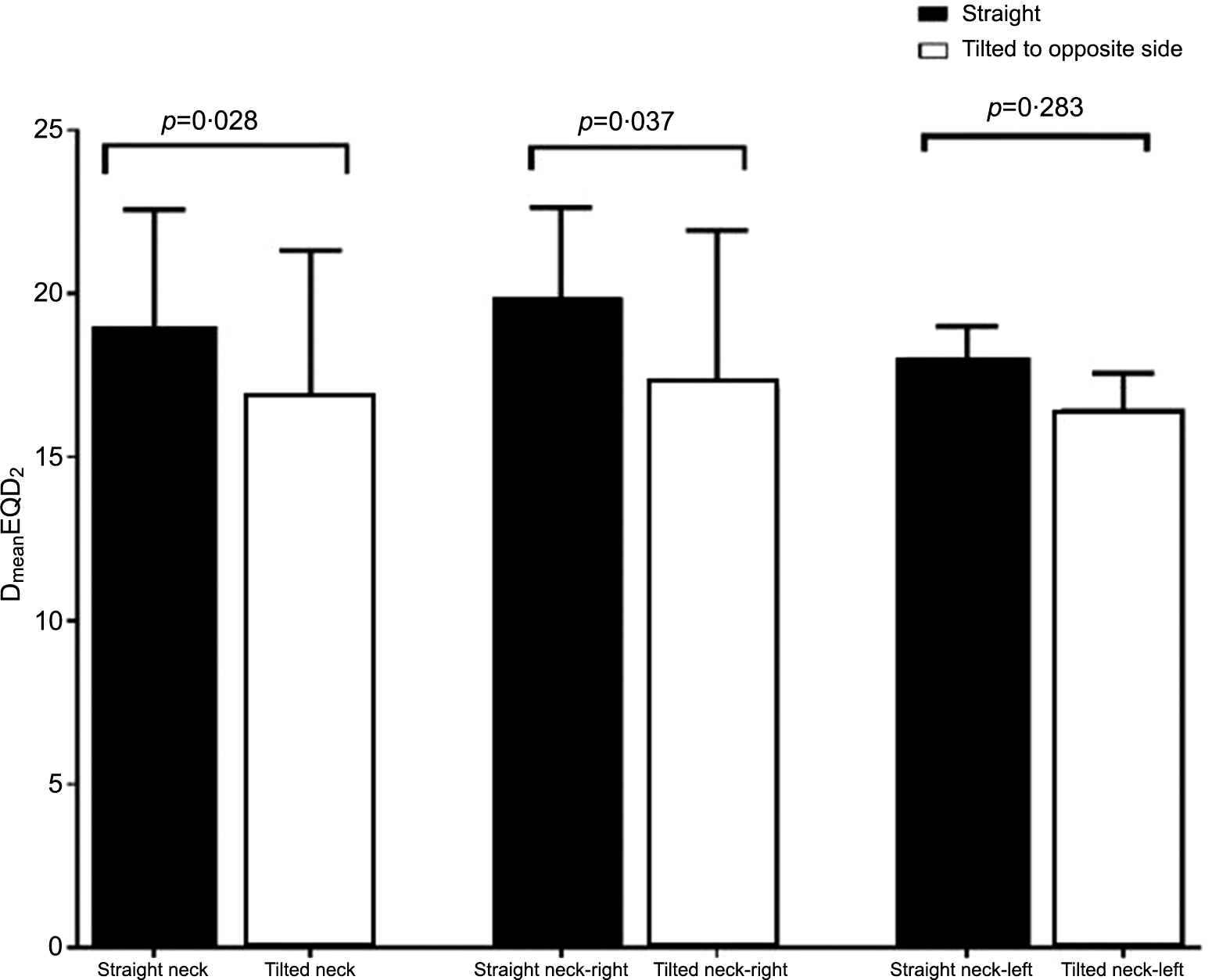
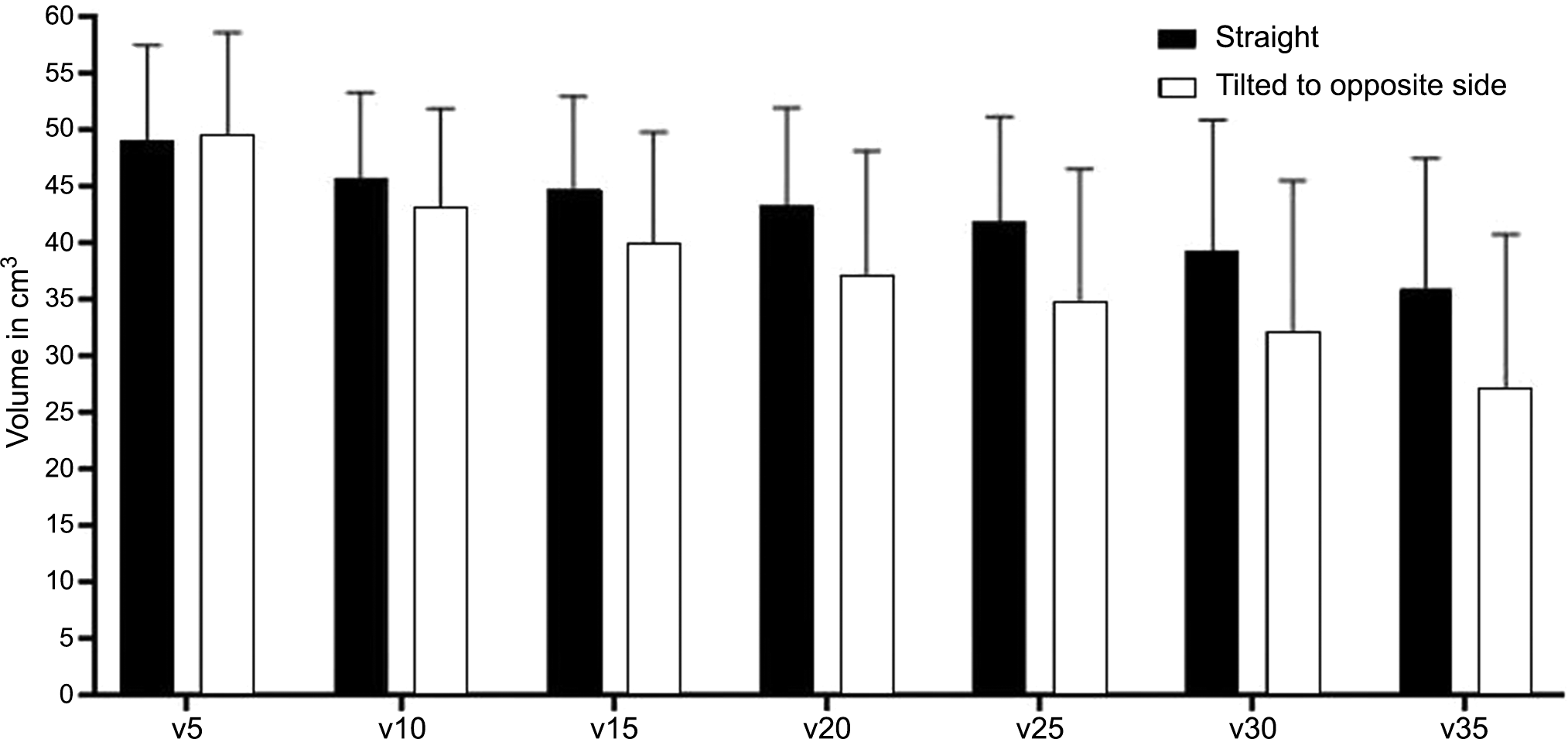
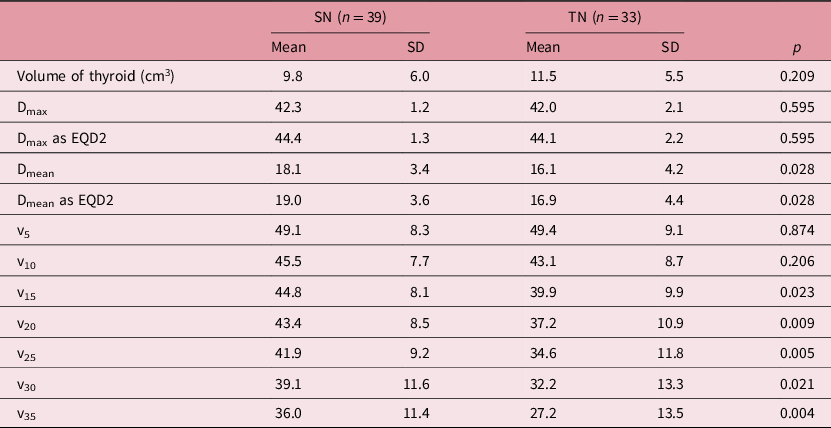
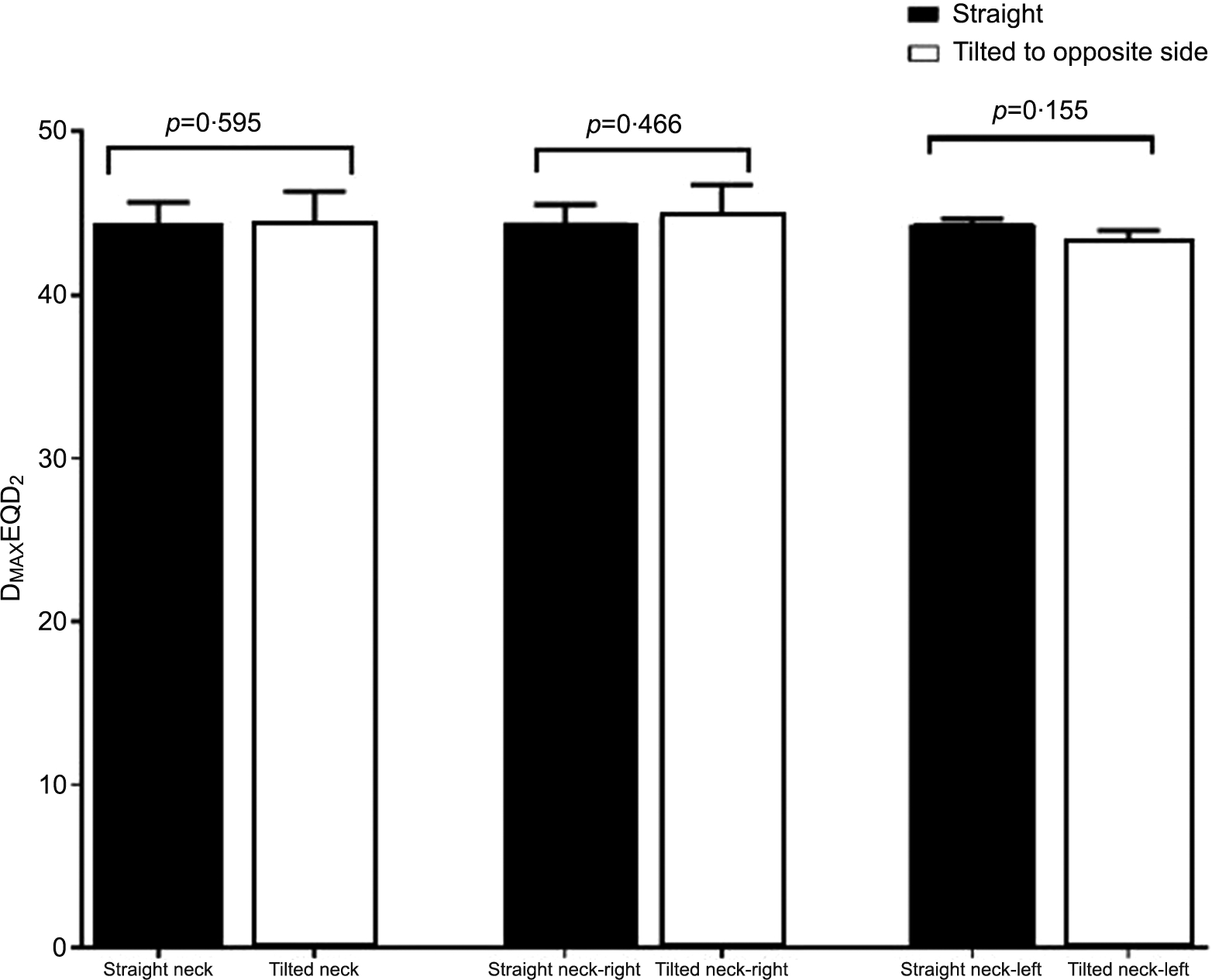
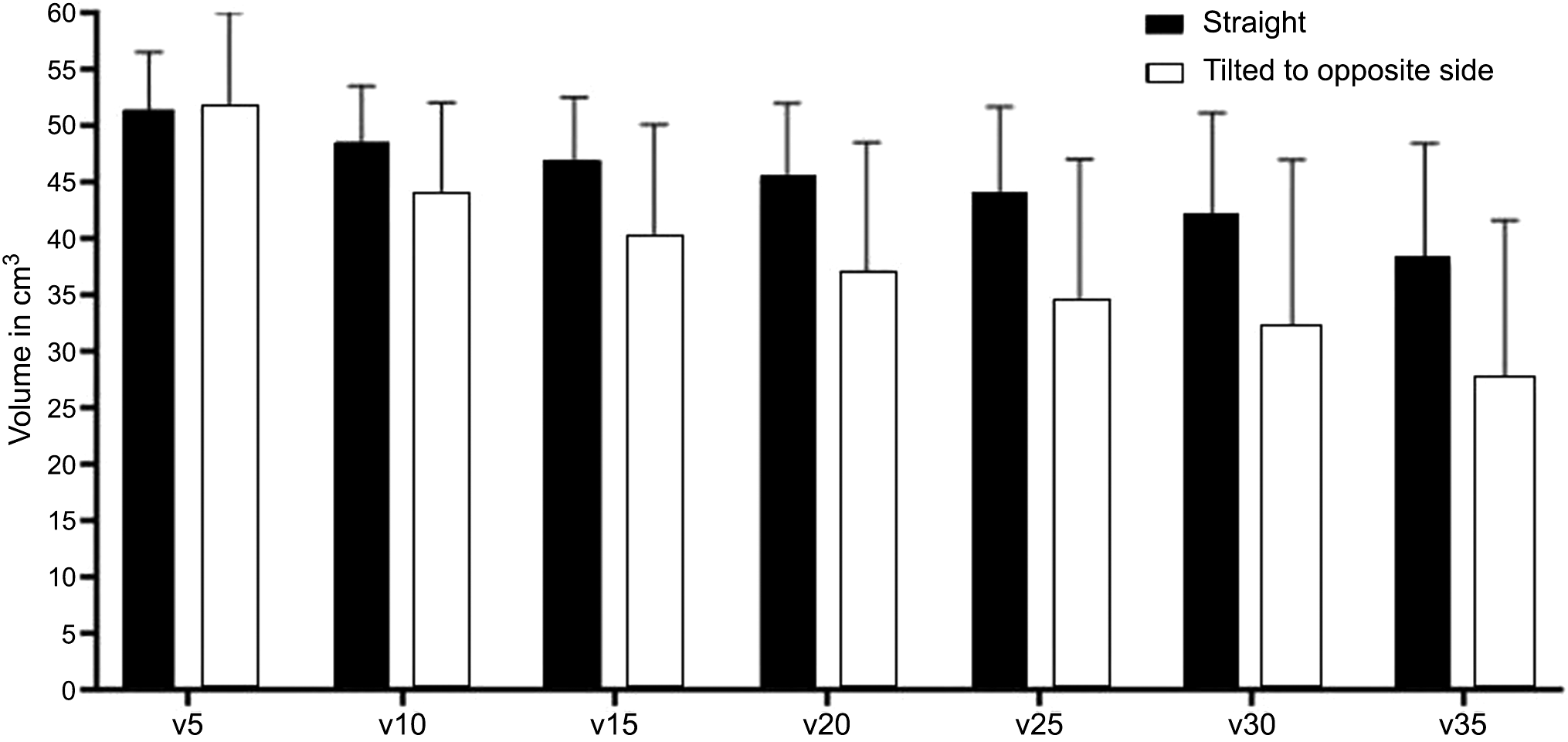
There was no significant difference in the irradiated thyroid volume between the two groups. Dmean (Figure 1), V15, V20, V25, V30 and V35 (Figure 2) were significantly lower in TN group patients when compared to SN patients (Table 1). However, there was no significant difference in Dmax (Figure 3), V5 and V10 between the groups. The absolute values of V10 were lower in turned neck patients as compared to those with a straight neck; however, this difference was not statistically significant (p 0.058).
Depicting the Dmean in two different neck positions for all patients, right-sided breast cancer and left-sided breast cancer patients separately.

Depicting the various volume parameters of thyroid gland for two different neck positions in all patients together.

Comparison of DVH parameters of the groups

Note: Data represented as mean ± standard deviation.
Abbreviations: SN, patients with neck positioned straight; TN, patients with neck tilted to contralateral side; Dmax, maximum dose; Dmean, mean dose; EQD2, equieffective dose; Vx, volume of thyroid receiving ≥ x Gy.
Depicting the Dmax in two different neck positions for all patients, right-sided breast cancer and left-sided breast cancer patients separately.

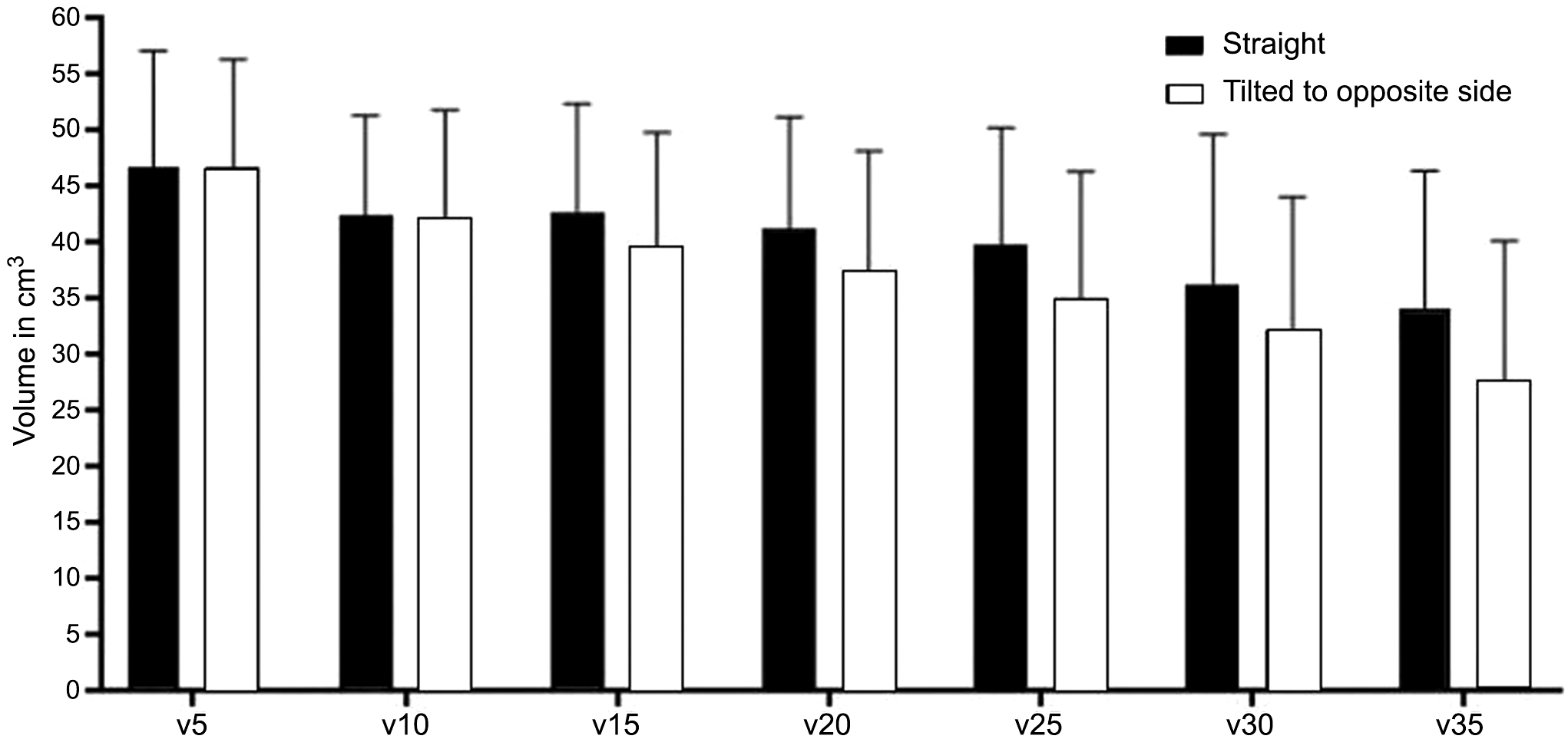
When the laterality of breast cancer was taken in consideration and the two groups were further divided into those with right- and left-sided breast cancers, it was observed that there was a statistically significant difference among the groups with respect to the parameters of V10, V20, V25, V30 and V35 (Figures 4 and 5). There was no significant difference among the groups for Dmax, Dmean, V5 and V15.
Depicting the various volume parameters of thyroid gland for two different neck positions in right-sided breast cancer patients.

Depicting the various volume parameters of thyroid gland for two different neck positions in left-sided breast cancer patients.

Discussion
Thyroid gland is considered as an OAR in radiation therapy for breast cancer, and tolerance doses for thyroid during supraclavicular radiation for breast cancer need to be considered. Reference Darvish, Ghorbani and Teshnizi7 The risk of hypothyroidism in breast cancer patients after supraclavicular radiotherapy (RT) depends on the thyroid gland volume irradiated and V30 > 50%. Reference Tunio, Al Asiri, Bayoumi, Stanciu, Al Johani and Al Saeed8 Kanyilmaz et al. Reference Kanyilmaz, Aktan, Koc, Demir and Demir9 found that Dmean > 21 Gy was associated with biochemically proven hypothyroidism in a retrospective study of 243 patients followed up for 41 months. Among the parameters studied, Dmean was the only variable associated with hypothyroidism in multivariate analysis.
In Haciislamoglu et al., Reference Haciislamoglu, Canyilmaz, Gedik, Aynaci, Serdar and Yoney10 two plans each were created using intensity-modulated RT and helical tomotherapy with and without contouring of the thyroid as an OAR in breast cancer patients. Tolerances used were Dmean < 21 Gy and V30 < 50%. Reference Darvish, Ghorbani and Teshnizi7 Dmean and V30 were found to be statistically significantly less in those plans where thyroid was contoured. Reference Haciislamoglu, Canyilmaz, Gedik, Aynaci, Serdar and Yoney10
An increase in the volume of thyroid volume irradiated correlated with an increased incidence of hypothyroidism according to Albuquerque et al. Reference Albuquerque, Beall, Shah, Niemierko and Bova11 In those patients who developed hypothyroidism, the mean thyroid volume was 7 cc whereas in patients who did not, the volume was 10 cc.
The only similar study to our study is by Reinertsen et al., Reference Reinertsen, Cvancarova and Wist12 in which 403 women who received radiation therapy with supraclavicular irradiation for breast cancer were randomised to 2 groups based on the RT planning technique used—traditional 2D RT (T-RT) used before the year 2000 in their centre and computed tomography (CT) based planning or 3DCRT (CT-RT). The T-RT group had their neck positioned to the contralateral side as is conventionally done, and the CT-RT group had their neck positioned straight. They found that the incidence of hypothyroidism was 59% (26 out of 44) in the CT-RT group as compared to 41% (18 out of 44) in the T-RT group. This was in concordance with our results, which showed significantly lower Dmean and V15 to V35 for turned neck patients than for straight neck patients. The radiation dose and volume parameters of thyroid gland were, however, not described in the study by Reinertsen et al. Reference Reinertsen, Cvancarova and Wist12
Further prospective studies with random allocation of patients may be conducted to confirm the results obtained from this retrospective study.
Conclusion
Radiation-induced hypothyroidism significantly affects quality of life in breast cancer survivors. Since the patients with neck positioned turned to the contralateral side received a lower radiation dose as compared to patients with neck positioned straight, we recommend using the tilted neck position even during modern conformal CT-based radiation planning.
Acknowledgements
The authors thank Dr Sivaramakrishnan, Head of Department of Radiotherapy and Oncology, Government TD Medical College, Alappuzha, and Dr. Harikrishnan, Lecturer, Department of Radiotherapy and Oncology, Government TD Medical College, Alappuzha.
Conflicts of interest
None.