When and how are women represented in government policymaking? While women now hold more offices than they did 30 years ago, uncertainty remains about whether their increased presence impacts macrolevel policy outputs at any level of government. In light of the uncertainty, this study poses a set of questions: Do cities with significant numbers of women in elected offices have more women-friendly policies? Do women need to obtain the most powerful positions to make those policies happen? While the study begins with the expectation that female officials will produce policy benefits for women as a group, a larger goal is to shed light on the institutional factors that condition the range of policies that they are able to effect.
Existing research teaches us much about the connection between women's descriptive (numerical) representation and responsiveness to women's issues in the policymaking process. Nonetheless, inquiry in this area can be expanded in several ways. First, many studies focus on the behavioral differences of male and female officials in public offices, while fewer consider the relationship between the presence of increasing numbers of women in political institutions and the production of women-friendly policy outputs (notable exceptions include Bratton Reference Bratton2005; Bratton and Ray Reference Bratton and Ray2002; Cowell-Meyers and Langbein Reference Cowell-Meyers and Langbein2009; Schwindt-Bayer and Mishler Reference Schwindt-Bayer and Mishler2005; Weldon Reference Weldon2002, Reference Weldon2004; Wittmer and Bouche Reference Wittmer and Bouche2013). Furthermore, results from this latter line of inquiry have yielded mixed results at best. This highlights an empirical puzzle: if individual female officials make a difference for representing women's interests, why are institutions with more women not producing distinctive policy outputs? By centering attention not simply on women's presence in public offices, but also the relative amount of power they have while there, this study makes headway toward addressing the puzzle. Unlike most studies that simply consider numerical representation, this approach acknowledges that structural features of governments often affect the ability of government officials to exert power and shape final policy outputs.
Furthermore, political scientists have devoted relatively little attention to the study of women and women's representation in local politics (Boles Reference Boles and Carroll2001; Dolan Reference Dolan, Wolbrecht, Beckwith and Baldez2008; MacManus and Bullock Reference MacManus, Bullock, Garber and Turner1995; Reingold Reference Reingold, Wolbrecht, Beckwith and Baldez2008). Yet cities vary in numerous important ways, including governmental structure, electoral institutions, and women's presence as officeholders—each of which may be consequential for understanding policy responsiveness to women as a group. Moving from individual representatives' policymaking behavior to municipal-level policy outputs provides leverage for addressing the aforementioned empirical puzzle and for understanding contingencies in the relationship between women's numerical and substantive representation.Footnote 1 Relatedly, more attention has been devoted to the policy impact of women in legislative rather than executive offices (but see Saltzstein Reference Saltzstein1986), likely due to the paucity of female executives serving at the state and national levels. This study relies on the variation in the gender of mayors across cities to assess the effect of having female executives.
Finally, few studies are able to separate the causal impact that female officials have on policy outputs from the institutions and political conditions that brought them into office in the first place. This research presents a novel identification strategy, employing an instrument of women's presence as commissioners in overlapping counties, to surmount this empirical hurdle and produce unbiased estimates of the connection between women's presence and power and municipal policy outputs.
Something beyond women's mere presence in government may be necessary to produce policy responsiveness to women as a group. In the context of urban politics, and perhaps more broadly, political incorporation is required (Browning, Marshall, and Tabb Reference Browning, Marshall and Tabb1984). When women obtain leadership positions in municipal government and when the positions they hold have greater power relative to other municipal positions, cities will be more likely to produce policy outputs that are often associated with women's interests and needs. Borrowing from research on race and urban politics (Browning, Marshall, and Tabb Reference Browning, Marshall and Tabb1984; Haynie Reference Haynie2001; Preuhs Reference Preuhs2006), female political incorporation is defined as the extent to which women are positioned to exercise significant influence over the municipal policymaking process; it is a key variable that may intervene between the presence of female officeholders and policy responsiveness to women.
The empirical analysis examines whether female political incorporation influences cities' spending patterns in the federal Community Development Block Grant (CDBG) program—a program that is comparable and measurable over a large group of cities and subject to a broad degree of discretion by local officials. The female political incorporation hypothesis is tested with an original cross-sectional dataset of the largest American cities in 2006, which includes unique and previously untapped data sources. Modeling women's incorporation and women-friendly policy outputs endogenously, the results show that cities with female mayors who are equipped with significant policymaking powers devote a higher percentage of their CDBG funding to services and centers for youth, childcare, and abused spouses and children. The findings suggest that political scientists should consider not only the presence of an underrepresented group, but also the relative amount of power that group has when assessing the effects on substantive representation. Furthermore, women in executive leadership positions may play an important yet understudied role in producing female-friendly policies. The study supplements and extends a growing body of work on the policy impact of women's presence and power in government and politics.
THE POLICY IMPACT OF WOMEN'S PRESENCE AND POWER IN MUNICIPAL GOVERNMENTS
Over the past four decades, political scientists have demonstrated that female representatives in American state legislatures and Congress make a difference for the advancement and protection of women's interests (Barrett Reference Barrett1995; Burrell Reference Burrell1994; Carey, Niemi, and Powell Reference Carey, Niemi, Powell, Thomas and Wilcox1998; Diamond Reference Diamond1977; Dodson Reference Dodson2006; Dodson and Carroll Reference Dodson and Carroll1991; Poggione Reference Poggione2004; Swers Reference Swers2002; Thomas Reference Thomas1991; Wolbrecht Reference Wolbrecht and Rosenthal2002). By and large, researchers have found that female representatives are more likely than their male counterparts to take leadership roles on feminist policy agendas and support legislation that deals with issues of traditional concern to women (Barrett Reference Barrett1995; Carey, Niemi, and Powell Reference Carey, Niemi, Powell, Thomas and Wilcox1998; Diamond Reference Diamond1977; Dodson and Carroll Reference Dodson and Carroll1991; Poggione Reference Poggione2004; Thomas Reference Thomas1991). Moreover, female state legislators have been found to express a sense of responsibility to represent women's policy preferences and to see women as a distinct component of their constituencies (Reingold Reference Reingold2000; Thomas Reference Thomas1994). At the national level, female members of Congress are more likely than men to vote in favor of legislation that promotes women's interests. Studies relying on roll-call votes in Congress have found that gender has a significant influence on voting patterns for specific gender-related concerns like abortion (Tatalovich and Schier Reference Tatalovich and Schier1993) and broadly defined sets of women's issues (Burrell Reference Burrell1994; Dodson Reference Dodson2006; Swers Reference Swers2002). More recently, scholarly attention has gone beyond roll-call votes to identify the effects of congresswomen throughout the legislative process. It finds, in particular, that congresswomen are more likely than congressmen to sponsor and cosponsor women's issues legislation (Swers Reference Swers2002; Wolbrecht Reference Wolbrecht and Rosenthal2002).
Although individual women representatives do act differently than men, the connection between having more women in political institutions and the production of policies that benefit women's interests is tenuous at best. This is true no matter whether one compares across cities (Bratton and Ray Reference Bratton and Ray2002; Kerr, Miller, and Reid Reference Kerr, Miller and Reid1998; Saltzstein Reference Saltzstein1986), states (Berkman and O'Connor Reference Berkman and O'Connor1993; Cowell-Meyers and Langbein Reference Cowell-Meyers and Langbein2009; Thomas Reference Thomas1991; Tolbert and Streuernagel Reference Tolbert and Steuernagel2001; Weldon Reference Weldon2004), or countries (Kittilson Reference Kittilson2008; Schwindt-Bayer and Mishler Reference Schwindt-Bayer and Mishler2005; Weldon Reference Weldon2002). The results of this sparse literature on the connection between descriptive and substantive representation at the institutional level of analysis leaves us with a puzzle: in some cases, female public officials are able to produce substantive representation as their numbers grow (Berkman and O'Connor Reference Berkman and O'Connor1993; Bratton and Ray Reference Bratton and Ray2002; Kittilson Reference Kittilson2008; Schwindt-Bayer and Mishler Reference Schwindt-Bayer and Mishler2005), but in others, there are diminishing marginal returns to women's increasing presence (Crowley Reference Crowley2004). In still other instances, women's presence fails to impact the production of women-friendly policies, one way or the other (Cowell-Meyers and Langbein Reference Cowell-Meyers and Langbein2009; Tolbert and Streuernagel Reference Tolbert and Steuernagel2001; Weldon Reference Weldon2004). If individual female representatives pay more attention to and are more involved in issues that are important to women, why are institutions with more women not always more likely to provide policy responsiveness? A theoretical model that focuses on positional power provides an important link between women's descriptive and substantive representation that existing scholarship has yet to consider.
Cities are a promising domain to study women's representation in policymaking because variation in women's office holding and in the design of municipal institutions extends beyond that which exists at the state and national levels. However, due to structural constraints on municipal spending decisions (Peterson Reference Peterson1981), cities may also be a hard context for finding a connection between women's office holding and leadership and the production of women-friendly policies. According to Paul Peterson (Reference Peterson1981), city officials are decidedly limited in their capacity to affect policymaking, for they must pursue economic development policies above all else. Municipal officials, regardless of their gender, do not have much room to pursue political agendas, especially related to underrepresented group interests (but see Stone Reference Stone1989; Swanstrom Reference Swanstrom1988). This is because progressive policymaking, often associated with group interests, attracts the poor and causes an exodus of the rich. Since cities require a stable tax base to stay solvent, officials may be constrained in their ability to pursue women-friendly policies.
Furthermore, some question whether there are real differences in elite behaviors and attitudes when it comes to local problems. They claim that “gender differences tend to decline with level of office” (Boles Reference Boles and Carroll2001, 69) and that municipalities are not where heated issues of the women's rights agenda are deliberated over and decided upon (Beck Reference Beck and Carroll2001; Donahue Reference Donahue1997). For example, Beck's (Reference Beck and Carroll2001) study demonstrates that men and women in municipal government share the same policy priorities, namely maintaining low taxes and high property values (see also Donahue Reference Donahue1997; Weikart et al. Reference Weikart, Chen, Williams and Hromic2007). Other studies have reached different conclusions. For instance, in her study of 174 cities with 500 to 10,000 employees, Saltzstein (Reference Saltzstein1986) finds that the presence of female mayors positively and significantly influences the number and types of municipal government jobs held by women (see also Kerr, Miller, and Reid Reference Kerr, Miller and Reid1998). Likewise, Schumaker and Burns (Reference Schumaker and Burns1998) find that gender cleavages in the opinions of policymakers in Lawrence, KS, exist on 20 out of the 30 policy issues included in their study and are particularly acute on issues involving economic growth, neighborhood protection, and social welfare (see also Boles Reference Boles and Carroll2001). Yet, they also report that policy outcomes tended to reflect the preferences of men.
Finally, some wonder whether there are gender differences in public attitudes regarding local issues. However, an examination of data from the Knight Foundation's 2002 Community Indicators Survey suggests that men and women do, in fact, have different preferences about local issues.Footnote 2 The survey reveals that women were more likely than men to state that a range of issues are a problem in their community, including crime, drugs, and violence; unemployment; homelessness; illiteracy; lack of affordable/quality childcare; and too many unsupervised children/teens. The gap between men and women was especially large for issues like unemployment and lack of affordable and quality childcare. Therefore, it appears that there may be gender gaps in public perceptions of local issues, especially those issues that concern women's traditional role as caregivers.
Women's increasing presence in public offices may not always or automatically yield responsiveness to women's interests, especially at the municipal level. As Browning, Marshall, and Tabb found close to 30 years ago, other variables sometimes intervene between “sheer” numbers and the substantive representation of various marginalized groups (Beckwith and Cowell-Meyers Reference Beckwith and Cowell-Meyers2007). Thus, my main hypothesis is as follows:
H1: When women assume key positions in city governments, especially the mayoralty and council seats, and when the offices they hold have greater power relative to other municipal positions, cities will be more likely to produce policies that are often associated with women's needs and interests.
When the structure of city government is such that the offices that women hold are equipped with more power relative to other municipal positions, then they will improve policy responsiveness to women as a group.
DEFINING AND OPERATIONALIZING POLICIES THOUGHT TO BENEFIT WOMEN'S INTERESTS
Just as there are differences between men and women, there are also significant differences among women (Jonasdottir Reference Jonasdottir1988), and any essentialist notion of “an exogenously given, universally shared, fixed female identity” that creates a common set of interests among all women is faulty (Franceschet and Piscopo Reference Franceschet and Piscopo2008, 396). Also, in many cases, women's interests are not mutually exclusive from the interests of men. Nonetheless, certain issues are commonly associated with women. These issues are likely to exist despite the presence of significant cleavages among women and the fact that men's issues and women's issues are not always or necessarily mutually exclusive. Following the work of other scholars who have defined policies thought to benefit women's interests in comparative analyses (Beckwith and Cowell-Meyers Reference Beckwith and Cowell-Meyers2007; Bratton Reference Bratton2005; Cowell-Meyers and Langbein Reference Cowell-Meyers and Langbein2009; Reingold Reference Reingold2000; Schwindt-Bayer and Mishler Reference Schwindt-Bayer and Mishler2005; Swers Reference Swers2002; Thomas Reference Thomas1991, Reference Thomas1994), I define this concept as those that (a) improve women's social, political, and economic status in relation to men, (b) address women's unique needs related to their bodies and health, and/or (c) concern women's traditional role as caregivers. Broader definitions are preferable to narrower ones for two reasons. First, women are a heterogeneous group, and so defining women's interests narrowly may exclude the interests of certain subgroups. Second, a broader definition permits comparison of the results to previous studies on women's substantive representation.
I operationalize policies that improve women's social and economic status, address women's unique needs, and concern women's caregiving role as the percentage of Community Development Block Grant funding that cities allocate to programs and services for childcare, youth, abused and battered spouses, and abused and neglected children. Previous research indicates that female elected officials care more about and spend more time working on these issues than similarly situated men (Dodson Reference Dodson2006; Dodson and Carroll Reference Dodson and Carroll1991; Poggione Reference Poggione2004; Swers Reference Swers2002; Thomas Reference Thomas1994; Wolbrecht Reference Wolbrecht and Rosenthal2002), including both social welfare issues, like childcare and youth services, and feminist issues that promote role change for women, like help for victims of domestic violence. Female representatives' increased advocacy may be the result of the gender gap in public opinion and voting behavior especially with regard to social welfare issues (Kaufmann and Petrocik Reference Kauffmann and Petrocik1999; Swers and Larson Reference Swers, Larson, Thomas and Wilcox2005) and/or the tendency for female representatives to view women as a distinctive part of their constituency (Carroll Reference Carroll and Rosenthal2002; Reingold Reference Reingold2000; Thomas Reference Thomas1994).
The Community Development Block Grant was signed into law as part of the Housing and Community Development Act of 1974 with the goal of making “power, funds, and responsibility … flow from Washington to the States and to the people” (Rich Reference Rich1993, 29). Continuing today, CDBG gives local decision makers flexibility to pursue programs that are consistent with their communities' needs (Brooks and Phillips Reference Brooks and Phillips2010). Cities and qualified urban counties are entitled to a block of funds “to be spent at local option, but within broad guidelines established by Congress” (Walker et al. Reference Walker, Hayes, Galster, Boxall and Johnson2002, i). As long as funds principally benefit low- and moderate-income people, a variety of activities may be pursued, including public services, economic development, housing, and public improvements. The analysis considers the percentage of CDBG disbursements that are spent on child and youth care as well as services for abused children and spouses.
CDBG is “the major source of federal aid for most city governments,” (Rich Reference Rich1993, 56) and since the mid-2000s, Congress has allocated approximately $5 billion per year to the program (Cytron Reference Cytron2008).Footnote 3 Central cities in metropolitan areas, metropolitan cities with populations of at least 50,000, and urban counties with populations of 200,000 or more are entitled to funding. Funds are distributed based on a formula of community need, which includes population size, extent of poverty, age of the housing stock, housing overcrowding, and population growth in relation to other metropolitan areas (Walker et al. Reference Walker, Hayes, Galster, Boxall and Johnson2002).
I consider the allocation of CDBG funding in the empirical analysis because local officials, particularly mayors and council members, have discretion in deciding how CDBG funds will be spent (Brooks and Phillips Reference Brooks and Phillips2010; Rich Reference Rich1993). In the American system of federalism, municipal officeholders are constrained in their ability to impact policy outputs since cities are not constitutionally recognized as independent (Nivola Reference Nivola2002; Rich 2003). In order to determine whether female political incorporation produces policies thought to benefit women's interests, one must consider policy outputs over which municipal officials have discretion, as is the case for the CDBG program.
MODELS, DATA, AND MEASUREMENT
The analysis considers whether women's presence in municipal government positions and the structural power they have influences expenditure decisions that are made in the CDBG program. To assess the hypothesis, I compiled a cross-sectional dataset that includes the 239 American cities with populations of 100,000 or more in 2006. I limit the analysis to midsized and large cities for several reasons. First, limiting the sampling frame to larger cities with a more accessible and accurate presence on the Web enables me to include a more complete sample of municipalities than those in previous studies. Second, my focus on larger cities coheres with the tendency in urban politics research to examine cities with greater degrees of political competition and more socioeconomic and demographic heterogeneity.
I collected data from a variety of sources, including the 2001 and 2006 Form of Government surveys of the International City/County Management Association, the 2002 Survey of Business Owners, and the 2000 decennial census by the U.S. Census Bureau, the Mayoral Election Center of the U.S. Conference of Mayors, the Municipal Yellow Book from 2001 and 2006, and municipal Web sites, among several others.Footnote 4
It is important to separate the effects of women in municipal positions on policy outputs from the factors that delivered them into these posts in the first place (Cowell-Meyers and Langbein Reference Cowell-Meyers and Langbein2009; Hopkins and McCabe Reference Hopkins and McCabe2012). I take a novel approach, modeling via a two-stage treatment regression—first, the determinants of women's presence as mayors and, second, the connection between women's presence and power and policy outputs. The treatment effect model includes ultimate outcome measures (that is, CDBG allocation decisions) for cities that both did and did not have female mayors.Footnote 5 The first stage dependent variable is thus a dichotomous measure of whether a city had a female mayor in 2006.
For the second-stage dependent variable, it is critical to identify a policy output that is subject to local discretion, comparable and measurable across cities, and a valid operationalization of the concept, policies thought to benefit women's interests. The CDBG program satisfies these criteria. Local policymakers make yearly allocation decisions (Brooks and Phillips Reference Brooks and Phillips2010; Rich Reference Rich1993), and all cities report how they spend their funds to the U.S. Department of Housing and Urban Development in annual CDBG Expenditure Reports, which are available on the Internet. I chose four program areas that are closely connected to improving women's social and economic status and to addressing women's unique needs and/or their traditional role as caregivers. The dependent variable, CDBG allocations to women's issues, is the percentage of funds that cities spent on services and centers for childcare, youth, abused and neglected children, and battered and abused spouses in 2007.Footnote 6
In the first stage, I include a variety of independent variables that previous research has found to influence women's election as mayors. First, scholars have long argued that the less prestigious and powerful the position, the more likely women would be to hold it (Diamond Reference Diamond1977; Karnig and Walter Reference Karnig and Walter1976). They reasoned that executive offices with more visibility and policymaking authority are more prestigious and thus more desirable to men who want to make an impact in their communities or rise to higher-level offices. Therefore, women will face stiffer competition for such slots. With this logic in mind, I include several measures of the desirability of the mayor's office. Strong mayor is a scale of whether the mayor has the power to (1) develop the annual budget, (2) veto council passed ordinances, and (3) appoint department heads. The scale ranges from 0, indicating that the city has a council-manager form of government and the mayor does not have power to develop the budget, appoint department heads, or veto the council, to 3, indicating a mayor-council form of government, wherein the mayor possesses all of these powers. I also include term length (measured in years) and population (logged). Since mayors appointed by rotation or council selection typically have less authority than elected mayors, the models also include a dichotomous indicator of whether the mayor is elected directly by voters. If the desirability esis carries weight, female mayors should be less common in cities where there is a strong mayor form of government, the mayor serves for longer terms, the population is larger, and the mayor is directly elected by voters.
Second, several electoral institutions may be relevant to women's presence as mayors. Although research on state legislative elections suggests mixed effects (Moncrief, Powell, and Storey Reference Moncrief, Powell, Storey, Kurtz, Cain and Niemi2007), scholars have long predicted that term limits have promise for ousting entrenched white male incumbents. Moreover, Trounstine and Valdini (Reference Trounstine and Valdini2008) find that term limits have a significant, positive effect on the numbers of women serving on city councils. I therefore include term limits, a dichotomous indicator of whether there are limits on the number of terms that mayors may serve. Next, partisan elections is a dummy variable indicating whether party affiliations appear on ballots in city elections. Theoretical expectations regarding partisan elections are contradictory. Some scholars speculate that nonpartisan elected offices are more open to women and other less connected political aspirants (Karnig and Walter Reference Karnig and Walter1976; MacManus and Bullock Reference MacManus, Bullock, Garber and Turner1995; Welch and Karnig Reference Welch and Karnig1979) while others, arguing that political parties are supportive of female candidates, are skeptical that nonpartisan contexts are any better (Darcy, Welch, and Clark Reference Darcy, Welch and Clark1994). Nonetheless, I include this measure, especially since a recent study finds that women are less likely to be mayors in cities with partisan elections (Smith, Reingold, and Owens Reference Smith, Reingold and Owens2012).
Third, women are more likely to serve as mayors in cities where the political context is favorable to them and where they have more resources at their disposal. Previous research demonstrates that states and cities with more liberal electorates elect greater numbers of women to political offices (Arceneaux Reference Arceneaux2001; Sanbonmatsu Reference Sanbonmatsu2002; Smith, Reingold, and Owens Reference Smith, Reingold and Owens2012). The ideology variable measures vote returns at the city level from the 2004 presidential election. It is the percentage of the city-level vote that went to the Democratic presidential candidate and any liberal third-party candidates who received more than 0.1% of the votes cast in a city.Footnote 7 A higher score indicates that the electorate is more liberal and thus more likely to elect a female mayor. Likewise, the supply of women candidates should be larger in localities where women have relatively higher socioeconomic status; women running in these areas will also have a larger pool of supporters to draw on during their campaigns and in the ballot box. Thus, I include a factor score of women's socioeconomic resources, which combines the percentage of college-educated women, female median income, and the number of women-owned businesses.Footnote 8
I also control for the percent female council members lagged, which is the percentage of council seats women held in 2001, because research suggests that the election of women as mayors and council members are interdependent phenomena (Smith, Reingold, and Owens Reference Smith, Reingold and Owens2012). Women who are considering a run for the mayor's office often emerge from city councils and/or take into account the gender composition of the council to see how likely the electorate would be to support their candidacies.
I use an instrumental variable to address the possibility that women's presence in municipal offices is endogenous to their policy impact. The instrumental variable approach “replaces the problematic independent variable [in this case, female mayor] with a proxy variable that is uncontaminated by error or unobserved factors that affect the outcome [women-friendly policy outputs]” (Sovey and Green Reference Sovey and Green2011, 188). I employ percent female county commissioners as an instrument of female mayor. The variable measures the percentage of women on commissions in overlapping county jurisdictions in 2006, adjusted for the proportion of the city that lies within a particular county's boundaries. This variable is correlated with the presence of a female mayor since many of the same voters and political conditions that produced a particular percentage of women on overlapping county commissions are also responsible for the presence of a female mayor. Importantly, however, the variable also satisfies the exclusion restriction (Sovey and Green Reference Sovey and Green2011): since county commissioners do not vote on or otherwise produce city level policies, percent female county commissioners is exogenous to the second stage dependent variable.
In the second stage, I include a variety of measures that are likely to predict the proclivity of a city to devote CDBG funding to women-friendly policy areas. First, I use a series of variables to test the main hypothesis. I consider female political incorporation in relation to variation in the forms of municipal government—mayor-council with a strong mayor (and weak council), mayor-council with a weak mayor (and strong council), and council-manager (typically, with a weak mayor and strong council). In the mayor-council structure, residents elect both a mayor and city council members to represent them. Mayor-council governments may have either a strong or weak mayor. In the former, more power is vested in the mayor than in the city council and in the latter, more power is vested in the council. In council-manager governments, voters choose members of the council and may choose a mayor, who presides over and votes on the council, but the mayor is less independent than in the mayor-council system. The council makes policy decisions and appoints a manager to implement its policies (Nelson and Svara Reference Nelson and Svara2010; Pelissero Reference Pelissero2003).
In order to produce policy responsiveness, the positions that women hold in government must be vested with more power than positions they do not hold at the time. Therefore, in addition to female mayor, I include percent female council members, which is the percentage of city council seats held by women in 2006, as another measure of women's descriptive representation. I interact both of these variables with the strong mayor scale described above. If, as my hypothesis predicts, CDBG funding allocated to women's issues increases as women gain more structural power, then the coefficient on the interaction between female mayor and strong mayor should be positively signed while the one on percent female council members times strong mayor should be negatively signed.
Second, four variables capture the cities' need or demand for CDBG-funded programs like childcare and services for abused spouses. The first, percent in poverty, is the percentage of the population whose income is below the poverty level. The second, percent minority, is the percentage of the population that is Black, Native American, Asian/Pacific Islander, or Hispanic. The third, percent below five, measures the percentage of the population that is younger than five years of age. Finally, the total population size is included, with larger cities expected to exhibit a greater demand for such services.
Third, as in the first stage, I include ideology, where higher scores indicate that the city's electorate is more liberal, and thus the city will allocate more CDBG funding to women-friendly policy areas. It would be extremely difficult to measure the partisan affiliations of municipal officials across cities, particularly because just 19% of cities in the dataset hold partisan elections. Yet, cities with liberal electorates and therefore liberal elected officials may be more likely to allocate CDBG funding to programs that benefit women's interests. Although women's interests are numerous and varied, many overlap with issues that the Democratic Party has traditionally promoted.
Fourth, women's extragovernmental resources may affect the percentage of CDBG funding devoted to women's issues. Individuals are more likely to participate in government processes and policymaking when they have the resources like time, money, and civic skills to do so (Burns, Schlozman, and Verba Reference Burns, Schlozman and Verba2001; Verba, Schlozman, and Brady Reference Verba, Schlozman and Brady1995). Women, particularly those with more resources at their disposal, may use nongovernmental means, in addition to elected offices, to promote and secure advances for women in local level policymaking. Therefore, the second stage includes the factor score of women's socioeconomic resources with the expectation that as this measure increases, women will have a greater ability and inclination to press municipal governments to respond to their demands and devote a greater percentage of CDBG funding to women's issues.
Finally, I control for the lagged value of the dependent variable, with the idea that CDBG spending decisions made in the current year are partially dependent on their value in the preceding year. I also include a measure of CDBG per capita, which is the total CDBG disbursement the city has received divided by its population. Cities with greater per capita disbursements should have more flexibility to allocate funds to women-friendly policy areas, after controlling for population size and measures of need.
RESULTS
I first summarize the descriptive statistics with regard to the dependent and key independent variables, showing how CDBG allocations and women's office holding varied across the country's large and midsized cities in 2006–2007. Then I present the results of the main model, which estimates the effects of women's presence and power on CDBG allocation decisions. I compare this analysis to one where women's numerical representation is considered alone, which shows that there is much to be gained by considering a theoretical model that incorporates the structural features of governments. Finally, I summarize the findings of an analysis that considers the impact of women's incorporation on an arguably less female-friendly policy area, local economic development.
Descriptive Analysis
The presence of women as mayors and council members varied significantly across the cities in 2006. Of the 239 cities, 32—or 13%—had female mayors. In terms of legislatures, the percentage of council members that were women ranged from a minimum of zero to a maximum of 77.8, with a median value of 28.6. This underscores the benefits of examining women's representation at the municipal level, where their presence in office varies to a much greater degree than it does at the state level, where the maximum percentage of female state legislators is currently 42 in Colorado (CAWP 2013), and in Congress, where just 18% of representatives are women.
Likewise, structural features of governments and policy decisions vary across the localities. For instance, 112—or 46.9%—of the cities in the dataset have strong council-weak mayor systems (where the strong mayor variable is 0), whereas 89—or 37.2%—have relatively or very strong mayors (where the strong mayor scale is 2 or 3). As we will see, this variation has significant consequences for the extent to which female officials are able to influence the policy making process.
In terms of the policy outputs, the minimum value of the dependent variable is zero, while its maximum is 22.8. The mean percentage of CDBG funding allocated to women's issues is 3.1, which indicates that, on average, cities allocate a fairly small proportion of their annual CDBG distribution to women's issues. In dollars, the mean amount of CDBG funding devoted to women-friendly programming is $184,586, while the range is $0 to $5,746,585. In short, cities vary significantly in terms of their proclivity to devote CDBG funding to women's issues. The question is, what determines such differences among cities? This is the question to which the remainder of this section turns.
Multivariate Analysis of Women's Presence and Power
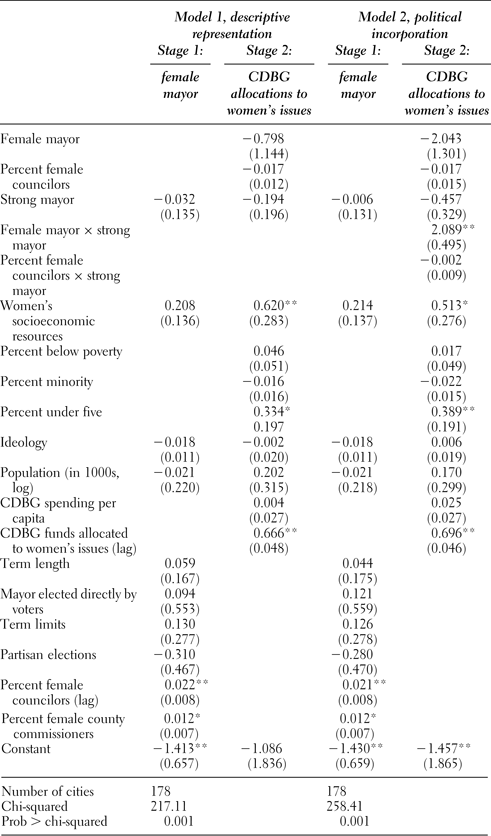
The two-stage treatment models in Table 1 assess whether women's presence and power in government influenced the expenditure decisions that cities made as part of the CDBG program in 2007.Footnote 9 In both models, the first stage predicts whether a city had a female mayor in 2006, relying on the exogenous instrument for identification, and then the second stage examines whether women's representation causes cities to devote a greater percentage of their CDBG funding to women's issues.
Determinants of CDBG allocations to women's issues: the impact of women's presence and power

*p < 0.10, **p < 0.05.
Model 1 considers the impact of “simple” numerical representation on CDBG allocations. In Stage 1 of the model, where the dependent variable is the presence of a female mayor, the most critical independent variables are the percentage of commission seats in overlapping counties that are occupied by women (the exogenous instrument) and percent female councilors lagged. Cities that had more women on their councils in 2001 were more likely to have a female mayor in 2006, either because these mayors rose from the council ranks or considered the gender diversity of the council when deciding to mount campaigns. Likewise, the percent female county commissioners variable is a positive predictor of having a female mayor, indicating the relevance of the instrument. The factor score of women's socioeconomic resources is positive and just beyond standard significance levels (p < 0.125), meaning that cities where women have more socioeconomic resources at their disposal are more likely to elect a female mayor. Such resources may be indicative of the supply of qualified female candidates who have the skills, training, and resources to run for mayor and/or of an electorate that is willing and able to support women's candidacies during the campaign and in the ballot box. It is interesting that when percent female councilors lagged and percent female county commissioners are controlled for, several other predictors of women's presence as mayor emerge as insignificant, including measures of the desirability of the mayoralty and electoral institutions. The political context of cities, particularly the presence of female county commissioners and women on the city council in recent years, and women's socioeconomic resources appear to be especially consequential to women's presence as mayors.
In the second stage of Model 1, many of the expected predictors of CDBG allocations to women's issues fail to reach standard significance levels. Importantly, however, the factor score of women's socioeconomic resources is positive and highly significant. When the factor score is two standard deviations below its mean, the predicted percentage of CDBG funding allocated to women's issues is 2.0. This value increases to 4.5% when the factor score is two standard deviations above its mean.Footnote 10 When women have more resources at their disposal, they are able to press city governments to respond to the needs of women as a group. This finding may seem counterintuitive since women with fewer resources may need CDBG-funded services such as childcare more than women with higher SES levels. However, women with more resources are much more likely to participate in political processes and make demands of government (Verba, Schlozman, and Brady Reference Verba, Schlozman and Brady1995), including trying to influence CDBG allocation decisions.
The findings in Model 1 also suggest that cities with larger populations of very young residents allocate larger shares of their CDBG funding to policies thought to benefit women's interests. When the percentage of the population that is under five is two standard deviations below its mean (i.e., at 4.8%), the predicted percentage of funding allocated to women's issues is 2.4. At two standard deviations above the mean (i.e., at 9.7%), the prediction is 4.1. To a certain extent, then, cities' CDBG allocations depend on the need for such programs.
It is important to note that the two measures of women's descriptive representation, percent female councilors and female mayor, fail to reach standard significance levels in Model 1. These findings cohere with the mixed results in previous research on the connection between women's presence in political institutions and the production of policies that are often associated with women's interests and are thus not overly surprising. When considering the impact of “sheer numbers” (Beckwith and Cowell-Meyers Reference Beckwith and Cowell-Meyers2007), it appears that there is little connection between women's office holding and women-friendly policy outputs. Also, in this model, the main measure of government structure, strong mayor, is negatively signed but insignificant. Aside from women's socioeconomic resources and percent under five, the other critical predictor of CDBG allocations to women-friendly areas is the lagged dependent variable. Cities are more likely to devote CDBG resources to women's issues when they have done so in the recent past, which indicates path dependence in municipal decision making.
The findings of Model 2 (also in Table 1), when compared to Model 1, underscore the importance of taking into consideration governmental structure when examining the connection between women's office holding and aggregate policy outputs. The results of Stage 1 of Model 2 are very similar to those of the previous model. As before, the percentage of council seats held by women in 2001 and the exogenous instrument are positive and significant predictors of the presence of a female mayor.
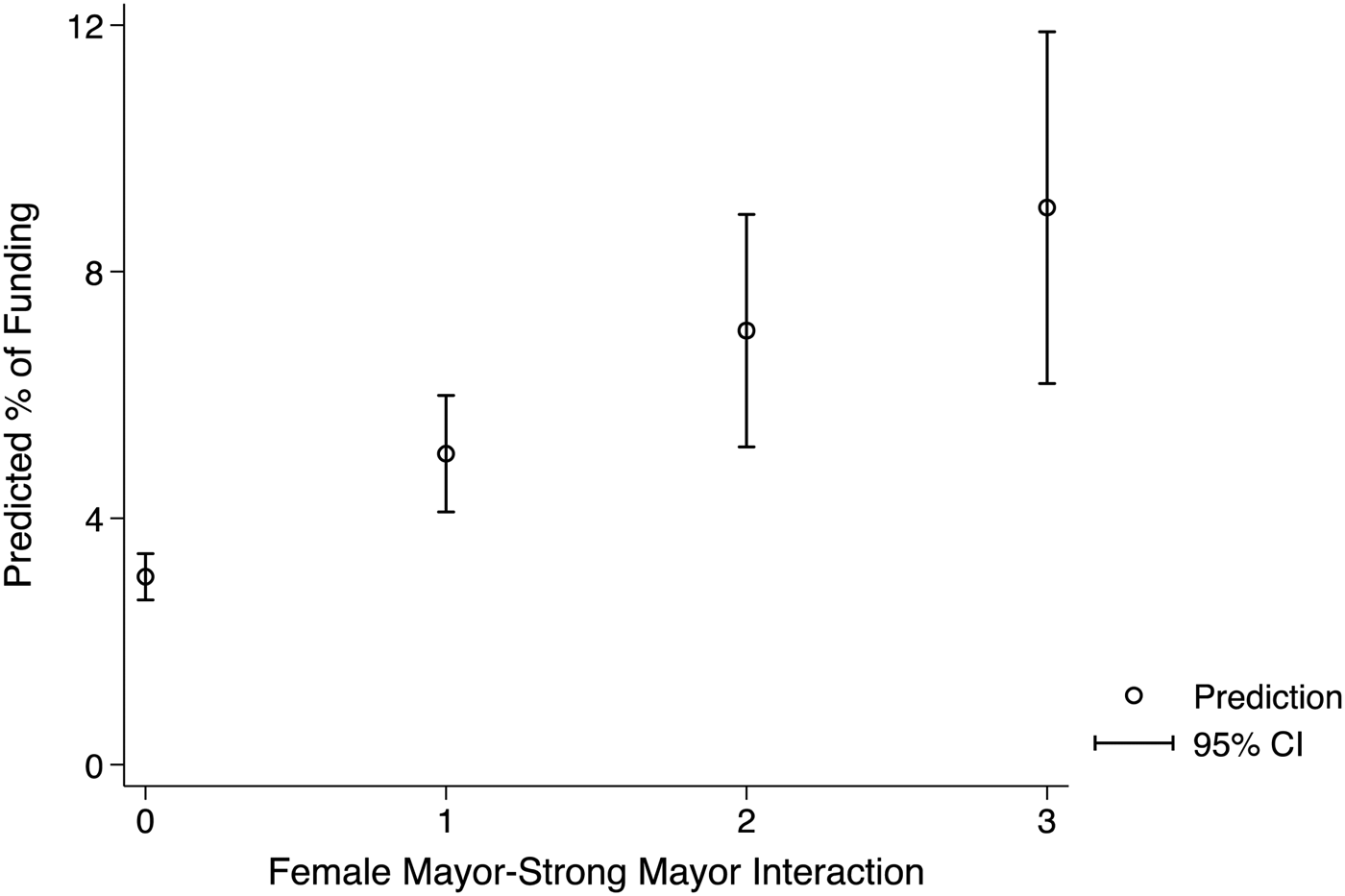
Stage 2 of this model interacts the two measures of descriptive representation with government structure, with the expectation that the interaction between female mayor and strong mayor format will be positively signed while the interaction between percent female councilors and strong mayor will be negatively signed. The results partially bear out this expectation. The coefficient on the first interaction term, between having a female mayor and strong mayor form of government, is positive and highly significant. This indicates that female mayors are able to devote a larger percentage of their cities' CDBG distributions to women's issues when they are equipped with significant power and authority to do so. Figure 1 depicts this relationship. When the interaction between female mayor and strong mayor is 0 (that is, when there is a male mayor or a female mayor who has very limited powers), the predicted percentage of CDBG funding allocated to women's issues is 3.1. When the interaction term increases to 3 (indicating a female mayor with considerable authority), the predicted percentage of funding devoted to women's issues increases to nine—an impressive almost threefold increase. To illustrate this finding further, consider the example of Tulsa, Oklahoma, which had a female mayor and a strong mayor form of government in 2006. As a consequence, the city devoted $635,546 of its $2,830,304 in CDBG disbursements to women-friendly programs and services. In contrast, Omaha, Nebraska, a city of similar size but which had a male mayor, allocated $0 out of $4,779,382 to such policy areas.
Predicted percentage of CDBG funding allocated to women's issues by women's mayoral incorporation.
In light of this large substantive finding, it is interesting that the interaction between percent female councilors and the strong mayor scale fails to reach standard significance levels. This suggests that women's power as executives is more critical to producing women-friendly policy outputs than is their legislative incorporation. Perhaps on legislative bodies, women are constrained by the necessity of securing coalition partners to achieve their preferred policy outcomes, which would matter less to female mayors who are equipped with a large degree of authority.
In terms of the control variables, as in Model 1, the lagged dependent variable is highly significant, meaning that policy decisions made in the previous year are influential in determining current allocation levels. The measure of women's socioeconomic resources once again reaches standard significance levels, indicating that women's extragovernmental resources are important in compelling local governments to respond to women's interests. The effects of two measures of the demand for women-friendly policies, percent below poverty and percent minority, are indistinguishable from zero. However, a third, the percentage of the population that is younger than five, positively and significantly predicts CDBG allocations to these policy areas. Finally, the ideology of the city's electorate, population size, and CDBG funding per capita are insignificant in Stage 2 of Model 2.
To determine whether the effect of female executive incorporation is simply an artifact of the data under examination, I ran the same model but substituted the percentage of CDBG funding allocated to economic development in for the dependent variable focused on women's issues. In this model (not shown), none of the key independent variables (i.e., the two interaction terms and the measures of women's descriptive representation) are significant. This robustness check indicates that female political incorporation does not shape policy outputs in areas that are not typically thought to relate to women's interests. In short, women's incorporation as mayors matters—and matters most to decisions in areas that are closely connected to women as a group.
CONCLUSIONS
Several decades of political science research has found that although individual female representatives behave differently and have different policy preferences than men, the causal connection between having more women in political institutions and the production of policies thought to benefit women's interests is tenuous at best. This research leveraged the variation in institutional arrangements, women's office holding, and policy outputs found in U.S. cities to address this puzzle. Using an original city-level dataset and modeling women's descriptive and substantive representation endogenously, the analysis revealed that empowered female executives in municipal governments influenced expenditure decisions made as part of the federal CDBG program.
A number of implications can be drawn from this research. When women rise to positions of significant executive authority, they have more control over municipal policymaking and, as a result, cities may become more responsive to women's interests and needs. The finding with regard to women's executive incorporation is noteworthy and indicates that political scientists should increase their attention to the causes and consequences of women's presence in executive offices at all levels of government. From an empirical standpoint, this becomes increasingly feasible to do as women gain more executive positions. From a normative standpoint, if female executives do make a difference, especially when they have significant authority, women as a group would be well served by efforts to recruit, train, support, and propel women into executive offices. Given the findings, strategic targeting of the most powerful executive slots may be necessary.
The findings also indicate that the allocation of CDBG funding by cities is a path-dependent phenomenon. The incremental nature of budget decisions is common to many other programs and levels of government, meaning that the findings may be generalizable beyond cities and mayors. Furthermore, given the path dependence, female executives who successfully change budget priorities and allocations may, in turn, make their impact felt beyond their immediate terms in office.
The theory and findings underscore the importance of considering not just women's numerical representation but also the factors that condition any proposed relationship between descriptive and substantive representation. The structural features of governments are one such factor. However, the conceptualization and operationalization of power employed in this study focused only on formal power. More work of this nature is needed, especially to define and incorporate measures of informal power, or power as perceived by officeholders themselves. As a former mayor of a major American city notes, “Some have power by virtue of their position—their elected position—and some have power by virtue of their position and their ideas—their ability to convene people or articulate a point of view. … The people who have power in local government are the people who take it.”Footnote 11 Perhaps women's informal power is critical in the legislative arena, which would explain the absence of significant findings between women on city councils and CDBG expenditure decisions. Furthermore, in city governments, there is a “symbiotic relationship between structure and agency” (Geron Reference Geron2005, 176), whereby the formal powers bestowed on officeholders shape opportunities in their quest for informal influence. Formal power may make the occasions for exercising influence over policy making more likely; still, officeholders need to capitalize on the opportunities presented to them. In order to gain a fuller understanding of women's political representation, it would behoove social scientists to increase their attention to matters of formal and informal power and how both are accumulated, maintained, and utilized.
Cities could be considered be a hard case for finding evidence of a linkage between women's presence and power in government and the production of women-friendly policy outputs, especially since municipal officeholders are beholden to decisions made at the state and national levels and also given the competition between localities for a stable tax base. Given these contextual factors, it is notable that female officials influenced the allocation of CDBG funding, demonstrating that there is room for creative policy making related to underrepresented group interests in cities (Stone Reference Stone1989; Swanstrom Reference Swanstrom1988). Although political scientists have devoted relatively little attention to the representation of women in municipal politics and policymaking, this study demonstrated that much could be gained by doing so. Indeed, conducting research on women in urban politics may yield a richer understanding of the nature of political representation at all levels of government.
APPENDIX
Variable descriptions, summary statistics, and sources