With new technologies in paediatric cardiac sciences, children are surviving cardiac defects that previously were considered lethal. Parents of babies with hypoplastic left heart syndrome now have a choice between compassionate care and surgical intervention to address this life-threatening congenital disease. Data from the National Inpatient Sample dataset in the United States of America for 1988 to 1997 indicate that the use of so-called “comfort care” for babies with hypoplastic left heart syndrome decreased, while the proportion of babies treated surgically with the Norwood procedure increased from 8% to 34%, with a corresponding decrease from 54.4% to 38.1% in the in-hospital rate of mortality.Reference Chang, Chen and Klitzner1 Recent results indicate further progress, with in-hospital survival of 93.1% now reported for babies who underwent the right ventricle to pulmonary artery modification of the Norwood procedure.Reference Reinhartz, Reddy and Petrossian2 Surgical treatment for hypoplastic left heart syndrome involves a 3-staged reconstruction, starting with the Norwood procedure during the neonatal period, a bidirectional cavo-pulmonary connection or Glenn procedure at 4 to 6 months, and the Fontan procedure at 2 to 4 years of age.Reference Tibballs, Kawahira, Carter, Donath, Brizard and Wilkinson3, Reference Jacobs, O’Brien, Chai, Morell, Lindberg and Quintessenza4, Reference Pizarro, Derby, Baffa, Murdison and Radtke5 The frequency of late complications related to this approach has led some clinicians to frame cardiac transplantation as the potential fourth stage.Reference Quintessenza, Morell and Jacobs6
Despite the increased rate of survival, there is evidence of neurological delays and deficits in children with congenitally malformed hearts who have undergone open heart surgery in the first year of life,Reference Limperopoulos, Majnemer and Shevell7, Reference Limperopoulos, Majnemer and Shevell8 including children with hypoplastic left heart syndrome.Reference Goldberg, Schwartz and Brunberg9, Reference Mahle, Visconti and Freier10 Biomedical factors, such as deep hypothermic circulatory arrest, that have been identified as contributing to cerebral injury in these children, are being addressed through changes in preoperative, intraoperative and postoperative procedures.Reference Dent, Spaeth and Jones11 Other factors, nonetheless, such as predisposing conditions related to fetal cerebral blood flow, may not be ameliorated by changes in such protocols.Reference Limperopoulos, Majnemer and Shevell12 Furthermore, there are indications that the developmental outcomes of children who survive their complex congenital diseases may depend in part on the behaviours of their parents.Reference Bjarnason-Wehrens, Dordel and Schidkendantz13 Some researchers have expressed concern that parents tend to overlook delays suffered by their children, or that they tend to be overly optimistic about their development and quality of life.Reference Limperopoulos, Majnemer and Shevell8, Reference Hagemo, Rasmussen, Bryhn and Vandvik14, Reference Mahle, Clancy, Moss, Gerdes, Jobes and Wernosvsky15 While these findings raise the possibility that behaviours of parents have a negative influence on the developmental trajectories of children who have survived open heart surgery, they are preliminary in nature. In addition, there is a lack of knowledge about underlying reasons for such behaviours, particularly from the perspective of parents whose children have complex cardiac disease.
With these features in mind, we conducted a qualitative study to examine the process of parenting a child with hypoplastic left heart syndrome who had survived the Norwood surgical approach.Reference Rempel and Harrison16 The specific research question reported here is “How do mothers and fathers manage their worry associated with uncertain outcomes for their child with hypoplastic left heart syndrome who has survived through advanced technology?”
Sample and methods
We used a constructivist grounded-theory approachReference Charmaz17, Reference Charmaz18 to elicit in-depth descriptions of the dynamic process of parenting a child with hypoplastic left heart syndrome, from the time of the diagnosis to the present reality and activities with their child. Constructivist grounded theory studies assume that there is no single, “true,” objective, or external reality awaiting discovery. Rather, realities are created, or constructed, by individuals as they make sense of, and give meaning to, their experiences.Reference Charmaz18, Reference Guba and Lincoln19 Consistent with constructivist grounded theory, and pointing to its appropriateness for our exploration of parenting within the context of advanced medical technology, one of the key assumptions underpinning this study was that parents of children with hypoplastic left heart syndrome create and maintain meaningful worlds in their effort to make sense of, and live within, their ever-changing experiences.
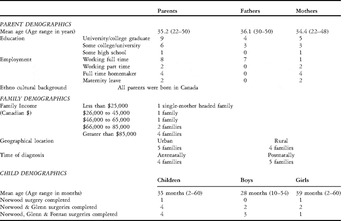
The Cardiac Sciences programme of a Canadian tertiary referral centre provided a population from which parents of 9 children participated. The Norwood procedure became available at this center in November 1996, and when recruitment commenced in August of 2001, there were 32 survivors, representing a survival rate of 60%. Maximum variation sampling was used in an effort to ensure a diverse sample, and to provide an in-depth understanding of parenting a child with life-threatening congenital cardiac disease.Reference Patton20 There was variation in the sample in terms of the age and state of employment of the parents, their family income, their geographic location of residence as urban or rural, the timing of the initial diagnosis as antenatal or postnatal, and the timing of the interviews in relation to the stage of surgical treatment for their child (See Table 1). An ability to tell their story with reflection on their experience of parenting was a primary criterion for participation.Reference Morse21 Non-English speaking parents, and parents whose child with hypoplastic left heart syndrome had died, were excluded from participation.
Demographics at time of first interview.

The first author conducted 30 interactive interviews with 16 parents, made up of 9 mothers and 7 fathers, over a period of 13 months from November, 2001, to December, 2002. Of these, 18 were face-to-face interviews, and 12 were conducted by telephone. Questions invited parents to describe medical events related to diagnosis and treatment, as well as daily life with their child with hypoplastic left heart syndrome. Parents were interviewed separately to ensure that they had the opportunity to tell their story in their own way and at their own pace, and to enable the identification of differences and similarities between parents. On a practical level, separate interviews allowed one parent to attend to their child or children while the other parent was interviewed. The interviews were audiotaped and transcribed verbatim.
Collection and analysis of data occur simultaneously when conducting grounded-theory studies. Thus, the process of analysis began once the first interview data were transcribed. Sampling ceased when there was saturation, that is, recurrence of themes in the data, with no new themes identified in the analysis, and ample data fully to describe the phenomenon of parenting a child with life-threatening cardiac disease.
Grounded-theory research is not about fitting or forcing the data around pre-existing concepts to verify or enhance conceptual existence. Rather, concepts that explain the experience of the participants emerge in the process of analysis of the data.Reference Charmaz18, Reference Glaser22 The data was analyzed using two grounded-theory levels of coding, open and selective. Open or initial coding is an inductive process, where the researcher moves from the data to theory.Reference Charmaz18 Glaser’s “theoretical sensitivity” is crucial to this process, and the researchers achieve it, in part, by continually asking questions of the data.Reference Glaser23 “What is this data a study of?” allows the data to “declare itself.” This question was asked as each interview was coded sentence by sentence. Another question that keeps the research theoretically sensitive while coding is “What category or property of a category of what part of the emerging theory, does this incident indicate?”Reference Glaser23 As similarities in the data became evident, categories were created, for example, caring for a child with a life-threatening cardiac condition. As the analysis proceeded to a more abstract level, categories related to other codes were generated, for instance, warding off worry was generated from trusting others, normalizing, and directing thoughts to the positive. Once we identified core categories or concepts, for example, parenting strategies to counter worry about child, and strain in the couple relationship, further coding was selective or focussed for these core concepts instead of aiming for additional categories or concepts.Reference Charmaz17
Rigorous grounded theory research yields findings that people readily recall and utilize,Reference Glaser23 and with a constructivist foundation remain at a more meaning-oriented level rather than a truth-oriented objectivist level.Reference Hagemo, Rasmussen, Bryhn and Vandvik14 To facilitate such an outcome, four trustworthiness criterions were considered: fit, work, relevance, and modifiabilityReference Charmaz18, Reference Glaser22, Reference Glaser23 throughout the process of generation of theories. The emerging grounded theory about parenting children with life-threatening cardiac disease that included the parenting strategy of normalization had to fit with the data from which it emerged. It had to work in that it facilitated understanding and interpretation of what it is to parent a child with hypoplastic left heart syndrome. Additionally, the theory had to have relevance for parents and researchers beyond this study. For the theory to be used in clinical practice, and to have value for further research and theory development, it also has to be readily modifiable.Reference Charmaz18, Reference Glaser22, Reference Glaser23 Evaluation of the latter two criterions is ongoing.
The Health Research Ethics Board members of the local university and local health region approved the research protocol. The advanced practice nurse made initial contact with parents of children with hypoplastic left heart syndrome who had undergone the Norwood procedure and referred parents who indicated they might be interested in participating in the study.
Informed consent was obtained from each participant who expressed interest in being part of the study. Parents were told that the care of their child would not be affected if they wished to withdraw from the study at any time. Identifying information was removed from each transcript for the sake of anonymity.
Results
When parents decided in favour of the Norwood surgical approach, they gave their child with hypoplastic left heart syndrome a chance for life. Taking this chance meant that parents lived with uncertainty and worry about the immediate and long-term survival of their child. One way of containing their worry was seemingly through a cognitive, or defining, processReference Deatrick, Knafl and Murphy-Moore24 of viewing the growth and development of their child as normal in spite of delays. This finding was striking, because parents were keenly aware that the Norwood surgical approach only recently had become available in the referral hospital, and that the survival of their child was novel and precarious.
New survivors with uncertain futures: a constant source of worry
The parents in this study described their children as having survived their complex cardiac condition and the surgical intervention. Although the parents did not describe their children as “survivors”, or “new survivors”, one mother explained that her son was the first child in their province to survive the Norwood surgical approach for hypoplastic left heart syndrome. Parents recounted the frequent and worry-provoking reminders of the novelty of the survival of their offspring from health care professionals who were unfamiliar with the requirements for care of children with hypoplastic left heart syndrome who had undergone the Norwood surgical approach. The local paediatrician attending one baby with hypoplastic left heart syndrome told her parents that “any baby with the same condition he ever saw was compassionate care only.” A father whose five year-old daughter had recently undergone the Fontan operation commented as follows:
These kids are so unique. … Now I look back and I think, “Holy smokes this is, this is way out there.” … Some doctors and nurses get a grasp on that right away … Others … it’s almost like walking with an egg in a spoon. They’re just not comfortable with it because there’s so many scenarios that can happen in a second’s notice.
Parents also understood that the survival of their children was precarious, and this was a constant source of worry for them. [See Box 1] Most parents knew of babies with hypoplastic left heart syndrome who had died. One couple had received a phone call from their paediatrician emphasizing the importance of closely monitoring their child for signs and symptoms of dehydration. One of the other infants with hypoplastic left heart syndrome that the physician was attending had died suddenly at home. Parents also gradually learned that the future for the child was uncertain. One mother described the moment when she realized that the future for her child was unknown. During the first year following the birth, she asked a specialist about the prognosis for her baby, and he said, “You are in for a lifetime of health problems and health concerns.” The mother commented:
Box 1 Worries about the future

It was like getting kicked in the guts because up until that point, you think, “I can do this, you know, she’s coming along. She’s showing progress.” …I asked him the question and he gave me the answer. I don’t even know why I asked it because I wasn’t ready to hear.
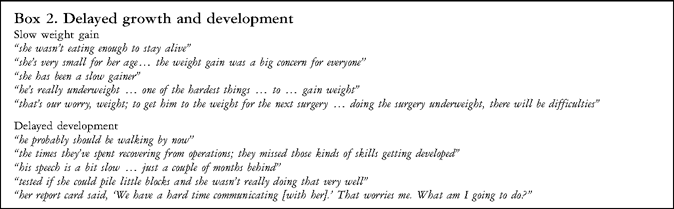
A key finding that emerged from analysis of the data collected during the interviews is that the parents normalized the growth and development of their children, however delayed, and this seemed to help to counteract their worry about the present and future survival of their child who had “beaten the odds, thus far”. Comments like “I feel more comfortable,” and “I really stopped worrying” when describing the growth and developmental progress of their children alluded to a connection between normalizing and less worry. [See Box 2]
Box 2 Delayed growth and development
Normalizing life: “Just treat him like a normal child.”
The parents, as much as possible, focused on thinking of their children as normal. It was beneficial to view their children as normal because it was exceedingly difficult constantly to worry about the life-threatening cardiac problem. One father articulated his struggle to view his two-year-old son as normal. His son had undergone the Norwood and Glenn operations.
It’s always in the back of your mind. I have a son with a heart condition … It’s the hardest thing to just forget about the heart condition … It’s not so much the challenge that he gives you; it’s the challenge you have within yourself to forget about the problem and just treat him like a normal child.
When their children were able to feed without the need for tubes, parents were relieved that their child was finally feeding “normally.” When parents realized that their children were going to crawl, walk, and talk they were reassured that their child was going “to be okay.” Thus, it appeared that parents used a strategy of normalizing in two main areas, the delayed growth and the delayed development of their children. [See Box 3]
Box 3 Themes about normalizing “Just treat him like a normal child”

Delayed growth: “He’s on his own growth curve.”
It is well-documented that babies with cardiac problems are at risk for delayed growth.Reference Nydegger and Bines25, Reference Varan, Tokel and Yilmaz26 All 9 children of the parents who participated in this study benefitted from nasogastric tube feeding between the Norwoord operation and the Glenn operation at 5 to 11 months of age. In 3 children, a G-tube had been placed because of ongoing issues with feeding. Of the 4 children in the study who had undergone completion of the Fontan circulation, one child, of kindergarten age, remained on a G-tube for ongoing oral feeding issues, and another was described as a picky eater and tiny for her age. Of note is that in all of the detailed descriptions of feeding difficulties and slow gain in weight, there were only two instances when mothers made brief comments that acknowledged that poor feeding was related to the cardiac problem.
He was little. But I guess they say that’s common in heart babies.
He always eats more than [his cousin of similar age]. But you know his metabolism is so high. So our perspective is a little bit different here.
Rather, most parents viewed the small size and small appetite of their children as related to other factors in an attempt to normalize the delayed growth.
Several parents described their babies as being on their own personal growth curve, even though it was below the normal growth curve, percentile-wise. This allayed their worry. One mother said:
Even though she’s below the growth curve, she’s following a normal growth curve and so I really stopped worrying about it so much.
Another mother compared the slow gain in weight of her toddler with the pattern of growth of the children of her sister. She expressed relief of worry when she positively concluded that her son was on “his own growth curve,” even though he “was always a pound or two behind the other two kids.”
Personality, levels of activity, and desire for food were other reasons given for the lack of gain in weight, and were viewed by parents as normal attributes, rather than cardiac-related problems. Although one mother mentioned that the higher nutritional needs of her son were related to his cardiac problem, she described his inability to eat enough to achieve steady gain in weight in this way:
He doesn’t like to eat … just his personality, like he couldn’t care less about food.
One father viewed the small stature of his daughter as due to her tendency, at the age of 5 years, to engage in constant activity and to have a limited appetite.
She is still tiny, but she never sits still. … She’s moving… all the time. She’s not a big eater yet. She eats pretty much everything but just little bits.
His wife was comforted by her view that the short attention span of their daughter contributed to her small appetite, and that small stature was part of her identity, not related to the cardiac problem.
She’ll eat anything that you give her. But she just doesn’t eat a lot. …That’s a bit of a challenge. But at least … I feel more comfortable with it now because I get to know her better and she’s just a little thing.
Although they knew that children with congenitally malformed hearts struggled to gain weight, most parents tended to separate the delayed growth from the cardiac problem. One couple had the ultimate comparison, as their baby was a twin. The father reported that their one year-old twin without the cardiac problem was twice as heavy as their twin with hypoplastic left heart syndrome. It would seem difficult to normalize such a striking difference, but he attributed his daughter’s cardiac-related delayed growth to the desire to stay small.
She [heart-healthy twin] is almost double [in size]. … It’s hard to look at but I guess she [twin with hypoplastic left heart syndrome] just wants to stay small.
Delayed development: “She does it at her own stage.”
Parents also normalized the development of their children despite evidence of delays. Motor, social, and language delays were common amongst the children, but parents expressed satisfaction, not worry, as they described the progress made in physical, social, and language attributes. They had been prepared for their child to die, so the development, however delayed, was cause for celebration.
I think every little thing that she has done or is doing right now is just a huge, huge deal to us. The first time she ever sat up, we called 20 people and with every little action she does … it is a huge ordeal to us. She took a bite of her first cracker the other day and I think it took me 20 minutes to finish calling everyone to tell them about it. It was just from where she is to where she started out … it makes every little thing a huge celebration.
Of all the children in the study, the 14 month-old twin was the most delayed in development. Her mother described the development as the most satisfying aspect about parenting her baby with hypoplastic left heart syndrome.
Just watching her grow and change. And she smiles. That’s big, the biggest thing. She smiles and she waves and she just, anything she does just melts your heart completely … Just to see the change in her is, is just wonderful. I think to see how far she’s come makes a big difference.
Even though parents described in detail the complications their child had encountered related to treatment, they did not acknowledge that the low levels of oxygen, the intraoperative circulatory arrest, and the possible cerebral injury during these complications, could be possible reasons for the slow development of their children. Instead, parents focused on alternative explanations for the delay, questioned the meaningfulness of early developmental testing, and celebrated the developmental progress they observed.
Similar to the ways in which the parents normalized the delayed growth, parents happily reported that their children were developing at their own pace and provided alternative explanations for the delay.
She does things at her own stage and she gets ready to do things on her own so I said I just let her do them when I feel she’s ready to do them. I don’t push her into anything.
One mother compared the slower development of their son compared to his older sister, and reassured herself that he was “gonna get there but on his own speed.”
His speech is a little bit behind but he’s been so in and out [of hospital] and on his back but I think he’s just a couple months behind that way. Then his mobility; he probably should be walking by now but you know that’s coming. That’s just around the corner and then look out.
Similar to this mother, other parents were not surprised by delays, as they saw prolonged time in hospital as impeding the psychomotor development of the children. Parents sometimes implicated themselves in their alternative explanations of their child’s developmental delays. One child with hypoplastic left heart syndrome was in kindergarten, and was not able to colour inside the lines of a shape. Her father wondered if this was because they, as parents, had not given her enough opportunity to practise with real crayons. One mother believed that the speech delay of her son was related to parenting rather than cerebral injury. Being their first child, she explained that she and her husband had anticipated his every need so that he had not needed to talk.
On the CT scan originally, the area where there was a little bit of swelling was the area that affects speech so they’ve always kept an eye on that. But in retrospect, I think it was more us than anything else because we were always trying to help him communicate. I think we overdid it and so he didn’t need to speak.
Even in the descriptions they gave of developmental testing that their children underwent, parents downplayed the detected delays.
One thing [the paediatrician] tested was if she could pile little blocks and she wasn’t really doing that very well so she said that was one thing that she said she might not be on track. But I would say overall if she’s not right on track, she’s very close.
Another mother, who had a background in health care, questioned whether the developmental testing her son had undergone thus far could reveal anything meaningful.
They test him developmentally but what can you do with a two-year-old? It’s really hard to assess right now … he’s not going to speak to strangers that much anyway … he really wasn’t speaking much to anybody except us at home.
When the speech therapist saw this child for intervention, she reinforced the questions about working with children at such a young age, and promoted the normalizing strategy.
So then they referred us to speech and the speech therapist that we saw was excellent. She said, “Well you know, what are you going to do with a two-year-old? Let’s just see how many words he knows and what he picks up in a month.” She said she really doesn’t have any concerns. … “Let’s track him for a couple months and then he’ll probably just go on his way.” So no big deal … especially because of the way he started out because he did have a couple of anoxic episodes and they just didn’t know where that would go.
Parents were confident that their children would do well because of their social development. All parents described the outgoing social personalities that were especially evident when the children entered school. The comments of three parents were as follows:
She certainly is probably above average in those skills [social skills].
The whole school knows him. They all love him. They all fight to play with him. So it’s worked out unbelievable.
She’s such a social butterfly. … Her kindergarten teacher, she can’t believe it. She says everybody in the whole school just loves her. I mean she’s always going up and hugging and they say she is so concerned about everybody if they fall down and get hurt.
Unlike the many ways that parents tried to help their child eat and gain weight, parents did not describe specific things that they were doing to help the development of motor and language skills. Although some of the babies received infant development services, and some received speech and language assistance in the preschool period, none of the parents described activities that they did to assist their child developmentally.
Discussion
Our study shows that parents of children with hypoplastic left heart syndrome normalize the growth and development of their children despite lags in both areas. Our findings are consistent with previous research, showing the tendencies of parents not to acknowledge developmental delays of their children with complex cardiac conditions.Reference Hagemo, Rasmussen, Bryhn and Vandvik14, Reference Mahle, Clancy, Moss, Gerdes, Jobes and Wernosvsky15 Importantly, our study also advances current knowledge by hypothesizing an underlying reason for the use of normalization; it helped them to worry less about the uncertain future for their children.
Such worries about the uncertainty of the future are not unfounded. Developmental delays in children who have had open-heart surgery to treat complex congenital cardiac malformations, including hypoplastic left heart syndrome, are well documented.Reference Limperopoulos, Majnemer and Shevell7, Reference Mahle, Clancy, Moss, Gerdes, Jobes and Wernosvsky15, Reference Rogers, Msall and Buck27 A prospective Canadian study indicated that almost half of the children who had open-heart surgery as newborns, and just over one-third of those who had surgery during the first 2 years of life, had abnormal neurological findings affecting behaviour, muscle tone and the cranial nerves.Reference Limperopoulos, Majnemer and Shevell7 Some also had microcephaly. Of further concern are the life-long negative consequences associated with delayed development in childhood. Evidence from developmental research would suggest that children with complex cardiac conditions who have abnormal neurological states will be at risk for ongoing difficulties throughout their lives in terms of subsequent school performance, social and behavioural development in adolescence, and health, well-being, and coping in adulthood.Reference Hertzman28, Reference Power and Hertzman29, Reference Hertzman and Power30, Reference Tremblay31
On a positive note, it has been concluded that severe disabilities are rare in children with complex cardiac disease who had surgery as infants.Reference Limperopoulos, Majnemer and Shevell7, Reference Limperopoulos, Majnemer and Shevell8 More common are moderate delays that are responsive to early intervention. Thus, perioperative interdisciplinary assessments are recommended for infants, along with counselling of families to encourage them to pursue early intervention for their children.Reference Limperopoulos, Majnemer and Shevell7, Reference Limperopoulos, Majnemer and Shevell8
Discrepancies between documented developmental delays and use of rehabilitation services by parents of children with congenital cardiac disease, other than hypoplastic left heart syndrome, are recognized,Reference Weinberg, Kern, Weiss and Ross32, Reference Majnemer, Mazer and Lecker33 and medical complexity did not make the children more likely to have been evaluated through an early intervention program or to be referred for evaluation.Reference Weinberg, Kern, Weiss and Ross32 Recommendations for early intervention were a standard of care at discharge for this cohort of children with hypoplastic left heart syndrome. One follow-up report from this centre indicated that, at 5 years of age, half of the children with hypoplastic left heart syndrome had received developmental intervention through preschool attendance.Reference Creighton, Robertson and Sauve34 Our findings suggest that the use of normalization by the parents could prevent them from seeking early intervention for their child, whether recommended or not, which could have negative consequences for the long term developmental trajectories. The parents in our study positively characterized the growth and developmental delays of their children, instead of seeing the delays as sources of concern requiring intervention. Parents recognized the differences in their children, but did not seem to see the delayed developmental milestones as setting their child apart from other children, or as indicative of future problems. In fact, the parents considered the achievement of delayed milestones with delight, and felt reassured about future health and progress.
Conceptualizations of normalization in descriptions of chronic illness in children define it as a constant process of active accommodations to the changing physical and emotional needs of the child,Reference Deatrick, Knafl and Walsh35 and indicate that parents may deny or ignore certain aspects of their situation to enhance or enable their efforts at normalization.Reference Knafl and Deatrick36 It has been argued that “the story of normalization” in the lives of those managing chronic illness in their children supports hope, and therefore can have a positive influence on parents and other family members.Reference Robinson37 Findings from a metasynthesis of 12 studies of mothers of other-than-normal children emphasized the social significance of normalcy, the constant maternal efforts to look for signs of normalcy, as well as the vital role of hope in fueling maternal care-giving.Reference Nelson38 There are recommendations, however, for researchers to explore and clinicians to consider the relative costs and benefits of normalization.Reference Knafl and Deatrick36 Reconsideration of the appropriateness of the commonly used advice “treat your child normally”Reference Carey, Nicholson and Fox39 is also warranted, given the dilemmas of normality reported by parents of adolescents with congenital cardiac malformations.Reference Sparacino, Tong, Messias, Foote, Chesla and Gillis40
Our findings raise concern that long-term developmental trajectories may be jeopardized if parents who normalize the growth and development of their children miss opportunities to enhance their development. In providing anticipatory guidance to parents about the importance of early intervention for addressing the developmental delays, however, health care professionals may unintentionally engage in negative judgments about normalization,Reference Landsman41 which could disrupt parenting practices that reflect positive perspectives on the problems with health suffered by the children.Reference Landsman41 This, is turn, could discourage the process of normalization through accommodations that helps parents cope with their ongoing worries about the future.
Our findings about the use of normalization, together with previous scholarly work,Reference Limperopoulos, Majnemer and Shevell7, Reference Bjarnason-Wehrens, Dordel and Schidkendantz13, Reference Hagemo, Rasmussen, Bryhn and Vandvik14, Reference Robinson37, Reference Landsman41 have important implications for practice and future research. There is a need to develop and test parent-focused interventions that support parents in enhancing the early development of their children while simultaneously supporting their hopeful outlook and optimistic view of the developmental progress achieved. Families of children with complex cardiac diseases, such as hypoplastic left heart syndrome, will be best served when health care professionals can affirm parents for the beneficial effects of normalization, and also alert them to potential negative long term risks associated with delayed growth and development. In light of our findings about tendencies to separate delayed growth and development from the cardiac problem, it is possible that the presentation of early intervention as a prevention strategy rather than one of remediation by health care professionals could facilitate the willingness of parents to pursue assistance from developmental specialists.
The development of effective parent-focused interventions will be strengthened with additional research that addresses the limitations of the current study. It will be important for future research to focus specific attention on perspectives of delayed growth and development. The focus of our study was on parenting a child with life-threatening congenital cardiac disease and the interview questions did not explicitly invite parents to discuss children’s growth and development. Nevertheless, the key finding about normalization relates closely to children’s growth and development. The emergence of this finding even though it was not our central interest suggests that children’s growth and development are top-of-the-mind issues for parents and that normalization plays a central role in the processes of parenting a child with hypoplastic left heart syndrome. Importantly though and pointing to the need for additional research, there is a relative dearth of studies that have specifically examined parents’ perspectives on the growth and development of their child with complex cardiac disease and the influence that their perspectives have on their willingness to seek early intervention; nor are there studies, including this one, that quantify the services that infants and children with hypoplastic left heart syndrome have received.
We do not know to what extent our sample was representative of typical parents who opt for surgical treatment for their infant’s life-threatening congenital cardiac malformation. Although the sample of parents in our study varied in terms of several key socioeconomic and demographic characteristics, most parents were partnered, the majority had middle and upper-middle family incomes, and all were Canadian-born. As such, it will be important for future studies to include more single parents, more parents from low-income families, and immigrants, to determine whether our findings about the strategy of normalizing delayed growth and development is common among parents, regardless of their socioeconomic and demographic characteristics and their ethno-cultural backgrounds. The inclusion of immigrant parents in future studies is particularly important in immigrant-receiving countries such as Canada so that interventions for facilitating efforts to enhance the delayed development acknowledge and integrate beliefs and practices related to children, health, and disability. A larger sample would also facilitate identification of trends in parenting related to growth and development based on the age of the child, and/or the stage of treatment. Longitudinal research would also be beneficial to determine how the parenting strategy of normalization plays out in the lives of the children with hypoplastic left heart syndrome who will survive into childhood and adolescence.
In conclusion, during the past two decades cardiac science researchers and practitioners have made remarkable progress in the development of advanced technological interventions that have increased the survival of infants born with complex and life-threatening congenital cardiac diseases, including hypoplastic left heart syndrome. While the survival afforded by these technological advances are unquestionably worthy of celebration, researchers are only in the early stages of studying the impact on parents of the care of children who are survivors of new technologies. Our study advances knowledge in this regard. Even though growth and developmental delays were common amongst the children in our study, parents normalized the growth and development in an effort to reduce their worries about the uncertain future, instead of seeing the delays as problems that could negatively influence the developmental trajectories. Affirmation by health care professionals for the beneficial effects of normalization likely provides the support and encouragement that parents require to remain emotionally invested in their child. This kind of support on its own, nonetheless, will not benefit survivors with complex congenitally malformed hearts if it prevents parents from seeking early intervention for their child. To increase the likelihood that children receive necessary interventions, practitioners also must draw attention to the benefits that early intervention can play in long-term outcomes, and actively assist parents in accessing services for their children. Parent-focused interventions, excluding advice to “treat your child normally,” need to be developed and tested in paediatric cardiology.
Acknowledgements
The authors thank the parents who participated in this study, and Lois Hawkins, Nurse Practitioner, Pediatric Cardiac Sciences, Stollery Children’s Hospital for her help with recruitment. This study was made possible by funding and support from the Canadian Institute of Health Research, the Heart and Stroke Foundation of Canada, and the Perinatal Research Centre of the University of Alberta. Our thanks also go to the anonymous reviewers of this paper for their insightful feedback and suggestions.